
Life, 1908-05-14 · page 12 of 20
Life — May 14, 1908 — page 12: what you’re looking at
What you’re looking at
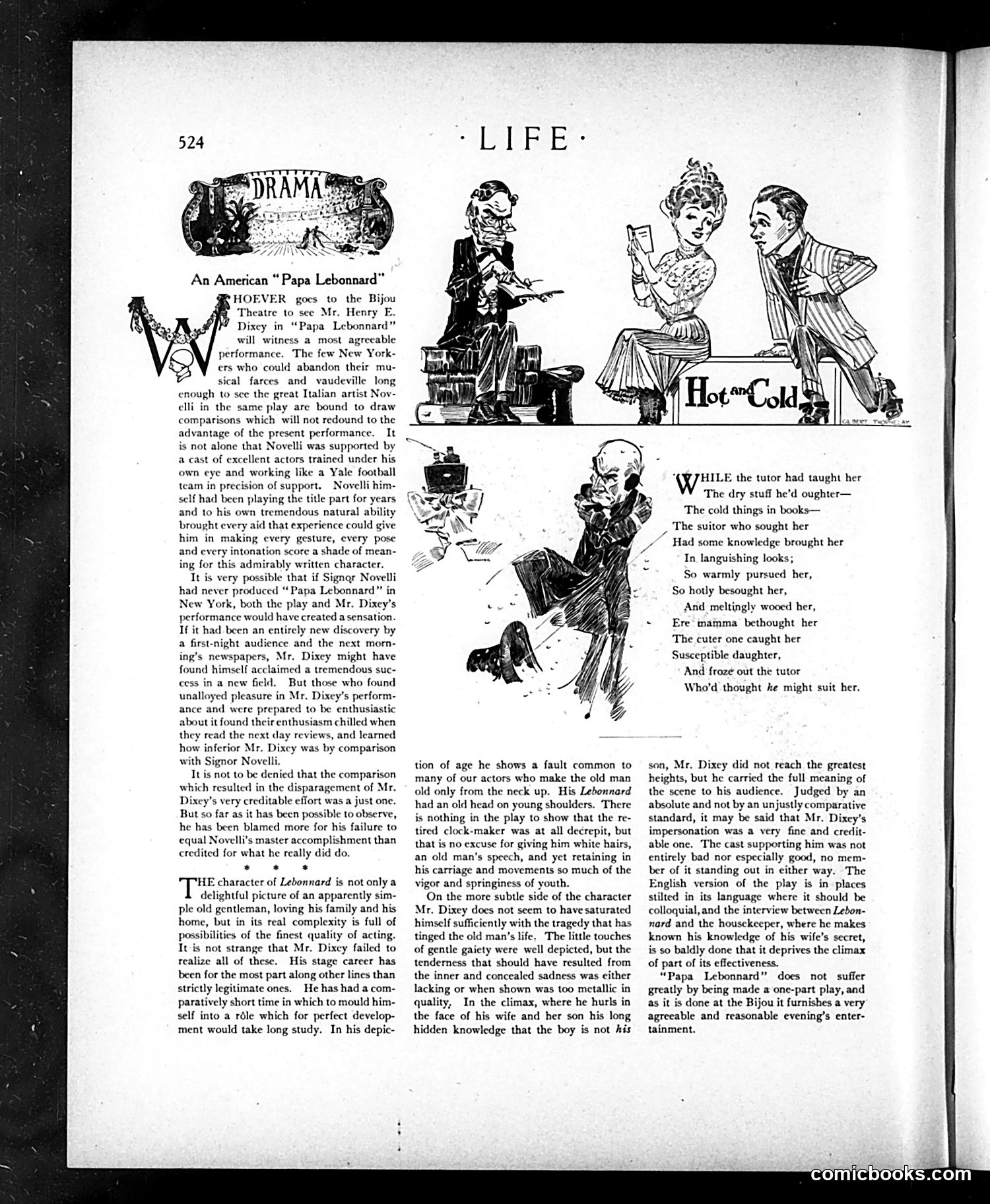
This page reviews a theatrical production of "Papa Lebonard," an American adaptation of an Italian play starring Henry F. Discy. The illustrations show scenes from the performance, including one labeled "Hot and Cold" depicting romantic/comedic interactions between characters. The text criticizes Discy's portrayal, noting he failed to capture the character's tragedy and inner life, instead relying on surface-level acting (white hair, old man's voice, physical movements). The reviewer argues that while Discy performed competently, he didn't saturate himself sufficiently with the role's emotional depth compared to the original Italian actor Novelli. The critique represents early 20th-century theatrical criticism focused on acting technique and character interpretation.
📄 Transcribed text from this page (OCR, searchable)
Machine-transcribed from the original scan — historical spelling and the odd misread are preserved.
An American “ Papa Lebonnard” R goes to the Bijou Theatre to see Mr. Henry E. Dixey in “Papa Lebonnard” will witness a most agreeable performance. The few New York- ers who could abandon their mu- sical farces and vaudeville long enough to sce the great Italian artist Nov- clli in the same play are bound to draw comparisons which will not redound to the advantage of the present performance. It is not alone that Novelli was supported by a cast of excellent actors trained under his own eye and working like a Yale football team in precision of support. Novelli him- self had been playing the title part for years and to his own tremendous natural ability brought every aid that experience could give him in making every gesture, every pose and every intonation score a shade of mean- ing for this admirably written characte! It is very possible that if Signgr No had never produced “Papa Lebonnard” in New York, both the play and Mr. Dixey’s performance would have created a sensation. If it had. been an entirely new discovery by a first-night audience and the next morn- ing’s newspapers, Mr. Dixey might have found himself acclaimed a tremendous suc- cess in a new field. But those who found unalloyed pleasure in Mr. Dixey’s perform- ance and were prepared to be enthusiastic about it found their enthusiasm chilled when they read the next day reviews, and learned how inferior Mr. Dixey was by comparison with Signor Novelli. It is not to be denied that the comparison which resulted in the disparagement of Mr. Dixey’s very creditable effort was a just one. But so far as it has been possible to observe, he has been blamed more for his failure to equal Novelli’s master accomplishment than credited for what he really did do. * #8 6 HE character of Lebonnard is not only a delightful picture of an apparently sim- ple old gentleman, loving his family and his home, but in its real complexity is full of possibilities of the finest quality of acting. It is not strange that Mr. Dixcy failed to realize all of these. His stage career has been for the most part along other lines than strictly legitimate ones. He has had a com- paratively short time in which to mould him- self into a réle which for perfect develop- ment would take long study. In his depic- tion of age he shows a fault common to many of our actors who make the old man old only from the neck up. His Lebonnard had an old head on young shoulders. There is nothing in the play to show that the re- tired clock-maker was at all decrepit, but that is no excuse for giving him white hairs, an old man’s speech, and yet retaining in his carriage and movements so much of the vigor and springiness of youth. On the more subtle side of the character Mr. Dixey does not seem to have saturated himself sufficiently with the tragedy that has tinged the old man’s life, The little touches of gentle gaiety were well depicted, but the tenderness that should have resulted from the inner and concealed sadness was either lacking or when shown was too metallic in quality, In the climax, where he hurls in the face of his wife and her son his long hidden knowledge that the boy is not his a 'HILE the tutor had taught her The dry stuff he'd oughter— The cold things in books— __ The suitor who sought her Had some knowledge brought her In languishing looks; So warmly pursued her, So hotly besought her, And meltingly wooed her, Ere‘mainma bethought her The cuter one caught her Susceptible daughter, And froze out the tutor Who'd thought ke might suit her. son, Mr. Dixey did not reach the greatest heights, but he carried the full meaning of the scene to his audience. Judged by an absolute and not by an unjustly comparative standard, it may be said that Mr. Dixcy’s impersonation was a very fine and credit- able one. The cast supporting him was not entirely bad nor especially good, no mem- ber of it standing out in either way. The English version of the play is in places stilted in its language where it should be colloquial, and the interview between Lebon- nard and the housckceper, where he makes known his knowledge of his wife’s secret, is so baldly done that it deprives the climax of part of its effectiveness. “Papa Lebonnard” docs not suffer greatly by being made a one-part play, and as it is done at the Bijou it furnishes a very agreeable and reasonable evening’s enter- tainment.