
Life, 1908-05-14 · page 13 of 20
Life — May 14, 1908 — page 13: what you’re looking at
What you’re looking at
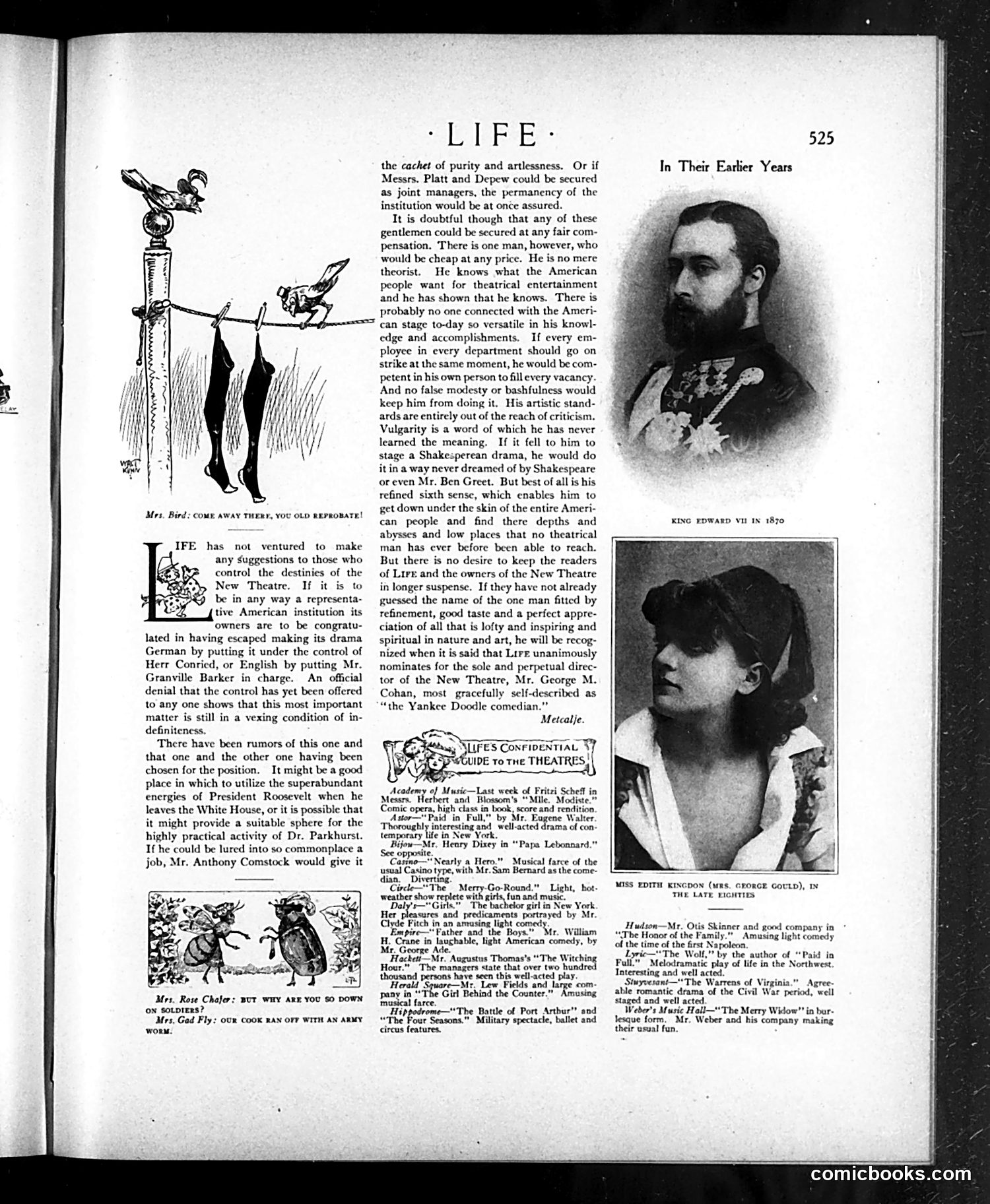
The page features two cartoons mocking theatrical management and performers: 1. **"Mrs. Bird: Come Away There, You Old Reprobate!"** (top left): Shows a woman pulling a man away from what appears to be theatrical attractions, satirizing backstage behavior or moral compromises in theater. 2. **"Mrs. Ben Chabot: But Why Are You So Down on Soldiers?"** (bottom left): Depicts a woman speaking to a man, likely criticizing anti-military sentiment or attitudes among theatrical circles during wartime. The surrounding text discusses theater management control and performer versatility. The page includes photographs of theatrical figures identified as "King Edward VII in 1870" and "Miss Edith Kingston," suggesting contemporary theater personalities. The overall thrust satirizes American theater's pretensions, management conflicts, and attitudes toward both performers and military service.
📄 Transcribed text from this page (OCR, searchable)
Machine-transcribed from the original scan — historical spelling and the odd misread are preserved.
Mrs, Bird: COME AWAY THERY, YOU OLD REPROBATE! has not ventured to make any suggestions to those who control the destinies of the New Theatre. If it is to be in any way a representa- tive American institution its ‘owners are to be congratu- lated in having escaped making its drama German by putting it under the control of Herr Conried, or English by putting Mr. Granville Barker in charge. An official denial that the control has yet been offered to any one shows that this most important matter is still in a vexing condition of in- definiteness. ‘There have been rumors of this one and that one and the other one having been chosen for the position. It might be a good place in which to utilize the superabundant energies of President Roosevelt when he leaves the White House, or it is possible that it might provide a suitable sphere for the highly practical activity of Dr. Parkhurst. If he could be lured into so commonplace a job, Mr. Anthony Comstock would give it Mrs. Rose Chafer: BUT WHY ARE YOU $0 DOWN ow SoLptERs? Mrs, Gad Fly: ov COOK RAN OFF WITH AN ARMY worm. IEA ee the cachet of purity and artlessness. Or if Messrs. Platt and Depew could be secured as joint managers, the permanency of the institution would be at once assured. It is doubtful though that any of these gentlemen could be secured at any fair com- pensation, There is one man, however, who would be cheap at any price. He is no mere theorist. He knows what the American people want for theatrical entertainment and he has shown that he knows. There is probably no one connected with the Ameri can stage to-day so versatile in his knowl- edge and accomplishments. If every em- ployee in every department should go on strike at the same moment, he would be com- petent in his own person to fill every vacancy. And no false modesty or bashfulness would keep him from doing it. His artistic stand- ards are entirely out of the reach of criticism. Vulgarity is a word of which he has never learned the meaning. If it fell to him to stage a Shakesperean drama, he would do it in a way never dreamed of by Shakespeare oreven Mr. Ben Greet. But best of all is his refined sixth sense, which enables him to get down under the skin of the entire Ameri- can people and find there depths and abysses and low places that no theatrical man has ever before been able to reach. But there is no desire to keep the readers of Lire and the owners of the New Theatre in longer suspense. If they have not already guessed the name of the one man fitted by refinement, good taste and a perfect appre- ciation of all that is lofty and inspiring and spiritual in nature and art, he will be recog- nized when it is said that Lire unanimously nominates for the sole and perpetual direc- tor of the New Theatre, Mr. George M. Cohan, most gracefully self-described as “the Yankee Doodle comedian.” Metcalje. CR) . S NUFES GonrioeNTvAc W RSGUIDE To THe THEATRES, Academy of Music—Last week of Fritzi Schef i Messrs. Herbert and Blossom's "Mile. Modiste.” high class in book, score and rendition. Paid in Full,” by Mr. Eagene Walter Thoroughly interesting and wellacted drama of con- life in New York. See opposit 4 Casino—" Nearly a Hero." Musical farce of the usual Casino type, with Mr. Sam Bernard as the come- dian. Diverting. Circle—""The Merry-Go-Round.” Light, hot weather show replete with girls, fun and music, Daly's—"Girls.” The bachelor girl is ~w York. Her pleasures and predicaments portrayed by Mr. Ciyde Fitch in an amusing light comedy. : Empire—‘Father and the Boys.” Mr. William H. Crane in laughable, light American comed by Mr. George Ade. ane Hacketi—Mr. Augustus Thomas's “The Witching Hour.” ‘The managers state that over two hundred thousand persons have seen this well-acted play. Herald, Spuare Mr, Lew Fields and large com- pany in “The Girl Behind the Counter.” Amusing musical farce. : Hippodrome—"The Battle of Port Arthur’ ond “The Four Seasons.” Military spectacle, ballet and circus features. 525 In Their Earlier Years KING EDWARD Vv — IN 1870 MISS EDITH KINGDON (MRS. GEORGE GOULD), IN THE LATE FIG Hudson—Mr. Otis Skinner and good company in “The Honor of the Family." Amusing light comedy of the time of the first Napoleon. Lyric—""The Wolf,” by the author of “Paid in Full.” Melodramatie play of life in the Northwest Interesting and well acted. Stuyvesont—"The Warrens of Virginia.” Agree- able romantic drama of the Civil War period, well staged and well acted Weber's Music Hall—"The Merry Widow" in bur- Jesque form. Mr. Weber and his company making their usual fun. comicbooks.com