
Life, 1908-05-14 · page 15 of 20
Life — May 14, 1908 — page 15: what you’re looking at
What you’re looking at
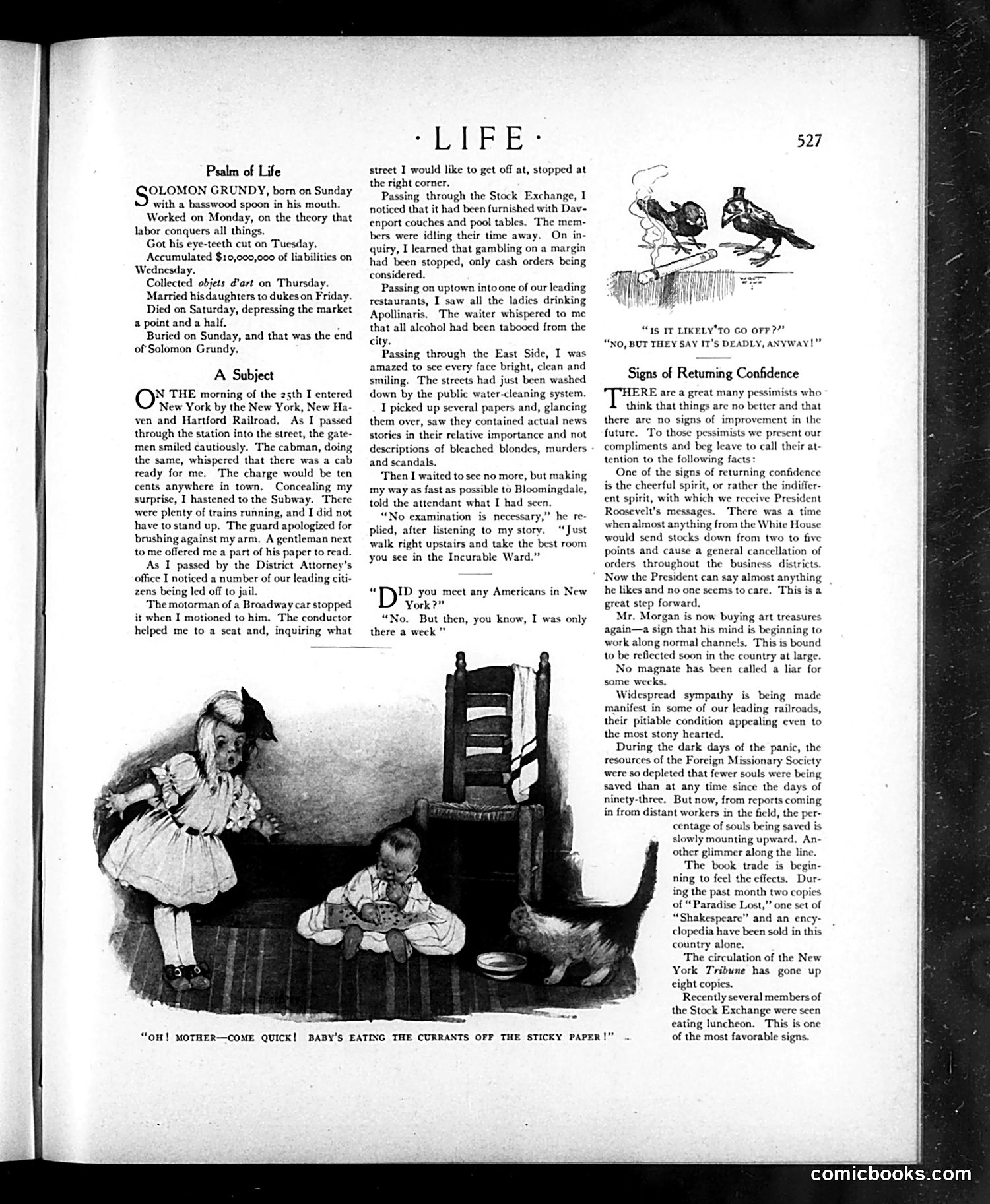
This page contains satirical commentary on early 1900s American society, presented through three pieces: **"Psalm of Life"**: A mock-serious poem mocking Solomon Grundy (a nursery rhyme character) whose life trajectory parodies American business culture—accumulating massive liabilities while collecting art and marrying daughters to nobles, dying and affecting the stock market. **"A Subject"**: A traveler's account describing an absurdly utopian New York where citizens are polite, gambling is banned, women drink only water, streets are clean, newspapers contain real news instead of scandal, and the narrator is so shocked he checks himself into an insane asylum. The satire mocks contemporary New York's corruption, crime, drinking culture, and sensationalist press. **"Signs of Returning Confidence"**: Commentary on economic recovery, noting improving public mood toward President Roosevelt's policies and J.P. Morgan's renewed art purchases as indicators of financial health restoration. The small cartoons depict social absurdities: birds discussing danger, and a mother discovering her baby eating poison from sticky paper—illustrating careless parenting and household hazards.
📄 Transcribed text from this page (OCR, searchable)
Machine-transcribed from the original scan — historical spelling and the odd misread are preserved.
Psalm of Life OLOMON GRUNDY, born on Sunday with a basswood spoon in his mouth. Worked on Monday, on the theory that labor conquers all things. Got his eye-teeth cut on Tuesday. Accumulated $10,000,000 of liabilities on Wednesday. Collected objets d'art on Thursday. Married his daughters to dukes on Friday. Died on Saturday, depressing the market a point and a half, : Buried on Sunday, and that was the end of Solomon Grundy, A Subject N THE morning of the 25th I entered New York by the New York, New Ha- ven and Hartford Railroad, As I passed through the station into the street, the gate- men smiled cautiously. The cabman, doing the same, whispered that there was a cab ready for me. The charge would be ten cents anywhere in town. Concealing my surprise, I hastened to the Subway. There were plenty of trains running, and I did not have to stand up. The guard apologized for brushing against my arm. A gentleman next to me offered me a part of his paper to re: As I passed by the District Attorney’s office I noticed a number of our leading c zens being led off to jail. ‘The motorman of a Broadway car stopped it when I motioned to him, The conductor helped me to a seat and, inquiring what “OH! MOTHER—COME QUICK! |i kg street I would like to get off at, stopped at the right corner. Passing through the Stock Exchange, I noticed that it had been furnished with Dav- enport couches and pool tables. The mem- bers were idling their time away. On in- quiry, I Icarned that gambling on a margin had been stopped, only cash orders being considered. Passing on uptown intoone of our leading restaurants, I saw all the ladics drinking Apollinaris.. The waiter whispered to me that all alcohol had been tabooed from the city. Passing through the t Side, I was amazed to sce every face bright, clean and smiling. The streets had just been washed down by the public water-cleaning system. I picked up several papers and, glancing them over, saw they contained actual news stories in their relative importance and not descriptions of bleached blondes, murders and scandals. ‘Then I waited to see no more, but making my way as fast as possible to Bloomingdale, told the attendant what I had seen. “No examination is necessary,” he re- plied, after listening to my story. “Just walk right upstairs and take the best room you see in the Incurable Ward.” “DID you meet any Americans in New York?” “No, But then, you know, I was only there a week ” BABY’S EATING THE CURRANTS OFF THE STICKY PAPER!” “1s IT LIKELY'TO Go OFF?”” “No, BUT THEY SAY IT’S DEADLY, ANYWAY!” Signs of Retuming Confidence TERE are a great many pessimists who think that things are no better and that there are no signs of improvement in the future. To those pessimists we present our compliments and beg leave to call their at- tention to the following facts: One of the sij of returning confidence is the cheerful spirit, or rather the indiffer- ent spirit, with which we reccive President Roosevelt's messages. There was a time when almost anything from the White House would send stocks down from two to five points and cause a general cancellation of orders throughout the business districts. Now the President can say almost anything he likes and no one seems to care. This is a great step forward. Mr. Morgan is now buying art treasures again—a sign that his mind is beginning to work along normal channe's. This is bound to be reflected soon in the country at large. No magnate has been called a liar for some weeks, Widespread sympathy is being made manifest in some of our leading railroads, their pitiable condition appealing even to the most stony hearted. During the dark days of the panic, the resources of the Foreign Missionary Society were so depleted that fewer souls were being saved than at any time since the days of ninety-three. But now, from reports coming in from distant workers in the field, the per- centage of souls being saved is slowly mounting upward. An- other glimmer along the line. The book trade is begin- ning to feel the effects, Dur- ing the past month two copies of “Paradise Lost,” one set of “Shakespeare” and an ency- clopedia have been sold in this country alone. ‘The circulation of the New York Tribune has gone up eight copie Recently several members of the Stock Exchange were seen eating luncheon. This is one of the most favorable signs. comicbooks.com