
A complete issue · 20 pages · 1908
Life — April 30, 1908
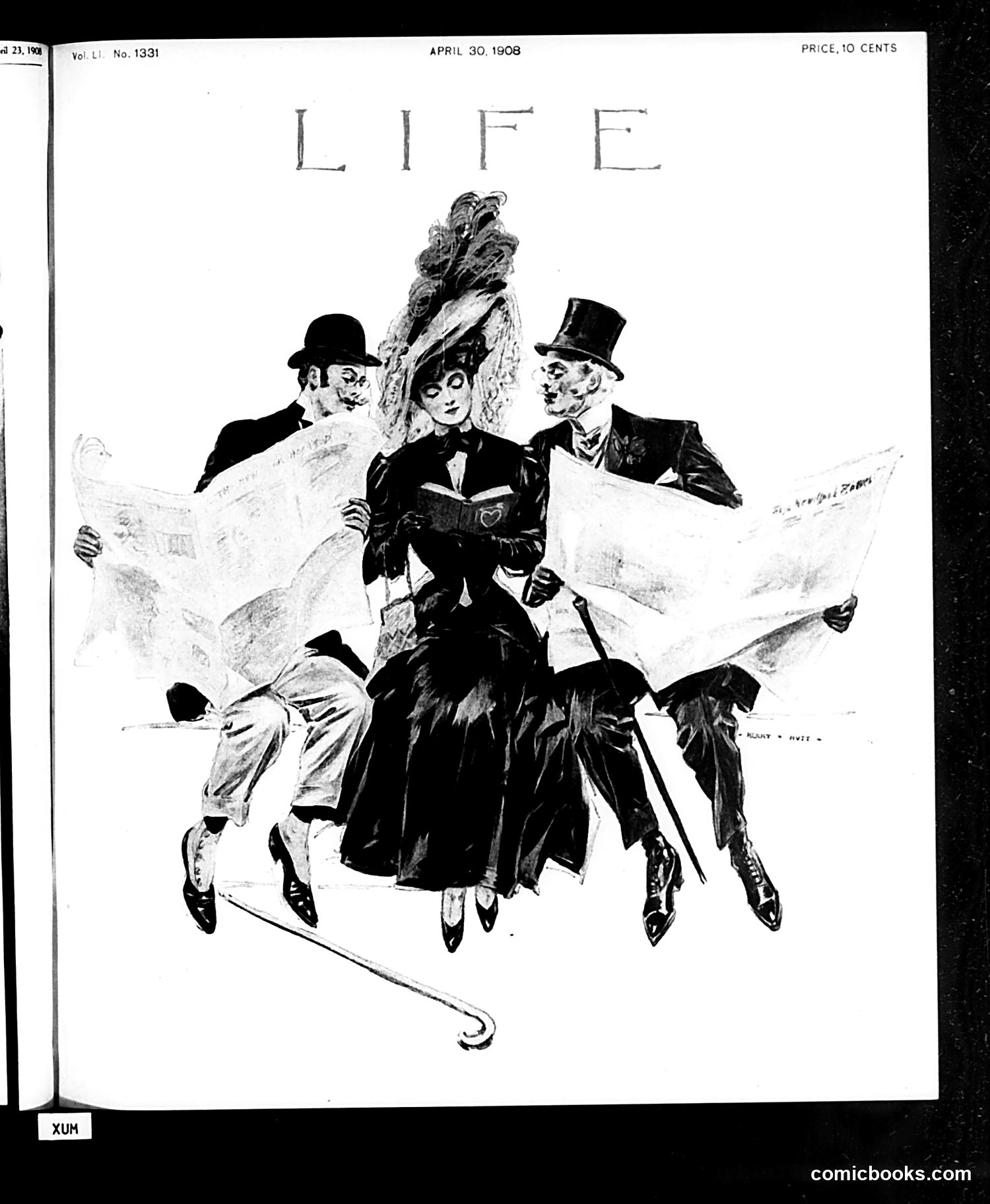
This cover depicts three well-dressed men in formal attire (top hats, tuxedos) sitting together and reading newspapers, with a woman in an elaborate black dress and feathered hat perched on their laps. The men's exaggerated facial expressions suggest surprise or disapproval. The satire likely comments on **women's increasing public visibility and social boldness** during the early 1900s—a period of growing women's suffrage movements and changing gender roles. The woman's assertive positioning and fashionable appearance contrast with the men's discomfort, suggesting anxiety about women's expanding presence in public spaces and their challenge to traditional social hierarchies. The newspapers they hold may reference contemporary debates about women's rights and social reform.
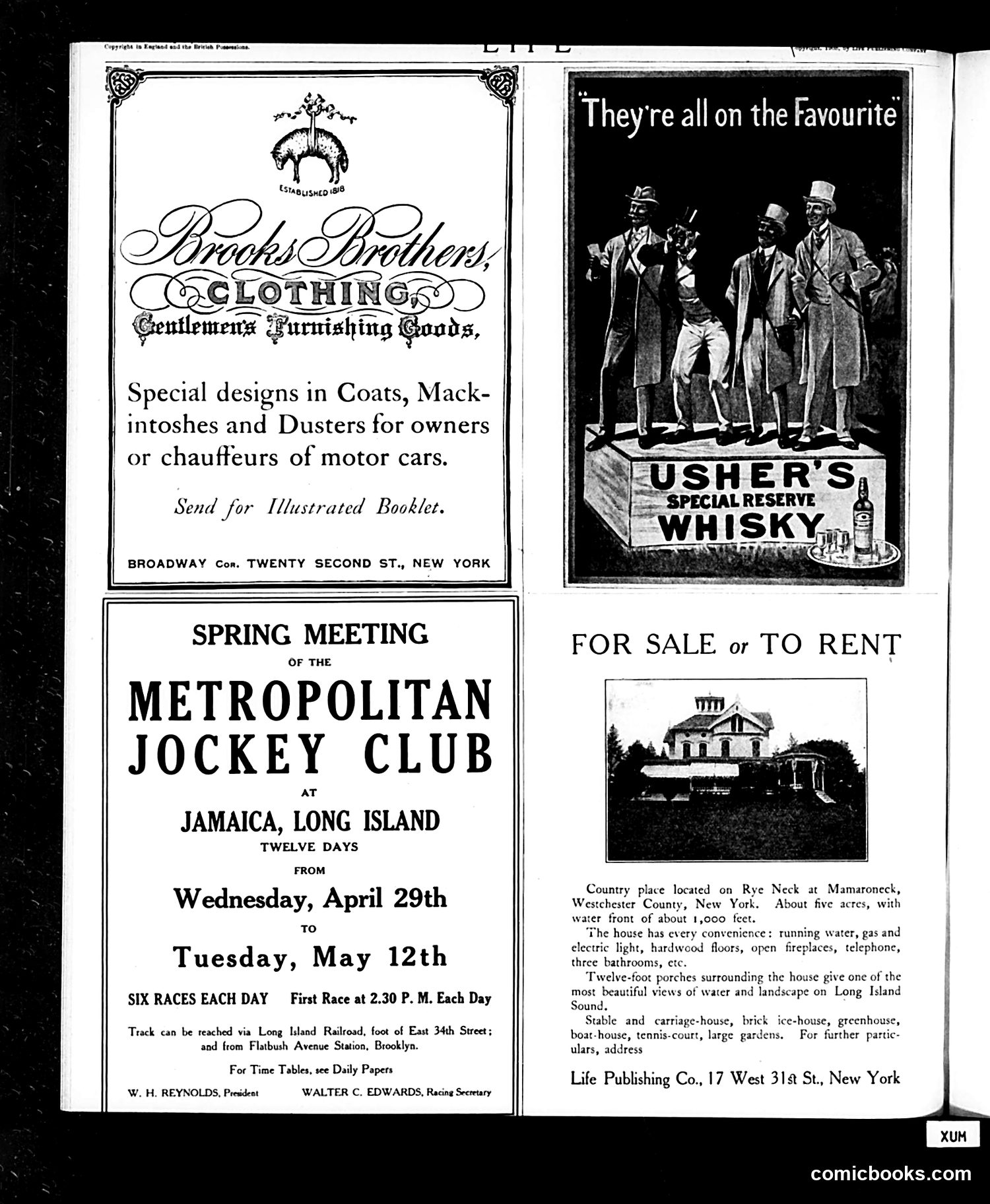
This page is primarily **advertising**, not political satire. The content includes: 1. **Brooks Brothers advertisement** for gentlemen's clothing, specifically motor-car attire (coats, mackintoshes, dusters) 2. **Usher's Whisky advertisement** featuring well-dressed men in top hats with the caption "They're all on the Favourite"—likely a horse-racing reference, given the context of the Jockey Club announcement below 3. **Metropolitan Jockey Club** announcement for a spring horse-racing meeting at Jamaica, Long Island (April 29–May 12) 4. **Real estate listing** for a country property in Mamaroneck, New York The whisky ad's racing reference connects thematically to the horse-racing content, but this is commercial juxtaposition rather than satire. No political commentary is evident on this page.
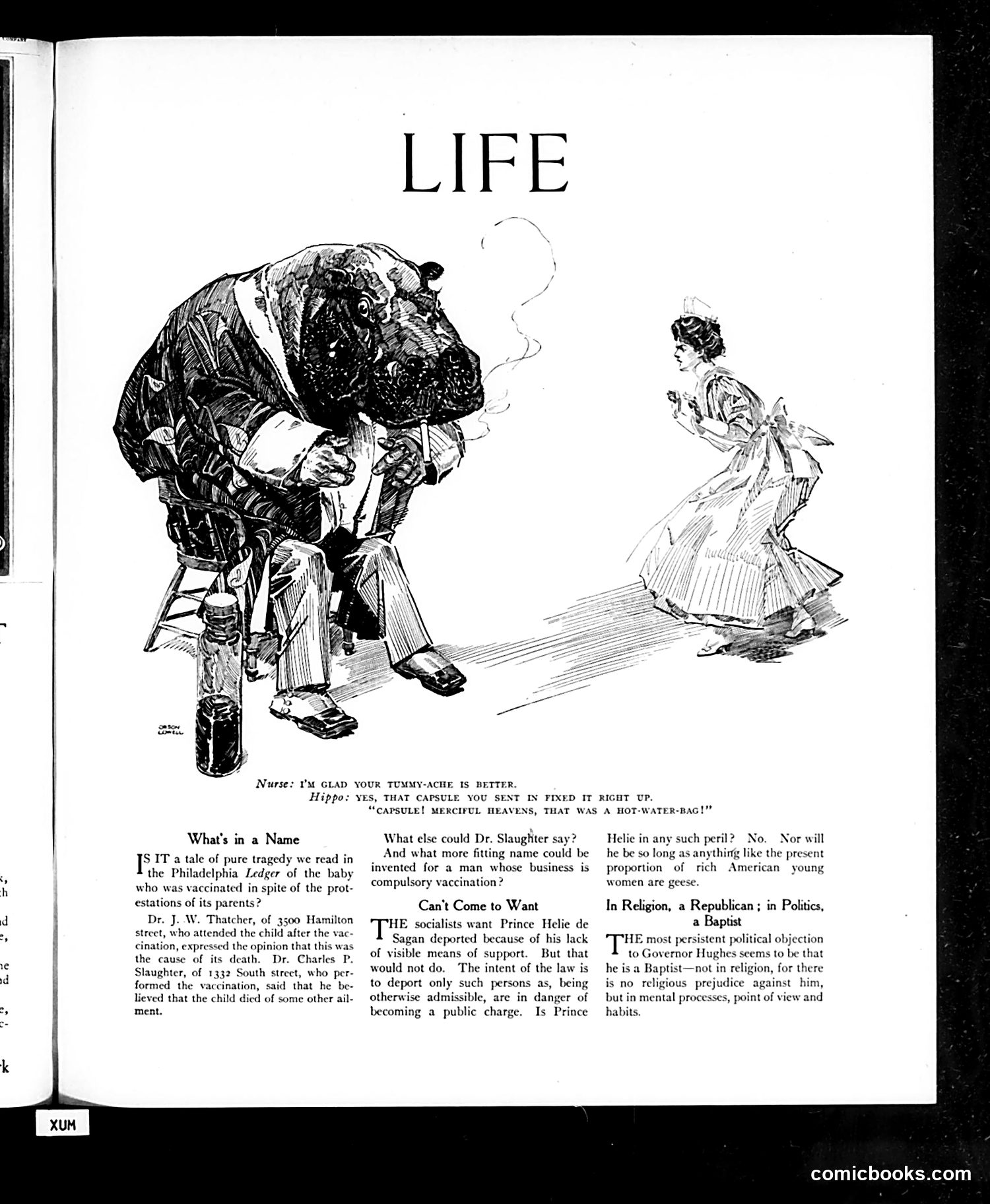
The main cartoon depicts a conversation between a rotund man (likely a doctor or medical figure based on context) seated in a chair and a woman standing nearby. The caption indicates dialogue about a "tummy-ache" and a "capsule" for treatment, with reference to a "hot-water-bag." The page includes three text articles below: "What's in a Name" discusses a vaccination death in Philadelphia involving Drs. Thatcher and Slaughter; "Can't Come to Want" concerns socialist Prince Helie de Sagan's deportation; and "In Religion, a Republican" addresses objections to Governor Hughes based on his Baptist faith. The cartoon appears to satirize either medical practice, quack remedies, or doctor-patient interactions of the early 1900s, though the specific reference remains somewhat unclear without additional context.
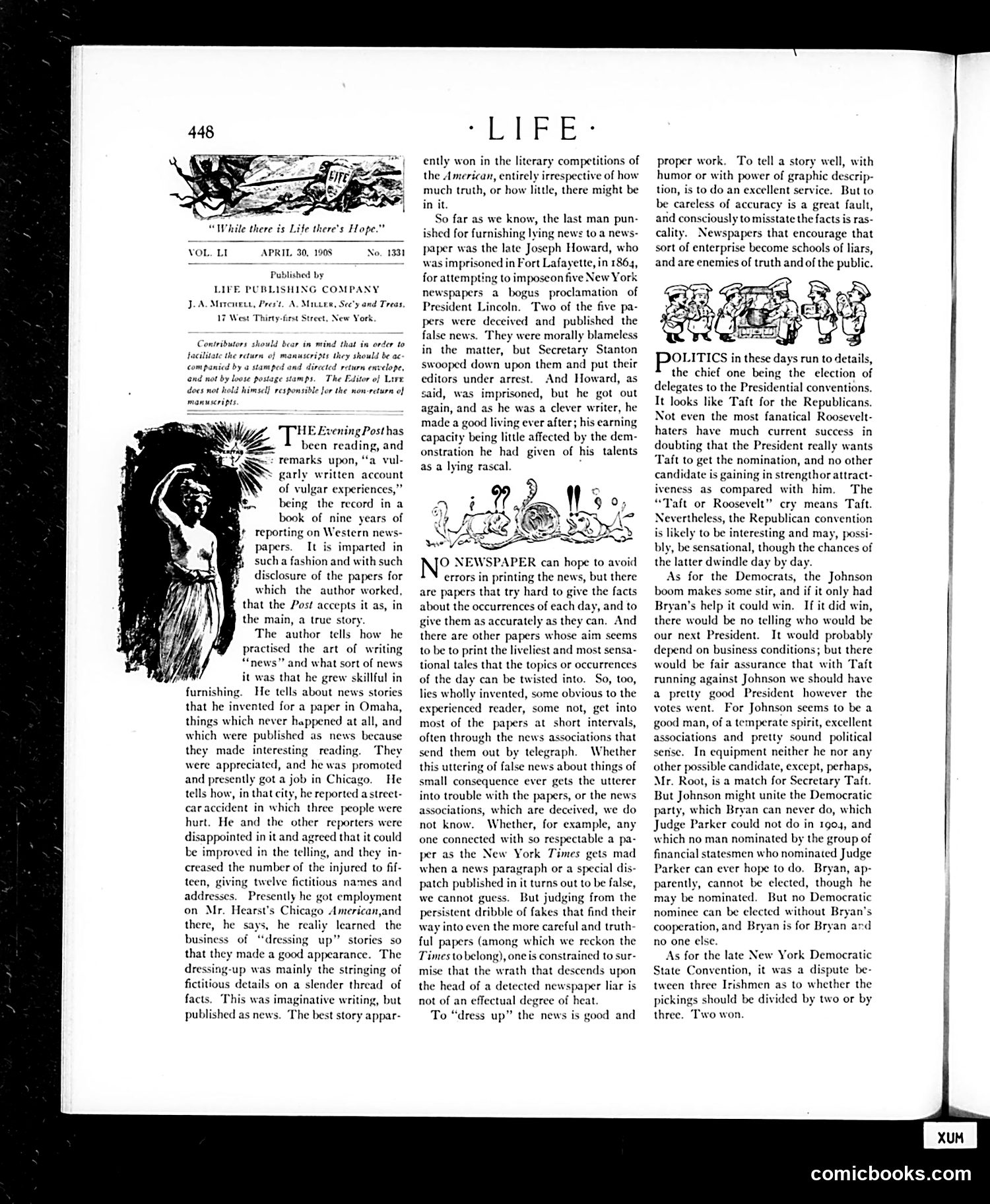
The page discusses newspaper accuracy and the 1908 U.S. presidential election. The text critiques how newspapers sometimes publish false or sensationalized news, citing the case of Joseph Howard Jr., imprisoned in 1864 for spreading false rumors about President Lincoln. The main political content addresses the Republican and Democratic conventions. It discusses speculation about whether President Theodore Roosevelt truly supports William Howard Taft for the Republican nomination, and whether Democrats might nominate William Jennings Bryan or another candidate. The piece suggests Johnson (likely a Democratic figure) could challenge the incumbent presidency but acknowledges Taft appears to be gaining strength as the likely Republican nominee. The cartoons appear to illustrate these political themes, though specific figures are difficult to identify with certainty from the image alone.
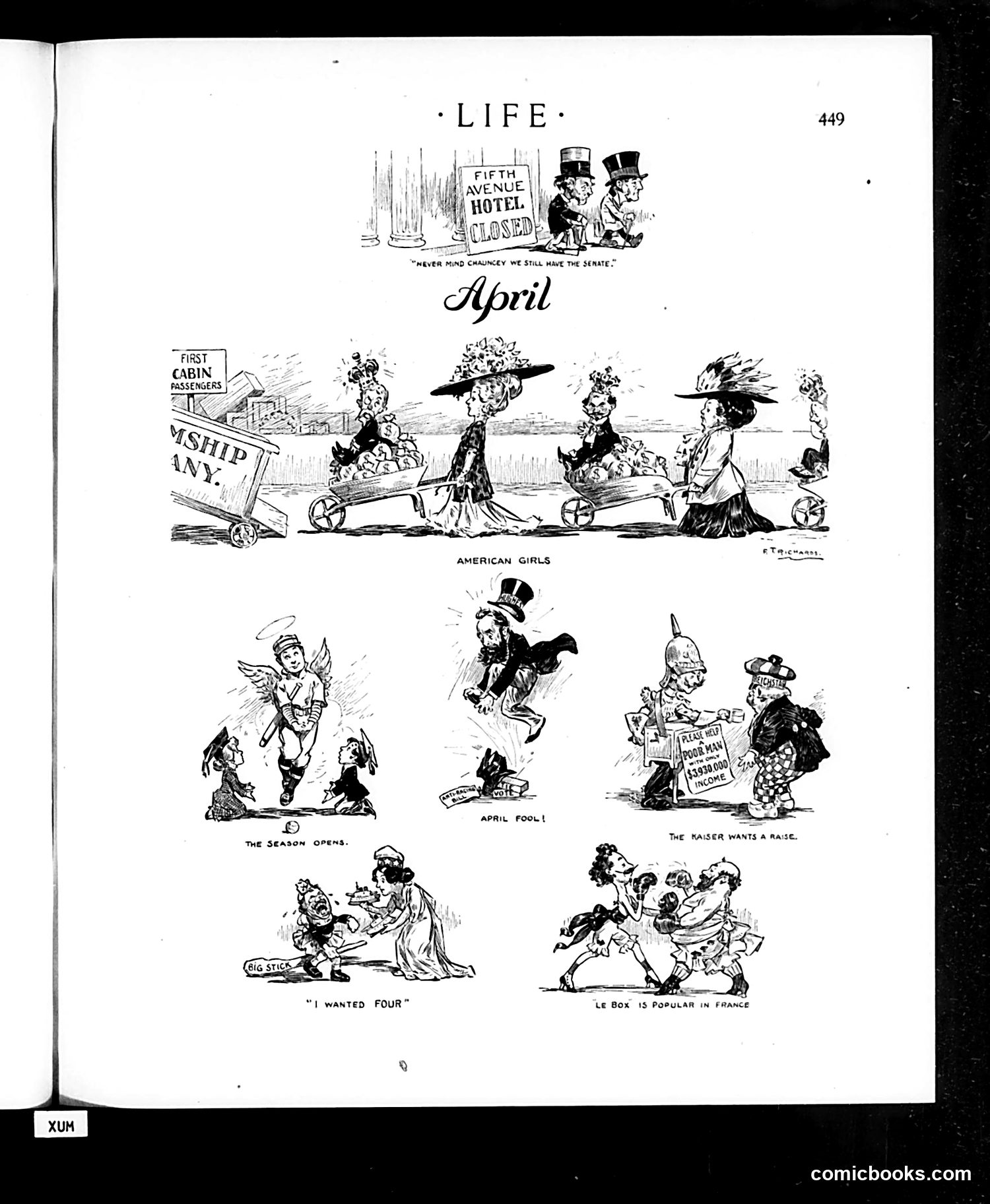
This page presents April-themed satirical cartoons from Life magazine (page 449). The top cartoon mocks political continuity despite institutional change, joking that "even if Chauncey we still have the Senate"—referring to a closed Fifth Avenue Hotel. The "April" section below includes seasonal and topical humor: - **"American Girls"**: Shows fashionable women with elaborate hats in spring attire - **"April Fool"**: Features a jester figure, playing on April 1st pranks - **"The Season Opens"**: References sports season - **"The Kaiser Wants a Raise"**: Appears to reference World War I–era German politics - **"I Wanted Four"** and **"Le Box is Popular in France"**: Likely reference contemporary social or political events The cartoons use exaggerated character drawings typical of early 20th-century satirical illustration, mixing domestic humor with international commentary.
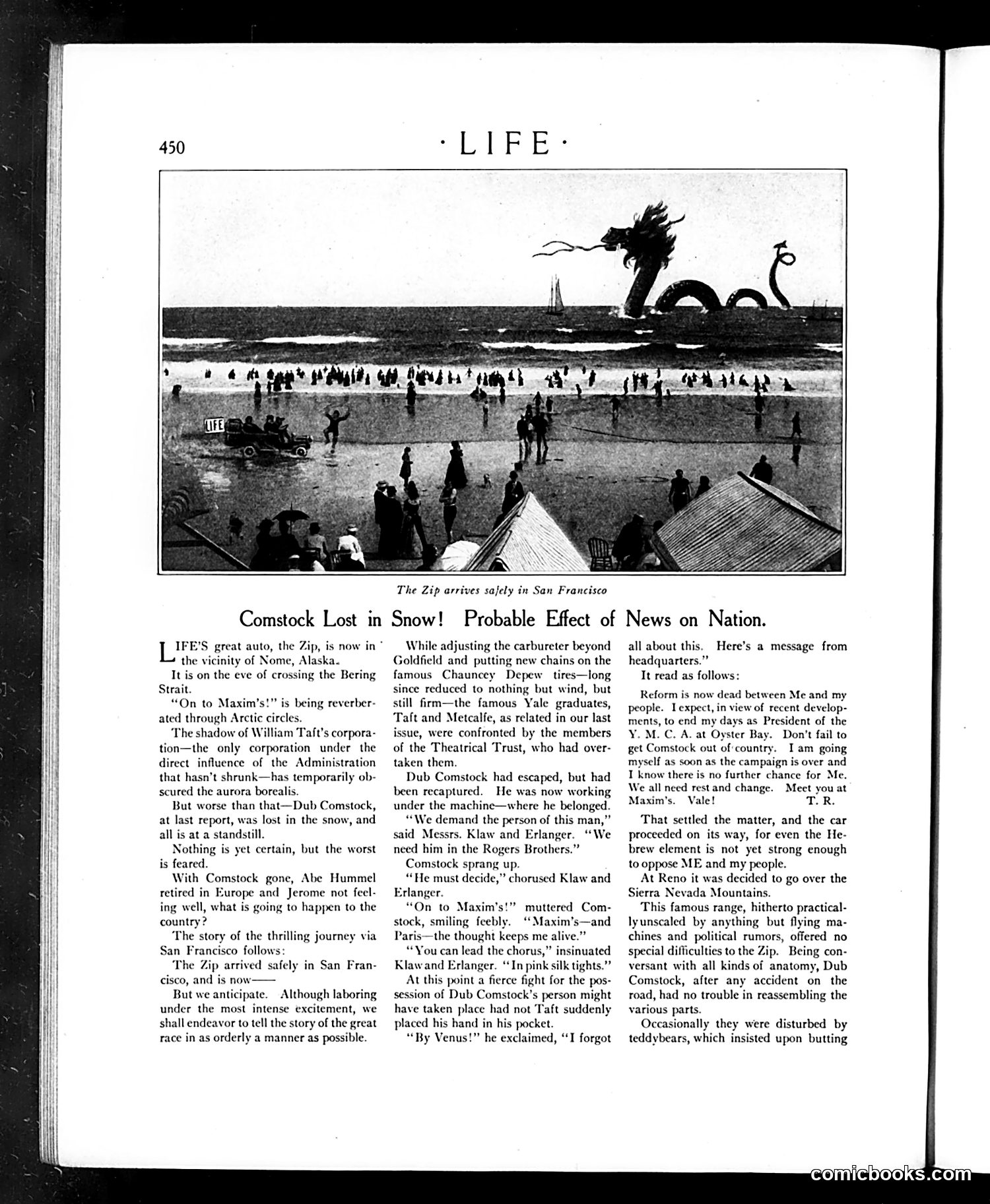
The page satirizes the arrival of the "Zip" (an automobile) in San Francisco, depicting it as a sensational news event. The headline "Comstock Lost in Snow! Probable Effect of News on Nation" references Anthony Comstock, a real U.S. postal inspector famous for aggressive censorship campaigns. The satire appears to mock how news media sensationalizes trivial events. The image shows crowds gathering at a beach to witness the Zip's arrival, treated as monumentally important. The text humorously exaggerates potential nationwide consequences of Comstock being lost in snow during the automobile's journey. This ridicules both Comstock's public prominence and the media's tendency toward hyperbolic reporting about technological novelties and celebrity figures.
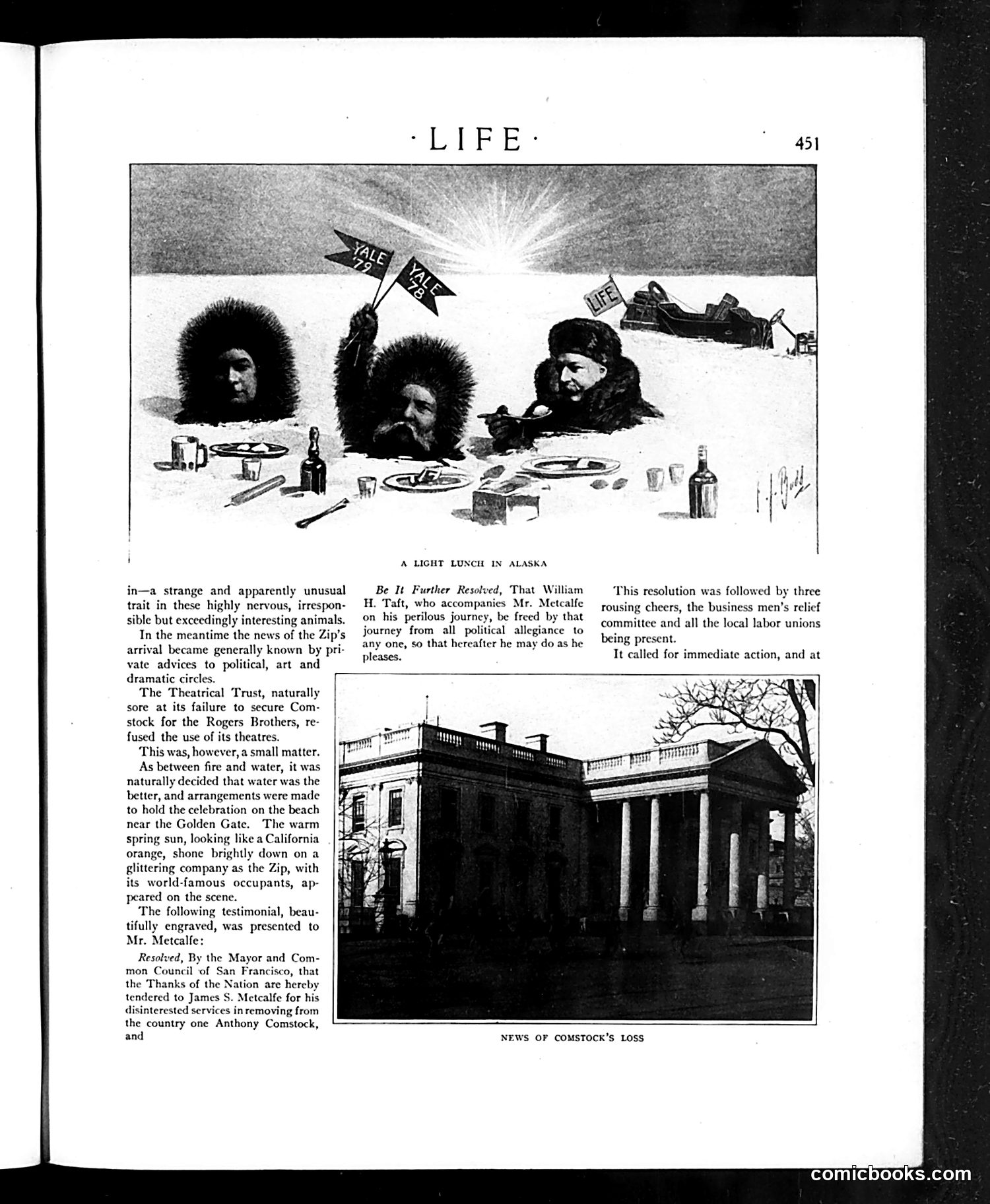
This satirical cartoon depicts three fur-clad figures buried in snow during an Alaskan expedition, dining on plates of food with bottles of alcohol nearby. The figures hold flags reading "YALE" (appearing twice) and "LIFE," suggesting wealthy college-educated men from privileged backgrounds. The satire mocks the contrast between their civilized dining setup—tablecloths, proper place settings, alcohol—and their desperate Arctic survival situation. The humor targets the presumed entitlement and obliviousness of wealthy Yale graduates attempting harsh wilderness survival while maintaining upper-class pretensions. The accompanying text references James S. Metcalfe and political matters, suggesting this relates to a specific contemporary expedition or news story from Life's era.
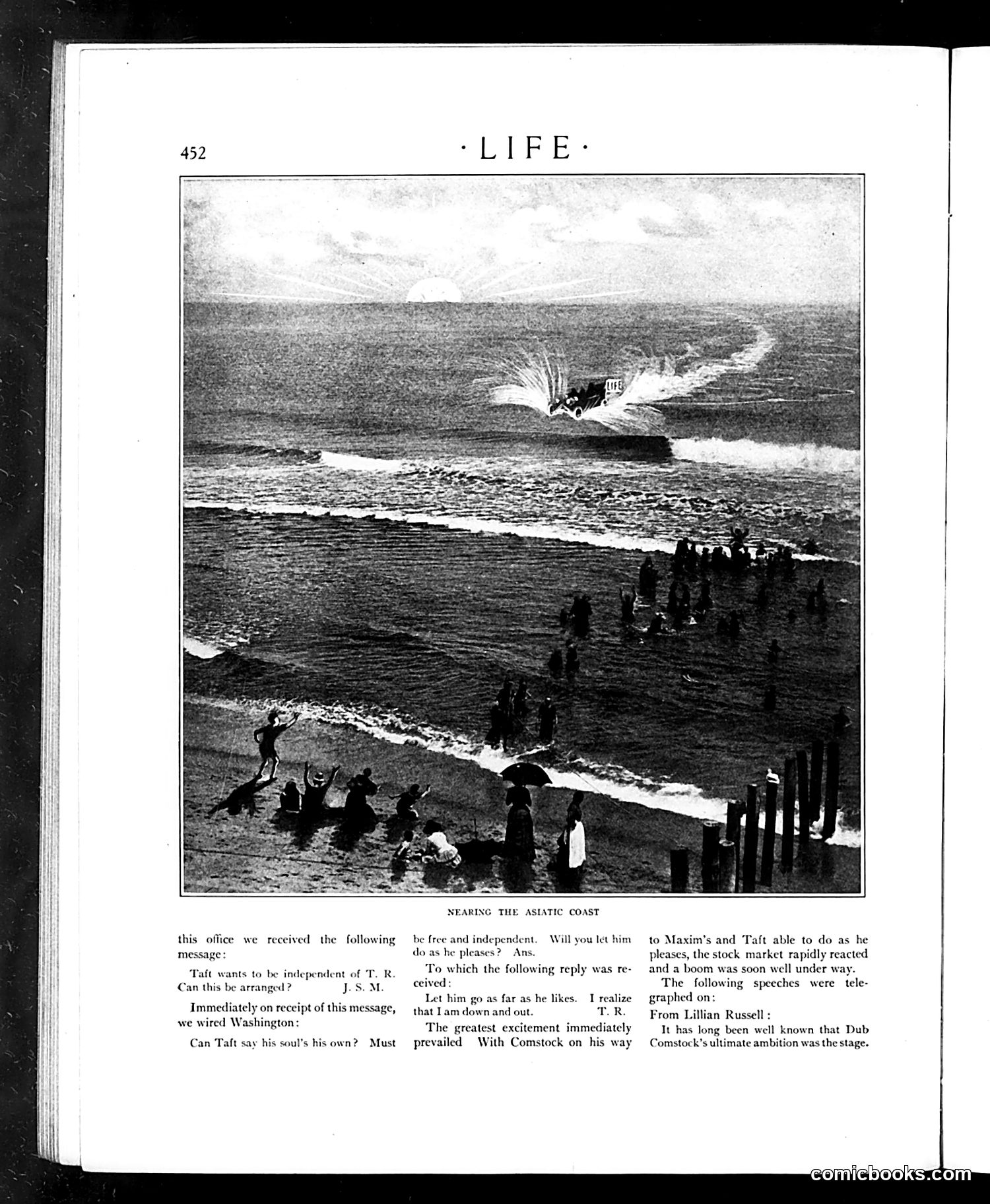
This page contains a photograph labeled "NEARING THE ASIATIC COAST" showing beachgoers and swimmers near what appears to be a pier, with waves and distant ships visible. The text below discusses messages received at "this office" regarding whether someone named Taft can be "independent" of T.R. (Theodore Roosevelt). References to "Taft," "Comstock," and "Lillian Russell" suggest this concerns political independence—likely about President William Howard Taft's relationship to his predecessor Roosevelt. The satirical point appears to be questioning whether Taft could govern independently or remained subordinate to Roosevelt's influence. The beach photograph seems decorative rather than directly related to the political commentary, which was common in *Life* magazine's layout during the progressive era (approximately 1909-1913).
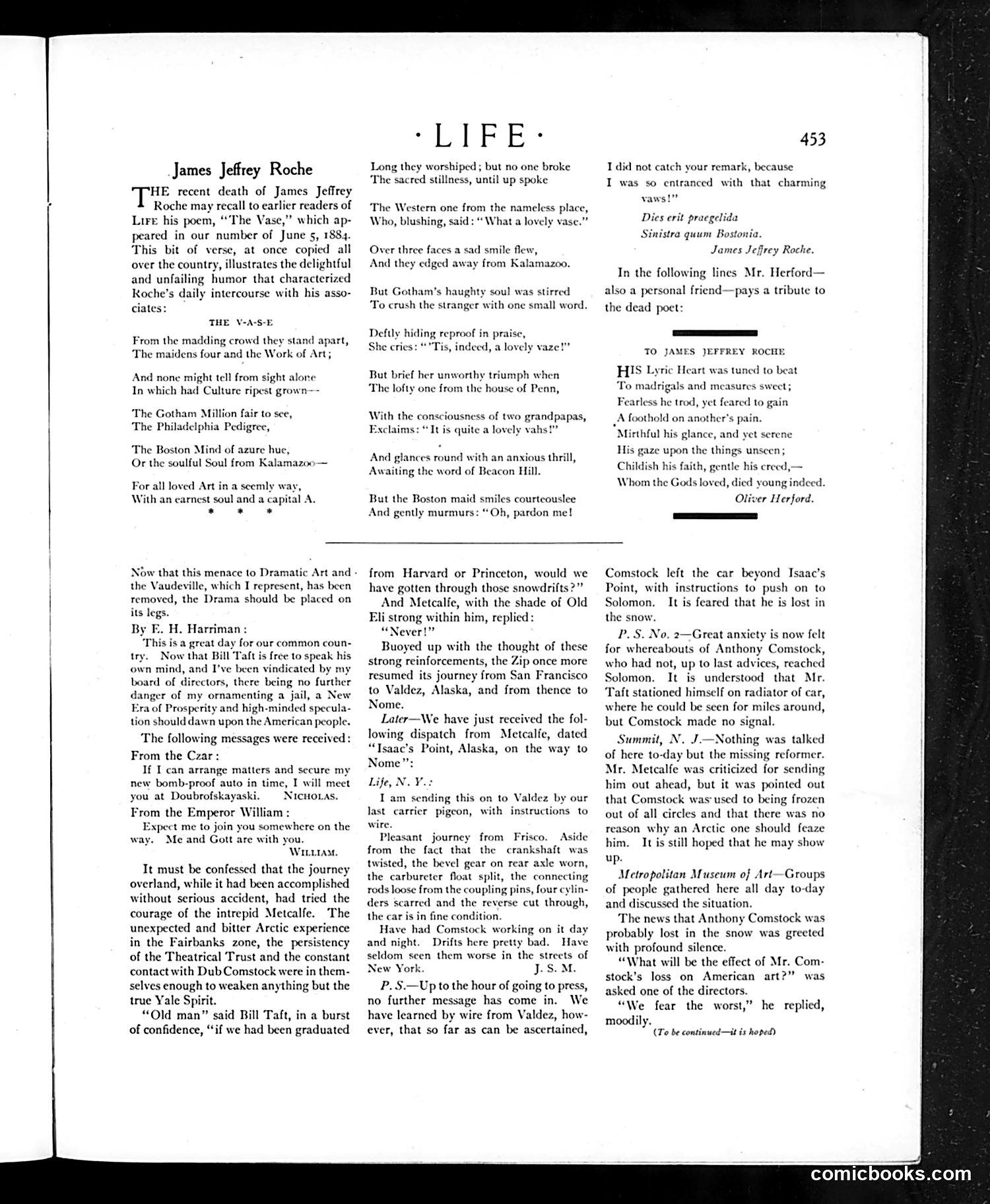
This page is primarily **literary content**, not political satire. It features James Jeffrey Roche's poem "The Vase" (circa June 5, 1884)—a humorous verse about Bostonians debating whether a vase is lovely. The poem mocks New England cultural pretension through characters including "The Gotham Vulcan" and "The Boston Mind." Below appears a tribute to the deceased poet by Oliver Herford, followed by editorial notes about a cross-country automobile journey and the Yale-Harvard rivalry. The content reflects **late 19th-century American literary culture**: the emphasis on Boston's intellectual status, casual references to Harvard and Princeton, and Early automotive technology as novelty. There is **no political cartoon** visible on this page—it's a literary/editorial section.
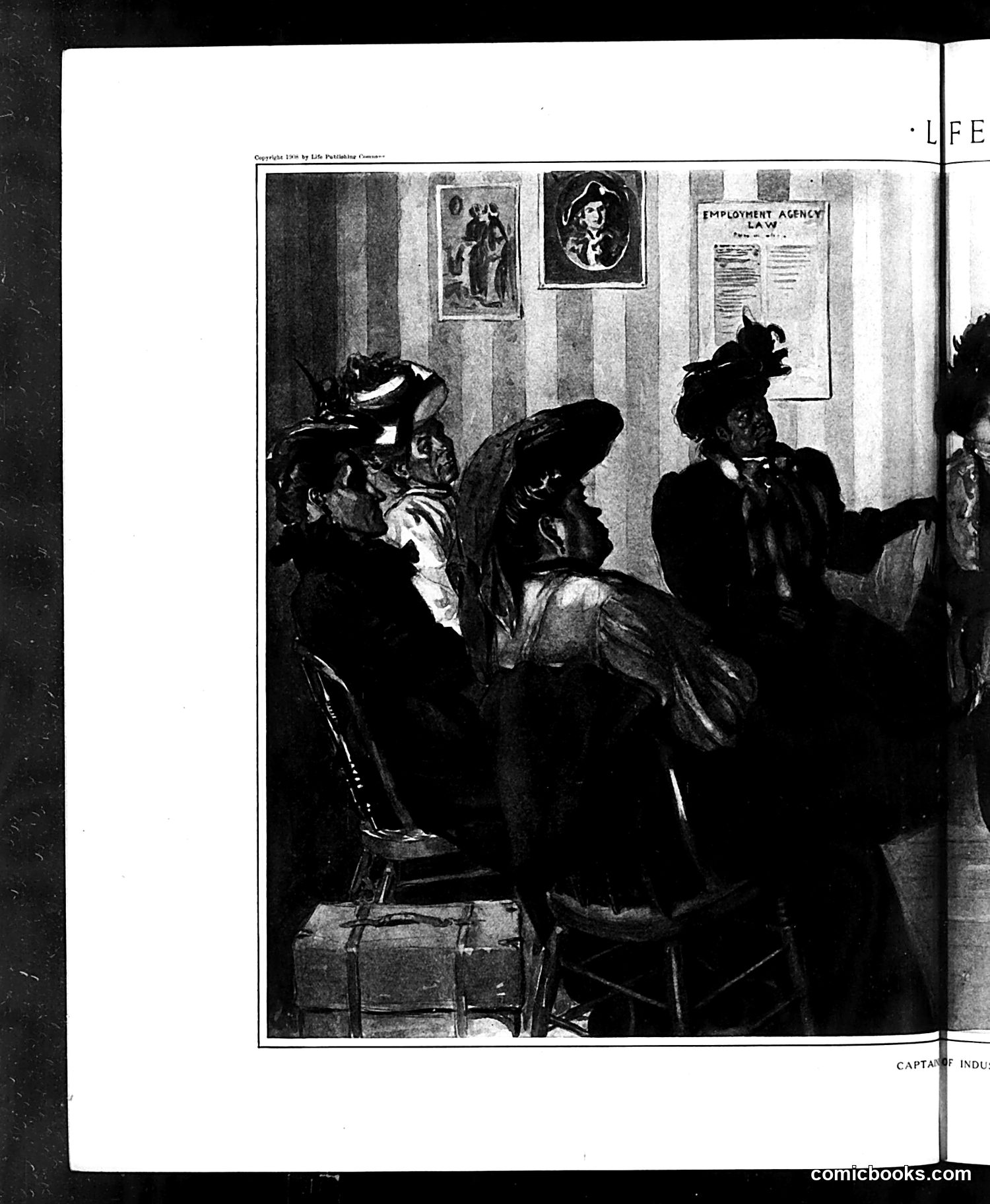
This illustration depicts what appears to be an employment agency office, as indicated by the "Employment Agency Law" notice posted on the striped wall. Several working-class figures with luggage are gathered in the office, apparently seeking employment. The satire likely critiques employment agencies of the period, which were known to exploit vulnerable workers—particularly immigrants and the poor—through predatory practices, false promises, and excessive fees. The "Employment Agency Law" poster on the wall suggests recent legislation attempted to regulate these practices. The cartoon's point appears to be skeptical commentary on whether such laws actually protect workers, or whether exploitation continues despite official oversight. The dark, crowded conditions and the workers' apparent desperation reinforce this critical perspective on labor market vulnerabilities.
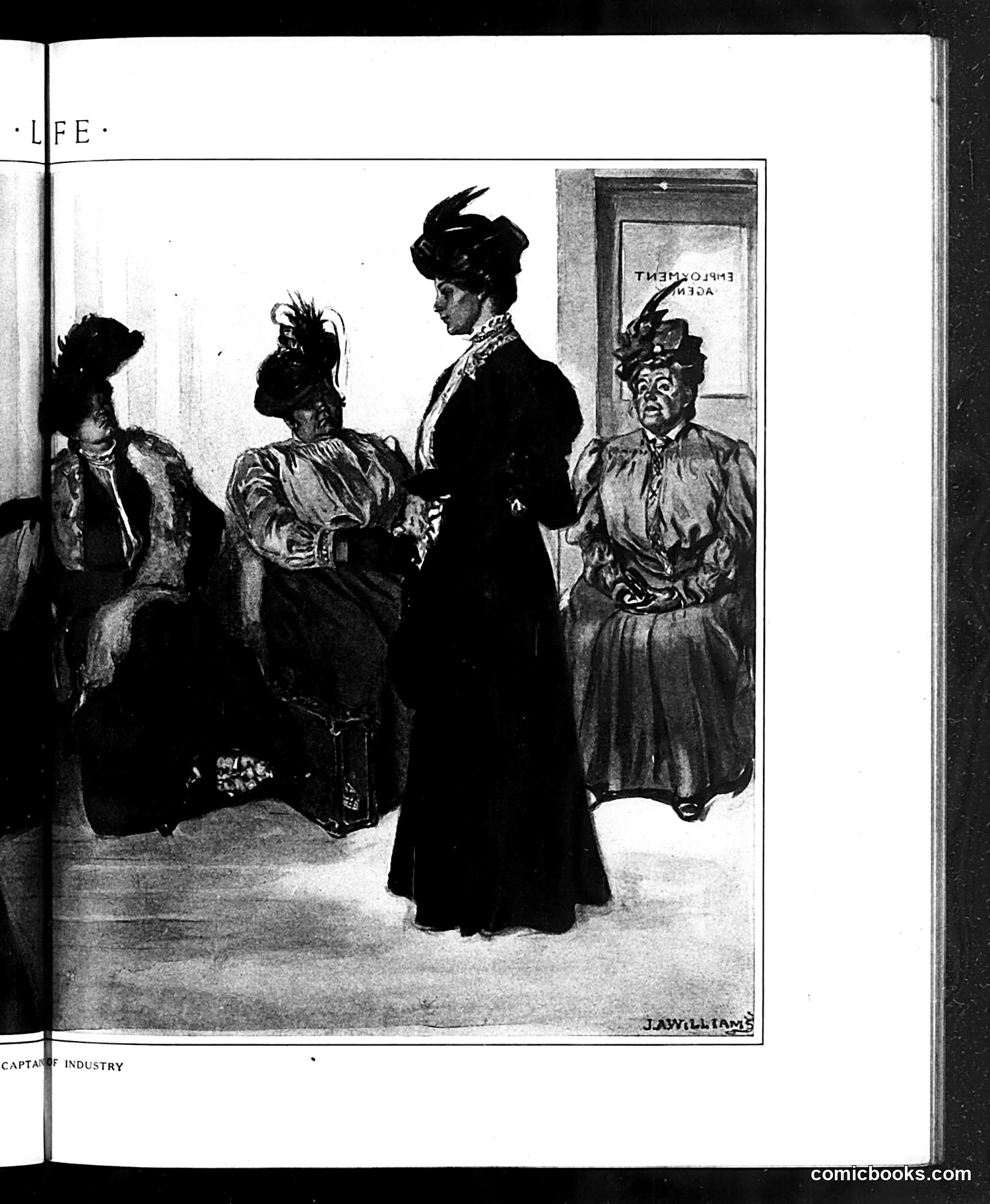
This appears to be a satirical illustration by J.A. Williams from *Life* magazine, signed at bottom. The image shows four women in early 1900s dress and elaborate hats in what seems to be an interior space, with a door visible bearing reversed text (suggesting a mirror or looking-glass setting). The cartoon likely satirizes women's fashion, particularly the exaggerated millinery styles of the Edwardian era—the enormous, ornate hats adorned with feathers that were fashionable among wealthy women. The women's expressions and poses suggest social commentary, possibly mocking the vanity or pretension associated with expensive hat-wearing culture. The page header "LIFE" and reference to "CAPTAIN INDUSTRY" suggest broader social or economic satire, though the exact context remains unclear from visible text.
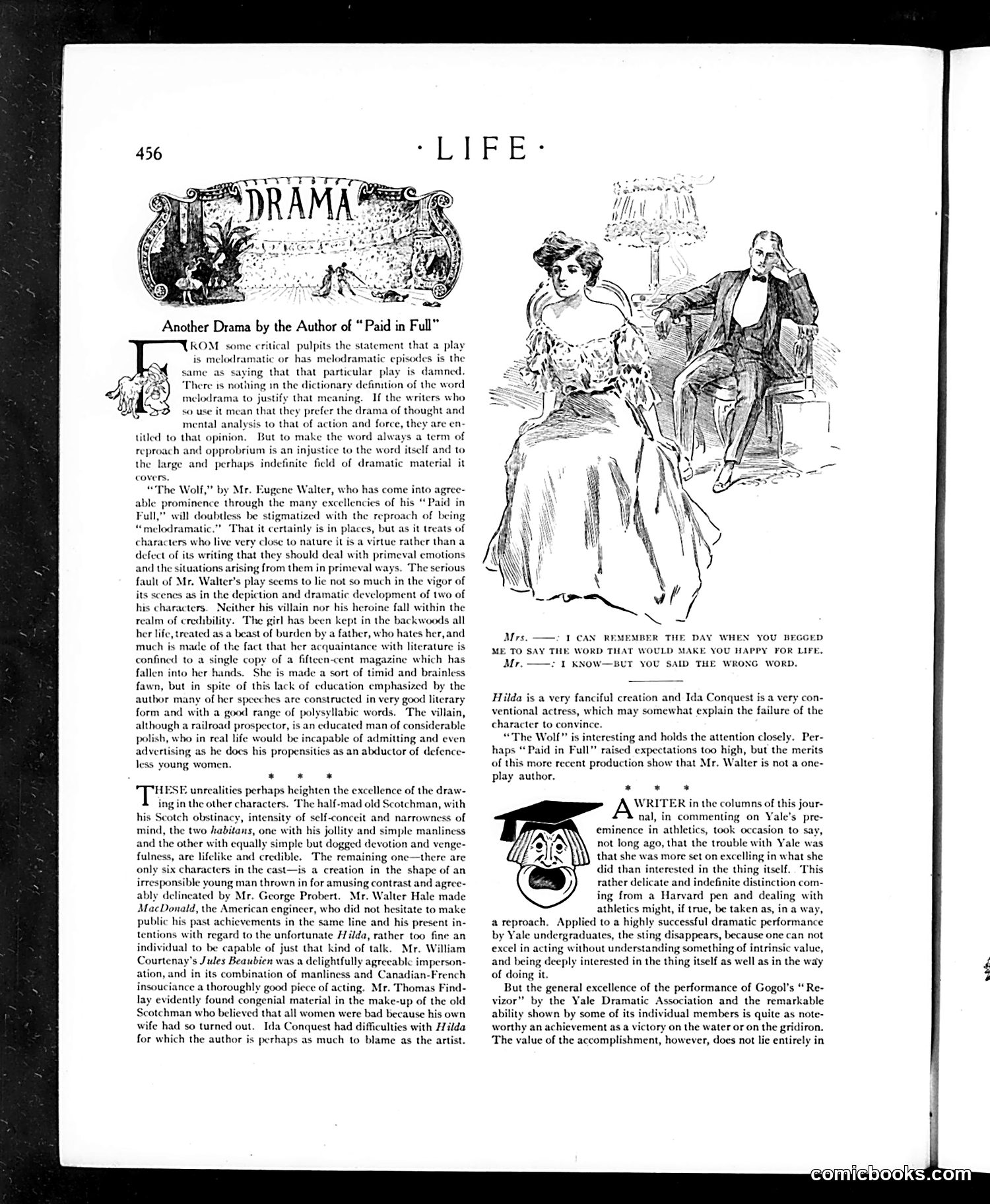
This page reviews a theatrical production called "The Wolf" by playwright Eugene Walter, author of the successful play "Paid in Full." The review critiques the play's characters and dramatic construction. The illustration shows three figures in an interior scene—a woman in an elaborate dress and two men in formal attire, suggesting a domestic drama involving romantic or social tension. The text discusses the play's depiction of characters who are "very close to nature" and criticizes both the heroine (named Hilda) and the villain as somewhat unrealistic. The reviewer notes Walter is not primarily a "one-play author," suggesting his body of work merits consideration beyond this single production. The review appears measured rather than satirical—it's serious theatrical criticism rather than political commentary.
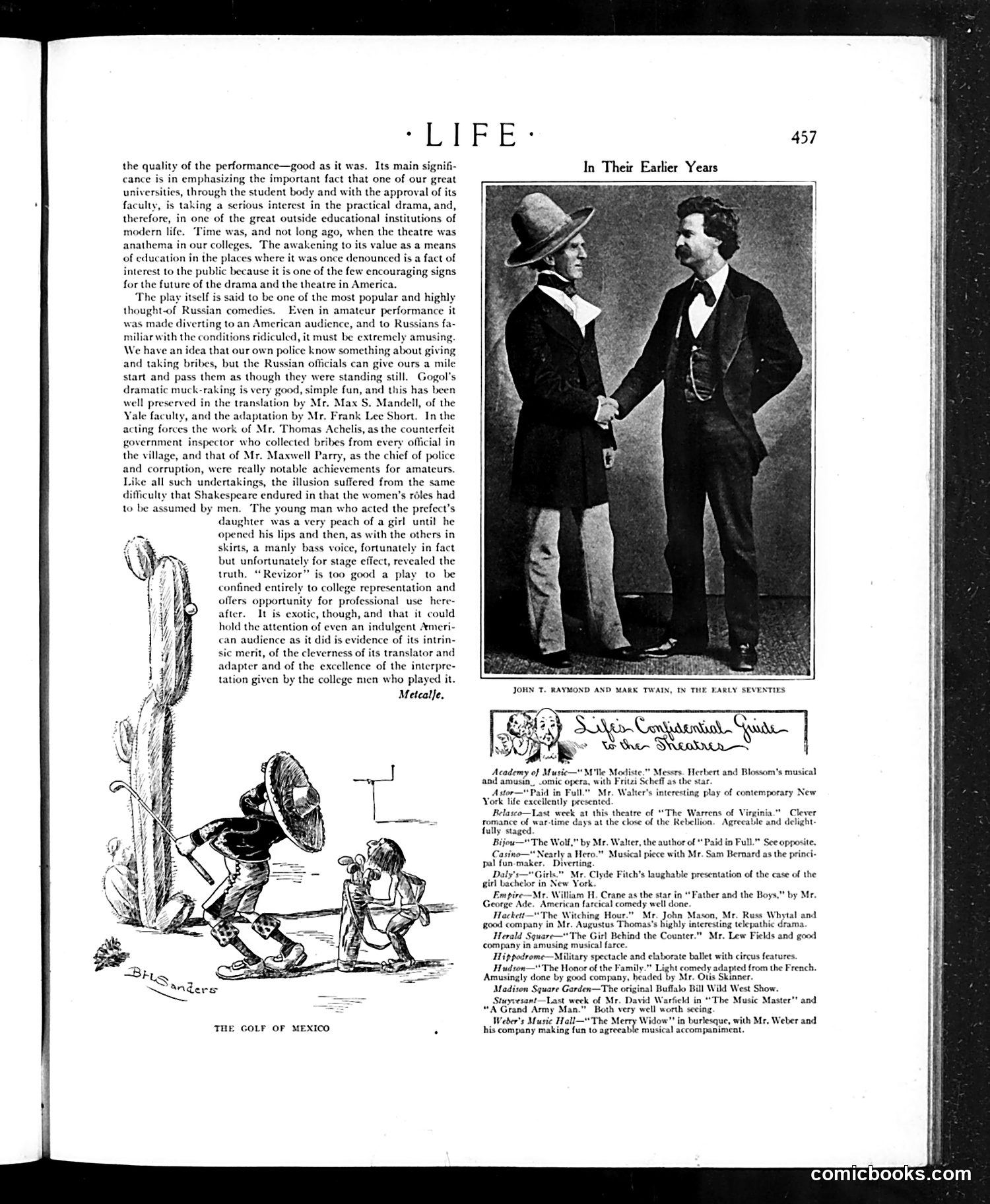
This political cartoon by B. Hlandero depicts a figure in Mexican dress (sombrero and traditional clothing) being struck or pushed by a golf club wielded by what appears to be an American figure (partially visible on left). The title "The Golf of Mexico" is a pun on the "Gulf of Mexico." The satire likely references American interventions or economic dominance in Mexico during this era. The golf metaphor suggests treating Mexico as a "playing ground" for American interests—the Mexican figure is positioned as a passive object to be manipulated or "hit around" by American power, rather than a sovereign nation. The cartoon reflects early 20th-century American imperialist attitudes toward Latin America.
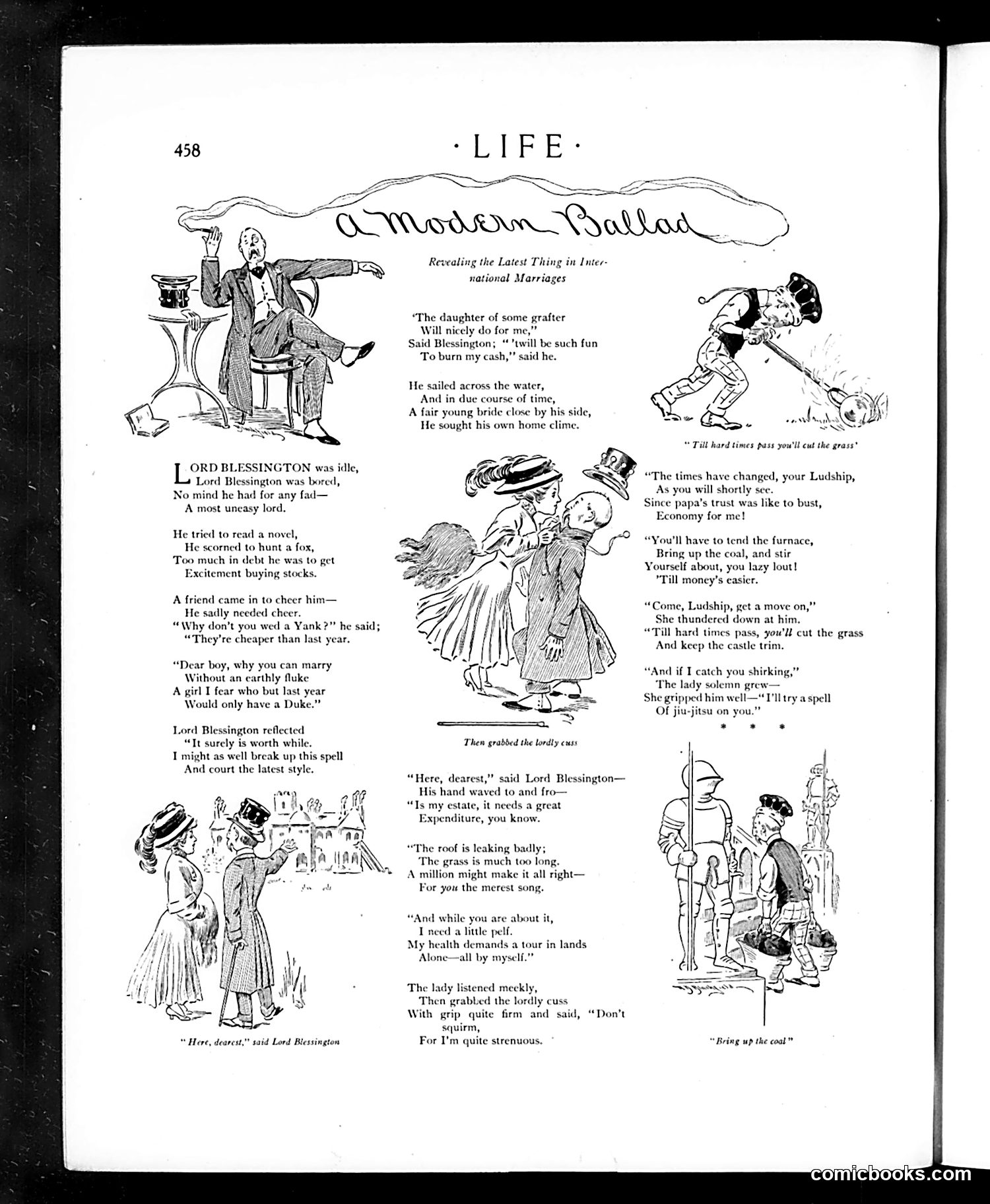
This satirical poem mocks the Gilded Age trend of wealthy American heiresses marrying impoverished British aristocrats. Lord Blessington, a broke English nobleman, takes a friend's advice to marry an American heiress—specifically "the daughter of some grafter"—expecting to exploit her wealth. The joke inverts expectations: instead of the nobleman controlling the marriage, his American bride (from a family of questionable wealth origins) completely dominates him. She forces him into manual labor (tending furnaces, cutting grass), denies him money for leisure travel, and threatens him with jiu-jitsu if he shirks duties. The satire targets both the impoverished British nobility willing to marry for money and American "new money" families. The American bride represents practical, no-nonsense values triumphing over Old World aristocratic pretension. The cartoon suggests that American women—and American money—are fundamentally different and more powerful than European tradition expects.
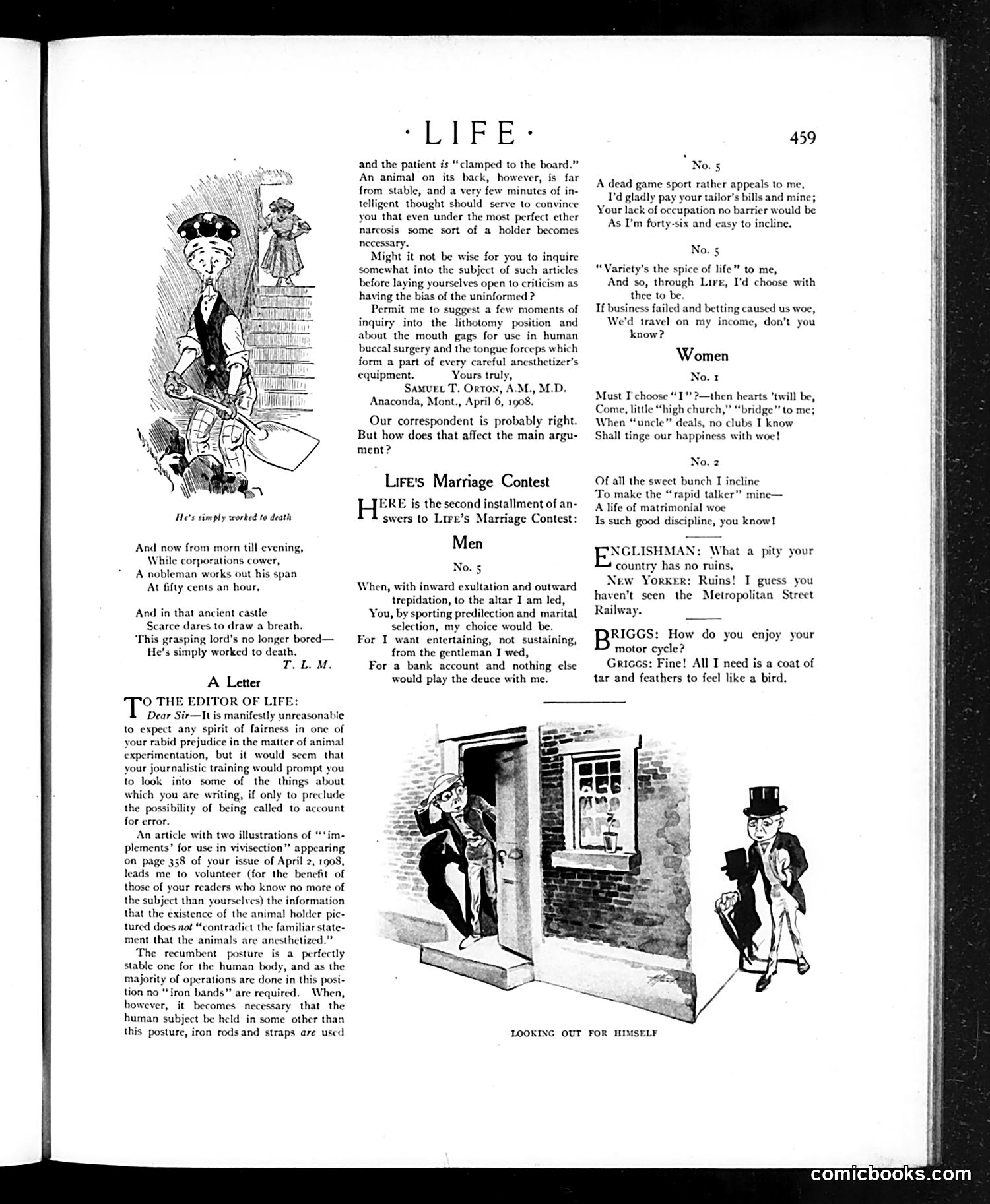
This page contains **Life's Marriage Contest**, a satirical feature where readers submit humorous responses about ideal marriage partners. **The Men's entries** (Nos. 5) mock gender expectations: one responder wants an "entertaining" wife with no bank account; another seeks a "dead game sport" willing to pay his bills. **The Women's entries** similarly satirize female stereotypes—one wants a husband who gambles and travels on her income; another humorously prefers a "rapid talker" as discipline. **The brief comic exchanges** at bottom mock contemporary issues: an Englishman jokes about America having "no ruins," and a New Yorker retorts that the Metropolitan Street Railway *is* a ruin (likely criticizing its poor condition). Another quip about a motorcycle needing "tar and feathers" references that lynch-mob punishment, applying it absurdly to feeling like a bird. The page also includes **a letter defending vivisection** against Life's earlier criticism, defending animal-testing protocols as properly anesthetized.
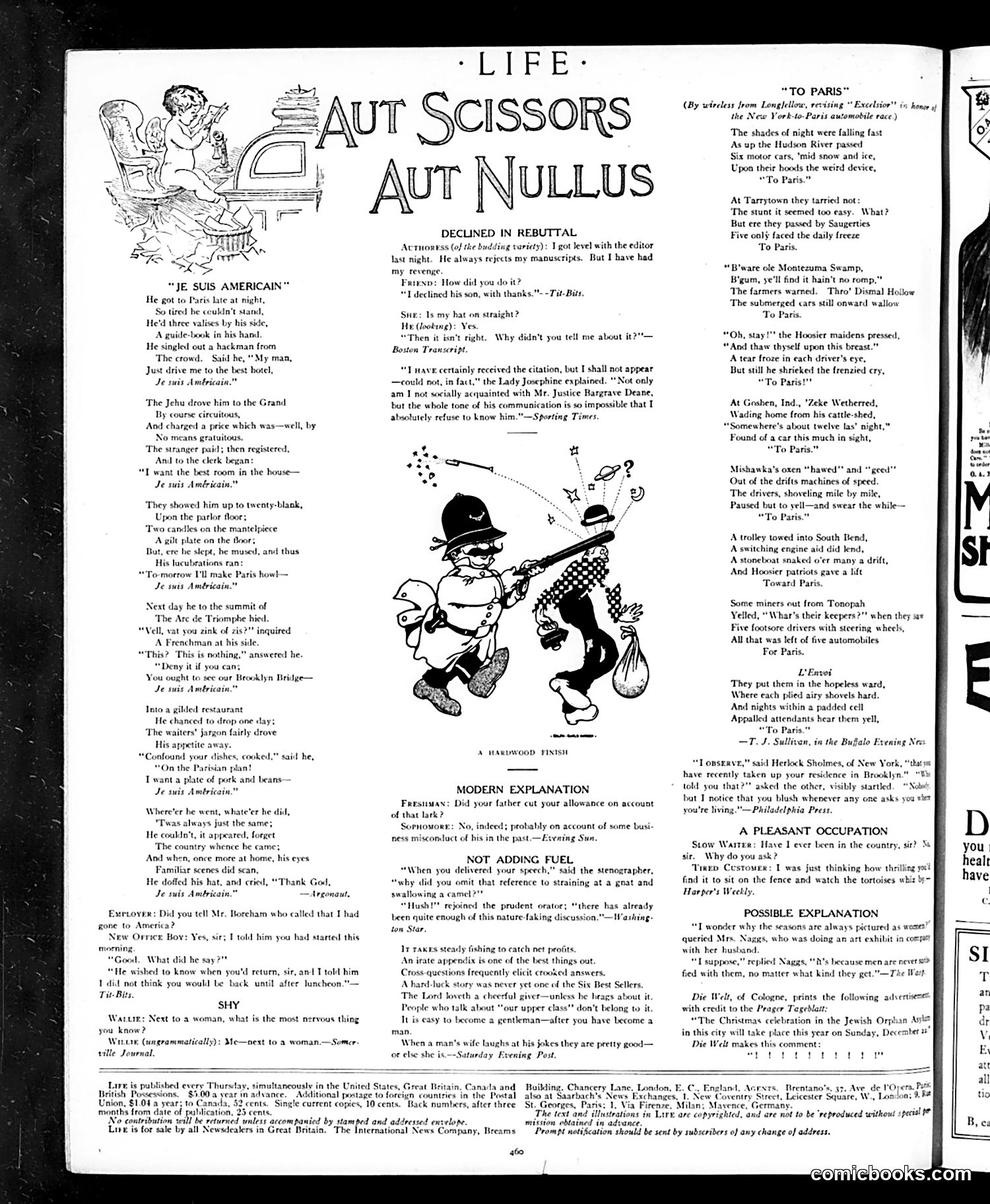
This page contains multiple satirical pieces mocking American tourists and social pretension. **"Je Suis Americain"**: A multi-part poem ridiculing an American tourist in Paris who constantly brags about American superiority—comparing the Arc de Triomphe unfavorably to the Brooklyn Bridge, complaining about French cuisine, and generally displaying obnoxious nationalist pride. The satire targets American arrogance and cultural insensitivity abroad. **"Aut Scissors Aut Nullus"**: A brief joke about an aspiring female writer seeking revenge on a rejecting editor by rejecting his son as a suitor—satirizing both literary gatekeeping and social climbing. The **central cartoon** depicts two figures in conflict with violent imagery, likely illustrating one of the accompanying satirical scenarios. Additional brief jokes mock pretension, social climbing, and foolish behavior—typical of Life's humor attacking American smugness, class affectation, and cultural ignorance during this era.
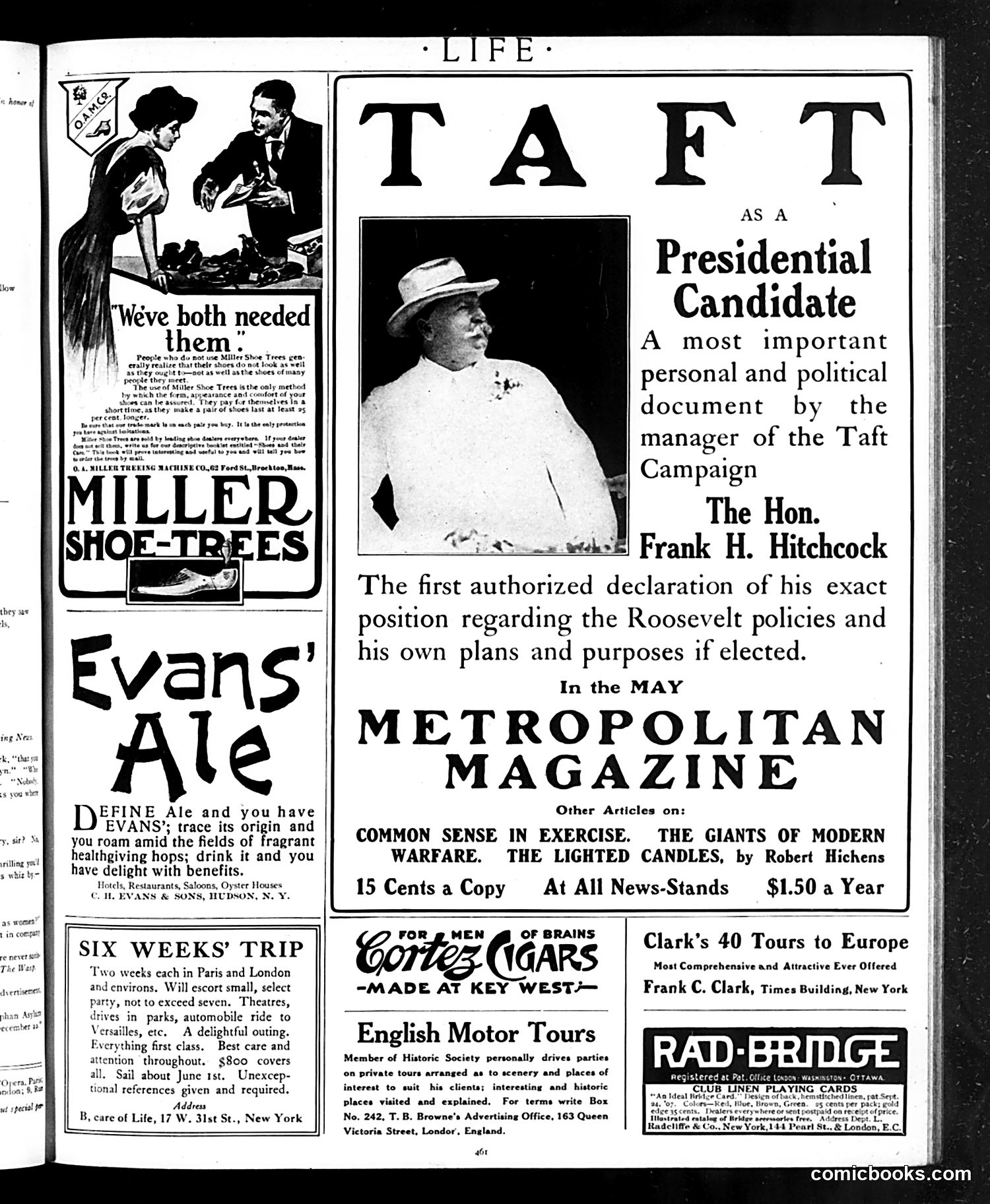
This page primarily advertises an upcoming article in *Metropolitan Magazine* about William Howard Taft's 1912 presidential campaign. Frank H. Hitchcock, Taft's campaign manager, will publish "the first authorized declaration" of Taft's position on Roosevelt's policies and his own platform if elected. The context: This appears during the Republican Party split between incumbent President Theodore Roosevelt and his chosen successor Taft. Roosevelt felt Taft had betrayed progressive policies, leading Roosevelt to challenge him in 1912—a divide that would split the GOP vote and elect Democrat Woodrow Wilson. **The small cartoon** (upper left) about Miller Shoe-Trees is unrelated political satire: it depicts a woman and man, with the caption "We've both needed them," satirizing shoe discomfort as a universal human problem. The rest of the page is **advertising**—tours, cigars, ale, and travel services typical of early 1900s *Life* magazine.
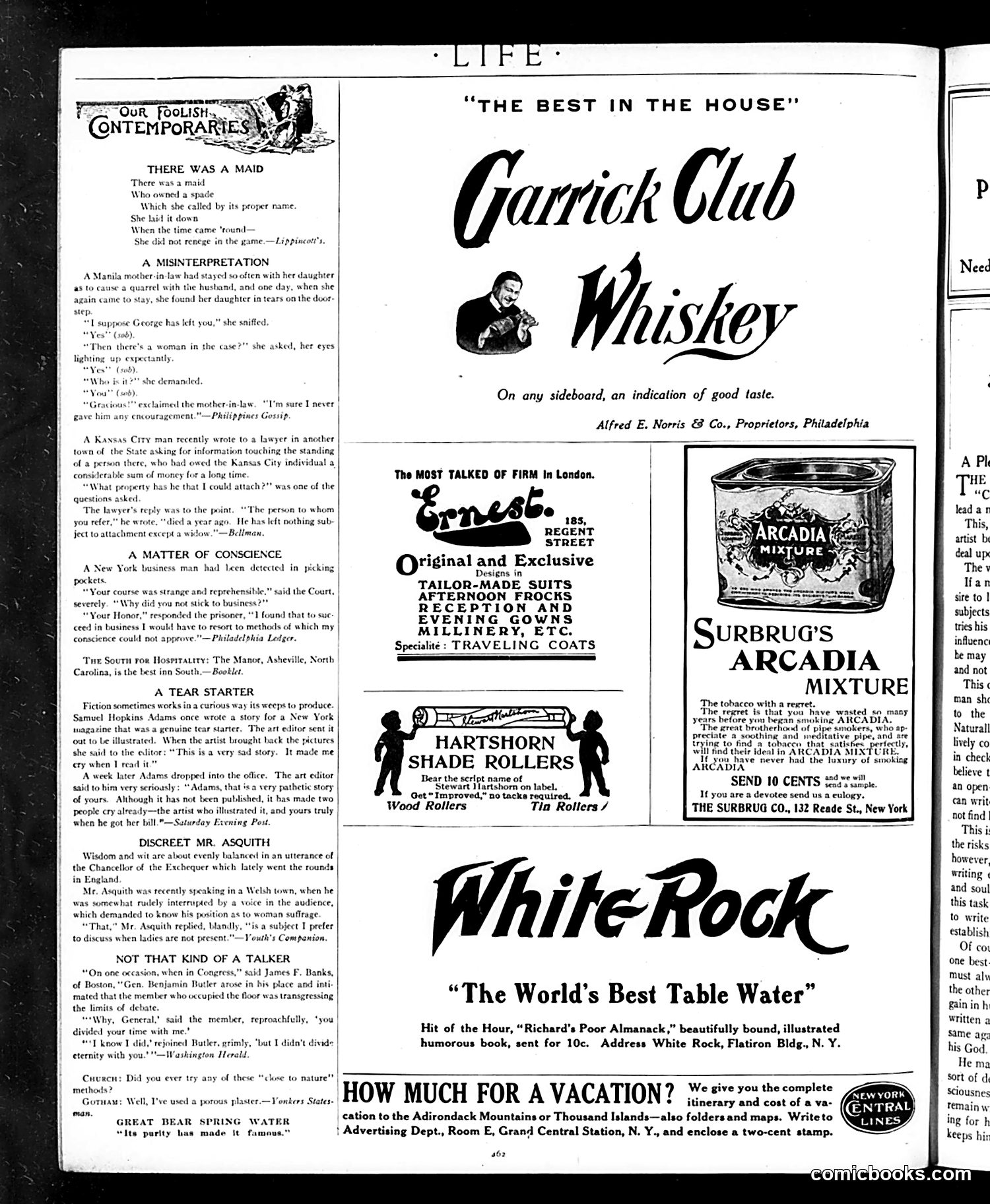
This page consists primarily of **short humorous anecdotes and advertisements** rather than political cartoons. The text sections ("Our Foolish Contemporaries") contain brief satirical stories mocking everyday social situations—a maid misunderstanding her employer, a mother-in-law causing marital discord, a lawyer's clever response about attaching a debtor's property (a widow being legally "unattachable"). These represent typical early 20th-century Life magazine humor: gentle mockery of middle-class domestic life and professional absurdities. The advertisements dominate the page, promoting consumer goods (Garrick Club Whiskey, Surburg's Arcadia Mixture tobacco, Hartshorn Shade Rollers, White Rock table water) with slogans emphasizing "good taste" and quality—typical early 1900s marketing. The anecdote about Mr. Asquith appears to reference a real political figure (likely British Prime Minister H.H. Asquith), satirizing his evasiveness on women's suffrage—a contemporary political controversy. Overall, this is a **lifestyle/humor/advertising page** reflecting pre-WWI American attitudes toward commerce, gender relations, and public figures.
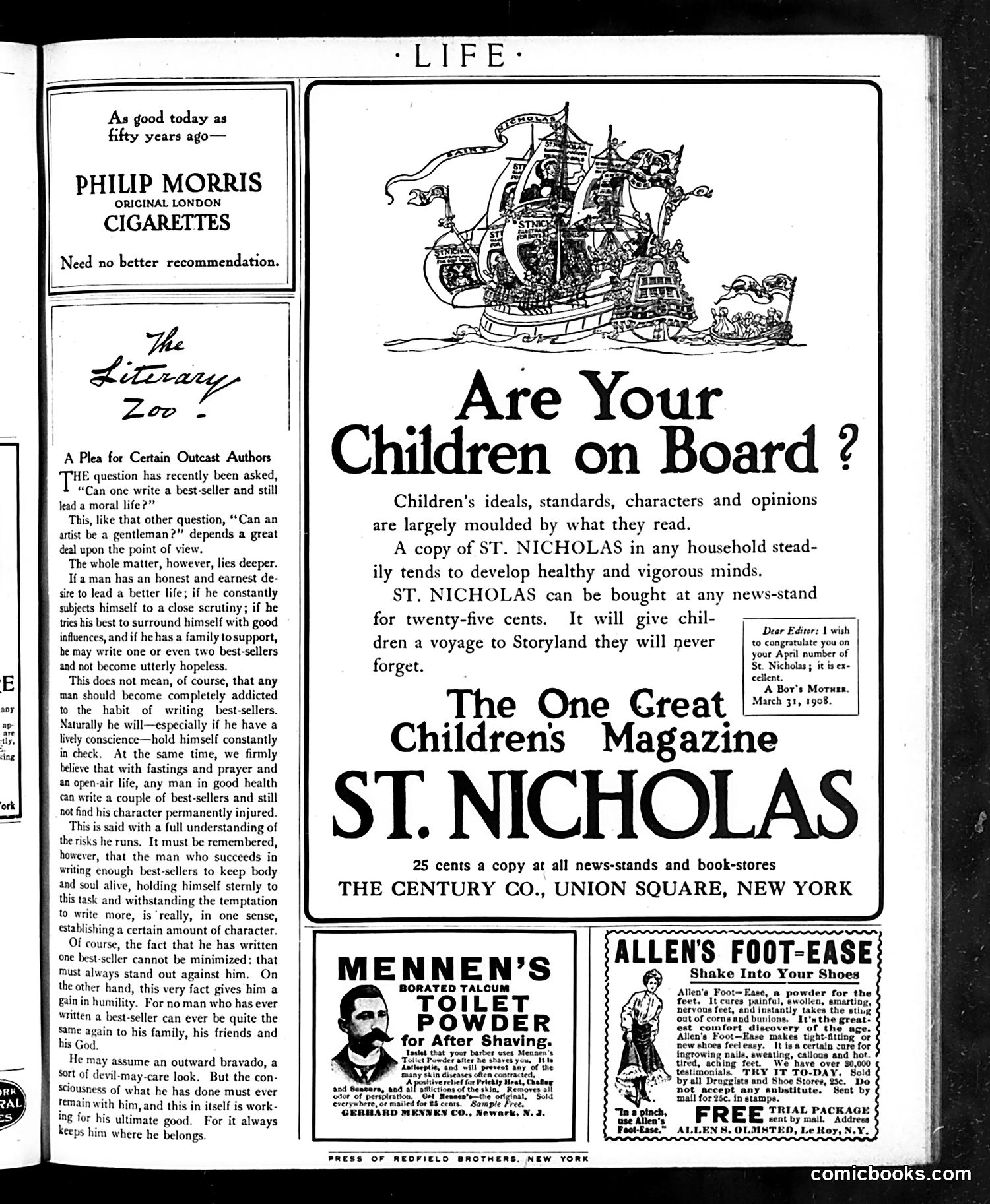
This page from *Life* magazine (dated March 31, 1908) consists primarily of **advertisements and editorial content rather than political satire**. The main satirical piece is "A Plea for Certain Outcast Authors"—a tongue-in-cheek essay defending writers who produce commercial bestsellers. The author uses mock-serious language to argue that even hack writers can maintain some moral character if they exercise restraint, surround themselves with good influences, and remain humble about their commercial success. The satire targets both the publishing industry's profit motive and authors' compromises with commercial demands. The piece treats bestseller-writing as a moral failing requiring spiritual discipline—an ironic commentary on early-20th-century anxieties about mass-market literature. The remaining content consists of period advertisements: Philip Morris cigarettes, *St. Nicholas* children's magazine, Mennen's talcum powder, and Allen's Foot-Ease powder. These ads reflect typical consumer products and marketing approaches of the Edwardian era.
This is a **full-page advertisement** for Pall Mall cigarettes from *Life* magazine (dated April 30, 1924). There is no political cartoon or satire here. The ad promotes "Him" cigarettes in "King's Size," marketed as appropriate for formal social occasions—banquets, clubs, and dinners. The copy suggests these are premium smokes for upscale settings. A coat of arms appears at bottom right, likely evoking British aristocratic prestige. The ad includes ordering instructions: if unavailable from local tobacconists, readers could mail thirty-five cents to Butler-Butler Inc. in New York to obtain them by mail. This straightforward commercial advertisement reflects 1920s tobacco marketing, when cigarette advertising was commonplace in mainstream magazines without health warnings.