
Life, 1908-04-30 · page 4 of 20
Life — April 30, 1908 — page 4: what you’re looking at
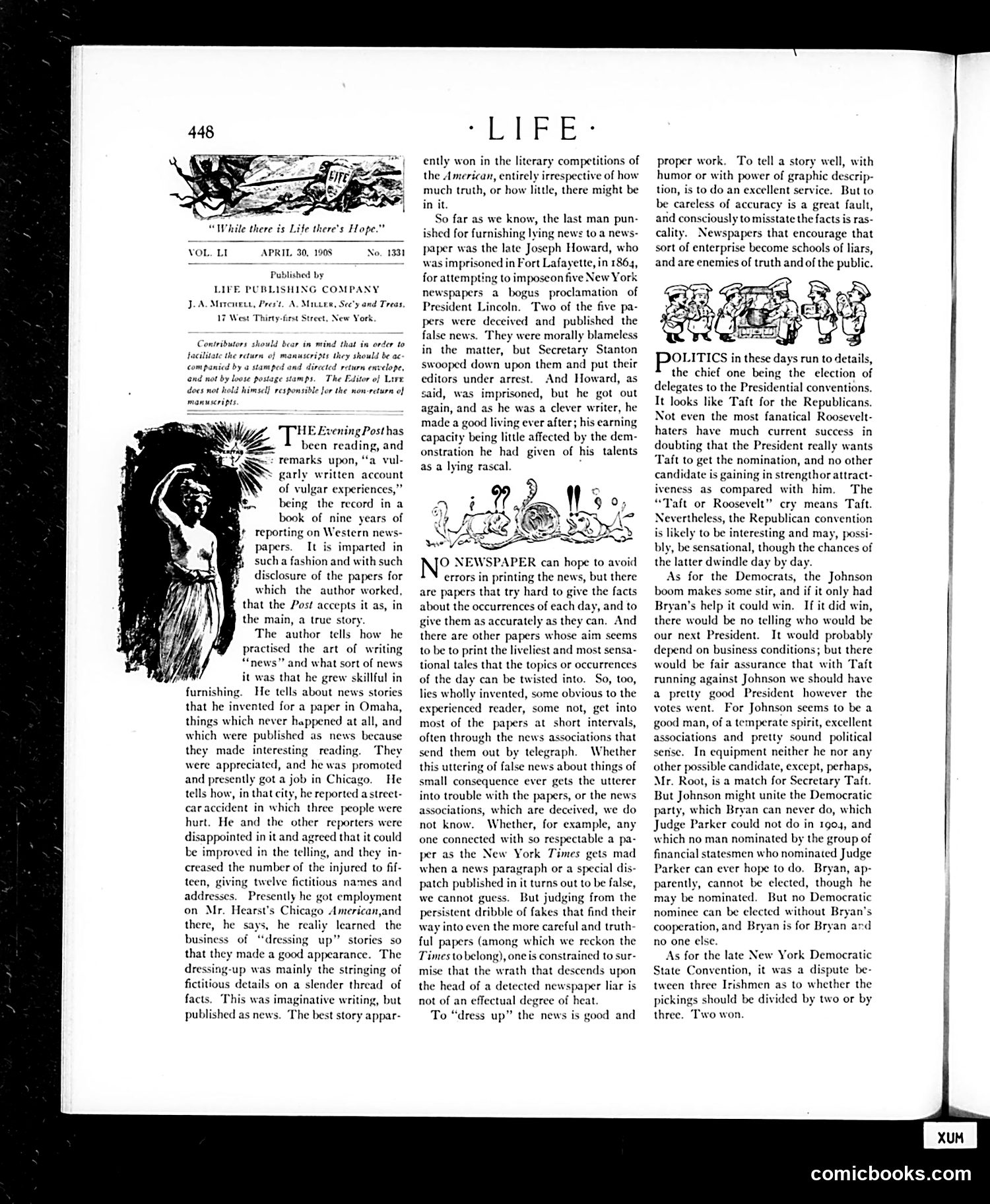
What you’re looking at
The page discusses newspaper accuracy and the 1908 U.S. presidential election. The text critiques how newspapers sometimes publish false or sensationalized news, citing the case of Joseph Howard Jr., imprisoned in 1864 for spreading false rumors about President Lincoln. The main political content addresses the Republican and Democratic conventions. It discusses speculation about whether President Theodore Roosevelt truly supports William Howard Taft for the Republican nomination, and whether Democrats might nominate William Jennings Bryan or another candidate. The piece suggests Johnson (likely a Democratic figure) could challenge the incumbent presidency but acknowledges Taft appears to be gaining strength as the likely Republican nominee. The cartoons appear to illustrate these political themes, though specific figures are difficult to identify with certainty from the image alone.
📄 Transcribed text from this page (OCR, searchable)
Machine-transcribed from the original scan — historical spelling and the odd misread are preserved.
0. 1331 Published by LIFE PUBLISHIN J.A. Mitenent, Pret 17 West Thirty-first Street, New York COMPANY A. Mitten, Sec'y and Treas. Contributors should bear im mind that in order to facilitate the return o} manuscripts they should be ac companied by a stamped and directed return envelope, and not by loose postage stamps. The Es rE docs not hold himsel} responsible Jor the non-return of manuscripts ‘vening Post has been reading, and remarks upon, “a vul- garly written account of vulgar experiences,” being the record in a book of nine years of reporting on Western new: papers. It is imparted in such a fashion and with such disclosure of the papers for which the author worked, that the Post accepts it as, in the main, a true story. The author tells how he practised the art of writing “news” and what sort of news it was that he grew skillful in furnishing. He tells about news stories that he invented for a paper in Omaha, things which never happened at all, and which were published as news because they made interesting reading. They were appreciated, and he was promoted and presently got a job in Chicago. He tells how, in that city, he reported a street- caraccident in which three people were hurt. He and the other reporters were disappointed in it and agreed that it could be improved in the telling, and they in- creased the number of the injured to fif- teen, giving twelve fictitious names and addresses. Presently he got employment on Mr. Hearst's Chicago American,and there, he says, he realiy learned the business of “dressing up” stories so that they made a good appearance. The dressing-up was mainly the stringing of fictitious details on a slender thread of facts. This was imaginative writing, but published as news. The best story appar- vee “NS LEFE ently won in the literary competitions of the American, entirely irrespective of how much truth, or how little, there might be in it. So far as we know, the last man pun- ished for furnishing lying news toa news- paper was the late Joseph Howard, who was imprisoned in Fort Lafayette, in 1864, for attempting to imposeon five New York newspapers a bogus proclamation of President Lincoln. Two of the five pa- pers were deceived and published the false news. They were morally blameless in the matter, but Secretary Stanton swooped down upon them and put their editors under arrest. And Howard, as said, was imprisoned, but he got out again, and as he was a clever writer, he made a good living ever after; his earning capacity being little affected by the dem- onstration he had given of his talents as a lying rascal if, 2 fe 5 2, oO ee SPAPER can hope to avoid errors in printing the news, but there are papers that try hard to give the facts about the occurrences of each day, and to give them as accurately as they can. And there are other papers whose aim seems to be to print the liveliest and most sensa- tional tales that the topics or occurrences of the day can be twisted into. So, too, lies wholly invented, some obvious to the experienced reader, some not, get into most of the papers at short intervals, often through the news associations that send them out by telegraph. Whether this uttering of false news about things of small consequence ever gets the utterer into trouble with the papers, or the news associations, which are deceived, we do not know. Whether, for example, any one connected with so respectable a pa- per as the New York Times gets mad when a news paragraph or a special dis- patch published in it turns out to be fals we cannot guess. But judging from the persistent dribble of fakes that find their way into even the more careful and truth: ful papers (among which we reckon the Times to belong), one is constrained to sur- mise that the wrath that descends upon. the head of a detected newspaper liar is not of an effectual degree of heat To “dress up” the news is good and proper work. To tell a story well, with humor or with power of graphic descrip- tion, is to do an excellent service. But to be careless of accuracy is a great fault, and consciously to misstate the facts is ras- cality. Newspapers that encourage that sort of enterprise become schools of liar: and are enemies of truth and of the public. OLITICS in these days run to details, the chief one being the election of delegates to the Presidential conventions. It looks like Taft for the Republica Not even the most fanatical Roosevelt- haters have much current success in doubting that the President really wants Taft to get the nomination, and no other candidate is gaining in strengthor attract- iveness as compared with him. The “Taft or Roosevelt” cry means Taft. Nevertheless, the Republican convention is likely to be interesting and may, possi- bly, be sensational, though the chances of the latter dwindle day by day. As for the Democrats, the Johnson boom makes some stir, and if it only had Bryan’s help it could win. If it did win, there would be no telling who would be our next President. It would probably depend on business conditions; but there would be fair assurance that with Taft running against Johnson we should have a pretty good President however the votes went. For Johnson scems to be a good man, of a temperate spirit, excellent associations and pretty sound political serise. In equipment neither he nor any other possible candidate, except, perhaps, Mr. Root, is a match for Secretary Taft. But Johnson might unite the Democratic party, which Bryan can never do, which Judge Parker could not do in 1904, and which no man nominated by the group of financial statesmen who nominated Judge Parker can ever hope to do. Bryan, ap- parently, cannot be elected, though he may be nominated. But no Democratic nominee can be clected without Bryan's cooperation, and Bryan is for Bryan and no one else. As for the late New York Democratic State Convention, it was a dispute be- tween three Irishmen as to whether the pickings should be divided by two or by three. Two won. comicbooks.com