
Life, 1908-04-30 · page 12 of 20
Life — April 30, 1908 — page 12: what you’re looking at
What you’re looking at
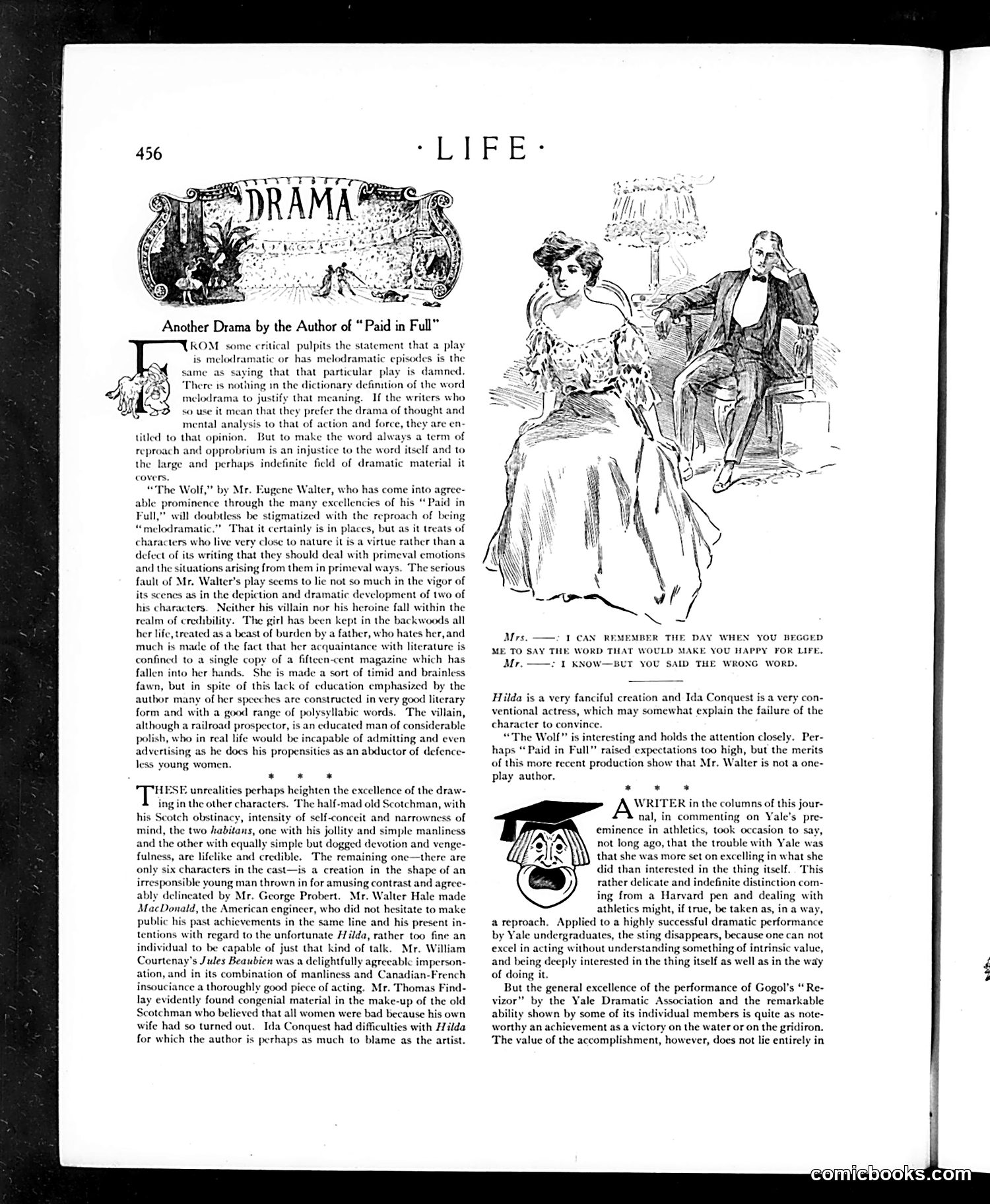
This page reviews a theatrical production called "The Wolf" by playwright Eugene Walter, author of the successful play "Paid in Full." The review critiques the play's characters and dramatic construction. The illustration shows three figures in an interior scene—a woman in an elaborate dress and two men in formal attire, suggesting a domestic drama involving romantic or social tension. The text discusses the play's depiction of characters who are "very close to nature" and criticizes both the heroine (named Hilda) and the villain as somewhat unrealistic. The reviewer notes Walter is not primarily a "one-play author," suggesting his body of work merits consideration beyond this single production. The review appears measured rather than satirical—it's serious theatrical criticism rather than political commentary.
📄 Transcribed text from this page (OCR, searchable)
Machine-transcribed from the original scan — historical spelling and the odd misread are preserved.
KOM some critical pulpits the statement that a play is melodramatic or has melodramatic episodes is the me as saying that that particular play is damned. ‘There ts nothing in the dictionary definition of the word melodrama to justify that meaning. If the writers who so use it mean that they prefer the drama of thought and mental analysis to that of action and force, they are en- titled to that opinion, But to make the word always a term of reproach and opprobrium is an injustice to the word itself and to the large and perhaps indefinite ficld of dramatic material it covers. “The Wolf,” by Mr. Eugene Walter, who has come into agree- able prominence through the many excellencies of his “Paid in Full,” will doubtless be stigmatized with the reproach of being “melodramatic.” ‘That it certainly is in places, but as it treats of characters who live very close to nature it is a virtue rather than a defect of its writing that they should deal with primeval emotions and the situations arising from them in primeval ways. The serious fault of Mr. Walter's play seems to lie not so much in the vigor of its scenes as in the depiction and dramatic development of two of his characters. Neither his villain nor his heroine fall within the realm of credibility. The girl has been kept in the backwoods all her life, treated as a beast of burden by a father, who hates her, and much is made of the fact that her acquaintance with literature is confined to a single copy of a fiftcen-cent magazine which has fallen into her hands. She is made a sort of timid and brainless fawn, but in spite of this lack of education emphasized by the author many of her speeches are constructed in very good literary form and with a good range of polysyllabic words. ‘The villain, although a railroad prospector, is an educated man of considerable polish, who in real life would be incapable of admitting and even advertising as he docs his propensities as an abductor of defence- less young women. * 8 * HESE unrealities perhaps heighten the excellence of the dra ing in the other characters. The half-mad old Scotchman, with his Scotch obstinacy, intensity of self-conceit and narrowness of mind, the two habitans, one with his jollity and simple manliness and the other with equally simple but dogged devotion and venge- fulness, are lifelike and credible. The remaining one—there are only six characters in the cast—is a creation in the shape of an irresponsible young man thrown in for amusing contrast and agree- ably delineated by Mr. George Probert. Mr. Walter Hale made MacDonald, the American engincer, who did not hesitate to make public his past achievements in the same line and his present in- tentions with regard to the unfortunate Hilda, rather too fine an individual to be capable of just that kind of talk. Mr. William Courtenay’s Jules Beaubien was a delightfully agrecable imperson- ation, and in its combination of manliness and Canadian-French i jance a thoroughly good piece of acting. Mr. ‘Thomas Find- evidently found congenial material in the make-up of the old ‘otchman who believed that all women were bad because his own wife had so turned out. Ida Conquest had difficulties with Hilda for which the author is perhaps as much to blame as the artist. Mrs. ——: 1 CAN REMEMBER THE DAY WHEN YOU BEGGED ME TO SAY THE WORD THAT WOULD MAKE YOU HAPPY FOR LIFE. Mr, ——: 1 KNOW—BUT YOU SAID THE WRONG WORD. Hilda is a very fanciful creation and Ida Conquest is a very con- ventional actress, which may somewhat explain the failure of the character to convince. Phe Wolf” is interesting and holds the attention closely. Per- haps “Paid in Full” raised expectations too high, but the merits of this more recent production show that Mr. Walter is not a one- play author. se 8 WRITER in the columns of this jour- nal, in commenting on Yale's pre- eminence in athletics, took occasion to say not long ago, that the trouble with Yale was that she was more set on excelling in what she did than interested in the thing itself. ‘This rather delicate and indefinite distinction com- ing from a Harvard pen and dealing with athletics might, if true, be taken as, in a way, a reproach. Applied to a highly successful dramatic performance by Yale undergraduates, the sting disappears, because one can not excel in acting without understanding something of intrinsic value, and being deeply interested in the thing itself as well as in the way of doing it. But the general excellence of the performance of Gogol’s “Re- vizor” by the Yale Dramatic Association and the remarkable ability shown by some of its individual members is quite as note- worthy an achievement as a victory on the water or on the gridiron. ‘The value of the accomplishment, however, does not lie entirely in