
Life, 1908-04-30 · page 13 of 20
Life — April 30, 1908 — page 13: what you’re looking at
What you’re looking at
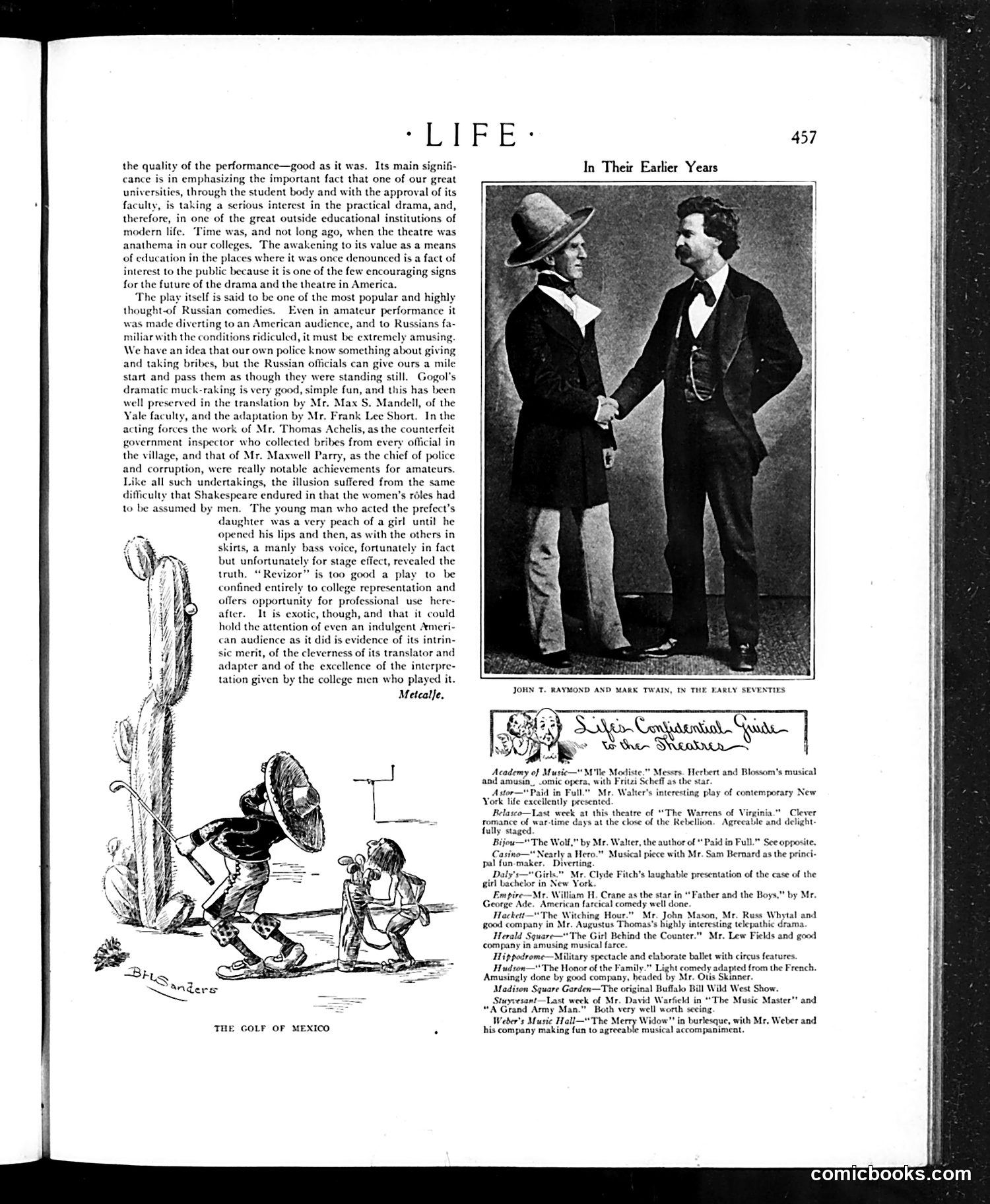
This political cartoon by B. Hlandero depicts a figure in Mexican dress (sombrero and traditional clothing) being struck or pushed by a golf club wielded by what appears to be an American figure (partially visible on left). The title "The Golf of Mexico" is a pun on the "Gulf of Mexico." The satire likely references American interventions or economic dominance in Mexico during this era. The golf metaphor suggests treating Mexico as a "playing ground" for American interests—the Mexican figure is positioned as a passive object to be manipulated or "hit around" by American power, rather than a sovereign nation. The cartoon reflects early 20th-century American imperialist attitudes toward Latin America.
📄 Transcribed text from this page (OCR, searchable)
Machine-transcribed from the original scan — historical spelling and the odd misread are preserved.
‘LIFE: the quality of the performance—good as it was. Its main signifi- In Their Earlier Years cance is in emphasizing the important fact that one of our great universities, through the student body and with the approval of its faculty, is taking a serious interest in the practical drama, and, therefore, in one of the great outside educational institutions of modern life. ‘Time was, and not long ago, when the theatre was anathema in our colleges. The awakening to its value as. a means of education in the places where it was once denounced is a fact of interest to the public because it is one of the few encouraging signs for the future of the drama and the theatre in America. The play itself is said to be one of the most popular and highly thought-of Russian comedies. Even in amateur performance it was made diverting to. an American audience, and to Russians fa- miliar with the conditions ridiculed, it must be extremely amusing. We have an idea that our own police know something about giving and taking bribes, but the Russian oflicials can give ours a mile start and pass them as though they were standing still. Gogol's dramatic muck-raking is very good, simple fun, and this has been well preserved in the translation by Mr. Max S. Mandell, of the Yale faculty, and the adaptation by Mr. Frank Lee Short. In the acting forces the work of Mr. ‘Thomas Achelis, as the counterfeit government inspector who collected bribes from every official in the village, and that of Mr. Maxwell Parry, as the chief of police and corruption, were really notable achievements for amateurs. Like all such undertakings, the illusion suffered from the same difficulty that Shakespeare endured in that the women's réles had to be assumed by men. The young man who acted the prefect’s daughter was a very peach of a girl until he opened his lips and then, as with the others in skirts, a manly bass voice, fortunately in fact but unfortunately for stage effect, revealed the truth. “Revizor” is to0 good a play to be confined entirely to college representation and offers opportunity for professional use here- after. It is exotic, though, and that it could hold the attention of even an indulgent Ameri- can audience as it did is evidence of its intrin- sic merit, of the cleverness of its translator and adapter and of the excellence of the interpre- tation given by the college men who played it. Metcalfe. Academy of Music— M'lle Modiste.” Messrs. Herbert and Blossom's musical and amusin_ comic opera, with Fritzi Scheff as the star. A stor—"Paid in Full.” Me. Walter's interesting play of contemporary New York life excellently. presented, Belasco—Last week at this theatre of * romance of war-time days at the close of the Rebellion. Agrecable and delight fully staged. Bijou—"The Wolf,” by Mr. Walter, the author of “ Paid in Full.”" See opposite. Casino—" Nearly a Hero."” Musical piece with Mr. Sam Bernard as the princi- pal fun-maker. Diverting Daly's—"Gitls." Mr. Clyde Fitch's laughable presentation of the ease of the girl bachelor in New York Empire—Mr. William H. Crane as the star in “Father and the Boys," by Mr. George Ade. American farcical comedy well done. Hackett—""The Witching Hour.” Mr. John Mason, Mr. Russ Whytal and good company in Mr. Augustus Thomas's highly interesting telepathic drama. Herald Square—""The Gil Behind the Counter.” Mr. Lew Fields and good company in amusing musical farce. Hippodrome—Military spectacle and elaborate ballet with circus features. Hudson—" The Honor of the Family.” Light comedy adapted {rom the French. Amusingly done by good company, headed by Mr. Otis Skinner. Madison Square Garden—The original Buffalo Bill Wild West Show. Stuyvesant—Last week of Mr. David Warfield in “The Music Master"? and “AGrand Army Man.” Both very well worth seeing Weber's Music Hall—""The Merry Widow" in burlesque, with Mr, Weber and THE GOLF OF MEXICO his company making fun to agreeable musical accompaniment. comicbooks.com