
Life, 1908-04-30 · page 14 of 20
Life — April 30, 1908 — page 14: what you’re looking at
What you’re looking at
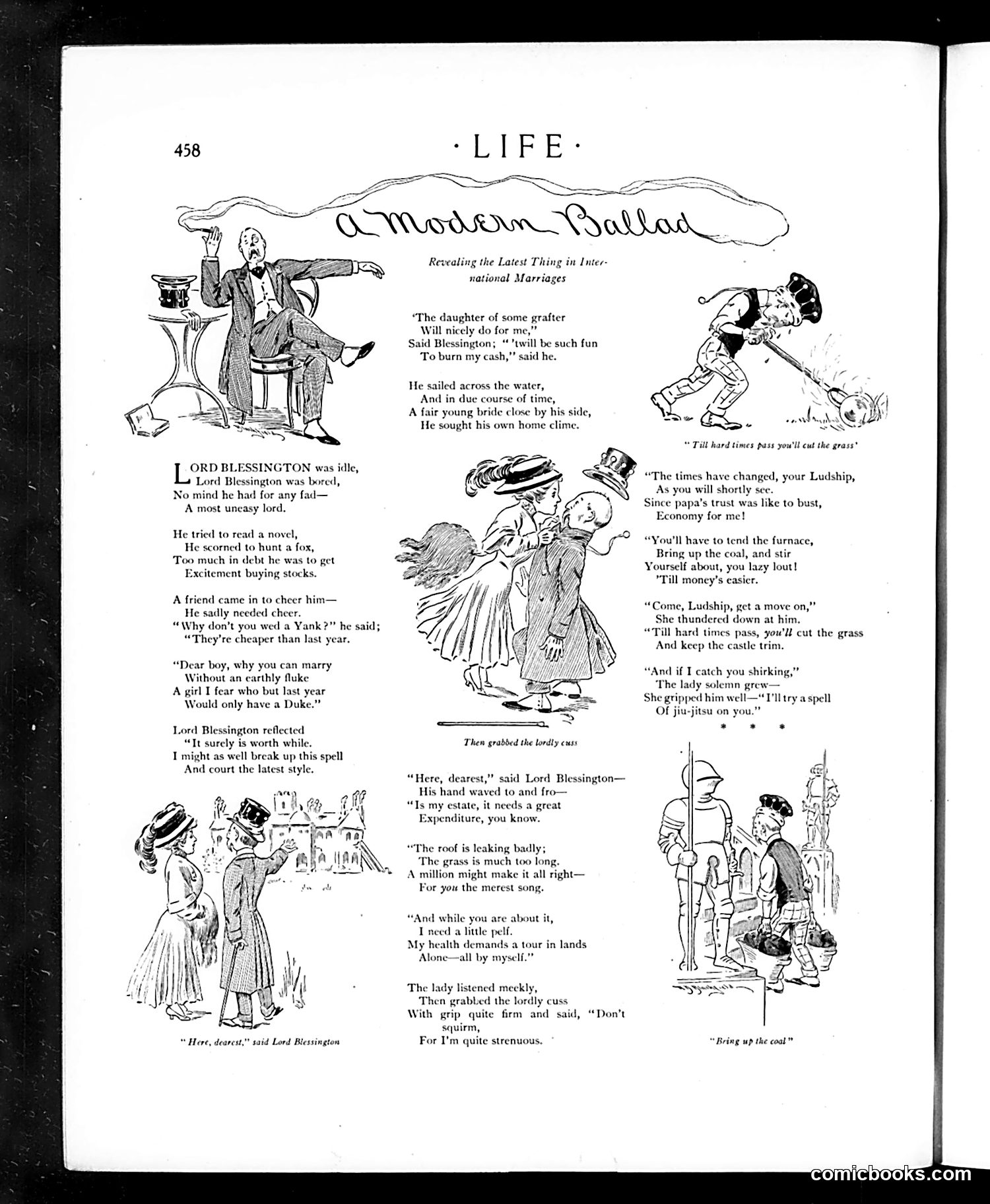
This satirical poem mocks the Gilded Age trend of wealthy American heiresses marrying impoverished British aristocrats. Lord Blessington, a broke English nobleman, takes a friend's advice to marry an American heiress—specifically "the daughter of some grafter"—expecting to exploit her wealth. The joke inverts expectations: instead of the nobleman controlling the marriage, his American bride (from a family of questionable wealth origins) completely dominates him. She forces him into manual labor (tending furnaces, cutting grass), denies him money for leisure travel, and threatens him with jiu-jitsu if he shirks duties. The satire targets both the impoverished British nobility willing to marry for money and American "new money" families. The American bride represents practical, no-nonsense values triumphing over Old World aristocratic pretension. The cartoon suggests that American women—and American money—are fundamentally different and more powerful than European tradition expects.
📄 Transcribed text from this page (OCR, searchable)
Machine-transcribed from the original scan — historical spelling and the odd misread are preserved.
ESSINGTON was idle, Lord Blessington was bored, No mind he had for any fad— A most uneasy lord. He tried to read a novel, He scorned to hunt a fox, Too much in debt he was to get Excitement buying stocks. A friend came in to cheer him— He sadly needed cheer. “Why don’t you wed a Yank?” he said; “They're cheaper than last ) “Dear boy, why you can marry Without an carthly fluke A girl I fear who but last year Would only have a Duke.” Lord Blessington reflected “Tt surely is worth while. I might as well break up this spell And court the latest style. © Here, dearest,” said Lord Blessington Revealing the Latest Thing in Inter- national Marriages “The daughter of some grafter Will nicely do for me,” Said Blessington; “ ’twill be such fun. To burn my cash,” said he. He sailed across the water, And in due course of time, A fair young bride close by his side, He sought his own home clime. Then grabbed the lordly cuss “Here, dearest,” said Lord Blessington— red to and fro— it needs a great you know. His hand w he roof is leaking badly; ‘The grass is much too long. A million might make it all right— For you the merest song. “And while you are about it, I need a little pelf. My health demands a tour in lands Alone—all by myself.” ‘The lady listened meckly, Then grabbed the lordly cuss With grip quite firm and said, “Don’t squirm, For I'm quite strenuous. " Till hard times pass you'll cut the grass* “The times have changed, your Ludship, As you will shortly sec. Since papa’s trust was like to bust, Economy for me! “You'll have to tend the furnace, Bring up the coal, and stir Yourself about, you lazy lout! Till moncy’s easier. “Come, Ludship, get a move on,” She thundered down at him. “Till hard times pass, you'll cut the grass And keep the castle trim. “And if I catch you shirking,” ‘The lady solemn grew— She gripped him well—"T'll try a spell Of jiu-jitsu on you.” ™ Bring up the coal”