
A complete issue · 24 pages · 1908
Life — April 23, 1908
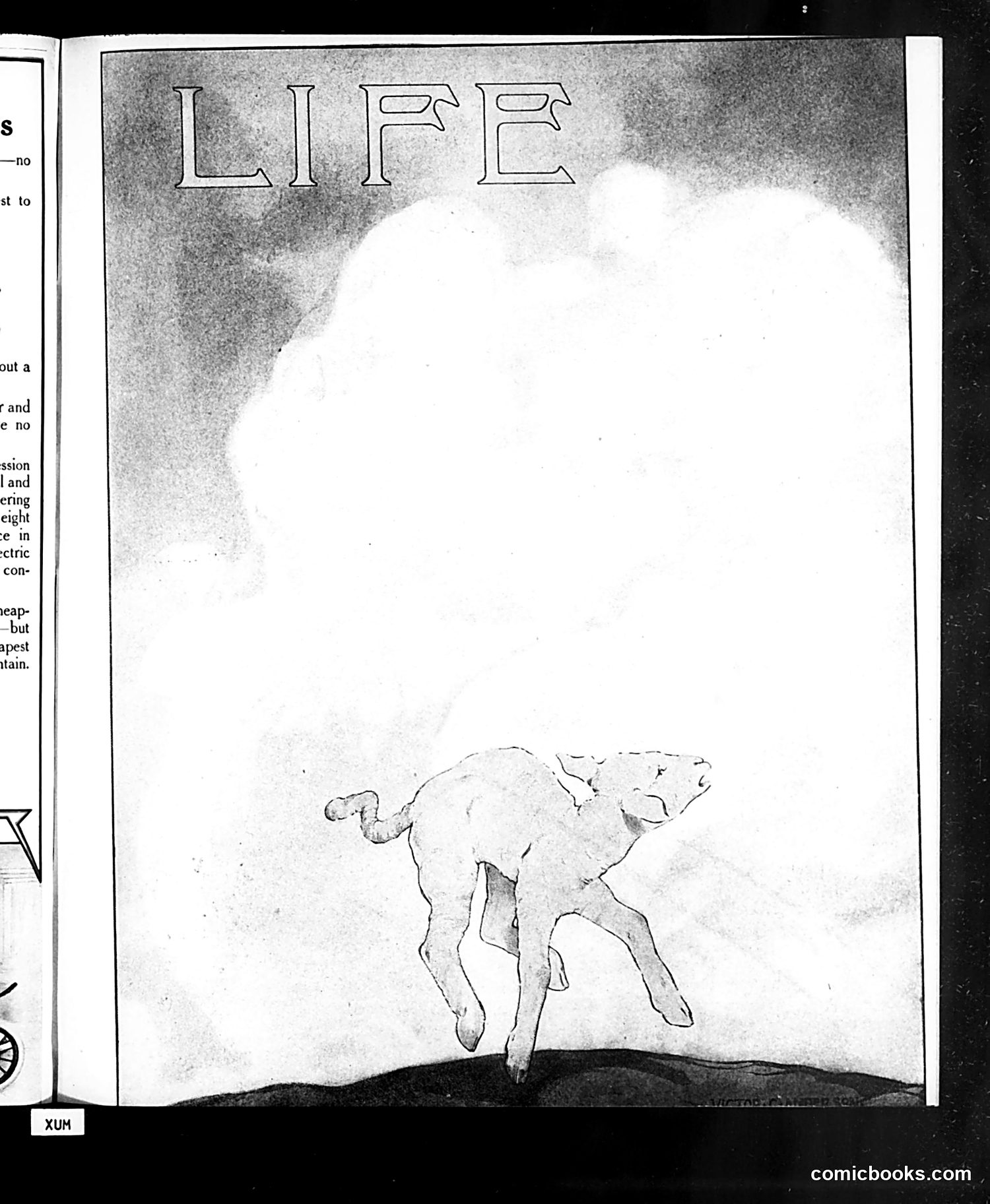
This page from *Life* magazine features the word "LIFE" as a title at the top, with a simple line-drawn illustration below depicting a camel in a walking pose against a minimal landscape. Without additional context from surrounding text or a clear date, the specific satirical meaning is unclear. The camel could reference several historical contexts—possibly relating to desert campaigns, colonial affairs, or a metaphorical comment on political stubbornness or burden-bearing (common camel symbolism in satirical work). The sparse composition and straightforward drawing style is typical of early-to-mid 20th century *Life* magazine layouts. However, without visible OCR text providing explanatory context or a discernible political figure/event reference, the precise satire intended remains ambiguous from this image alone.
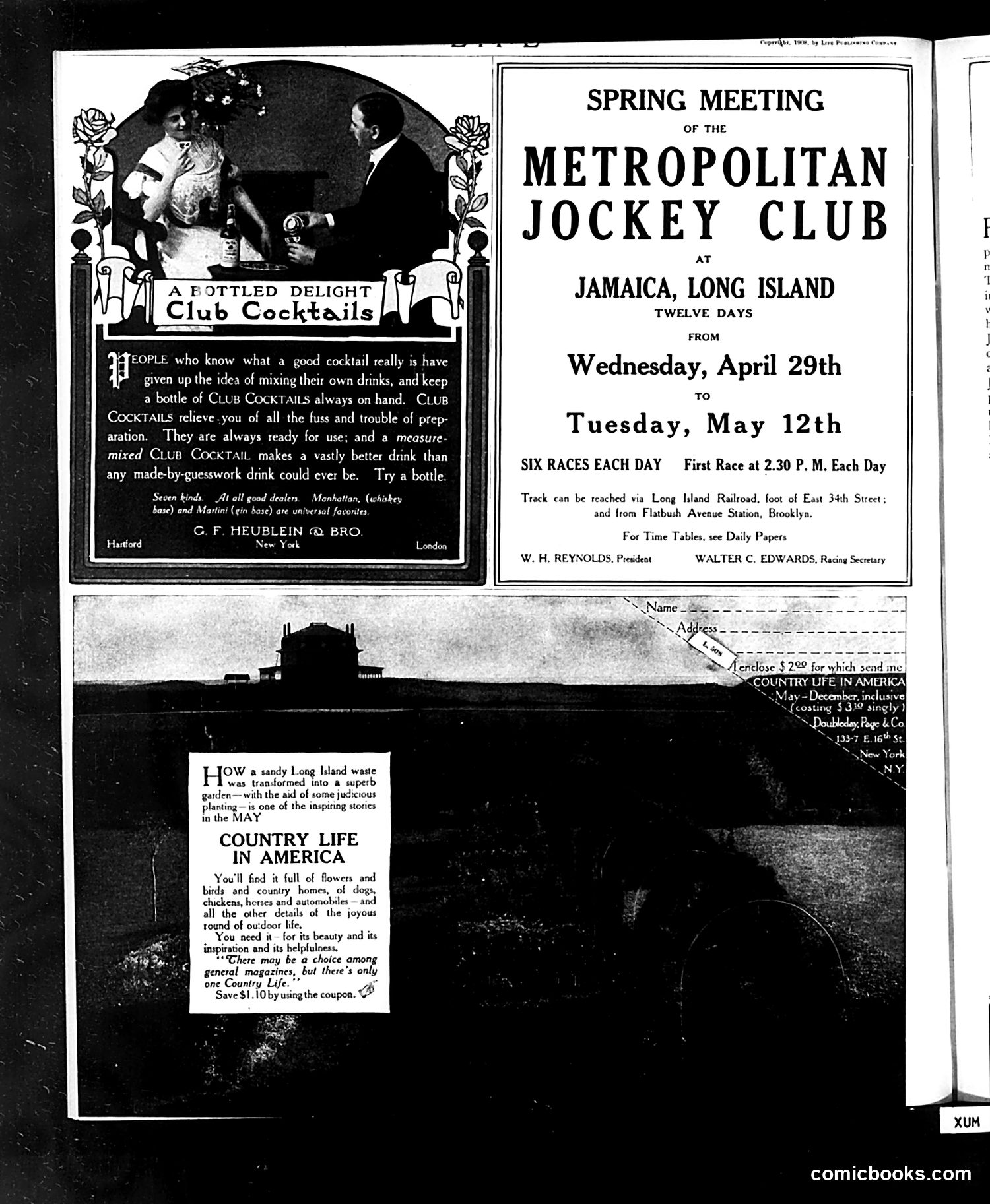
This page is primarily **advertising and event announcements** rather than satirical content. The top-left features a Club Cocktails advertisement showing two well-dressed figures in what appears to be a social setting, promoting pre-mixed cocktails as convenient alternatives to homemade drinks. The right side announces a **Spring Meeting of the Metropolitan Jockey Club** at Jamaica, Long Island, running April 29 to May 12, with six daily horse races starting at 2:30 PM. The venue is accessible via Long Island Railroad or Brooklyn transit. The lower portion advertises **"Country Life in America"** magazine, promoting a May-December issue focused on rural lifestyle, gardens, and outdoor pursuits. There is **no political satire** visible on this page. It reflects early 20th-century leisure activities and consumer goods marketed to affluent readers.
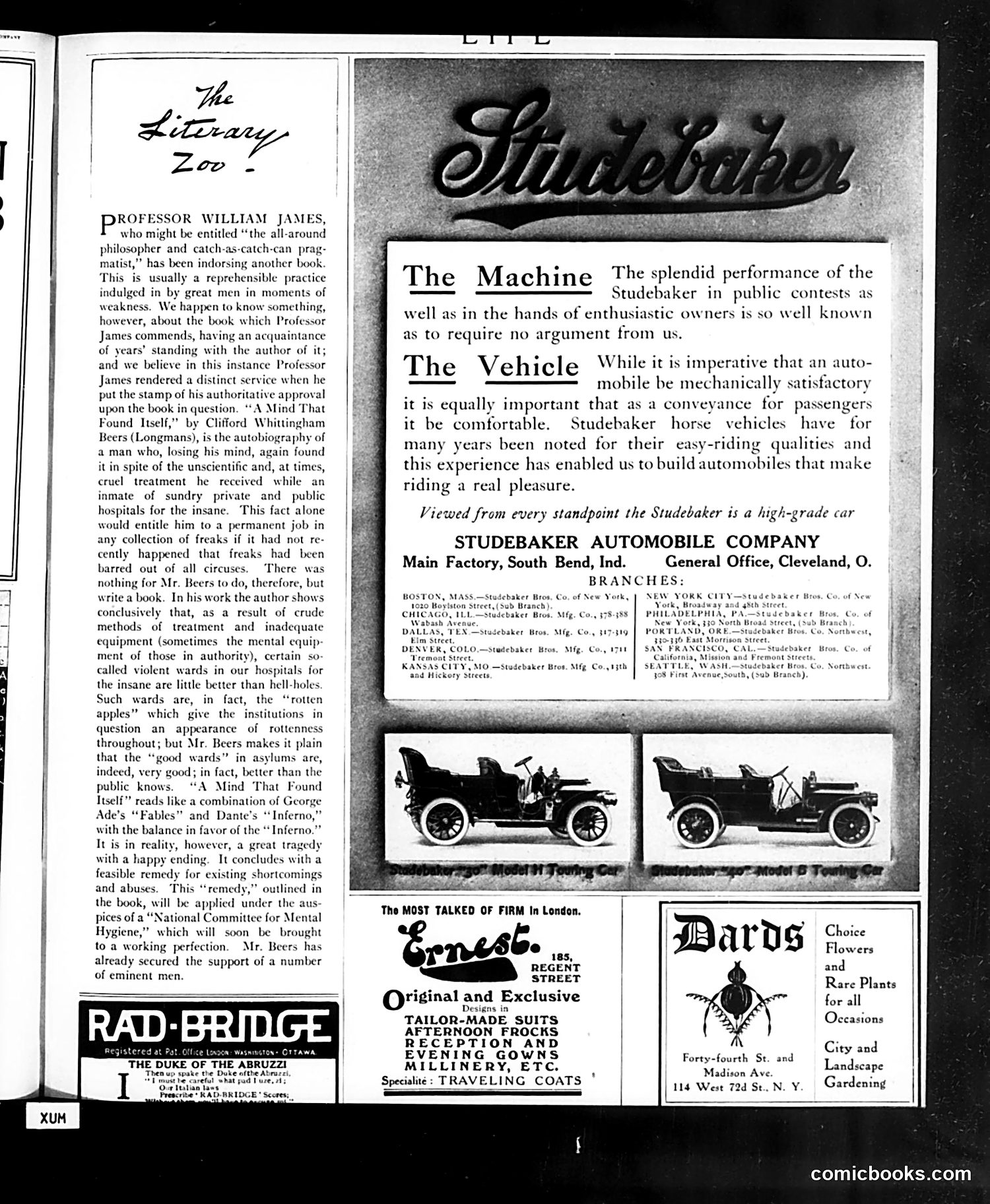
This page is primarily **advertising rather than satire or political commentary**. The main content features a Studebaker automobile advertisement prominently displayed, emphasizing the vehicle's performance and comfort qualities. Two automobile images are shown to showcase the product. The left column contains a brief literary review by "The Literary Zoo" discussing Professor William James's endorsement of Clifford Whitingham Beers's book "A Mind That Found Itself," which concerns mental health treatment and asylum conditions. This is genuine editorial content, not satire. Additional advertisements appear for RAD-BRIDGE (tailored suits), Ernest (a London tailor), and Dards (florist/gardening services). The page reflects early 20th-century magazine layout combining editorial commentary with commercial advertising.
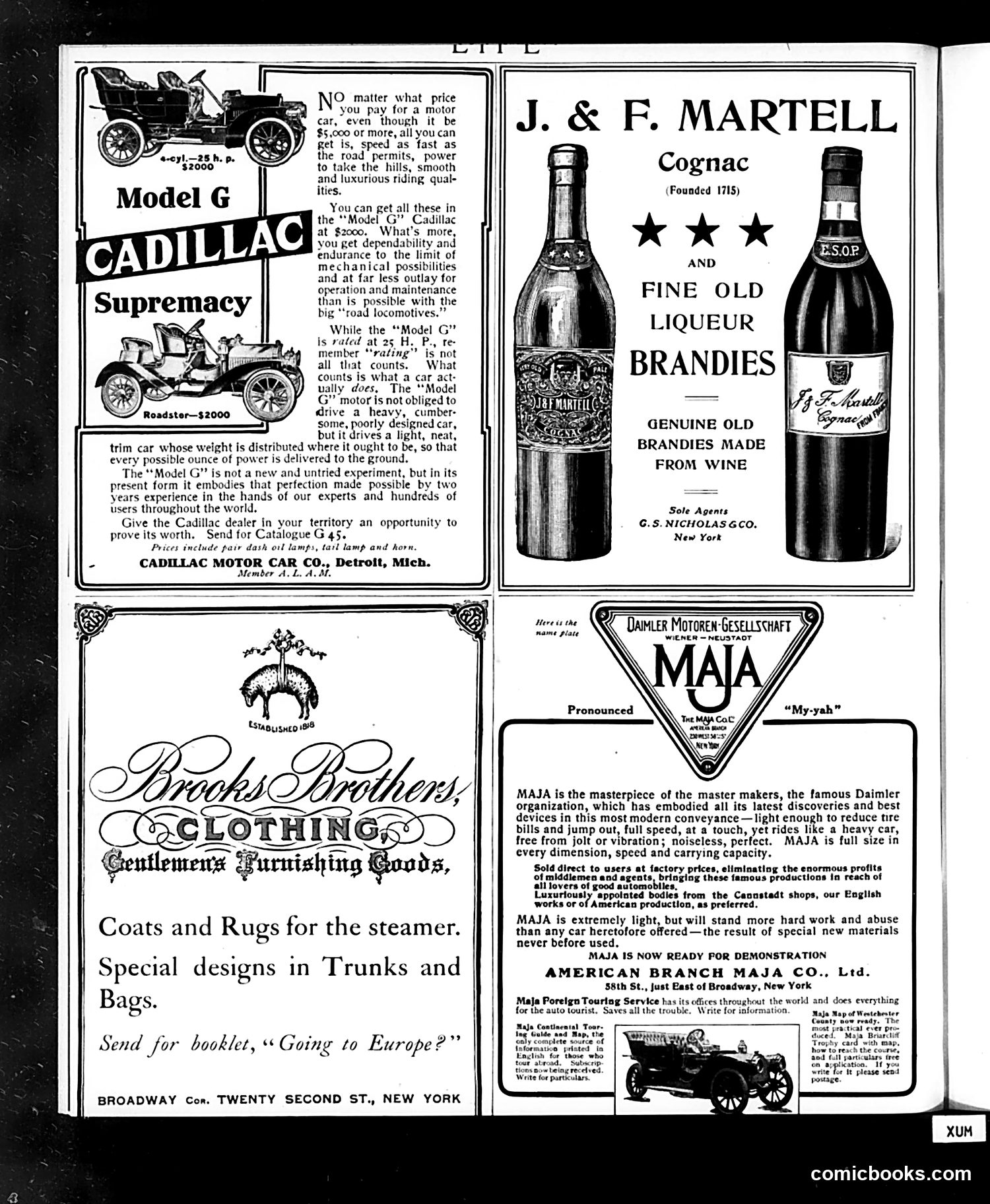
This page contains **no political cartoons or satire**—it's entirely **advertisements** from the early 1900s. The ads include: - **Cadillac automobiles** (Model G "Supremacy"), emphasizing speed, power, and mechanical reliability - **J. & F. Martell Cognac** brandy, established 1715 - **Brooks Brothers** clothing for steamship travel ("Going to Europe") - **Maia automobiles** by Daimler (German), touting modern engineering and reduced vibration These ads reflect the era's consumer aspirations: luxury automobiles as status symbols, imported spirits as sophistication, and quality clothing for international travel. The technical language emphasizes mechanical innovation—then a major selling point for automobiles and a marker of wealth and modernity.
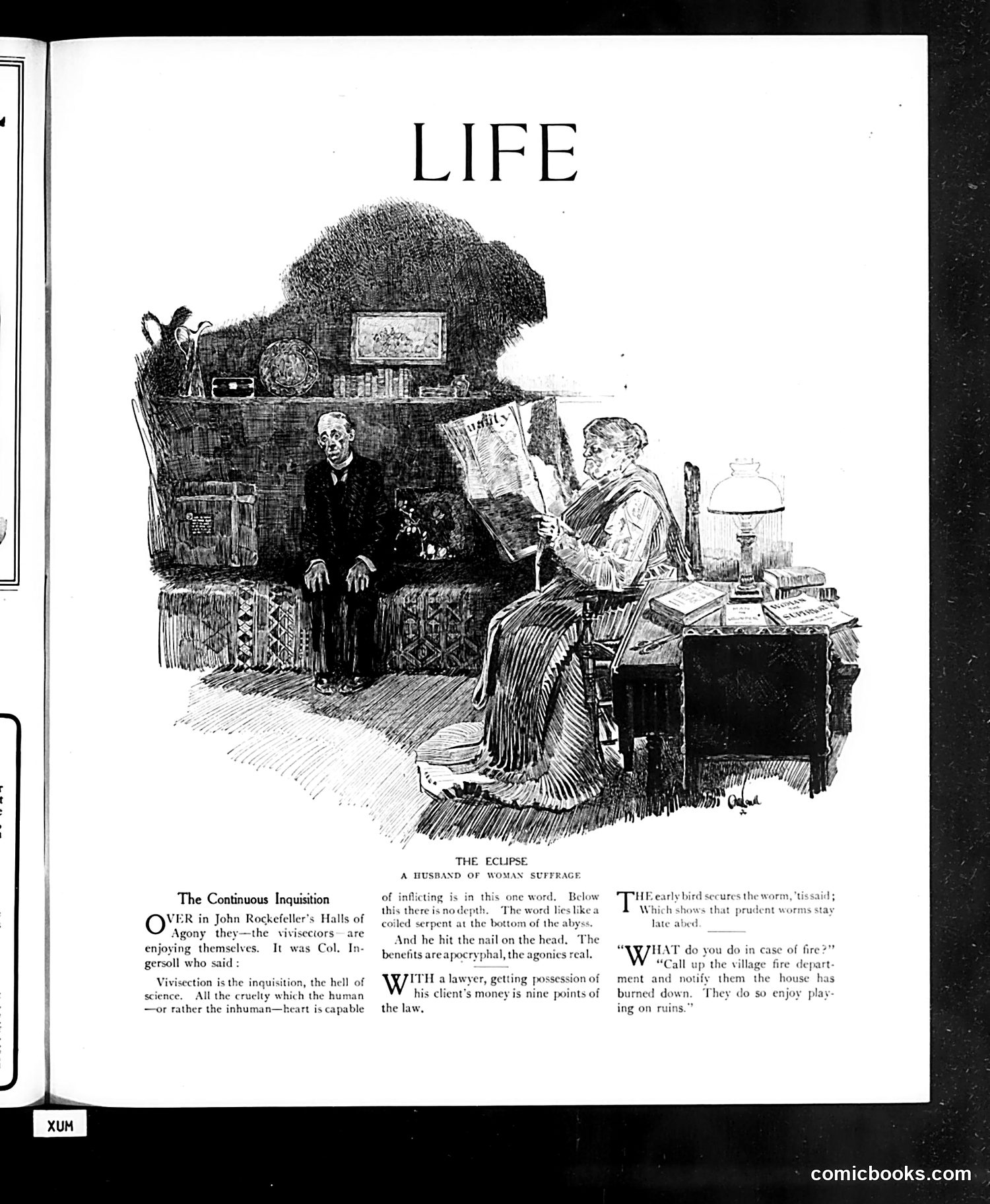
This page from *Life* magazine satirizes early 20th-century social anxieties. The main cartoon, "The Eclipse: A Husband of Woman Suffrage," depicts a man being eclipsed—literally shadowed—by a woman's growing power and visibility. The woman reads a newspaper while the man sits diminished beside her, illustrating contemporary fears that women's suffrage would undermine male authority in the home. The accompanying text snippets mock both vivisection (animal testing in science) and lawyers' financial greed, suggesting these were interconnected social concerns. The satire reflects the period's resistance to women's political empowerment, presenting suffrage as an "eclipse" of traditional male dominance rather than democratic progress.
This page discusses alcohol consumption in America, a major social and political issue during the Progressive Era. The text debates whether drinking intoxicants is inherently sinful or merely dangerous when excessive. The article argues that **some people can drink moderately without harm** (citing George Washington and Abraham Lincoln as examples), while acknowledging that **many people cannot safely consume alcohol**. It critiques both absolute prohibition advocates and those dismissing alcohol's dangers. The piece advocates for **education and individual discretion** rather than total prohibition—a nuanced position in the pre-Prohibition debate. It warns against government overreach while acknowledging legitimate public health concerns about alcohol's documented harms. The decorative initial letters and small illustrations are typical period magazine design elements without specific satirical content.
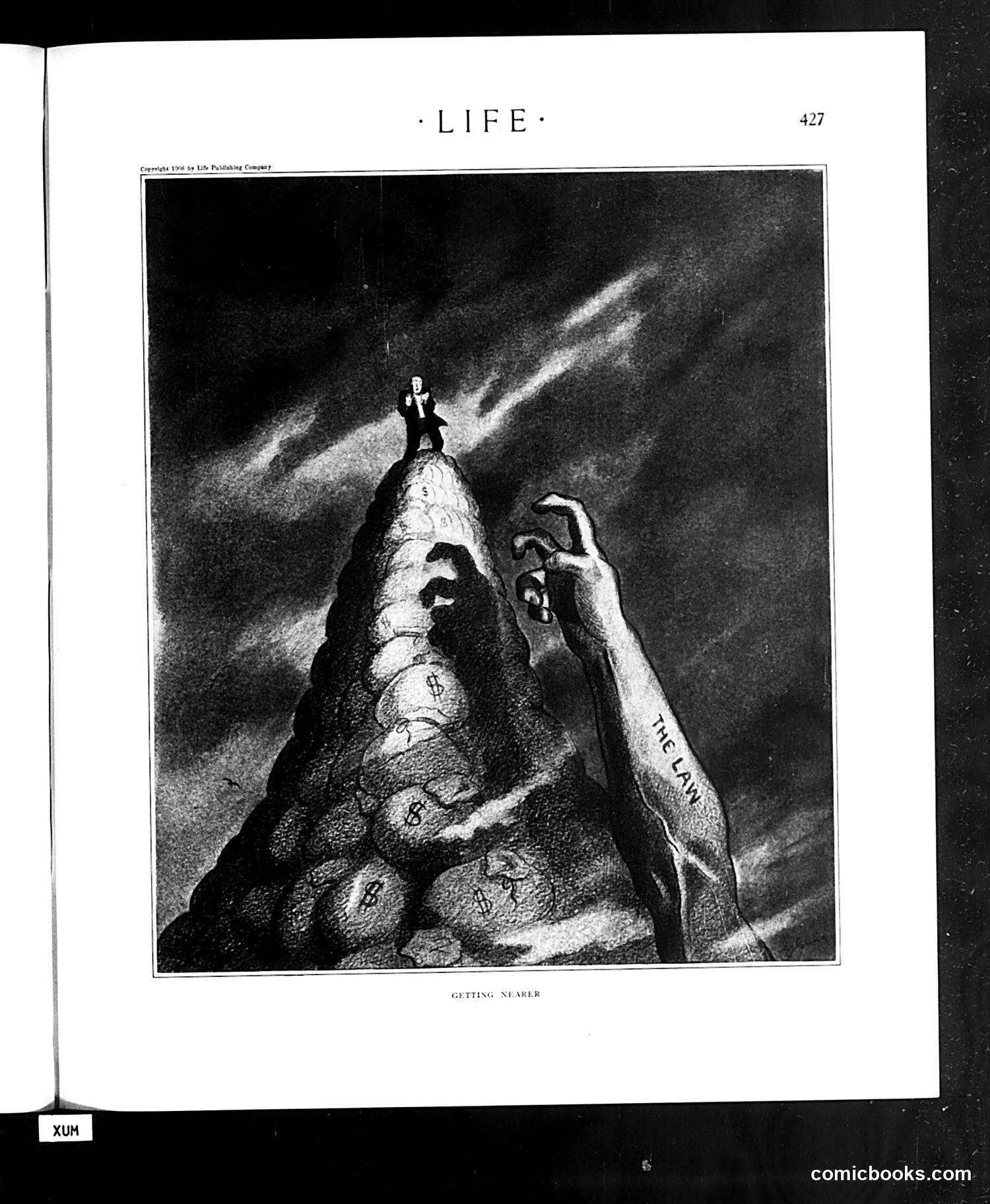
This political cartoon depicts a large figure (appearing to represent a wealthy industrialist or capitalist) being climbed by smaller figures with "THE LAMP" marked on one arm. A tiny figure stands atop the giant's head holding what appears to be a light source, with dramatic rays of light breaking through dark clouds above. The title "Getting Nearer" suggests progressive movement toward illumination or enlightenment. The satire likely comments on labor activism, socialism, or reform movements of the early 20th century—depicting workers ("the lamp" of knowledge or revolution) gradually ascending the structure of capitalist power, getting closer to reaching the top and changing the system. The imagery suggests inevitability and mounting pressure from below.
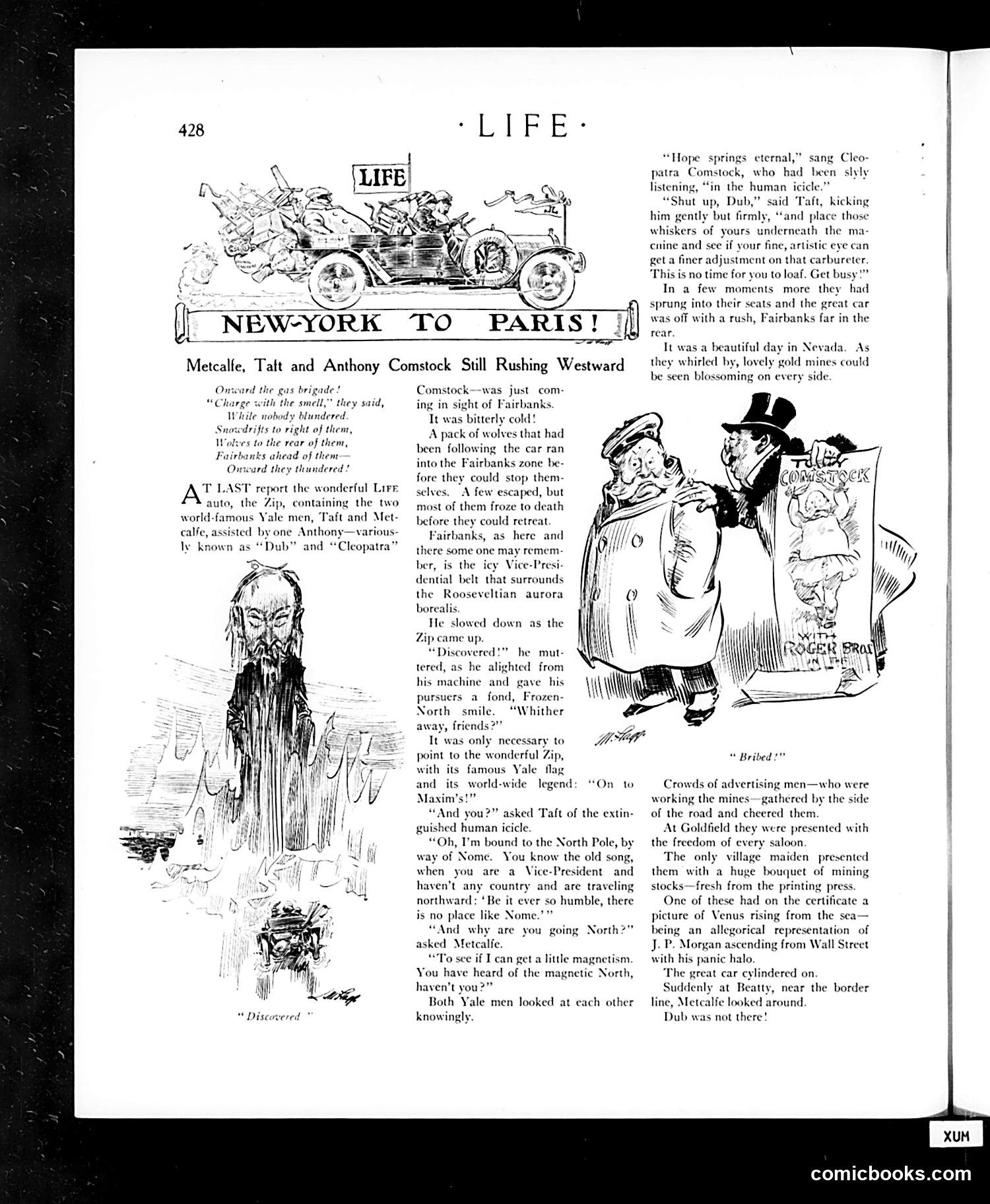
This page satirizes a fictional race from New York to Paris by automobile, featuring characters named Metcalfe, Taft, and Anthony Comstock. The narrative mocks these figures' competing motivations: Comstock aims for the "North Pole" (likely referencing his moral crusades), while others pursue "magnetism" and commercial opportunity. The cartoons depict exaggerated character types—a bearded "discovered" figure and well-dressed advertising men—satirizing turn-of-the-century America's obsession with automobiles, exploration, and sensationalism. The references to mining stocks and Wall Street suggest mockery of financial speculation and hype. The overall piece appears to be satirical commentary on American ambition, commercialism, and the era's fascination with technological advancement and polar exploration, presented through absurdist humor.
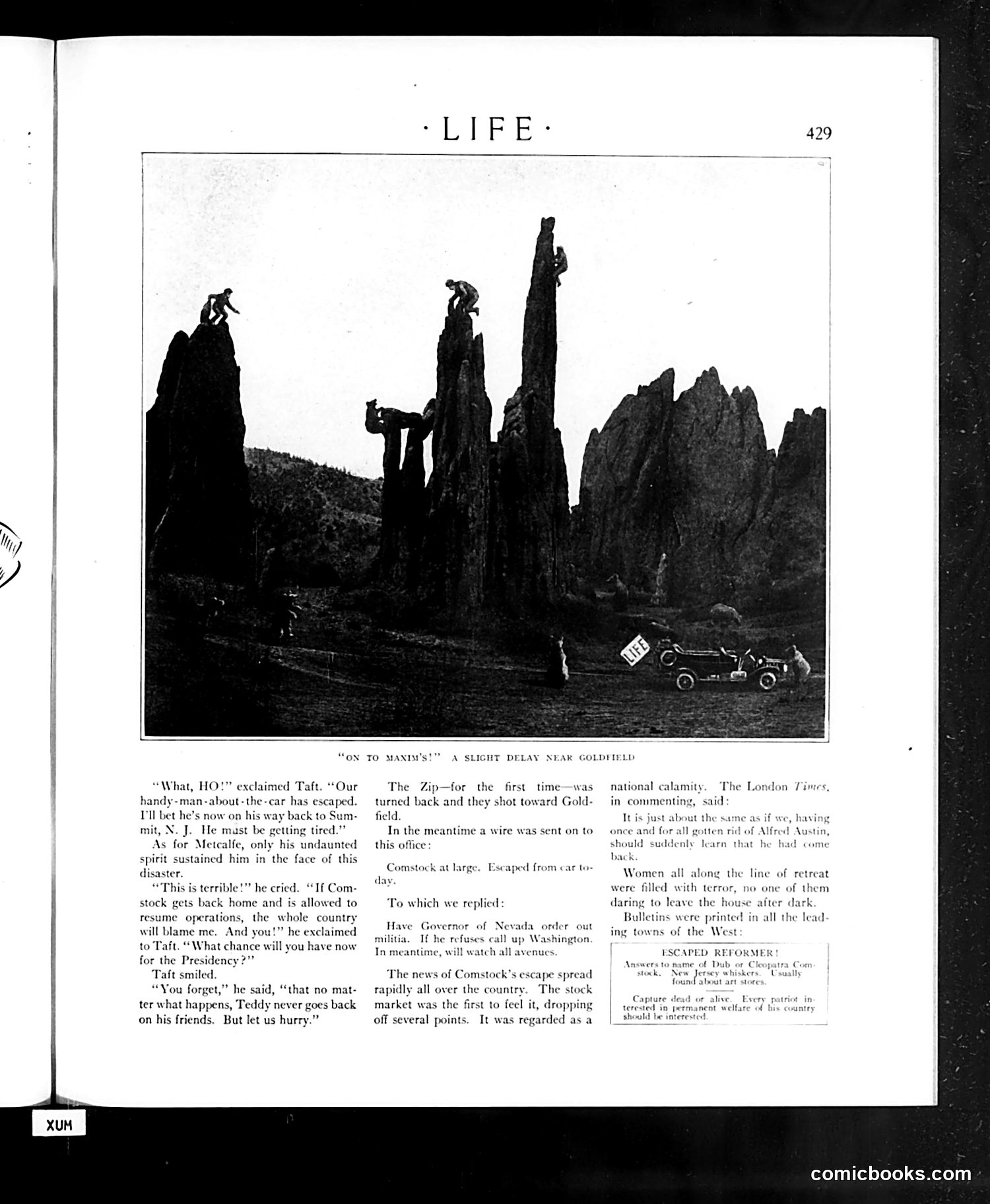
This page depicts an early 20th-century incident involving Comstock, likely a fugitive or escapee from custody. The photograph shows dramatic rock formations with a vehicle, illustrating the text's reference to Comstock's escape "near Goldfield" (Nevada). The satirical dialogue mocks the situation: Taft (presumably President William Howard Taft) and others discuss the escape, with jokes about political responsibility and the chase. The caption "What, ho!" and references to "the Presidency" suggest this played into contemporary debates about executive authority and competence. The phrase "On to Maxim's" (a famous French restaurant) implies absurd juxtaposition—from frontier chaos to civilized luxury—typical of Life magazine's satirical humor mocking both criminal incidents and political figures' responses to them.
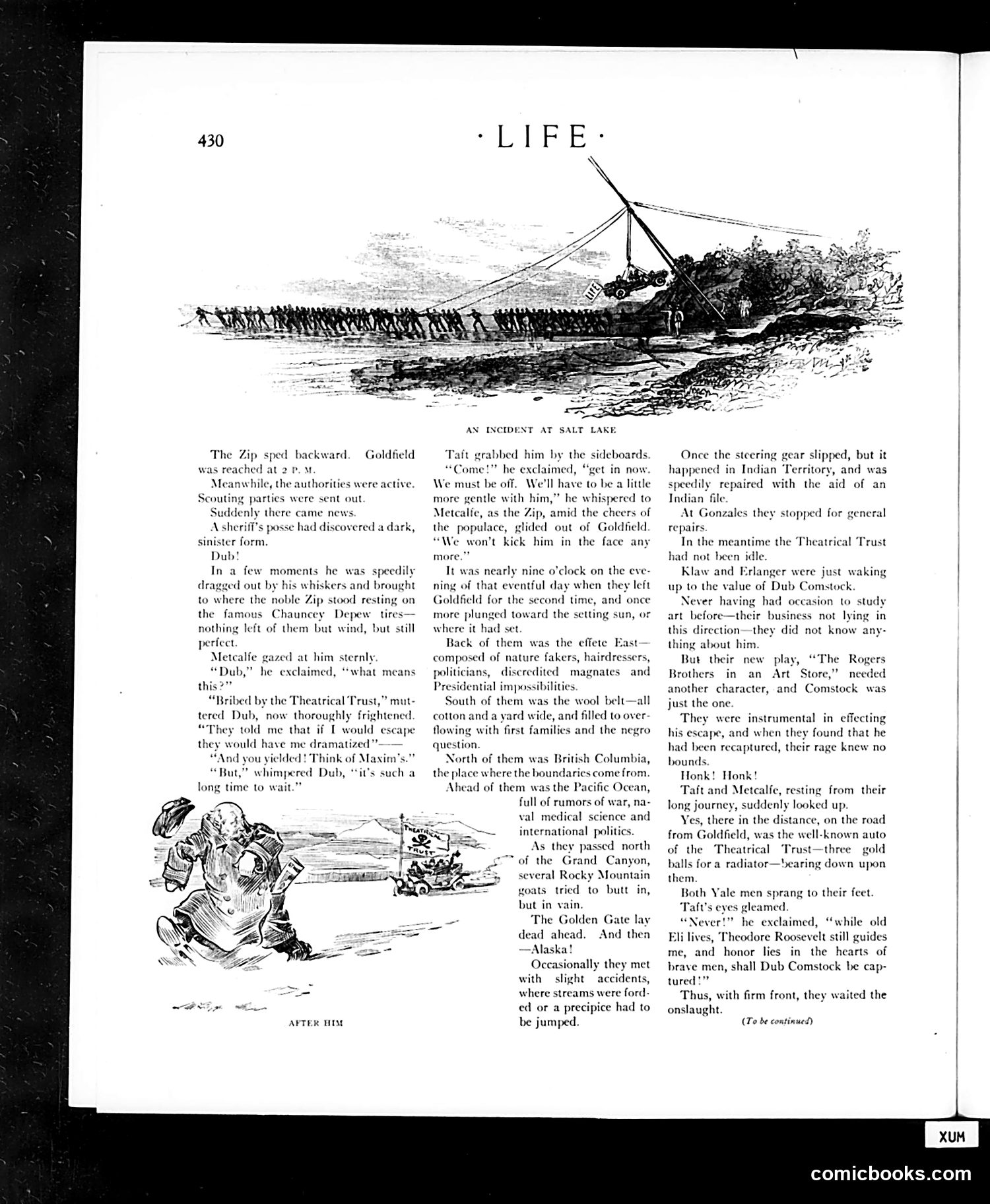
This page contains a serialized adventure story titled "An Incident at Salt Lake" with accompanying illustrations. The narrative follows characters named Dub, Goldfield, Taft, and Metcalfe fleeing in a vehicle called "the Zip." The text references "the Theatrical Trust" as antagonists pursuing the protagonists, and mentions "Dub Comstock" as a character of significance. The story involves escape, chase sequences, and eventual safe arrival at Gonzales. The bottom illustration shows a man reclining, labeled "After Him," suggesting pursuit. **This appears to be fiction entertainment rather than political satire.** Without knowing the original publication date or story context, I cannot identify specific real-world figures being satirized, though the "Theatrical Trust" reference suggests commentary on entertainment industry power structures of the era.
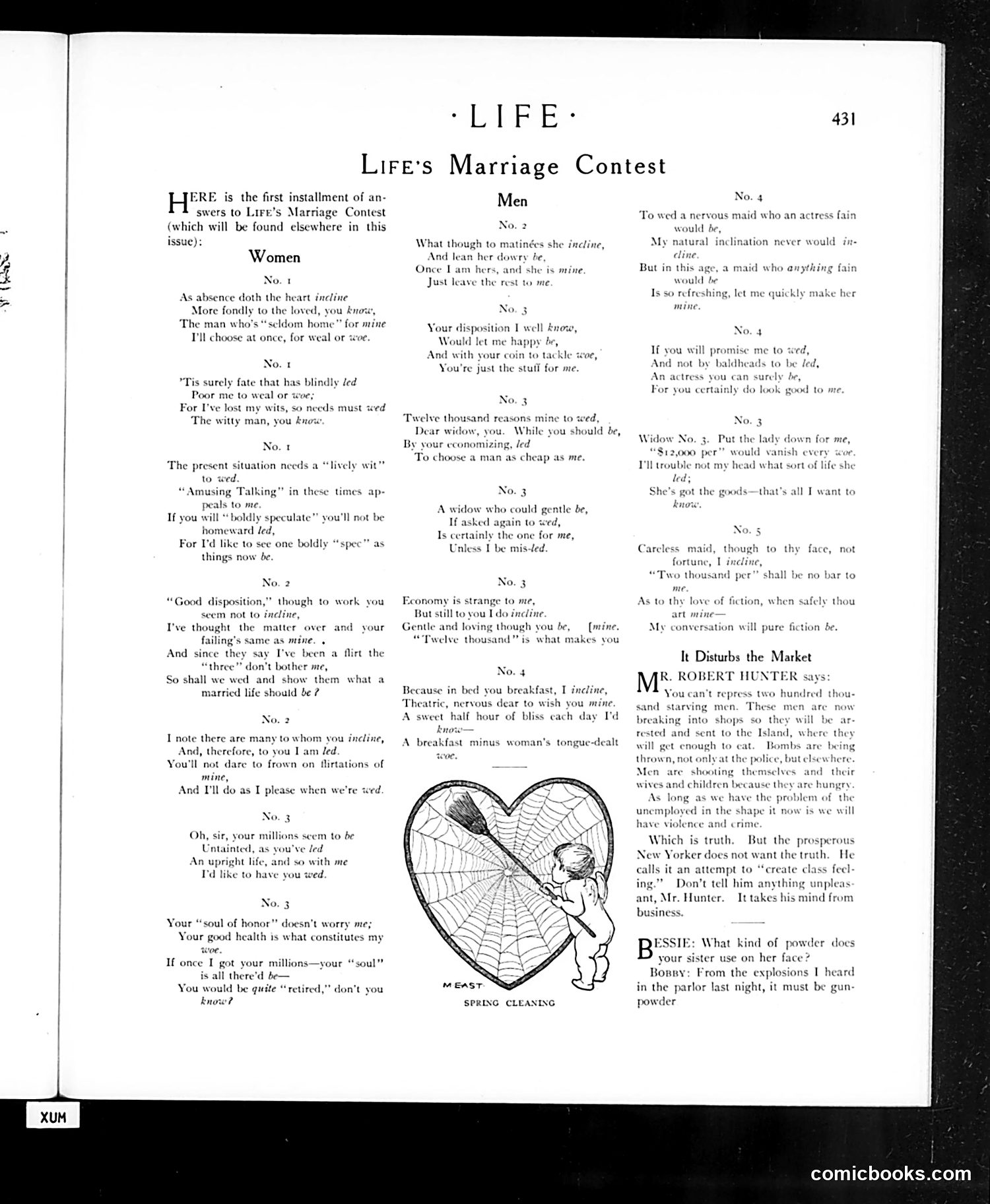
This page presents satirical poetry responses to a marriage advice contest. The left columns feature women's and men's answers to romantic dilemmas—each numbered entry presents increasingly cynical or pragmatic takes on matrimony. Entries reference financial concerns ("two thousand per"), class anxiety, and the tension between romantic ideals and practical realities. The illustration shows Cupid (a baby with bow and arrow) trapped in a spider's web labeled "BEAST / SPRING CLEANING," suggesting marriage as an inescapable trap rather than romantic bliss. Below, a brief comedic dialogue mocks newspaper sensationalism, with "Mr. Robert Hunter" dismissing concerns about unemployed men as manufactured "class feeling" rather than genuine crisis—satire of how media and elites downplay social problems.
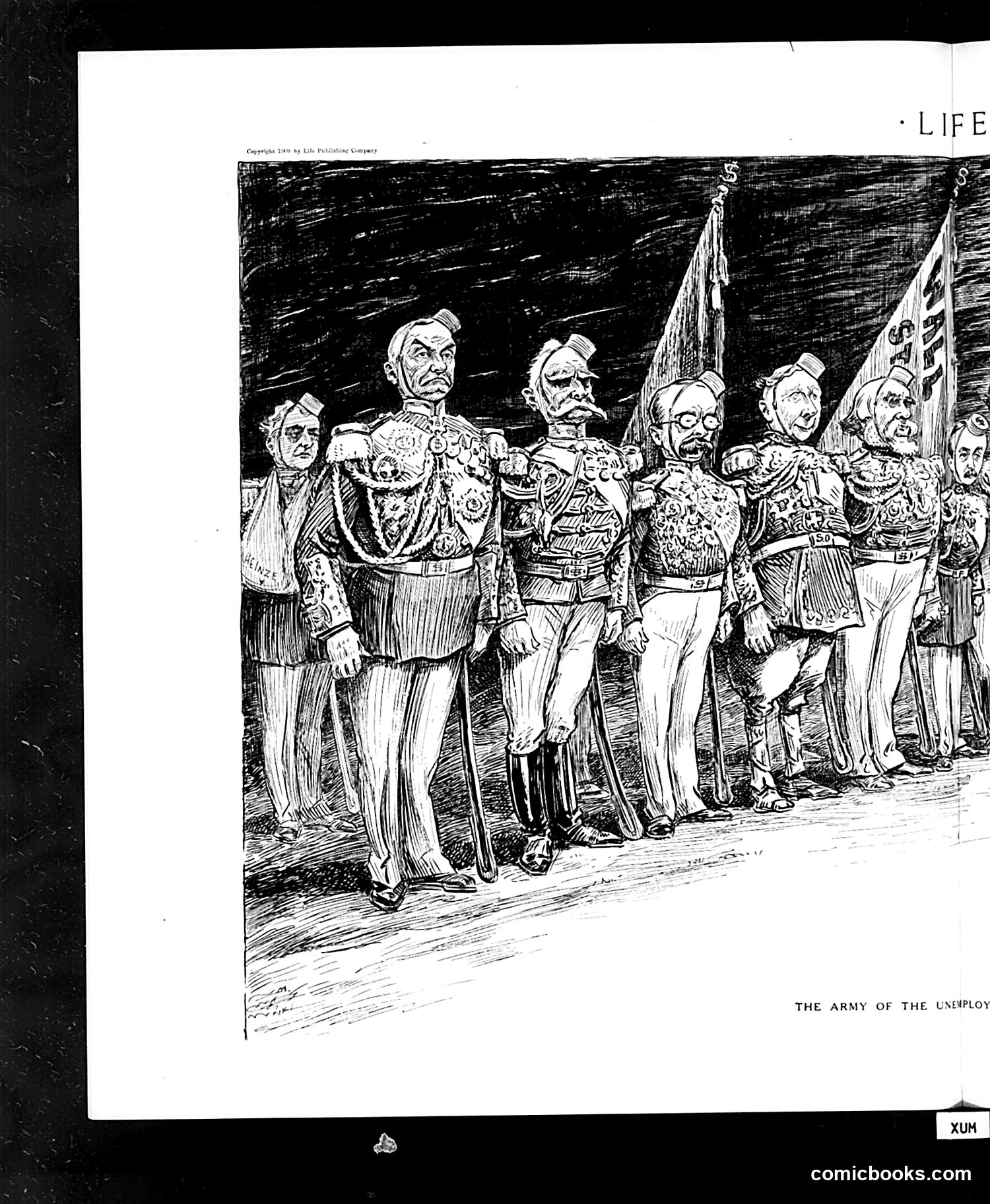
This satirical cartoon depicts military and political figures dressed in ornate uniforms and regalia, standing in formation like soldiers. The caption "The Army of the Unemploy[ed]" suggests bitter social commentary about unemployment. The caricature style exaggerates facial features prominently—a common technique in early 20th-century political satire. The work appears to critique how government or military leadership handled unemployment, possibly suggesting that unemployed citizens were being treated as soldiers or mobilized without genuine assistance or employment. The formal military dress contrasts ironically with the "unemployed" designation, implying these figures either failed to address joblessness or were complicit in creating it. The exact historical context and identification of specific individuals remains unclear without publication date information.
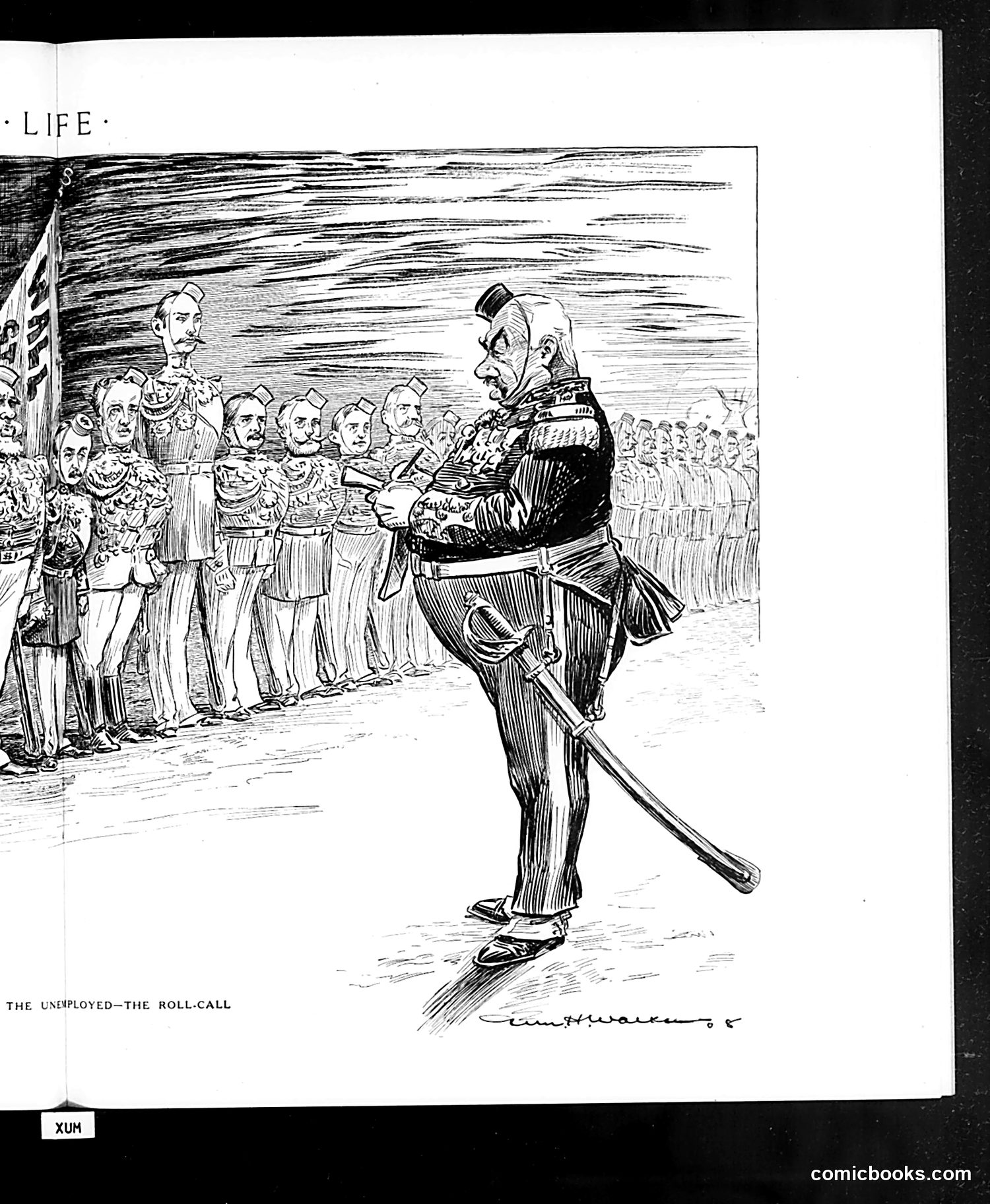
This political cartoon satirizes military leadership during a period of widespread unemployment. A stern, caricatured military officer (exaggerated facial features suggest contempt) conducts a "roll-call" of uniformed soldiers, while masses of civilians crowd behind them. The satire appears to critique how military institutions or government leadership addressed unemployment: rather than solving joblessness through economic policy, the solution was to conscript or militarize the unemployed population. The officer's authoritarian demeanor and the civilians' passive, crowded positioning suggests dark commentary on treating desperate workers as disposable military fodder. The cartoon's title emphasizes the bitter irony—these aren't soldiers by choice but unemployed people converted into military manpower.
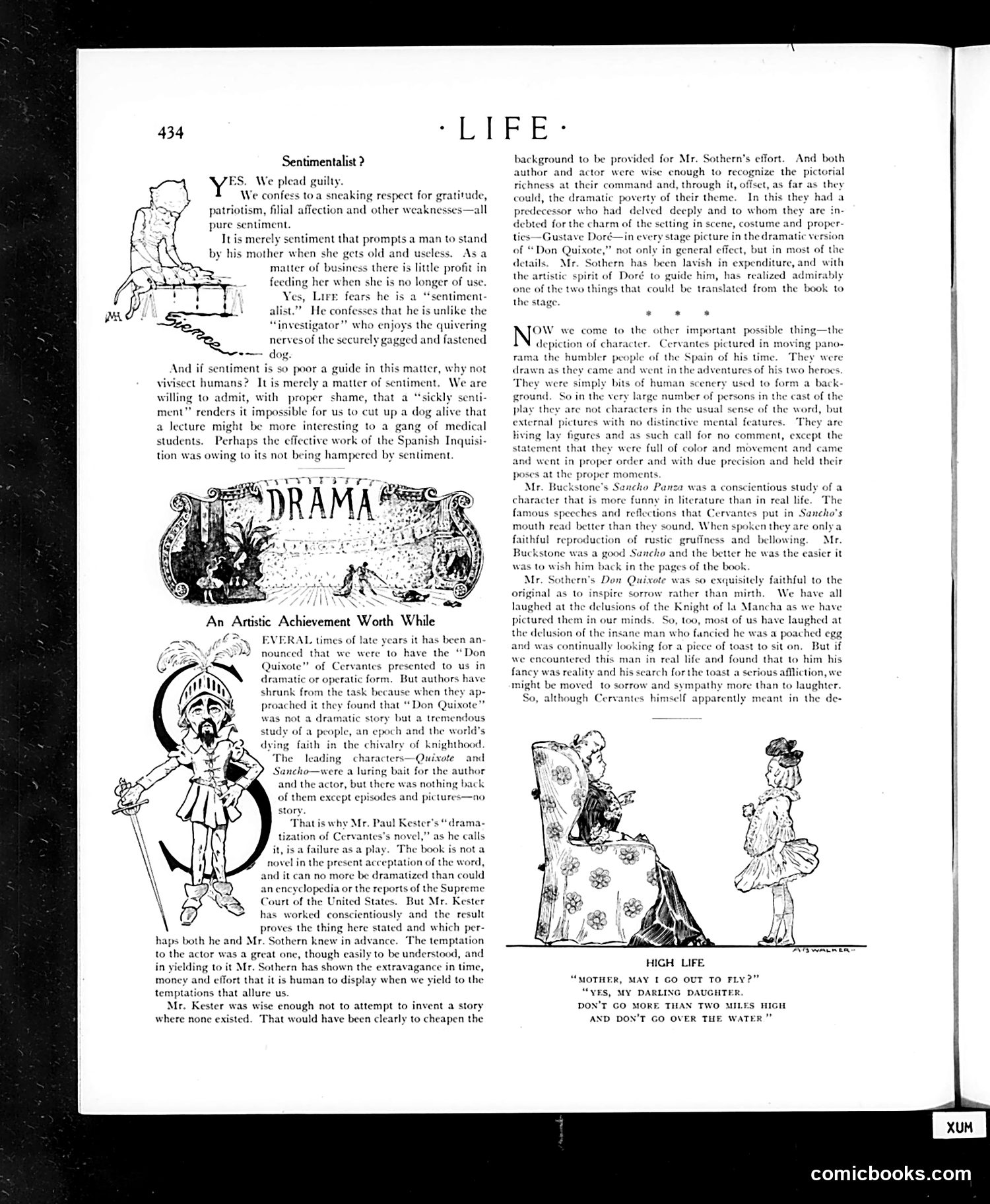
This page defends sentiment and human feeling against cold rationalism, then critiques a theatrical adaptation of Cervantes's *Don Quixote*. The opening section sarcastically attacks those who dismiss sentiment as weakness—arguing that caring for elderly parents or refusing to vivisect dogs reflects moral character, not foolishness. It mocks the "investigator" mentality that abandons ethics for efficiency. The main article addresses Paul Kester's dramatization starring E.H. Sothern (a famous actor of the era, visible in the Don Quixote illustration). Life acknowledges the production's artistic success—particularly its visual design inspired by Gustave Doré's illustrations and elaborate costumes. However, it faults the adaptation for failing to capture *character*. The critic notes that Cervantes's novel depicts humble Spanish people as living, complex individuals, while the stage version reduces them to "living lay figures"—mere decorative extras without psychological depth. The core problem: a novel about human complexity cannot become a dramatically coherent play.
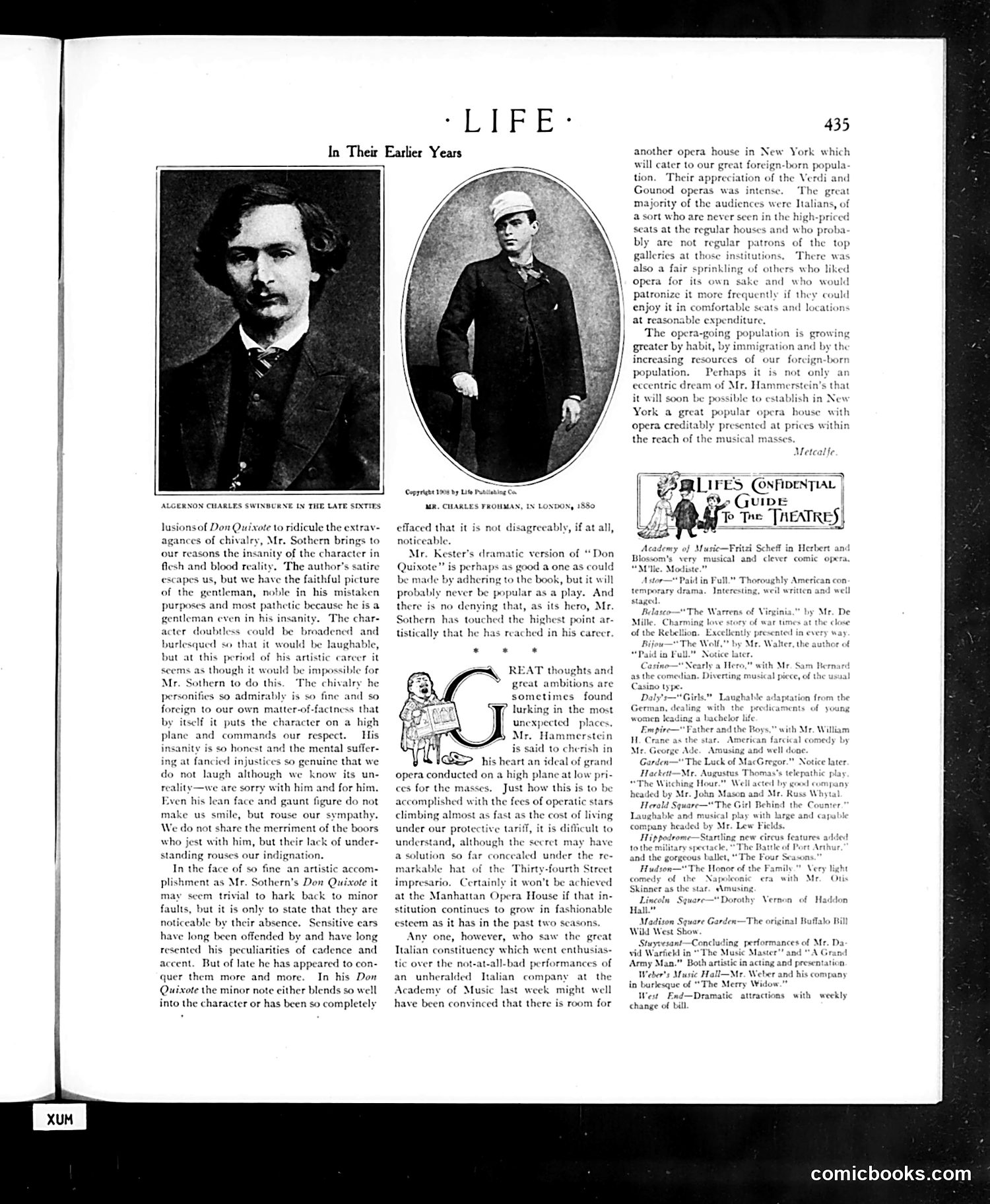
This page features two separate profiles from Life's "In Their Earlier Years" section: **Algernon Charles Swinburne (left photo):** The text discusses actor E.H. Sothern's acclaimed performance in a dramatic adaptation of *Don Quixote*. The review praises Sothern for bringing nobility and pathos to the character rather than broad burlesque comedy. The critic notes Sothern has overcome earlier peculiarities of cadence and accent that previously distracted audiences. **Charles Frohman (right photo, dated London 1880):** The text shifts to discussing impresario Oscar Hammerstein's ambition to establish an affordable grand opera house in New York. The writer observes that Italian immigrant audiences at recent performances showed genuine enthusiasm for opera, suggesting an underserved market exists among working-class foreign-born New Yorkers who cannot afford regular opera house tickets. Both pieces celebrate artistic ambition—Sothern's refined performance and Hammerstein's democratic vision of making opera accessible to immigrant populations rather than only wealthy elites.
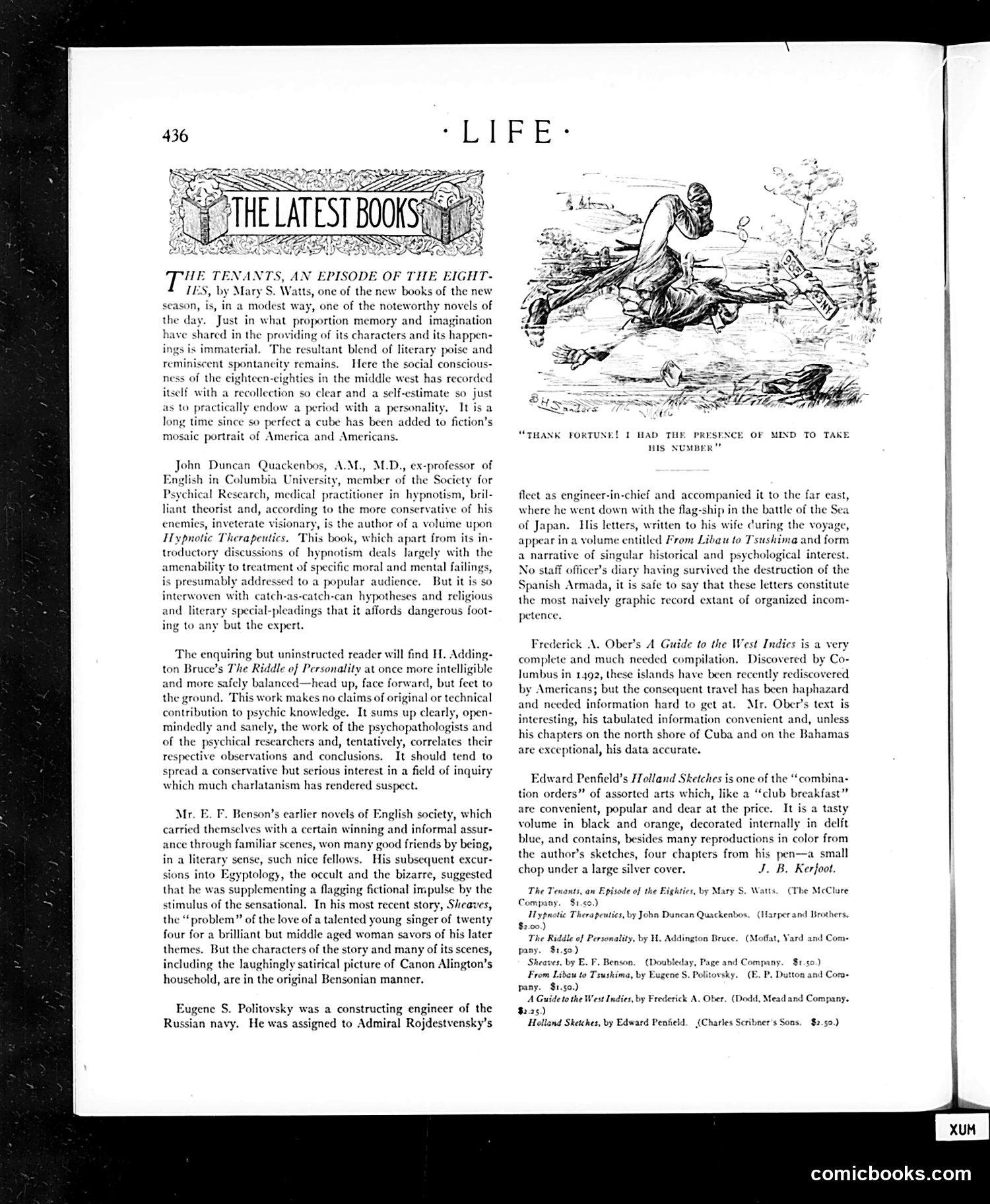
This page from *Life* magazine is primarily a book review section titled "The Latest Books," not a political cartoon. The single illustration shows a figure reclining outdoors with the caption "Thank Fortune! I had the presence of mind to take his number"—a humorous visual gag about obtaining someone's identifying information, likely illustrating a scene from one of the reviewed novels. The reviews themselves discuss newly published works by Mary S. Watts, John Duncan Quackenbos, H. Addington Bruce, E. F. Benson, Eugene S. Politovsky, and Frederick A. Ober. The tone is witty and sometimes sharply critical—for instance, the review of Quackenbos's *Hypnotic Therapeutics* warns it's "interwoven with catch-as-catch-can hypotheses" and "affords dangerous footing to any but the expert." This demonstrates *Life*'s role as a literary tastemaker offering educated commentary on contemporary publishing.
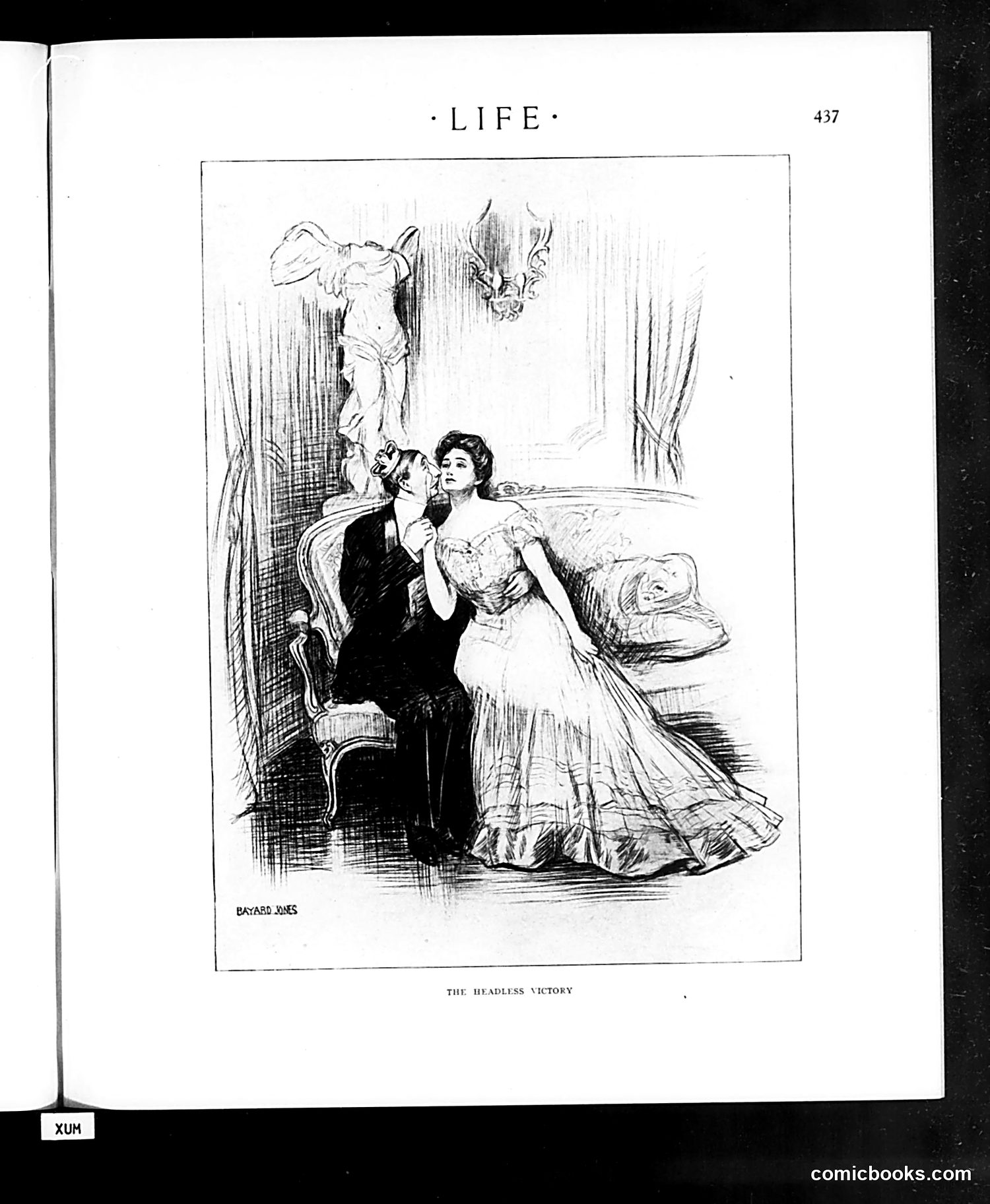
This cartoon by Bayard Jones depicts a man in formal attire and a woman in an elegant gown admiring a classical statue of Victory—notably depicted without a head. The couple gazes upward at this incomplete monument with apparent satisfaction or admiration. The satire likely critiques a contemporary victory or achievement that is somehow flawed, incomplete, or pyrrhic (hollow despite appearing successful). By showing them celebrating a "headless" Victory—missing reason, direction, or wisdom—Jones suggests they're praising something fundamentally compromised or foolish. Without additional historical context, the specific political or social reference remains unclear, but the cartoon mocks celebrating triumphs that lack substance or proper judgment.
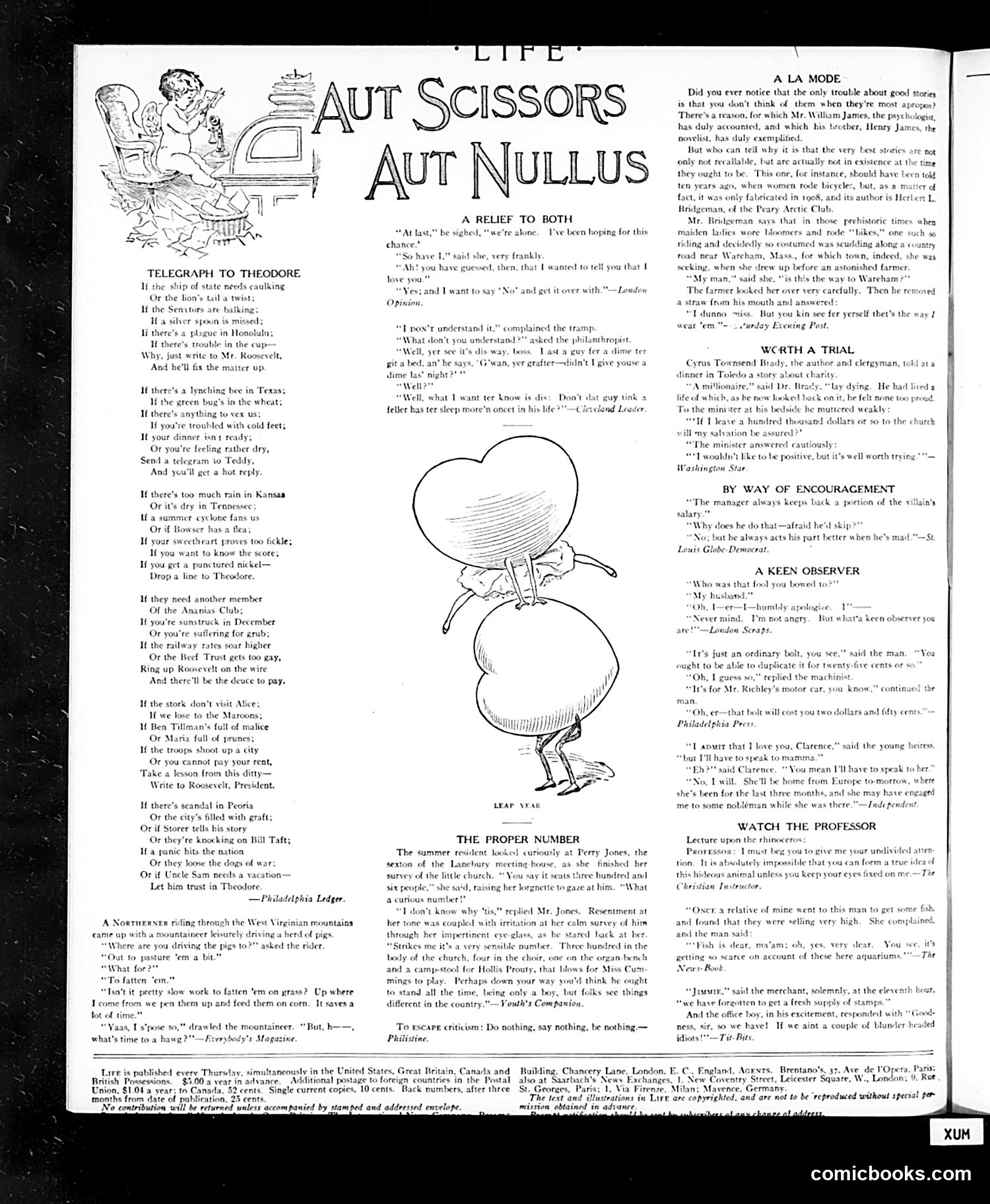
This page satirizes President Theodore Roosevelt's perceived willingness to intervene in virtually any national problem. The main poem "Telegraph to Theodore" lists absurd scenarios—from lynchings in Texas to punctured bicycle tires—suggesting Americans should simply wire Roosevelt for solutions to any crisis, major or minor. The satire mocks Roosevelt's expansive executive activism and his public prominence during his presidency. By treating trivial domestic inconveniences (cold feet, dinner not ready) alongside serious national issues (railway rates, the Beef Trust), the cartoonist suggests Roosevelt's tendency toward overreach and his celebrity status made him seem like a solution to everything. The accompanying humorous short stories ("Aut Scissors, Aut Nullus") provide lighter satirical relief typical of Life's format. The overall message: Roosevelt had become so dominant a political figure that Americans jokingly treated him as a catch-all answer to every problem, reflecting both his popularity and concerns about executive overreach.
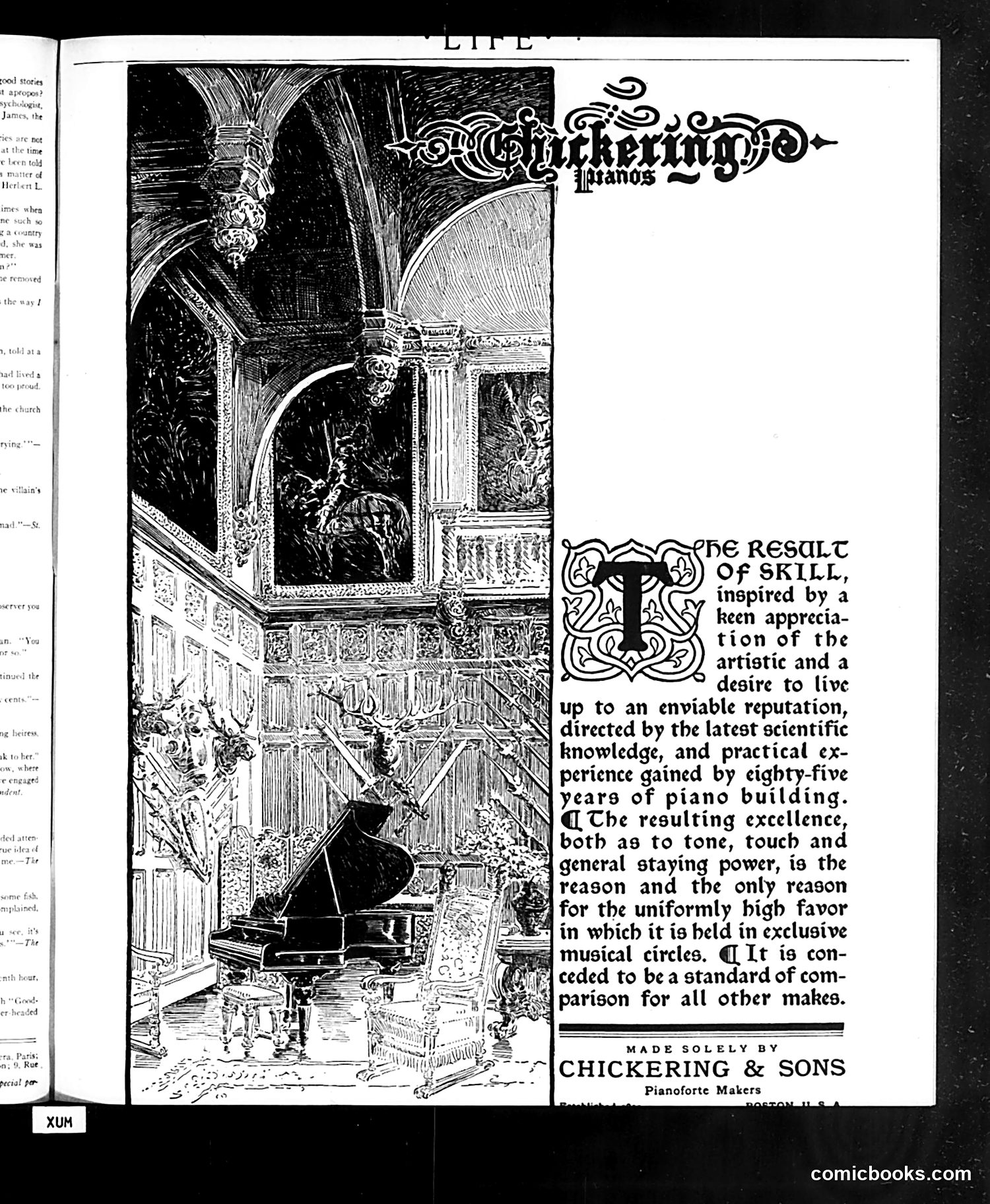
This is **not a cartoon or satire**—it's a **full-page advertisement** for Chickering & Sons pianos, a real American piano manufacturer. The image shows an ornate, luxurious concert hall or music room with a grand piano, rendered in detailed black-and-white illustration. The decorative architectural setting (columns, arches, ornamental details) and the elegant piano emphasize wealth and refined taste. The accompanying text is straightforward advertising copy claiming the pianos result from "eighty-five years of piano building," possess superior tone and durability, and are favored by "exclusive musical circles." It positions Chickering & Sons as the standard by which other piano makers are judged. This represents typical early-20th-century *Life* magazine content: alongside satirical commentary, the publication carried premium advertisements targeting affluent readers interested in luxury goods and cultural refinement.
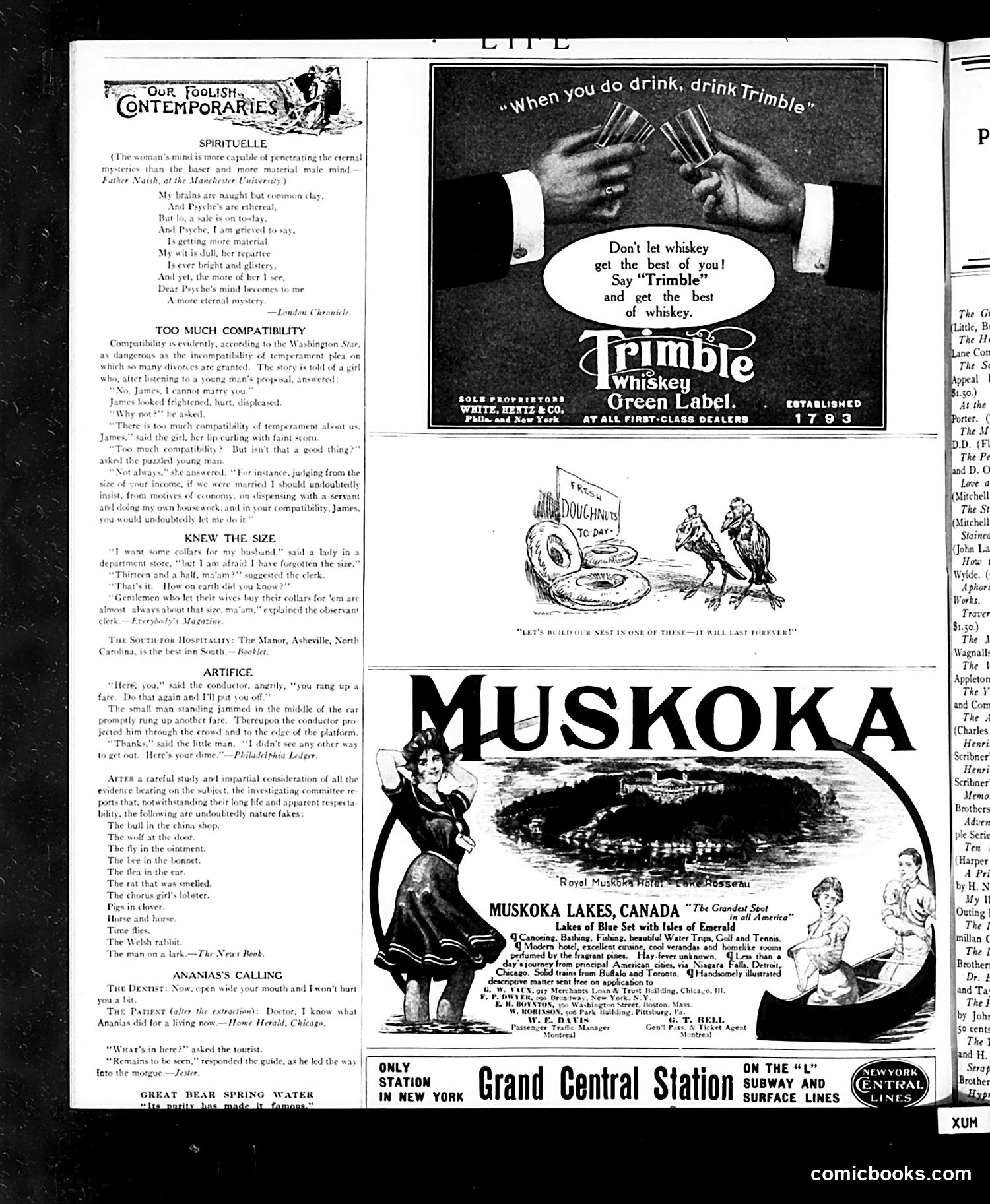
This page is primarily **advertising**, with several distinct advertisements and short humorous pieces. The main content includes: 1. **Trimble Whiskey ad** (top right): A pitch claiming the brand prevents whiskey from "getting the best of you"—ironic given whiskey's known intoxicating effects. The appeal to moderation was typical of pre-Prohibition alcohol advertising. 2. **Muskoka Lakes travel ad** (center-bottom): Promotes Canadian resort destinations as a tourist destination, emphasizing natural beauty and escape from urban life. 3. **Grand Central Station ad** (bottom): NYC transportation advertisement. 4. **Short humor pieces** (left side): Including "Spirituelle" (a poem about women's minds), "Too Much Compatibility" (marriage compatibility satire), "Knew the Size" (shopping anecdote), "Artifice" (conductor story), and "Ananias's Call" (dentist joke). These pieces employ wordplay and situational humor typical of early 20th-century American magazines. The page reflects contemporary concerns about marriage, gender roles, and urban life.
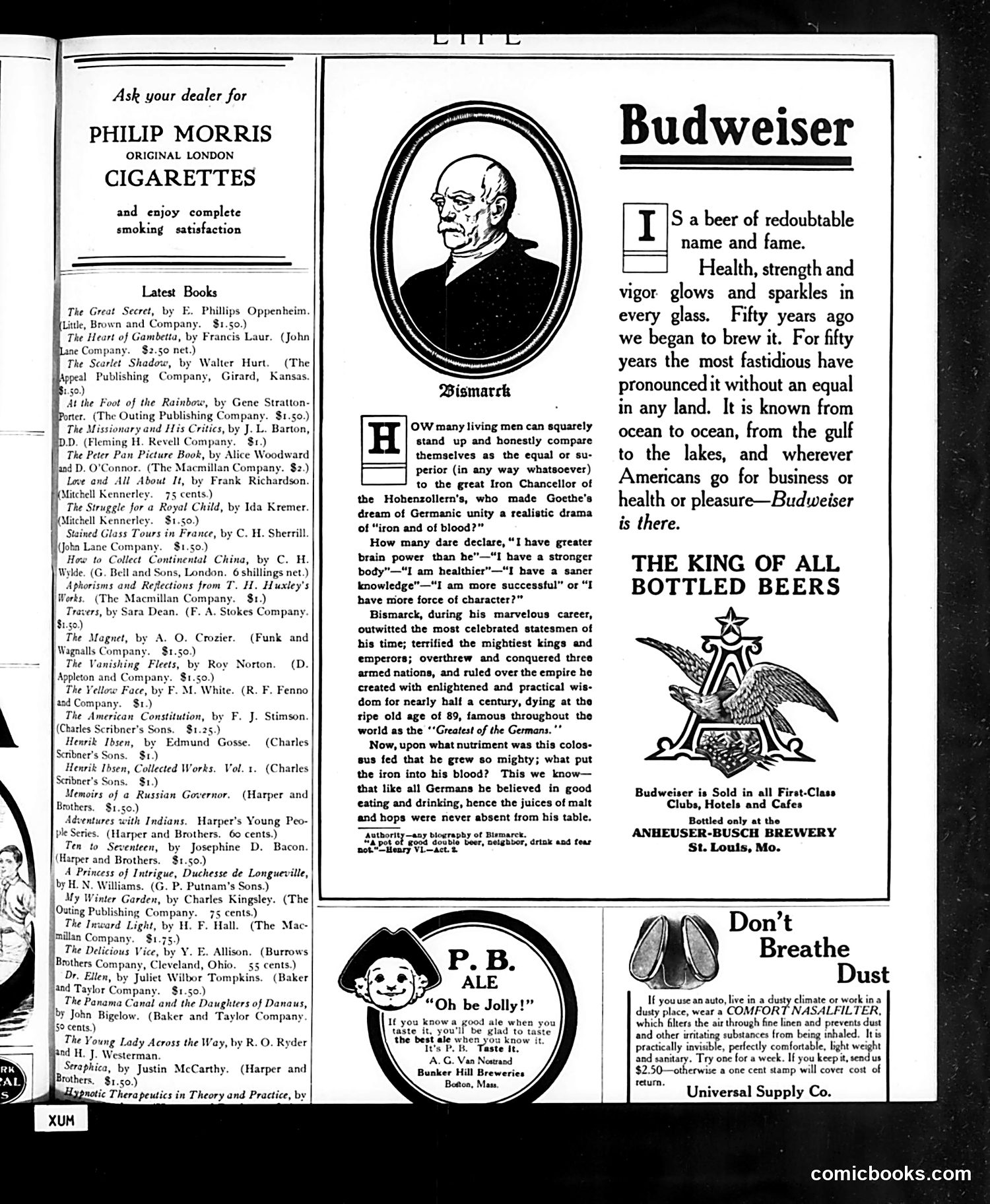
This page is primarily **advertising**, not editorial content or satire. It features: **Main Advertisement:** A Budweiser beer ad using **Otto von Bismarck**, the 19th-century Prussian statesman, as its centerpiece. The ad argues that Bismarck's power and longevity (he lived to 89) derived from consuming German beer and malt beverages. The copy explicitly states that "like all Germans he believed in good eating and drinking, hence the juices of malt and hops were never absent from his table." **The Appeal:** This leverages Bismarck's reputation as history's greatest German leader ("Greatest of the Germans") to suggest beer consumption equals strength, health, and success. It's nationalistic marketing exploiting German pride. **Secondary Ads:** Include Philip Morris cigarettes and P.B. Ale, plus a "Comfort Nasal Filter" for dust protection. The page reflects early 20th-century advertising practices: making grand historical/nationalistic claims to sell consumer products with minimal scientific basis.
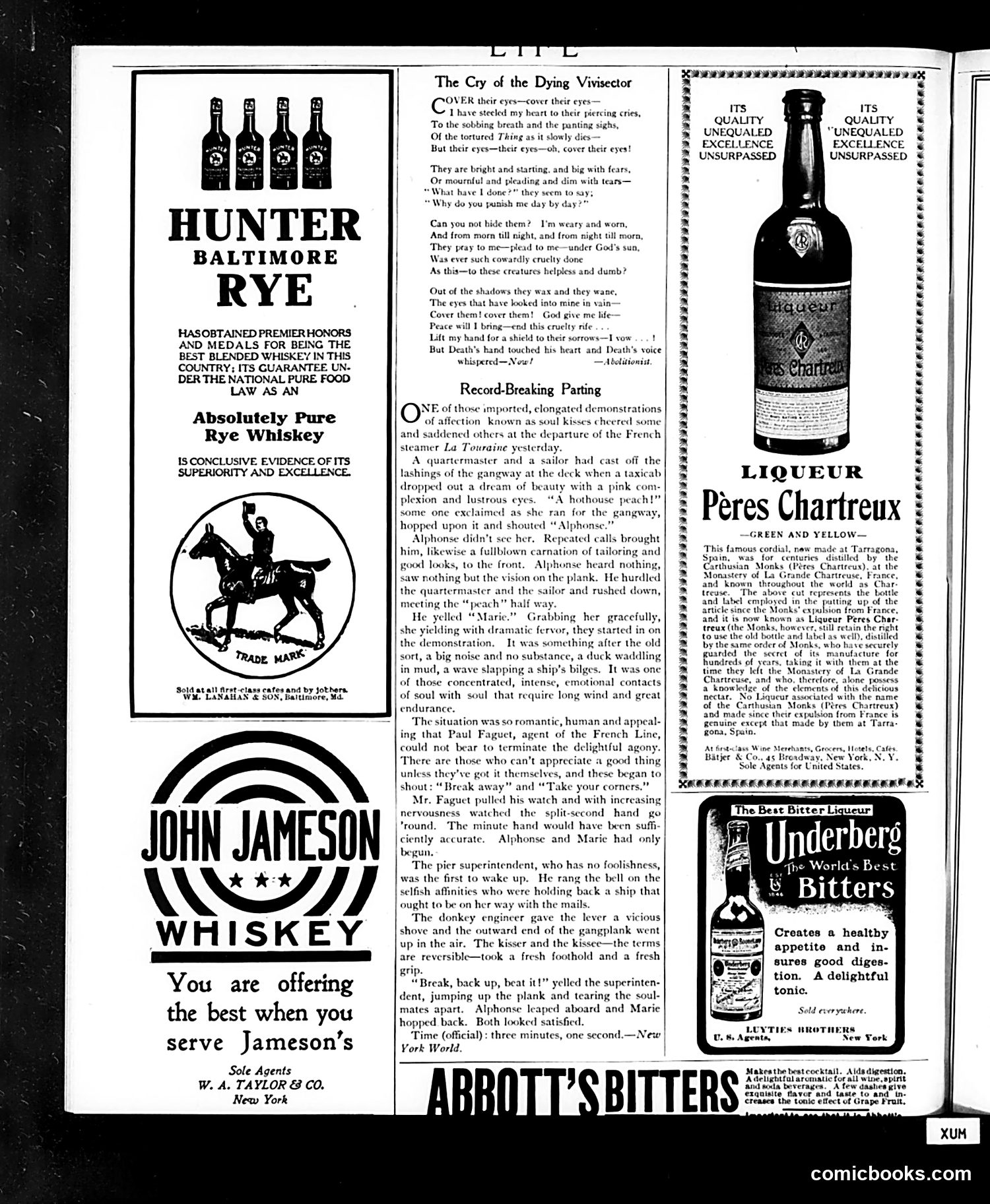
This page is primarily **advertising**, not political satire. It contains four liquor advertisements (Hunter Baltimore Rye, John Jameson Whiskey, Pères Chartreux Liqueur, and Underberg Bitters) surrounding editorial content. The notable non-advertising piece is **"The Cry of the Dying Vivisector,"** a poem criticizing animal experimentation. The vivisector (scientist performing live animal testing) is haunted by the eyes of tortured creatures, ultimately dying with guilt. This reflects early-20th-century animal welfare activism and anti-vivisection sentiment—a genuine social movement of the era opposing medical testing on living animals. The other editorial feature, **"Record-Breaking Parting,"** is a humorous anecdote about an extended goodbye kiss between departing French steamer passengers, playing on contemporary fascination with romantic drama and the famous "soul kiss" fad. The page reflects Life magazine's mix of social commentary, humor, and commercial content typical of the era.
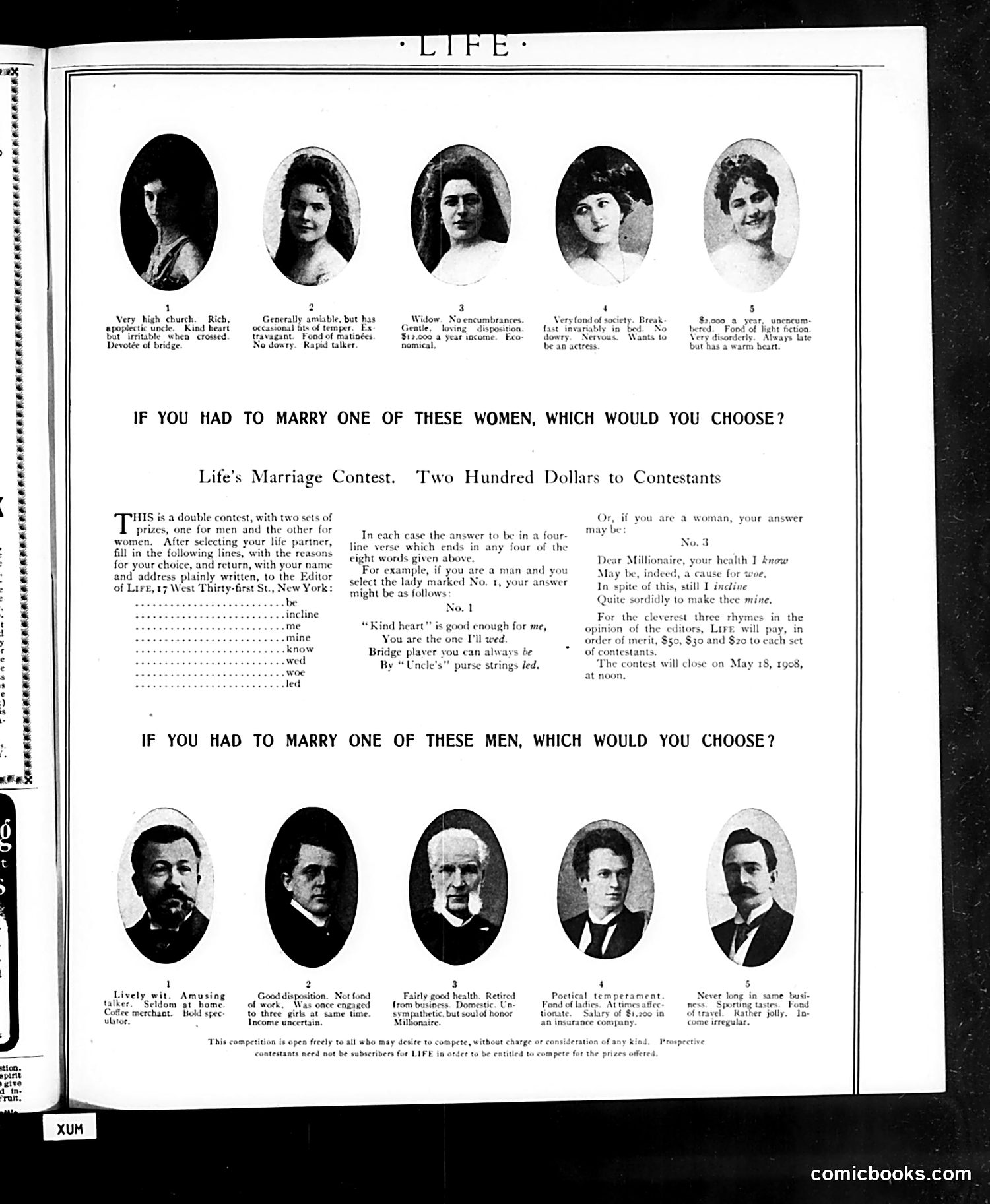
This is a participatory satire on matrimonial matchmaking. Readers select which woman or man they'd hypothetically marry, then submit rhyming verses explaining their choice, competing for $200 prize money. The humor lies in the brutally frank character descriptions that reduce people to marriageability metrics: women are catalogued by wealth, temperament, and domestic utility (one is a "devotée of bridge," another "always late but has a warm heart"). Men are similarly reduced to occupational status and financial worth (a coffee merchant, a millionaire, an insurance company man). The satire targets both the superficiality of marriage markets and the materialistic calculations underlying courtship in the period. By inviting public judgment on these caricatures—and soliciting witty justifications—Life mocks how potential spouses were evaluated as commodities rather than as full human beings. The contest treats marriage selection as a lighthearted game while simultaneously exposing its transactional nature.
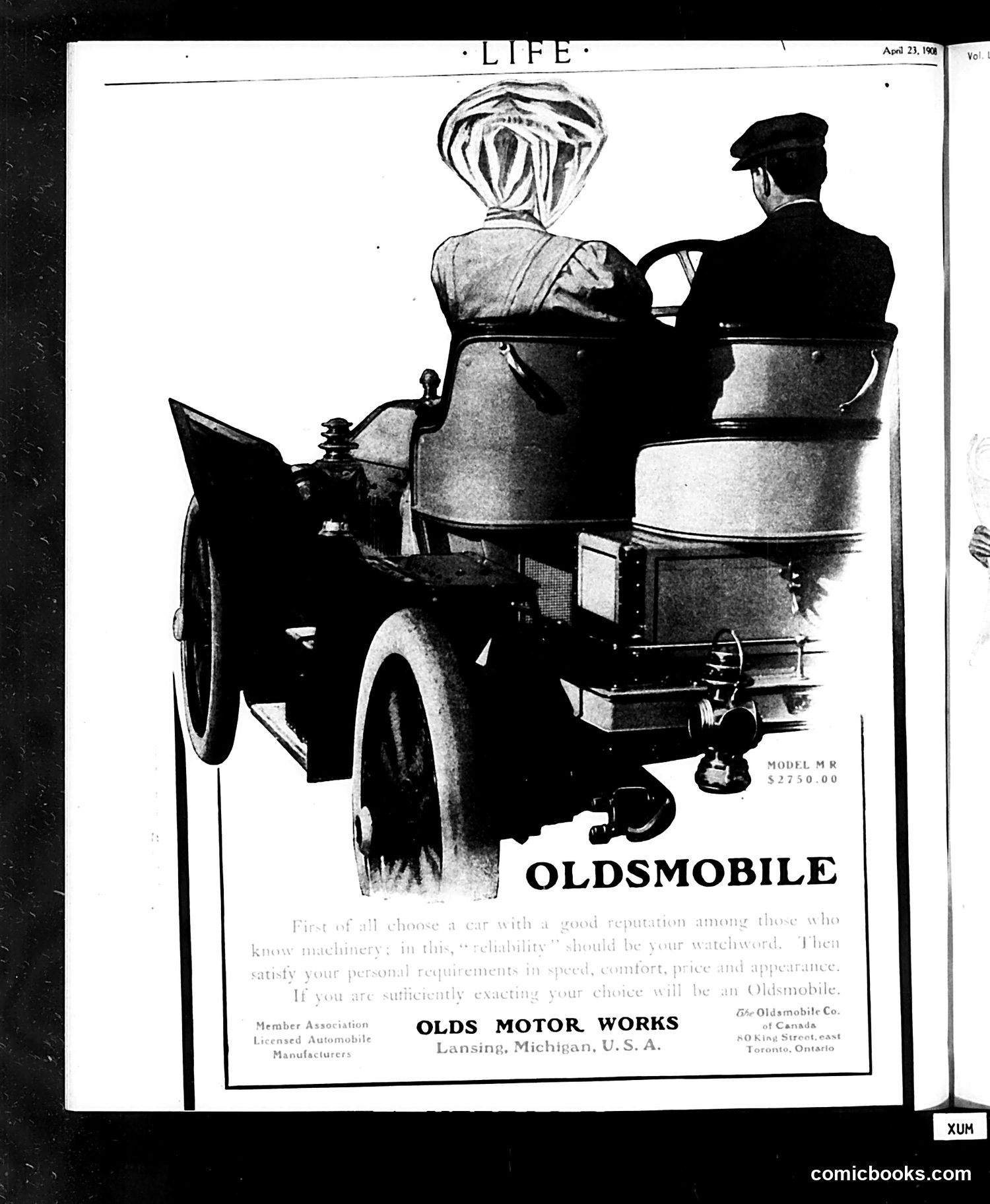
This is an **advertisement, not satire or editorial content**. It features an Oldsmobile Model M R priced at $2,250.00, published in Life magazine on April 23, 1908. The image shows a well-dressed couple in an early automobile—the woman facing forward in an elaborate hat, the man in a cap at the steering wheel. The ad's text appeals to buyers seeking "a good reputation among those who know machinery," promising the car will satisfy "requirements in speed, comfort, price and appearance." The advertisement uses the couple as aspirational imagery, marketing the automobile as a status symbol for the middle-to-upper class. The styling and messaging reflect early 1900s consumer culture, positioning car ownership as a mark of refined taste and practical judgment.