
Life, 1908-04-23 · page 16 of 24
Life — April 23, 1908 — page 16: what you’re looking at
What you’re looking at
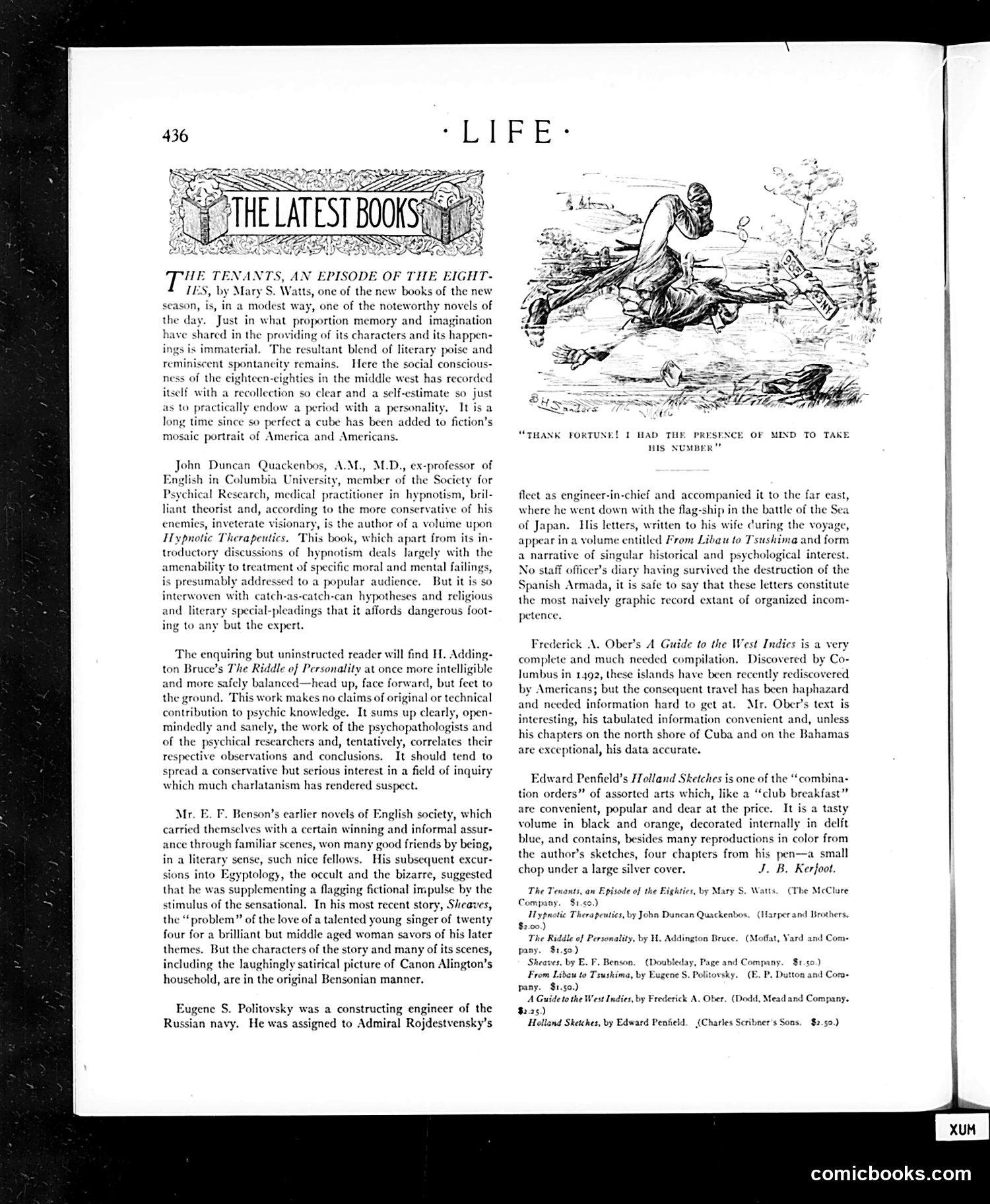
This page from *Life* magazine is primarily a book review section titled "The Latest Books," not a political cartoon. The single illustration shows a figure reclining outdoors with the caption "Thank Fortune! I had the presence of mind to take his number"—a humorous visual gag about obtaining someone's identifying information, likely illustrating a scene from one of the reviewed novels. The reviews themselves discuss newly published works by Mary S. Watts, John Duncan Quackenbos, H. Addington Bruce, E. F. Benson, Eugene S. Politovsky, and Frederick A. Ober. The tone is witty and sometimes sharply critical—for instance, the review of Quackenbos's *Hypnotic Therapeutics* warns it's "interwoven with catch-as-catch-can hypotheses" and "affords dangerous footing to any but the expert." This demonstrates *Life*'s role as a literary tastemaker offering educated commentary on contemporary publishing.
📄 Transcribed text from this page (OCR, searchable)
Machine-transcribed from the original scan — historical spelling and the odd misread are preserved.
ITE TENANTS, AN EPISODE OF THE EIGHT- TES, by Mary S. Watts, one of the new books of the new on, is, in a modest way, one of the noteworthy novels of the day. Just in what proportion memory and imagination have shared in the providing of its character ings is immaterial. The resultant blend of literary poise and reminiscent spontaneity remains. Here the social conscious- ness of the eighteen-eighties in the middle west has recorded itself with a recollection so clear and a self-estimate so just as to practically endow a period with a personality, It is a long time since so perfect a cube has been added to fiction’s mosaic portrait of America and Americans. John Duncan Quackenbos, A.M., M.D., ex-professor of English in Columbia University, member of the Society for Psychical Research, medical practitioner in hypnotism, bril- liant theorist and, according to the more conservative of his enemies, inveterate visionary, is the author of a volume upon Hypnotic Therapeutics. This book, which apart from its in- troductory discussions of hypnotism deals largely with the amenability to treatment of specific moral and mental failings, is presumably addressed to a popular audience. But it is so interwoven with catch-as-catch-can hypotheses and religious and literary special-pleadings that it affords dangerous foot- ing to any but the expert. The enquiring but uninstructed reader will find H. Adding- ton Bruce’s The Riddle oj Personality at once more intelligible and more safely balanced—head up, face forward, but fect to the ground. This work makes no claims of original or technical contribution to psychic knowledge. It sums up clearly, open- mindedly and sancly, the work of the psychopathologists and of the psychical researchers and, tentatively, correlates their respective observations and conclusions. It should tend to spread a conservative but serious interest in a field of inquiry which much charlatanism has rendered suspect. Mr. E. F. Benson's earlier novels of English society, which carried themselves with a certain winning and informal assur- ance through familiar scenes, won many good friends by being, in a literary sense, such nice fellows. His subsequent excur- sions into Egyptology, the occult and the bizarre, suggested that he was supplementing a flagging fictional impulse by the stimulus of the sensational. In his most recent story, Sheaves, the “problem” of the love of a talented young singer of twenty four for a brilliant but middle aged woman savors of his later themes. But the characters of the story and many of its scenes, including the laughingly satirical picture of Canon Alington’s household, are in the original Bensonian manner. Eugene S. Politovsky was a constructing engincer of the Russian navy. He was assigned to Admiral Rojdestvensky’s “THANK FORTUNE! I HAD THE PRESEN HIS NUMBER” OF MIND TO TAKE fleet as engineer-in-chief and accompanied it to the far where he went down with the flag-ship in the battle of the § of Japan. His letters, written to his wife curing the voyage, entitled From Libau to Tsushima and form appear ina volume a narrative of singular historical and psychological interest. No staff officer’s diary having survived the destruction of the Spanish Armada, it is safe to say that these letters constitute the most naively graphic record extant of organized incom- petence. Frederick \. Ober’s A Guide to the West Indies is a very complete and much needed compilation, Discovered by Co- red ard is lumbus in 1492, these islands have been recently rediscov by Americans; but the consequent travel has been hapha: and needed information hard to get at. Mr. Ober’s tex interesting, his tabulated information convenient and, unless his chapters on the north shore of Cuba and on the Bahamas are exceptional, his data accurate. Edward Penfield’s Holland Sketches is one of the “combina- tion orders” of assorted arts which, like a “club breakfast” are convenient, popular and dear at the price. It is a tasty volume in black and orange, decorated internally in delft blue, and contains, besides many reproductions in color from the author’s sketches, four chapters from his pen—a small chop under a large silver cover. J. B. Kerfoot. (The McClure The Tenants, an Episode of the Eighties, by Mary S. Watts. Company. $1.50.) Hypnotic Therapeutics, by John Duncan Quackenbos, (Harper and Brothers. $2.00.) The Riddle of Personality, by H. Addington Bruce. (Moat, Yard pany. $1.50) Sheaves, by E. F, Benson. (Doub! From Libau to Tsuskima, by Eugene S. Po! pany. $1.50.) A Guide to the West Indies, by Fred $2.25.) Helland Sketches, by Edward Penfield. (Charles Sc Com- ad Company. $1.50.) (E. P, Dutton and Com- ick A. Ober. (Dodd, Mead and Company. bner's Sons. $2.59.) comicbooks.com