
Life, 1908-04-23 · page 6 of 24
Life — April 23, 1908 — page 6: what you’re looking at
What you’re looking at
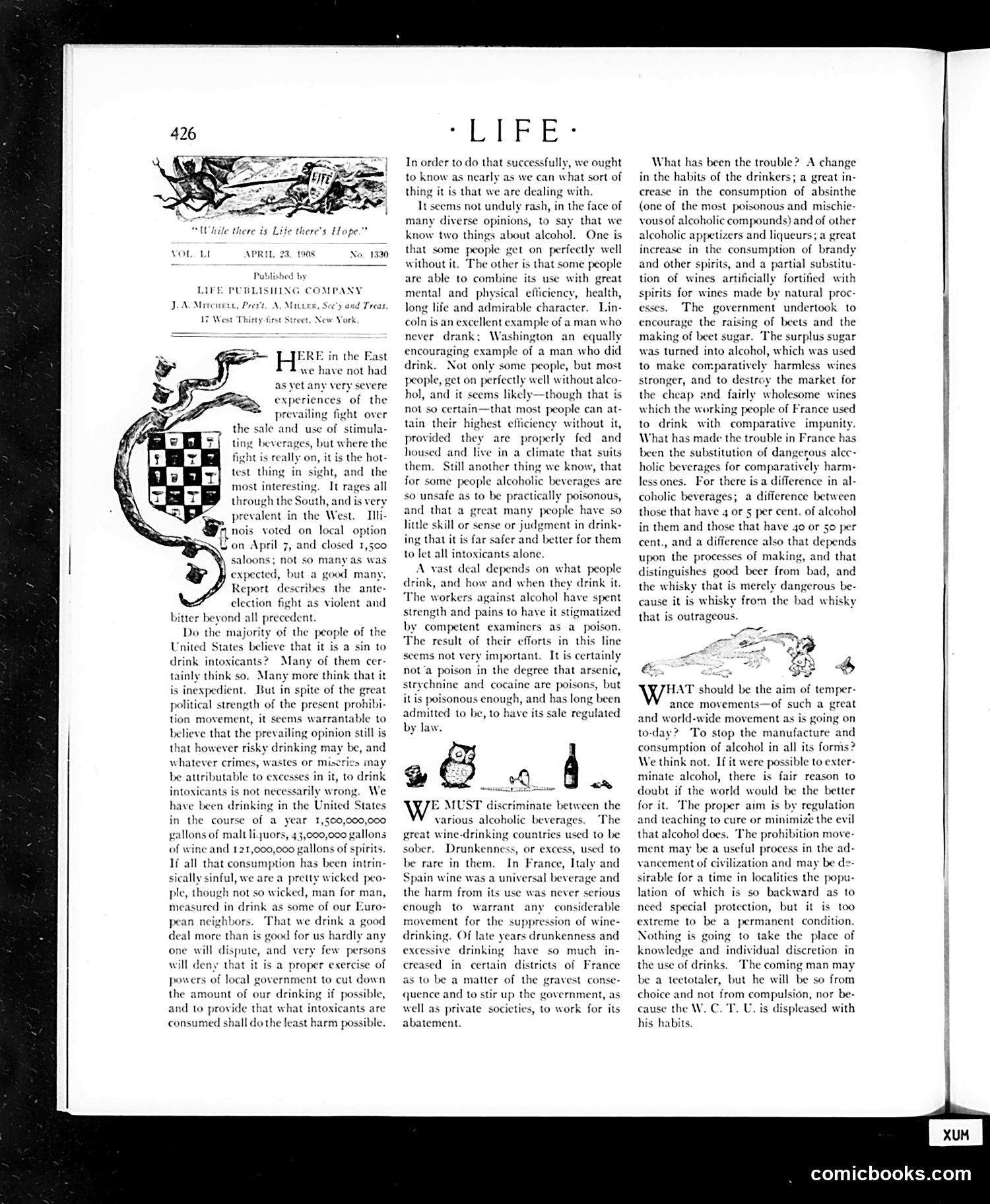
This page discusses alcohol consumption in America, a major social and political issue during the Progressive Era. The text debates whether drinking intoxicants is inherently sinful or merely dangerous when excessive. The article argues that **some people can drink moderately without harm** (citing George Washington and Abraham Lincoln as examples), while acknowledging that **many people cannot safely consume alcohol**. It critiques both absolute prohibition advocates and those dismissing alcohol's dangers. The piece advocates for **education and individual discretion** rather than total prohibition—a nuanced position in the pre-Prohibition debate. It warns against government overreach while acknowledging legitimate public health concerns about alcohol's documented harms. The decorative initial letters and small illustrations are typical period magazine design elements without specific satirical content.
📄 Transcribed text from this page (OCR, searchable)
Machine-transcribed from the original scan — historical spelling and the odd misread are preserved.
cre’s Hope.” VOL. Lt APRIL 23, 1908 No, 1330 Publ LIFE PUBLISHING COMPANY by J.A. Mirren A. Mitten, See’y and Treas = aed ERE in the East we have not had as yet any very severe experiences of the prevailing fight over the sale and use of stimula- ting beverages, but where the fight is really on, it is the hot- test thing in sight, and the most interesting. It rages all through th prevalent in the West. Illi- *nois voted on local option on April 7, and closed 1,300 saloons; not so many as was expected, but a good many, Report describes the ante- election fight as violent and bitter beyond all precedent. Do the majority of the people of the United States believe that it is a sin to drink intoxicants? Many of them cer- tainly think so. Many more think that it is inexpedient. But in spite of the great political strength of the present prohibi- tion movement, it seems warrantable to believe that the prevailing opinion still is that however risky drinking may be, and whatever crimes, wastes or miseries inay be attributable to excesses in it, to drink intoxicants is not necessarily wrong. We have been drinking in the United States in the course of a year 1,500,000,000 gallons of malt liquors, 43,000,000 gallons of wine and 121,000,000 gallons of spirits. Ii all that consumption has been intrin- sically sinful, we are a pretty wicked peo- ple, though not so wicked, man for man, measured in drink as some of our Euro- pean neighbors. That we drink a good deal more than is good for us hardly any one will dispute, and very few persons at it is a proper exercise of powers of local government to cut down the amount of our drinking if possible, and to provide that what intoxicants are consumed shall do the least harm possible. “IE TPB « In order to do that successfully, we ought to know as nearly as we can what sort of thing it is that we are dealing with. It seems not unduly rash, in the face of many diverse opinions, to say that we know two things about alcohol. One is that some people get on perfectly well without it. The other is that some people are able to combine its use with great mental and physical efficiency, health, long life and admirable character. Lin- coln is an excellent example of a man who never drank; Washington an equally encouraging example of a man who did drink. Not only some people, but most people, get on perfectly well without alco- hol, and it seems likely—though that is not so certain—that most people can at- tain their highest efficiency without it, provided they are properly fed and housed and live in a climate that suits them. Still another thing we know, that for some people alcoholic beverages are so unsafe as to be practically poisonous, and that a great many people have so little skill or sense or judgment in drink- ing that it is far safer and better for them. to let all intoxicants alone. A vast deal depends on what people drink, and how and when they drink it. The workers against alcohol have spent strength and pains to have it stigmatized by competent examiners as a_ poison. The result of their efforts in this line seems not very important. It is certainly not’a poison in the degree that arsenic, strychnine and cocaine are poisons, but it is poisonous enough, and has long been admitted to be, to have its sale regulated by law. 4 en the W* MUS iscriminate betw various alcoholic beverages. The great wine-drinking countries used to be sober. Drunkenness, or excess, used to be rare in them. In France, Italy and Spain wine was a universal beverage and the harm from its use was never serious enough to warrant any considerable vement for the suppression of wine- drinking. Of late years drunkenness and excessive drinking have so much in- creased in certain districts of France as to be a matter of gravest conse- quence and to stir up the government, as well as private socicties, to work for its abatement. What has been the trouble? A change in the habits of the drinkers; a great in- crease in the consumption of absinthe (one of the most poisonous and mischie vousof alcoholic compounds) and of other alcoholic appetizers and liqueurs; a great increase in the consumption of brandy and other spirits, and a partial substitu- tion of wines artificially fortified with spirits for wines made by natural proc- esses. The government undertook to encourage the raising of beets and the making of beet sugar. The surplus sugar was turned into alcohol, which was used to make comparatively harmless wines stronger, and to destroy the market for the cheap and fairly wholesome wines which the working people of France used to drink with comparative impunity What has made the trouble in France been the substitution of dangerous alec- holic beverages for comparatively harm- less ones. For there isa difference in al- coholic beverages; a difference between those that have 4 or § per cent. of alcohol in them and those that have 4o or 50 per cent., and a difference also that depends upon the processes of making, and that distinguishes good beer from bad, and the whisky that is merely dangerous be- cause it is whisky from the bad whisky that is outrageous. ? SS HAT should be the aim of temper- ance movements—of such a great and world-wide movement as is going on to-day? To stop the manufacture and consumption of alcohol in all its forms? We think not. If it were possible to exter- minate alcohol, there is fair reason to doubt if the world would be the better for it. The proper aim is by regulation and teaching to cure or minimize the evil that alcohol does. The prohibition move- ment may be a useful process in the ad- vancement of civilization and may be de- sirable for a time in localities the popu- lation of which is so backward as to need special protection, but it is too extreme to be a permanent condition. Nothing is going to take the place of knowledge and individual discretion in the use of drinks. The coming man may be a teetotaler, but he will be so from choice and not from compulsion, nor be- cause the W. C. ‘T. U. is displeased with his habits. comicbooks.com