
Life, 1908-04-23 · page 14 of 24
Life — April 23, 1908 — page 14: what you’re looking at
What you’re looking at
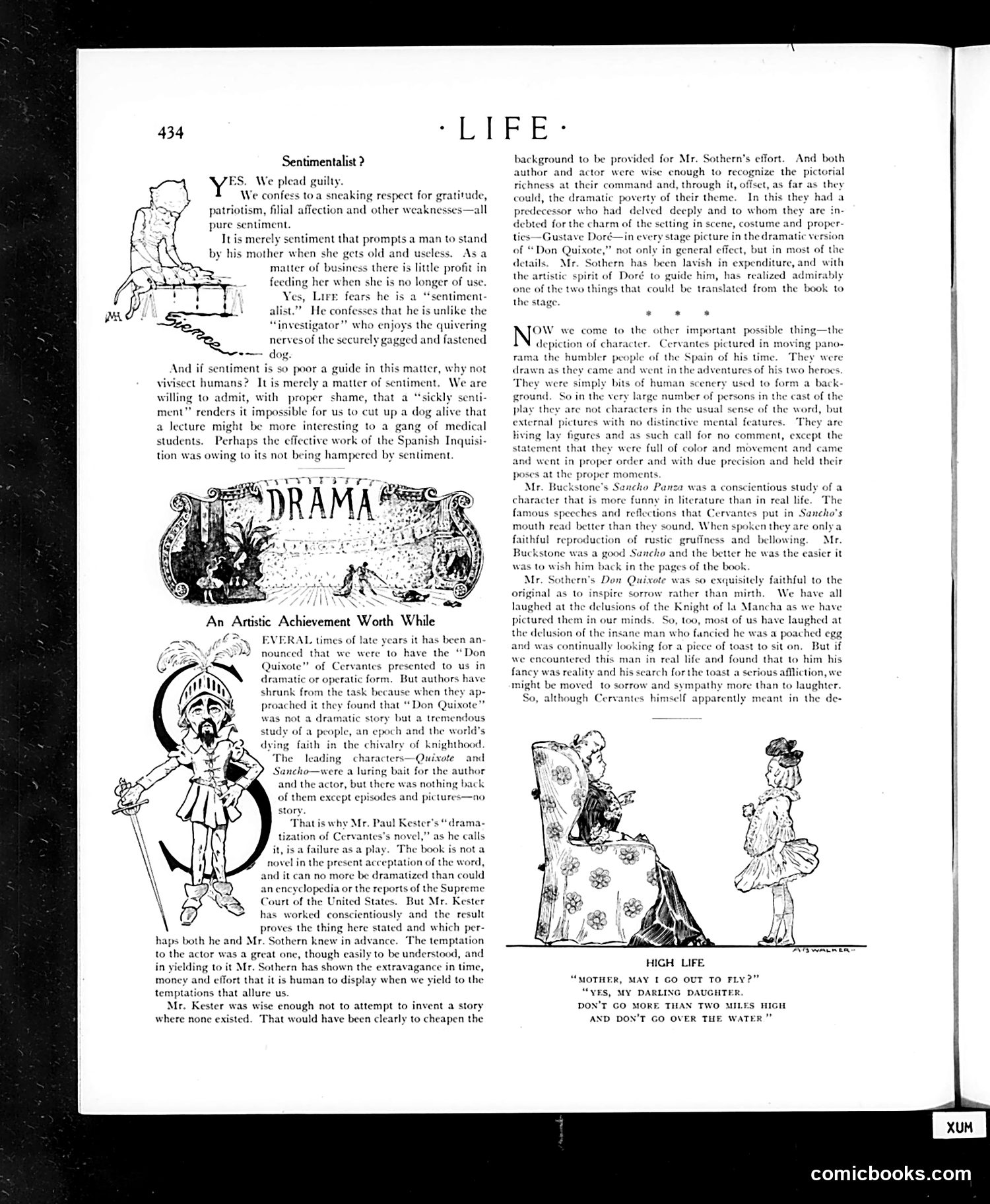
This page defends sentiment and human feeling against cold rationalism, then critiques a theatrical adaptation of Cervantes's *Don Quixote*. The opening section sarcastically attacks those who dismiss sentiment as weakness—arguing that caring for elderly parents or refusing to vivisect dogs reflects moral character, not foolishness. It mocks the "investigator" mentality that abandons ethics for efficiency. The main article addresses Paul Kester's dramatization starring E.H. Sothern (a famous actor of the era, visible in the Don Quixote illustration). Life acknowledges the production's artistic success—particularly its visual design inspired by Gustave Doré's illustrations and elaborate costumes. However, it faults the adaptation for failing to capture *character*. The critic notes that Cervantes's novel depicts humble Spanish people as living, complex individuals, while the stage version reduces them to "living lay figures"—mere decorative extras without psychological depth. The core problem: a novel about human complexity cannot become a dramatically coherent play.
📄 Transcribed text from this page (OCR, searchable)
Machine-transcribed from the original scan — historical spelling and the odd misread are preserved.
Sentimentalist ? ES. We plead guilty. We confess to king respect for gratitude, patriotism, filial affection and other weaknesses—all pure sentiment. It is merely sentiment that prompts a man to stand by his mother when she gets old and useless. As a matter of business there is little profit in feeding her when she is no longer of use. Yes, Lire fi entiment list.” He confesses that he is unlike the “investigator” who enj¢ nervesof the securely gagged and fastened And if sentiment is so poor a guide in this matter, why not vivisect humans? It is merely a matter of sentiment. We are willing to admit, with proper shame, that a “sickly senti- ment” renders it impossible for us to cut up a dog alive that a lecture might be more interesting to a gang of medical students. Perhaps the effective work of the Spanish Inquisi- tion was owing to its not being hampered by sentiment sne s he is a yys the quivering An Artistic Achievement Worth While 2. EVERAL times of late years it has been an nounced that we were to fe the “Don Quixote” of Cervantes presented to us in dramatic or operatic form. But authors have shrunk from the task because when they ap- proached it they found that “Don Quixote” was not a dramatic story but a tremendous study of a people, an epoch and the world’s dying faith in the chivalry of knighthood The leading characters—Quixote and Sancho—were a luring bait for the author and the actor, but there was nothing back of th story: ‘That is why Mr. Paul Kester’s “drama- "as he c sa play. The book is not a novel in the present acceptation of the word, and it can no more be dramatized than could an encyclopedia or the reports of the Supreme Court of the United States. But Mr. Kester has worked conscientiously and the result proves the thing here stated and which per- haps both he and Mr. Sothern knew in advance. The temptation to the actor was a great one, though casily to be understood, and in yielding to it Mr. Sothern has shown the extravagance in time, money and effort that it is human to display when we yield to the temptations that allure us. Mr. Kester was wise enough not to attempt to invent a story ‘That would have been clearly to cheapen the m except episodes and pictures—no tization of Cervantes's novel it, is a failure where none existed. « LIPE background to be provided for Mr. Sothern’s effort. And both nd actor were wise enough to recognize the pictorial richness at their con 1 and, through it, offset, as far as they could, the dramatic poverty of their theme. In this they had a ad delved deeply and to whom they are } ted for the charm of the setting in scene, costume and proper- ties—Gustave Dor in the dramatic versi of “Don Quixote,” not only in general effect, but in most of the details. Mr. Sothern has been lavish in expenditure, and with the artistic spirit of Doré to guide him, has realized admirably author Jecessor who ‘é—in every stage pictu one of th two things that could be translated from the book to the stage. No’ we come to the other important possible thing—the depiction of character. Cervantes pictured in moving pano- rama the draw umbler people as they came ani { the Spain of his time. They wer dventures of his two heroes. man scenery used to form a back, ns in the cast of the of the word, but They were simply bits of h ground. So in the very large number of per play they are not characters in the usual sense external pictures with no distinctive mental features. Th are living lay figures and as such call for no comment, except the statement that they were full of color and movement and came went 1 held their proper order and with due precision a poses at the proper moments. Mr. Buckstone’s S. cho Panza was a conscientious study of a in literature than in real life. The famous speeches and reflections that Cervantes put in Sancho's mouth read better than they sound, When spoken they are only a faithful reproduction of rustic grufiness and bellowing. Mr. Buckstone was a good Sancho and the better he was the easier it character that is more fu wi was to wish him back in the pages of the book ful to the original as to inspire sorrow rather than mirth. We have all laughed at the delusions of the Knight of la Mancha as we have minds. So, too, the delusion of the insane mar Mr. Sothern’s Don Quixote was so exquisitely fa pictured them in ow jost of us have laughed at who fancied he was a poached egg for a picce of toast to sit on. But if real life and found that to him his fancy was reality and his search for the toast a serious afiliction, we and was contin ally looking we encountered this mai might be moved to sorrow and syn So, although Cervantes thy more than to laughter arently meant in the de- HIGH LIFE “MOTHER, MAY I GO OUT TO FLY?” “YES, MY DARLING DAUGHTER DON'T GO MORE THAN TWO MILES HIGH AND DON'T GO OVER THE WATER” comicbooks.com