
A complete issue · 20 pages · 1908
Life — March 12, 1908
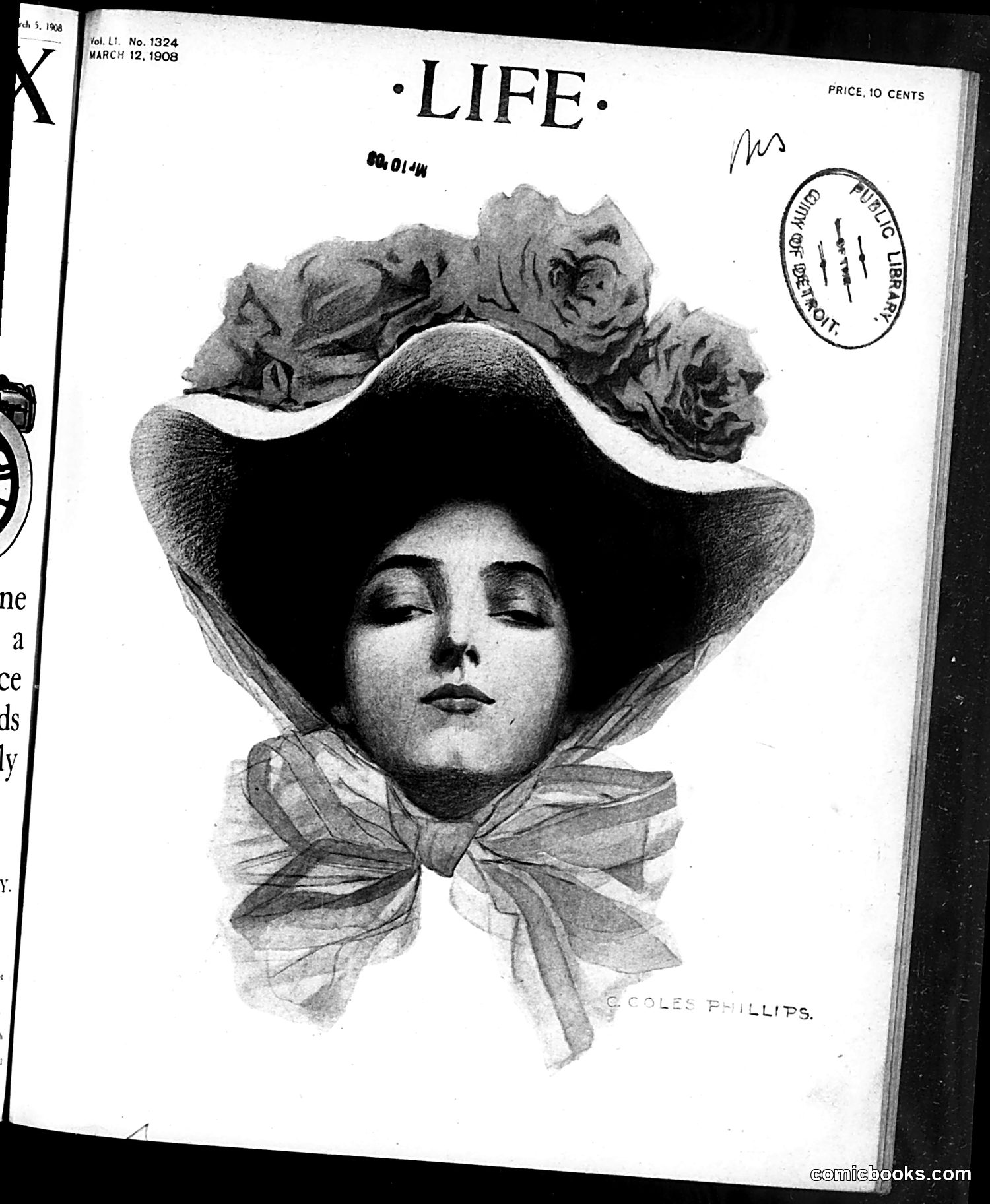
This is a cover illustration by Coles Phillips, a prominent illustrator of the era. It depicts an elegantly dressed woman wearing an elaborate wide-brimmed hat adorned with roses and a flowing bow tie at her neck. The artistic style emphasizes the woman's refined features and fashionable Edwardian-era attire. Rather than political satire, this appears to be a fashion and lifestyle cover celebrating contemporary women's style. The image represents the "Gibson Girl" aesthetic popular in early 1900s America—an idealized vision of modern womanhood featuring sophisticated clothing and grooming. The cover cost 10 cents and served as Life's commentary on current fashion trends and social culture of the period.
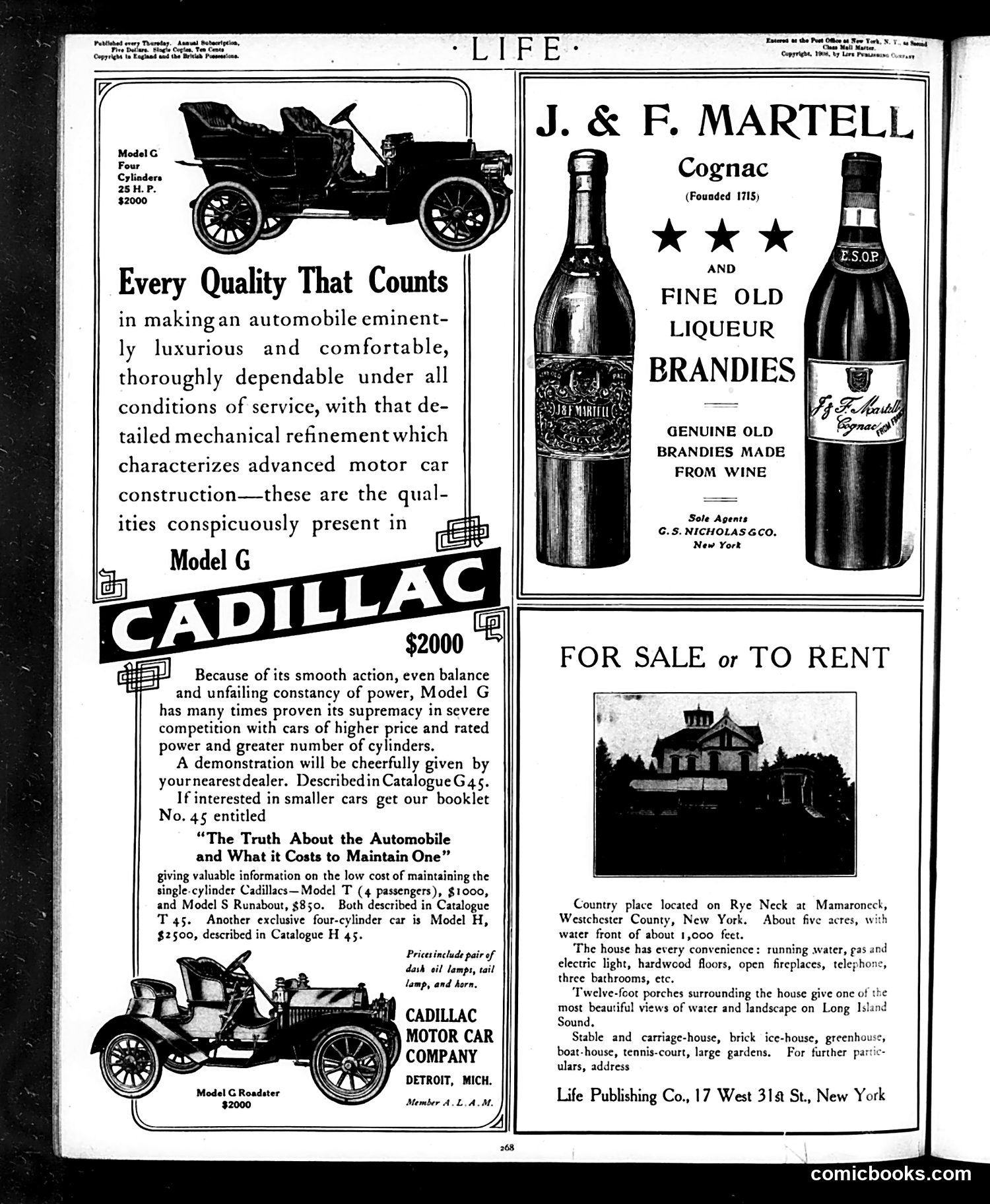
This page contains **no political cartoons or satirical content**. It consists entirely of **period advertisements** from what appears to be an early 1900s issue of Life magazine. The left side advertises the **Cadillac Model G automobile** ($2,000), emphasizing luxury, reliability, and mechanical refinement. It includes testimonial language about performance superiority. The right side advertises **J. & F. Martell Cognac and brandy** (founded 1715), noting it's "genuine old brandies made from wine," with the sole U.S. agent listed as G.S. Nicholas & Co. in New York. Below that is a real estate advertisement for a **country estate on Rye Neck, Mamaroneck, New York**, available for sale or rent, featuring waterfront property with extensive outbuildings. The page reflects early twentieth-century consumer marketing targeting wealthy readers.
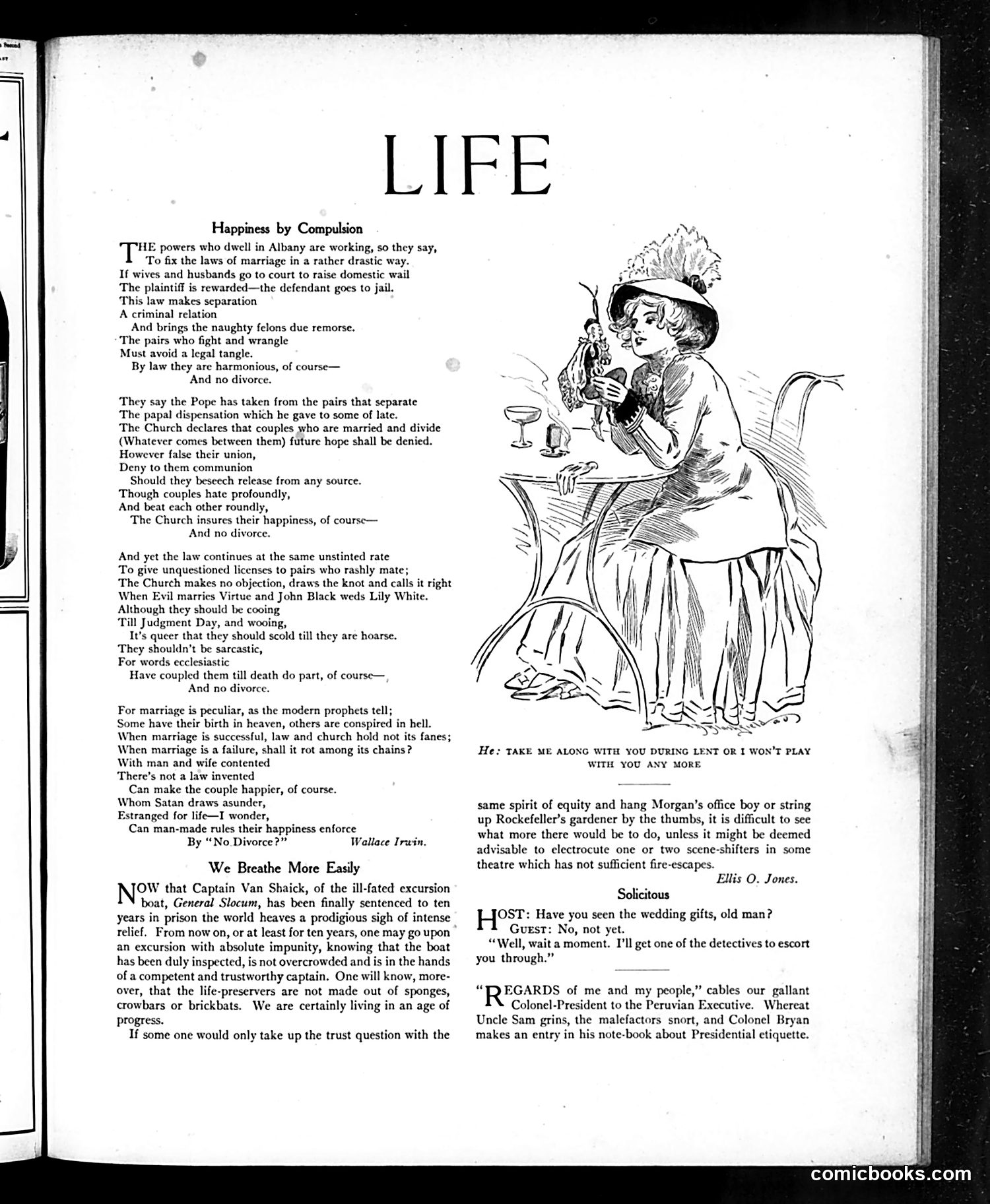
This page satirizes marriage law and divorce through poetry and illustrations. The main cartoon shows a woman at a table with a drink, captioned "He: take me along with you during lent or I won't play with you any more." The poem "Happiness by Compulsion" critiques how church and civil law regulate marriage and divorce, mocking the contradiction between strict papal doctrine forbidding divorce and the state's permissive licensing of unsuitable marriages. The satire targets institutional hypocrisy: the Church claims authority over marriage permanence while civil law enables hasty unions. The poem's conclusion questions whether man-made divorce laws actually benefit couples, suggesting legal restrictions paradoxically fail to increase happiness. The other brief anecdotes mock social pretension and bureaucratic absurdity in daily life.
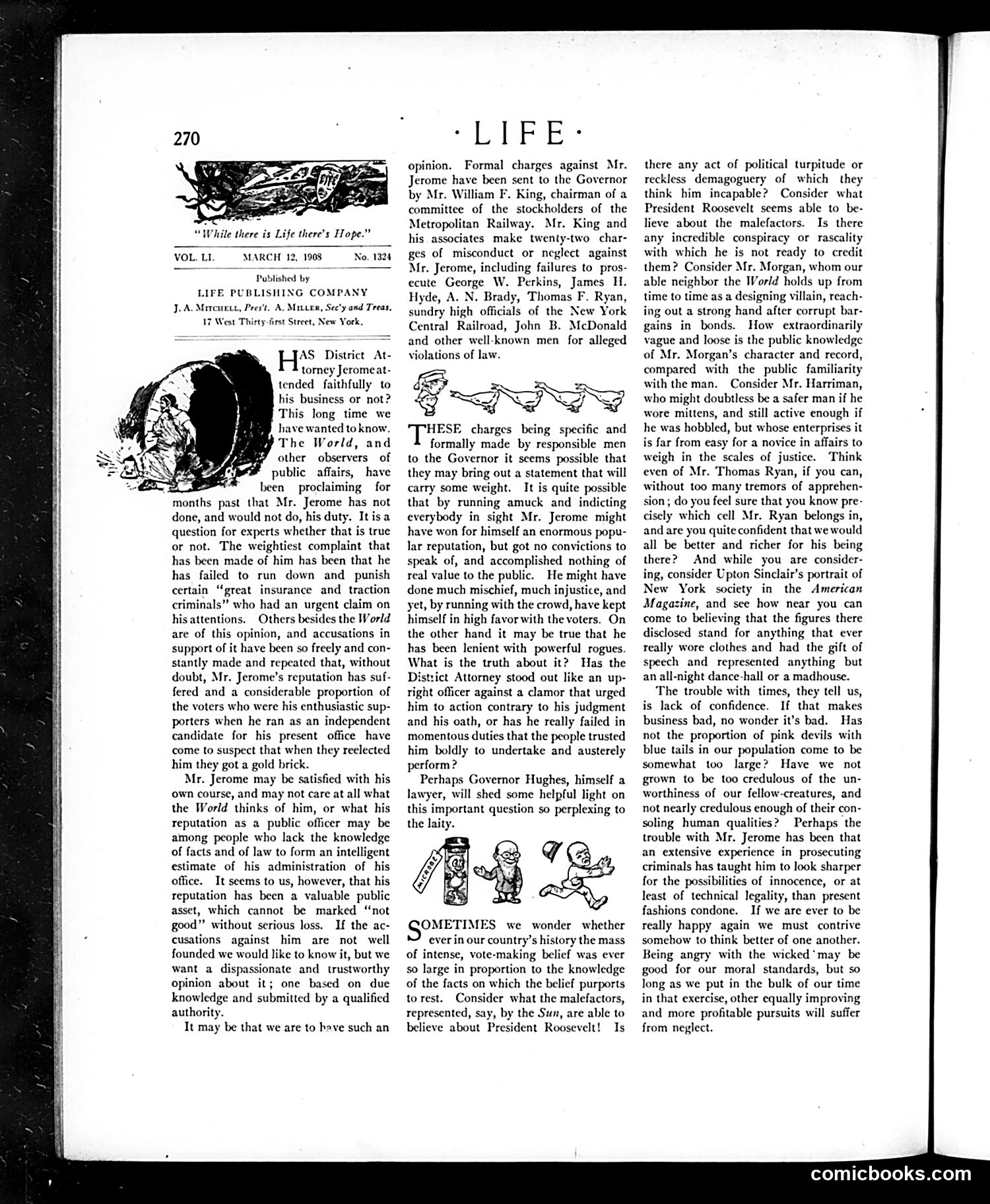
The page contains two political cartoons criticizing District Attorney Jerome. The upper cartoon, captioned "While there is Life there's Hope," depicts Jerome as a figure of public scrutiny regarding corruption allegations against New York Central Railroad officials (Perkins, Brady, Ryan, McDonald, and others). The text argues Jerome has made charges but failed to secure convictions, suggesting he's either incompetent or grandstanding. The lower cartoon appears to show figures dancing or celebrating, likely mocking Jerome's ineffectiveness. The article sardonically questions whether Jerome has genuinely pursued justice or merely created spectacle for public attention, comparing his reputation unfavorably to President Roosevelt's trustbusting efforts. The satire targets Jerome's apparent inability to translate accusations into legal victories.
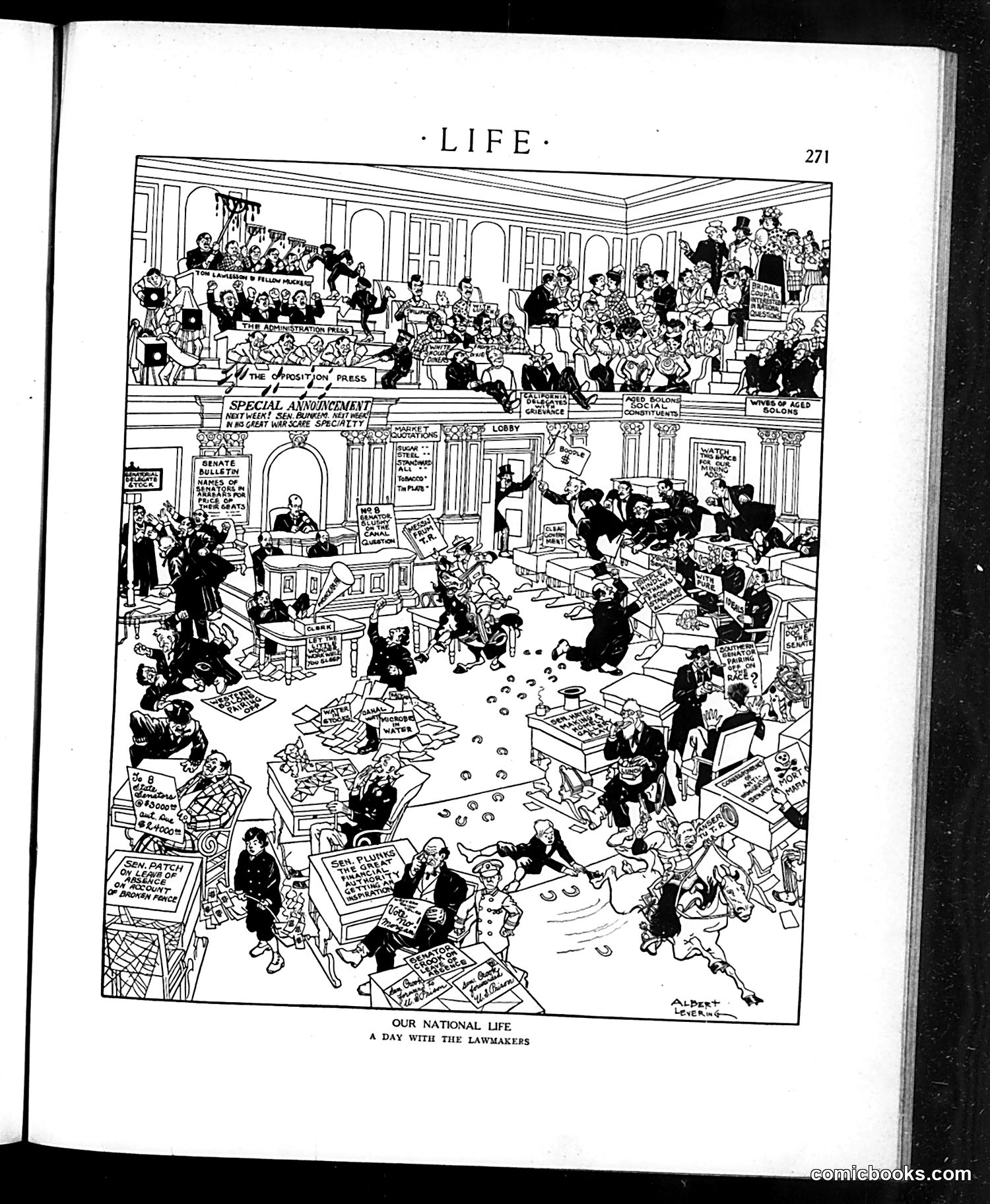
This satirical cartoon by Albert Levering depicts the U.S. Capitol in chaotic disarray. The upper gallery shows crowds of spectators and press; the lower level shows legislators scattered throughout, engaged in various activities—some appear to be socializing, others conducting business amid scattered papers and documents. The satire criticizes congressional inefficiency and disorder. Signs visible throughout reference legislative business, but the overall composition emphasizes confusion rather than productive governance. The cartoon suggests lawmakers are distracted, disorganized, or prioritizing socializing over serious legislative work. Without specific readable sign details or identified figures, the broad point appears to be mocking institutional dysfunction and the gap between the Capitol's formal architecture and the actual conduct of business within it.
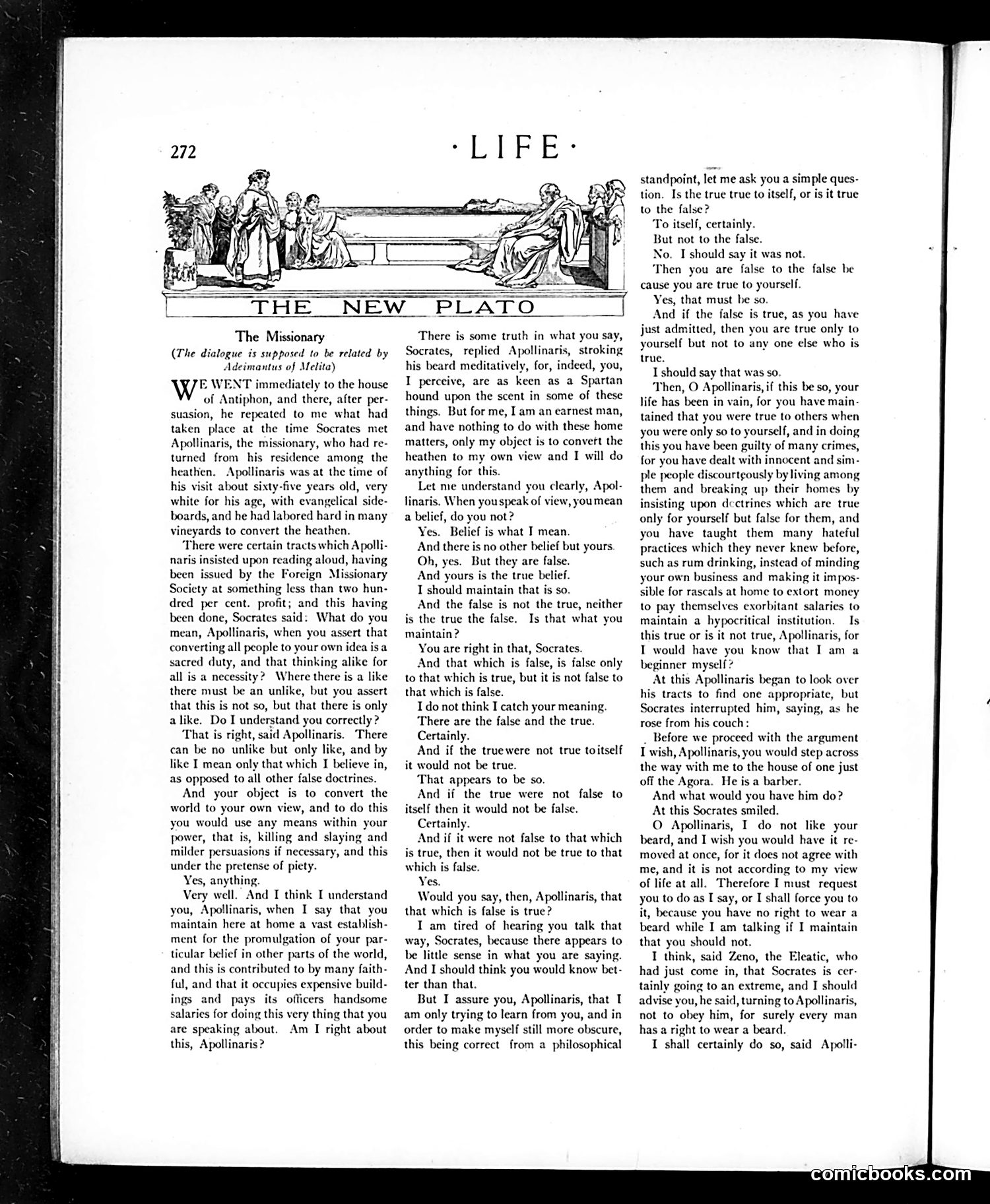
This page presents a Platonic dialogue titled "The Missionary" between Socrates and Apollinaris. The satirical cartoon at top depicts figures in classical robes engaged in philosophical debate—evoking Plato's dialogues. The text mocks missionary conversion efforts through philosophical wordplay. Apollinaris defends converting "heathens" to Christian views, while Socrates challenges the logical contradictions in his arguments about truth and falsehood. A character named Zeno interrupts, defending his right to wear a beard against Apollinaris's demands for conformity. The satire appears to critique rigid missionary dogmatism and cultural imperialism—the insistence on imposing Western/Christian customs alongside doctrine. By casting this in Socratic form, the author suggests missionaries lack genuine philosophical rigor, merely asserting beliefs rather than reasoning through them.
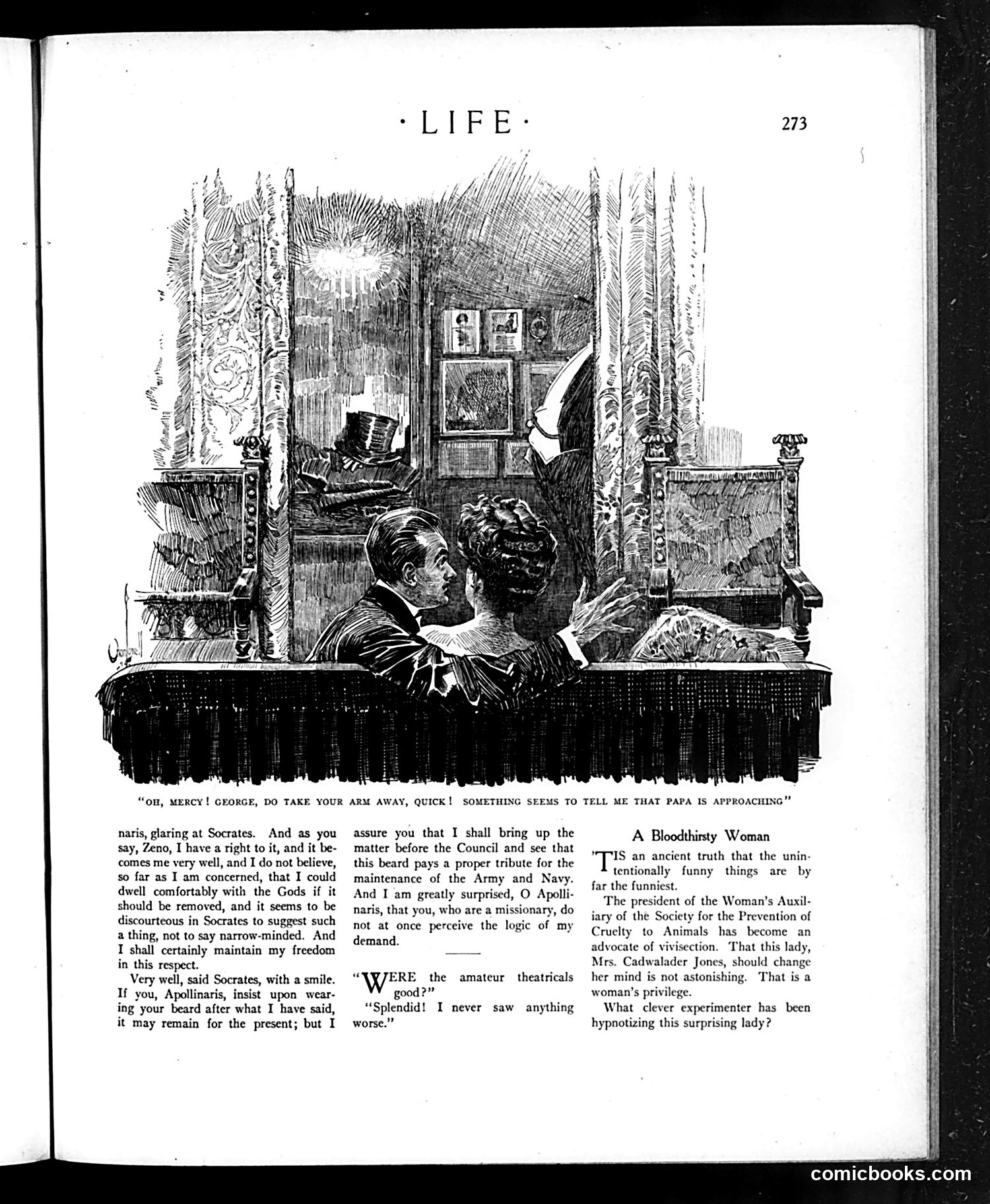
The main illustration depicts a couple at a window seat in what appears to be an elegant interior. The man says to the woman: "Oh, mercy! George, do take your arm away, quick! Something seems to tell me that papa is approaching." This is a romantic comedy cartoon about Victorian courtship proprieties. The humor relies on the era's strict social conventions: physical affection between unmarried couples was considered improper, especially if observed by the woman's father. The joke captures the tension between young desire and parental surveillance—the woman's premonition that her father's arrival requires them to hastily cease their intimate contact. Below, an article titled "A Bloodthirsty Woman" discusses a woman's advocacy against animal cruelty, using satirical language typical of early 20th-century social commentary.
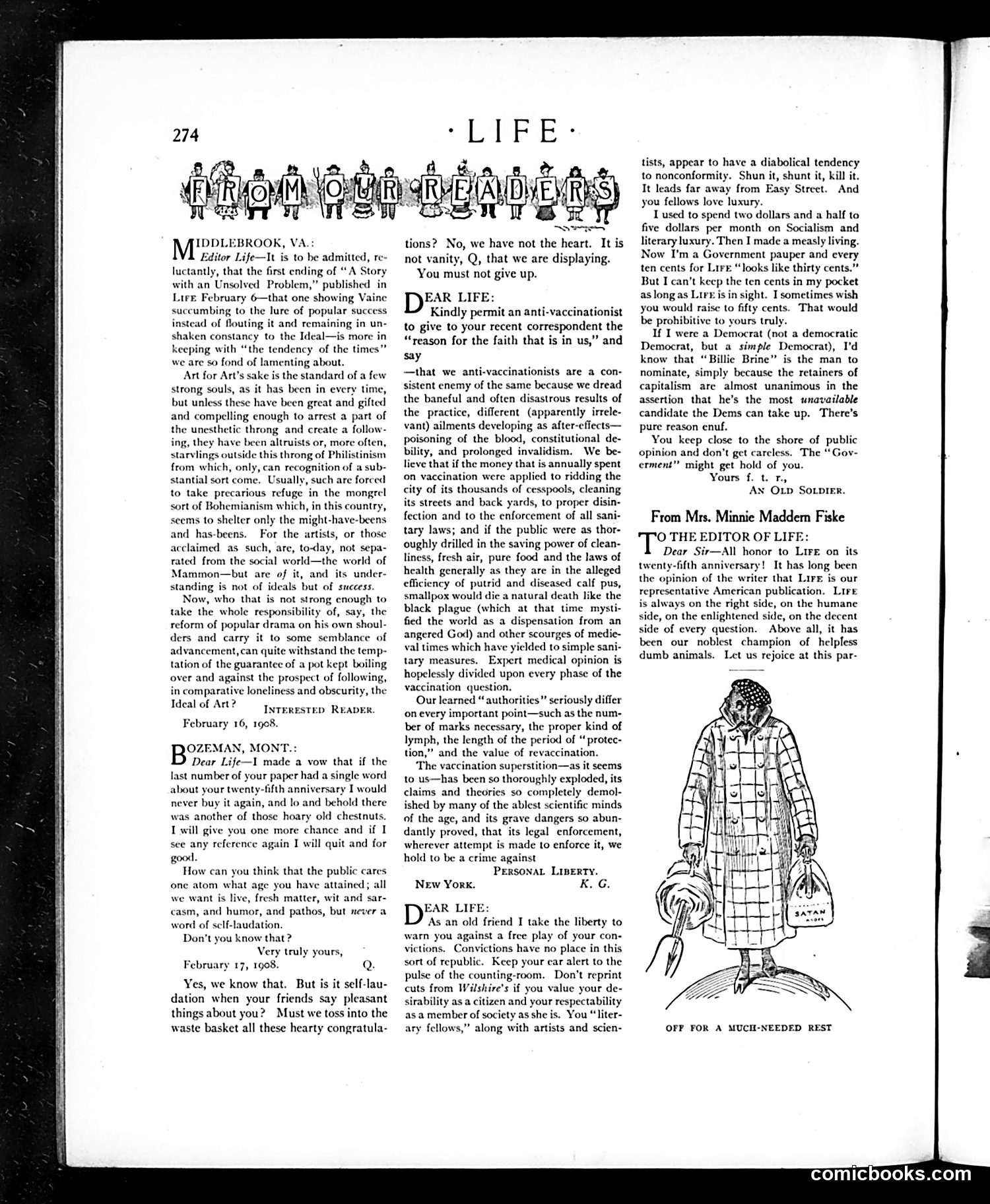
This page contains readers' letters to *Life* magazine debating vaccination and public health policy. The accompanying cartoon shows a woman in a checkered coat labeled "OFF FOR A MUCH-NEEDED REST," presumably exhausted from the vaccination controversy. The letters reveal significant anti-vaccination sentiment circa 1928. Writers argue that vaccines cause serious side effects and constitutional damage, and claim medical authorities disagree on vaccination's safety. One correspondent dismisses vaccination as a "superstition" thoroughly debunked by science. The satire targets anti-vaccination activists as unreasonable and fatiguing to public discourse. The cartoon woman suggests that the heated debate itself—rather than vaccination—has worn people out. This reflects *Life*'s satirical stance favoring medical expertise over populist health skepticism.
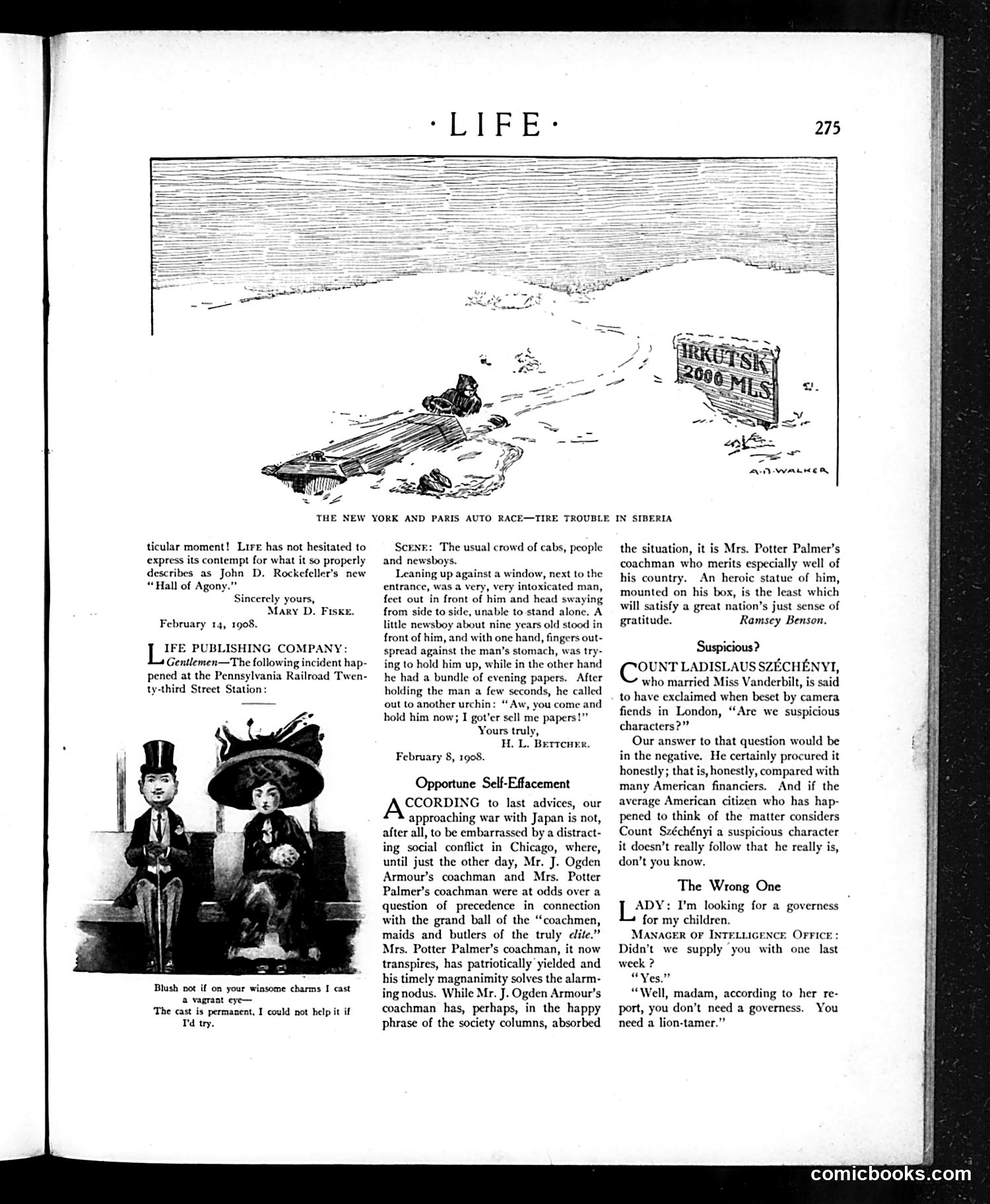
**Top Cartoon:** "The New York and Paris Auto Race—Tire Trouble in Siberia" depicts an automobile stranded in snowy wilderness with a "Irkutsk 2000 Mls" sign, satirizing the famous 1908 New York to Paris automobile race. The joke mocks the extreme conditions and distance involved in this real international racing event. **Middle Cartoon:** Shows two fashionably dressed women in large hats with caption "Blush not if on your weapons charms I cast a vagrant eye— The cast is permanent. I could not help it I'd try." This appears to be social satire about women's fashion and romantic entanglements. **Text Sections:** Include humorous letters and anecdotes about Chicago society conflicts, Japanese-American relations, and employment matters—typical satirical content of the era.
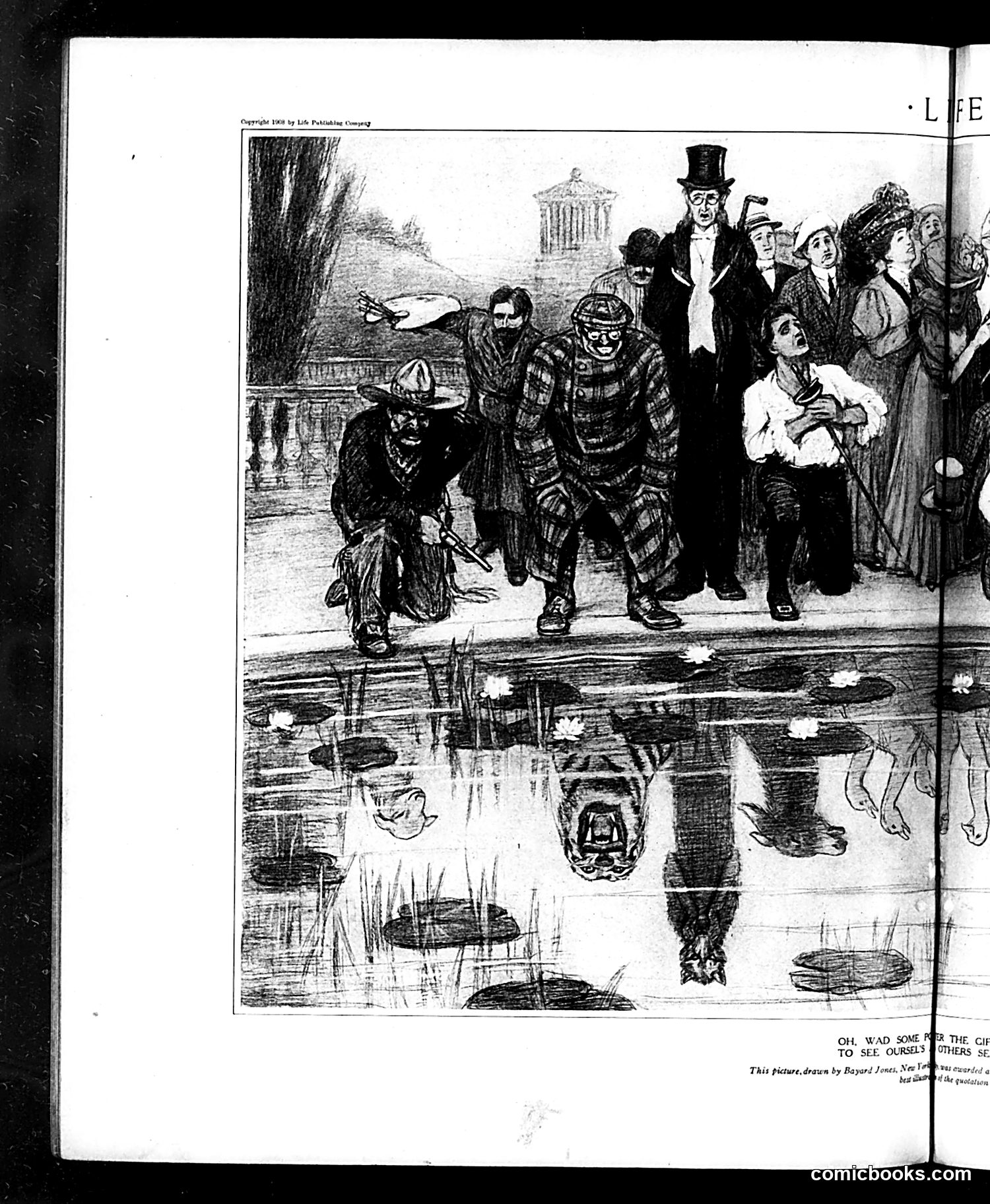
This is a satirical illustration showing a group of well-dressed onlookers standing above a body of water where several figures are drowning or struggling. The caption reads "OH, WAD SOME POW'R THE GIE TO SEE OURSEL'S AS OTHERS SEE US" (a Robert Burns quote about self-perception). The satire appears to critique wealthy or privileged observers who witness suffering below them with apparent indifference. The contrast between the formally-dressed spectators above and the drowning figures below suggests commentary on class inequality or social apathy—those with means ignoring or failing to help those in distress. The Burns quotation reinforces the message: the cartoon asks viewers to recognize how they appear to others when witnessing suffering without intervention. The work likely critiques passive observation of social problems or humanitarian crises.
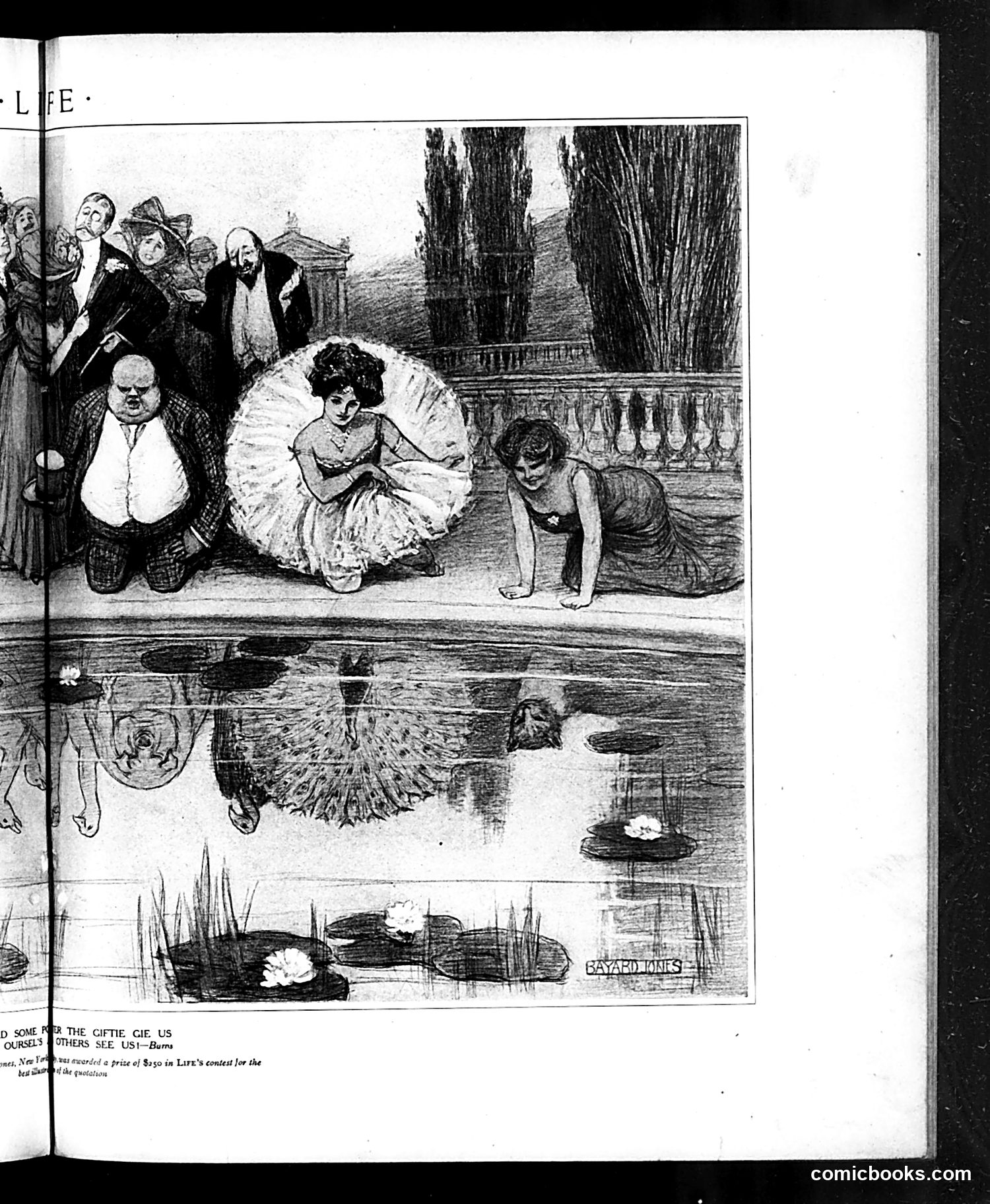
This satirical cartoon by Bayard Jones depicts a scene at what appears to be an elegant estate or garden party. The upper portion shows well-dressed observers watching two women by a pond—one in an elaborate white dress with a large fan, another in dark clothing in a crawling position. The lower half shows their reflections in the water, where they appear as aquatic creatures or fish. The satire likely comments on **social pretense and artificiality**—how wealthy society figures present polished exteriors while their "true nature" (shown in reflections) reveals something less dignified or more base. The caption references "seeing ourselves as others see us," suggesting the cartoon mocks the gap between social appearance and reality among the upper classes. The precise social context remains unclear without additional publication information.
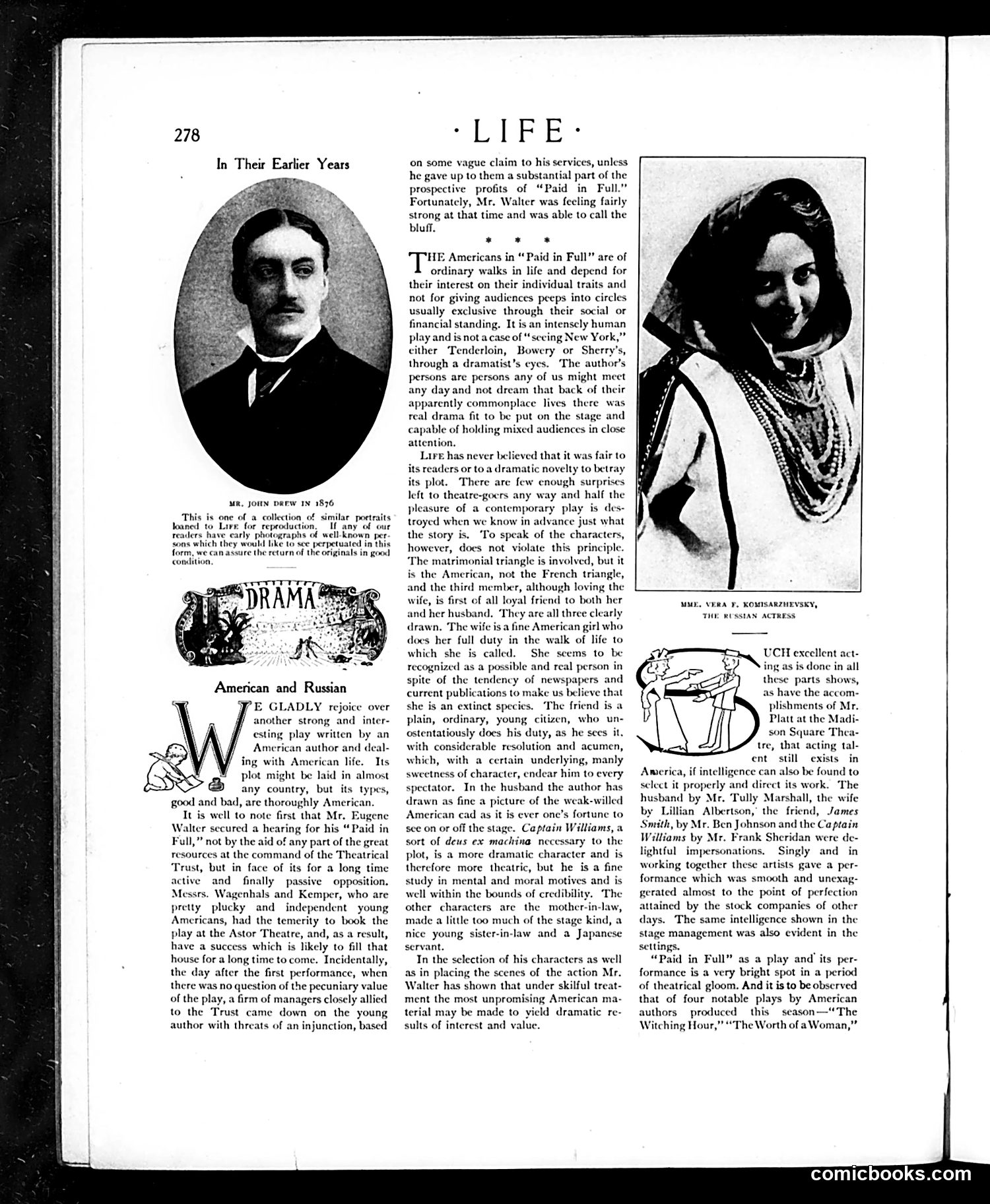
This page discusses Eugene Walter's play "Paid in Full," comparing American and Russian dramatic traditions. The left photograph shows a male playwright or theatrical figure from the early 1900s. The right photograph identifies "Mrs. Vera T. Komissarzhevsky, the Russian actress." The text argues that Walter successfully adapted American life for the stage, creating characters recognizable to ordinary audiences rather than elite society circles. It praises his depiction of a matrimonial triangle involving an American wife, a French friend, and a loyal husband—presenting genuinely human drama rather than exotic spectacle. The article suggests American drama was gaining sophistication by treating common lives seriously, moving beyond reliance on Russian theatrical techniques to develop distinctly American dramatic forms.
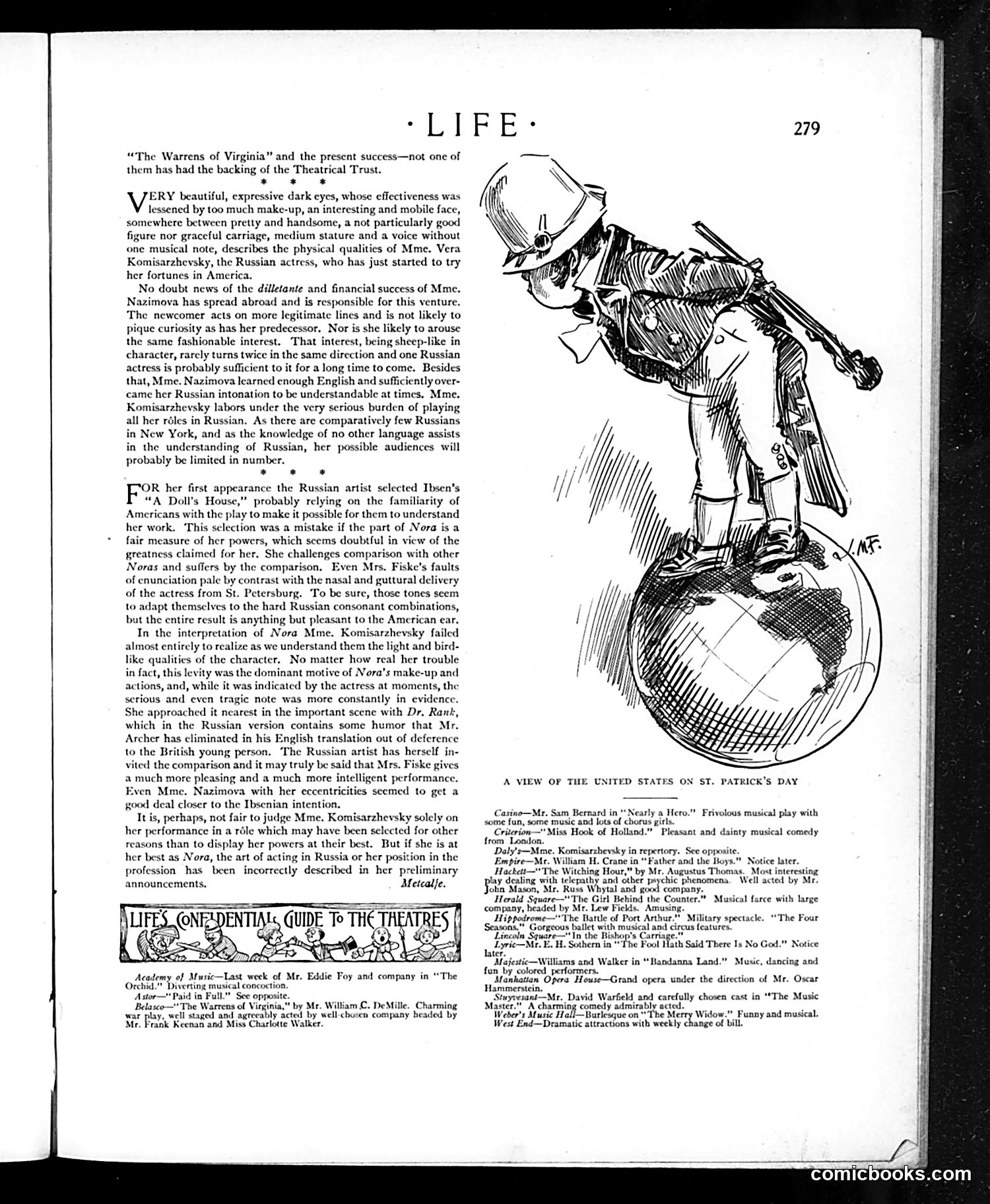
This cartoon depicts a figure in stereotypical Irish dress—wearing a bowler hat and what appears to be tattered clothing—stumbling or dancing awkwardly. The caption identifies this as a representation of America on St. Patrick's Day. The satire likely mocks Irish-American celebrations of St. Patrick's Day, portraying them as rowdy, drunken, or undignified. The disheveled appearance and awkward posture suggest buffoonery or loss of composure. The surrounding text discusses Russian actress Mme. Komissarzhevsky's American theatrical debut, appearing unrelated to the cartoon itself—typical for Life magazine's mixed content layout from this era (early 20th century). The image reflects period stereotypes about Irish immigrants and Irish-Americans that were common in American satire.
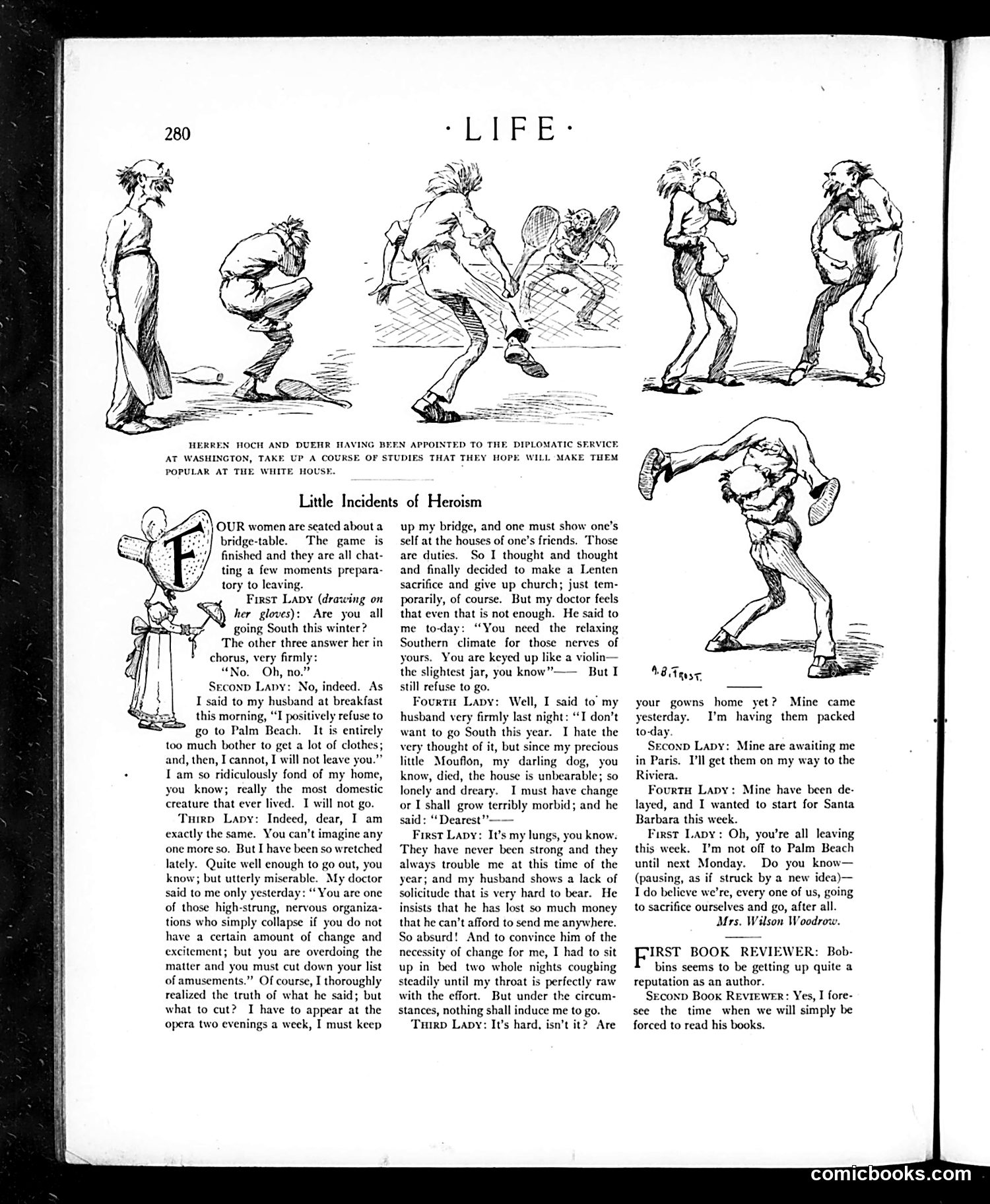
This page satirizes wealthy society women's transparent hypocrisy about winter travel. Four ladies claim they absolutely refuse to go South—citing domestic devotion, health concerns, nervous exhaustion, and grief over a dead dog. Yet through their excuses, each reveals she's actually *already made arrangements*: gowns arriving in Paris, trunks being packed, departure dates set. The joke is their performative self-sacrifice. They claim reluctance while describing elaborate preparations and doctor's orders, ultimately admitting they're all leaving that week anyway. The satire mocks how privileged women rationalize their leisure as duty—framing vacations as medical necessity or mourning rituals rather than simple desire. The caption crediting "Mrs. Wilson Woodrow" suggests this reflects actual White House social circles, where such performances of reluctance were apparently common among political wives.
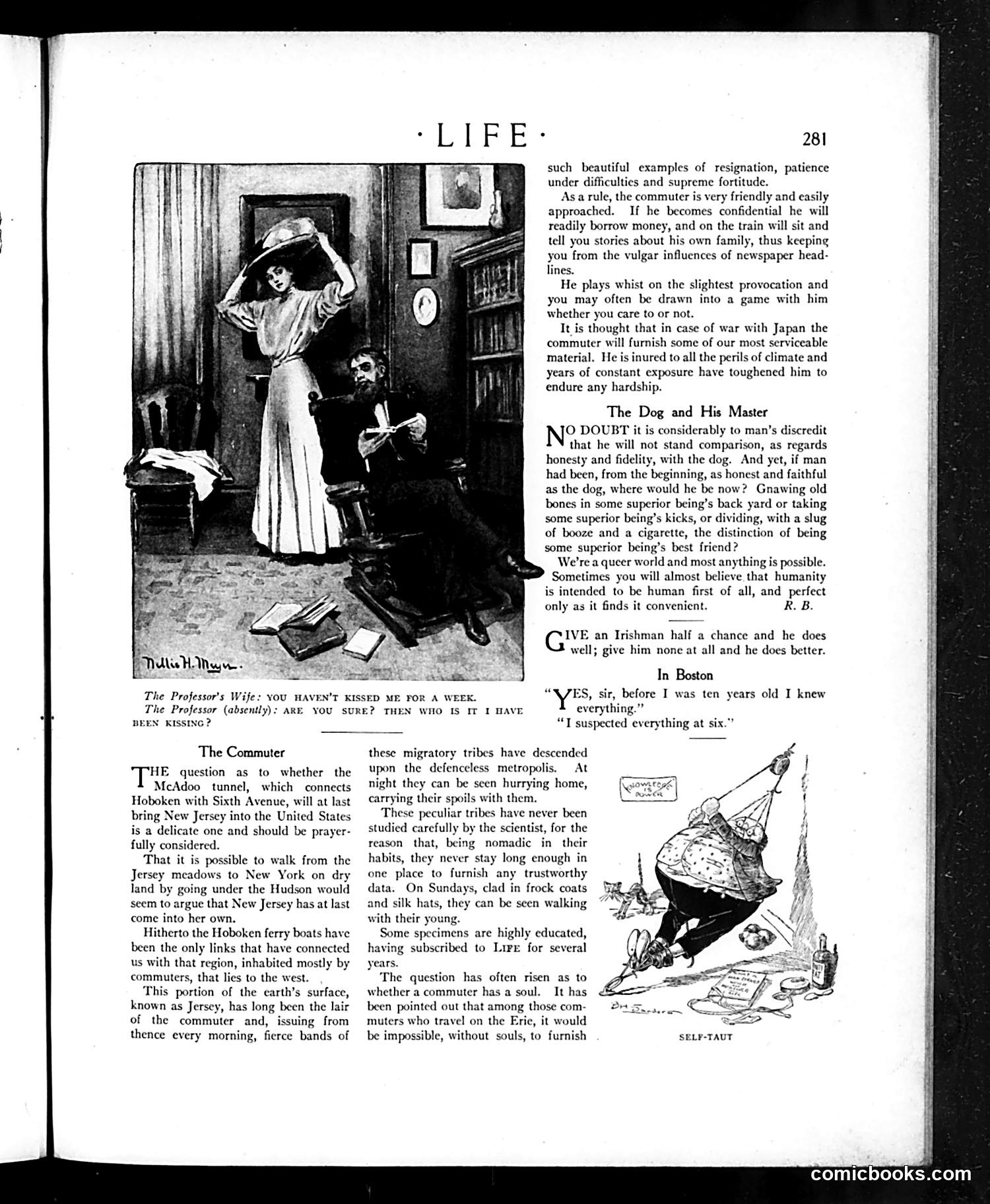
This page satirizes **commuters** — workers traveling daily from New Jersey suburbs to New York City via the newly proposed McAdoo tunnel (connecting Hoboken to Manhattan). **The Commuter Section** portrays suburbanites as an exotic, almost primitive "tribe" invading the city each morning and retreating nightly with "spoils." The satire mocks their predictability, friendliness bordering on intrusion, and their perceived lack of sophistication (subscribing to *Life* magazine counts as "highly educated"). A joke questions whether Erie Railroad commuters possess souls. **The top cartoon** ("The Professor's Wife") shows domestic comedy: a professor so absent-minded he can't recall who he kissed, illustrating intellectual preoccupation. **"The Dog and His Master"** essay argues that dogs surpass humans in loyalty and honesty — a moralistic reflection suggesting humans prioritize convenience over integrity. The satire reflects early 20th-century urban anxiety about suburban sprawl and the emerging commuter class.
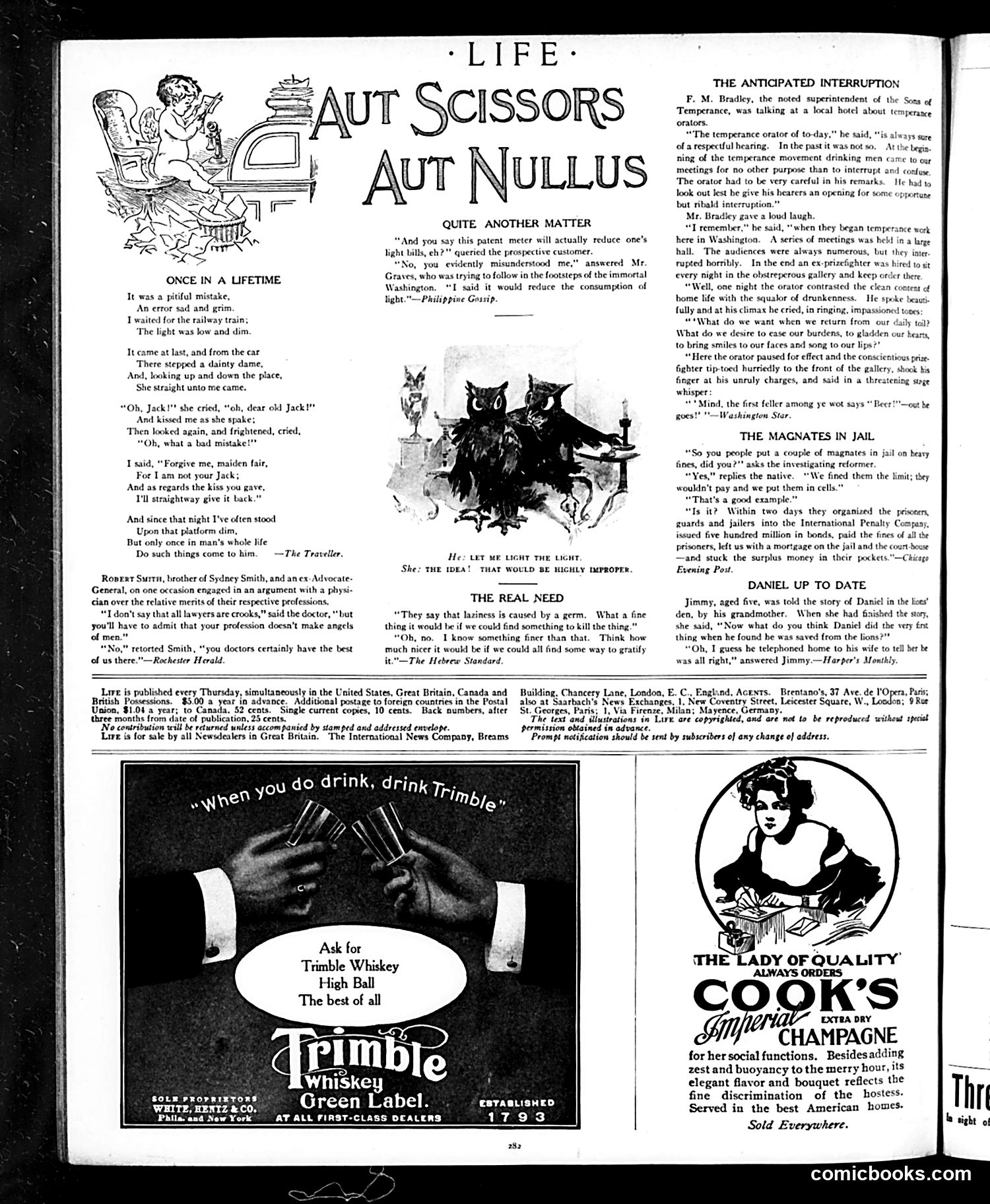
This page collects humorous anecdotes and light social commentary typical of *Life* magazine's satirical format. **Main cartoons/stories:** 1. **"Once in a Lifetime"** — A romantic mishap poem about mistaken identity at a train station; purely comedic. 2. **"Quite Another Matter"** — A salesman's deceptive pitch: he claims a meter reduces "consumption of light" (implying lower bills) when he means literal light usage. The joke satirizes commercial dishonesty. 3. **"The Real Need"** — Medical humor: scientists hunt for a germ causing laziness, but the punchline suggests people *prefer* laziness to work—mocking both scientific overconfidence and human idleness. 4. **"The Anticipated Interruption"** — A temperance reformer's anecdote about early 1900s drinking culture: rowdy audiences disrupted temperance speeches until a hired ex-prizefighter threatened hecklers with physical force. Dark humor about alcohol's social disorder. The page is primarily **light satirical humor** targeting early 20th-century American vices (dishonesty, laziness, drunkenness) rather than specific political figures.
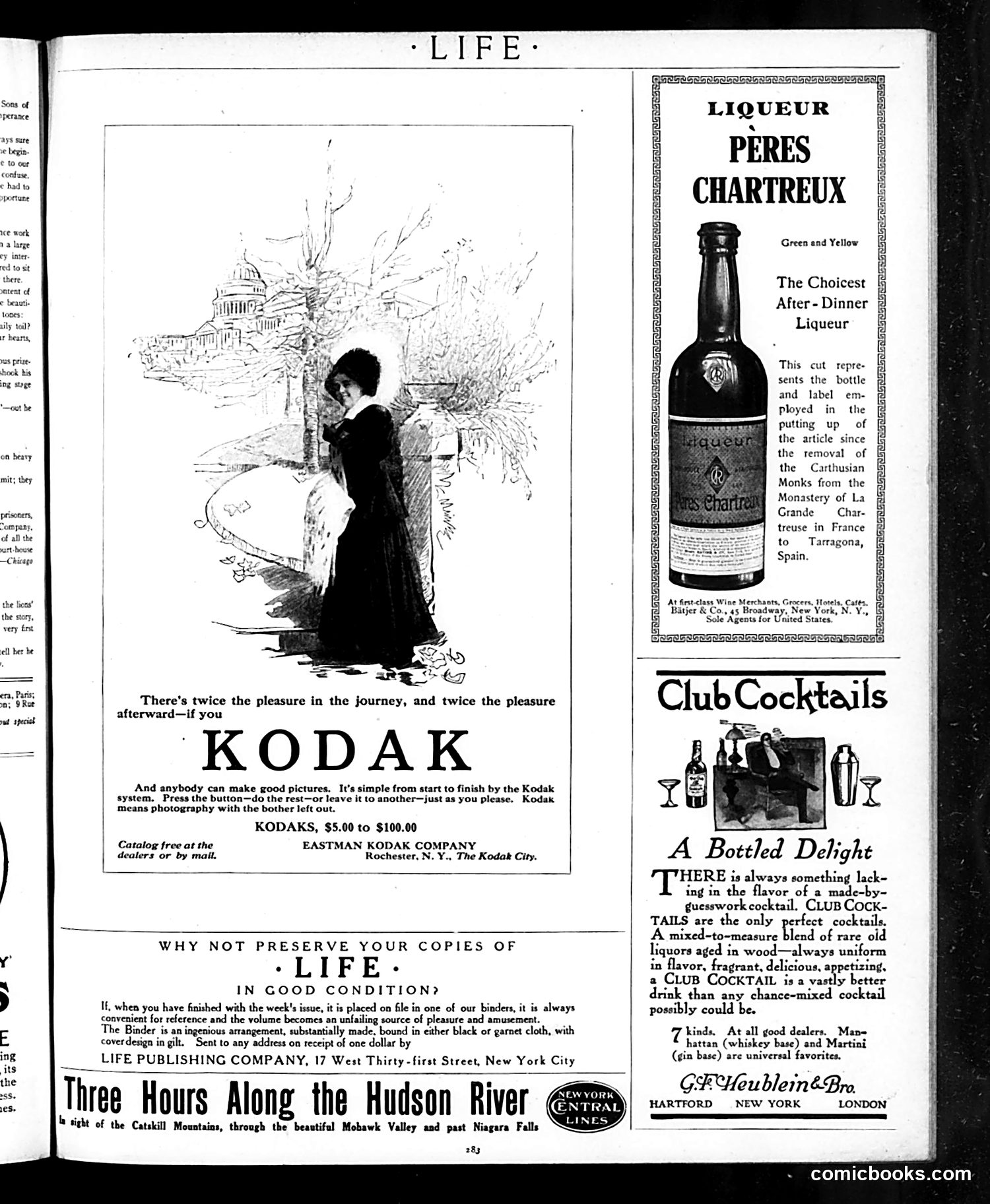
This is primarily an **advertising page** from Life magazine, not a satirical cartoon. The page contains four distinct advertisements: 1. **Kodak camera ad** (left): Features an illustration of a woman photographing a scenic landscape, promoting Kodak's ease-of-use ("Press the button—do the rest"). Priced $5-$100. 2. **Liqueur advertisement** (top right): Promotes Pères Chartreux liqueur, noting the product's history following Carthusian monks' relocation from France to Spain. 3. **Club Cocktails ad** (bottom right): Markets pre-mixed cocktails as superior to homemade versions, emphasizing consistency and quality. 4. **Life Magazine subscription** (center-bottom): Promotes binding Life issues for preservation and reference. 5. **Travel advertisement** (bottom): Three Hours Along the Hudson River train excursion via New York Central Lines. The page reflects early 20th-century consumer culture and leisure activities targeting middle-class audiences.
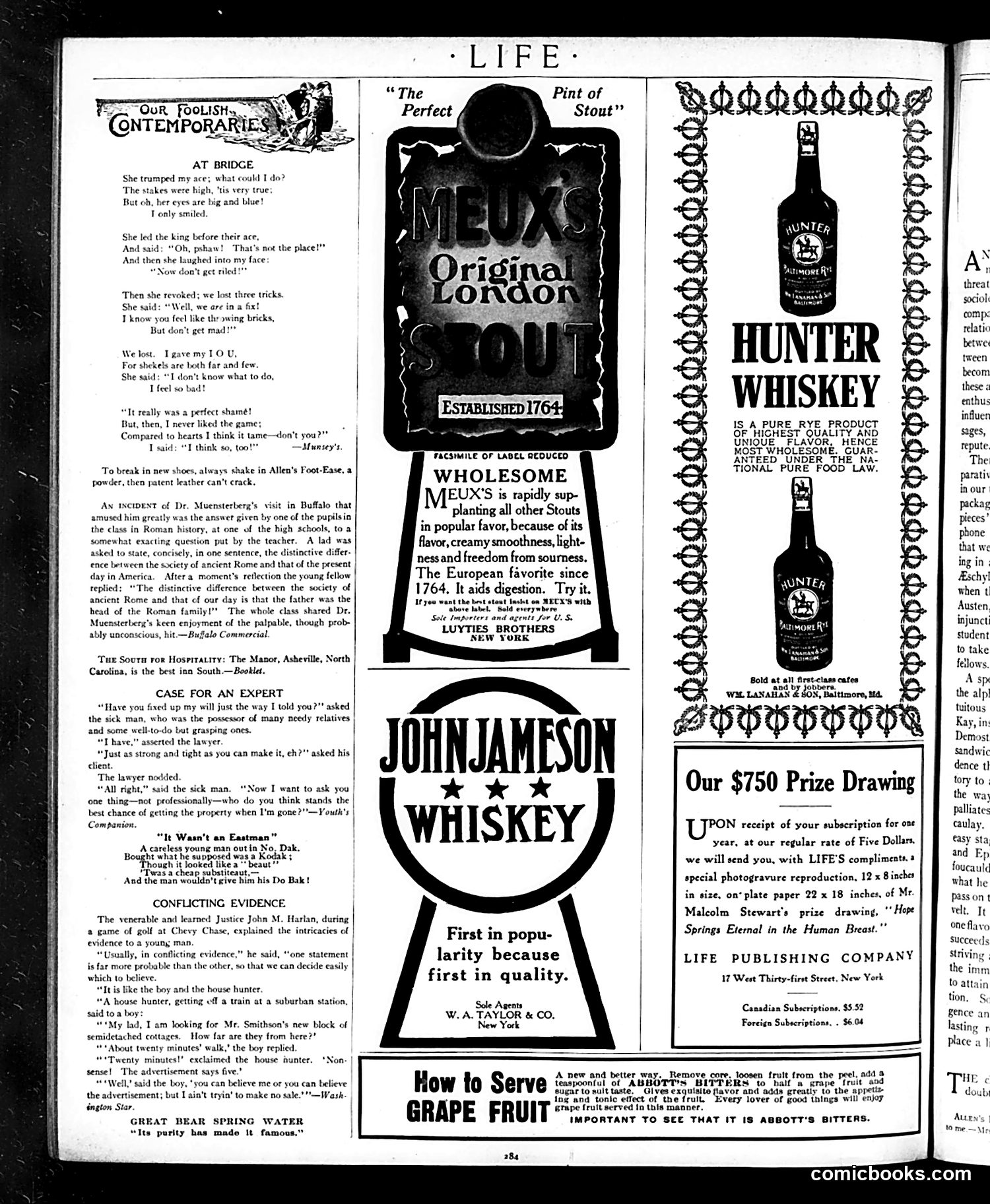
This page is primarily **advertising and humor**, not political satire. The content includes: **Humorous Anecdotes:** - "Our Foolish Contemporaries" presents bridge-playing scenarios where a man loses at cards but doesn't mind because his opponent is attractive—satirizing romantic foolishness over rational judgment - A Roman history student unknowingly makes an astute observation about family structure differences between ancient Rome and modern America - A lawyer joke about a dying man trying to prevent relatives from inheriting - Justice John Harlan's anecdote about conflicting evidence, using a boy's honesty versus advertisement claims **Advertisements:** The page is dominated by alcohol ads (Meux's Stout, John Jameson Whiskey, Hunter Whiskey, Abbott's Bitters) and other products (Great Bear Spring Water, Allen's Foot-Ease). This reflects early-20th-century magazine culture where alcohol advertising was prominent and unregulated. **The humor targets:** naïve romanticism, family greed, and the gap between advertising claims and reality—mild social commentary typical of *Life* magazine's satirical approach.
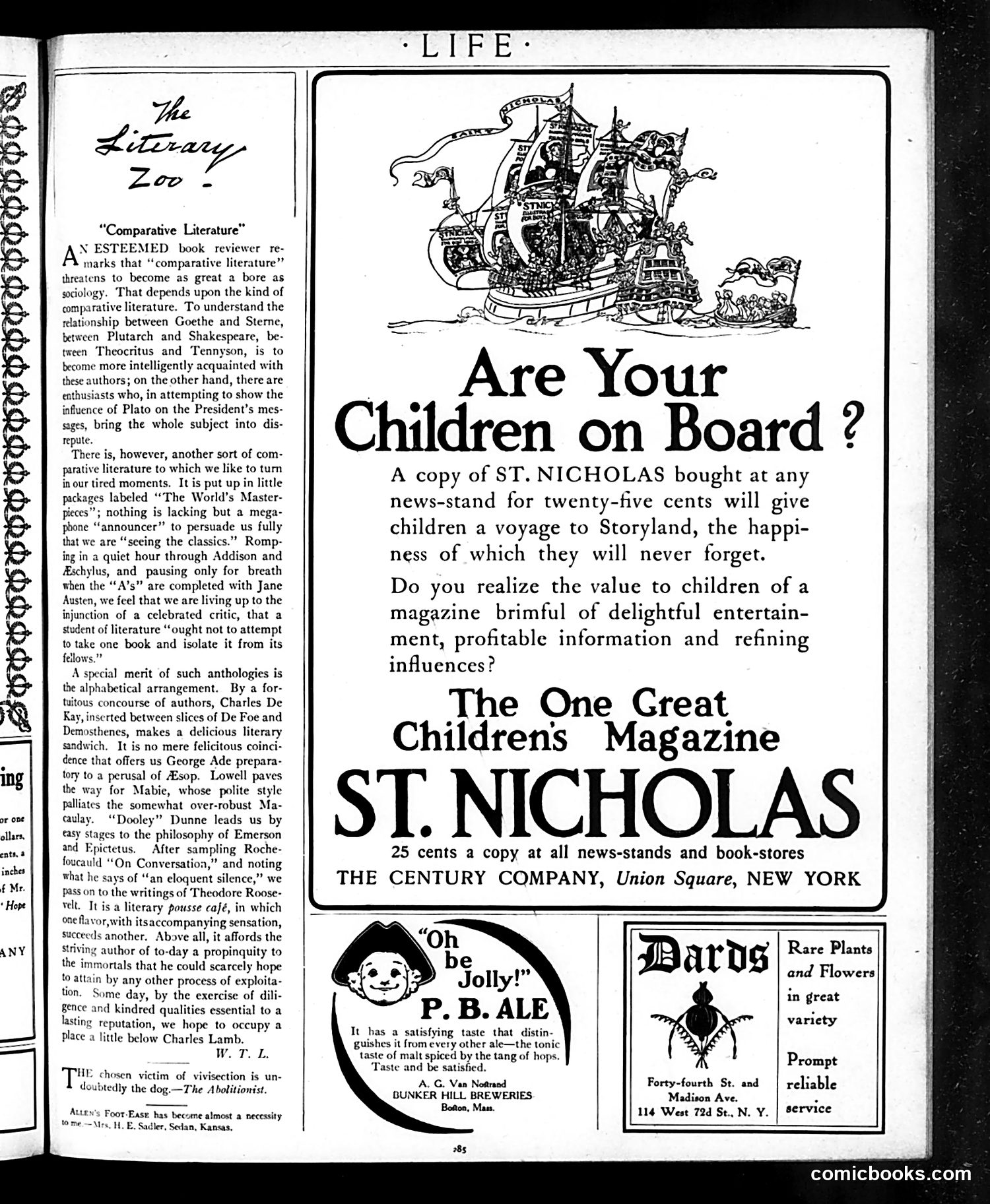
This page is primarily **advertising and editorial content**, not political satire. The left column contains "The Literary Zoo," a humorous essay mocking "comparative literature" anthologies. The author satirizes collections that arbitrarily group classic authors alphabetically—creating absurd juxtapositions like Charles De Kay sandwiched between Defoe and Demosthenes, or Theodore Roosevelt following Rochefoucauld. The joke is that alphabetical arrangement creates pretentious but meaningless "literary" connections, and that reading such collections makes readers feel cultured without genuine understanding. The page's three **advertisements** promote: - *St. Nicholas* magazine for children (with an illustration of a fantastical ship) - P.B. Ale beer - Dard's rare plants and flowers The brief quotes at bottom are reader testimonials. There is **no political cartoon or satire** on this page—it's a typical early 20th-century magazine layout mixing editorial content with paid advertising.
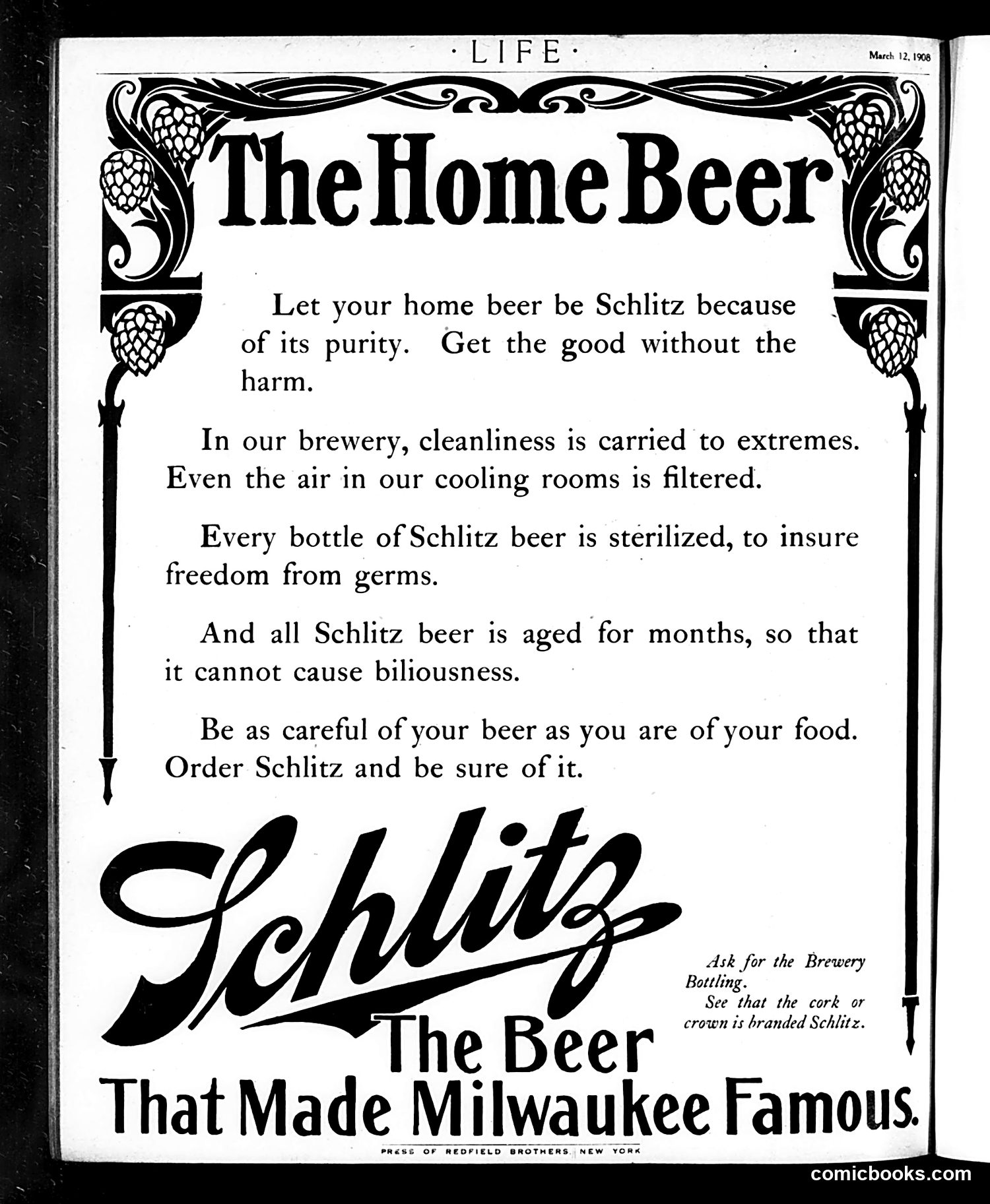
This is a **Schlitz beer advertisement**, not a political cartoon. Published in *Life* magazine on March 12, 1908, it promotes Schlitz as "The Beer That Made Milwaukee Famous." The ad appeals to early 20th-century health anxieties by emphasizing sanitation and purity—claims that would resonate with consumers concerned about food safety and contamination. Key selling points include sterilized bottles, filtered air in cooling rooms, and extended aging to prevent "biliousness" (digestive upset). The decorative hops imagery frames the text, reinforcing the product's natural origins. The closing instruction to verify the branded cork or crown suggests counterfeiting was a concern. This reflects the pre-Prohibition era when beer marketing stressed wholesomeness and scientific production methods to build consumer confidence in an increasingly industrialized food supply.