
Life, 1908-03-12 · page 12 of 20
Life — March 12, 1908 — page 12: what you’re looking at
What you’re looking at
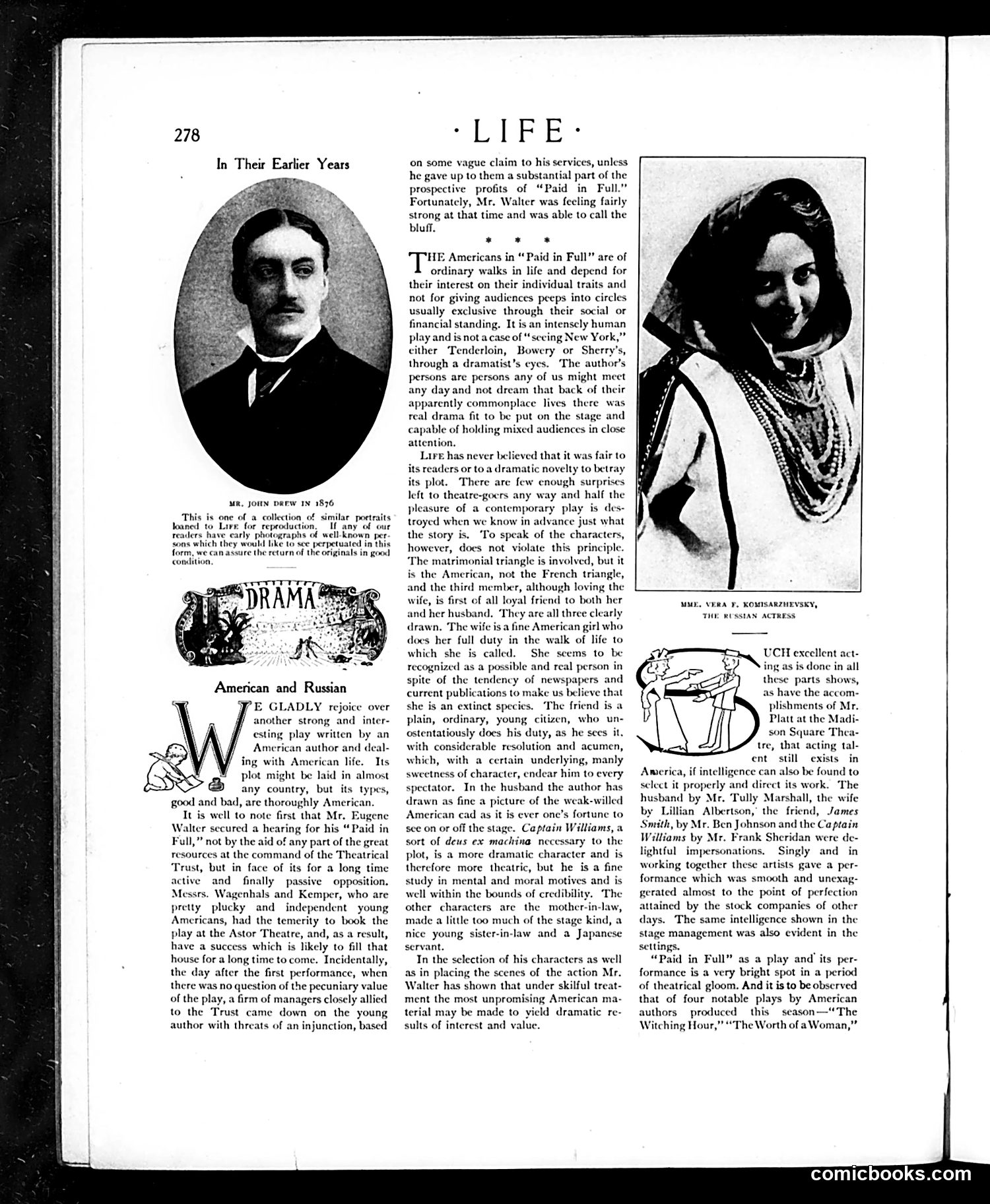
This page discusses Eugene Walter's play "Paid in Full," comparing American and Russian dramatic traditions. The left photograph shows a male playwright or theatrical figure from the early 1900s. The right photograph identifies "Mrs. Vera T. Komissarzhevsky, the Russian actress." The text argues that Walter successfully adapted American life for the stage, creating characters recognizable to ordinary audiences rather than elite society circles. It praises his depiction of a matrimonial triangle involving an American wife, a French friend, and a loyal husband—presenting genuinely human drama rather than exotic spectacle. The article suggests American drama was gaining sophistication by treating common lives seriously, moving beyond reliance on Russian theatrical techniques to develop distinctly American dramatic forms.
📄 Transcribed text from this page (OCR, searchable)
Machine-transcribed from the original scan — historical spelling and the odd misread are preserved.
—— 9 rh aR iE RE 278 In Their Earlier Years atk, JOHN DREW IN 1876 of a collection of similar portraits for reproduction. It any of our phs of well-known per ¢ lo see perpetuated in this turn of the originals in good This is one loaned to L readers have sons which form, we condition, American and Russian PE GLADLY rejoice over another strong and. inter- esting play written by an American author and deal- ing with American life. Its plot might be laid in almost any country, but its types, good and bad, are thoroughly American. It is well to note first that Mr, Eugene Walter secured a hearing for his “Paid in Full,” not by the aid of any part of the great resources at the command of the Theatrical Trust, but in face of its for a long time active and finally passive opposition, Messrs. Wagenhals and Kemper, who are pretty plucky and independent young Americans, had the temerity to book the play at the Astor Theatre, and, as a result, have a success which is likely to fill that house for a long time to come. Incidentally, the day after the first performance, when there was no question of the pecuniary value of the play, a firm of managers closely allied to the Trust came down on the young author with threats of an injunction, based *LIPE- on some vague claim to his services, unless he gave up to them a substantial part of the prospective profits of “Paid in Full Fortunately, Mr. Walter was feeling fairly strong at that time and was able to call the bluff. + * * HE Americans in “ Paid in Full” are of ordinary walks in life and depend for their interest on their individual traits and not for giving audiences peeps into circles usually exclusive through their social or financial standing. It is an intensely human play and is not acase of “seeing New York,” cither Tenderloin, Bowery or Sherry through a dramatist’s eyes. ‘The author's persons are persons any of us might meet any day and not dream that back of their apparently commonplace lives there was. al drama fit to be put on the stage and capable of holding mixed audiences in close attention, Lire has never believed that it fair to its readers or to a dramatic novelty to betray its plot. There are few enough surprises left to theatre-gocrs any way and half the pleasure of a contemporary play is des- troyed when we know in advance just what the story is. ‘To speak of the characters, however, docs not violate this principle. ‘The matrimonial triangle is involved, but it is the American, not the French triangle, and the third member, although loving the wife, is first of all loyal friend to both her and her husband. ‘They are all three clearly drawn. The wife isa fine American girl w1 docs her full duty in the walk of life to which she is called. She scems to be recognized as a possible and real person in spite of the tendency of newspapers and current publications to make us believe that she is an extinct species. ‘The friend is a plain, ordinary, young citizen, who un- ostentatiously does his duty, as he sees it, with considerable resolution and acumen, which, with a certain underlying, manly sweetness of character, endear him to every spectator. In the husband the author has drawn as fine a picture of the weak-willed American cad as it is ever one’s fortune to sce on or off the sta Captain Williams, a sort of deus ex machina necessary to the plot, is a more dramatic character and is therefore more theatric, but he is a fine study in mental and moral motives and is well within the bounds of credibility. The other characters are the mother-in-law, made a little too much of the stage kind, a nice young sister-in-law and a Japanese servant. In the selection of his characters as well as in placing the scenes of the action Mr. Walter has shown that under skilful treat- ment the most unpromising American ma- terial may be made to yield dramatic re- sults of interest and value. oO MALE, VERA ¥, KOMISARZH THEE RUSSIAN. ACTRESS. > SKY, UCH excellent act- ing as is donc in all these parts shows, as have the accom- plishments of Mr. Platt at the Madi. son Square The: tre, that acting tal- ent. still exists in Awcrica, if intelligence can also be found to select it properly and direct its work. ‘The husband by Mr. Tully Marshall, the wife by Lillian Albertson, the friend, James Smith, by Mr. Ben Johnson and the Captain Williams by Mr. Frank Sheridan were de- lightful impersonations, Singly and in working together these a per- formance which was smooth and unexag- gerated almost to the point of perfection attained by the stock companies of other days. The same intelligence shown in the stage management was also evident in the settings. “Paid in Full” as a play and’ its per- formance is a very bright spot in a period of theatrical gloom. And it is to be observed that of four notable plays by American authors produced this season—“ The Witching Hour,” “The Worth of aWoman,” tists gav comicbooks.com