
Life, 1908-03-12 · page 13 of 20
Life — March 12, 1908 — page 13: what you’re looking at
What you’re looking at
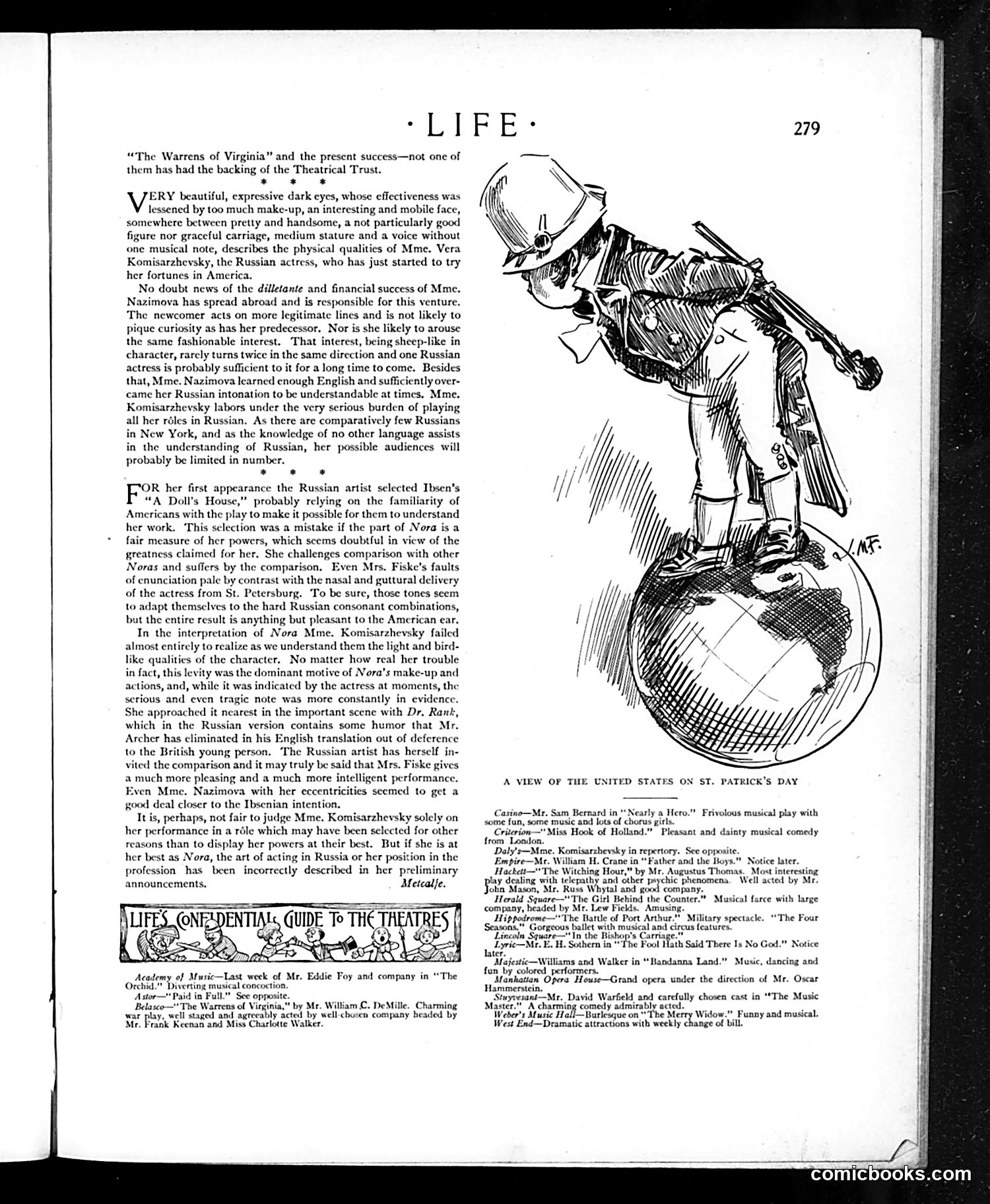
This cartoon depicts a figure in stereotypical Irish dress—wearing a bowler hat and what appears to be tattered clothing—stumbling or dancing awkwardly. The caption identifies this as a representation of America on St. Patrick's Day. The satire likely mocks Irish-American celebrations of St. Patrick's Day, portraying them as rowdy, drunken, or undignified. The disheveled appearance and awkward posture suggest buffoonery or loss of composure. The surrounding text discusses Russian actress Mme. Komissarzhevsky's American theatrical debut, appearing unrelated to the cartoon itself—typical for Life magazine's mixed content layout from this era (early 20th century). The image reflects period stereotypes about Irish immigrants and Irish-Americans that were common in American satire.
📄 Transcribed text from this page (OCR, searchable)
Machine-transcribed from the original scan — historical spelling and the odd misread are preserved.
“The Warrens of Virginia” and the present success—not one of them has had the backing of the Theatrical Trust. * 8 ERY beautiful, expressive dark eyes, whose effectiveness was ssened by too much make-up, an interesting and mobile face, somewhere between pretty and handsome, a not particularly good figure nor graceful carriage, medium stature and a voice without one musical note, describes the physical qualities of Mme. Vera Komisarzhevsky, the Russian actress, who has just started to try her fortunes in America, No doubt news of the dilletante and financial success of Mme. Nazimova has spread abroad and is responsible for this venture. ‘The newcomer acts on more legitimate lines and is not likely to pique curiosity as has her predecessor. Nor is she likely to arouse the same fashionable interest. That interest, being sheep-like in character, rarely turns twice in the same direction and one Russian actress is probably sufficient to it for a long time to come. Besides that, Mme. Nazimova learned cnough English and sufficiently over- came her Russian intonation to be understandable at times. Mme. Komisarzhevsky labors under the very serious burden of playing all her réles in Russian. As there are comparatively few Russians in New York, and as the knowledge of no other language assists in the understanding of Russian, her possible audiences will probably be limited in number. * 8 * OR her first appearance the Russian artist selected Ibsen's “A Doll's House,” probably relying on the familiarity of Americans with the play to make it possible for them to understand her work. ‘This selection was a mistake if the part of Nora is a fair measure of her powers, which scems doubtful in view of the greatness claimed for her. She challenges comparison with other Noras and suffers by the comparison, Even Mrs. Fiske’s faults of enunciation pale by contrast with the nasal and guttural delivery of the actress from St. Petersburg. ‘To be sure, those tones seem to adapt themselves to the hard Russian consonant combinations, but the entire result is anything but pleasant to the American ear. In the interpretation of Nora Mme. Komisarzhevsky failed almost entirely to realize as we understand them the light and bird- like qualities of the character. No matter how real her trouble in fact, this levity was the dominant motive of Nora's make-up and actions, and, while it was indicated by the actress at moments, the serious and even tragic note was more constantly in evidence. She approached it nearest in the important scene with Dr, Rank, which in the Russian version contains some humor that Mr. Archer has climinated in his English translation out of deference to the British young person, ‘The Russian artist has herself in- vited the comparison and it may truly be said that Mrs. Fiske gives a much more pleasing and a much more intelligent performance. Even Mme. Nazimova with her eccentricities seemed to get a good deal closer to the Ibsenian intention. It is, perhaps, not fair to judge Mme. Komisarzhevsky solely on her performance in a réle which may have been selected for other reasons than to display her powers at their best. But if she is at her best as Nora, the art of acting in Russia or her position in the profession has been incorrectly described in her preliminary announcements. Metcalfe. THEATRES GP 302) =A Academy of Music—Last week of Mr. Eddie Foy and company in “The Orchid." Diverting musical concoction. Astor—" Paid in Full." Sce opposite. Belasco—" The Warrens of Vii ia.” by Mr. William C. DeMille. Charming bly acted by well-chosen company headed by rank Keenan and Miss Charlotte Walker. war play, well staged and agrees Mr. F ~ LIFE - A VIEW OP THE UNITED STATES ON ST. PATRICK'S DAY Casino—Mr, Sam Bernard in “Nearly a Hero.” Frivolous musical play with some fun, some music and lots of chorus girls. Criterion—" Miss Hook of Holland.” Pleasant and dainty musical comedy from London. Daly’s—Mme. Komisarzhevsky in repertory. See opposite. Empire—Mc. William H. Crane in “Father and the Boys.” Notice later. Hackett—"The Witching Hour,” by Mr. Augustus Thomas. Most interesting tay dealing with telepathy and other psychic phenomena. Well acted by Mr. Joka Masos, Mr. Russ Whytal and geod company, Herald Square—The Girl Behind the Counter.” company, headed by Mr. Lew Fields. Amusin, Hipp —The Battle of Port Arthur."" Military spectacle. ‘Seas orgeous ballet with musical and circus features. In Square—"'In the Bishop's Carriage.” ri¢é—Mr. E. H. Sothern in ‘The Fool Hath Said There Is No God." Notice Musical farce with large ‘The Four later. Afajestic—Williams and Walker in “‘Bandanna Land.” Music, dancing and fun by colored performers. Manhattan Opera House—Grand opera under the direction of Mr. Oscar Hammerstein. ‘Stuyvesant—Mr. David Warfield and carefully chosen cast in "The Music Master.” A charming comedy admirably acted. : . Weber's Music Hall—Burlesque on "The Merry Widow.” Funny and musical. West End—Dramatic attractions with weekly change of bill. Ccomicbooks.com