
Life, 1908-03-12 · page 4 of 20
Life — March 12, 1908 — page 4: what you’re looking at
What you’re looking at
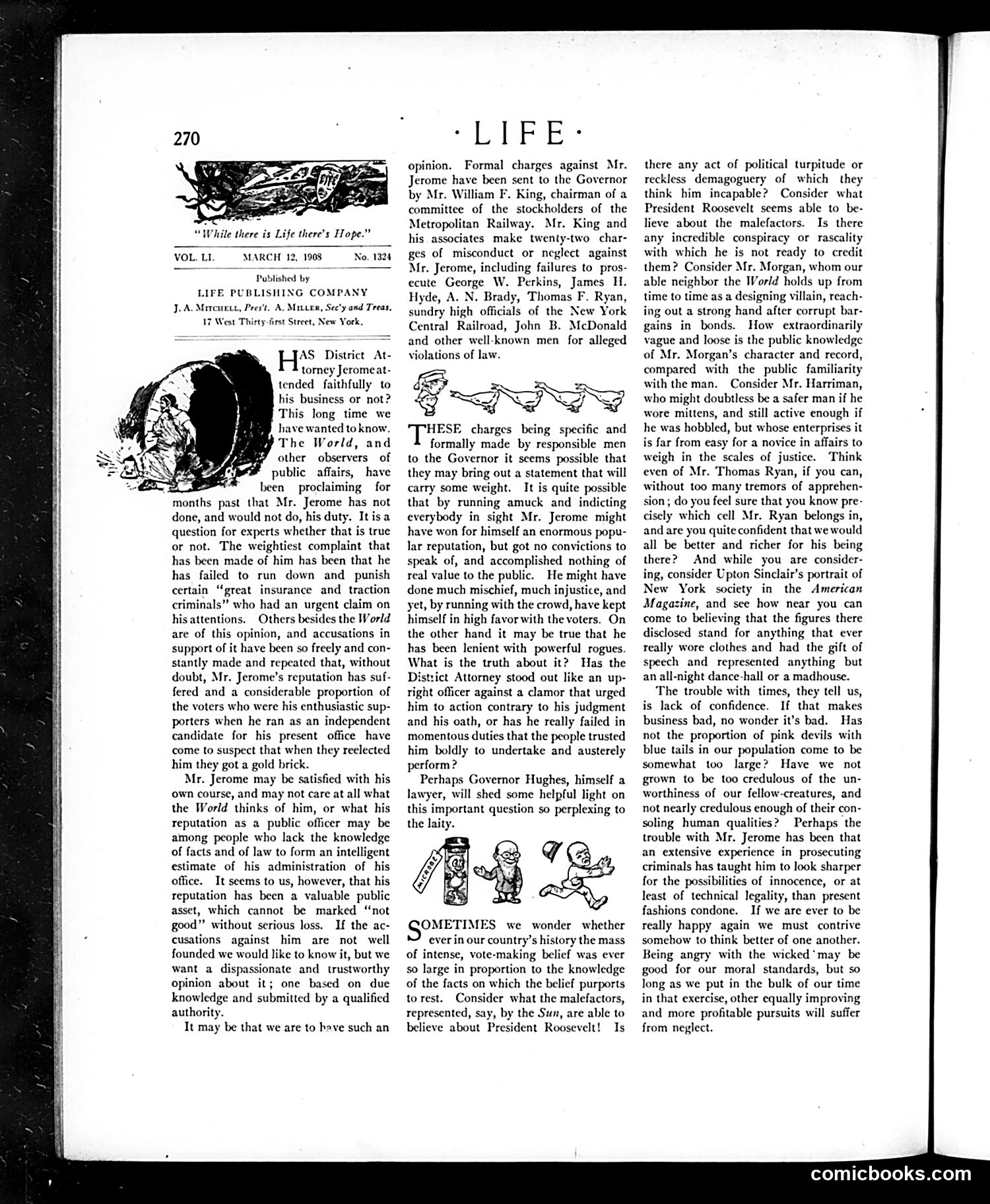
The page contains two political cartoons criticizing District Attorney Jerome. The upper cartoon, captioned "While there is Life there's Hope," depicts Jerome as a figure of public scrutiny regarding corruption allegations against New York Central Railroad officials (Perkins, Brady, Ryan, McDonald, and others). The text argues Jerome has made charges but failed to secure convictions, suggesting he's either incompetent or grandstanding. The lower cartoon appears to show figures dancing or celebrating, likely mocking Jerome's ineffectiveness. The article sardonically questions whether Jerome has genuinely pursued justice or merely created spectacle for public attention, comparing his reputation unfavorably to President Roosevelt's trustbusting efforts. The satire targets Jerome's apparent inability to translate accusations into legal victories.
📄 Transcribed text from this page (OCR, searchable)
Machine-transcribed from the original scan — historical spelling and the odd misread are preserved.
“While there is Life there’s Hope.” MARCH 12, 1908 No. 1324 VOL. LI. Published by LIFE PUBLISHING COMPANY J.A. Mireur, Pres't. A. Miter, Sec'y and Treas. 17 West Thirty-first Street, New York. H*s District At- torney Jeromeat- tended faithfully to his business or not? This long time we have wanted to know. The World, and other observers of public affairs, have been proclaiming for months past that Mr. Jerome has not done, and would not do, his duty. It is a question for experts whether that is truce or not. The weightiest complaint that has been made of him has been that he has failed to run down and punish certain “great insurance and traction criminals” who had an urgent claim on his attentions. Others besides the World are of this opinion, and accusations in support of it have been so freely and con- stantly made and repeated that, without doubt, Mr. Jerome’s reputation has suf- fered and a considerable proportion of the voters who were his enthusiastic sup- porters when he ran as an independent candidate for his present office have come to suspect that when they reelected him they got a gold brick. Mr. Jerome may be satisfied with his own course, and may not care at all what the World thinks of him, or what his reputation as a public officer may be among people who lack the knowledge of facts and of law to form an intelligent estimate of his administration of his office. It seems to us, however, that his reputation has been a valuable public asset, which cannot be marked “not good” without serious loss. If the ac- cusations against him are not well founded we would like to know it, but we want a dispassionate and trustworthy opinion about it; one based on due knowledge and submitted by a qualified authority. It may be that we are to have such an ‘LIFE « opinion. Formal charges against Mr. Jerome have been sent to the Governor by Mr. William F. King, chairman of a committee of the stockholders of the Metropolitan Railway. Mr. King and his associates make twenty-two char- ges of misconduct or neglect against Mr. Jerome, including failures to. pros- ecute George W. Perkins, James H. Hyde, A. N. Brady, Thomas F. Ryan, sundry high officials of the New York Central Railroad, John B. McDonald and other well-known men for alleged violations of law. ESE charges being specific and formally made by responsible men to the Governor it seems possible that they may bring out a statement that will carry some weight. It is quite possible that by running amuck and indicting everybody in sight Mr. Jerome might have won for himself an enormous popu- lar reputation, but got no convictions to speak of, and accomplished nothing of real value to the public. He might have done much mischief, much injustice, and yet, by running with the crowd, have kept himself in high favor with the voters. On the other hand it may be true that he has been lenient with powerful rogues. What is the truth about it? Has the District Attorney stood out like an up- right officer against a clamor that urged him to action contrary to his judgment and his oath, or has he really failed in momentous duties that the people trusted him boldly to undertake and austerely perform? Perhaps Governor Hughes, himself a lawyer, will shed some helpful light on this important question so perplexing to the laity. OMETIMES we wonder whether ever in our country’s history the mass of intense, vote-making belief was ever so large in proportion to the knowledge of the facts on which the belief purports to rest. Consider what the malefactors, represented, say, by the Sux, are able to believe about President Roosevelt! Is there any act of political turpitude or reckless demagoguery of which they think him incapable? Consider what President Roosevelt seems able to be- lieve about the malefactors. Is there any incredible conspiracy or rascality with which he is not ready to credit them? Consider Mr. Morgan, whom our able neighbor the World holds up from time to time as a designing villain, reach- ing out a strong hand after corrupt bar- gains in bonds. How extraordinarily vague and loose is the public knowledge of Mr. Morgan’s character and record, compared with the public familiarity with the man. Consider Mr. Harriman, who might doubtless be a safer man if he wore mittens, and still active enough if he was hobbled, but whose enterprises it is far from easy for a novice in affairs to weigh in the scales of justice. Think even of Mr. Thomas Ryan, if you can, without too many tremors of apprehen- sion ; do you feel sure that you know pre- cisely which cell Mr. Ryan belongs in, and are you quite confident that we would all be better and richer for his being there? And while you are consider- ing, consider Upton Sinclair’s portrait of New York society in the American Magazine, and see how near you can come to believing that the figures there disclosed stand for anything that ever really wore clothes and had the gift of speech and represented anything but an all-night dance-hall or a madhouse. The trouble with times, they tell us, is lack of confidence. If that makes business bad, no wonder it’s bad. Has not the proportion of pink devils with blue tails in our population come to be somewhat too large? Have we not grown to be too credulous of the un- worthiness of our fellow-creatures, and not nearly credulous enough of their con- soling human qualities? Perhaps the trouble with Mr. Jerome has been that an extensive experience in prosecuting criminals has taught him to look sharper for the possibilities of innocence, or at least of technical legality, than present fashions condone. If we are ever to be really happy again we must. contrive somehow to think better of one another. Being angry with the wicked may be good for our moral standards, but so long as we put in the bulk of our time in that exercise, other cqually improving and more profitable pursuits will suffer from neglect. comicbooks.com