
Life, 1908-03-12 · page 6 of 20
Life — March 12, 1908 — page 6: what you’re looking at
What you’re looking at
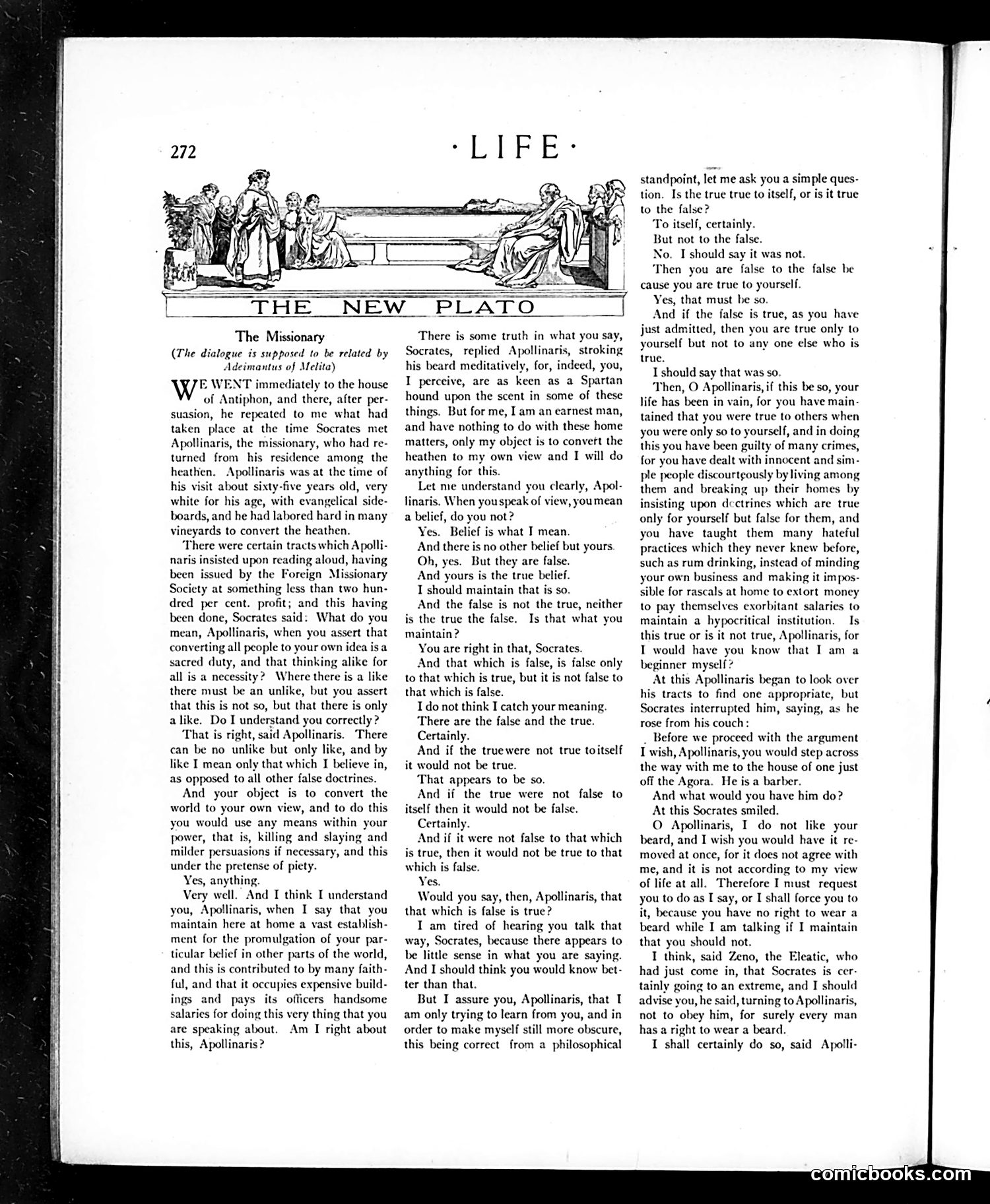
This page presents a Platonic dialogue titled "The Missionary" between Socrates and Apollinaris. The satirical cartoon at top depicts figures in classical robes engaged in philosophical debate—evoking Plato's dialogues. The text mocks missionary conversion efforts through philosophical wordplay. Apollinaris defends converting "heathens" to Christian views, while Socrates challenges the logical contradictions in his arguments about truth and falsehood. A character named Zeno interrupts, defending his right to wear a beard against Apollinaris's demands for conformity. The satire appears to critique rigid missionary dogmatism and cultural imperialism—the insistence on imposing Western/Christian customs alongside doctrine. By casting this in Socratic form, the author suggests missionaries lack genuine philosophical rigor, merely asserting beliefs rather than reasoning through them.
📄 Transcribed text from this page (OCR, searchable)
Machine-transcribed from the original scan — historical spelling and the odd misread are preserved.
THE NEW PLATO The Missionary (The dialogue is supposed to be related by Adeimantus of Melita) E WENT immediately to the house of Antiphon, and there, after per- suasion, he repeated to me what had taken place at the time Socrates met Apollinaris, the missionary, who had re- turned from his residence among the heathen. Apollinaris was at the time of his visit about sixty-five years old, v white for his age, with evangelical side- boards, and he had labored hard in many vineyards to convert the heathen. ‘There were certain tracts which Apolli- naris insisted upon reading aloud, having been issued by the Foreign Missionary Society at something less than two hun- dred per cent. profit; and this having been done, Socrates said: What do you mean, Apollinaris, when you assert that converting all people to your own idea isa sacred duty, and that thinking alike for all is a necessity? Where there is a like there must be an unlike, but you assert that this is not so, but that there is only alike. Do I understand you correctly ? ‘That is right, said Apollinaris. There can be no unlike but only like, and by like I mean only that which I believe in, as opposed to all other false doctrines. And your object to convert the world to your own view, and to do this you would use any means within your power, that is, killing and slaying and milder persuasions if necessary, and this under the pretense of piety. Yes, anything. Very well. And I think I understand you, Apollinaris, when I say that you maintain here at home a vast establish- ment for the promulgation of your par- ticular belief in other parts of the world, and this is contributed to by many faith- ful, and that it occupies expensive build- ings and pays its officers handsome salaries for doing this very thing that you are speaking about. Am I right about this, Apollinaris? There is some truth in what you say, Socrates, replied Apollinaris, stroking his beard meditatively, for, indeed, you, I perceive, are as keen as a Spartan hound upon the scent in some of these things. But for me, I am an earnest man, and have nothing to do with these home matters, only my object is to convert the heathen to my own view and I will do anything for thi Let me understand you clearly, Apol- linaris. When you speak of view, youmean a belief, do you not? Yes. Belief is what T mean. And there is no other belief but yours. Oh But they are false. And yours is the true belief. I should maintain that is so. And the false is not the true, neither is the true the false. Is that what you maintain? You are right in that, Socrates. And that which is false, is false only to that which is true, but it is not false to that which is false. Ido not think I catch your meaning. There are the false and the true. Certainly. And if the truewere not truc toitself it would not be true. That appears to be so. And if the true were not false to itself then it would not be false. Certainly. And if it were not false to that which true, then it would not be true to that which is false. Would you say, then, Apollinaris, that that which is false is true? I am tired of hearing you talk that way, Socrates, because there appears to be little sense in what you are saying. And I should think you would know bet- ter than that. But I assure you, Apollinaris, that T am only trying to learn from you, and in order to make myself still more obscure, this being correct. from a_ philosophical standpoint, let me ask you a simple ques- tion. Is the true true to itself, or is it true to the false? To itself, certainly. But not to the false. No. I should say it was not. Then you are false to the false be cause you are true to yourself. Yes, that must be so. And if the false is true, as you have just admitted, then you are true only to yourself but not to any one else who is true. I should say that was so. ‘Then, O Apollinaris, if this be so, your life has been in vain, for you have main- tained that you were true to others when you were only so to yourself, and in doing this you have been guilty of many crimes, for you have dealt with innocent and sim- ple people discourtgously by living among them and breaking up their homes by insisting upon dcctrines which are true only for yourself but false for them, and you have taught them many hateful practices which they never knew before, such as rum drinking, instead of minding your own business and making it impos- sible for rascals at home to extort money to pay themselves exorbitant salaries to maintain a hypocritical institution. Is this true or is it not true, Apollinaris, for T would have you know that I am a beginner myself? At this Apollinaris began to look over his tracts to find one appropriate, but Socrates interrupted him, saying, as he rose from his couch : . Before we proceed with the argument I wish, Apollinaris, you would step across the way with me to the house of one just off the Agora. He is a barber. And what would you have him do? At this Socrates smiled. © Apollinaris, I do not like your beard, and I wish you would have it re- moved at once, for it does not agree with me, and it is not according to my view of life at all. Therefore I must request you to do as I say, or I shall force you to it, because you have no right to wear a beard while I am talking if I maintain that you should not. I think, said Zeno, the Eleatic, who had just come in, that Socrates is cer- tainly going to an extreme, and I should advise you, he said, turning to Apollinaris, not to obey him, for surely every man has a right to wear a beard. I shall certainly do so, said Apolli- Comicbooks.com