
A complete issue · 20 pages · 1908
Life — February 13, 1908
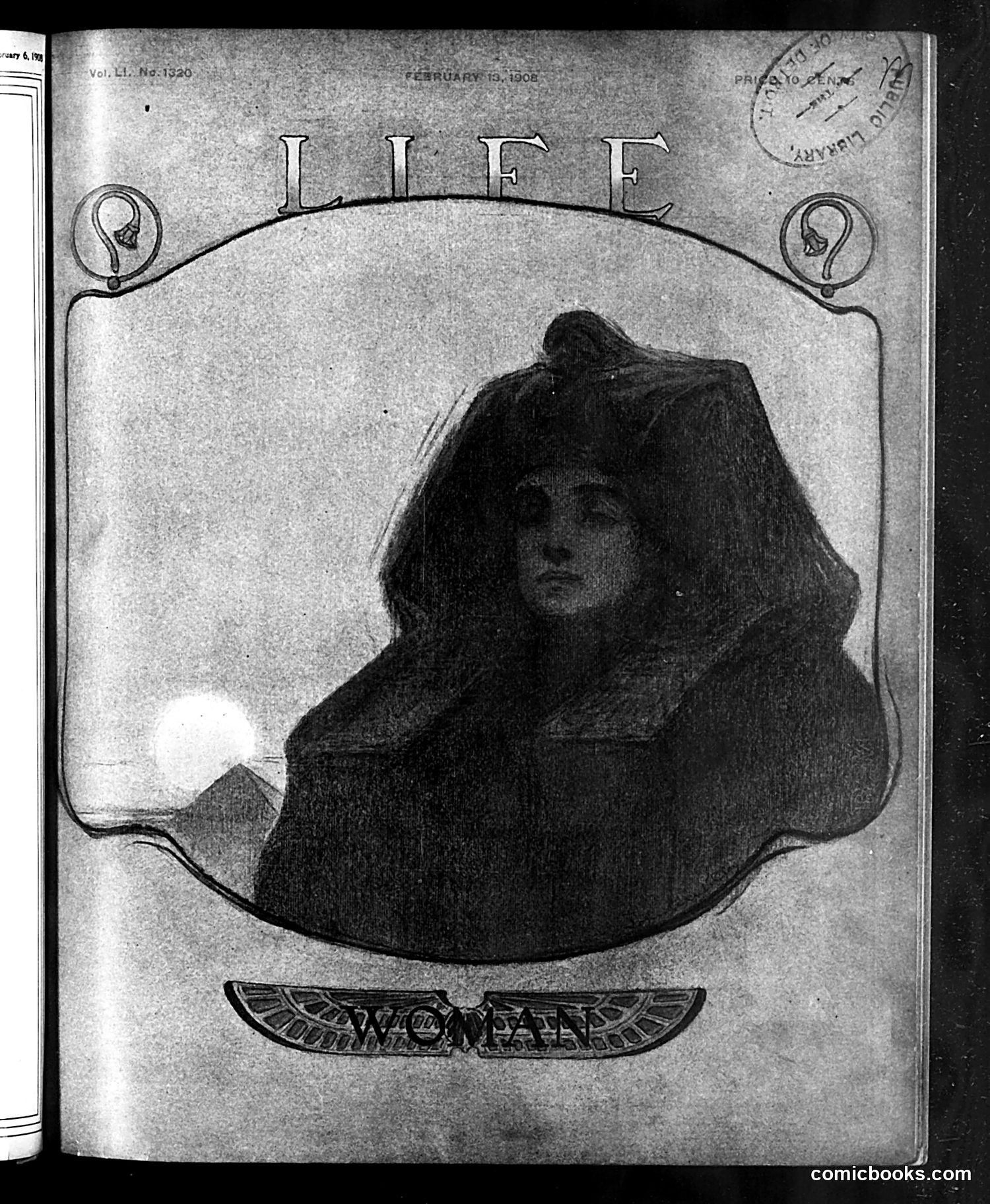
I can see this is a cover from *Life* magazine dated February 13, 1908 (Vol. 51, No. 1320). The image shows a portrait of a woman wearing a dark veil or head covering, rendered in dramatic black and white. The word "LIFE" appears at the top in large letters, with decorative Art Nouveau-style elements on either side. However, without the accompanying article text or caption, I cannot definitively identify who this woman is or what specific political or social commentary the cover intended. The veil suggests possible themes around women's roles, fashion, or potentially international affairs of that era, but identifying the specific figure or satirical point would require additional context I cannot reliably extract from the image alone.
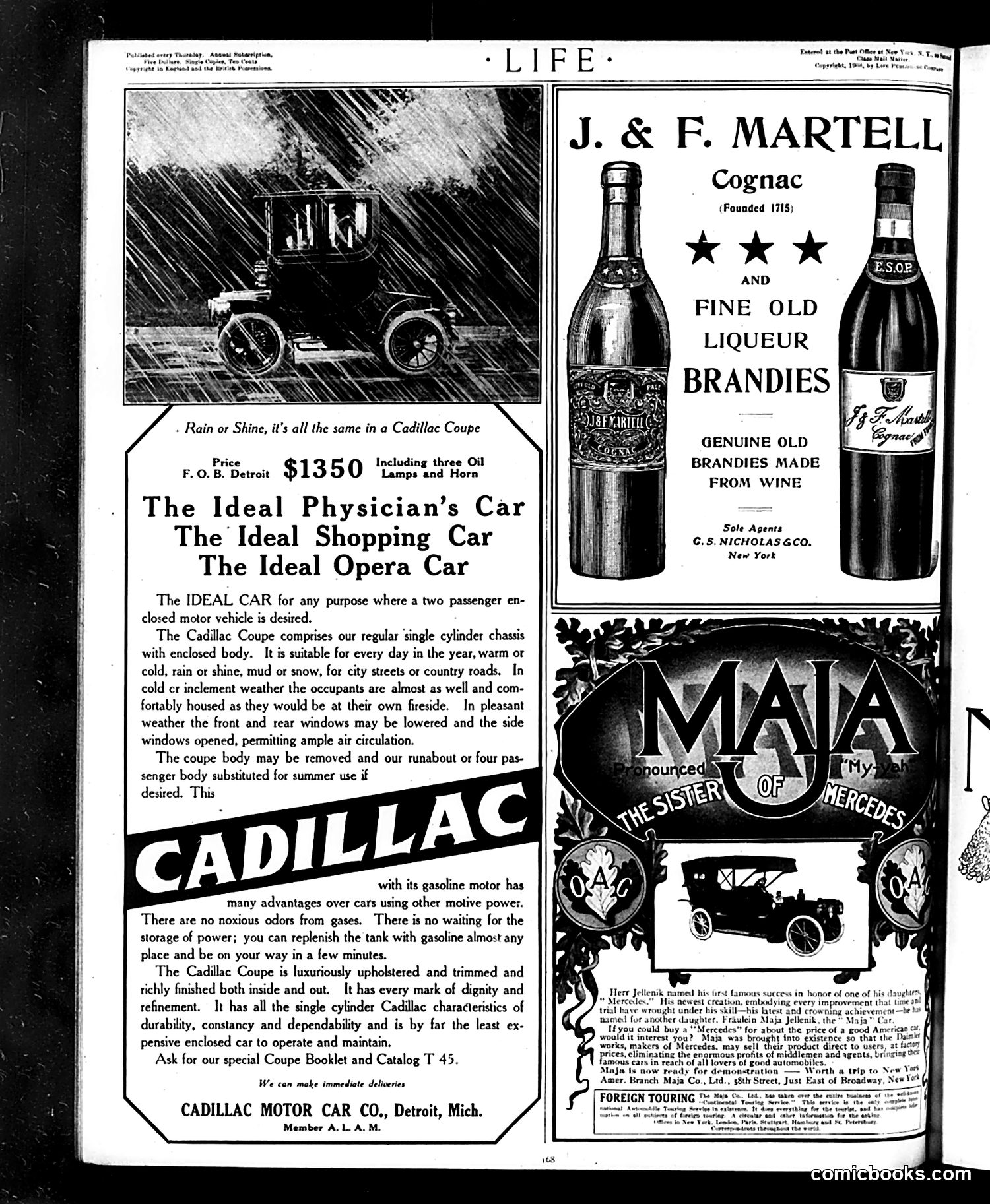
This page is primarily **advertising**, not satirical content. The left side features a Cadillac Coupe advertisement emphasizing its enclosed, weather-resistant design suitable for physicians, shopping, and opera attendance—appealing to affluent urban professionals. The $1,350 price (F.O.B. Detroit) highlights this as a luxury vehicle. The right side shows two advertisements: J. & F. Martell cognac (founded 1715) and Maja perfume, described as "The Sister of Mercedes." The Maja ad includes decorative text about a fictional character and references "Foreign Touring," suggesting international luxury goods marketed to wealthy consumers. Together, these ads target the same affluent readership with premium products—automobiles, spirits, and cosmetics—reflecting 1910s consumer culture and aspirational marketing.
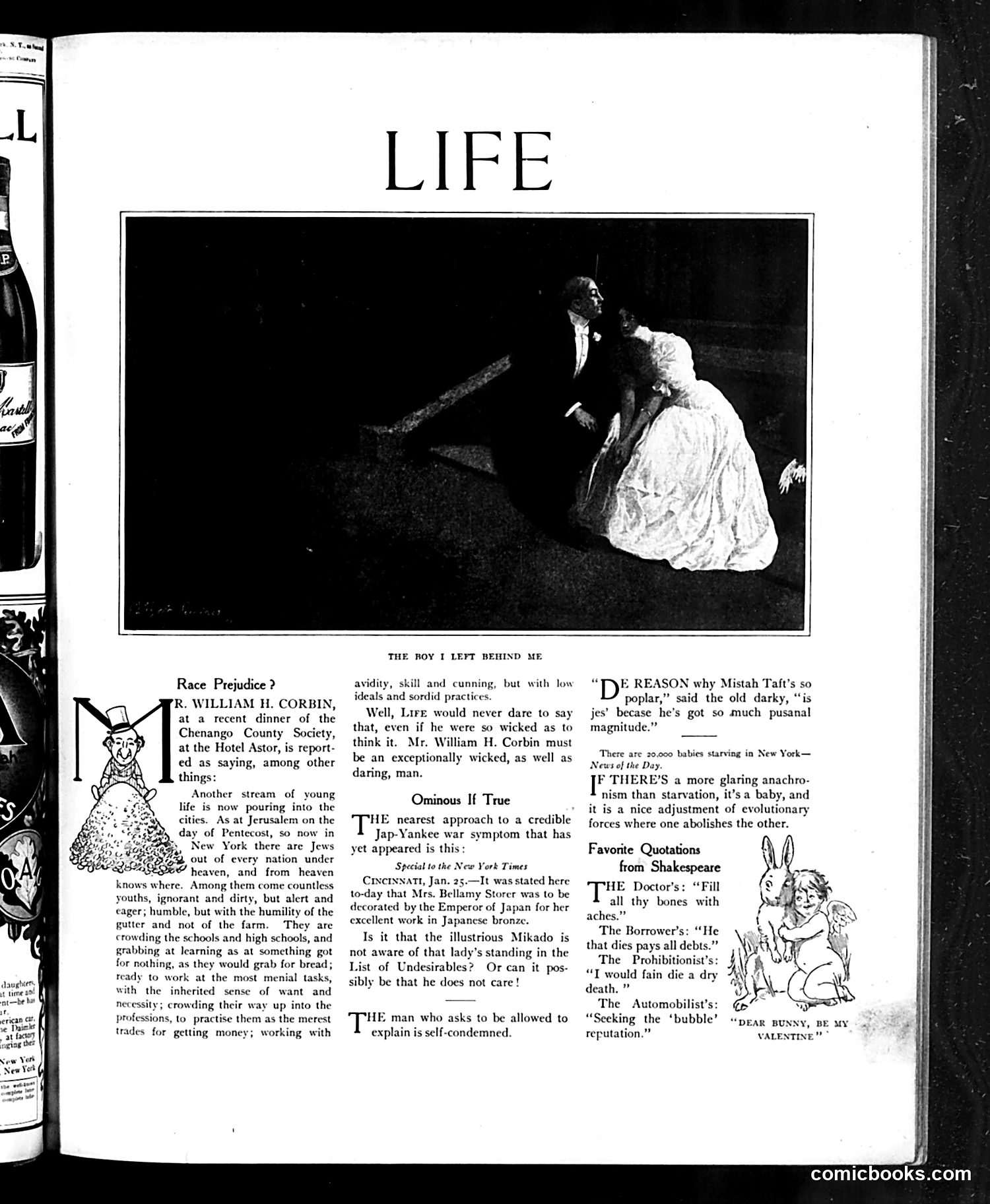
The page features an article titled "Race Prejudice?" by William H. Corbin from the Chenango County Society at the Hotel Astor. Corbin argues that prejudice against Jewish immigrants in New York cities isn't actually prejudice but rather justified criticism of their behavior—describing them as "ignorant and dirty" but possessing "cunning" and "wicked" practices. The accompanying photograph shows a couple in formal dress labeled "The Boy I Left Behind Me." The article represents early 20th-century antisemitic rhetoric, presenting ethnic stereotyping as rational observation rather than prejudice. This reflects the period's widespread anti-immigrant and antisemitic attitudes in American publications, even those claiming satire.
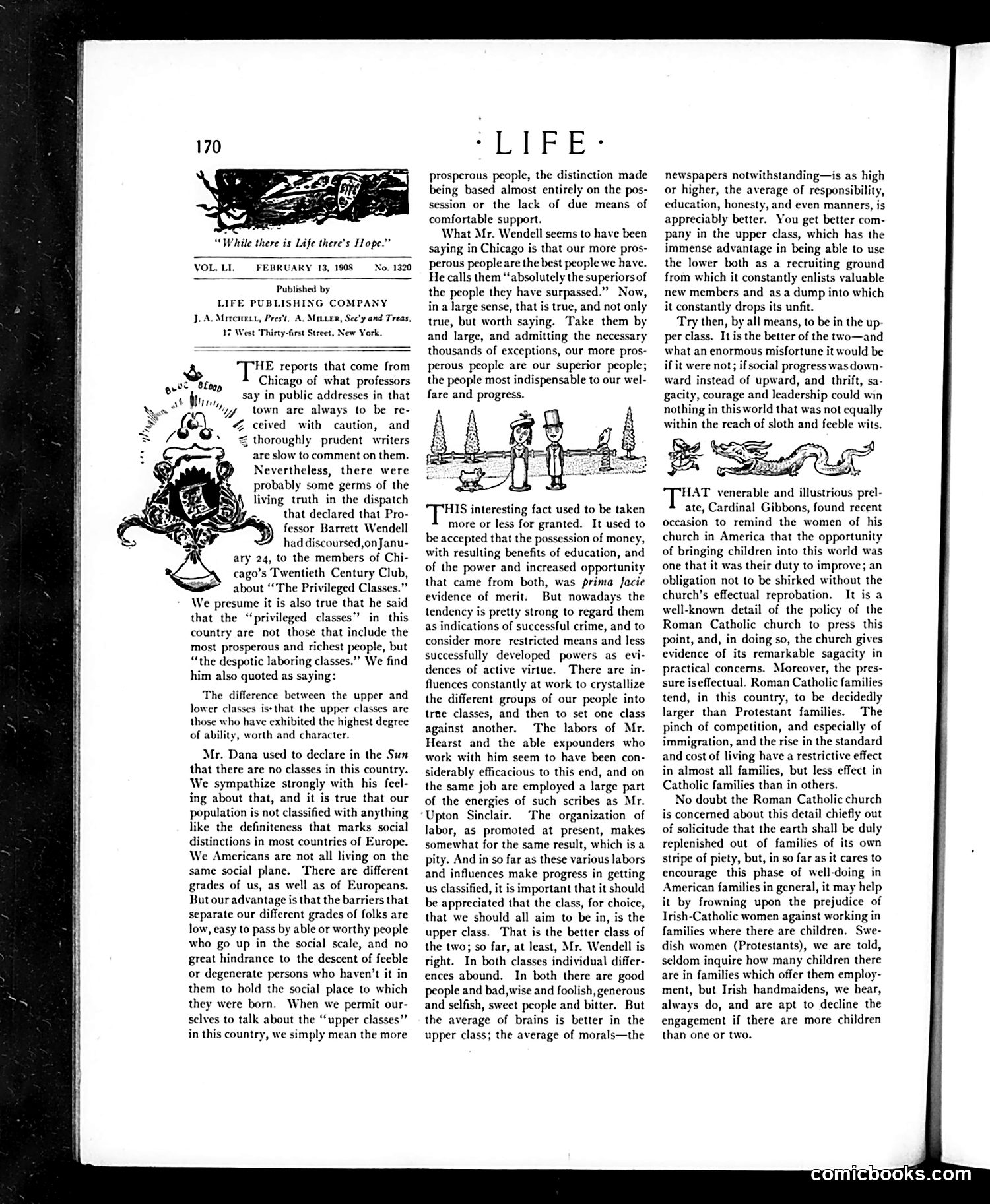
The page contains two distinct editorial cartoons addressing American class distinctions. **Left cartoon**: Shows a decorative heraldic crest or coat of arms, accompanying text mocking the notion of "privileged classes" in America. The illustration satirizes American pretensions to European-style aristocracy, suggesting such class hierarchies shouldn't exist in a democratic nation. **Right cartoon**: Depicts figures in Victorian dress (appearing to be wealthy people) in a domestic scene. This supports the article's discussion of whether upper and lower classes possess inherent superiority or merely different circumstances. **Main argument**: The editorial criticizes the assumption that wealth indicates moral or intellectual superiority, arguing instead that both classes contain virtuous and flawed individuals. The satire targets American class snobbery and the false belief that prosperity reflects personal merit rather than circumstance.
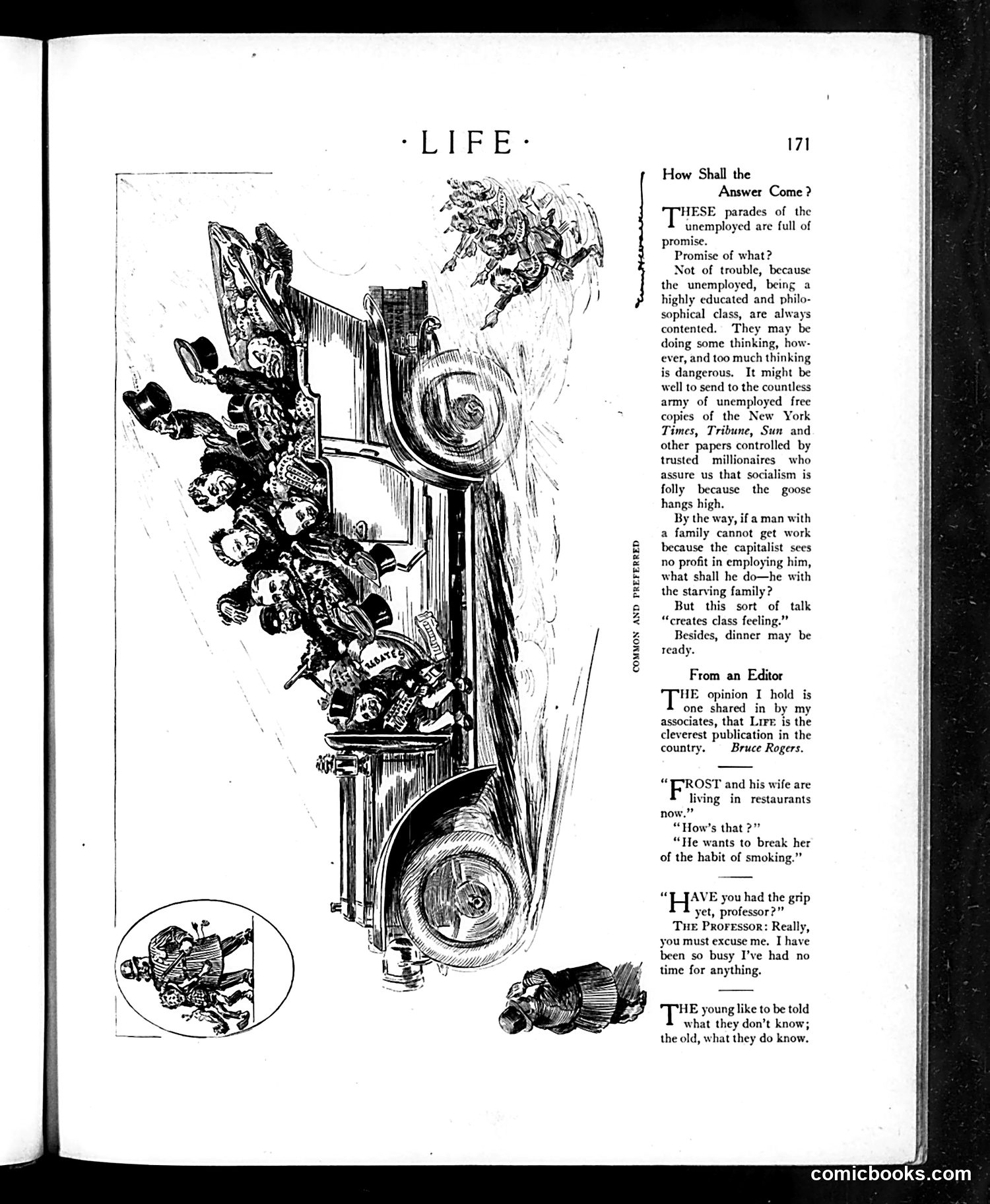
The main cartoon depicts **unemployed workers literally overflowing from a trash bin or disposal container**, suggesting they're being treated as human waste. This satirizes how society discards jobless people during economic hardship. The accompanying text attacks **wealthy newspaper owners** (Times, Tribune, Sun) for distributing free pro-capitalist propaganda to the unemployed, telling them socialism is foolish while offering no actual solutions. The author mocks this as "creates class feeling." The smaller comic snippets below offer social commentary: Frost living in restaurants to quit smoking, and a professor admitting he's too busy for anything. The overall message: **the unemployed are being manipulated by the wealthy press rather than genuinely helped**, during what appears to be a Depression-era economic crisis.
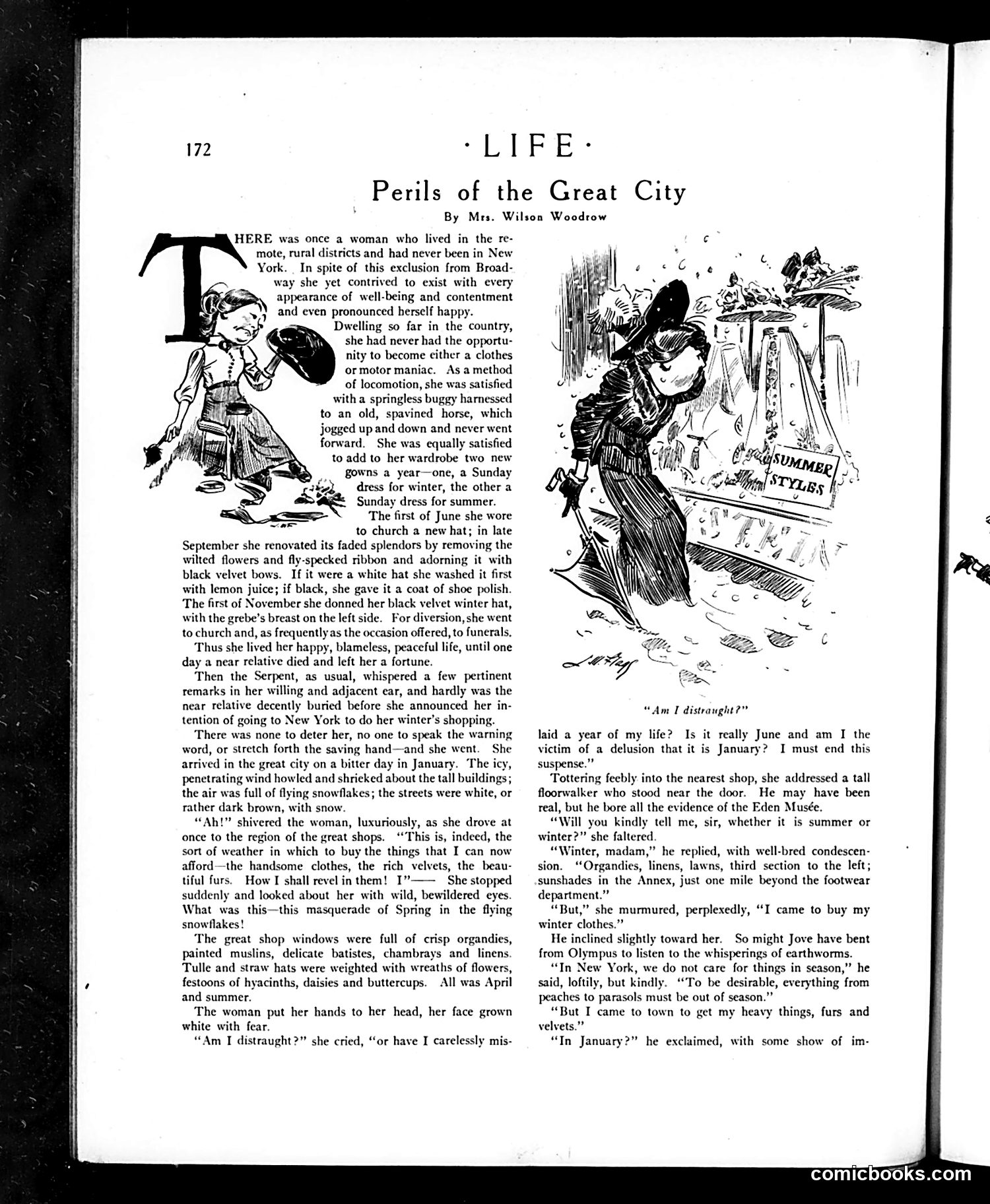
This satirical story warns against the corrupting dangers of urban life. A naive rural woman moves to New York City and becomes seduced by consumerism and fashion. She abandons her simple country contentment for expensive clothes, accessories, and seasonal fashions—summer hats, winter coats, furs, and velvet trimmings. The narrative's ironic title suggests she faces genuine "perils": not crime or moral corruption, but rather the city's materialistic temptations. A shopkeeper deliberately exploits her confusion about seasons, convincing her that New York's summer requires entirely different wardrobes than winter. The satire mocks both the woman's gullibility and the city's commercial machinery designed to create artificial consumer desires in unsuspecting newcomers.
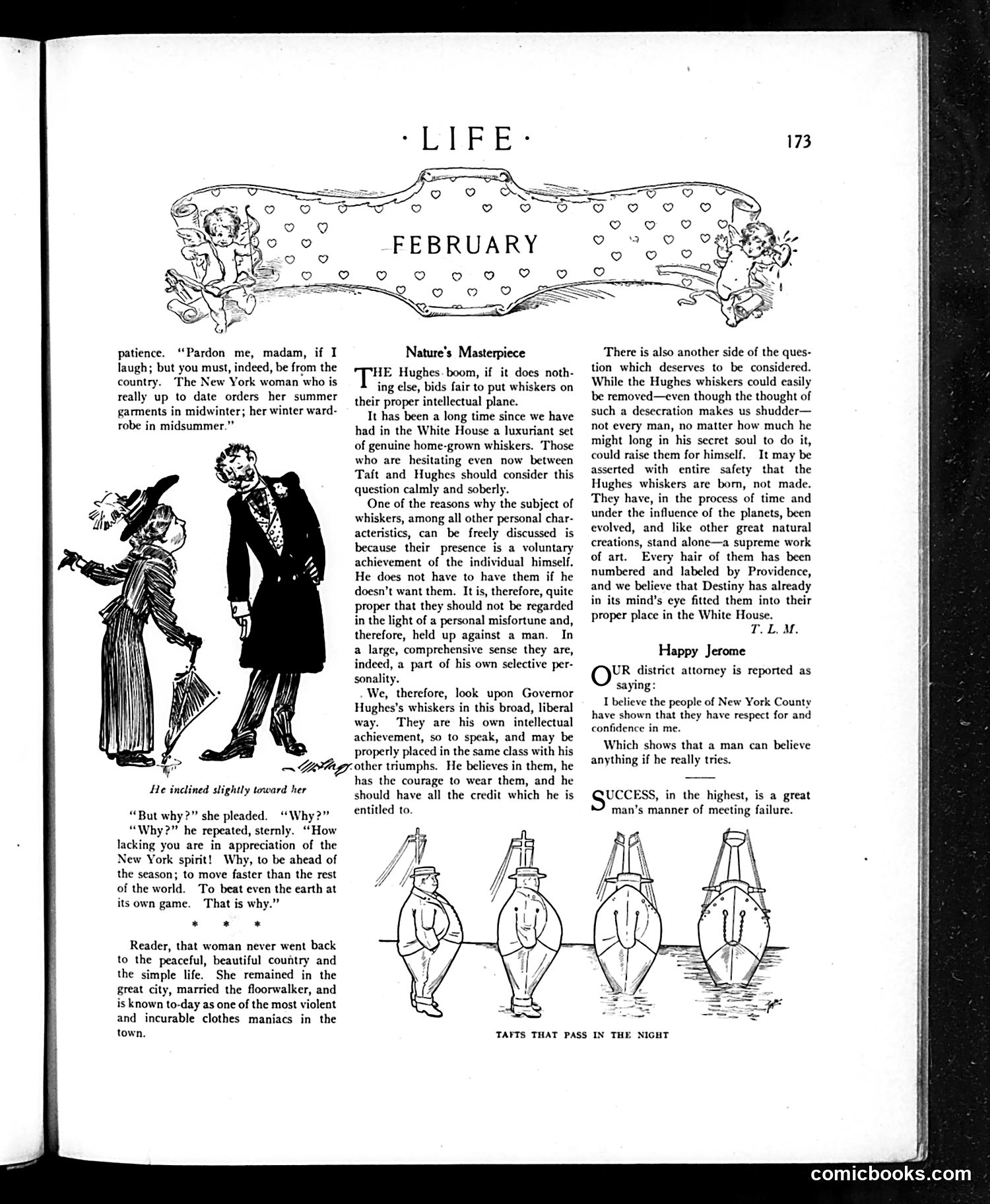
This page contains satirical commentary on New York society and politics, likely from the early 20th century. The main illustrated anecdote depicts a couple, with text explaining a woman's choice to remain in New York despite her suitor's pleas. She rejects his proposal to leave for the countryside, preferring the city's social scene. The satire targets both urban pretension and women's social ambitions. The "Nature's Masterpiece" section discusses Governor Hughes' whiskers as an intellectual achievement, mocking both the Governor and society's obsession with trivial personal characteristics. The bottom cartoon, "Tafts That Pass in the Night," appears to be political commentary on President Taft, using visual puns about "tafts" (unclear exact meaning) and nighttime activity—likely satirizing political dealings or social behavior. The overall tone mocks urban sophistication and political figures.
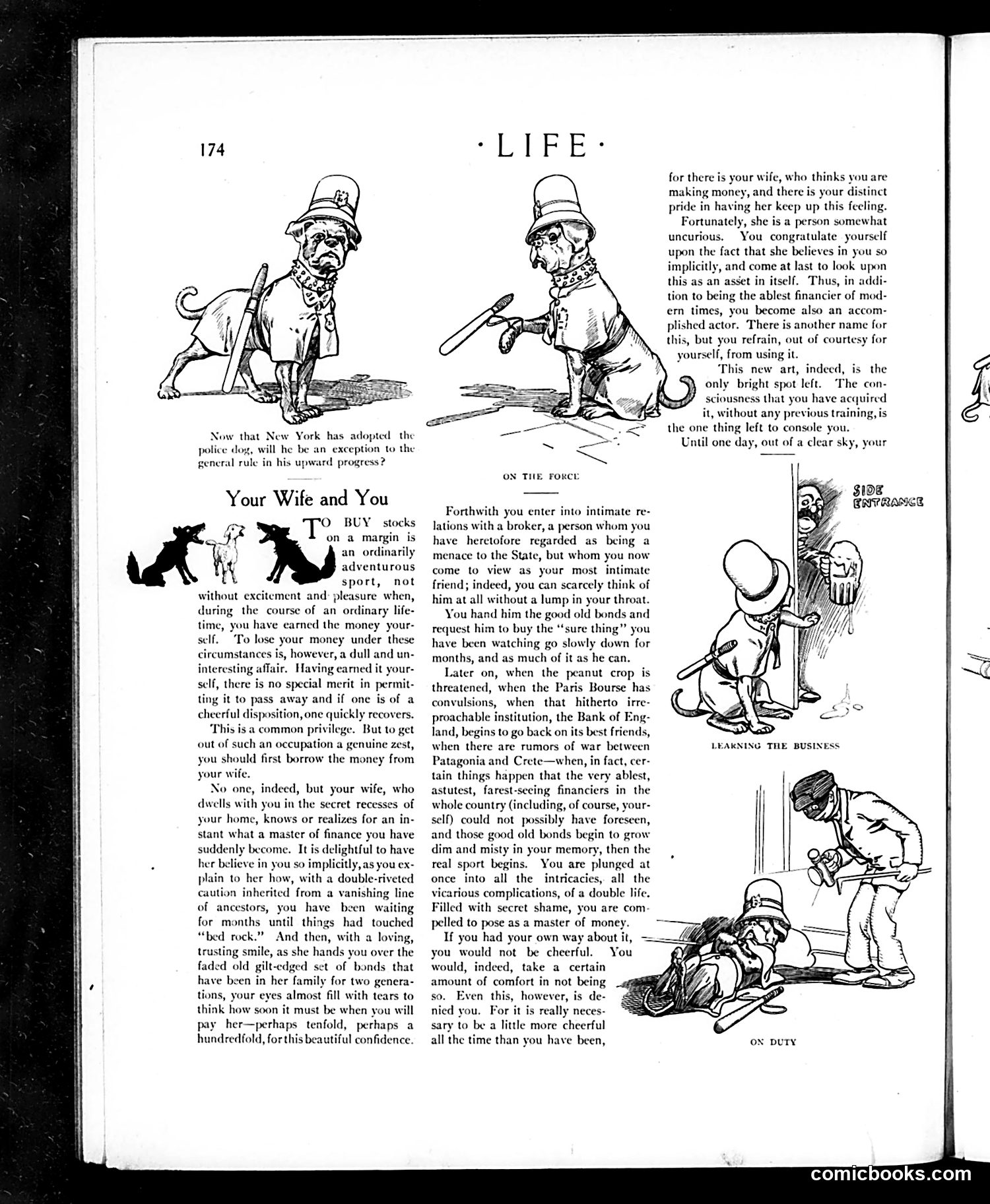
This page satirizes the relationship between husbands and wives regarding finances and social standing. The main article "Your Wife and You" advises men on borrowing money from their wives to maintain appearances of wealth—a delicate social matter in early 20th-century upper-class culture. The cartoon vignettes labeled "ON THE FORCE," "SIDE COMMENTARY," "LEARNING THE BUSINESS," and "ON DUTY" appear to depict dogs in human situations (wearing hats and clothes), likely satirizing men navigating financial and social obligations. The anthropomorphized dogs suggest these behaviors are animalistic or undignified. The overall message critiques masculine pride and the performative nature of wealth in polite society, where men must sometimes depend on wives' discretion to maintain their social facade.
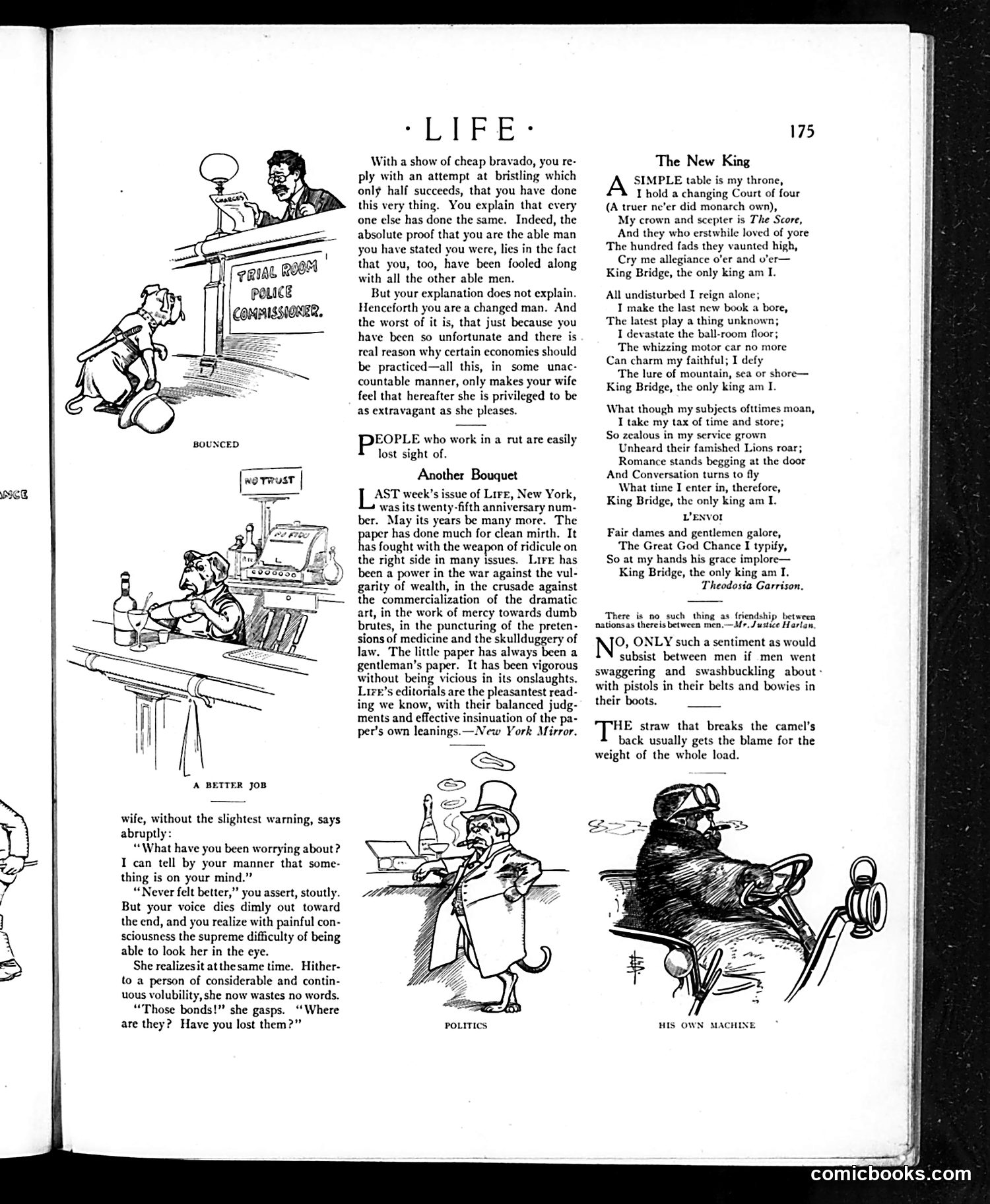
The page contains three political cartoons satirizing early 20th-century American governance and social issues. **"Bounced"** shows a figure being ejected from a "Trial Room" labeled "Police Commissioner," likely mocking corrupt or incompetent police leadership. **"A Better Job"** depicts marital discord, where a wife confronts her worried husband. The satire targets domestic anxiety, possibly reflecting economic or professional instability of the era. **"Politics"** caricatures a portly politician, suggesting commentary on corrupt or self-serving government officials. **"His Own Machine"** shows a figure trapped in mechanical gears, likely satirizing how citizens become ensnared by industrial or governmental systems beyond their control. The accompanying text discusses Life magazine's twenty-fifth anniversary and praises its role fighting commercial corruption and vulgar excess in American society.
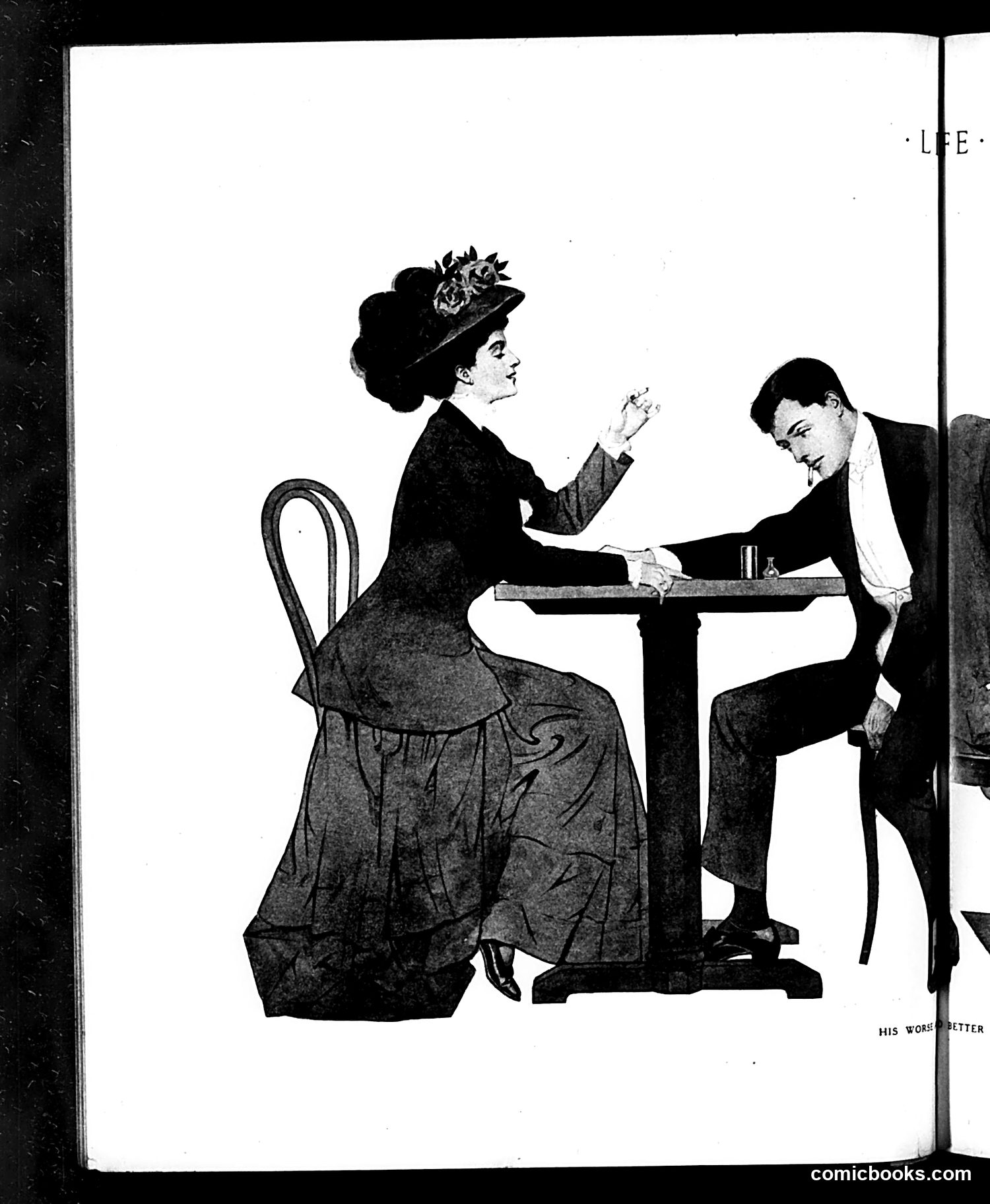
This appears to be a satirical illustration from *Life* magazine showing two figures at a small table. A woman in elegant Edwardian dress with an elaborate hat sits across from a man in business attire who is writing or signing something. The partial caption visible reads "HIS WORSE BETTER" (likely "HIS WORK BETTER" or similar). The satire likely comments on **gender dynamics in courtship or marriage**—suggesting that a woman's presence or attention improves a man's productivity or behavior. The illustration's style and fashion suggest **early 20th century** dating. Without the complete caption text, the exact satirical point remains somewhat unclear, but it appears to mock either male vanity or contemporary assumptions about women's influence on men's professional performance.
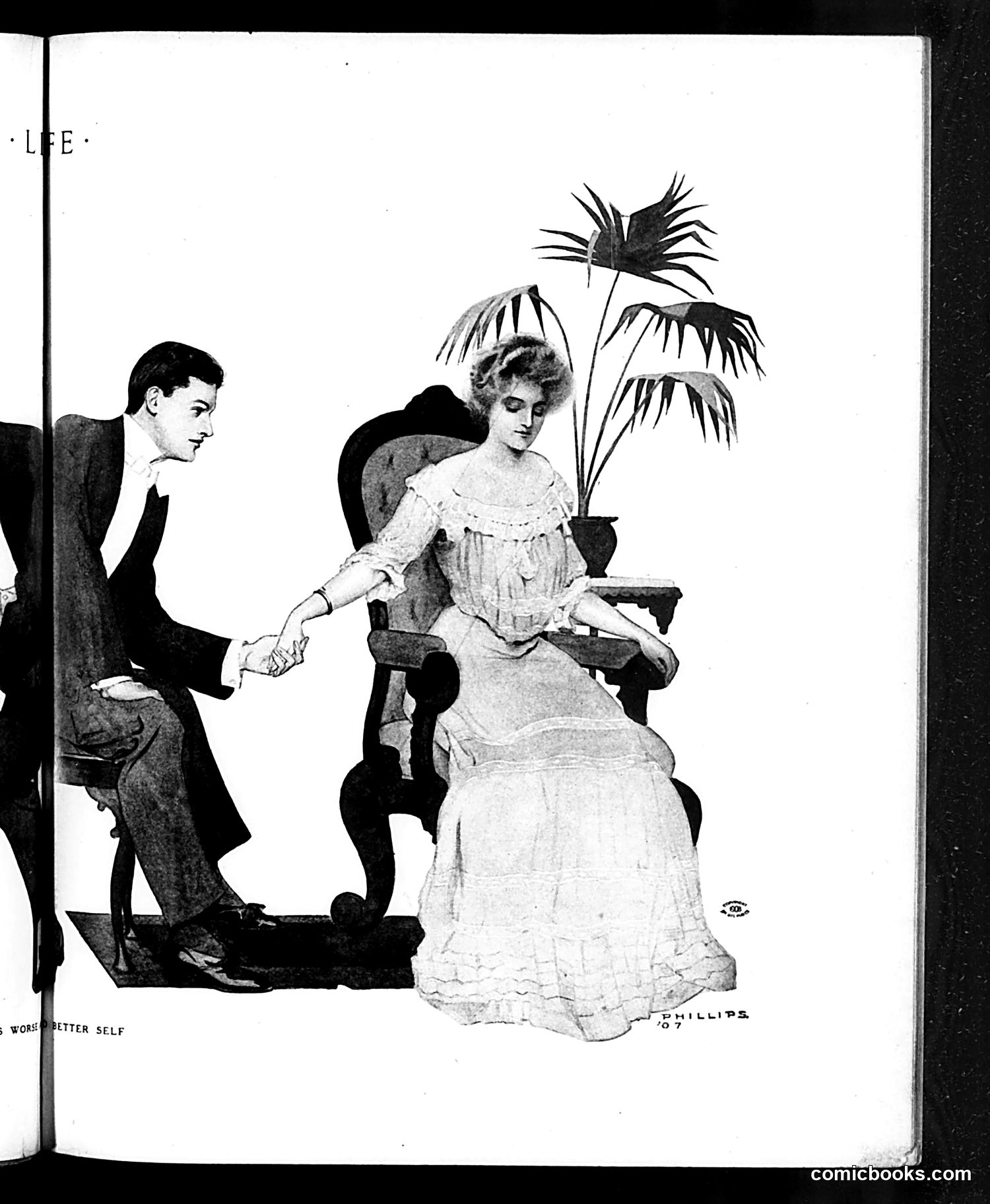
This illustration by Phillips depicts a romantic or courtship scene between a well-dressed man and an elegantly gowned woman seated beside a potted plant. The page header reads "LIFE" and partial text at bottom mentions "BETTER SELF," suggesting this relates to self-improvement or social etiquette themes common to early 20th-century Life magazine. The formal attire, refined poses, and domestic setting reflect upper-class social conventions of the era. Without additional context or visible caption text, the specific satirical point remains unclear—though it likely comments on courtship rituals, social propriety, or relationship dynamics that Life's readers would have recognized. The artwork style is consistent with early 1900s magazine illustration.
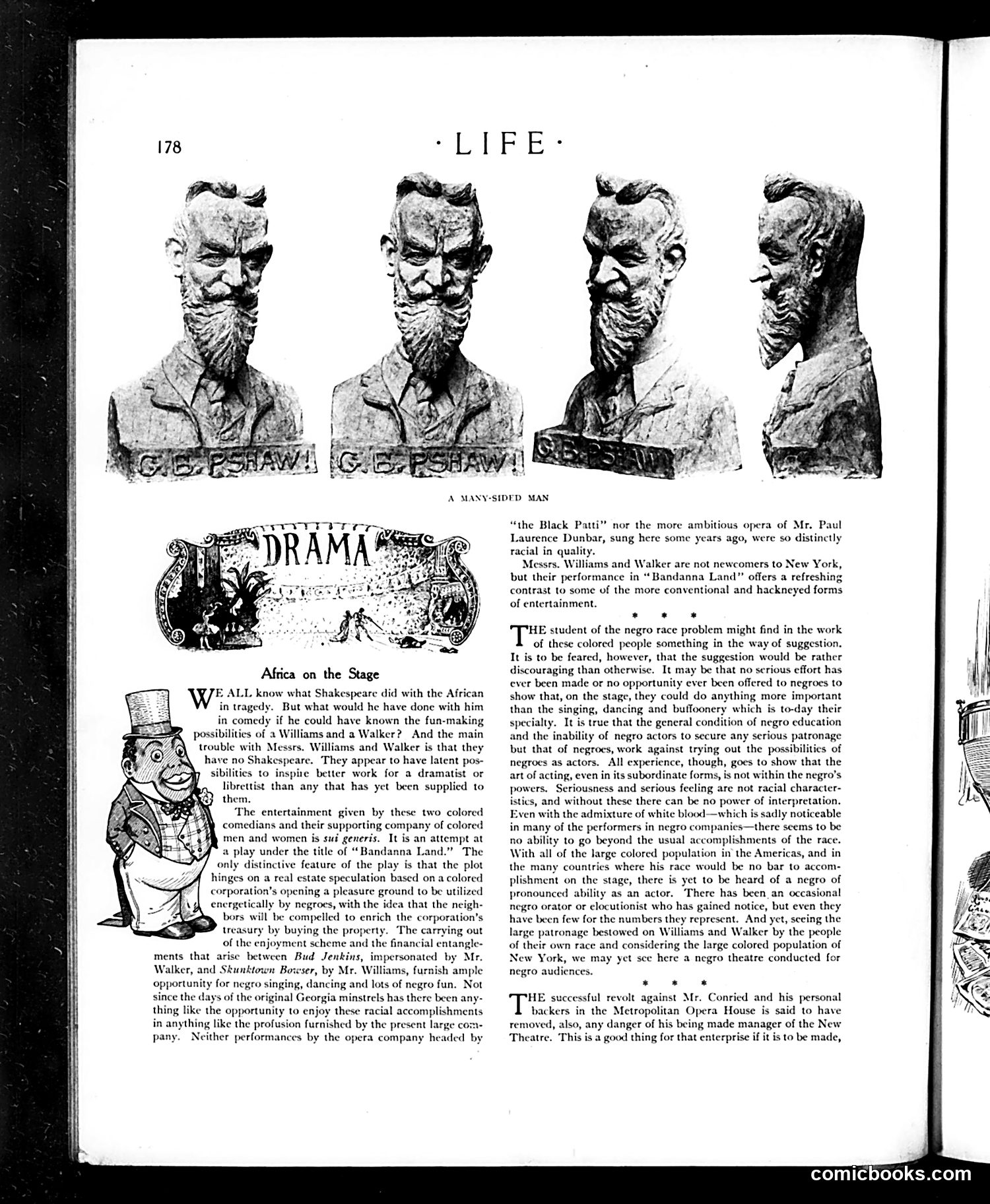
This page critiques a theatrical production called "Bandanna Land," performed by African American entertainers Williams and Walker. The busts at top show G.E. Pshaw (likely a caricatured critic or figure of authority). The article expresses ambivalence about Black performers on stage. While acknowledging their talent and seriousness as artists, the text worries that the production's success might encourage white patrons to view African Americans primarily through entertainment stereotypes rather than as serious performers capable of dramatic roles. The satire targets both the limitations imposed on Black artists and the entertainment industry's reliance on racial caricature and "fun" rather than substantive representation. The author suggests genuine theatrical opportunity for Black performers remains constrained by racial prejudice and audience expectations.
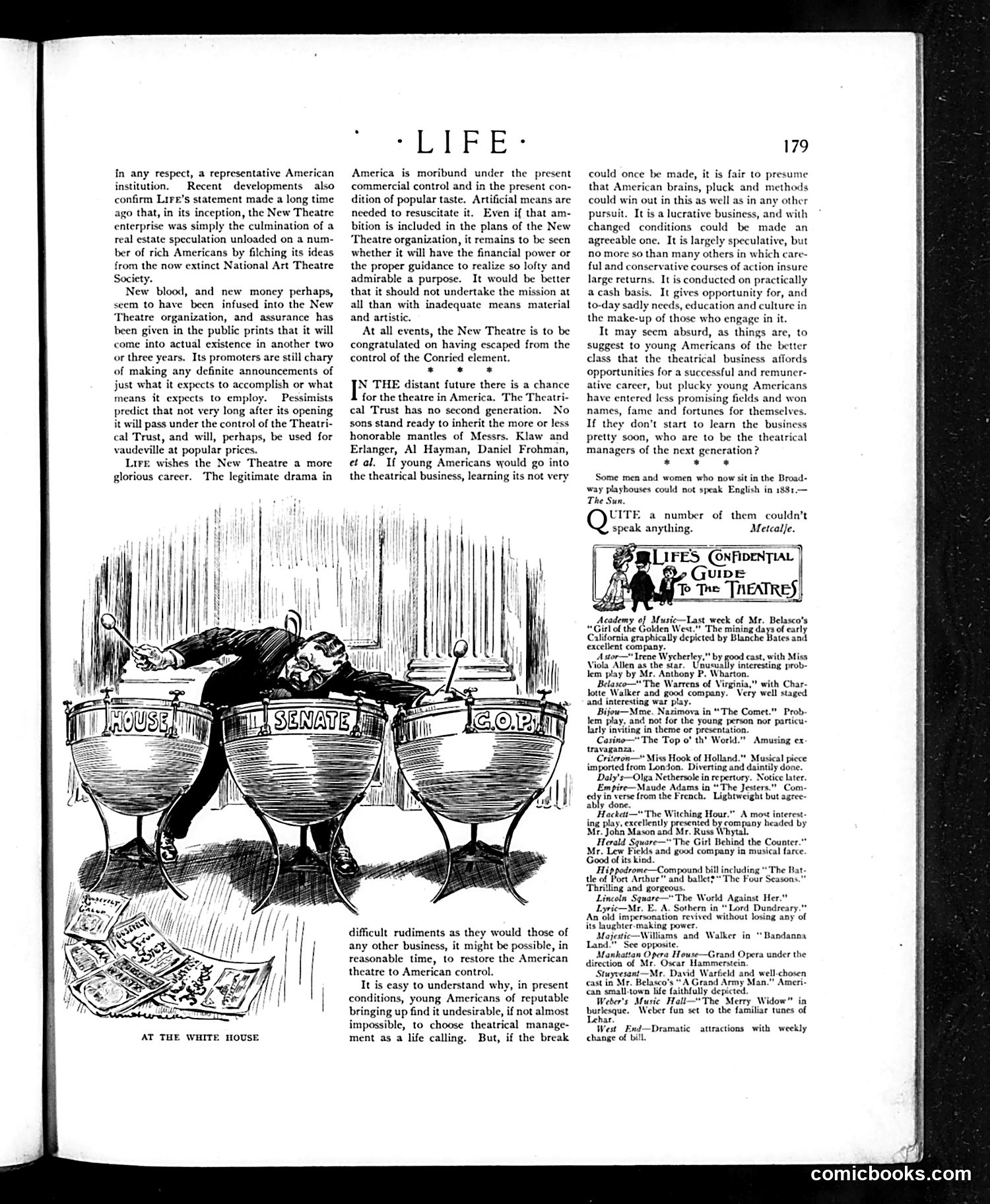
This cartoon satirizes American political control during what appears to be the early 20th century. Three large bowls labeled "HOUSE," "THE SENATE," and "GOP" (Republican Party) are depicted as vessels containing money and controlled by a single figure lounging atop them. The satire suggests that corporate or political interests have consolidated control over all three branches—the House, Senate, and Republican Party apparatus—treating them as unified instruments of power rather than independent bodies. The money scattered below reinforces the critique that financial interests, not democratic representation, drive governance "at the White House." The cartoon criticizes the concentration of political power and corporate influence in American institutions.
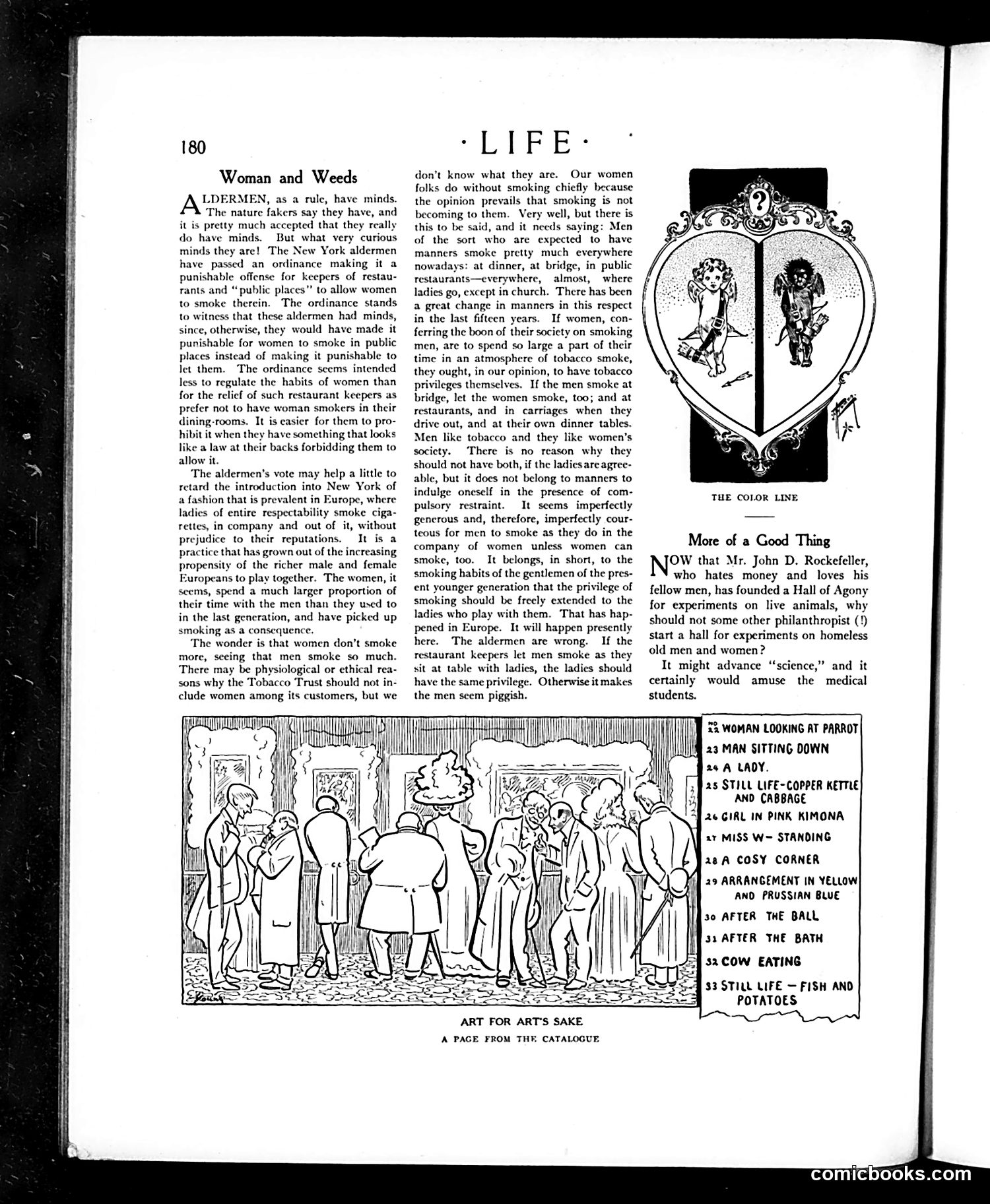
This page satirizes New York aldermen who passed an ordinance prohibiting restaurant owners from allowing women to smoke, while permitting men to do so. **The Satire's Point:** Life mocks the aldermen's logic as backwards—they penalize business owners rather than the women themselves, suggesting the law exists merely to help restaurants avoid female smokers rather than regulate behavior genuinely. **The Social Argument:** The editorial argues for equality: if men smoke freely in women's company at dinner, bridge, and carriages, women should have the same privilege. Life notes this already occurs in Europe among "respectable" women without scandal. The piece contends men smoking while women cannot is ungentlemanly—even "piggish." **The Bottom Illustration:** Shows a crowded social gathering, captioned "Art for Art's Sake—A Page from the Catalogue," likely satirizing art world pretension or some contemporary exhibition. **Historical Context:** This reflects early 20th-century debates over women's social freedom and smoking as a symbol of modernity and equality.
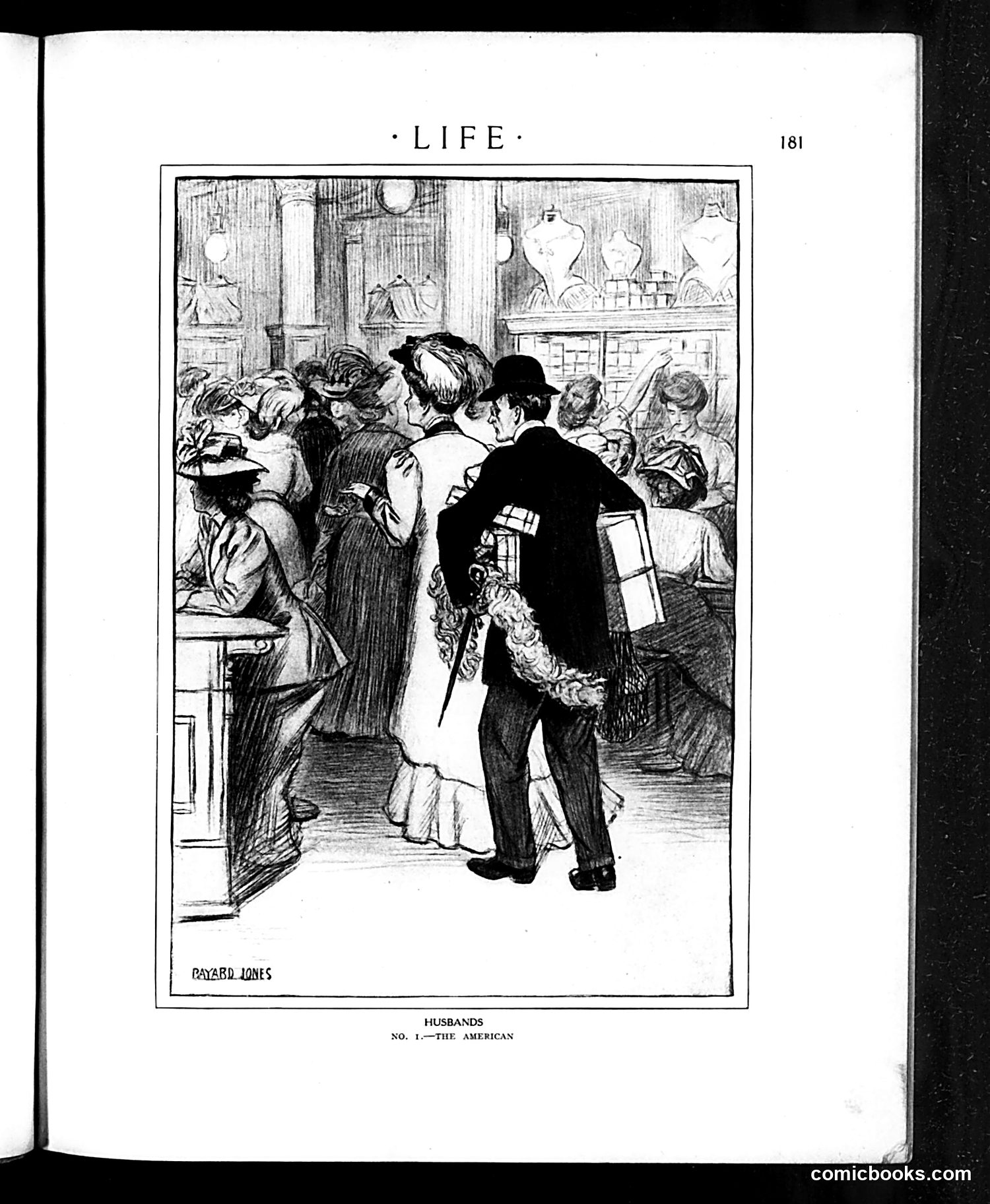
This satirical illustration by Bayard Jones depicts a crowded, fashionable social gathering—likely a department store or reception—where a uniformed military officer dominates the composition. The cartoon appears to mock "The American" husband type through visual exaggeration. The officer's prominent military decorations, formal dress uniform, and central positioning suggest the satire targets American masculine vanity or pretension. The surrounding crowd of elegantly dressed women creates a context of social performance and display. The cartoon's inclusion in a series titled "Husbands" implies it stereotypes American male behavior—possibly critiquing materialism, military posturing, social climbing, or attention-seeking among upper-class men. Without additional publication date context, the precise historical moment remains unclear, though the style and fashion suggest early-to-mid twentieth century.
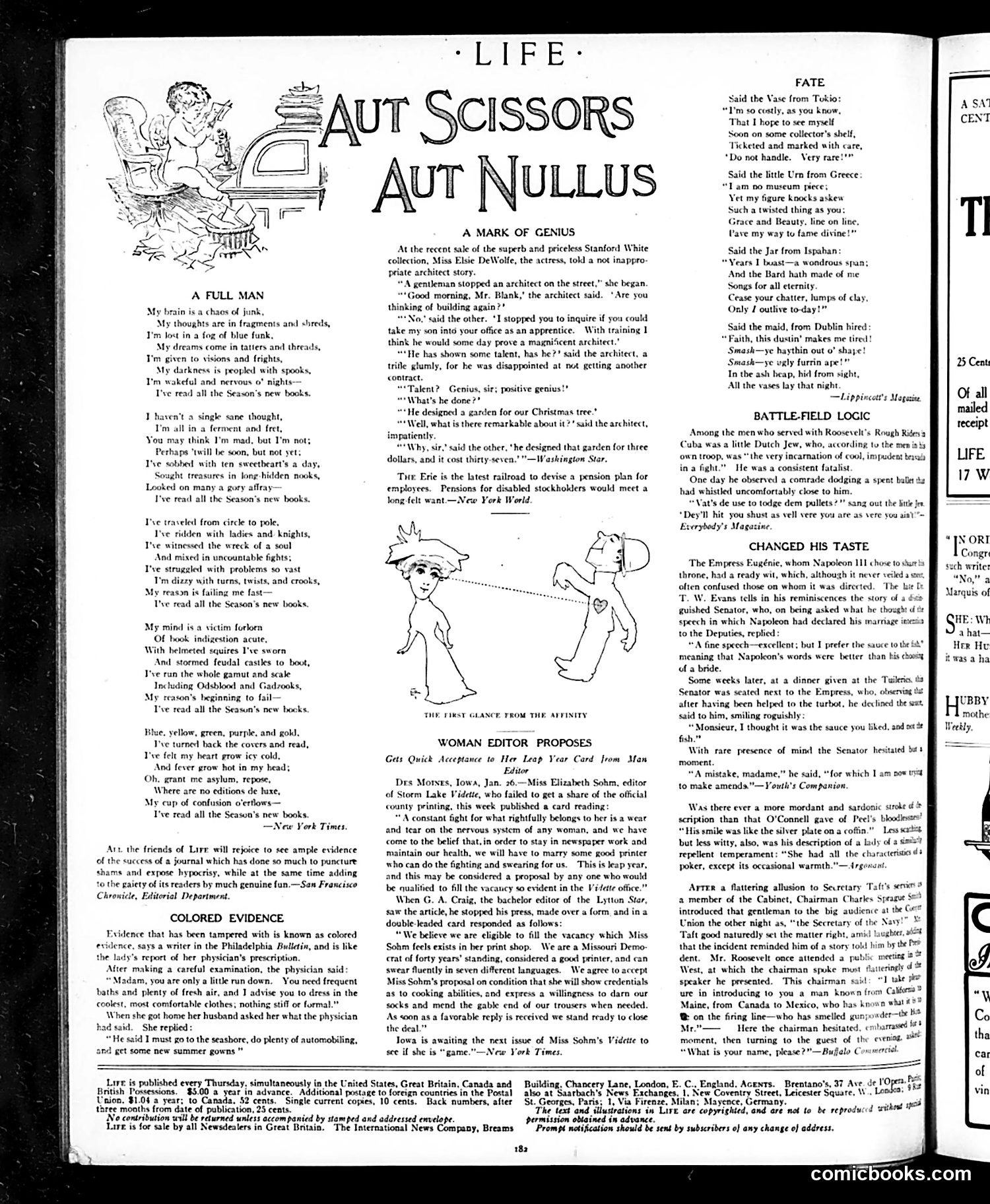
This page from Life magazine contains satirical poetry and humor pieces typical of early 20th-century American satire. **"A Full Man"** is a poem mocking intellectual overload—specifically the fad of reading all the current season's bestselling books. The speaker satirizes someone who's consumed so much contemporary literature that it's driven him to nervous exhaustion, insomnia, and mental confusion. The recurring refrain "I've read all the Season's new books" suggests that fashionable book-consumption has become a status symbol and sign of cultured pretension, yet it produces only mental chaos rather than enlightenment. **"Aut Scissors, Aut Nullus"** collects brief anecdotes, including Elsie DeWolfe's story about a father claiming his son is a "genius" for designing a Christmas tree garden—that cost thirty-seven dollars instead of the budgeted three. The satire targets parental delusion and inflated claims of children's abilities. The "Colored Evidence" section satirizes how people exaggerate or misrepresent information (a doctor's simple advice becomes elaborate recommendations through retelling). These pieces use humor to critique contemporary vanity, pretension, and dishonesty.
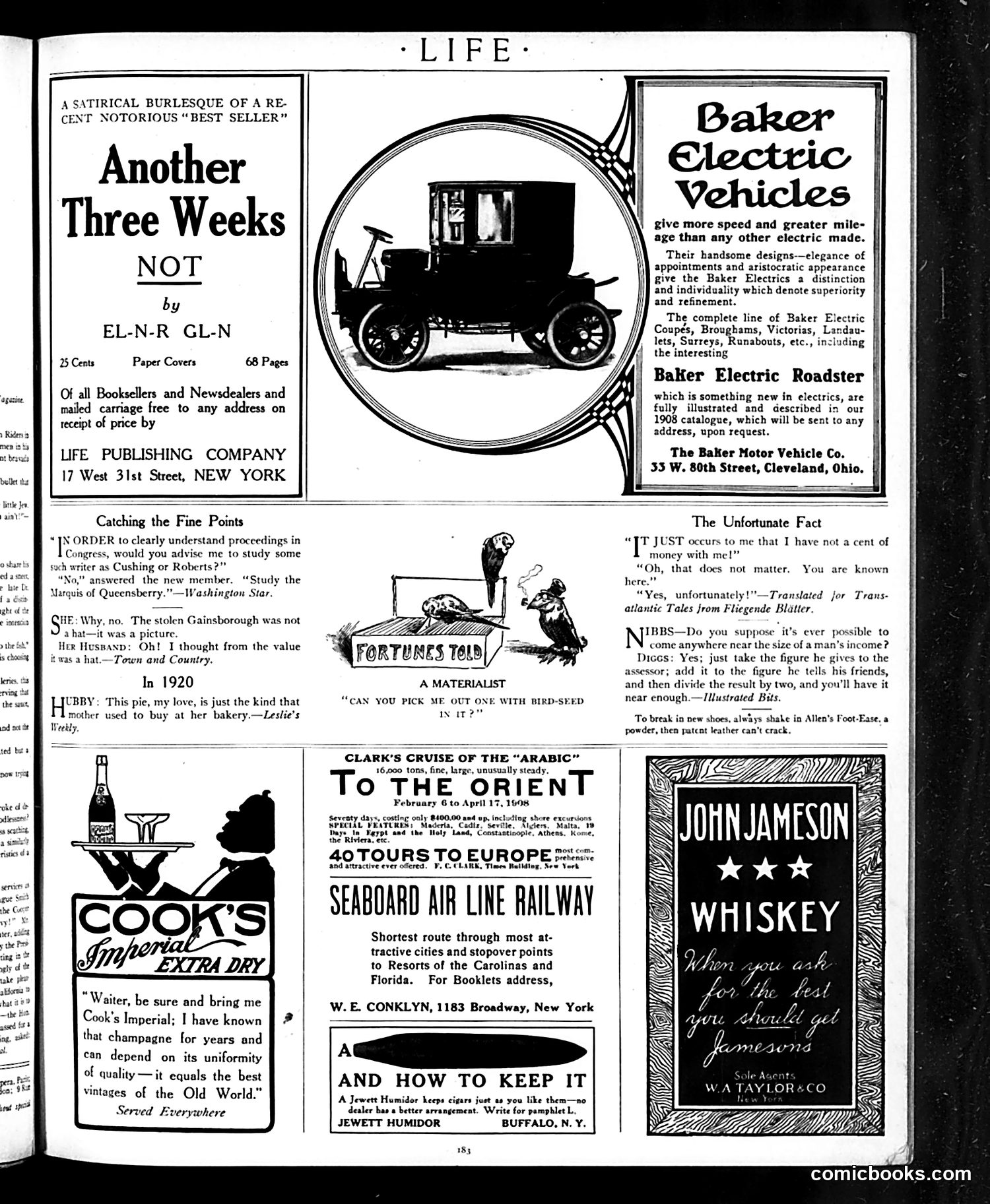
This page is primarily **advertising** with minimal satirical content. The main notable item is a book advertisement for "*Another Three Weeks* NOT" — a parody of the scandalous bestseller "*Three Weeks*" by Elinor Glyn, which was notorious for its sexually suggestive content. Life's satirical burlesque mocks this notorious "best seller" by publishing a competing parody version. The remainder of the page consists of period advertisements: Baker Electric Vehicles, Cook's Imperial champagne, travel cruises, the Seaboard Air Line Railway, Jewett Humidors, and John Jameson whiskey. There are also several short humorous anecdotes and jokes about money, art theft, and cigars scattered throughout. The page reflects early 1900s consumer culture and advertising practices rather than political satire.
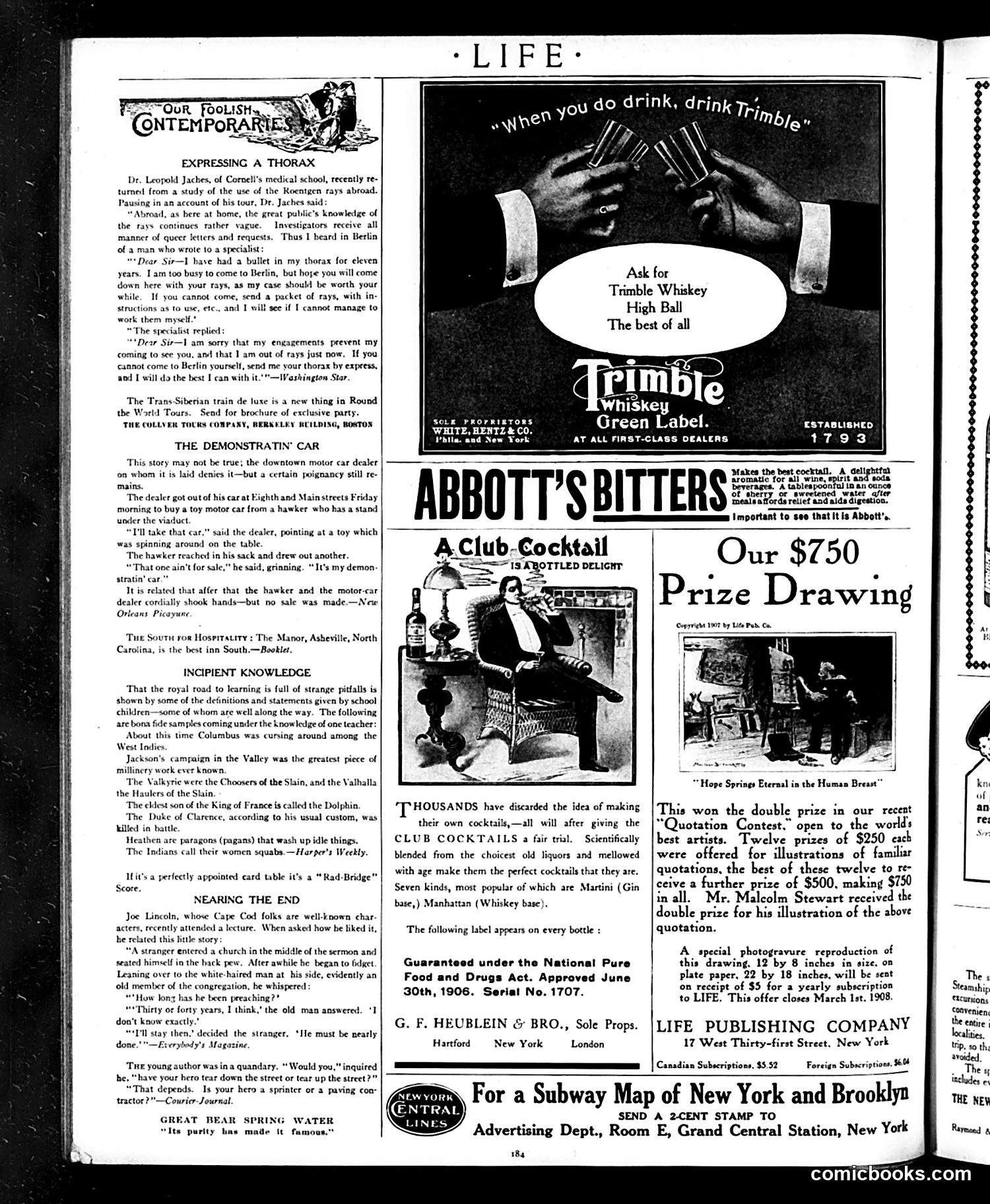
This page is primarily **advertising and miscellaneous content** rather than political satire. The main elements include: **"Our Foolish Contemporaries"** column features anecdotes mocking human folly: - A story about a Berlin doctor receiving absurd X-ray requests (someone wanting rays "mailed" to them) - A toy car dealer's encounter with a street hawker who won't sell his "demonstrating car" - School children's humorous misunderstandings (Columbus "cursing" in West Indies; Jackson's campaign as "millinery work") These are gentle, observational humor pieces about everyday absurdities and linguistic confusion—typical of Life's satirical style. **The advertisements** dominate: Trimble Whiskey, Abbott's Bitters, and a "$750 Prize Drawing" for Life Publishing Company occupy substantial space. There is **no clear political cartoon or caricature** on this page. The content reflects early 1900s concerns (X-rays as novel technology, automobiles, educational standards) but through humorous anecdotes rather than visual satire.
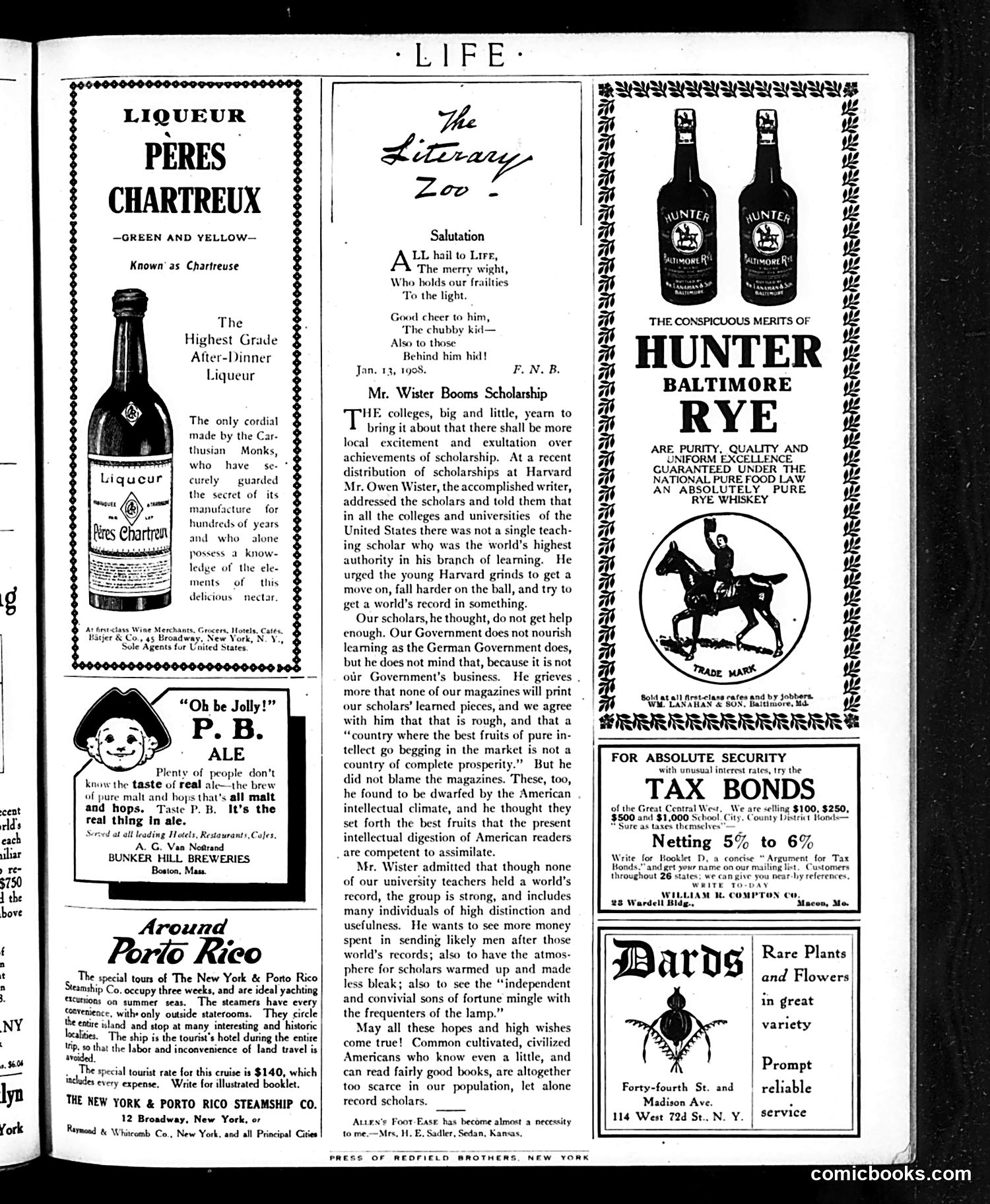
This page is primarily **advertisements with one substantive article** about scholarship in American universities. ## The Main Article: "Mr. Wister Booms Scholarship" Writer Owen Wister addressed Harvard scholars, arguing that American universities lack world-leading experts in any field—unlike Germany. He urged students to achieve "world's records" in scholarship. Wister lamented that American magazines won't publish serious scholarly work and that the intellectual climate discourages top minds, yet he stopped short of blaming the publications themselves, attributing the problem instead to America's general culture. The satire is subtle: **the author (F.N.B.) gently mocks Wister's contradictions**—he wants better scholarship but won't blame the media for ignoring it, and he wants government support for learning while insisting it's "not our Government's business." ## Advertisements The page features liquor ads (Chartreuse, Hunter Baltimore Rye, P.B. Ale), investment bonds, plants, and steamship travel—typical period advertising with appeals to quality and sophistication rather than substantive critique.
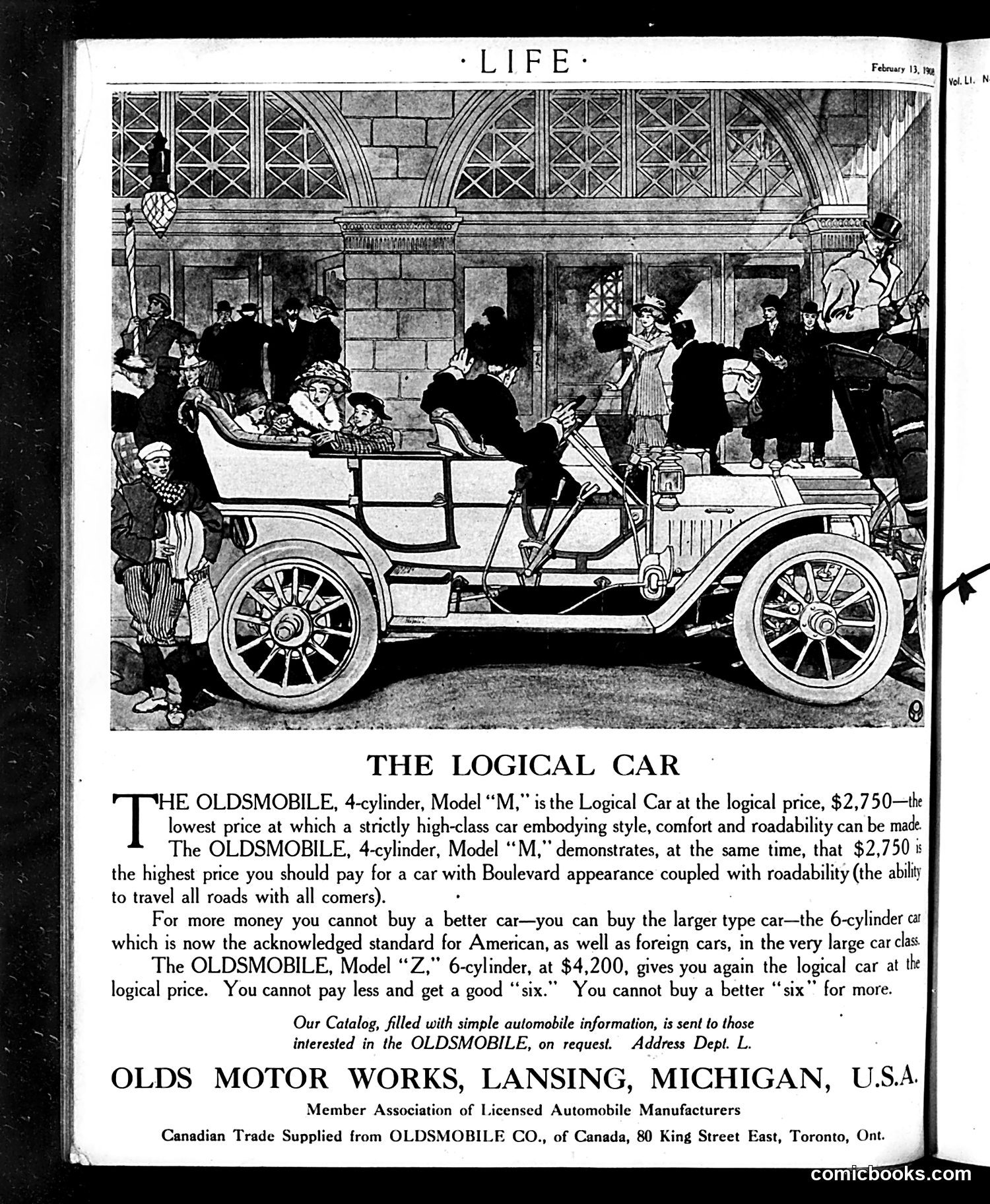
This is primarily **an advertisement, not satire or political commentary**. The page features an Oldsmobile automobile ad with an illustration showing an open-air car departing from what appears to be a grand hotel or train station, with elegantly dressed passengers and onlookers. The ad's central claim is marketing language rather than humor: Oldsmobile positions itself as "The Logical Car" at the "logical price"—claiming $2,750 is both the lowest acceptable price for quality and the highest one should pay for a 4-cylinder vehicle. The 6-cylinder model at $4,200 receives identical reasoning. The illustration depicts the car as a status symbol in an upscale urban setting, appealing to affluent early-1900s buyers. The "logic" being sold is essentially price-justification marketing: you get exactly what you should pay for, no more, no less—a sales strategy positioning Oldsmobile as the rational consumer's choice.