
Life, 1908-02-13 · page 12 of 20
Life — February 13, 1908 — page 12: what you’re looking at
What you’re looking at
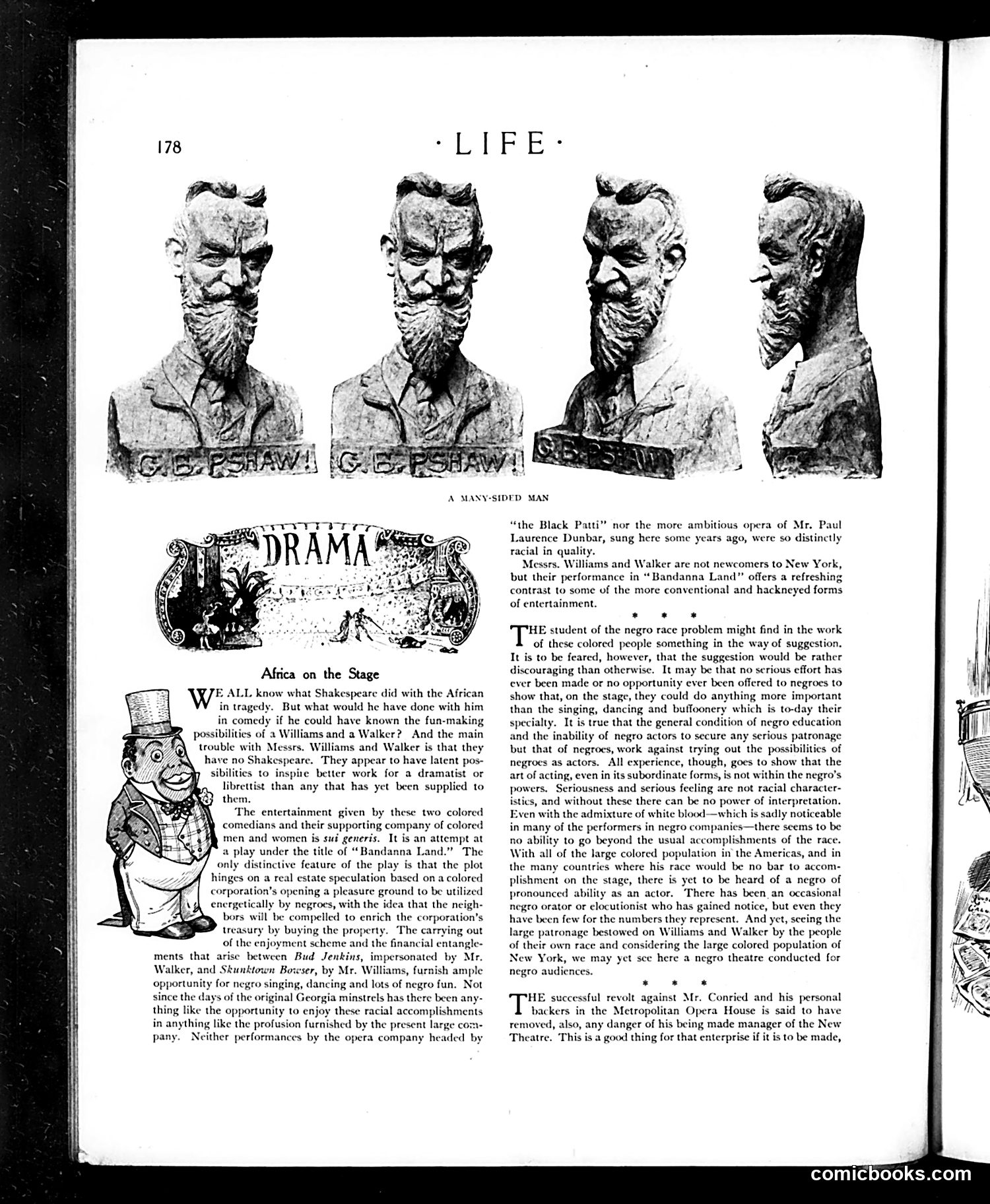
This page critiques a theatrical production called "Bandanna Land," performed by African American entertainers Williams and Walker. The busts at top show G.E. Pshaw (likely a caricatured critic or figure of authority). The article expresses ambivalence about Black performers on stage. While acknowledging their talent and seriousness as artists, the text worries that the production's success might encourage white patrons to view African Americans primarily through entertainment stereotypes rather than as serious performers capable of dramatic roles. The satire targets both the limitations imposed on Black artists and the entertainment industry's reliance on racial caricature and "fun" rather than substantive representation. The author suggests genuine theatrical opportunity for Black performers remains constrained by racial prejudice and audience expectations.
📄 Transcribed text from this page (OCR, searchable)
Machine-transcribed from the original scan — historical spelling and the odd misread are preserved.
A MANY-SIDED MAN in comedy if he could have known the fun-making possibilities of a Williams and a Walker? And the main trouble with Messrs, Williams and Walker is that they peare. They appear to have latent pos- sto inspire better work for a dramatist or librettist than any that has yet been supplied to them, ‘The entertainment given by these two colored comedians and their supporting company of colored men and women is sui generis. It is an attempt at a play under the title of “Bandanna Land.” The only distinctive feature of the play is that the plot hinges on a real estate speculation based on a colored corporation's opening a pleasure ground to be utilized energetically by negroes, with the idea that the neigh- bors will be compelled to enrich the corporation’s treasury by buying the property. ‘The carrying out of the enjoyment scheme and the financial entangle- ments that arise between Bud Jenkins, impersonated by Mr. Walker, and Skunktown Bowser, by Mr. Williams, furnish ample opportunity for negro singing, dancing and lots of negro fun. Not since the days of the original Georgia minstrels has there been any- thing like the opportunity to enjoy these racial accomplishments in anything like the profusion furnished by the present large com- Neither performances by the opera company headed by “the Black Patti” nor the more ambitious opera of Mr. Paul i aurence Dunbar, sung here some years ago, were so distinctly ial in quality. ‘s. Williams and Walker are not newcomers to New York, but their performance in “Bandanna Land” offers a refreshing contrast to some of the more conventional and hackneyed forms of entertainment. es 8 # HE student of the negro race problem might find in the work of these colored people something in the way of suggestion. It is to be feared, however, that the suggestion would be rather discouraging than otherwise. It may be that no serious effort has ever been made or no opportunity ever been offered to negroes to show that, on the stage, they could do anything more important than the singing, dancing and buffoonery which is to-day their specialty. It is true that the general condition of negro education and the inability of negro actors to secure any serious patronage but that of negroes, work against trying out the possibilities of negroes as actors. All experience, though, goes to show that the art of acting, even in its subordinate form: not within the negro’s powers. Seriousness and serious feeling are not racial character- istics, and without these there can be no power of interpretation. en with the admixture of white blood—which is sadly noticeable in many of the performers in negro companies—there scems to be no ability to go beyond the usual accomplishments of the race. With all of the large colored population in the Americas, and in the many countries where his race would be no bar to accom- plishment on the stage, there is yet to be heard of a negro of pronounced ability as an actor. “There has been_an occasional negro orator or elocutionist who has gained notice, but even they have been few for the numbers they represent. And yet, sceing the large patronage bestowed on Williams and Walker by the people f their own race and considering the large colored population of w York, we may yet sce here a negro theatre conducted for negro audiences. * * * HE successful revolt against Mr. Conried and his personal backers in the Metropolitan Opera House is said to have Iso, any danger of his being made manager of the N . This is a good thing for that enterprise if it is to be made, comicbooks.com