
Life, 1908-02-13 · page 6 of 20
Life — February 13, 1908 — page 6: what you’re looking at
What you’re looking at
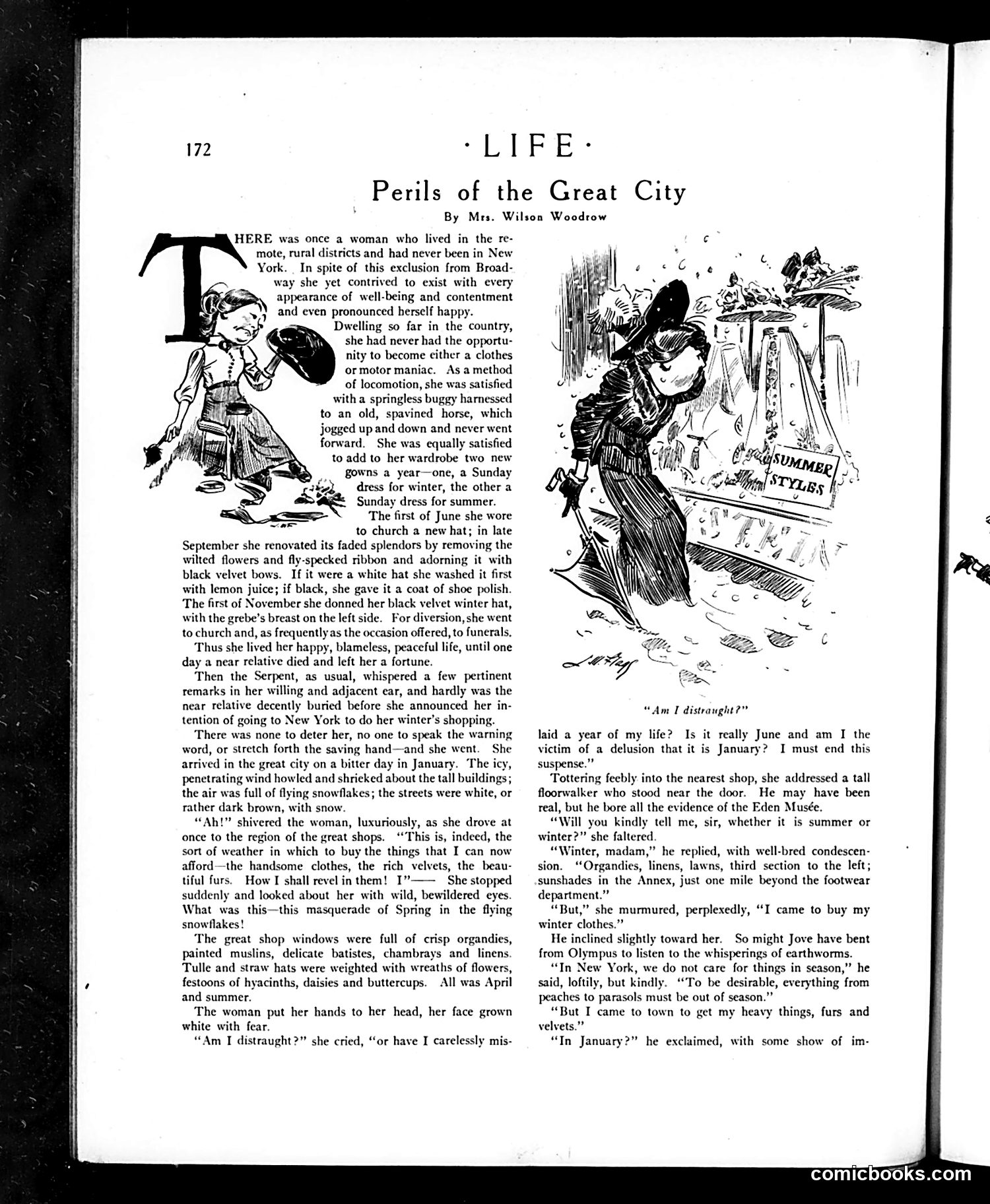
This satirical story warns against the corrupting dangers of urban life. A naive rural woman moves to New York City and becomes seduced by consumerism and fashion. She abandons her simple country contentment for expensive clothes, accessories, and seasonal fashions—summer hats, winter coats, furs, and velvet trimmings. The narrative's ironic title suggests she faces genuine "perils": not crime or moral corruption, but rather the city's materialistic temptations. A shopkeeper deliberately exploits her confusion about seasons, convincing her that New York's summer requires entirely different wardrobes than winter. The satire mocks both the woman's gullibility and the city's commercial machinery designed to create artificial consumer desires in unsuspecting newcomers.
📄 Transcribed text from this page (OCR, searchable)
Machine-transcribed from the original scan — historical spelling and the odd misread are preserved.
-LIFE- ; Perils of the Great City By Mrs. Wilson Woodrow HERE was once a woman who lived in the re- mote, rural districts and had never been in New York. In spite of this exclusion from Broad- way she yet contrived to exist with every appearance of well-being and contentment ) and even pronounced herself happy. Dwelling so far in the country, she had never had the opportu- nity to become cither a clothes ormotor maniac. As amethod of locomotion, she was satisfied witha springless buggy harnessed to an old, spavined horse, which jogged up and down and never went forward. She was equally satisfied to add to her wardrobe two new gowns a year—one, a Sunday ste). dress for winter, the other a 4 Sunday dress for summer. The first of June she wore to church a new hat; in late September she renovated its faded splendors by removing the wilted flowers and fly-specked ribbon and adorning it with black velvet bows. If it were a white hat she washed it first if black, she gave it a coat of shoe polish. ovember she donned her black velvet winter hat, with the grebe’s breast on the left side. For diversion, she went to church and, as frequently as the occasion offered, to funerals, ‘Thus she lived her happy, blameless, peaceful life, until one day a near relative died and left her a fortune. Then the Serpent, as usual, whispered a few pertinent remarks in her willing and adjacent ear, and hardly was the near relative decently buried before she announced her in- tention of going to New York to do her winter’s shopping. There was none to deter her, no one to speak the warning word, or stretch forth the saving hand—and she went arrived in the great city on a bitter day in January. The icy, penetrating wind howled and shrieked about the tall buildings; the air was full of flying snowflakes; the streets were white, or rather dark brown, with snow. “Ah!” shivered the woman, luxuriously, as she drove at once to the region of the great shops. “This is, indeed, the sort of weather in which to buy the things that I can now afford—the handsome clothes, the rich velvets, the beau- tiful furs. How I shall revel in them! I” She stopped suddenly and looked about her with wild, bewildered eyes. What was this—this masquerade of Spring in the flying snowflakes! The great shop windows were full of crisp organdies, painted muslins, delicate batistes, chambrays and linens. Tulle and straw hats were weighted with wreaths of flowers, festoons of hyacinths, daisies and buttercups. All was April and summer. ‘The woman put her hands to her head, her face grown white with fear. “Am I distraught?” she cried, ‘‘or have I carelessly mis- Si “Am I distraught?” laid a year of my life? Is it really June and am I the victim of a delusion that it is January? I must end this suspen: Tottering feebly into the nearest shop, she addressed a tall floorwalker who stood near the door. He may have been real, but he bore all the evidence of the Eden Musée. “Will you kindly tell me, sir, whether it is summer or winter?” she faltered. “Winter, madam,” he replied, with well-bred condescen- sion. ‘Organdies, linens, lawns, third section to the left; sunshades in the Annex, just one mile beyond the footwear department.” “But,” she murmured, perplexedly, “I came to buy my winter clothes,” He inclined slightly toward her. So might Jove have bent fen to the whisperings of carthworms. “In New York, we do not care for things in season,” he said, loftily, but kindly. “To be desirable, everything from peaches to parasols must be out of season.” “But I came to town to get my heavy things, furs and “In January?” he exclaimed, with some show of im- comicbooks.com