
Life, 1908-02-13 · page 4 of 20
Life — February 13, 1908 — page 4: what you’re looking at
What you’re looking at
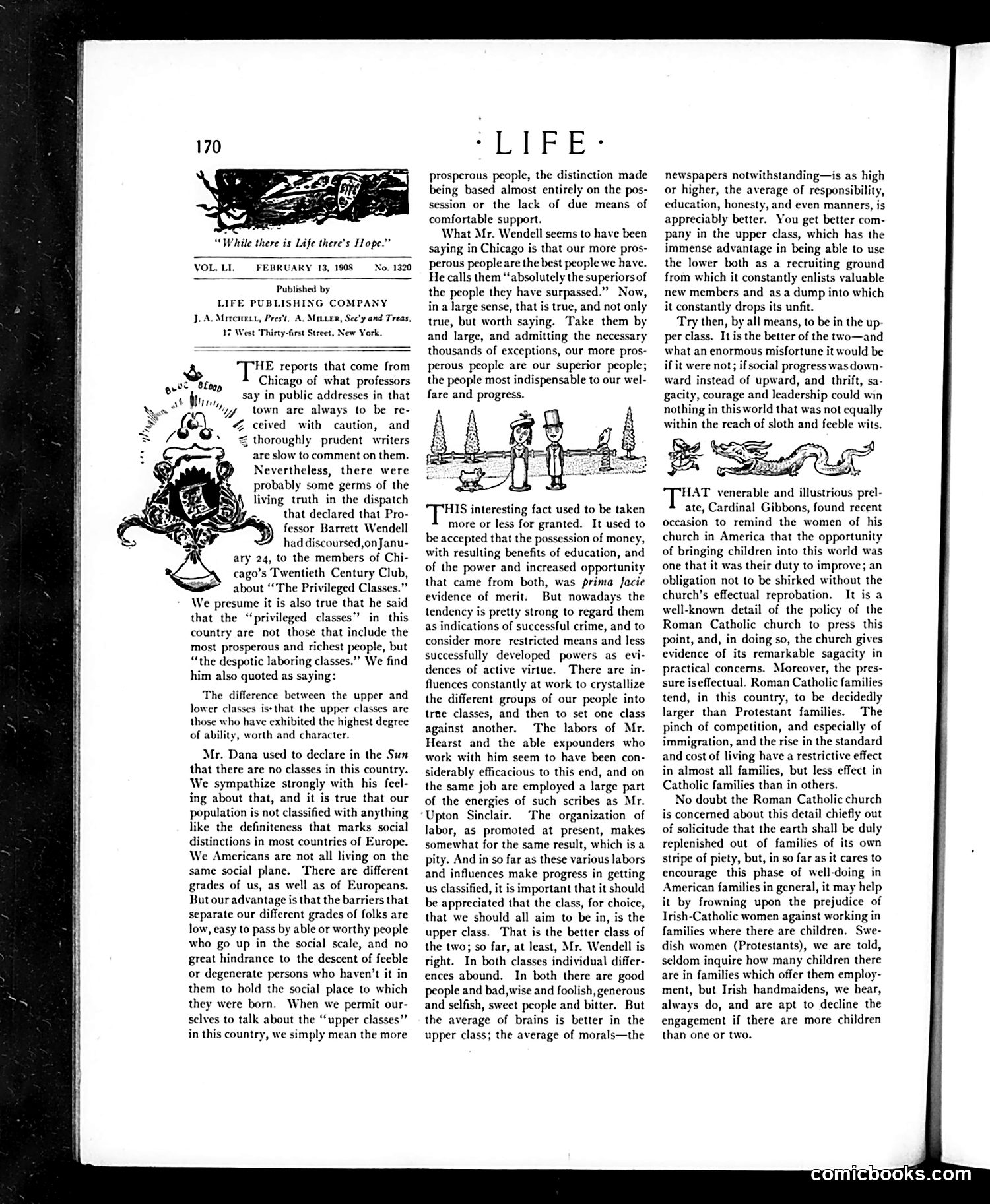
The page contains two distinct editorial cartoons addressing American class distinctions. **Left cartoon**: Shows a decorative heraldic crest or coat of arms, accompanying text mocking the notion of "privileged classes" in America. The illustration satirizes American pretensions to European-style aristocracy, suggesting such class hierarchies shouldn't exist in a democratic nation. **Right cartoon**: Depicts figures in Victorian dress (appearing to be wealthy people) in a domestic scene. This supports the article's discussion of whether upper and lower classes possess inherent superiority or merely different circumstances. **Main argument**: The editorial criticizes the assumption that wealth indicates moral or intellectual superiority, arguing instead that both classes contain virtuous and flawed individuals. The satire targets American class snobbery and the false belief that prosperity reflects personal merit rather than circumstance.
📄 Transcribed text from this page (OCR, searchable)
Machine-transcribed from the original scan — historical spelling and the odd misread are preserved.
“While there is Life there's Hope.” VOL. LI. FEBRUARY 13, 1908 No. 1320 Published by LIFE PUBLISHING COMPANY J. A. Mrrcurat, Pres't, A. Mruizr, Sec'y and Treas, 17 West Thirty-first Street, New York. THE reports that come from geen ttong Chicago of what professors 0 Win, 53¥ in public addresses in that # “yy town are always to be re- 2 4 ceived with caution, and * thoroughly prudent. writers € are slow to comment on them. Nevertheless, there were probably some germs of the living truth in the dispatch that declared that Pro- fessor Barrett Wendell had discoursed,onJanu- ary 24, to the members of Chi- cago’s Twentieth Century Club, about ‘The Privileged Classes.” We presume it is also true that he said that the “privileged classes” in this country are not those that include the most prosperous and richest people, but “the despotic laboring classes.” We find him also quoted as saying: The difference between the upper and lower classes is*that the upper classes are those who have exhibited the highest degree of ability, worth and character. Mr. Dana used to declare in the Sun that there are no classes in this country. We sympathize strongly with his feel- ing about that, and it is true that our population is not classified with anything like the definiteness that marks social distinctions in most countries of Europe. We Americans are not all living on the same social plane. There are different grades of us, as well as of Europeans. But ouradvantage is that the barriers that separate our different grades of folks are low, easy to pass by able or worthy people who go up in the social scale, and no great hindrance to the descent of feeble or degenerate persons who haven’t it in them to hold the social place to which they were born. When we permit our selves to talk about the “upper class in this country, we simply mean the more ‘LIFE - prosperous people, the distinction made being based almost entirely on the pos- session or the lack of due means of comfortable support. What Mr. Wendell seems to have been saying in Chicago is that our more pros- perous people are the best people we have. He calls them “absolutely the superiors of the people they have surpassed.” Now, in a large sense, that is true, and not only true, but worth saying. Take them by and large, and admitting the necessary thousands of exceptions, our more pros- perous people are our superior people; the people most indispensable to our wel- fare and progress. THs interesting fact used to be taken more or less for granted. It used to be accepted that the possession of money, with resulting benefits of education, and of the power and increased opportunity that came from both, was prima facie evidence of merit. But nowadays the tendency is pretty strong to regard them as indications of successful crime, and to consider more restricted means and less successfully developed powers as ev dences of active virtue. There are in- fluences constantly at work to crystallize the different groups of our people into trae classes, and then to set one class against another. The labors of Mr. Hearst and the able expounders who work with him seem to have been con- siderably efficacious to this end, and on the same job are employed a large part of the energies of such scribes as Mr. Upton Sinclair. The organization of labor, as promoted at present, makes somewhat for the same result, which is a pity. And in so far as these various labors and influences make progress in getting us classified, it is important that it should be appreciated that the class, for choice, that we should all aim to be in, is the upper class. That is the better class of the two; so far, at least, Mr. Wendell is right. In both classes individual differ- ences abound. In both there are good people and bad, wise and foolish, generous and selfish, sweet people and bitter. But the average of brains is better in the upper class; the average of morals—the newspapers notwithstanding—is as high or higher, the average of responsibility, education, honesty, and even manners, is appreciably better. You get better com- pany in the upper class, which has the immense advantage in being able to use the lower both as a recruiting ground from which it constantly enlists valuable new members and as a dump into which it constantly drops its unfit. Try then, by all means, to be in the up- per class. It is the better of the two—and what an enormous misfortune it would be if it were not; if social progress was down- ward instead of upward, and thrift, sa- gacity, courage and leadership could win nothing in this world that was not equally within the reach of sloth and feeble wi HAT venerable and illustrious prel- ate, Cardinal Gibbons, found recent occasion to remind the women of his church in Amcrica that the opportu of bringing children into this world was one that it was their duty to improve; an obligation not to be shirked without the church’s effectual reprobation. It is a well-known detail of the policy of the Roman Catholic church to press thi: point, and, in doing so, the church gives evidence of its remarkable sagacity in practical concems. Moreover, the pres- sure iseffectual. Roman Catholic families tend, in this country, to be decidedly larger than Protestant families. The pinch of competition, and especially of immigration, and the rise in the standard and cost of living have a restrictive effect in almost all families, but less effect in Catholic families than in other: No doubt the Roman Catholic church is concerned about this detail chiefly out of solicitude that the earth shall be duly replenished out of families of its own stripe of piety, but, in so far a: encourage this phase of well-doing in American families in general, it may help it by frowning upon the prejudice of Irish-Catholic women against working in fami where there are children. Swe- dish women (Protestants), we are told, seldom inquire how many children there are in families which offer them employ- ment, but Irish handmaidens, we hear, always do, and are apt to decline the engagement if there are more children than one or two. icbooks.com