
Life, 1908-02-13 · page 14 of 20
Life — February 13, 1908 — page 14: what you’re looking at
What you’re looking at
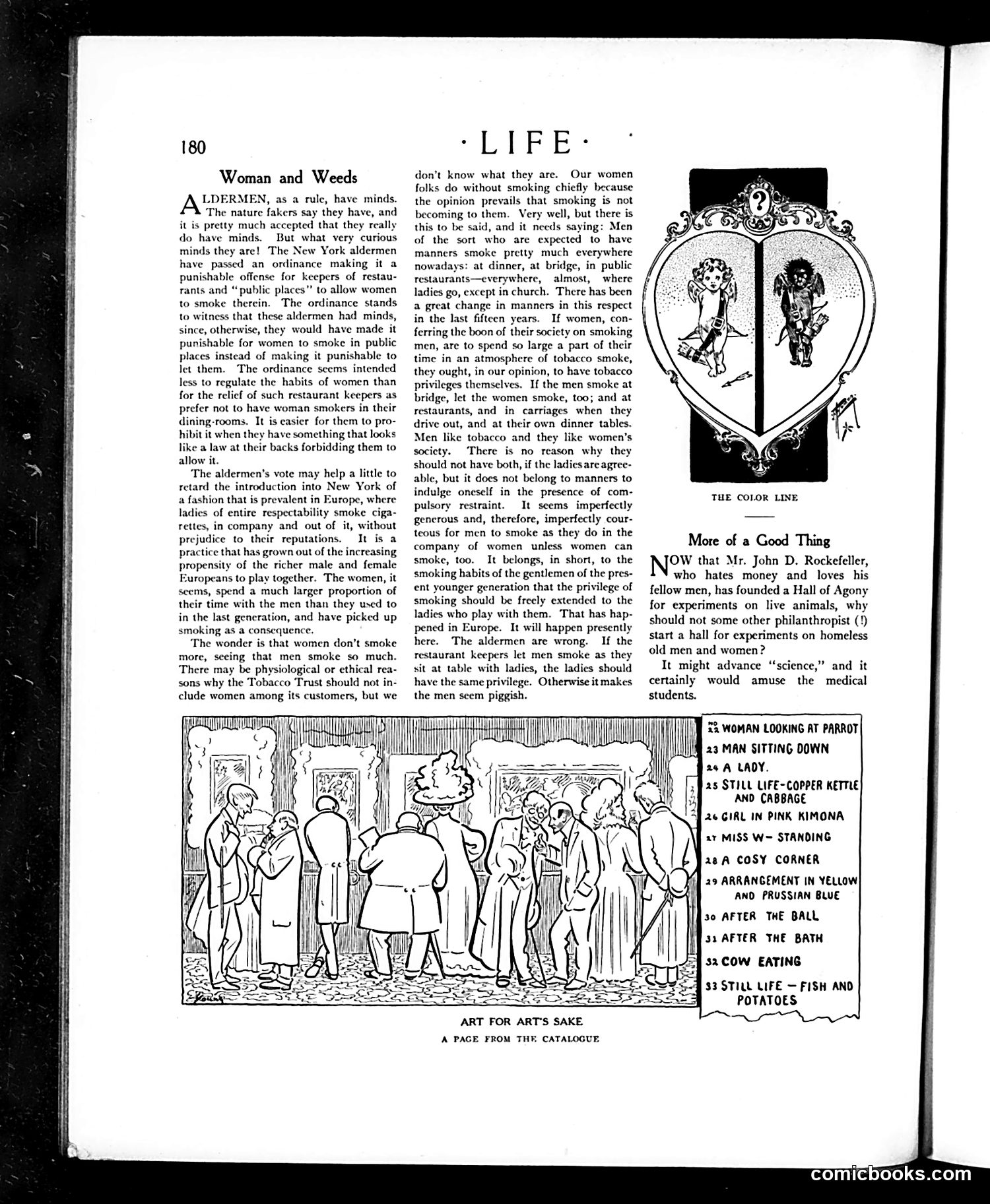
This page satirizes New York aldermen who passed an ordinance prohibiting restaurant owners from allowing women to smoke, while permitting men to do so. **The Satire's Point:** Life mocks the aldermen's logic as backwards—they penalize business owners rather than the women themselves, suggesting the law exists merely to help restaurants avoid female smokers rather than regulate behavior genuinely. **The Social Argument:** The editorial argues for equality: if men smoke freely in women's company at dinner, bridge, and carriages, women should have the same privilege. Life notes this already occurs in Europe among "respectable" women without scandal. The piece contends men smoking while women cannot is ungentlemanly—even "piggish." **The Bottom Illustration:** Shows a crowded social gathering, captioned "Art for Art's Sake—A Page from the Catalogue," likely satirizing art world pretension or some contemporary exhibition. **Historical Context:** This reflects early 20th-century debates over women's social freedom and smoking as a symbol of modernity and equality.
📄 Transcribed text from this page (OCR, searchable)
Machine-transcribed from the original scan — historical spelling and the odd misread are preserved.
180 ‘Woman and Weeds LDERMEN, as a rule, have minds. The nature fakers say they have, and it is pretty much accepted that they really do have minds. But what very curious minds they are! The New York aldermen have passed an ordinance making it a punishable offense for keepers of restau- rants and “public places” to allow women to smoke therein. The ordinance stands to witness that these aldermen had minds, since, otherwise, they would have mad punishable for women to smoke in public places instead of making it punishable to let them. The ordinance seems intended less to regulate the habits of women than for the relief of such restaurant keepers as prefer not to have woman smokers in their dining-rooms. It is easier for them to pro- hibit it when they have something that looks like a law at their backs forbidding them to allow it. ‘The aldermen’s vote may help a little to retard the introduction into New York of a fashion that is prevalent in Europe, where ladies of entire respectability smoke rettes, in company and out of it, without prejudice to their reputations. It is a practice that has grown out of the increasing propensity of the richer male and female Europeans to play together. The women, it seems, spend a much larger proportion of their time with the men than they used to in the last generation, and have picked up smoking as a consequence. The wonder is that women don’t smoke more, seeing that men smoke so much. There may be physiological or ethical rea- sons why the Tobacco Trust should not in- clude women among its customers, but we “LIPE = don’t know what they are. Our women folks do without smoking chiefly because the opinion prevails that smoking is not becoming to them. Very well, but there is this to be said, and it needs saying: Men of the sort who are expected to have manners smoke pretty much everywhere nowadays: at dinner, at bridge, in public restaurants—everywhere, almost, where ladies go, except in church. There has been a great change in manners in this respect in the last fifteen years. If women, con- ferring the boon of their society on smoking men, are to spend so large a part of their time in an atmosphere of tobacco smoke, they ought, in our opinion, to have tobacco privileges themselves. If the men smoke at bridge, let the women smoke, too; and at restaurants, and in carriages when they drive out, and at their own dinner tables. Men like tobacco and they like women’s society. There is no reason why they should not have both, if the ladies are agree- able, but it does not belong to manners to indulge oneself in the presence of com- pulsory restraint. It seems imperfectly gencrous and, therefore, imperfectly cour- teous for men to smoke as they do in the company of women unless women can smoke, too. It belongs, in short, to the smoking habits of the gentlemen of the pres- ent younger generation that the privilege of smoking should be freely extended to the ladies who play with them. That has hap- pened in Europe. It will happen presently here. The aldermen are wrong. If the restaurant keepers let men smoke as they sit at table with ladies, the ladies should have the same privilege. Otherwise it makes the men scem piggish. ART FOR ARTS SAKE A PAGE FROM THE CATALOGUE THE COLOR LINE More of a Good Thing OW that Mr. John D. Rockefeller, who hates money and loves his fellow men, has founded a Hall of Agony for experiments on live animals, why should not some other philanthropist (!) start a hall for experiments on homeless old men and women? It might advance ‘‘science,” and it certainly would amuse the medical students. & WOMAN LOOKING AT PARROT 23 MAN SITTING DOWN 26 A LADY. a STILL LIFE-COPPER KETTLE AND CABBAGE Af 26 GIRL IN PINK KIMONA ay MISS W~ STANDING 28 A COSY CORNER jf 29 ARRANGEMENT IN YELLOW AND PRUSSIAN BLUE 30 AFTER THE BALL \[32 AFTER THE BATH =] $2 COW EATING $3 STILL LIFE — FISH AND POTATOES comicbooks.com