
A complete issue · 28 pages · 1907
Life — December 19, 1907
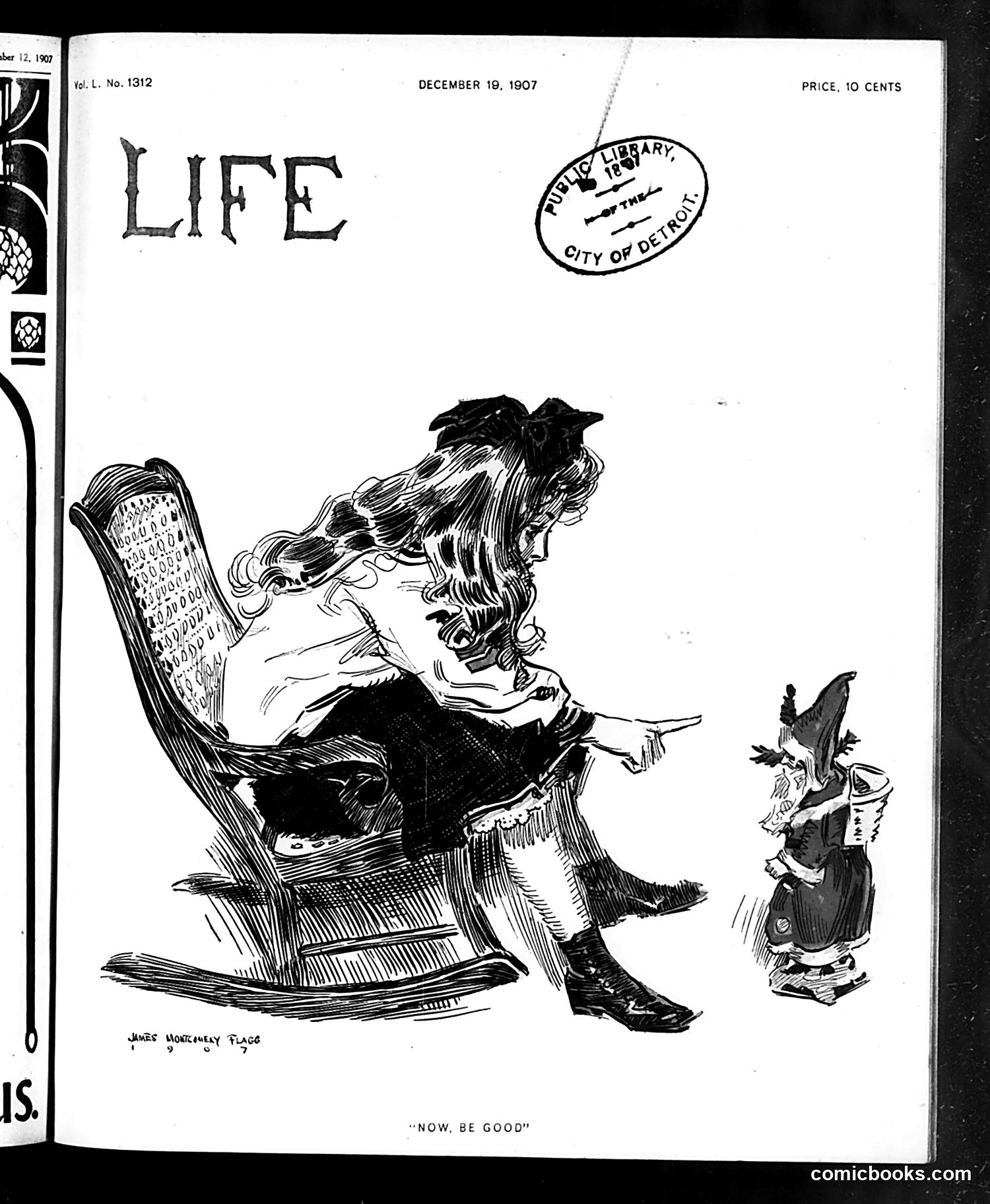
This cover illustration depicts a woman seated in a rocking chair, reading a newspaper. A small figure—appearing to be a child—stands nearby. The caption reads "Now, Be Good." The satire likely comments on domestic discipline and parental authority in early 20th-century America. The woman's relaxed posture while reading the newspaper contrasts with her instruction to the child to behave, possibly mocking inconsistent parenting or the gap between adults' expectations of children and their own conduct. The artwork is credited to James Montgomery Flagg, a prominent illustrator of the era. Without additional context, the specific political or social event being referenced remains unclear, though it appears to address contemporary attitudes toward child-rearing and household dynamics.
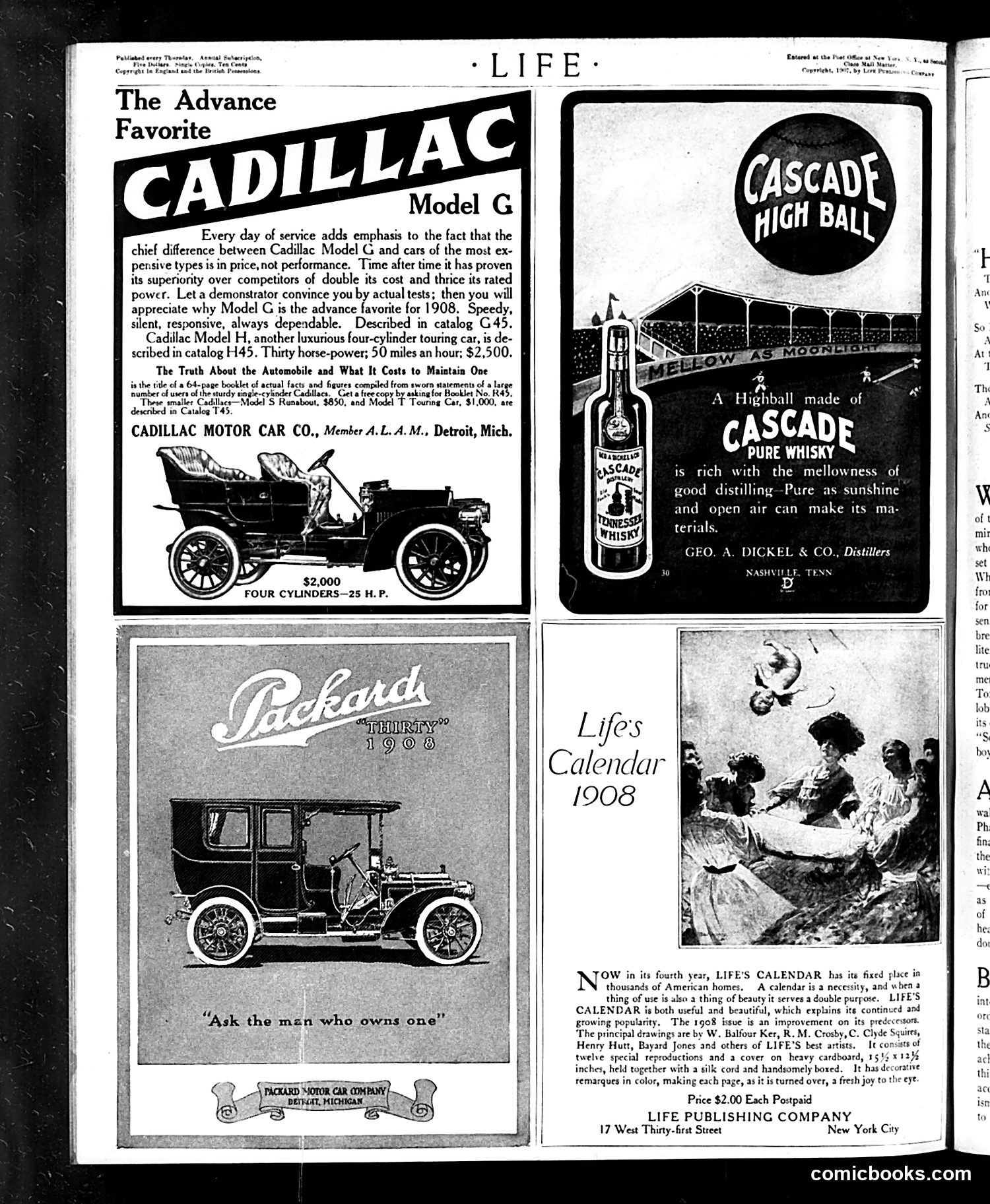
This page is primarily **advertising**, not political satire. It contains three automobile and consumer product advertisements from 1908: 1. **Cadillac Model G** - emphasizes affordability and reliability compared to more expensive competitors, priced at $2,000 with four cylinders and 25 horsepower. 2. **Packard Thirty** - a competing luxury automobile with the tagline "Ask the men who owns one," appealing to prestige buyers. 3. **Cascade High Ball Whisky** - pure whisky advertisement from Nashville distillers. 4. **Life's Calendar 1908** - a decorative calendar product being sold by Life Publishing Company for $2.00. There is no political cartoon or satire on this page—it represents typical early-1900s magazine advertising aimed at middle and upper-class readers.
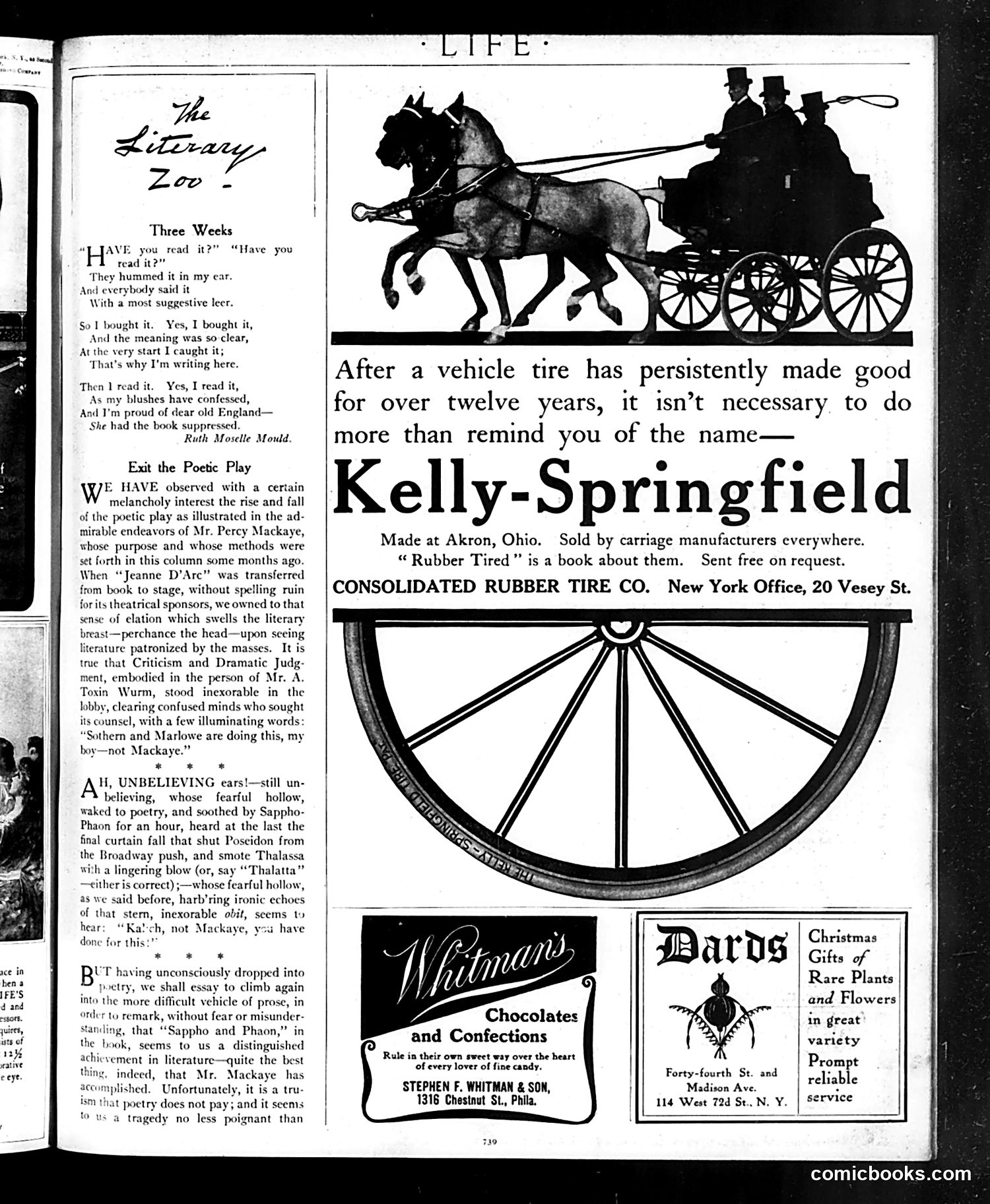
This page is primarily **advertising**, not political satire. The dominant content features a Kelly-Springfield tire advertisement showing a horse-drawn carriage with well-dressed passengers in top hats—a deliberate anachronism emphasizing the tire's twelve-year durability by contrasting modern rubber tires with outdated transportation. The left column contains a literary discussion titled "The Literary Zoo," discussing poetic drama and theatrical criticism, apparently referencing theatrical figures and works from the period (names are unclear from context alone). The bottom features period advertisements for Whitman's Chocolates and Dard's flowers/plants—typical early 20th-century luxury goods marketing. There is **no political cartoon** on this page. It represents Life magazine's mix of light literary commentary and upscale advertising.
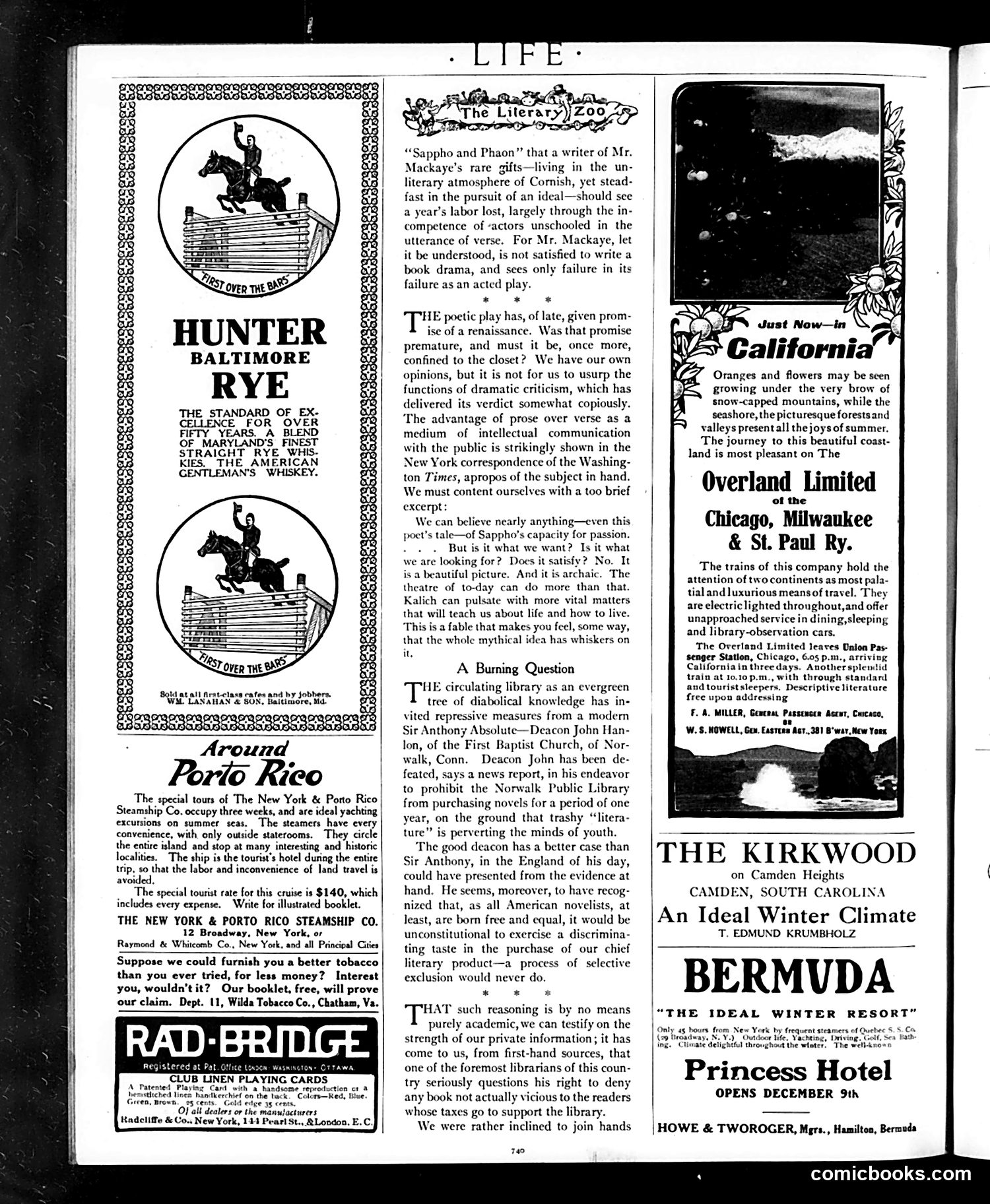
This page's main article critiques literary standards through the lens of library censorship. The piece discusses Deacon John Hanlon of Connecticut, who attempted to prohibit his public library from purchasing novels for one year, arguing "trashy literature" corrupts youth. The author defends American novelists' right to equal treatment, arguing that selective exclusion based on moral judgment sets a dangerous precedent. The piece suggests the deacon's reasoning—that librarians should deny taxpayers access to books deemed objectionable—is fundamentally flawed. The satire criticizes moral gatekeeping in early 20th-century America, when anxiety about popular fiction's influence on young readers was widespread. The article advocates for intellectual freedom and questions who gets to decide what's "unsuitable."
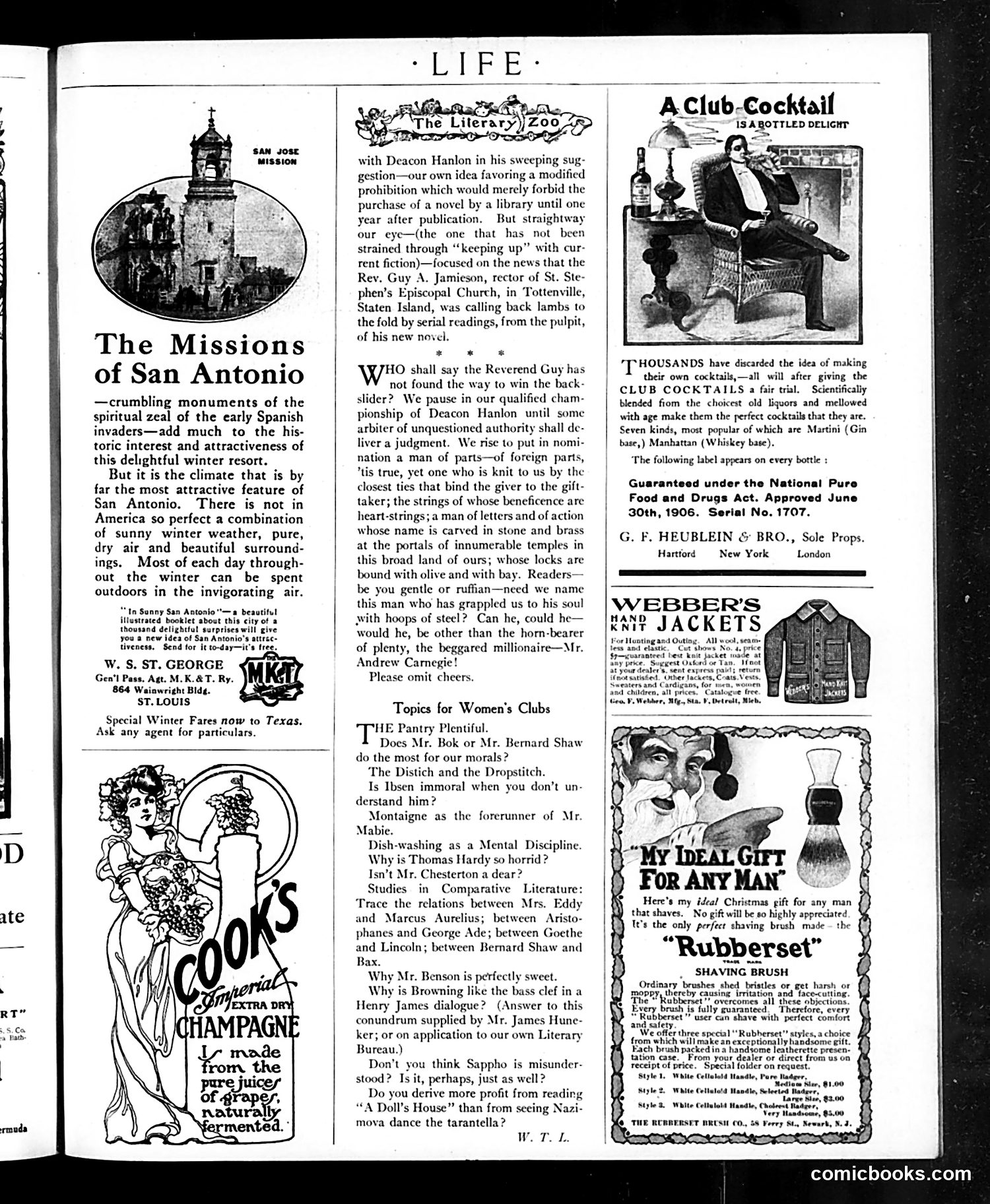
This page is primarily **advertising and literary content** rather than political satire. The main elements include: **Editorial Content:** - "The Missions of San Antonio" promotes winter tourism to Texas, highlighting Spanish colonial religious sites - "The Literary Zoo" discusses Deacon Hanlon's novel and Rev. Guy A. Jamieson's serial readings, debating whether libraries should stock recent fiction **"Topics for Women's Clubs"** lists discussion questions about literature and morality, referencing authors like Ibsen, Hardy, Shaw, and Hax—typical early-1900s intellectual fare for educated women's groups. **Advertisements** dominate: champagne, jackets, shaving brushes. These ads use period conventions—decorative illustration, pseudo-scientific claims—typical of early-twentieth-century marketing. No clear political satire is evident.
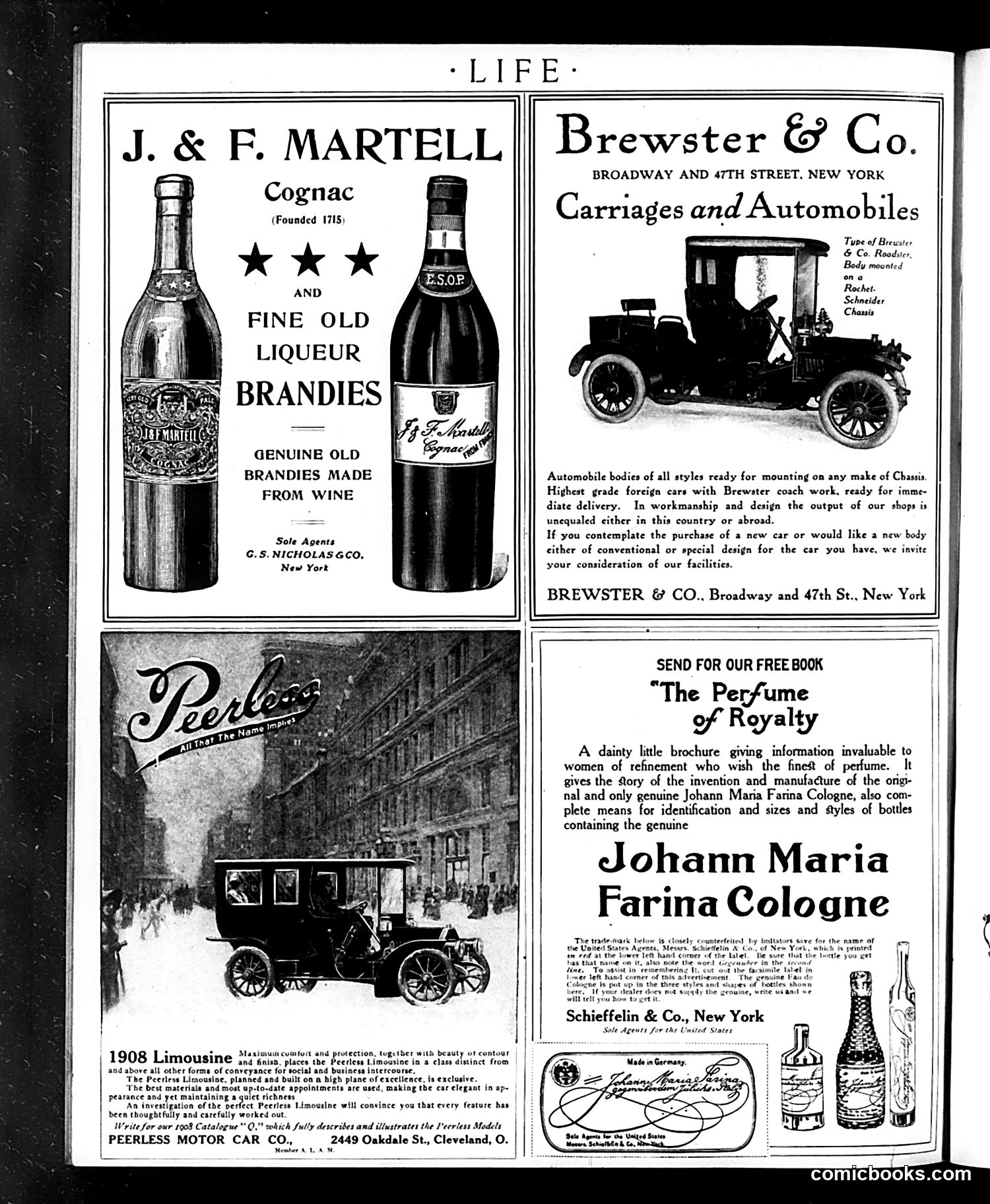
This page is **primarily advertising**, not satire or political commentary. It contains four product advertisements from the early 1900s: 1. **J. & F. Martell Cognac** - promoting French brandy as "fine old liqueur" 2. **Brewster & Co.** - advertising custom automobile and carriage bodies for wealthy clients 3. **Peerless Motor Car** - showcasing a 1908 limousine for "social and business conveyance" 4. **Johann Maria Farina Cologne** - promoting perfume with a free informational brochure The advertisements reflect the lifestyle and consumption patterns of affluent Americans in the early 20th century: imported luxury goods, custom automobiles, and personal grooming products. There is no political cartoon or satirical content on this page—it represents standard magazine advertising of the era.
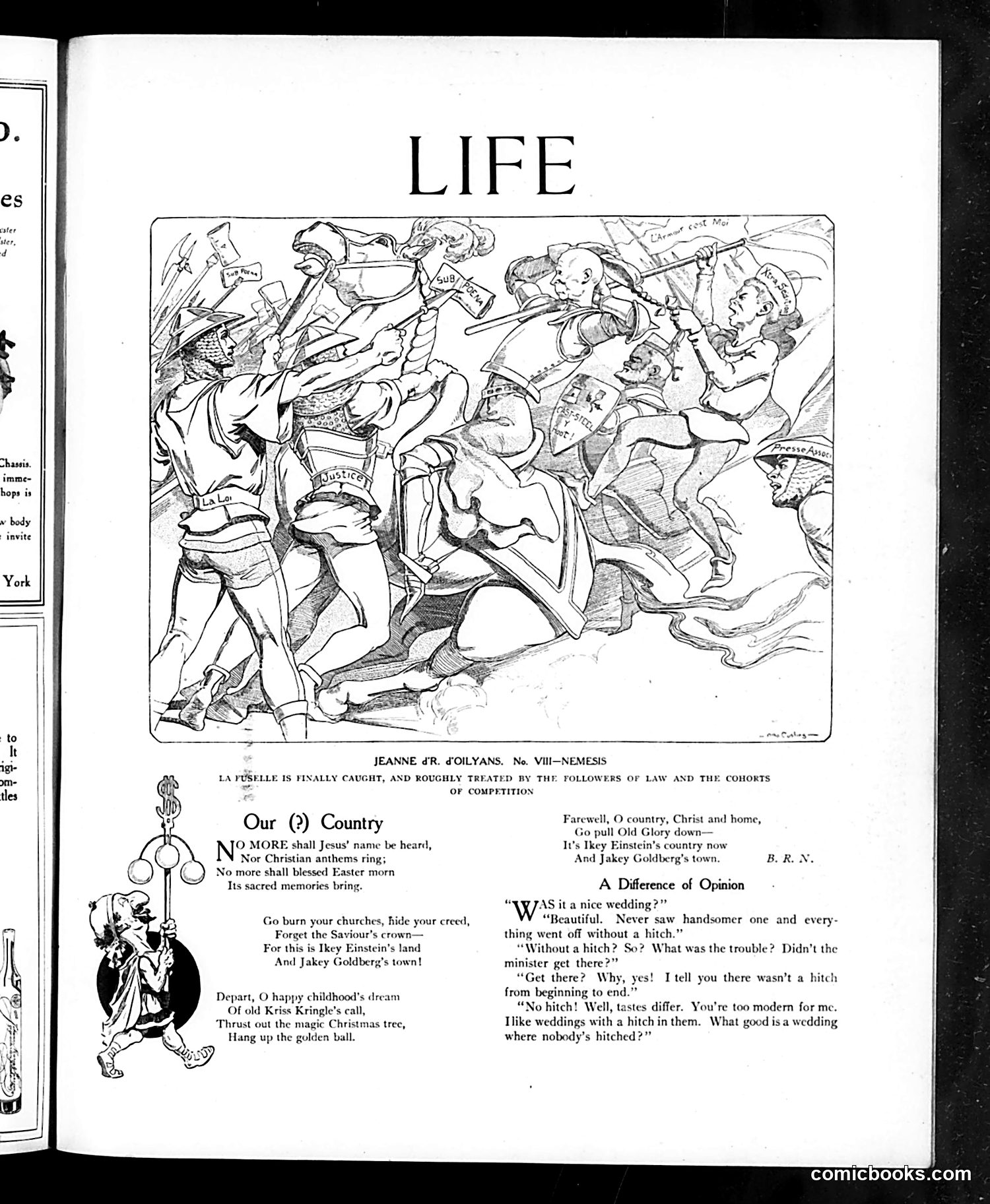
This page satirizes early 20th-century American society through multiple pieces: **Main Cartoon (top):** Depicts "Jeanne d'Orléans" being captured and mistreated by "followers of law and the cowards of competition." This appears to reference Joan of Arc as metaphor for France or French virtue under attack—likely commentary on international conflict or business ruthlessness. **Left Poem:** "Our (?) Country" mocks the decline of Christian values and traditional holidays (Easter, Christmas) in favor of commercialism ("Ikey Einstein's country" and "Jakey Goldberg's town" contain period antisemitic stereotyping). **Right Section:** "A Difference of Opinion" humorously contrasts wedding expectations—one person values traditional ceremonies; the other prefers modern weddings without ritual complications. The page combines political allegory with social commentary on modernization and cultural anxiety.
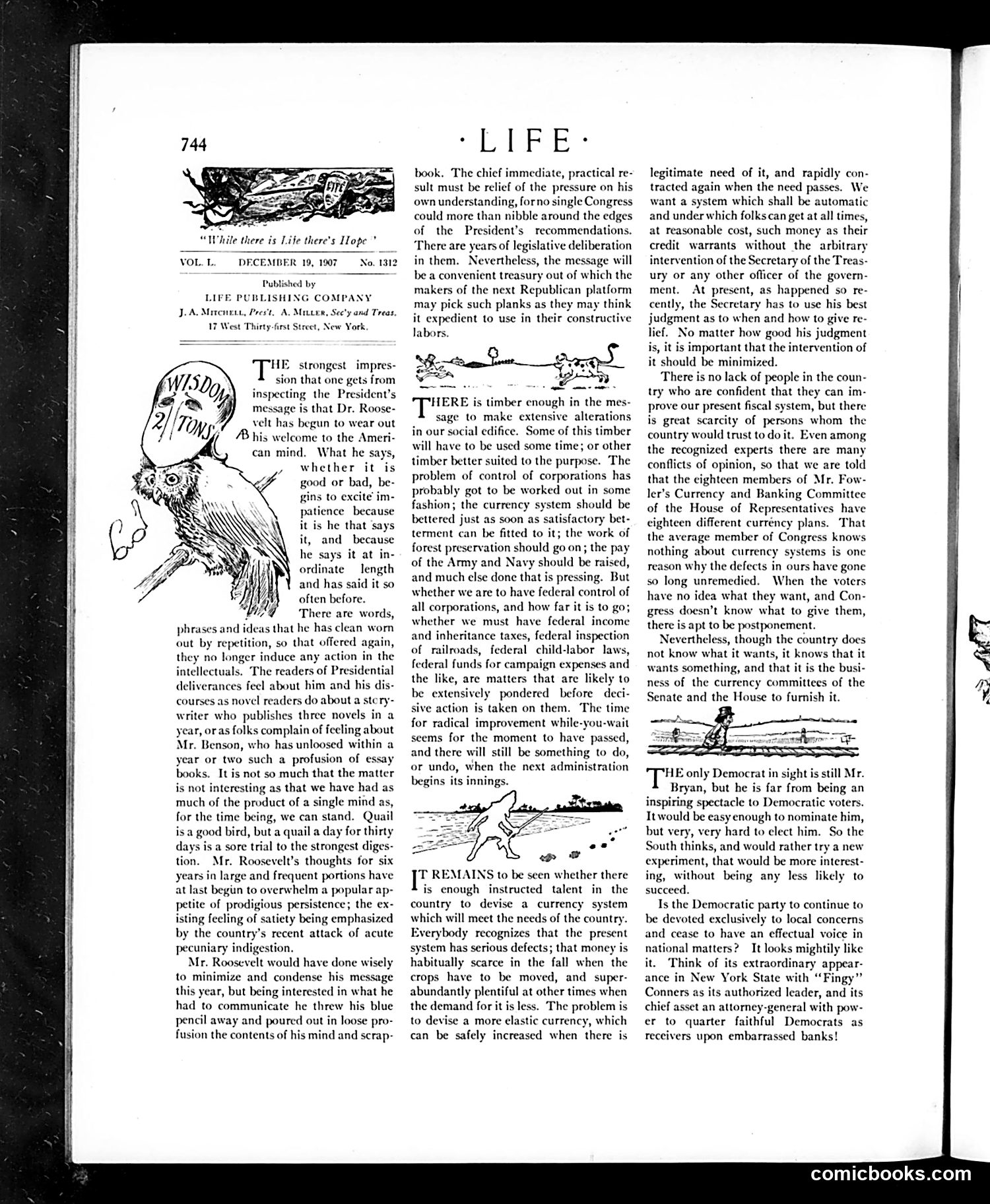
The main cartoon depicts an owl wearing a mortarboard labeled "WISDOM" and holding a torch labeled "TORY." This caricature appears to represent conservative Republican ideology being invoked to guide political discussion. The accompanying article discusses President Roosevelt's recent message to Congress regarding corporate control, currency reform, and labor issues. The text critiques both Roosevelt's approach and contemporary Democratic weakness, particularly mentioning William Jennings Bryan as an uninspiring Democratic candidate. The cartoon satirizes the conservative establishment's attempt to position itself as the voice of wisdom and tradition during a period of significant political debate over federal power, corporate regulation, and economic reform—core issues of the Progressive Era.
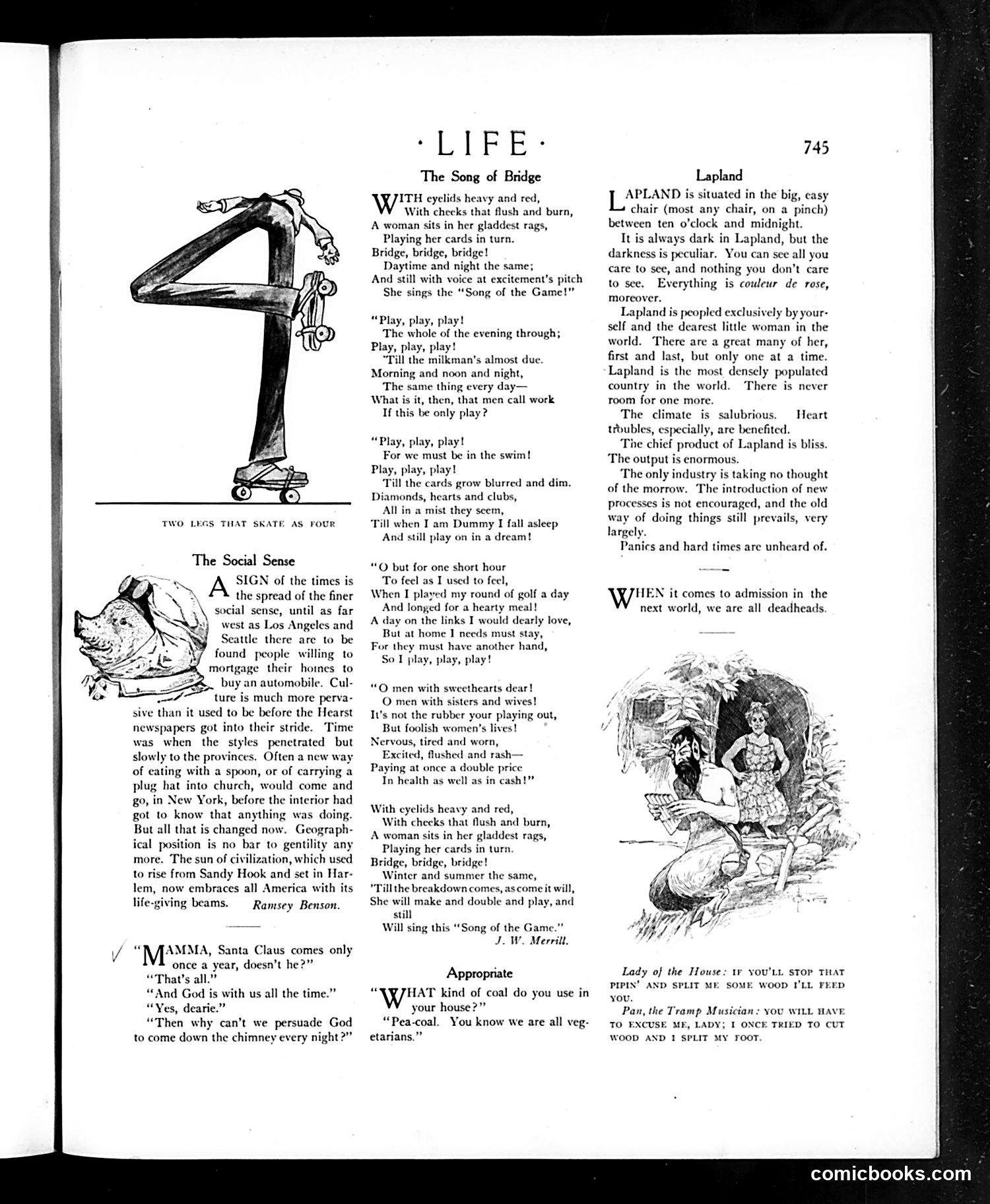
This page contains three distinct pieces of satirical content: 1. **"The Song of Bridge"** — A poem mocking women's obsession with card games, specifically bridge, which was enormously popular among affluent women in the early 20th century. The satire critiques how women neglect household duties and family obligations to play continuously. 2. **"The Social Sense"** — A brief piece satirizing geographic snobbery, particularly how West Coast residents (Los Angeles/Seattle) aspire to own automobiles as status symbols before East Coast society deemed them fashionable. 3. **"Appropriate"** — A humorous dialogue about coal types used for heating, likely poking fun at domestic pretension or vegetarian households. The illustrations depict women engaged in card-playing, reflecting the era's gendered social commentary about leisure and domestic responsibility.
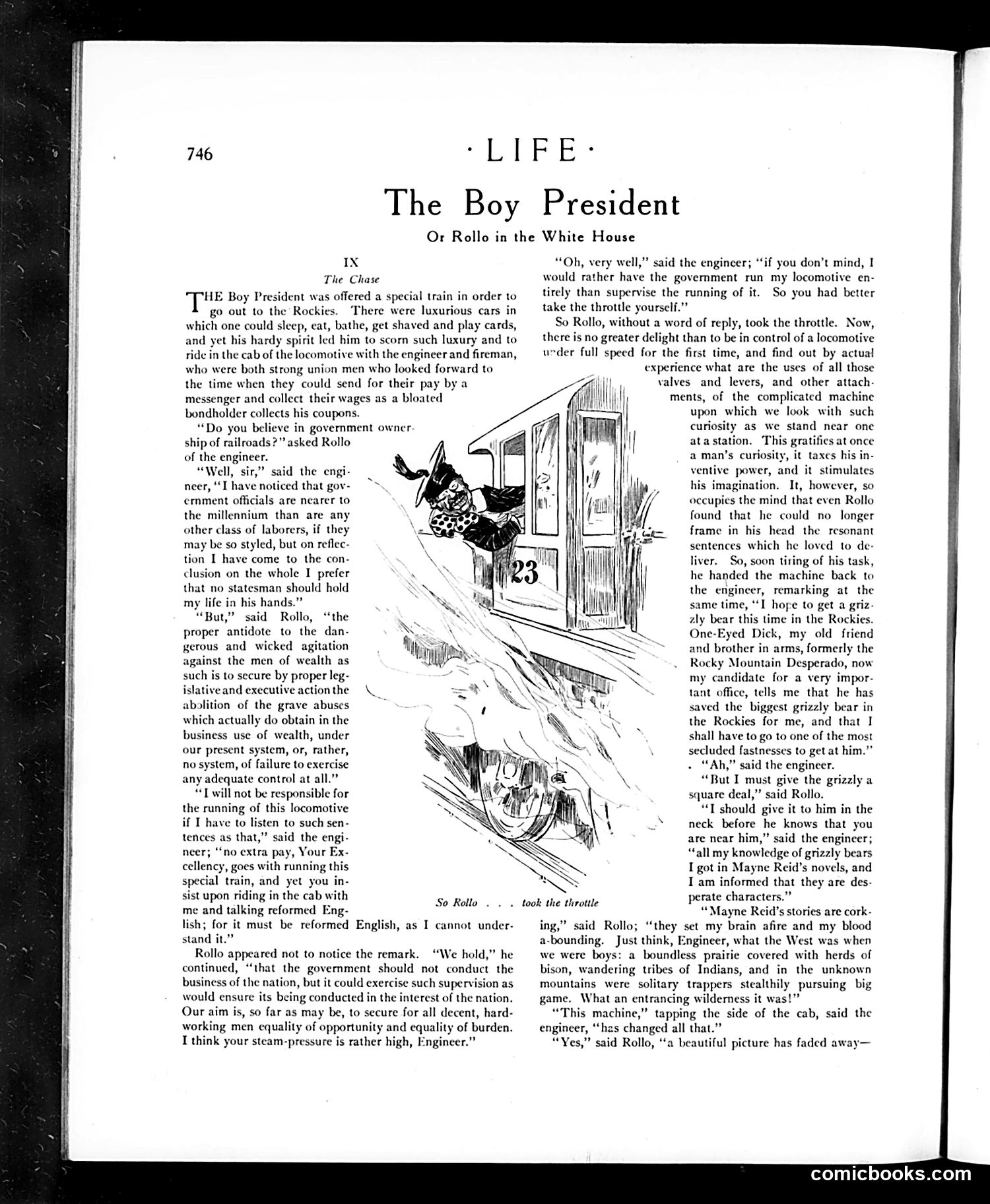
This satirical story mocks a young, inexperienced president character called "Rollo" who has been offered a special train to the Rockies. The humor centers on Rollo's naive idealism clashing with practical governance. An engineer challenges Rollo's belief in government ownership of railways, arguing that statesmen shouldn't micromanage operations. Rollo responds with patronizing moral lectures about wealth redistribution and labor reform—positions the story presents as impractical idealism disconnected from reality. The satire targets Progressive Era reformers and their often sanctimonious, youth-driven political rhetoric. The illustration shows Rollo riding the train's exterior, emphasizing his reckless inexperience. The "Boy President" title suggests incompetence rooted in immaturity rather than genuine policy disagreement.
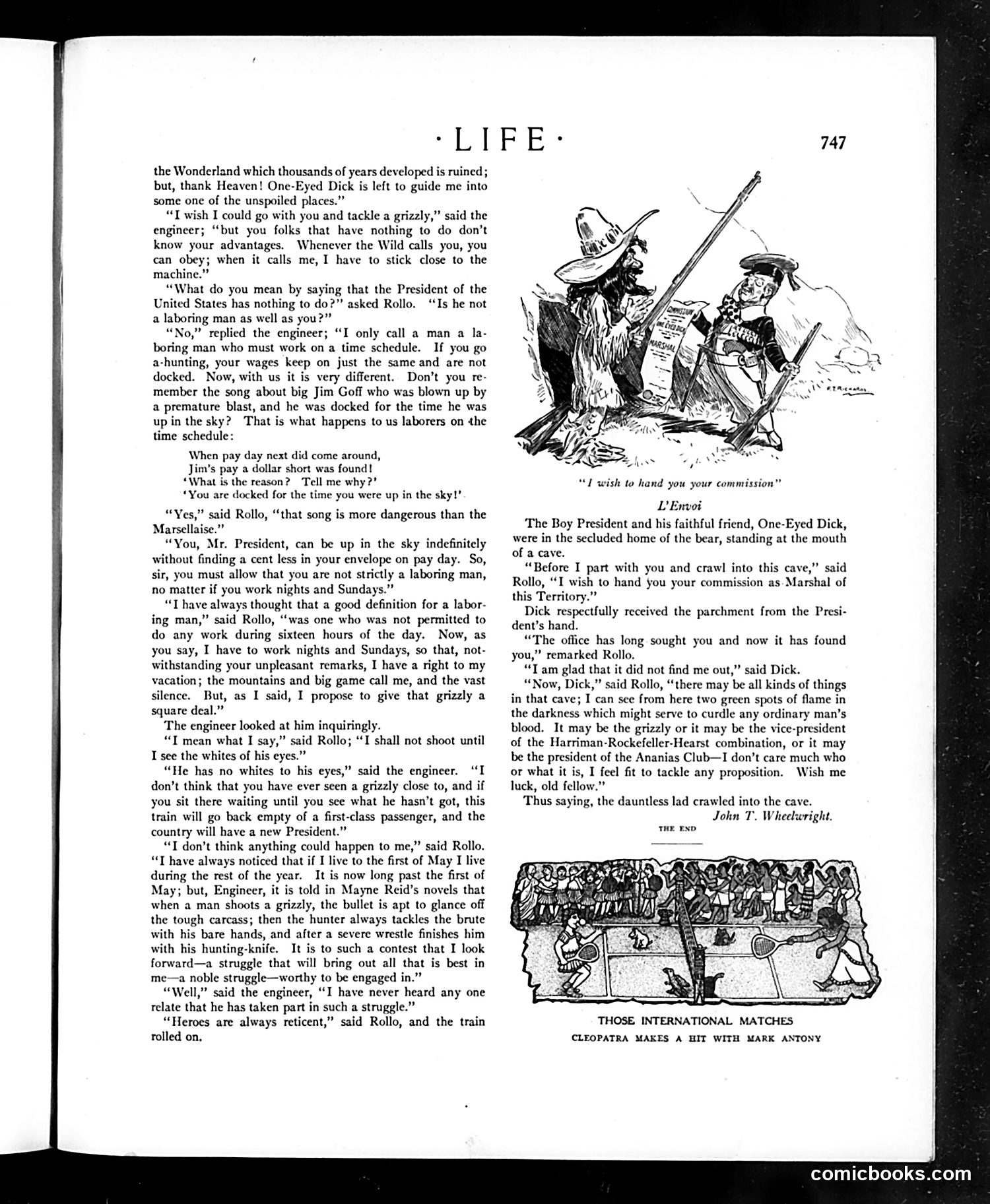
The main illustration depicts two figures in a cave: "The Boy President" (labeled One-Eyed Dick) receiving a parchment commission from what appears to be a grizzly bear. This is political satire mocking Theodore Roosevelt. The "Boy President" refers to Roosevelt's youth when assuming office after McKinley's assassination in 1901. "One-Eyed Dick" is a derisive nickname referencing Roosevelt's actual eye injury. The grizzly bear symbolizes Roosevelt's famous hunting prowess and "Rough Rider" persona. The accompanying text dialogue satirizes Roosevelt's labor policies and his claims about working men's rights, suggesting contradiction between his rhetoric and actual worker protections. The bottom panel caption reads "THOSE INTERNATIONAL MATCHES: CLEOPATRA MAKES A HIT WITH MARK ANTONY"—an unrelated classical history joke.
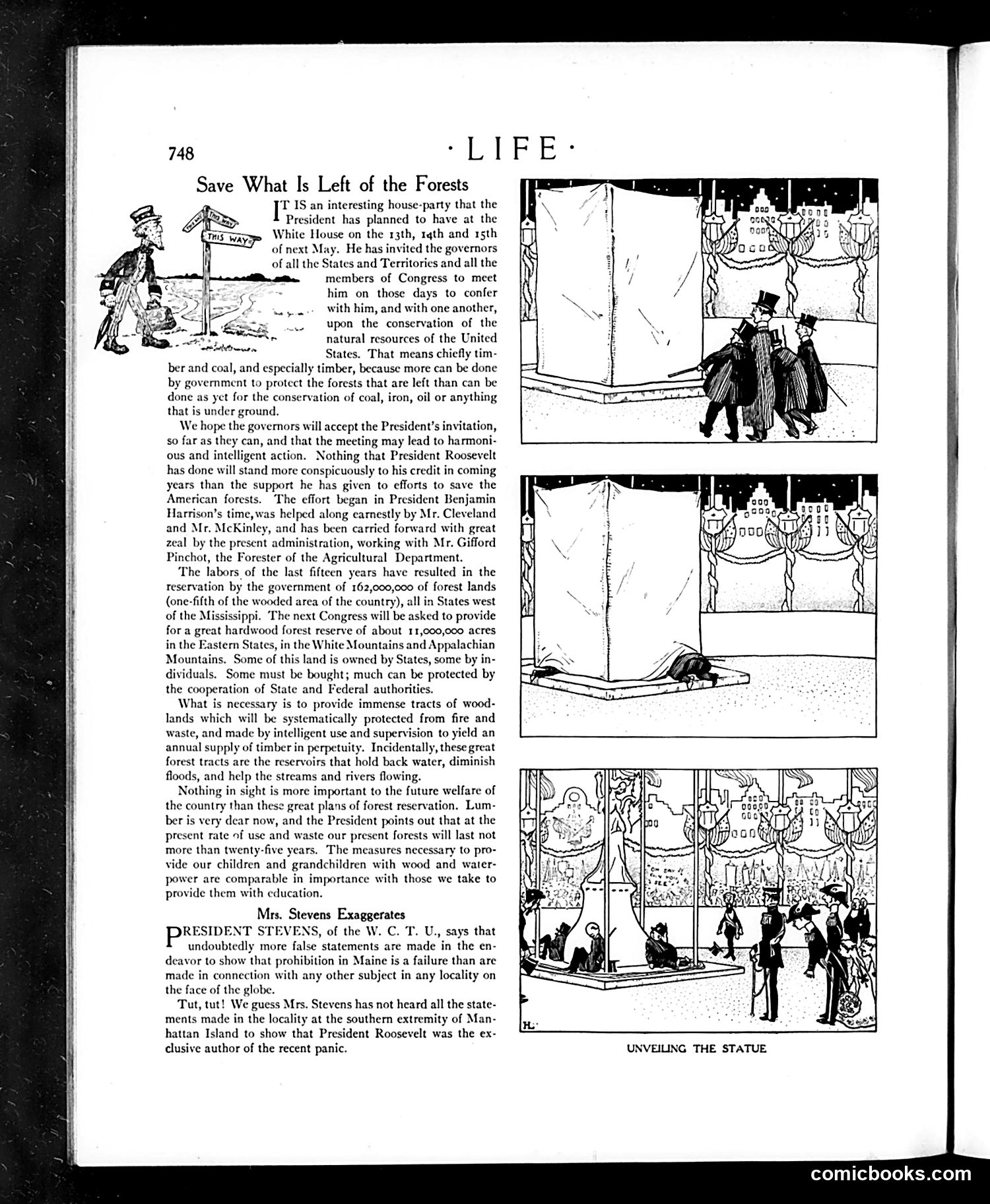
This page discusses President Roosevelt's conservation efforts, specifically his plan to convene governors to discuss protecting America's forests and natural resources. The article praises Roosevelt's commitment to forest preservation and mentions his support from predecessors Cleveland and McKinley, as well as current officials like Gifford Pinchot (Forester of the Agricultural Department). The four cartoon panels on the right appear to depict a formal White House event—likely the governors' conference itself—showing dignitaries arriving, meeting, and culminating in "unveiling the statue" (the final panel). The cartoons seem to humorously document this significant conservation meeting, suggesting the event's importance through the formal ceremony depicted.
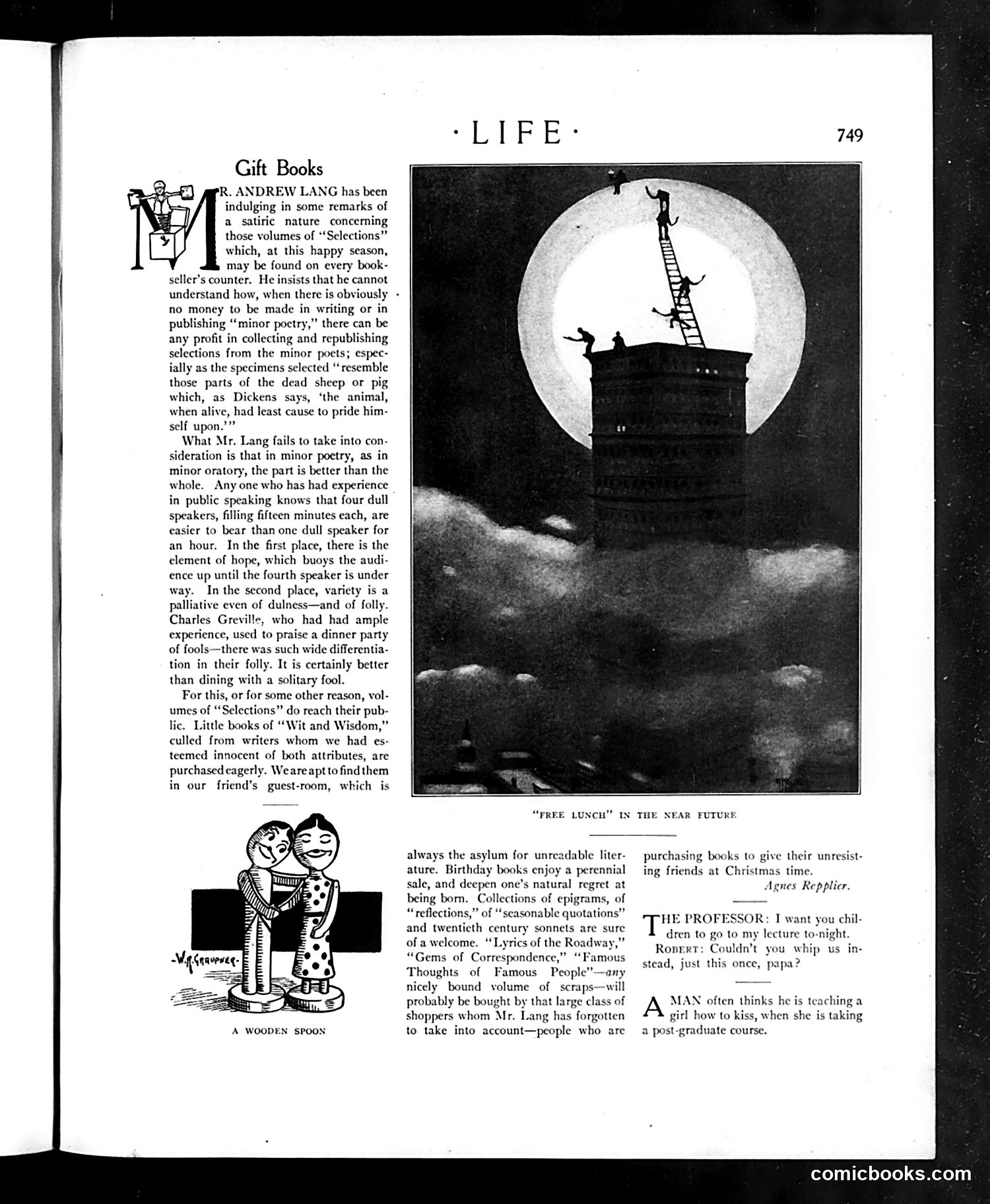
This page critiques Andrew Lang's "Selections" gift books. Lang insisted minor poetry collections were unprofitable, yet publishers produced them anyway—Lang apparently overlooking that anthologies of minor poets actually sold well as affordable gift books. The satire mocks Lang's contradiction: he claims there's "no money" in such volumes, yet they were popular Christmas purchases. The article argues that short selections are actually *better* than complete works (citing variety as preferable to dullness), making Lang's dismissal of the genre economically and artistically misguided. The illustration "Free Lunch in the Near Future" appears unrelated—likely separate satirical content about a different social topic. The page demonstrates Life's role as a literary-minded humor magazine critiquing publishing industry figures and their flawed reasoning.
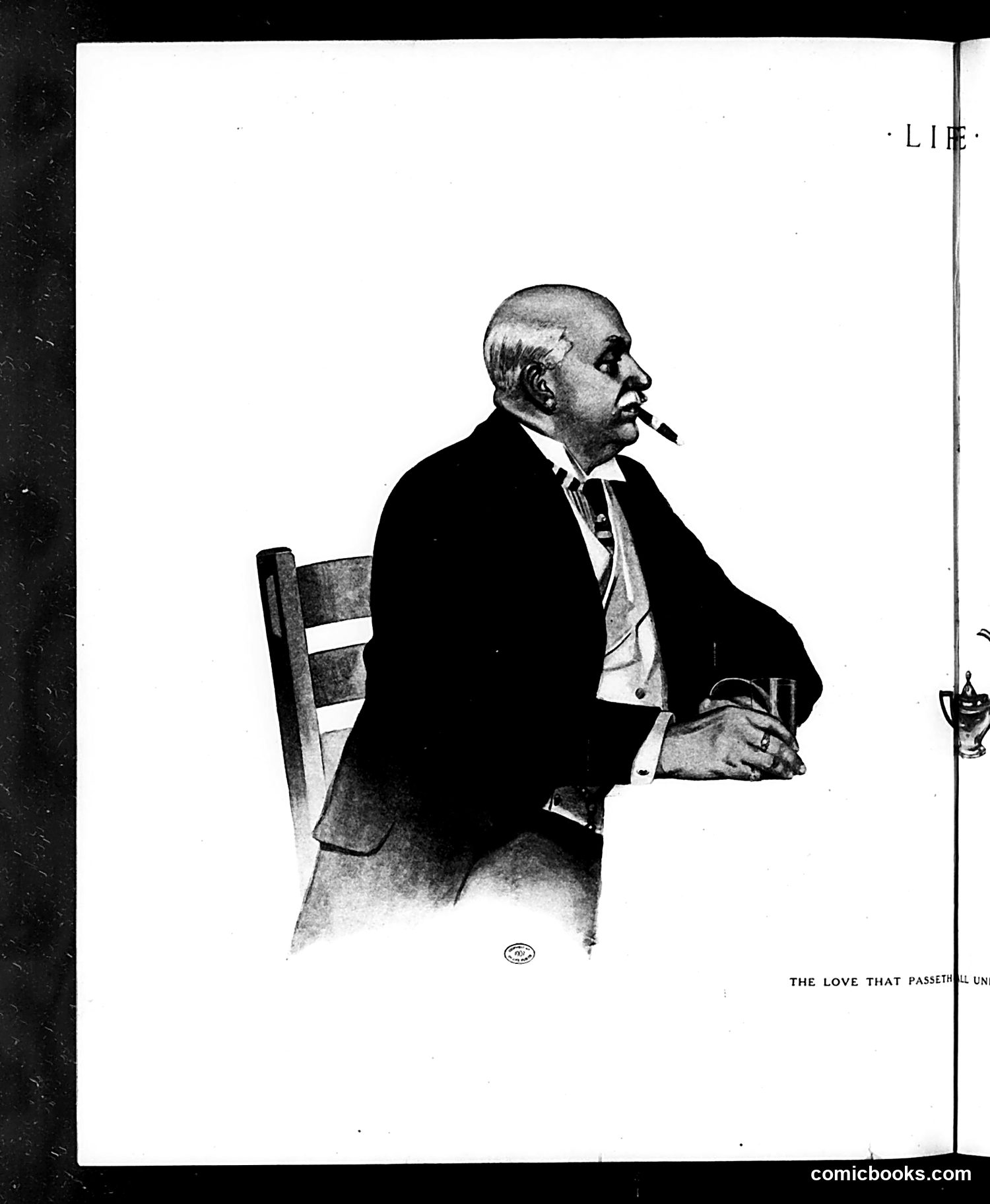
This page shows a political cartoon featuring a distinguished older gentleman in formal attire, seated and smoking a cigar. The incomplete caption reads "THE LOVE THAT PASSETH ALL UN[DERSTANDING]" — likely a biblical reference (1 Corinthians 13). The identity of the figure is unclear from the image alone, though his formal dress, cigar-smoking pose, and prominent placement suggest he was a notable public figure of Life magazine's era (likely early-to-mid 20th century). Without the complete caption or additional context, the specific satire remains ambiguous. The biblical reference combined with the dignified portrait suggests ironic commentary on some controversial aspect of this person's character or actions — possibly criticizing public perception versus reality. The "love" reference may indicate hypocrisy or misplaced admiration.
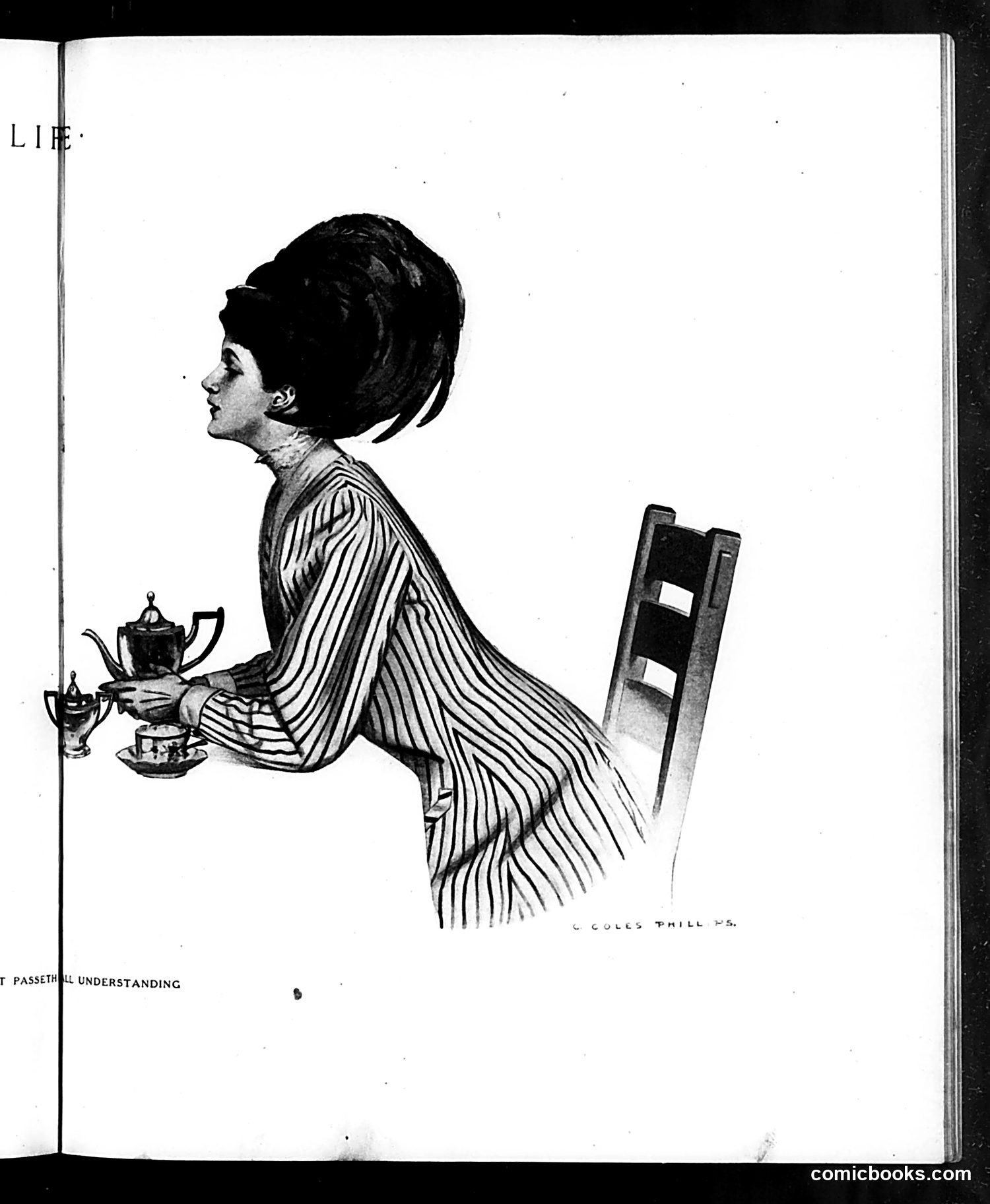
This is a satirical illustration signed by Coles Phillips, a prominent early-20th-century illustrator. The cartoon depicts a woman in an elegant striped dress seated on a chair, serving tea. The text fragment "passeth all understanding" (likely "surpasseth all understanding") suggests ironic commentary on something inexplicable or absurd. The satire appears to target either domestic life expectations for women or perhaps wartime rationing and resource management—the contrast between refined tea service and the sparse setting creates the joke. The woman's fashionable appearance and composed posture contrast with whatever absurdity the caption references, suggesting criticism of either gender roles, economic conditions, or social pretense during a specific historical period. Without complete caption text, the specific target remains unclear.
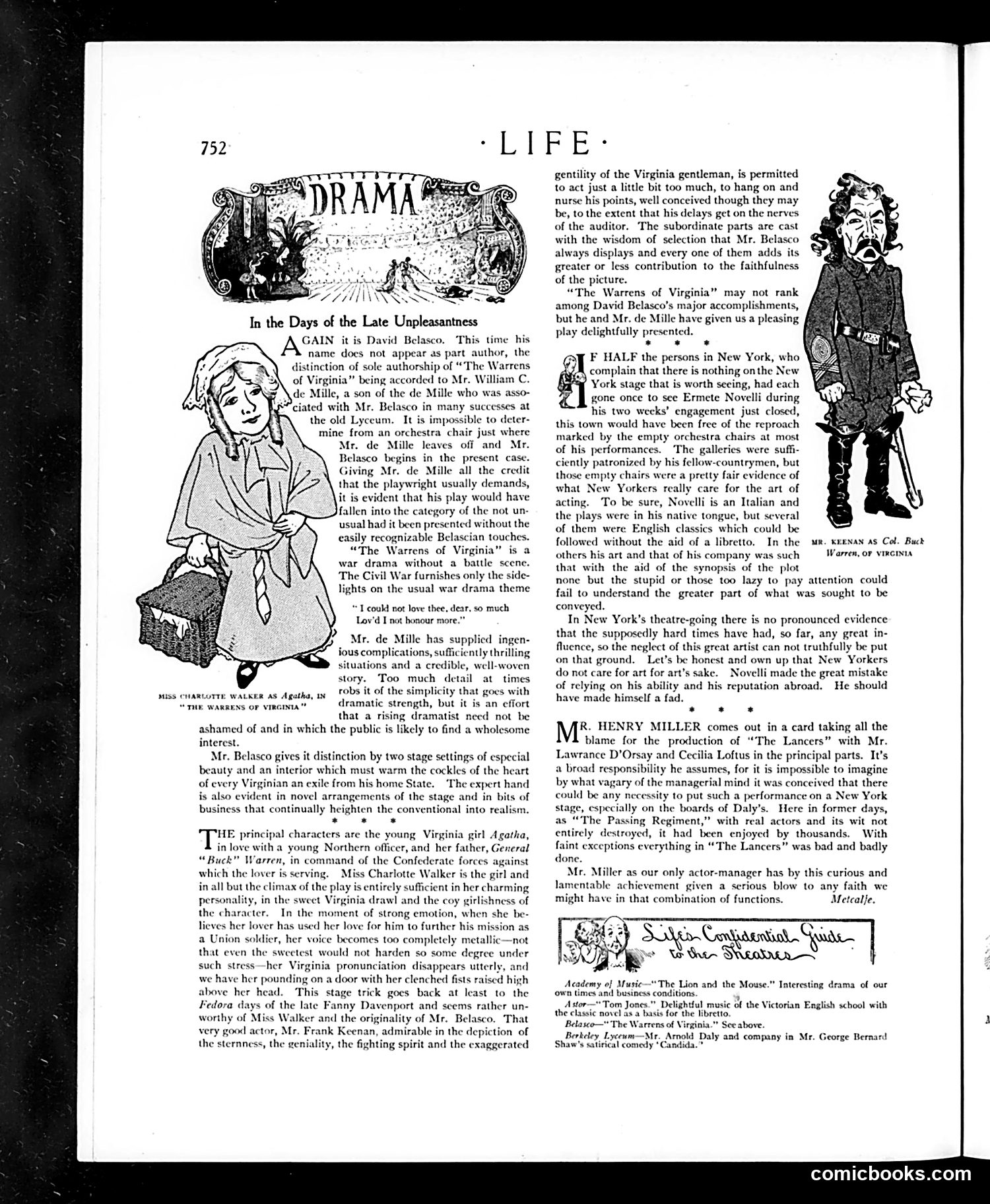
This page reviews a Civil War play produced by theatrical impresario David Belasco. The cartoon depicts **Charlotte Walker as Agatha**, the female lead character—a young Virginia woman caught between love for a Northern officer and loyalty to her Confederate father. The review credits playwright **William C. de Mille** with sole authorship, though Belasco's directorial "touches" distinguish the production. The critic praises the atmospheric staging and performances by Walker and actor Frank Keenan, though noting Walker oversells emotion in climactic scenes with outdated theatrical mannerisms (compared unfavorably to "Fedora days"). The phrase "Days of the Late Unpleasantness" is period euphemism for the Civil War. The review treats this wartime romance as a successful commercial entertainment, appreciating Belasco's craftsmanship while suggesting the play itself wouldn't survive without his directorial expertise.
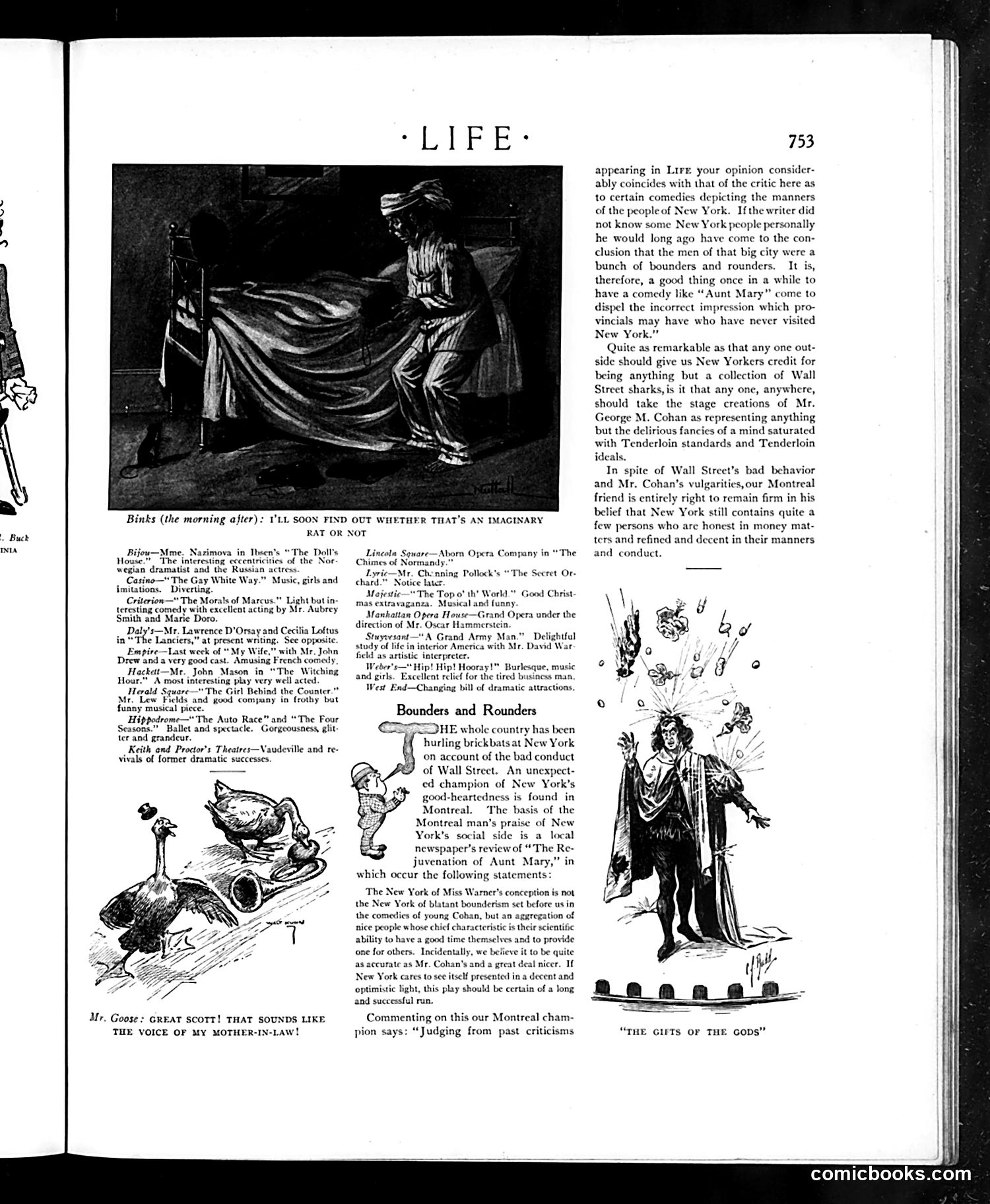
This page satirizes New York's unflattering reputation and defends the city's actual character. A Montreal newspaper praised the play "The Rejuvenation of Aunt Mary" for depicting New Yorkers as decent, refined people—contrasting sharply with George M. Cohan's comedies, which portrayed them as "bounders and rounders" (con artists and dissolute characters). Life's editor agrees emphatically, arguing that Cohan's stage creations reflect only the seedy "Tenderloin" district's moral standards, not genuine New York society. The piece criticizes outsiders for believing Cohan's exaggerated depictions, while acknowledging Wall Street's recent scandals have damaged the city's reputation nationally. The cartoons mock these stereotypes: one shows a man discovering an actual rat (titled "I'll soon find out whether that's an imaginary rat or not"), satirizing the absurdity of mistaking theatrical fantasy for reality.
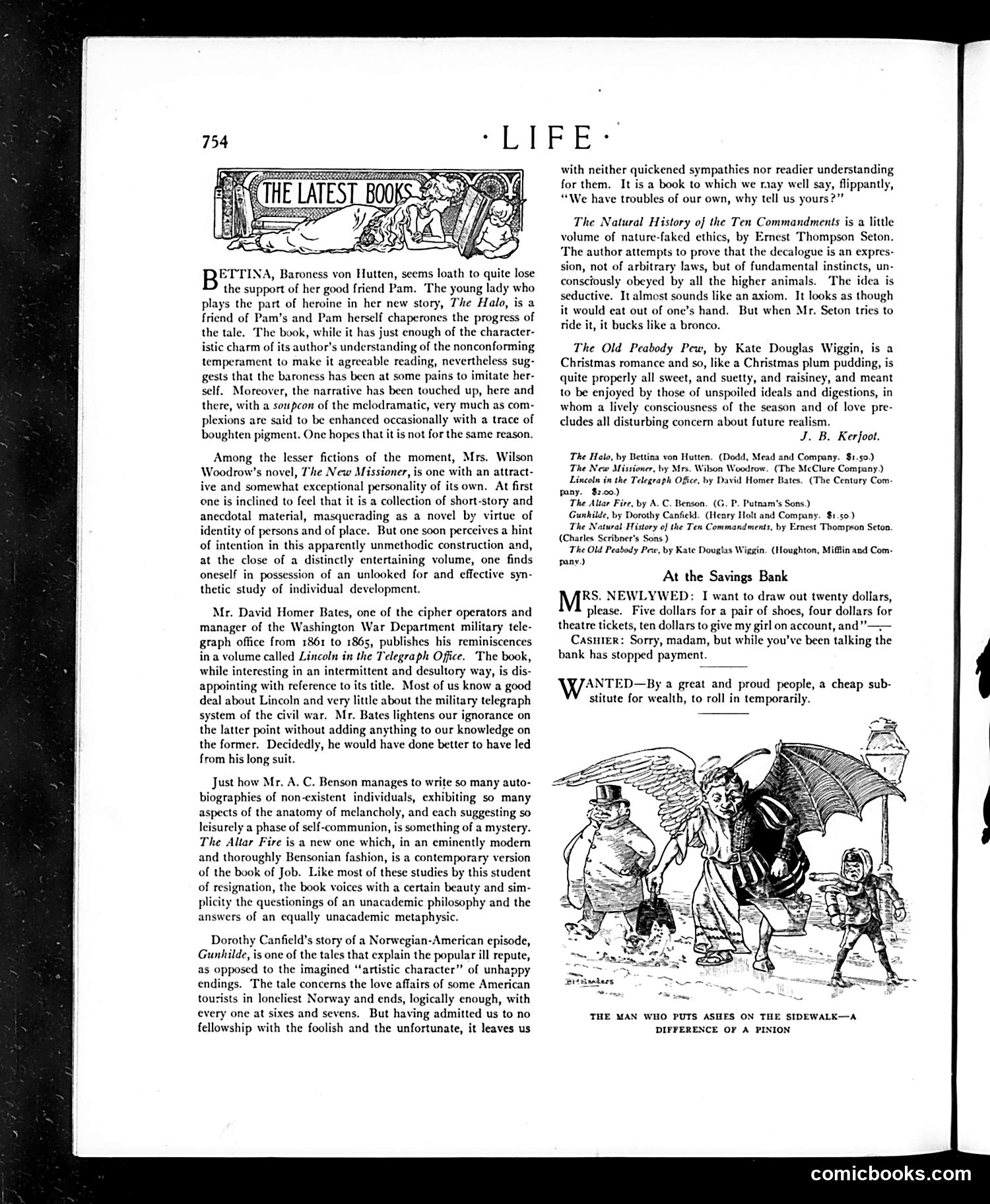
This cartoon illustrates a class-based social conflict common in early 20th-century urban America. A well-dressed gentleman with a top hat and cane appears to object to a working-class man scattering ashes on an icy sidewalk—a practical safety measure to prevent slipping. The satire mocks the gentleman's apparent disapproval of this utilitarian solution, suggesting the wealthy prioritize aesthetic or property concerns over public welfare and worker practicality. The "difference of opinion" is between upper-class sensibilities and working-class common sense. The title's ironic tone—treating such a mundane disagreement as philosophically weighty—underscores Life magazine's critique of class pretension and disconnect between social classes during the Progressive Era.
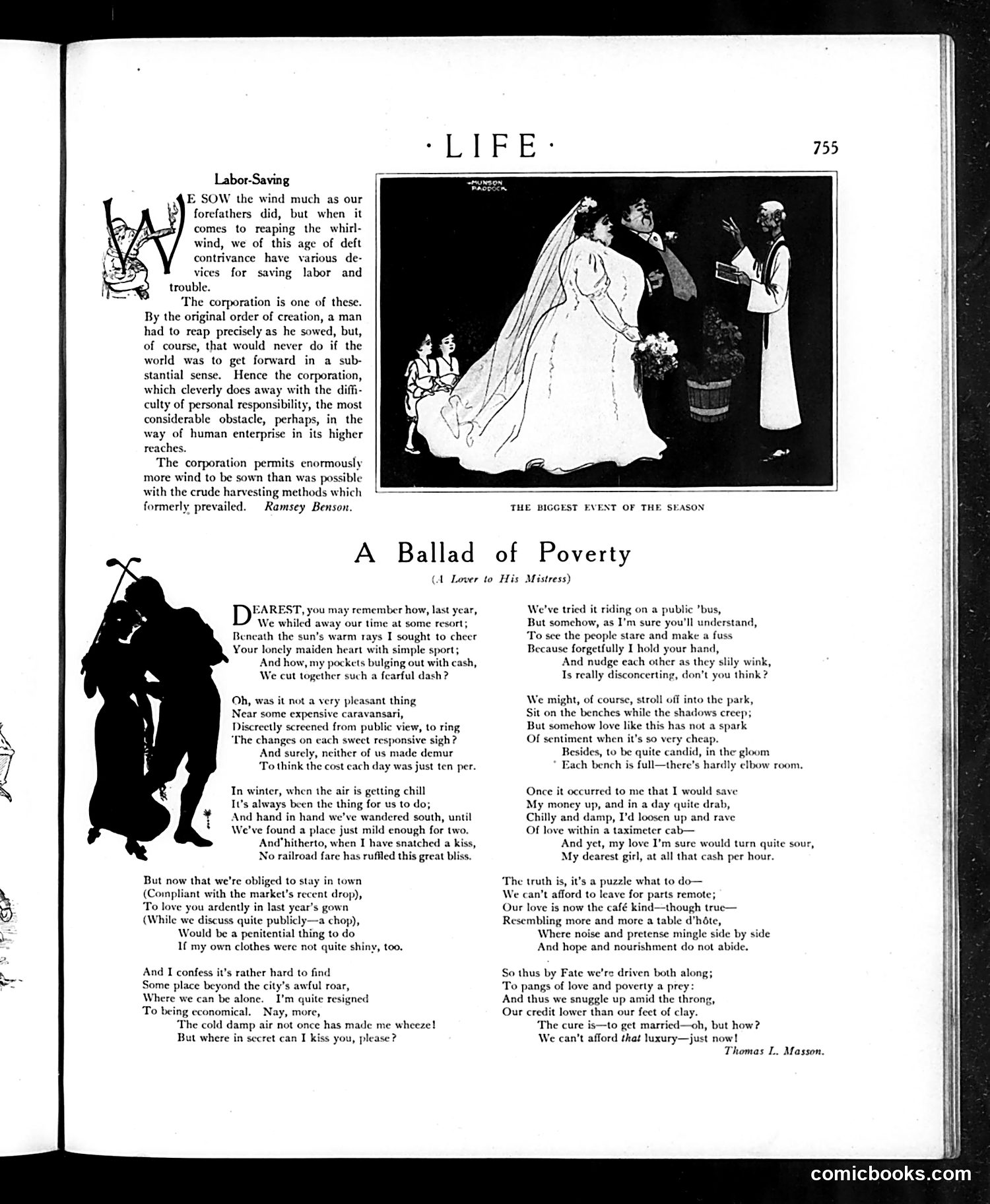
**"Labor-Saving" Editorial Cartoon:** The text satirizes corporations as devices that allow businesses to escape personal responsibility for their actions. The author argues that while individuals must "reap what they sow," corporations exploit a legal loophole—permitting unethical behavior without individual accountability. This appears to critique early 20th-century corporate malfeasance and the ability of companies to cause harm while evading consequences. **"A Ballad of Poverty" Poem:** A romantic satire about a couple forced by economic hardship to abandon their luxurious lifestyle. Once able to afford expensive resorts and hotels, they now cannot find private places to meet without public scrutiny or cost. The poem's final irony: they cannot even afford marriage as a solution. This reflects post-World War I economic strain affecting middle and upper-middle classes, satirizing how poverty intrudes upon romance and forcing couples into undignified compromises.
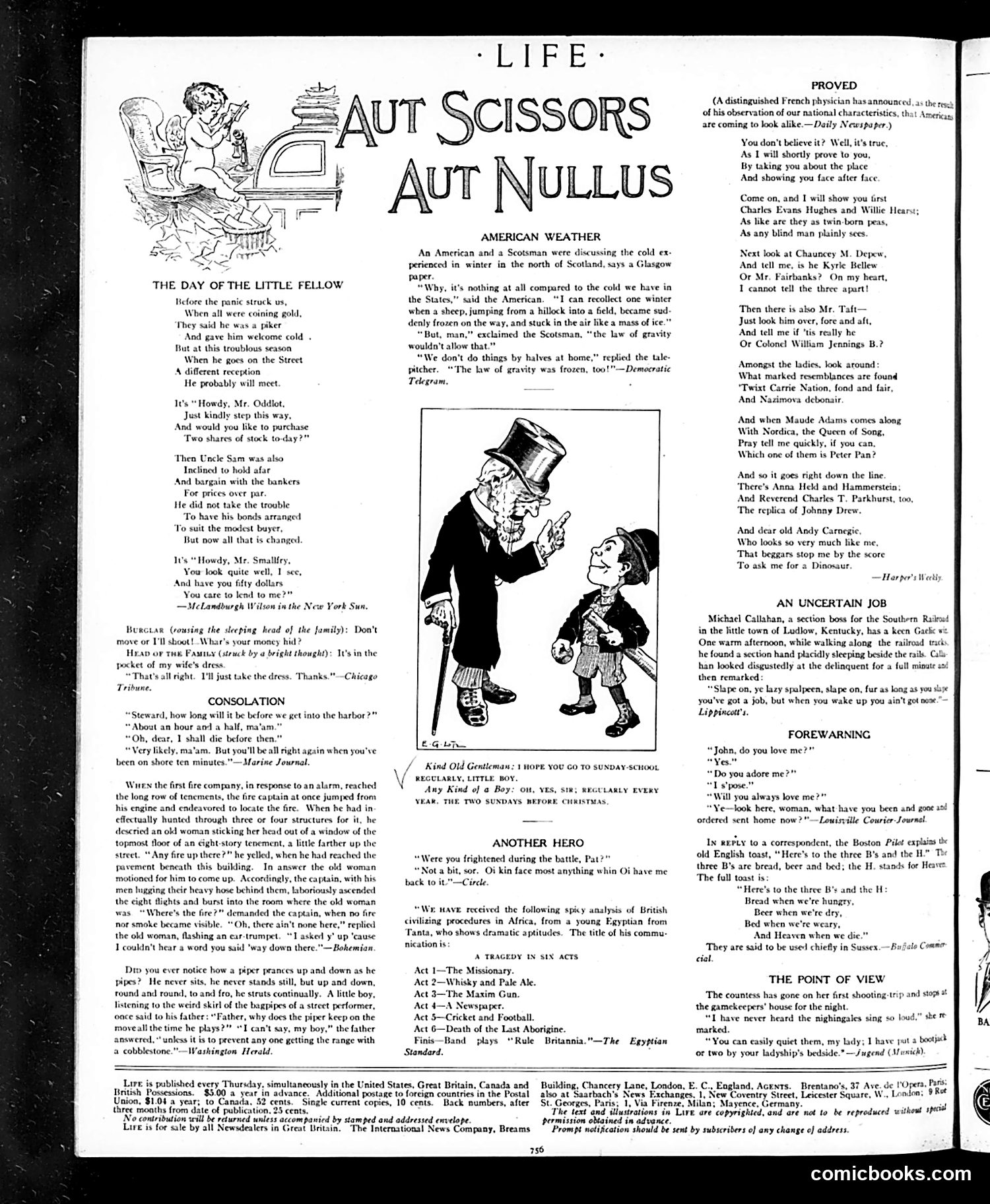
This page from *Life* magazine contains several satirical pieces reflecting early 20th-century American concerns: **"The Day of the Little Fellow"** (poem): A commentary on class reversal during financial panic. Before the crisis, wealthy "small" investors were dismissed; now desperate bankers eagerly court them for loans, reversing social hierarchies. **"Aut Scissors Aut Nullus"** cartoon: Shows a well-dressed man (appears to be a banker or wealthy figure) condescendingly addressing a small boy, illustrating economic power dynamics and exploitation of the vulnerable. **Various humorous anecdotes** mock American exaggeration, Irish immigrant stereotypes (the "Pat" character), and social pretension—standard satirical targets for the era. The overall theme reflects anxieties about financial instability, class conflict, and the reversal of social positions during economic crisis—likely referencing the 1907 Panic or similar market disruption.
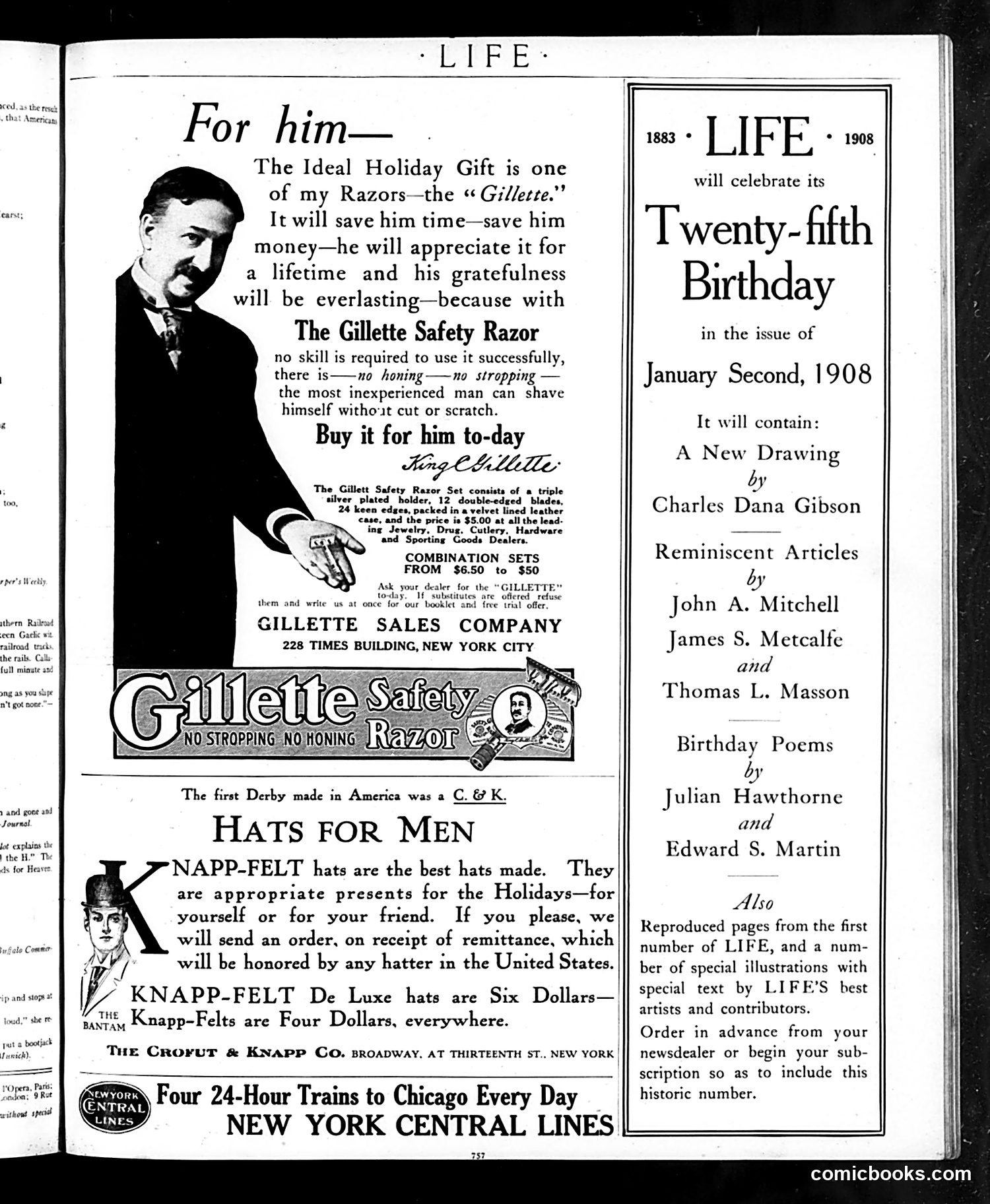
This page is primarily **advertising**, not satire or political commentary. It features holiday gift advertisements for three products: Gillette Safety Razors, Knapp-Felt hats, and New York Central Lines trains. The Gillette ad uses a formal portrait of a man to market razors as practical gifts, emphasizing the product's ease of use—"no skill required," "no honing, no stropping"—making it suitable for any man. The hat and train ads similarly target male consumers with holiday shopping suggestions. The right column announces **Life magazine's 25th birthday issue** (January 2, 1908), promoting it as a historic collectible featuring contributions from notable writers and illustrators like Charles Dana Gibson. This is a self-promotional announcement, not editorial content. The page reflects early 1900s consumer culture and advertising conventions, with no apparent satire or caricature intended. It's a standard commercial page from a magazine that supported itself through advertising revenue.
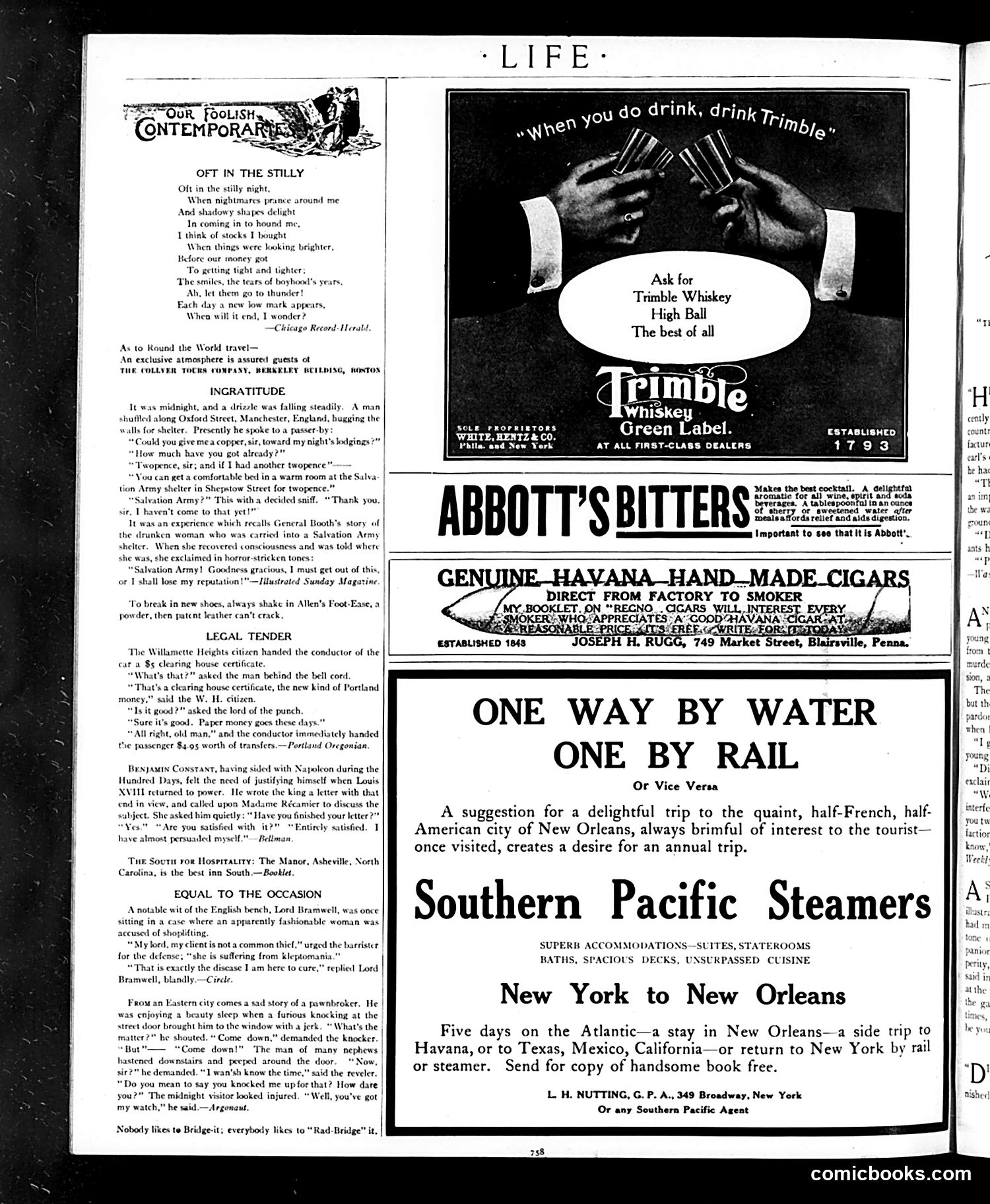
This page from Life magazine (circa early 1900s based on styling) combines satirical poetry and humorous anecdotes with period advertisements. The lead poem "Oft in the Stilly" satirizes financial anxiety—a man tormented by memories of lost stock investments, reflecting widespread economic concerns of the era (likely referencing late-1800s market volatility). The short humorous pieces below mock human nature: a homeless man refuses Salvation Army shelter fearing loss of reputation; a Portland citizen attempts to use a "clearing house certificate" as legal tender; Lord Bramwell makes a quick legal quip about treating "kleptomania" through arrest. These anecdotes represent Life's satirical brand of humor—gently mocking pretension, desperation, and human contradiction. The advertisements (Trimble Whiskey, Abbott's Bitters, cigars, Southern Pacific Steamers) are typical period marketing, using claims about health benefits and social status now recognized as dubious.
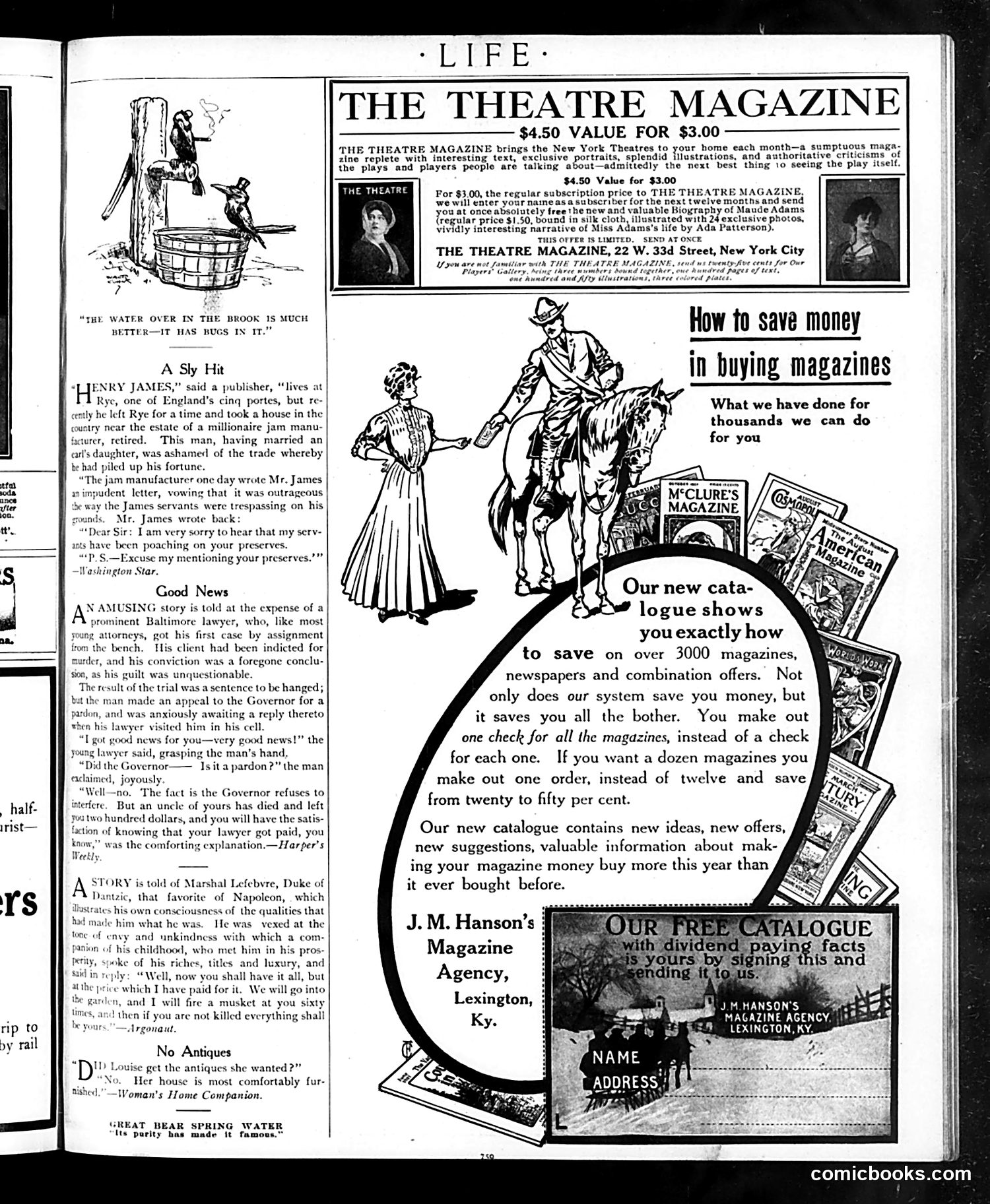
This page contains **mostly advertising** interspersed with brief humorous anecdotes typical of Life magazine's satirical format. The **main content** comprises: 1. **Theatre Magazine advertisement** (top): Promoting a subscription deal offering a biography of actress Maude Adams 2. **Four short comic anecdotes** (left column): "A Sly Hit" about Henry James and a jam manufacturer's snobbishness; "Good News" about a condemned man's lawyer; a Marshal Lefebvre story about comeuppance; "No Antiques" (brief joke). These are genteel, mild humor targeting social pretension and irony. 3. **Magazine subscription service advertisement** (right, dominant): J.M. Hanson's Magazine Agency promoting bulk magazine purchasing that saves money through consolidated ordering—consolidating 3,000+ publications into one check rather than individual subscriptions. The page reflects **early 20th-century consumer culture**: magazine proliferation, subscription services, and advertising's growing sophistication. The anecdotes exemplify *Life's* characteristic urbane, class-conscious humor mocking social affectation.
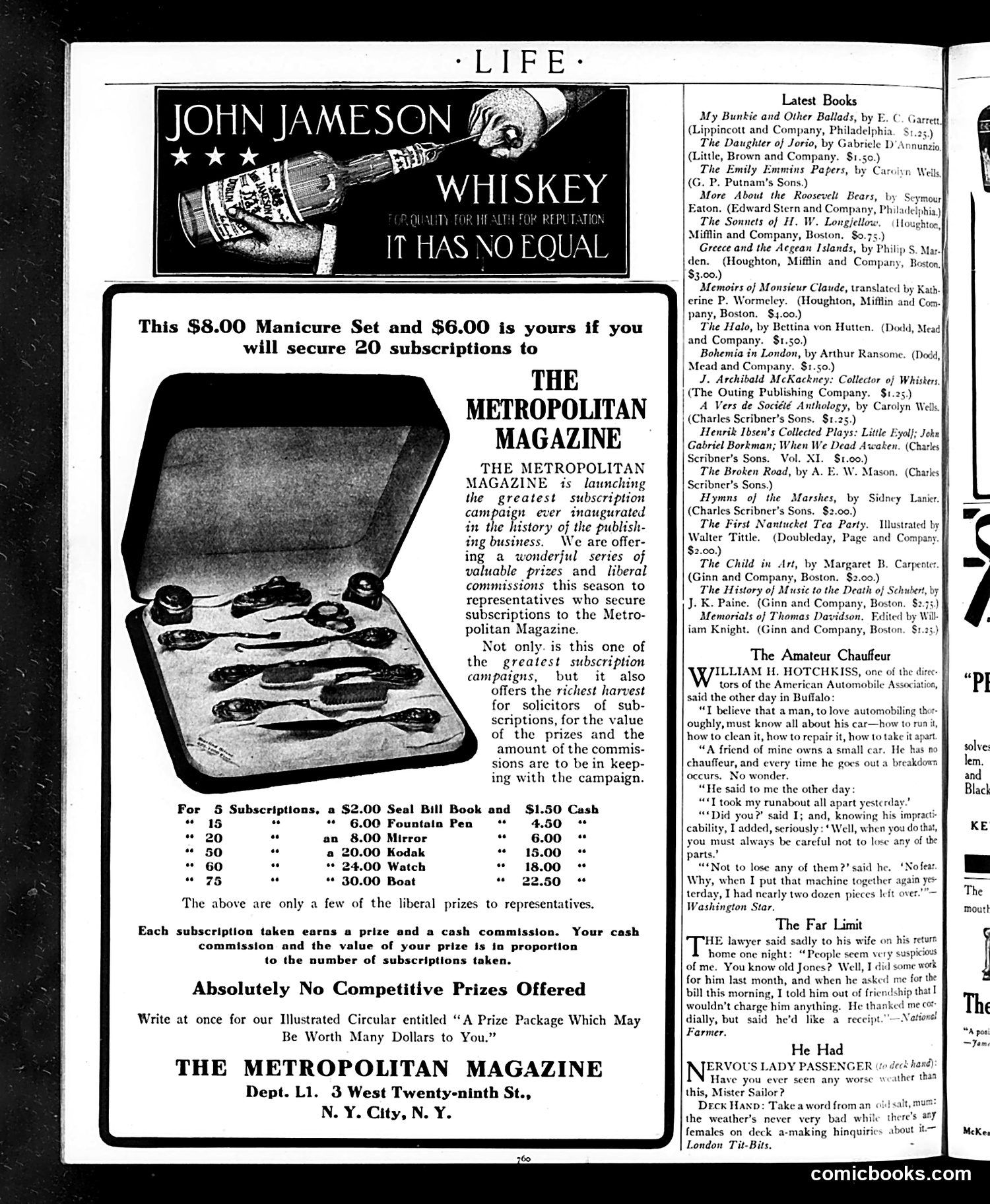
This page is primarily **advertising**, not political satire. The dominant content is a subscription campaign for *The Metropolitan Magazine*, offering prizes (manicure sets, fountain pens, mirrors, kodaks, watches) to solicitors who secure 20+ subscriptions. The small **John Jameson Whiskey advertisement** at top is standard commercial promotion—no satire present. The right column contains book reviews and a humorous anecdote titled "The Amateur Chauffeur" by William H. Hotchkiss about a car owner who disassembles his automobile and reassembles it with leftover parts, illustrating ignorance about proper vehicle maintenance. This is gentle humor about the then-novel automobile industry, not political commentary. The page reflects **early 1900s commercial culture**: aggressive subscription sales campaigns with material incentives, emerging automobile ownership, and leisurely magazine content mixing literary reviews with light comedic pieces.
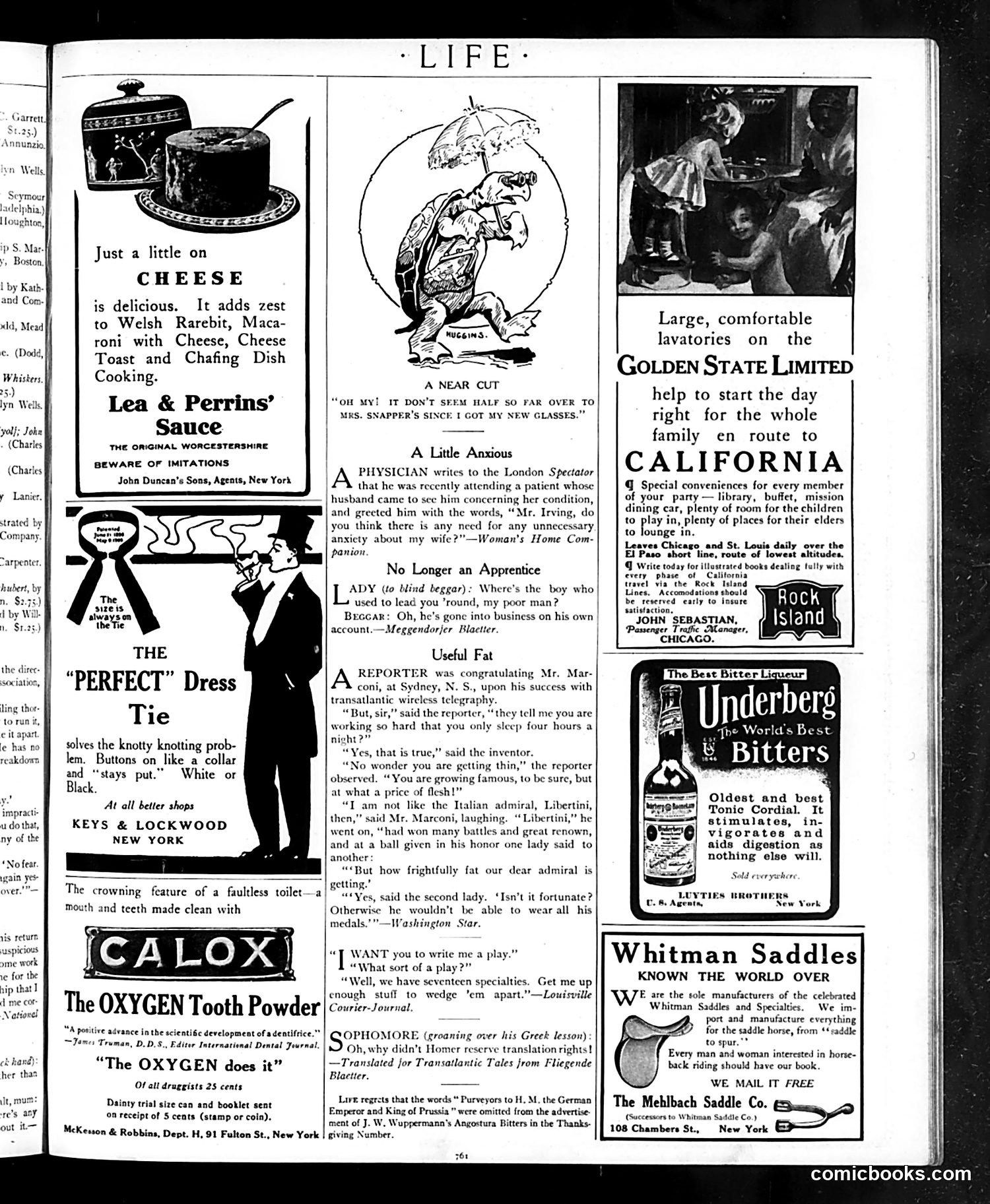
This is primarily an **advertising page** from Life magazine, interspersed with brief humorous anecdotes typical of the publication's satirical style. The cartoons and jokes are short, disconnected pieces targeting early 20th-century social absurdities: - **"A Little Anxious"**: Mild humor about a husband's awkward phrasing when visiting his wife's doctor. - **"No Longer an Apprentice"**: A blind beggar's boy has quit to start his own business—simple irony about ambition. - **"Useful Fat"**: Mocks Italian Admiral Libertini, joking that his obesity helps him wear all his medals—satirizing vanity and military pretension. - **Marconi anecdote**: Gently ribbs inventor Guglielmo Marconi about working so hard he's losing weight. - **"Seventeen Specialties"**: Theater producer joke about padding a play with disconnected acts. The advertisements (Lea & Perrins sauce, dress ties, tooth powder, California rail travel, bitters) reflect period consumer goods. The overall tone is light, gossipy, and family-friendly satire aimed at educated urban readers.
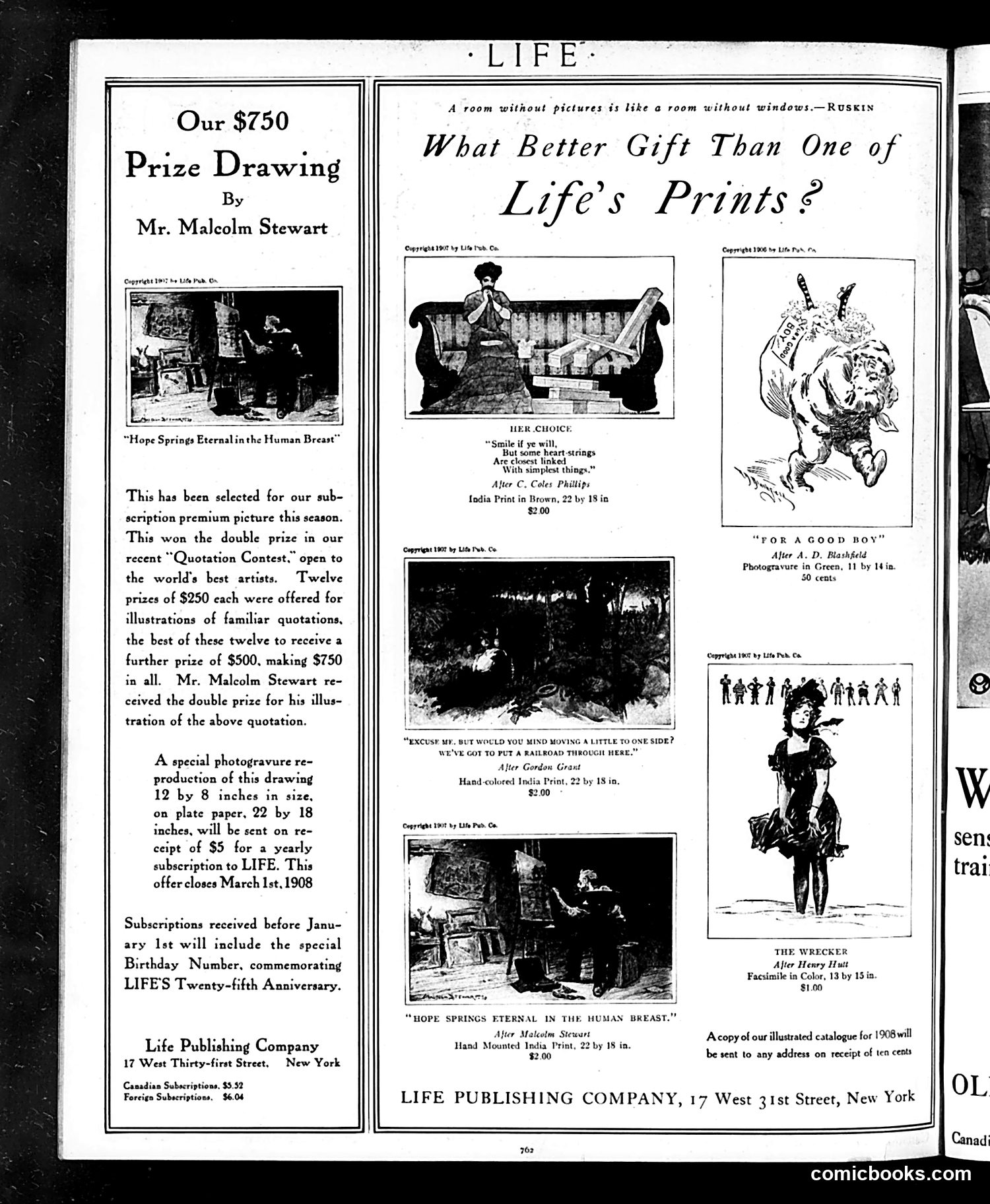
This page primarily advertises art prints for sale by Life Publishing Company. The left column announces Malcolm Stewart's prize-winning drawing "Hope Springs Eternal in the Human Breast"—which won $750 in Life's "Quotation Contest," where artists illustrated famous quotations. The right side displays several other available prints, including Gordon Grant's "Excuse Me, But Would You Mind Moving a Little to One Side? We've Got to Put a Railroad Through Here"—a satirical commentary on railroad expansion's disregard for individual property rights during America's industrial boom. Other offerings include sentimental images like "Her Choice" and "For a Good Boy," plus Henry Hutt's "The Wrecker." The page is primarily commercial—advertising these reproductions as subscription premiums and gifts—rather than presenting editorial satire. It reflects the magazine's dual role as both satirical publication and art print distributor.
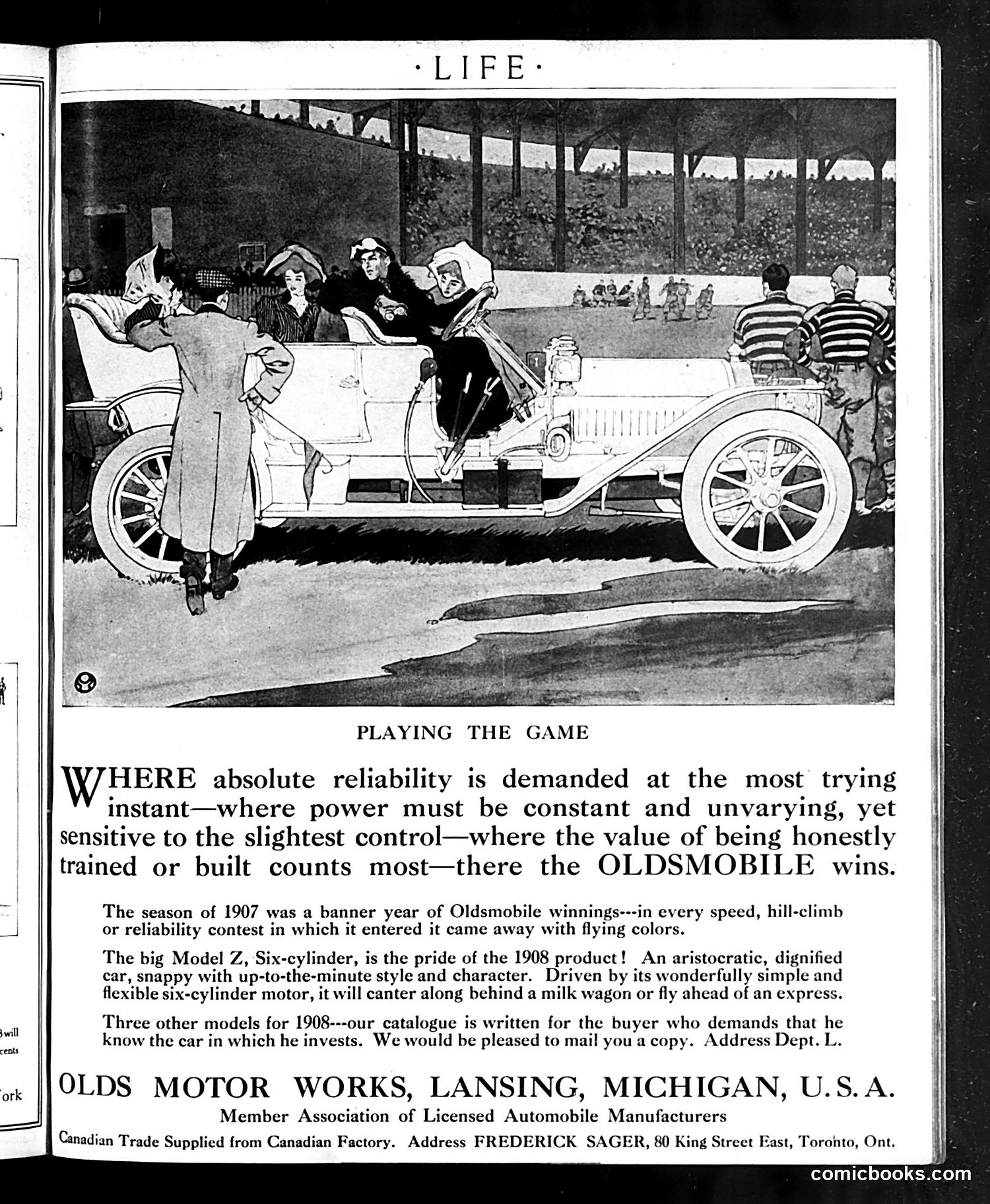
This is **not satire or political commentary**—it's a straightforward automobile advertisement. The image depicts a wealthy couple at what appears to be a country club or sporting event, arriving in an Oldsmobile Model Z. Spectators and attendants surround them, suggesting the car's status as a luxury vehicle. The ad uses sports metaphors ("Playing the Game") to associate the automobile with reliability and performance. It claims Oldsmobile dominated 1907 racing and reliability contests, positioning the six-cylinder Model Z as both aristocratic and practical—able to follow a milk wagon or outpace an express vehicle. The text targets affluent buyers who demand engineering quality. This represents early automotive advertising's focus on demonstrating mechanical superiority and social prestige through competitive success rather than lifestyle imagery alone.
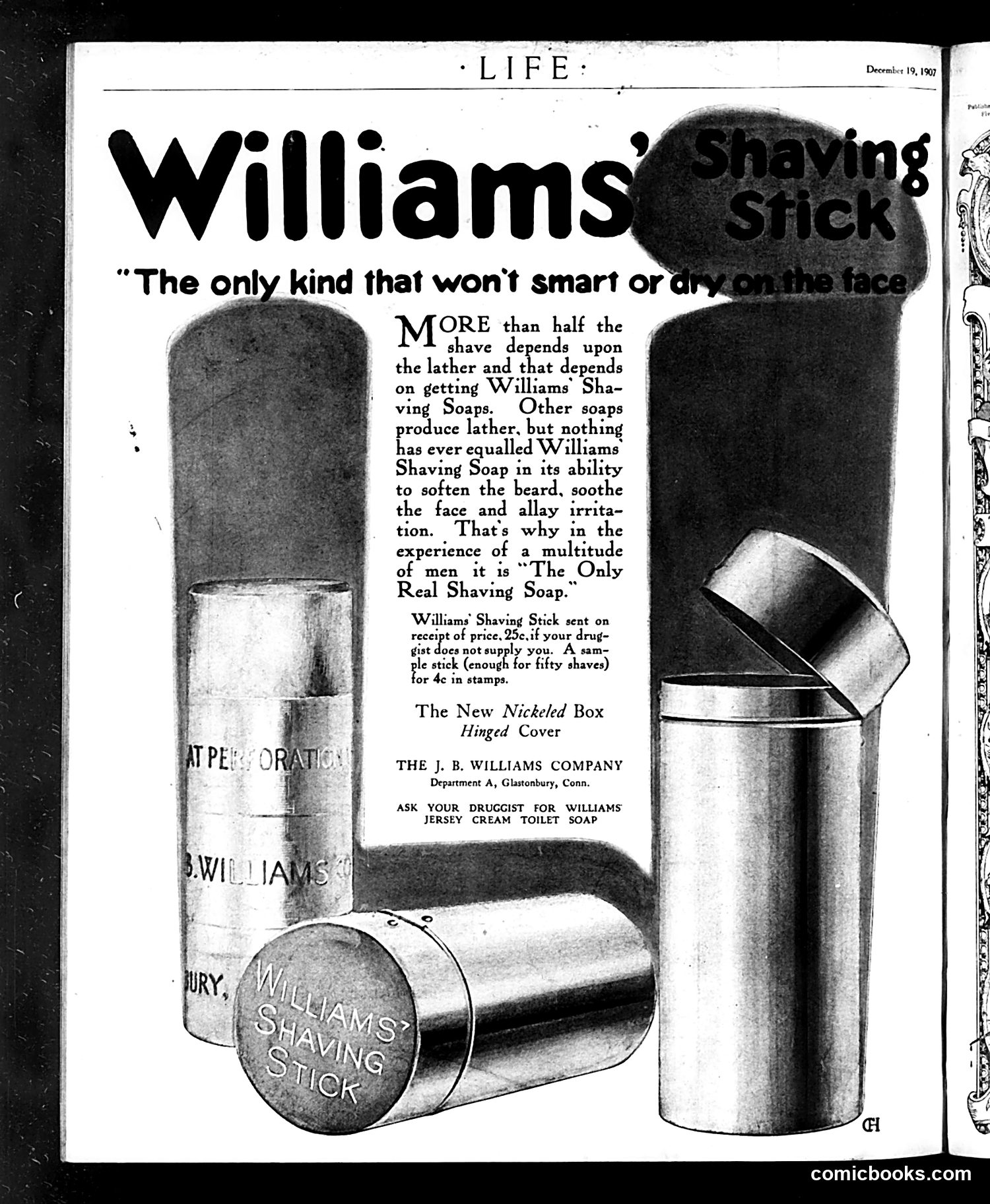
This is a **product advertisement**, not political satire. It appears in *Life* magazine (dated December 19, 1907) promoting Williams' Shaving Soap and Shaving Stick. The ad makes conventional marketing claims: that Williams produces superior lather compared to competitors, softens beards effectively, and soothes facial irritation. The imagery shows the product packaging—cylindrical containers with hinged nickel-plated boxes. The tagline "The only kind that won't smart or dry on the face" emphasizes the product's gentleness versus rival soaps that apparently caused stinging or drying. The copy addresses common shaving complaints of the era. **There is no political or social satire here**—this is straightforward early-20th-century consumer advertising using period typography and photography to promote grooming products to male readers.