
Life, 1907-12-19 · page 10 of 28
Life — December 19, 1907 — page 10: what you’re looking at
What you’re looking at
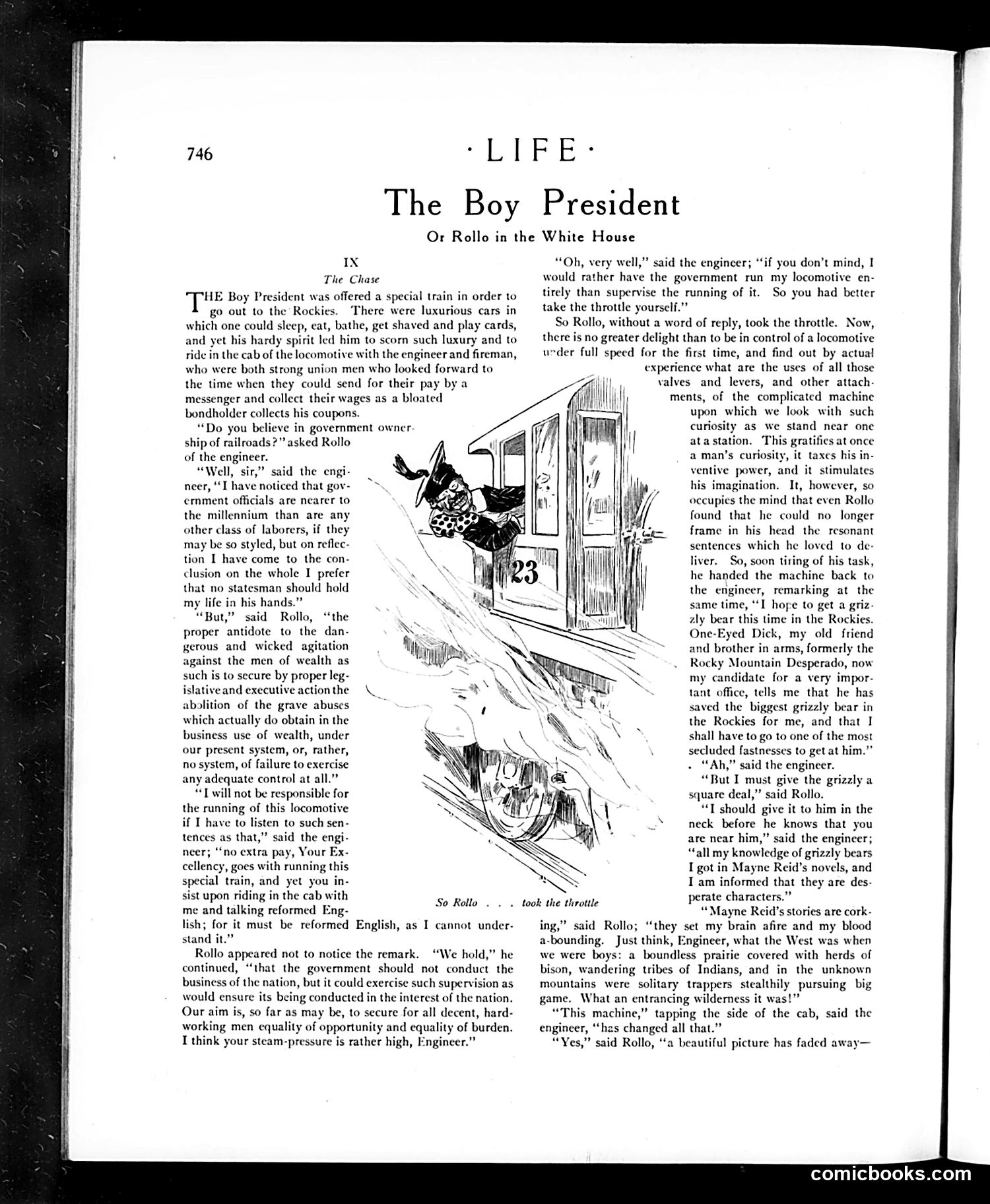
This satirical story mocks a young, inexperienced president character called "Rollo" who has been offered a special train to the Rockies. The humor centers on Rollo's naive idealism clashing with practical governance. An engineer challenges Rollo's belief in government ownership of railways, arguing that statesmen shouldn't micromanage operations. Rollo responds with patronizing moral lectures about wealth redistribution and labor reform—positions the story presents as impractical idealism disconnected from reality. The satire targets Progressive Era reformers and their often sanctimonious, youth-driven political rhetoric. The illustration shows Rollo riding the train's exterior, emphasizing his reckless inexperience. The "Boy President" title suggests incompetence rooted in immaturity rather than genuine policy disagreement.
📄 Transcribed text from this page (OCR, searchable)
Machine-transcribed from the original scan — historical spelling and the odd misread are preserved.
aiLiF E * The Boy President Or Rollo in the White House IX The Chase 'HE Boy President was offered a special train in order to go out to the Rockies. There were luxurious cars in which one could sleep, eat, bathe, get shaved and play cards, and yet his hardy spirit led him to scorn such luxury and to ride in the cab of the locomotive with the engineer and fireman, who were both strong union men who looked forward to the time when they could send for their pay by a messenger and collect their wages as a bloated bondholder collects his coupons. “Do you believe in government owner ship of railroads?” asked Rollo of the engineer. “Well, sir,” said the engi- neer, ‘I have noticed that gov- ernment officials are nearer to the millennium than are any other class of laborers, if they may be so styled, but on reflec- tion I have come to the con- clusion on the whole I prefer that no statesman should hold my life in his hands.” “But,” said Rollo, “the proper antidote to the dan- gerous and wicked agitation against the men of wealth as such is to secure by proper leg- islative and executive action the abolition of the grave abuses which actually do obtain in the business use of wealth, under our present system, or, rather, no system, of failure to exercise any adequate control at all.” “T will not be responsible for the running of this locomotive if I have to listen to such sen- tence that,” said the engi- neer; “no extra pay, Your Ex- cellency, goes with running this special train, and yet you in- sist upon riding in the cab with me and talking reformed Eng- lish; for it must be reformed English, as I cannot under- stand it.” Rollo appeared not to notice the remark. “We hold,” he continued, “that the government should not conduct the business of the nation, but it could exercise such supervision as would ensure its being conducted in the interest of the nation. Our aim is, so far as may be, to secure for all decent, hard- working men equality of opportunity and equality of burden. I think your steam-pressure is rather high, Engince! So Rollo “Oh, very well,” said the engincer; “if you don’t mind, I would rather have the government run my locomotive en- tirely than supervise the running of it. So you had better take the throttle yourself.” So Rollo, without a word of reply, took the throttle. Now, there is no greater delight than to be in control of a locomotive urder full speed for the first time, and find out by actual experience what are the uses of all those valves and levers, and other attach- ments, of the complicated machine upon which we look with such curiosity as we stand near one atastation. This gratifies at once a man’s curiosity, it taxes his in- ventive power, and it stimulates his imagination. It, however, so occupies the mind that even Rollo found that he could no longer frame in his head the resonant sentences which he loved to de- liver. So, soon tiring of his task, he handed the machine back to the engineer, remarking at the same time, “I hope to get a griz zly bear this time in the Rockies One-Eyed Dick, my old friend and brother in arms, formerly the Rocky Mountain Desperado, now my candidate for a very impor- tant office, tells me that he has saved the biggest grizzly bear in the Rockies for me, and that I shall have to go to one of the most secluded fastnesses to get at him.” + “Ah,” said the engineer. “But I must give the gri. square deal,” said Rollo. “T should give it to him in the neck before he knows that you are near him,” said the engineer; “all my knowledge of grizzly bears I got in Mayne Reid’s novels, and I am informed that they are des- perate characters.” “Mayne Reid’s stories are cork- ing,” said Rollo; “they set my brain afire and my blood a-bounding. Just think, Engineer, what the West was when we were boys: a boundless prairie covered with herds of bison, wandering tribes of Indians, and in the unknown mountains solitary trappers stealthily pursuing big game. What an entrancing wilderness it was!” “This machine,” tapping the side of the cab, said the engineer, “has changed all that.” “Yes,” said Rollo, ‘‘a beautiful picture has faded away— comicbooks.com