
Life, 1907-12-19 · page 18 of 28
Life — December 19, 1907 — page 18: what you’re looking at
What you’re looking at
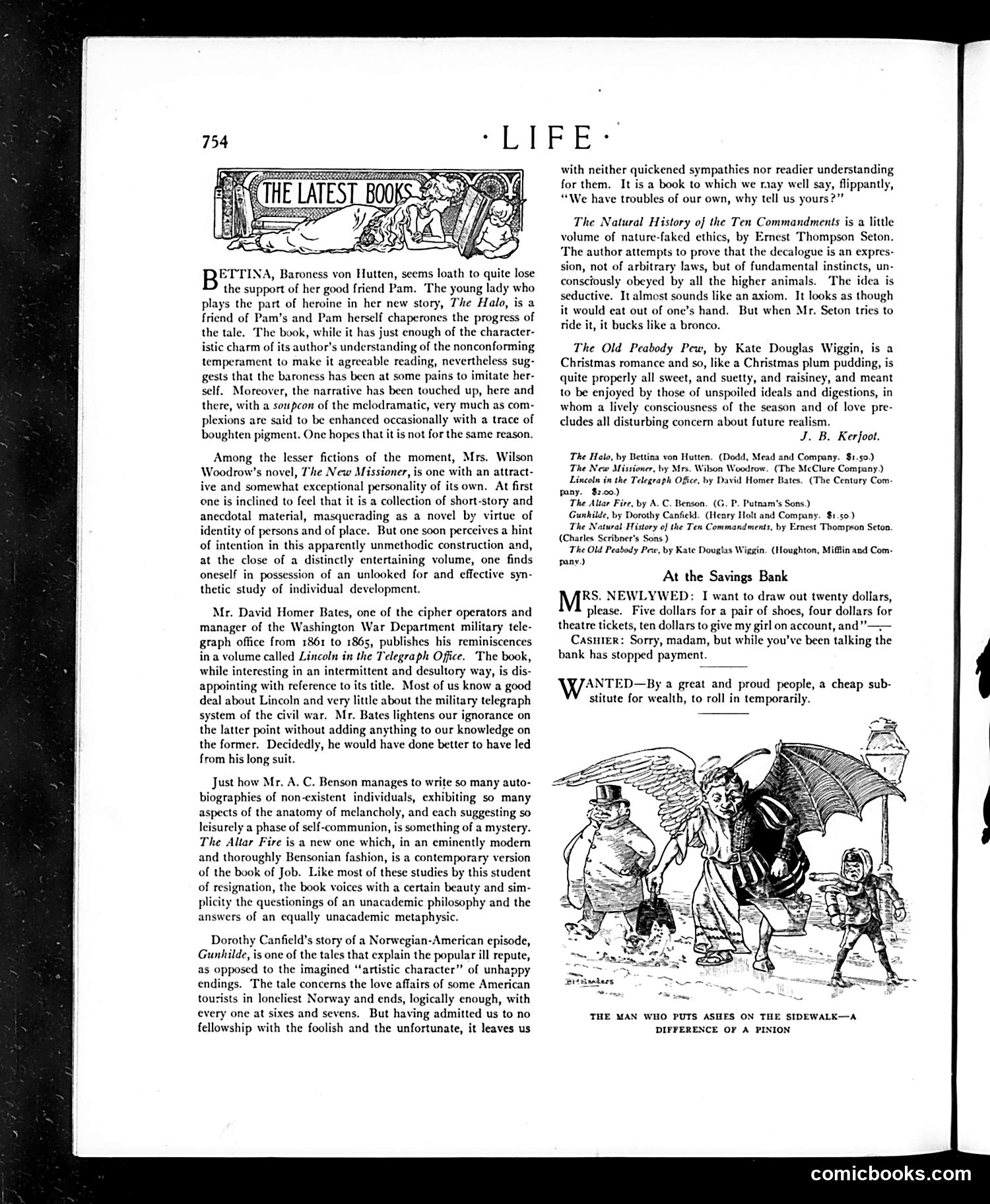
This cartoon illustrates a class-based social conflict common in early 20th-century urban America. A well-dressed gentleman with a top hat and cane appears to object to a working-class man scattering ashes on an icy sidewalk—a practical safety measure to prevent slipping. The satire mocks the gentleman's apparent disapproval of this utilitarian solution, suggesting the wealthy prioritize aesthetic or property concerns over public welfare and worker practicality. The "difference of opinion" is between upper-class sensibilities and working-class common sense. The title's ironic tone—treating such a mundane disagreement as philosophically weighty—underscores Life magazine's critique of class pretension and disconnect between social classes during the Progressive Era.
📄 Transcribed text from this page (OCR, searchable)
Machine-transcribed from the original scan — historical spelling and the odd misread are preserved.
*LIFE*® ETTINA, Baroness von Hutten, seems loath to quite lose the support of her good friend Pam. ‘The young lady who plays the part of heroine in her new story, The Halo, is a friend of Pam’s and Pam herself chaperones the progress of the tale. The book, while it has just enough of the character- istic charm of its author’s understanding of the nonconforming temperament to make it agreeable reading, nevertheless sug- gests that the baroness has been at some pains to imitate her- self. Moreover, the narrative has been touched up, here and there, with a soupcon of the melodramatic, very much as com- plexions are said to be enhanced occasionally with a trace of boughten pigment. One hopes that it is not for the same reason. Among the lesser fictions of the moment, Mrs. Wilson Woodrow’s novel, The New Missioner, is one with an attract- ive and somewhat exceptional personality of its own. At first one is inclined to feel that it is a collection of short-story and anecdotal material, masquerading as a novel by virtue of identity of persons and of place. But one soon perceives a hint of intention in this apparently unmethodic construction and, at the close of a distinctly entertaining volume, one finds oneself in possession of an unlooked for and effective syn- thetic study of individual development. Mr. David Homer Bates, one of the cipher operators and manager of the Washington War Department military tele- graph office from 1861 to 1865, publishes his reminiscences ina volume called Lincoln in the Telegraph Office. The book, while interesting in an intermittent and desultory way, is dis- appointing with reference to its title. Most of us know a good deal about Lincoln and very little about the military telegraph system of the civil war. Mr. Bates lightens our ignorance on the latter point without adding anything to our knowledge on the former. Decidedly, he would have done better to have led from his long suit. Just how Mr. A. C. Benson manages to write so many auto- biographies of non-existent individuals, exhibiting so many aspects of the anatomy of melancholy, and each suggesting so Ieisurely a phase of self-communion, is something of a mystery. The Altar Fire is a new one which, in an eminently modem and thoroughly Bensonian fashion, is a contemporary version of the book of Job. Like most of these studies by this student of resignation, the book voices with a certain beauty and sim- plicity the questionings of an unacademic philosophy and the answers of an cqually unacademic metaphysic. Dorothy Canfield’s story of a Norwegian-American episode, Gunhilde, is one of the tales that explain the popular ill repute, as opposed to the imagined “artistic character” of unhappy endings. The tale concerns the love affairs of some American tourists in loncliest Norway and ends, logically enough, with every one at sixes and sevens. But having admitted us to no fellowship with the foolish and the unfortunate, it leaves us with neither quickened sympathies nor readier understanding for them. It is a book to which we ray well say, flippantly, “We have troubles of our own, why tell us yours?” The Natural History of the Ten Commandments is a little volume of nature-faked ethics, by Emest Thompson Seton, ‘The author attempts to prove that the decalogue is an expres- sion, not of arbitrary laws, but of fundamental instincts, un- consciously obeyed by all the higher animals. ‘The idea is seductive. It almost sounds like an axiom. It looks as though it would eat out of one’s hand. But when Mr. Seton tries to ride it, it bucks like a bronco. The Old Peabody Pew, by Kate Douglas Wiggin, is a Christmas romance and so, like a Christmas plum pudding, is quite properly all sweet, and suetty, and raisiney, and meant to be enjoyed by those of unspoiled ideals and digestions, in whom a lively consciousness of the season and of love pre- cludes all disturbing concern about future realism. J. B. Kerjoot. The Helo, by Bettina von Hutten. (Dodd, Mead and Company. $1.50.) The New Missioner, by Mrs. Wilson Woodrow. (The McClure Company.) Lincoln in the Telegraph Office, by D: Homer Bates. (The Century Com: pany. $2.00.) The Altar Fire, by A.C. Benson, (G. P. Putnam's Sons.) Gunkilde, by Dorothy Canfield. (Heary Holt and Company. $1.50) The Natural History of the Ten Commandments, by Emnest Thompson Seton. (Charles Scribner's Sons ) The Old Peabody Pew, by Kate Douglas Wiggin. (Houghton, Midfin and Com- pany.) At the Savings Bank RS. NEWLYWED: I want to draw out twenty dollars, please. Five dollars for a pair of shoes, four dollars for theatre tickets, ten dollars to give my girl on account, and Casuier: Sorry, madam, but while you’ve been talking the bank has stopped payment. WANTED —By a great and proud people, a cheap sub- stitute for wealth, to roll in temporarily. THE MAN WHO PUTS ASHES ON THE SIDEWALK—A DIFFERENCE OF A PINION comicbooks.com