
Life, 1907-12-19 · page 16 of 28
Life — December 19, 1907 — page 16: what you’re looking at
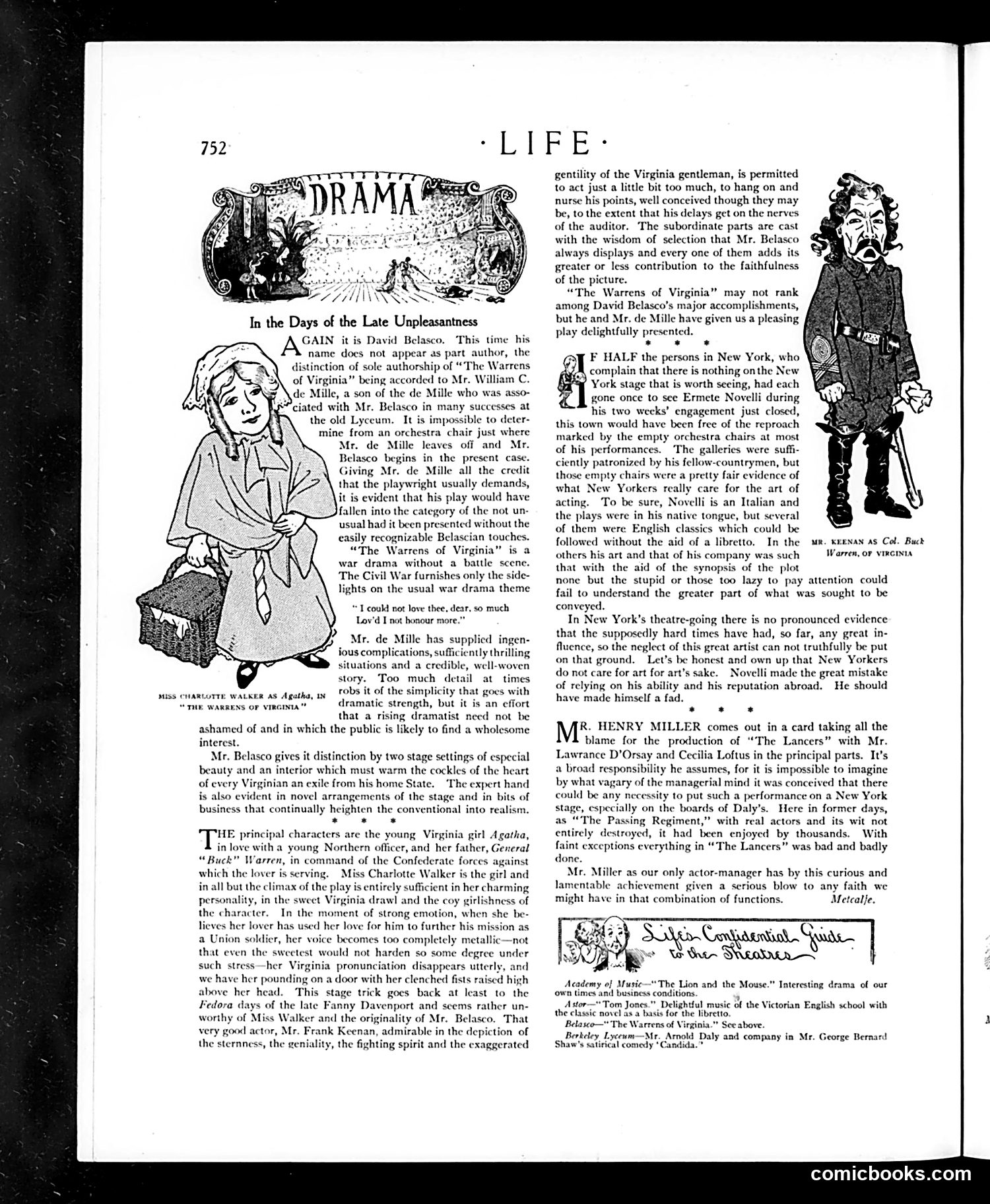
What you’re looking at
This page reviews a Civil War play produced by theatrical impresario David Belasco. The cartoon depicts **Charlotte Walker as Agatha**, the female lead character—a young Virginia woman caught between love for a Northern officer and loyalty to her Confederate father. The review credits playwright **William C. de Mille** with sole authorship, though Belasco's directorial "touches" distinguish the production. The critic praises the atmospheric staging and performances by Walker and actor Frank Keenan, though noting Walker oversells emotion in climactic scenes with outdated theatrical mannerisms (compared unfavorably to "Fedora days"). The phrase "Days of the Late Unpleasantness" is period euphemism for the Civil War. The review treats this wartime romance as a successful commercial entertainment, appreciating Belasco's craftsmanship while suggesting the play itself wouldn't survive without his directorial expertise.
📄 Transcribed text from this page (OCR, searchable)
Machine-transcribed from the original scan — historical spelling and the odd misread are preserved.
MISS CHARLUTTE WALKE: ‘LIP E: a M7 7711 \\\\ ae In the Days of the Late Unpleasantness GAIN it is David Belasco, This time his name docs not appear as part author, the distinction of sole authorship of “The Warrens. of Virginia” being accorded to Mr. William C. de Mille, a son of the de Mille who was asso- ciated with Mr. Belasco in many successes at the old Lyceum. It is impossible to deter- mine from an orchestra chair just where Mr. de Mille leaves off and Mr. Belasco begins in the present case. ing Mr. de Mille all the credit the playwright usually demands, it is evident that his play would have fallen into the category of the not un- usual had it been presented without the easily recognizable Belascian touches. “The Warrens of Virginia” is a war drama without a battle scene. ‘The Civil War furnishes only the side- lights on the usual war drama theme * I could not love thee, dear, so much Lov'd I not honour more. ) Mr. de Mille has supplicd ingen- ious complications, sufficiently thrilling situations and a credible, well-woven story. Too much detail at times robs it of the simplicity that goes with dramatic strength, but it is an effort that a rising dramatist need not be ashamed of and in which the public is likely to find a wholesome interest. Mr. Belasco gives it distinction by two stage settings of especial beauty and an interior which must warm the cockles of the heart of every Virginian an exile from his home State. ‘The expert hand is also evident in novel arrangements of the stage and in bits of business that continually heighten the conventional into realism. is 3 HE principal characters are the young Virgin in love with a ing Northern officer, and her father, General “Buck” Warren, in command of the Confederate forces against which the lover is serving. Miss Charlotte Walker is the girl and in all but the climax of the play is entirely sufficient in her charming ality, in the sweet Virginia drawl and the coy girlishness of the characte In the moment of strong emotion, when she be- lieves her lover has used her love for him to further his mission as a Union soldier, her voice becomes too complet: i that even the sweetest would not harden so some degree under such stress—her Virginia pronunciation disappears utterly, and we have her pounding on a door with her clenched fists raised high above her head. This stage trick goes k at least to the Fedora days of the late Fanny Davenport and seems rather un- worthy of Miss Walker and the originality of Mr. Belasco. ‘That very good actor, Mr. Frank Keenan, admirable in the depiction of the sternness, the geniality, the fighting spirit and the exaggerated “TALE WARRENS OF V1 gentility of the Virginia gentleman, is permitted to act just a little bit too much, to hang on and nurse his points, well conceived though they may be, to the extent that his delays get on the nerves of the auditor. The subordinate parts are cast with the wisdom of selection that Mr. Belasco always displays and every one of them adds its greater or less contribution to the faithfulness of the picture. “The Warrens of Virginia” may not rank among David Belasco’s major accomplishments, but he and Mr. de Mille have given usa pleasing f play delightfully presented. * 8 8 F HALF the persons in New York, who complain that there is nothing onthe New York stage that is worth seeing, had each gone once to see Ermete Novelli during his two weeks’ engagement just closed, this town would have been free of the reproach marked by the empty orchestra chairs at most of his performances. The galleries were suffi- ciently patronized by his fellow-countrymen, but those empty chairs were a pretty fair evidence of what N Yorkers ly care for the art of acting. To be sure, Novelli is an Italian and the plays were in his native tongue, but several of them were English classics which could be followed without the aid of a libretto. In the others his art and that of his company was such that with the aid of the synopsis of the plot none but the stupid or those too lazy to pay attention could fail to understand the greater part of what was sought to be conveyed. In New York's theatre-going there is no pronounced evidence that the supposedly hard times have had, so far, any great in- fluence, so the neglect of this great artist can not truthfully be put on that ground. Let’s be honest and own up that New Yorkers do not care for art for art's sak ovelli made the great mistake of relying on his ability and his reputation abroad. He should have made himself a fad. * 8 « R. HENRY MILLER comes out in a card taking all the blame for the production of “The Lancers” with Mr. wrance D’Orsay and Cecilia Loftus in the principal parts. It a broad responsibility he assumes, for it is impossible to imagine by what vagary of the managerial mind it was conceived that there could be any necessity to put such a performance on a New York ally on the boards of Daly's. Here in former days, he Passing Regiment,” with real actors and its wit not entirely destroyed, it had been enjoyed by thousands. With faint exceptions everything in “The Lancers” was bad and badly done. Mr. Miller as our only actor-manager has by this curious and ntable achievement given a serious blow to any faith we might have in that combination of functions. Metcalfe. Academy of Music—"The Lion and the Mouse." Interesting drama of our cs and business conditions Tom Jones.” Delightful music Of the Victorian English school with novel as a basis for the Ii Belasco—* The Warrens of Virginia.” See above. Berkeley Lyceum—Mr. Arnold Daly and company in Mr. George Bernard Shaw's satirical comedy Candida.” ur. KEENAN AS Col. Buck Warren, or vincixia comicbooks.com