
Life, 1907-12-19 · page 13 of 28
Life — December 19, 1907 — page 13: what you’re looking at
What you’re looking at
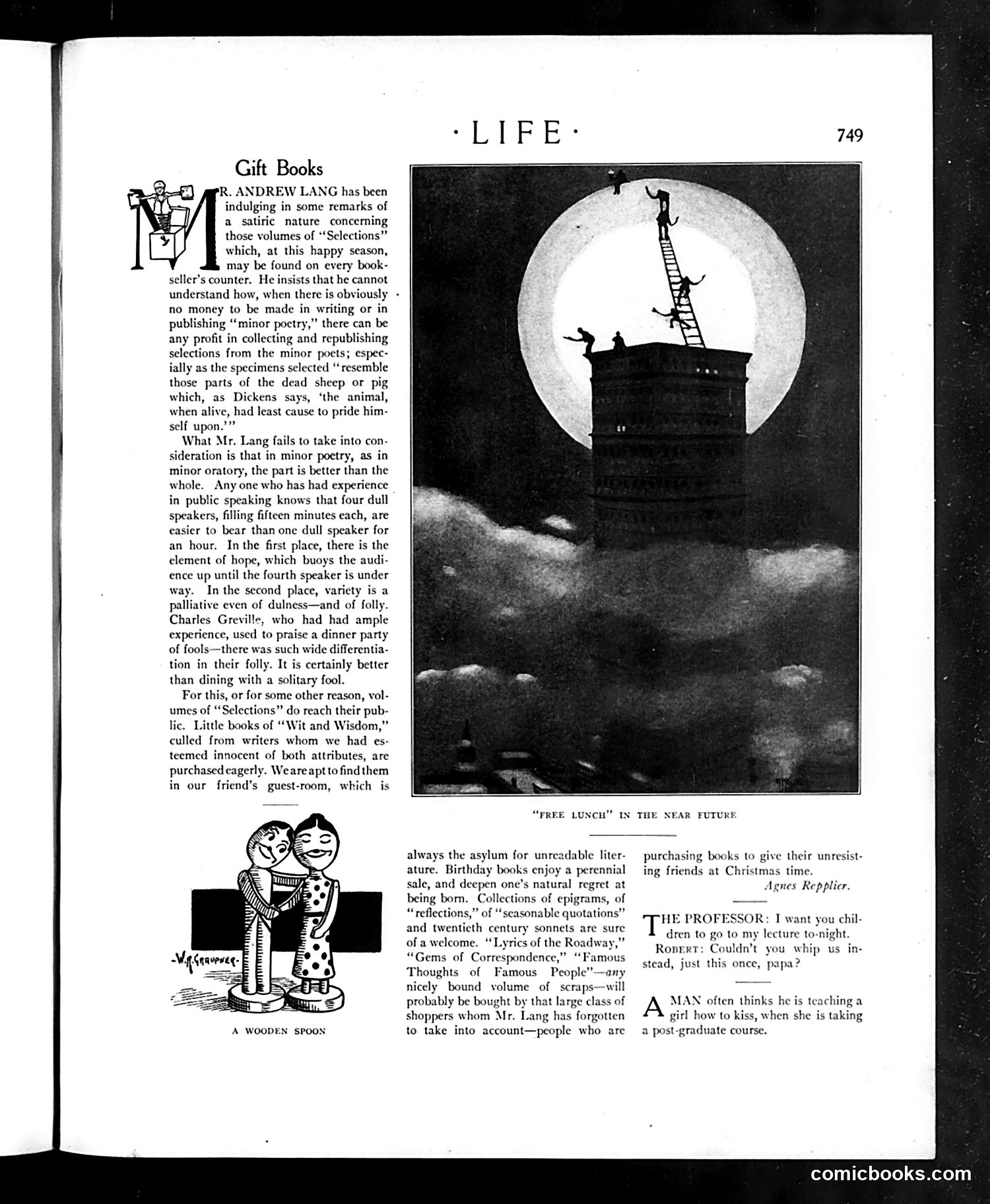
This page critiques Andrew Lang's "Selections" gift books. Lang insisted minor poetry collections were unprofitable, yet publishers produced them anyway—Lang apparently overlooking that anthologies of minor poets actually sold well as affordable gift books. The satire mocks Lang's contradiction: he claims there's "no money" in such volumes, yet they were popular Christmas purchases. The article argues that short selections are actually *better* than complete works (citing variety as preferable to dullness), making Lang's dismissal of the genre economically and artistically misguided. The illustration "Free Lunch in the Near Future" appears unrelated—likely separate satirical content about a different social topic. The page demonstrates Life's role as a literary-minded humor magazine critiquing publishing industry figures and their flawed reasoning.
📄 Transcribed text from this page (OCR, searchable)
Machine-transcribed from the original scan — historical spelling and the odd misread are preserved.
Gift Books R. ANDREW LANG has been indulging in some remarks of a satiric nature concerning those volumes of ‘‘Selections”” which, at this happy season, may be found on every book- seller's counter. He insists that he cannot understand how, when there is obviously - no money to be made in writing or in publishing “minor poctry,” there can be any profit in collecting and republishing selections from the minor poets; espec- ially as the specimens selected “resemble those parts of the dead sheep or pig which, as Dickens says, ‘the animal, when alive, had least cause to pride him- self upon?” What Mr. Lang fails to take into con- sideration is that in minor poetry, as in minor oratory, the part is better than the whole. Any one who has had experience in public speaking knows that four dull speakers, filling fifteen minutes each, are easier to bear than one dull speaker for an hour. In the first place, there is the clement of hope, which buoys the audi- ence up until the fourth speaker is under way. In the second place, variety is a palliative even of dulness—and of folly. Charles Greville, who had had ample experience, used to praise a dinner party of fools—there was such wide differentia- tion in their folly. It is certainly better than dining with a solitary fool. For this, or for some other reason, vol- umes of “Selections” do reach their pub- lic. Little books of “Wit and Wisdom,” culled from writers whom we had es- teemed innocent of both attributes, are purchased cagerly. Weareaptto find them in our friend’s guest-room, which is “FREE LUNCH” IN THE NEAR FUTURE, always the asylum for unreadable liter- purchasing books to give their unresist- ature. Birthday books enjoy a perennial ing friends at Christmas tim sale, and deepen one’s natural regret at Agnes Repplier. being bom. Collections of epigrams, of = “reflections,” of “seasonable quotations” 114: PROF and twenticth century sonnets are sure of a welcome. “Lyrics of the Roadway,” “Gems of Correspondence,” “Famous Thoughts of Famous People”—any nicely bound volume of scraps—will probably be bought by that large class of AV MAN often thinks he is teaching a shoppers whom Mr. Lang has forgotten girl how to kiss, when she is taking A WOODEN SPOON to take into account—people who are a post-graduate course. =SSOR: I want you chil- dren to go to my lecture to-night. Ronert: Couldn’t you whip us in- stead, just this once, papa? comicbooks.com