
A complete issue · 22 pages · 1907
Life — October 31, 1907
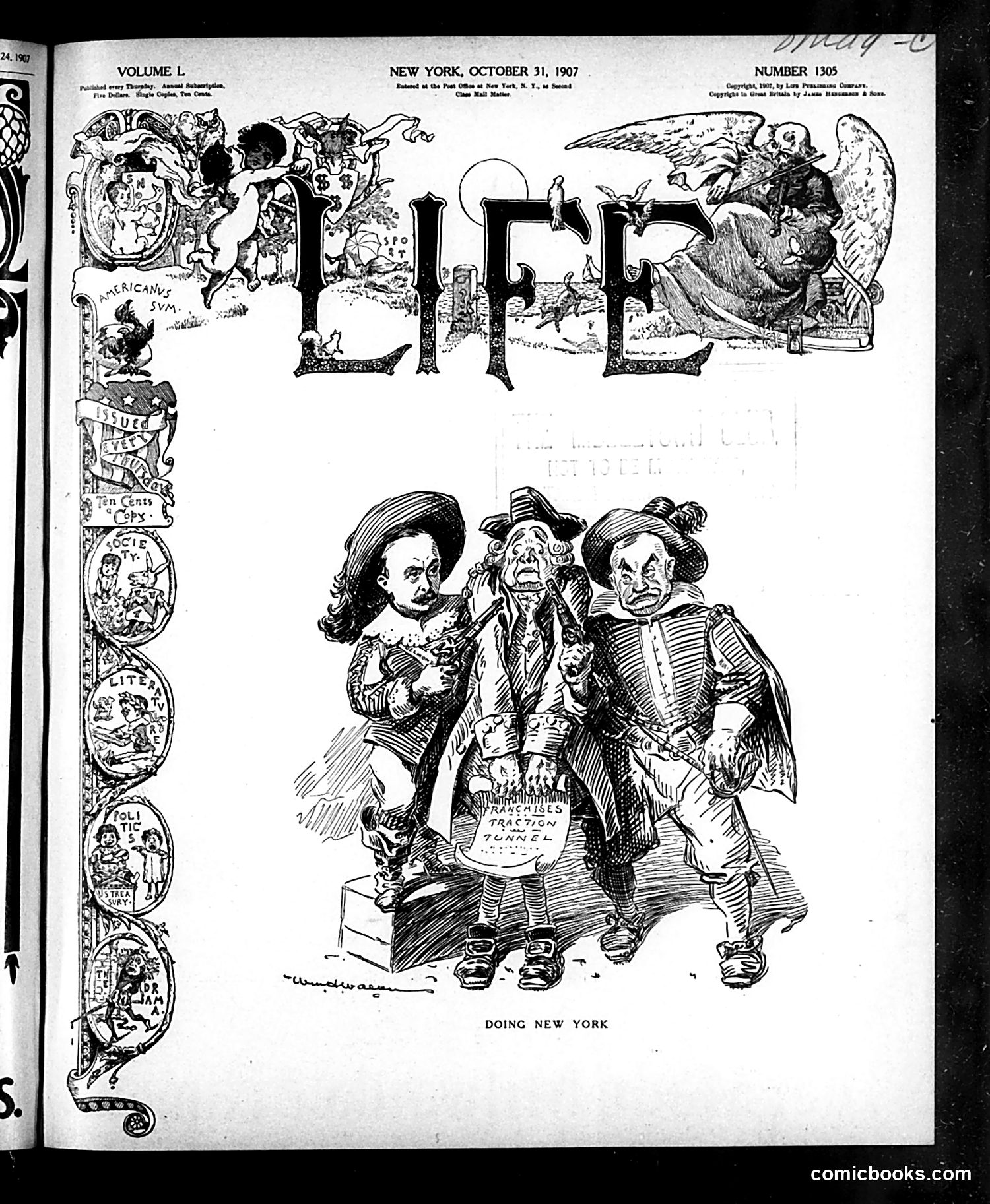
This satirical cartoon depicts three grotesquely caricatured figures labeled "Doing New York," a phrase referring to tourists experiencing the city's attractions. The central figure wears a sign reading "Fresh from the Tunnel" (likely the recently completed Hudson River Tunnel, opened in 1908), suggesting newly arrived visitors. The exaggerated facial features and expressions mock unsophisticated tourists attempting to navigate New York's sophisticated urban culture. The elaborate decorative border on the left side is characteristic of Life magazine's design aesthetic. The satire targets the contrast between tourists' earnest attempts at "doing" (experiencing) New York versus their lack of urban sophistication—a common theme in early 20th-century American humor about the perceived clash between provincial visitors and cosmopolitan city culture.
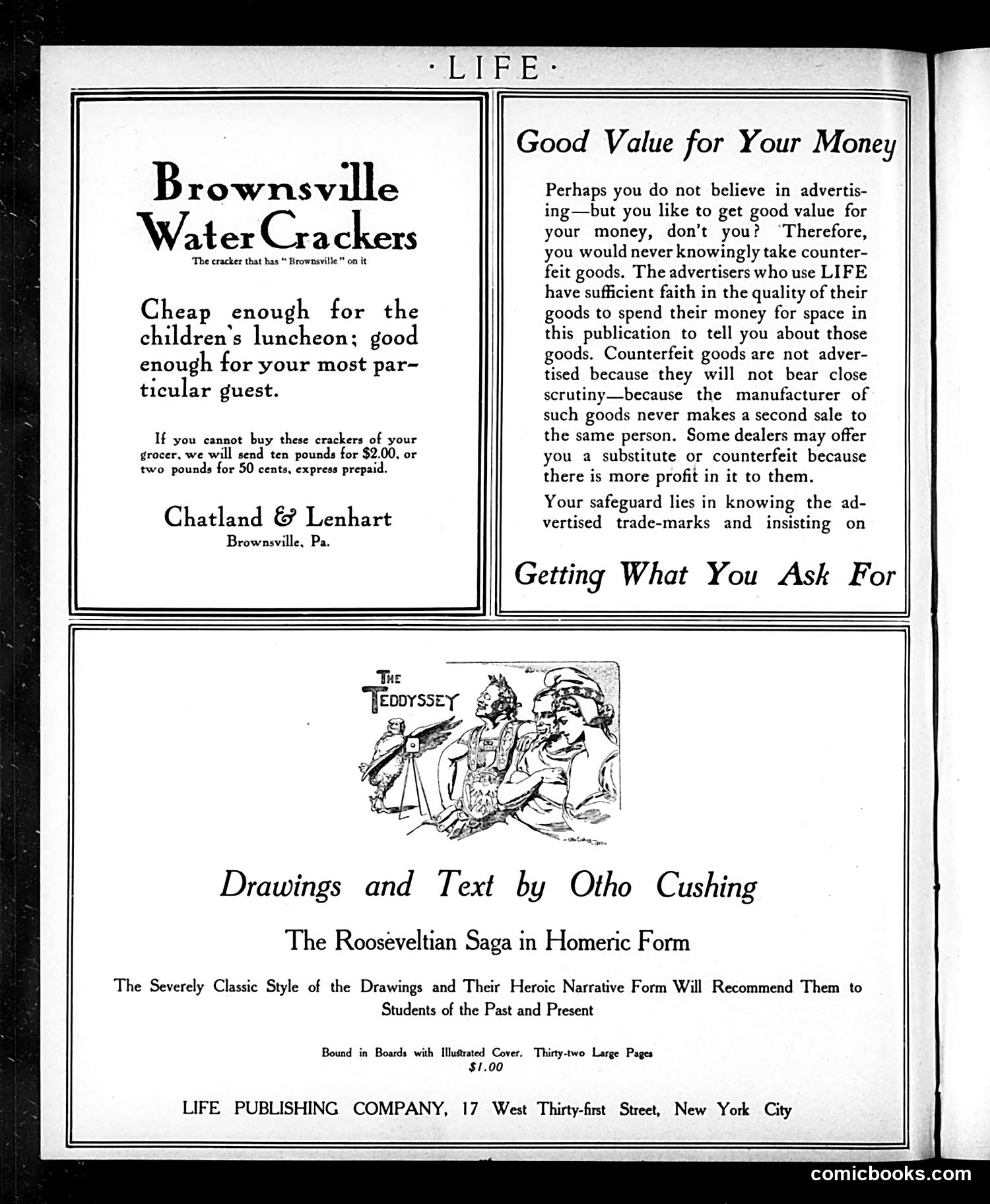
This page consists primarily of **advertisements rather than satirical content**. The top left advertises **Brownsville Water Crackers** from Chatland & Lenhart in Pennsylvania—positioning them as affordable enough for children's lunches yet quality enough for guests. The top right contains an editorial piece titled "Good Value for Your Money" and "Getting What You Ask For." It argues that **LIFE magazine advertisers maintain high standards** because they have confidence in their products' quality, making them trustworthy. The piece implicitly warns readers against counterfeit goods sold by less scrupulous dealers. The bottom advertises **"The Teddyssey,"** a book with drawings and text by Otho Cushing depicting "The Rooseveltian Saga in Homeric Form"—a humorous classical-style narrative about Theodore Roosevelt, priced at $1.00. The page functions as both commercial space and publisher self-promotion.
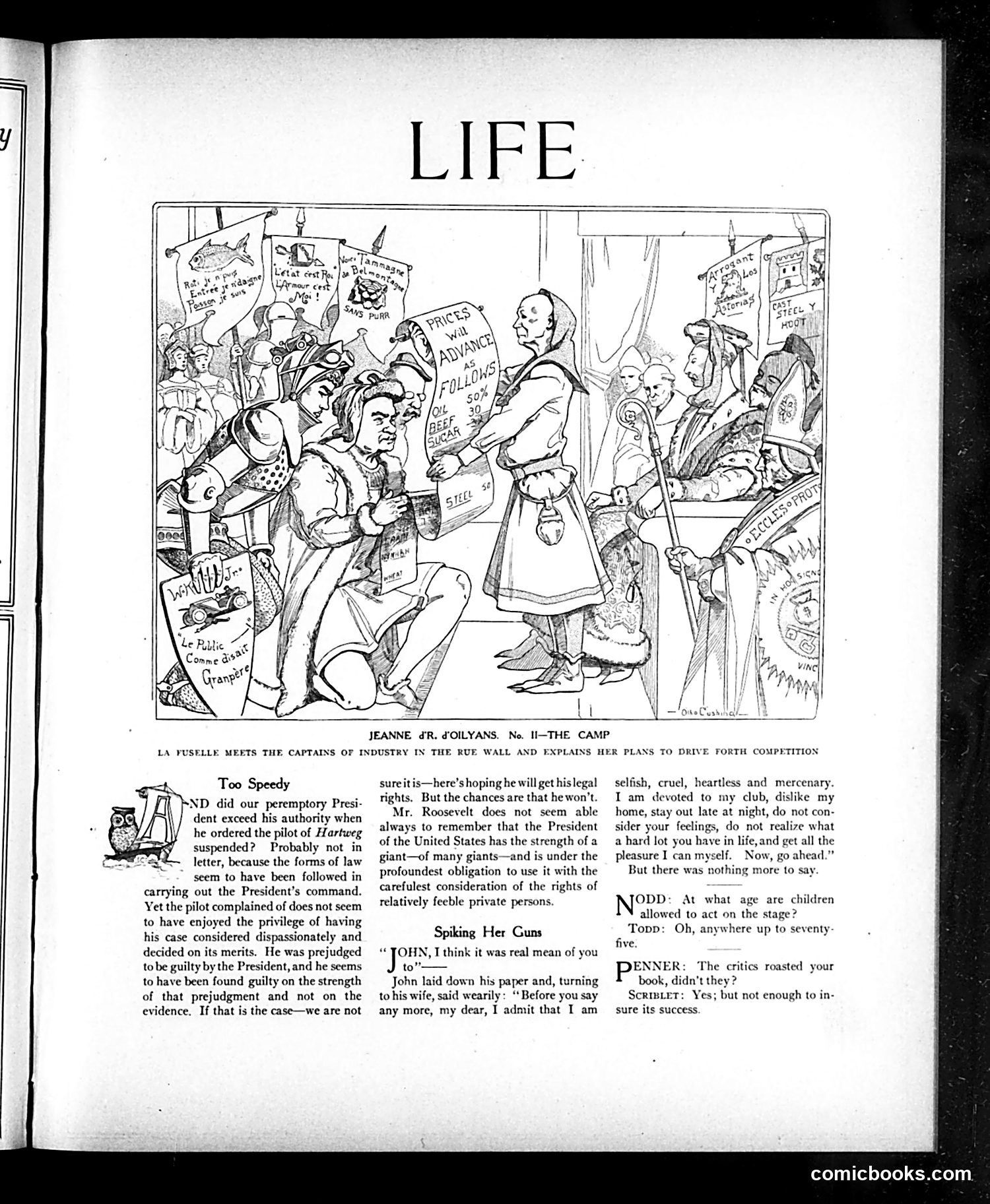
This Life magazine page features a cartoon titled "Jeanne d'Arc Oilyans No. II—The Camp," depicting a woman (labeled as Joan of Arc of New Orleans) addressing industrial captains about competition and prices. The satire appears to mock President Roosevelt's antitrust efforts and his perceived interference in business. The text discusses Roosevelt's authority being questioned—specifically whether he exceeded it when ordering the halt of a railroad case. The cartoon satirizes business leaders' complaints about government intervention, portraying them as needing a "Joan of Arc" figure to rally them against what they view as unfair presidential overreach. The accompanying dialogue sections ("Too Speedy," "Spiking Her Guns") debate Roosevelt's judicial methods and whether his prejudgment of cases was justified.
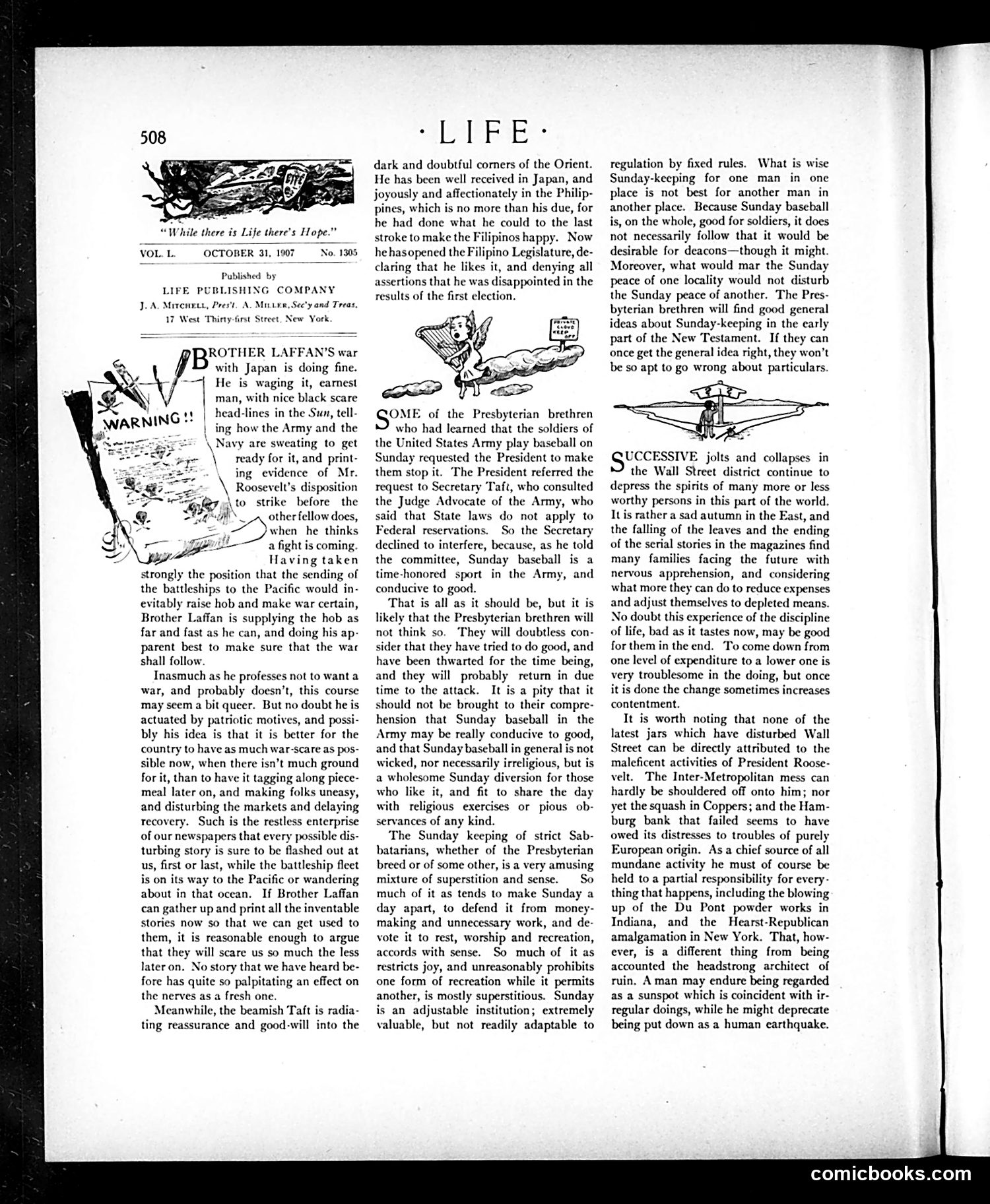
The main cartoon criticizes **Brother Laffan's** pro-war stance toward Japan. Laffan, depicted as a military figure, advocates for military readiness against Japan while personally avoiding combat service. The satire attacks his hypocrisy: he enthusiastically supports war preparation but isn't willing to fight himself—he "may seem a bit queer" not wanting war while profiting from it. The accompanying article discusses Presbyterian soldiers requesting the President stop Sunday baseball games. The satirist defends Sunday baseball as harmless recreation, arguing strict Sabbatarians are inconsistent—they permit some leisure activities while prohibiting others based on superstition rather than principle. Both pieces exemplify *Life*'s satirical approach: exposing contradictions in public figures' stated values versus actual behavior.
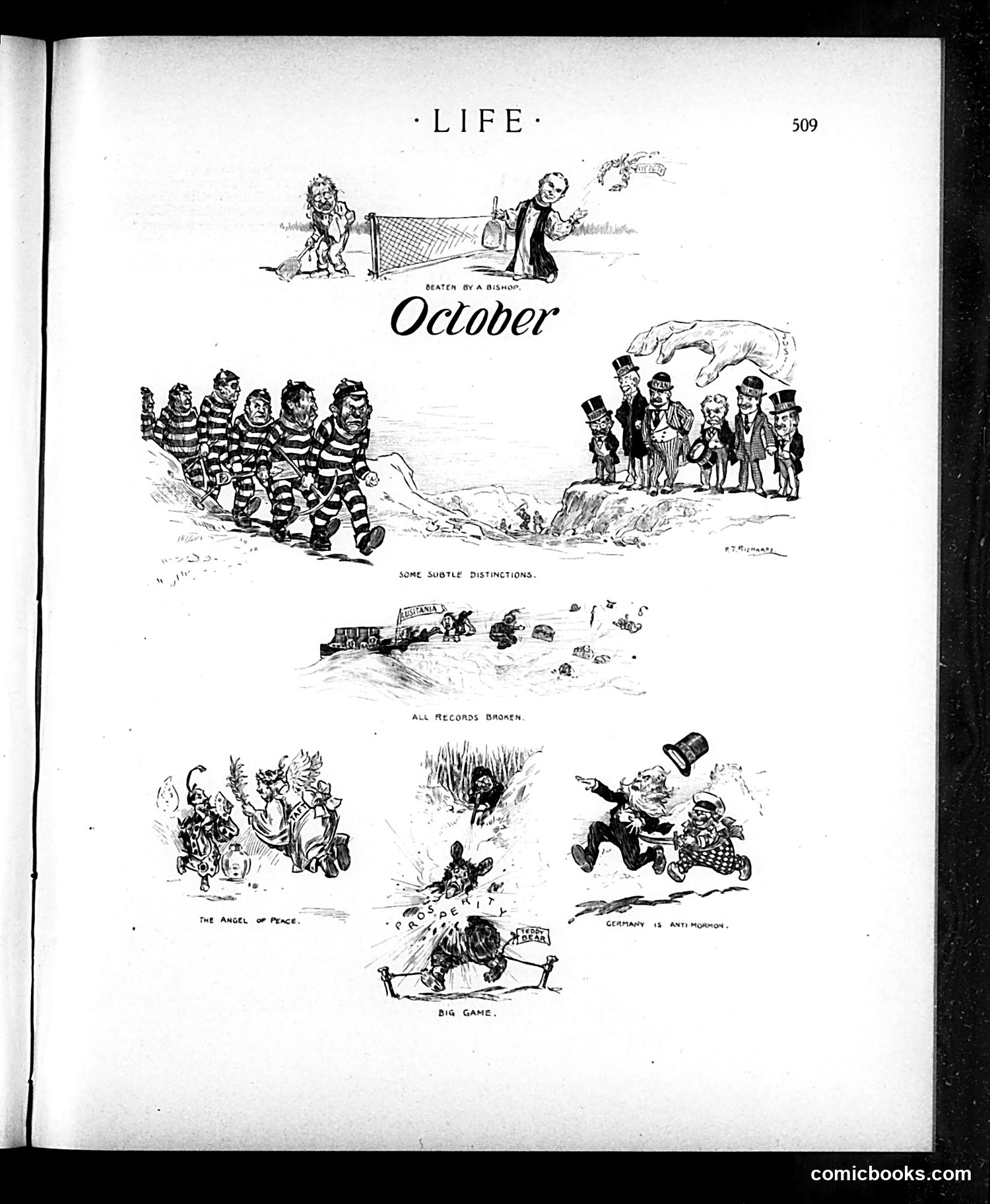
This page presents political satire from October during what appears to be a period of international tension, likely early 20th century based on the art style. The cartoons mock various subjects: - **"Beaten by a Bishop"**: Two figures struggle over a net, apparently satirizing a specific incident involving clergy. - **"Some Subtle Distinctions"**: Convicts contrast with well-dressed gentlemen, likely commenting on class hypocrisy or justice system inequities. - **"All Records Broken"**: A train derailment scene, probably referencing a specific disaster or accident. - **"Germany is Anti-Humane"**: Shows conflict with Germany, suggesting pre-WWI tensions. - **"Big Game"** and **"The Angel of Peace"** offer additional commentary, though specific references remain unclear without additional historical context. The overall tone criticizes political leadership, international affairs, and social injustices.
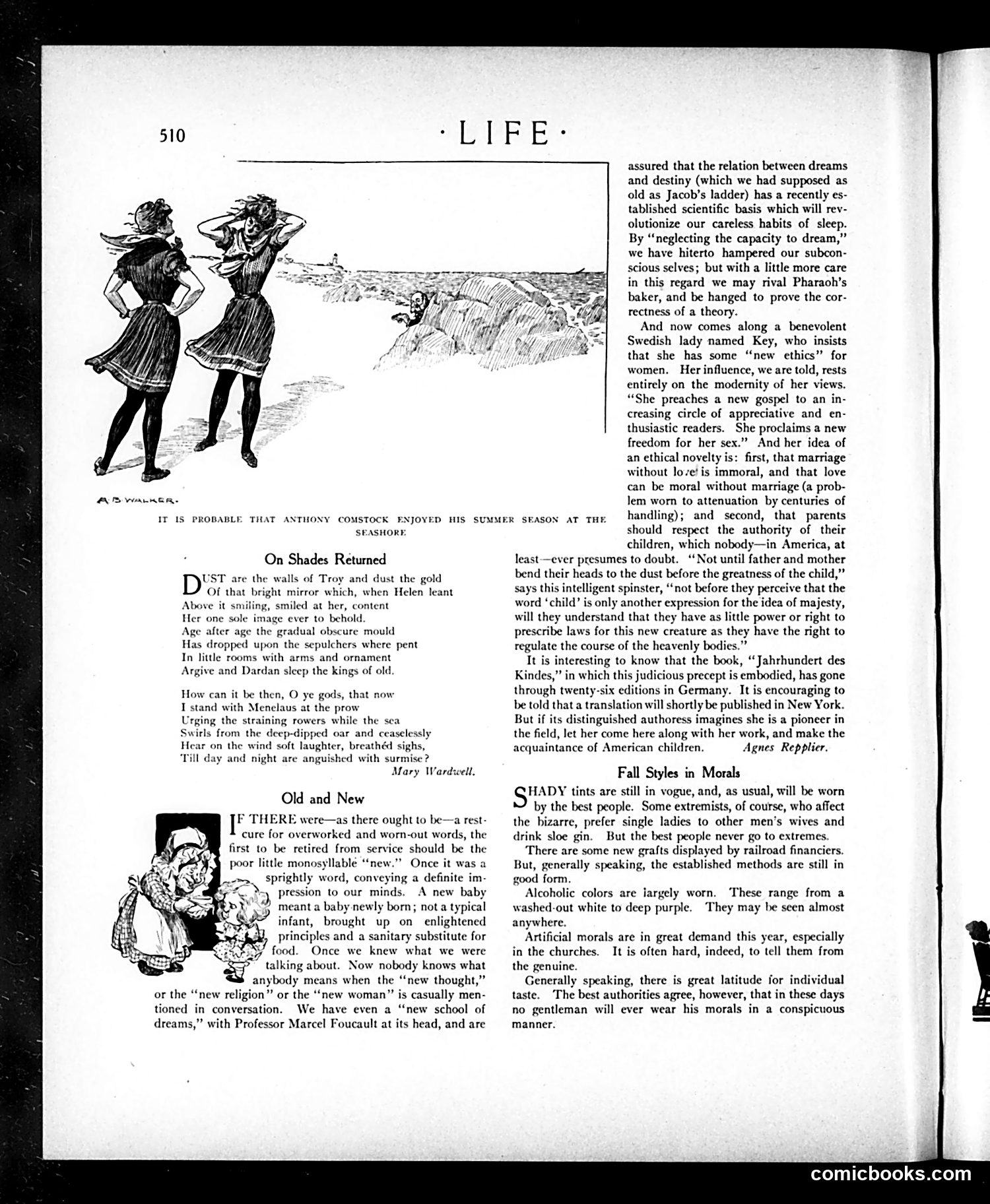
The top illustration depicts two women pointing toward a distant seashore landscape, captioned "It is probable that Anthony Comstock enjoyed his summer season at the seashore." This is a satirical jab at **Anthony Comstock**, the notorious anti-obscenity crusader who led the "Comstock Laws" campaign. The women's pointing gesture and knowing expressions suggest mockery of his moral policing efforts. The cartoon implies Comstock hypocritically enjoyed leisure activities while condemning others' freedoms. The page's text discusses "new ethics" for women, particularly Swedish author Ellen Key's ideas about marriage, love outside marriage, and parental authority—clearly progressive social positions Life's editors found worth satirizing against Comstock-style moral conservatism. The contrast between puritanical censorship and actual human behavior is the joke's essence.
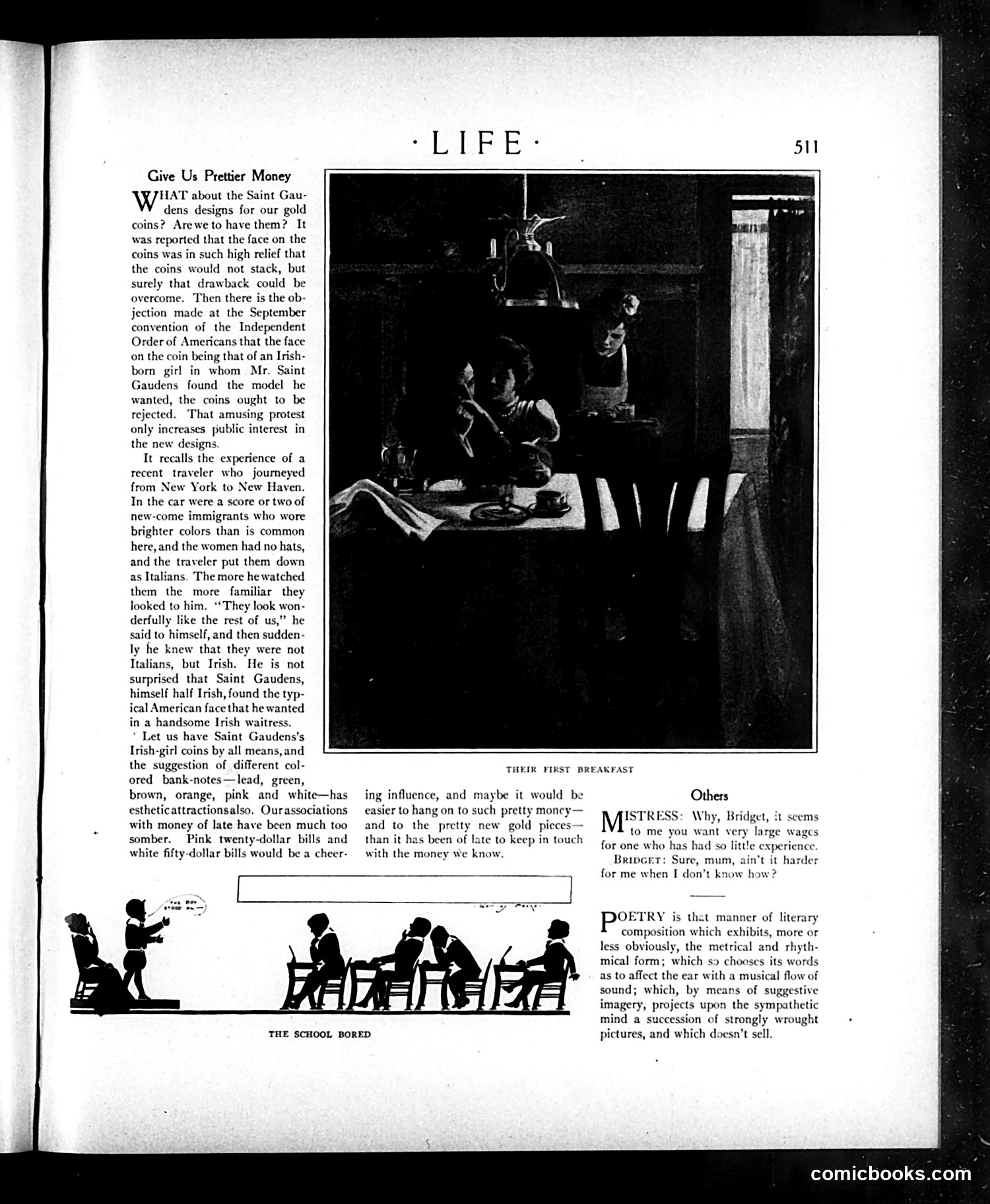
This page contains two distinct pieces: **"Give Us Prettier Money"** (left column): A satirical article arguing against Saint Gaudens' proposed coin designs featuring an Irish-born woman as the model. The author objects that the face is in such high relief coins won't stack properly. The piece ironically suggests accepting the design while proposing alternative colored banknotes instead—an absurd compromise clearly mocking the resistance to the new coin aesthetic. **"Their First Breakfast"** (photograph): A domestic scene showing what appears to be a young couple at a meal, likely illustrating themes of newlywed inexperience or domestic life. **"The School Bored"** (silhouette cartoon): A satirical illustration showing students in a classroom, commenting on educational tedium. The page also includes brief dictionary-style definitions of "Others" and "Poetry," typical of Life's humorous, miscellaneous content format.
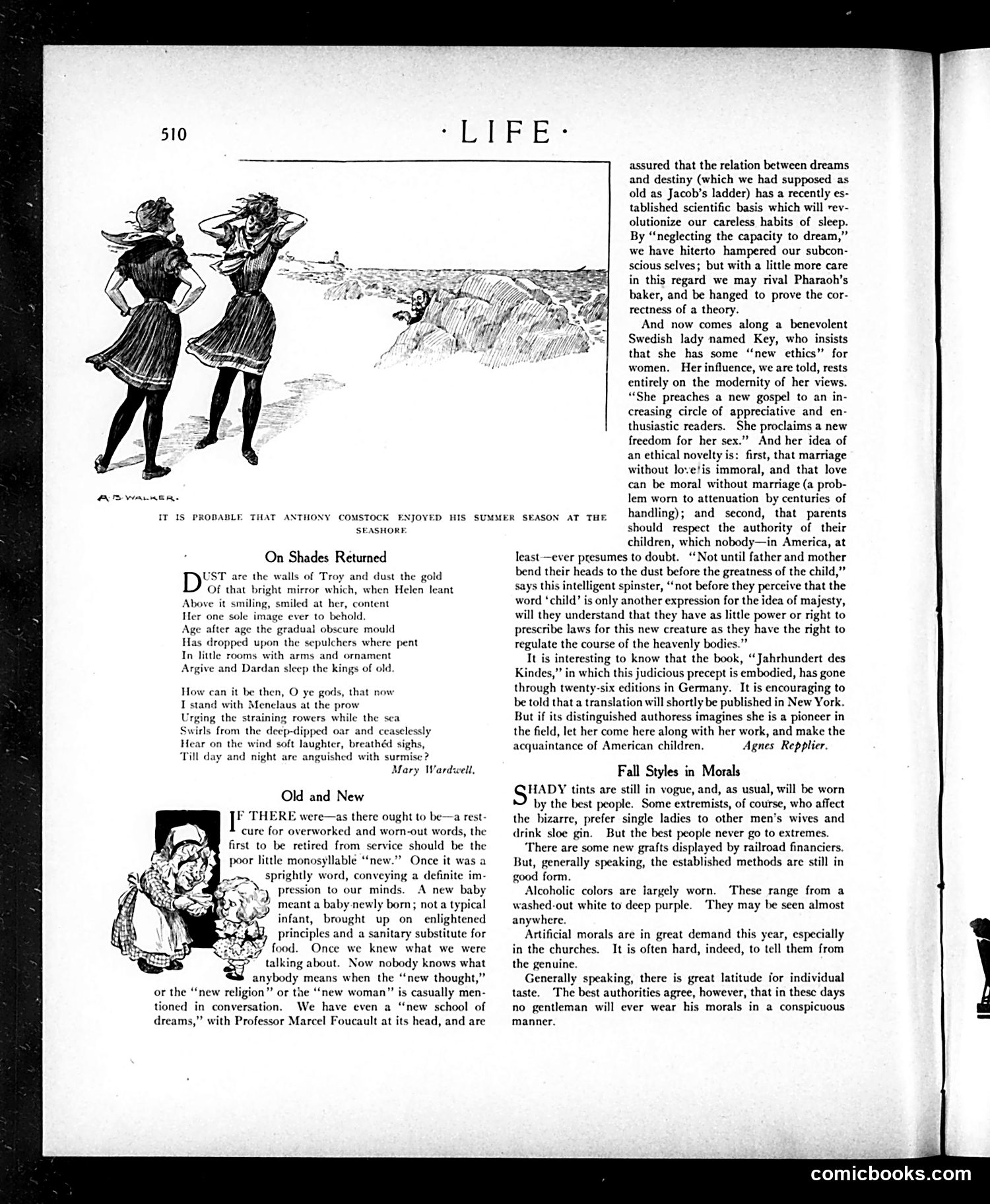
The page contains three distinct pieces of social commentary: 1. **"On Shades Returned"** - A poem by Mary Wardwell about summer at the seashore, seemingly nostalgic but likely satirizing fashionable leisure culture. 2. **"Old and New"** - A section critiquing the term "new thought" and "new woman," mocking contemporary discussions of modern concepts while questioning their actual meaning. It references Professor Marcel Foucault and debates about changing social norms. 3. **"Fall Styles in Morals"** - Commentary on shifting ethical standards, particularly regarding marriage without love, parental authority over children, and fashion in moral behavior. The text satirizes how ethics become trendy, comparing artificial morality to seasonal fashion changes. The illustration shows two women in contemporary dress, likely representing the "new woman" being discussed.
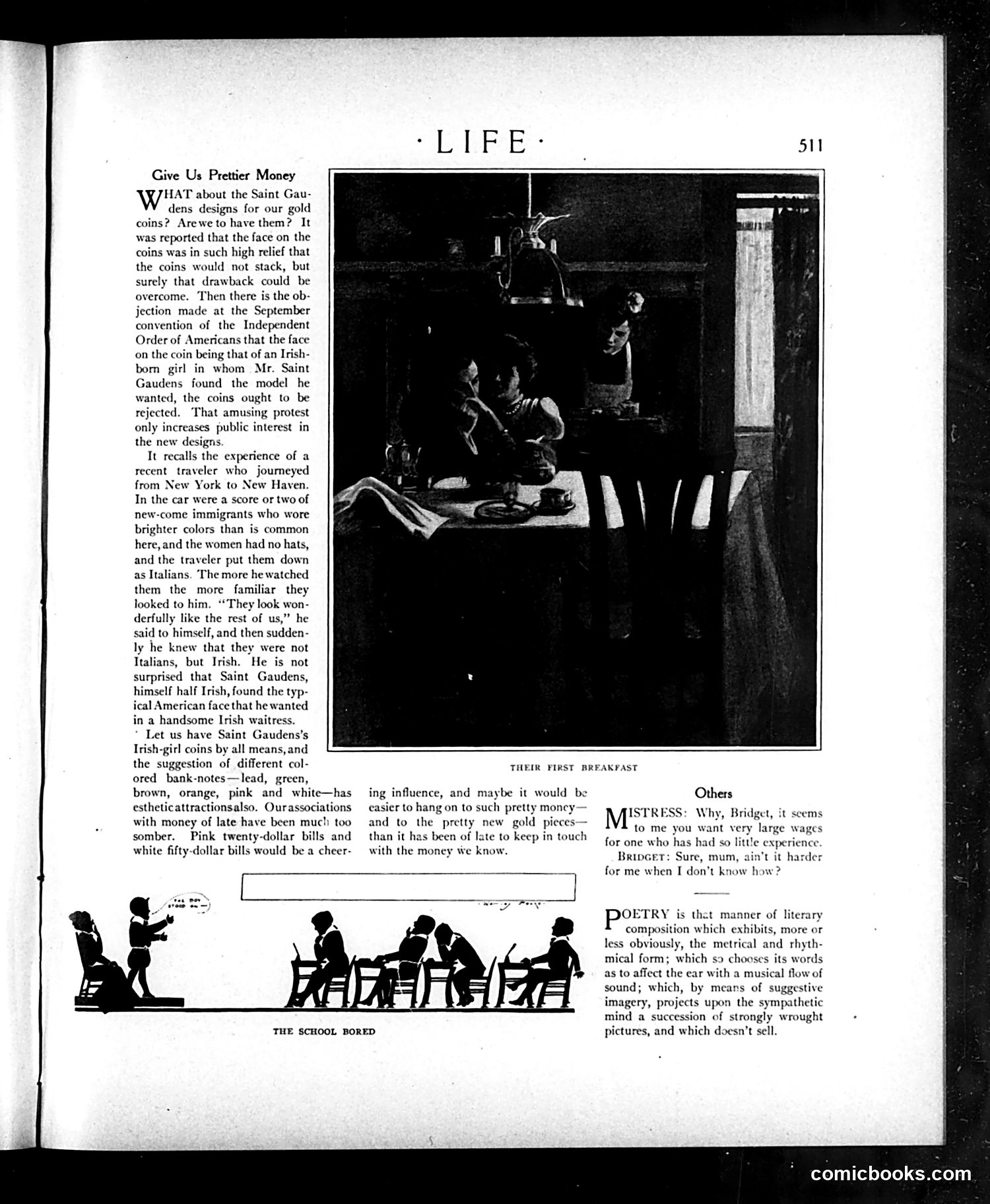
This page contains two distinct pieces: **Main Article** discusses a proposal by sculptor Saint Gaudens to redesign U.S. gold coins with an Irish-born girl's face as the model. The text humorously reports an objection from the Independent Order of Americans, who argued against this design. The article satirizes the controversy by noting that a traveler mistook Irish immigrants for Italians, suggesting the absurdity of debating national representation on currency. It advocates for Saint Gaudens's prettier, colorful coin designs over "five-dollar bills and white fifty-dollar bills." **"The School Bored"** - A small illustration shows children sitting in classroom chairs, apparently disengaged or bored during lessons, satirizing education. **"Others"** section contains brief witty dialogue about domestic life.
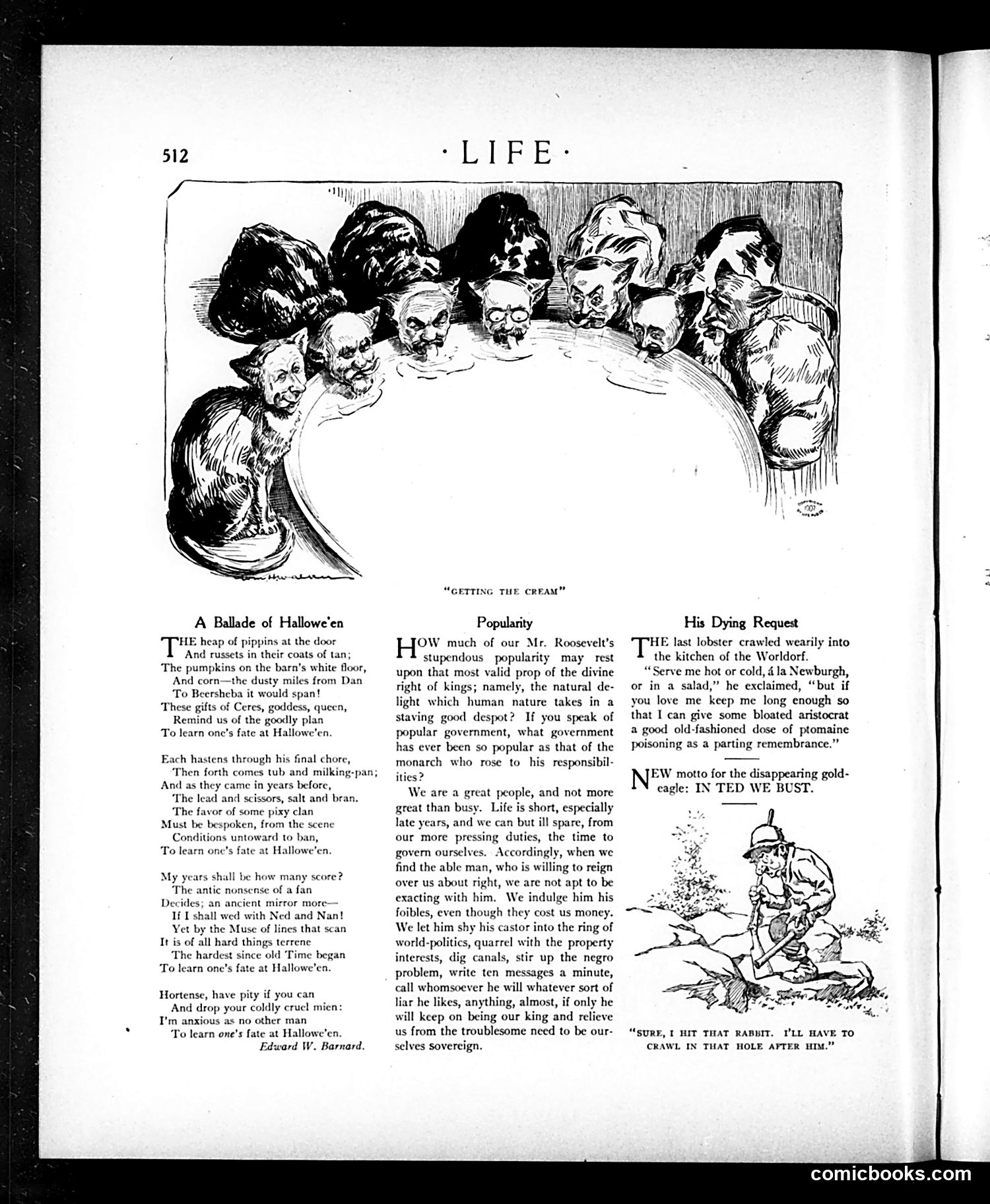
The top cartoon, titled "Getting the Cream," depicts multiple figures gathered around a table, appearing to share or divide something valuable—likely representing politicians or power-brokers "getting their share" of benefits or spoils. The three text sections below include: 1. **"A Ballad of Hallowe'en"** by Edward W. Barnard—a poem about Halloween festivities and fate 2. **"Popularity"**—an essay discussing President Roosevelt's popularity, arguing it stems from his willingness to "let shy his castor into the ring of world-politics" and handle various national problems (canals, race issues), thereby relieving citizens from governing responsibilities 3. **"His Dying Request"**—a humorous anecdote about a lobster's final wish, with accompanying illustration The page satirizes public willingness to delegate governance to popular leaders.
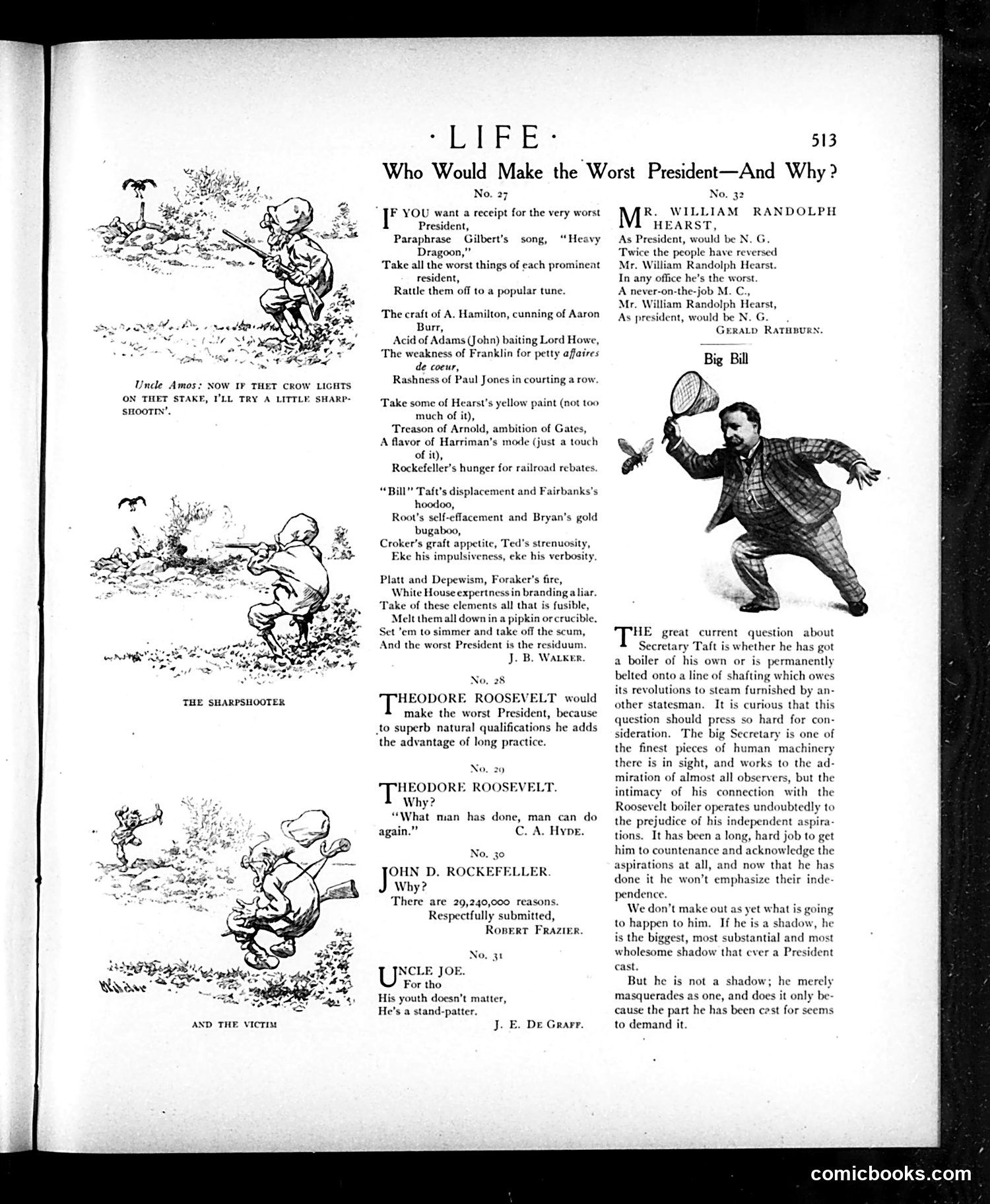
This 1912 *Life* magazine page satirizes potential worst presidential candidates through humorous submissions from readers. The format lists numbered proposals (entries 27-31) nominating figures like William Randolph Hearst, Theodore Roosevelt, and John D. Rockefeller as deliberately bad choices, with satirical reasons appended. The cartoon "Big Bill" on the right depicts Secretary of State William Howard Taft as an oversized figure using a megaphone. The accompanying article questions whether Taft has secretly connected his boiler to railroad shafting—political satire suggesting Taft is merely an extension of other powerful interests rather than independent. The left cartoons labeled "The Sharpshooter" and "And the Victim" appear to illustrate political targeting themes, though their specific references are unclear from the image alone.
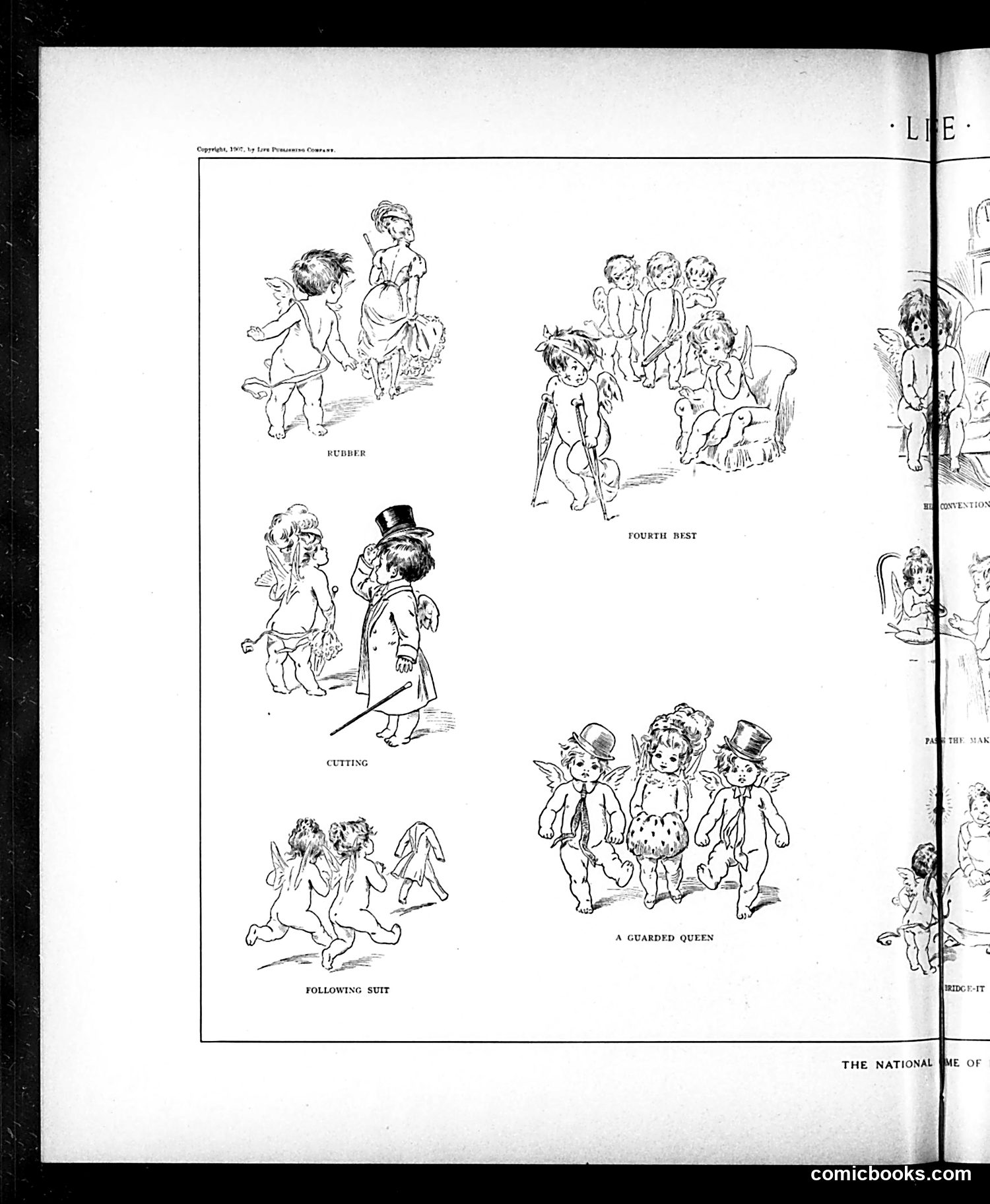
This page from *Life* magazine presents six satirical sketches labeled with children's games or activities: "Rubber," "Cutting," "Following Suit," "Fourth Best," "A Guarded Queen," and appears to reference "Convention" on the right margin. The cherubic figures and game titles suggest this is political satire using children's pastimes as metaphors for adult political behavior—likely commentary on political maneuvering, compromise, or party dynamics. "A Guarded Queen" and "Following Suit" particularly suggest card-game metaphors applied to political strategy. Without the article text, the specific political targets remain unclear, though the 1907 copyright and convention reference suggest this may comment on presidential politics or party proceedings of that era. The satirical tone is evident, but the precise political figures or events referenced cannot be determined from the image alone.
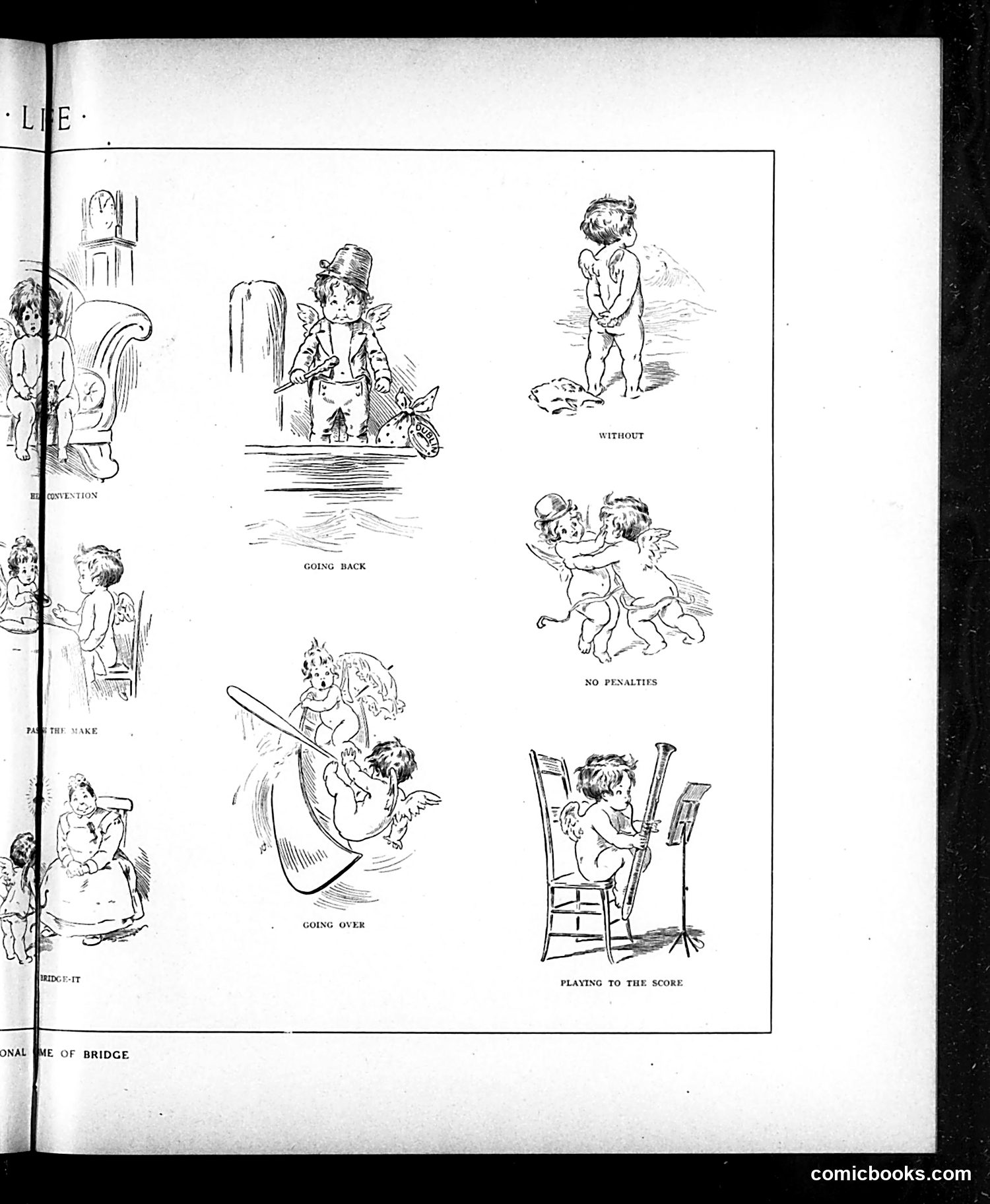
This page presents a humorous instructional guide to playing bridge using cherub figures. The six panels humorously depict bridge game rules and etiquette through allegorical scenes: - **"Convention"**: A cherub consults rules - **"Going Back"**: Returning to the table - **"Without"**: Playing solo - **"No Penalties"**: Cherubs playing freely - **"Going Over"**: Exceeding tricks (shown dramatically with a spoon/ladle) - **"Playing to the Score"**: Recording results The satire appears to mock bridge's complex rules and social conventions by treating the serious card game with whimsical, childlike reverence. The cherubs suggest innocence clashing with the game's formality. This likely appealed to Life's audience during the bridge-playing era when the game was popular among American social classes, lampooning both the game's intricacy and players' pretentiousness.
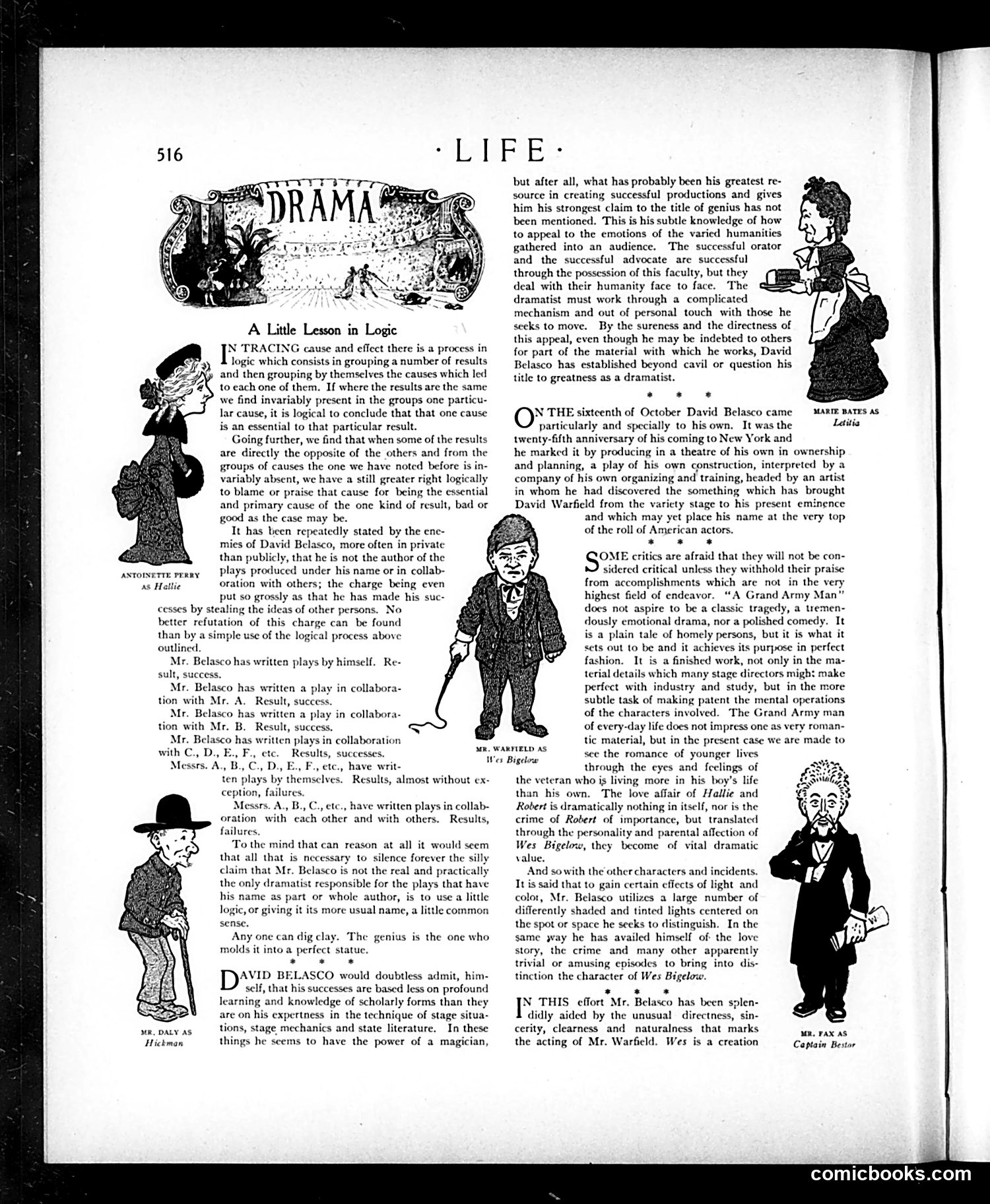
This page celebrates **David Belasco**, a prominent theatrical producer and dramatist. The article defends him against accusations that he steals others' work, using a satirical "logic lesson" format. ## The Satire: The opening section titled "A Little Lesson in Logic" mockingly demonstrates through formal logical reasoning that Belasco's consistent success—whether working alone or in collaboration—proves he is the essential creative force, not a plagiarist. The cartoons show caricatured figures (labeled as theatrical types like "Hallie" and "Belasco") illustrating this logical progression humorously. ## The Context: The piece marks Belasco's 25th anniversary in New York theater. It acknowledges contemporary criticism that Belasco merely repackages others' material, then rebuts this by showing his track record produces success regardless of collaboration structure. ## For Modern Readers: This defends a powerful theater figure against reputation-damaging claims—essentially early-20th-century accusations of creative theft. The "logic" format is tongue-in-cheek, suggesting critics were being unfair or envious of his success.
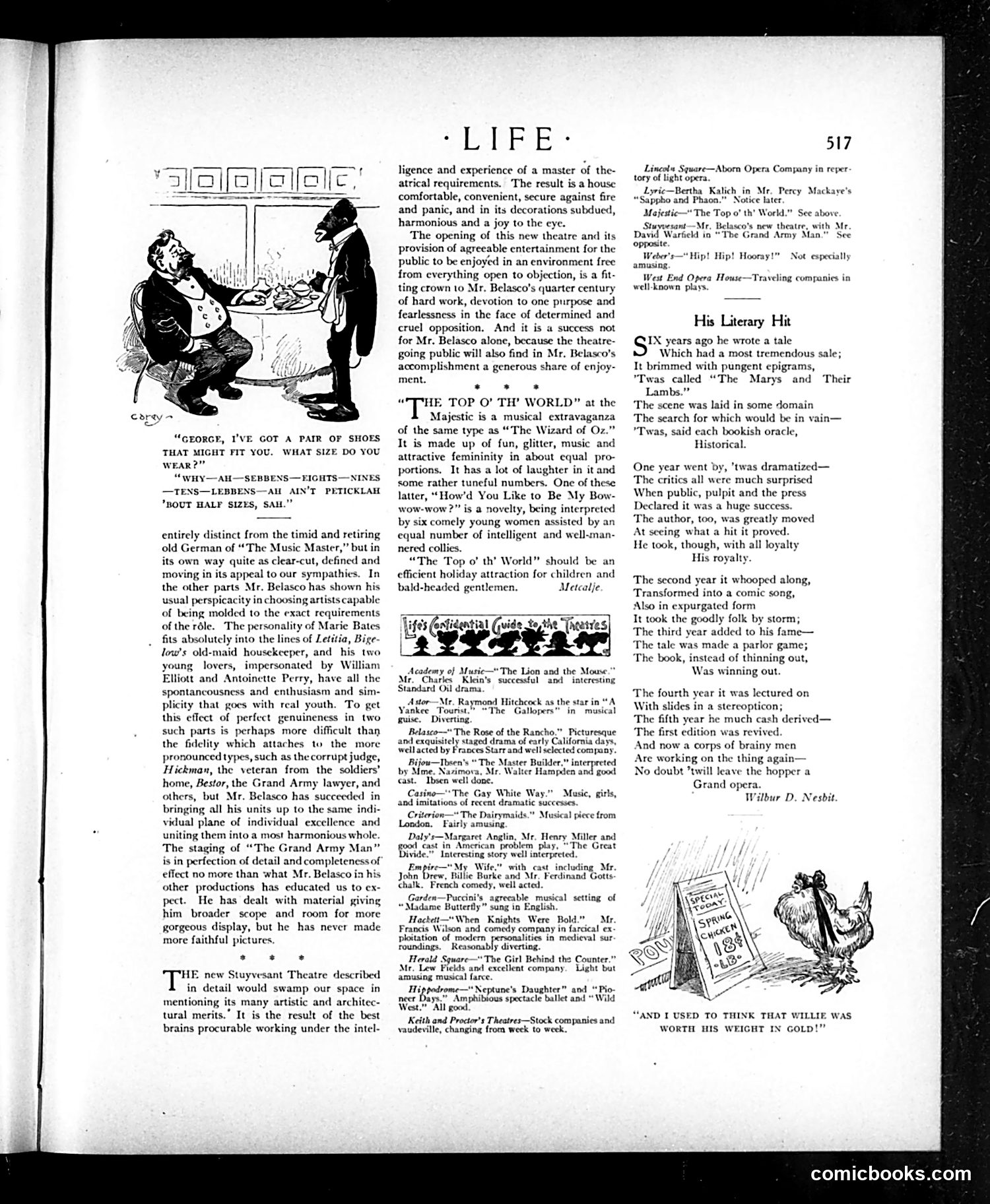
The cartoon depicts a shoe-store transaction between a white shopkeeper ("George") and a Black customer. The customer, rendered in caricature with exaggerated dialect ("LEBBED," "PETICKLAH"), responds to being asked his shoe size with nonsensical responses about fighting and numbers. **The Satire:** This is a racist "humor" piece typical of early 20th-century Life magazine. It mocks Black Americans through stereotyped dialect and implied stupidity—the customer cannot (or pretends not to) understand a simple question. The caricature and broken English are designed to demean. **Context:** While Life magazine was satirical, it frequently featured racist content reflecting widespread prejudices of the era. This represents offensive period humor targeting African Americans, not commentary critiquing racism. The rest of the page reviews theatrical productions by David Belasco and other Broadway shows.
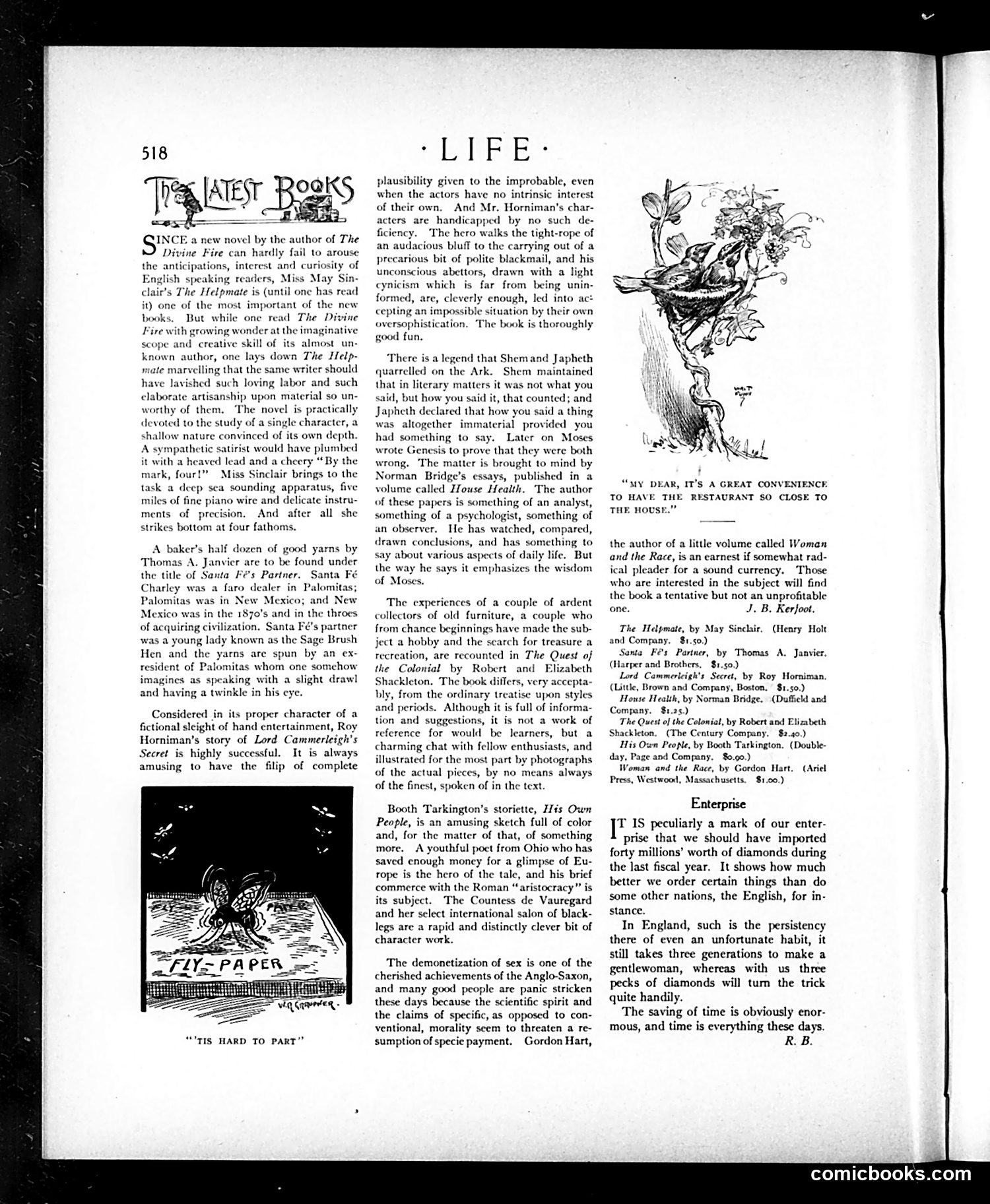
This page from Life magazine (circa early 1900s) contains book reviews and a small cartoon titled "Tis Hard to Part" showing a fly attempting to escape from flypaper—a visual pun on the expression "hard to part" (difficult to separate). The reviews discuss contemporary novels, with the critic particularly harsh on Miss May Sinclair's *The Helpmate*, using an extended metaphor comparing her analytical approach to using deep-sea sounding equipment to measure shallow waters. The reviewer suggests she wasted her considerable talent on an unworthy subject. Other reviews praise lighter entertainment: Thomas Janvier's Western yarns set in 1870s New Mexico, and Roy Horniman's *Lord Cammerleigh's Secret*, a thriller about blackmail. Norman Bridge's essay collection *House Health* receives criticism for over-analyzing everyday life. The page exemplifies Life's role as a literary and cultural arbiter for educated American readers, mixing humor with substantive criticism of popular books.
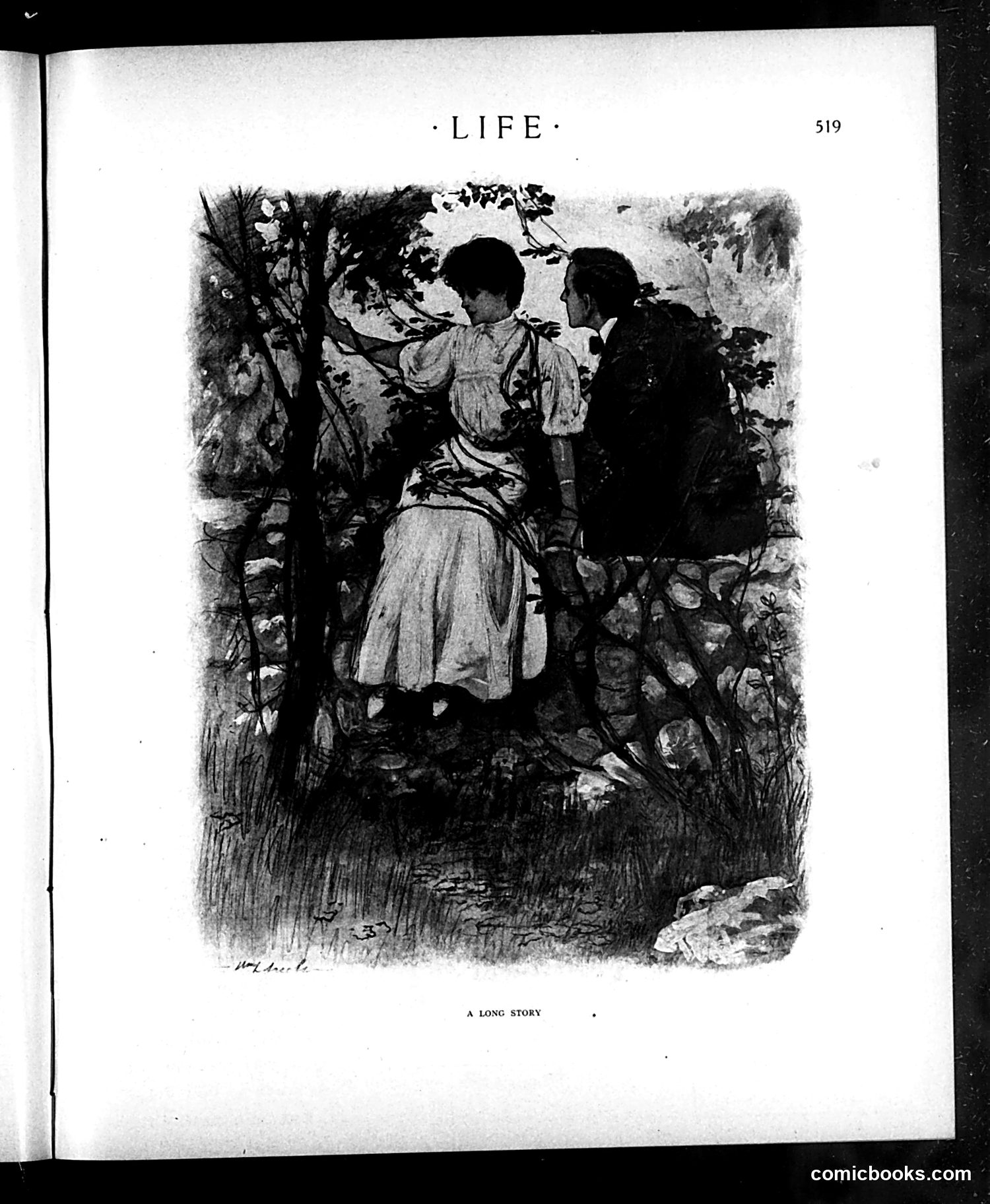
This illustration from *Life* magazine shows three figures in what appears to be a garden or natural setting with stone walls and vegetation. The title "A Long Story" suggests this is likely a humorous or satirical commentary on romance or courtship. The image depicts what seems to be a romantic scene—a woman in a light dress speaking with two men, one in dark clothing. The artistic style and composition suggest this may be satirizing Victorian or Edwardian courtship customs, perhaps poking fun at elaborate romantic narratives or the tedious nature of wooing. Without clearer visual caricatures or identifiable public figures, the specific satirical target remains unclear. The piece appears to be social satire rather than political commentary, likely aimed at contemporary courtship conventions or romantic pretensions of the era.
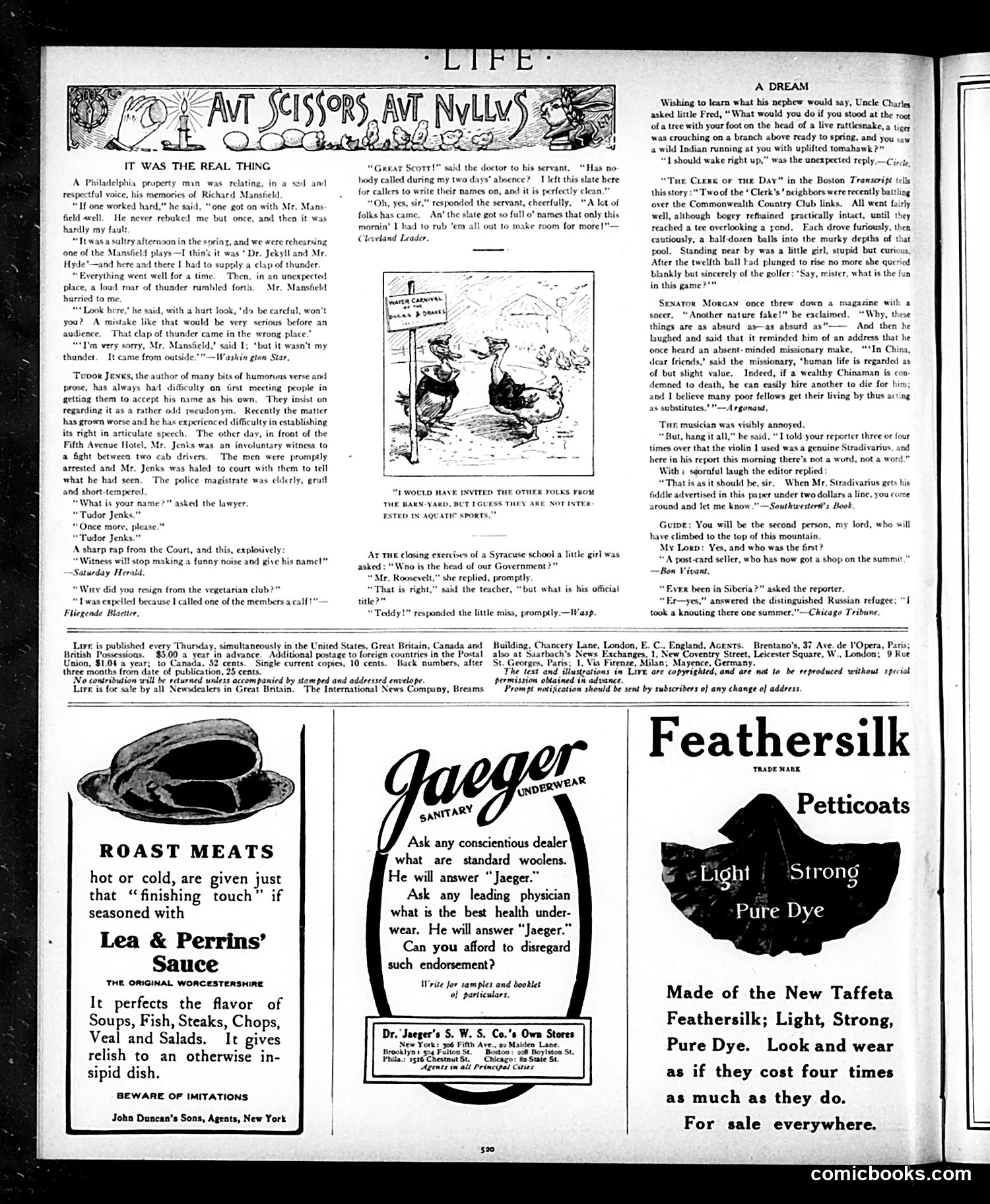
This page from *Life* magazine (a satirical publication, not the modern photo magazine) contains several humorous anecdotes and jokes targeting recognizable figures and social pretensions of the era. **Main content:** The page features short comic stories, including one about actor **Richard Mansfield** being overly critical during rehearsals, and another about author **Tudor Jenks**, whose real name people refuse to believe. A third joke plays on Theodore Roosevelt being called "Teddy" rather than by his official title. **The satire:** These pieces mock theatrical pomposity, the quirk of having an unusual-sounding real name that seems invented, and the informal familiarity with which Americans addressed President Roosevelt—suggesting a casual, irreverent national attitude toward authority. The page also contains period advertisements for Lea & Perrins Sauce, Jaeger undergarments, and Feathersilk petticoats, typical of early-1900s consumer publications. **Bottom line:** This is light, domestic humor targeting recognizable public figures and everyday social awkwardness.
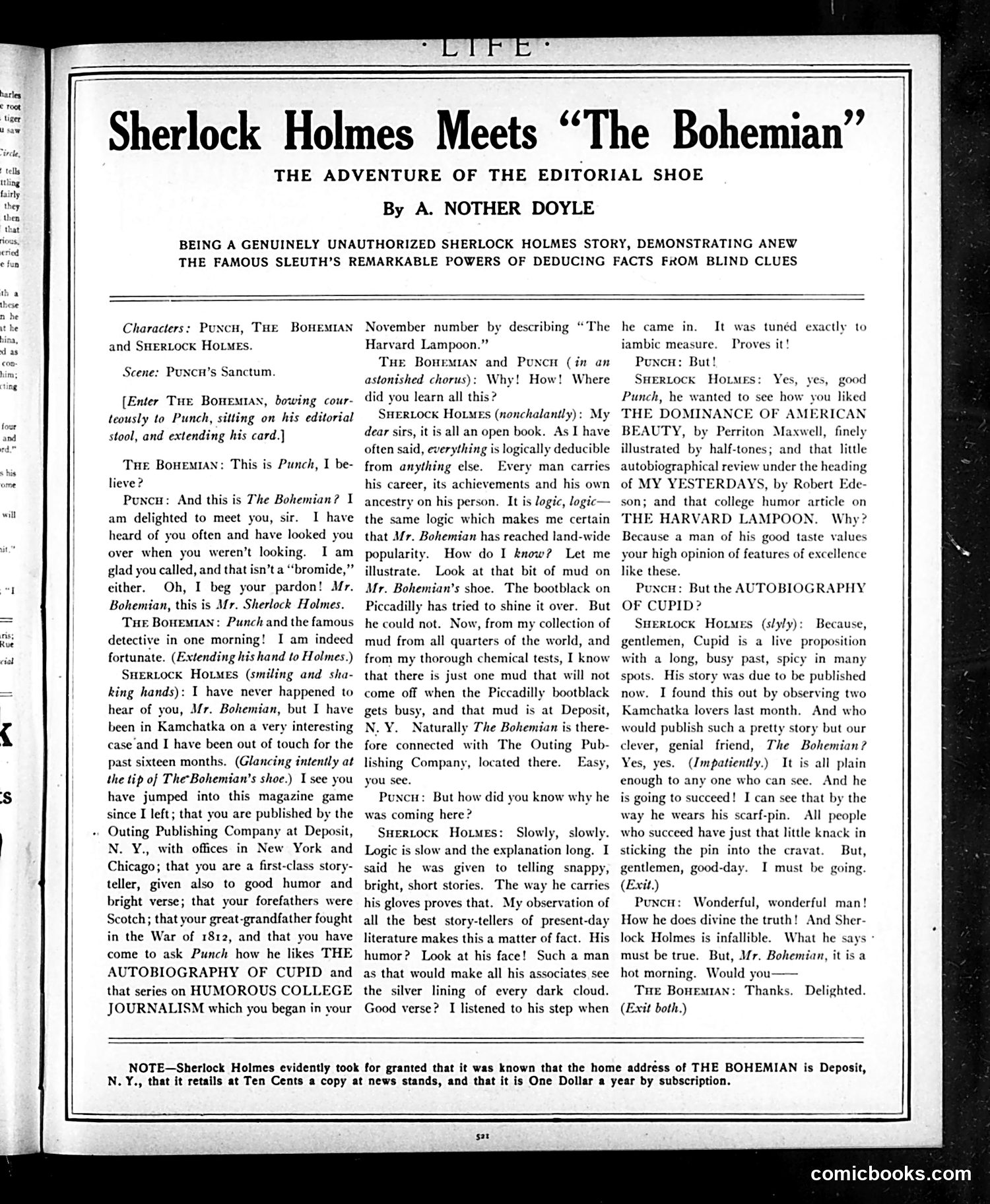
This is a humorous parody where Sherlock Holmes deduces facts about "The Bohemian" (a rival magazine) and its editor purely from mud on his shoe. The satire mocks both Holmes's famous deductive method and magazine competition of the era. **The Setup:** Punch magazine (an established British satirical publication) is visited by The Bohemian's editor. Sherlock Holmes, present in Punch's office, identifies the visitor's magazine affiliation, ancestry, literary style, and even which specific mud proves his New York location—all from examining his footwear. **The Joke:** Holmes's absurdly over-the-top deductions—tracing mud to Deposit, N.Y., identifying Scottish ancestry from glove-wearing, determining humor from facial structure—parody the detective's legendary logical prowess while poking fun at The Bohemian as a competitor. The exaggeration suggests The Bohemian is somehow obvious or transparent. **Context:** This reflects competitive literary magazine culture in early 20th-century America, where publications like Punch, The Bohemian, and Harvard Lampoon vied for readers with humor, stories, and satire.
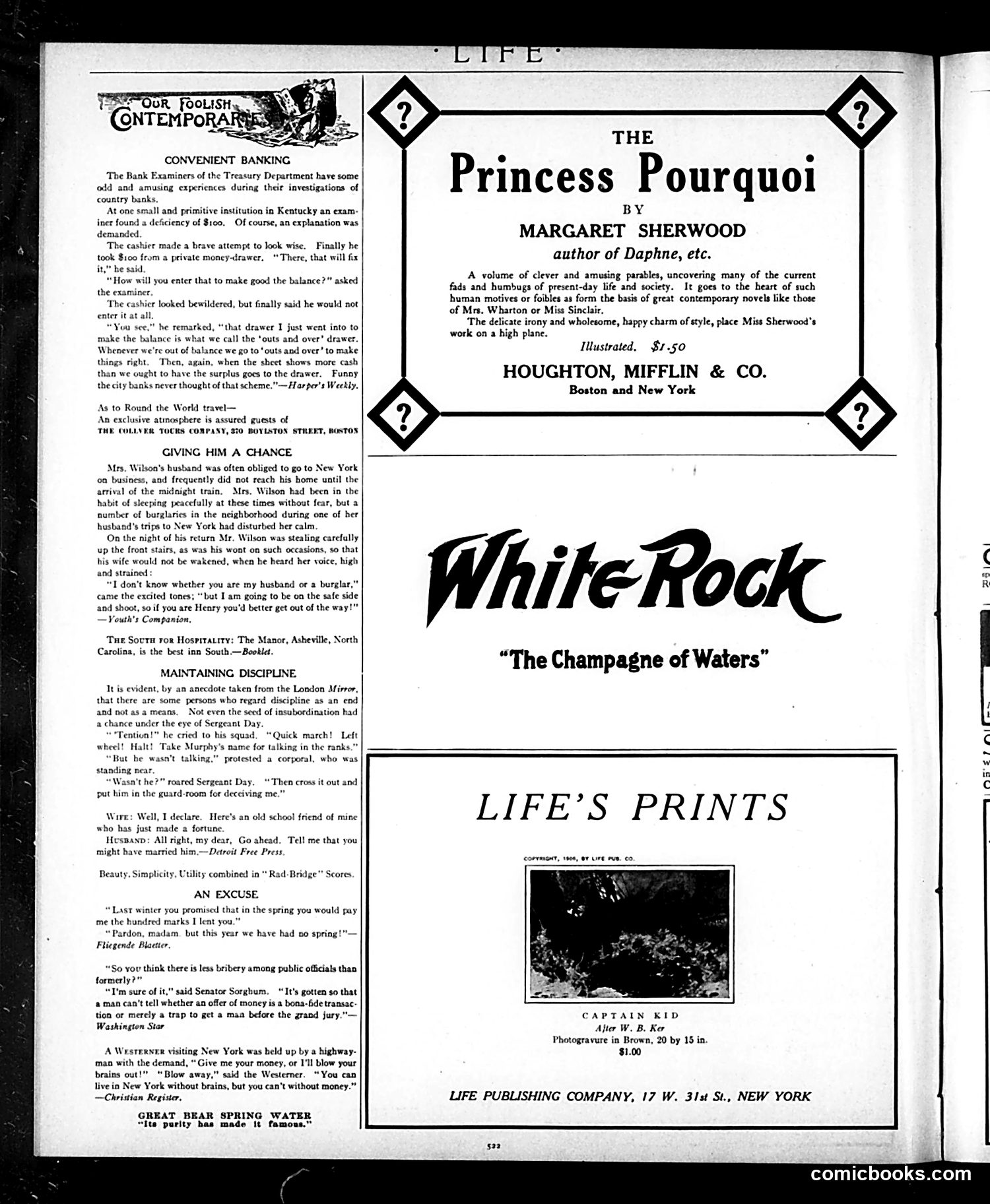
This is primarily an **advertising and book promotion page** rather than a political cartoon page. The main content includes: **Book Advertisement:** "The Princess Pourquoi" by Margaret Sherwood, promoted as clever satire on contemporary society's "fads and humbugs," comparing it to works by Wharton and Sinclair. **Humorous Anecdotes** (Our Foolish Contemporaries section): - "Convenient Banking": Rural Kentucky bank cashier uses an informal "outs and over" drawer to balance books—satirizing unsophisticated banking practices - "Giving Him a Chance": Wife threatens to shoot an intruder, not realizing it's her husband—humor about urban crime anxiety - "Maintaining Discipline": Sergeant punishes a corporal for "deceiving" him by reporting another soldier wasn't talking—absurdist military humor **Advertisement:** White Rock mineral water and various other products The satire targets **rural banking incompetence, urban anxiety about burglaries, and rigid military bureaucracy**—typical early-20th-century American social comedy. No specific political figures are identifiable.
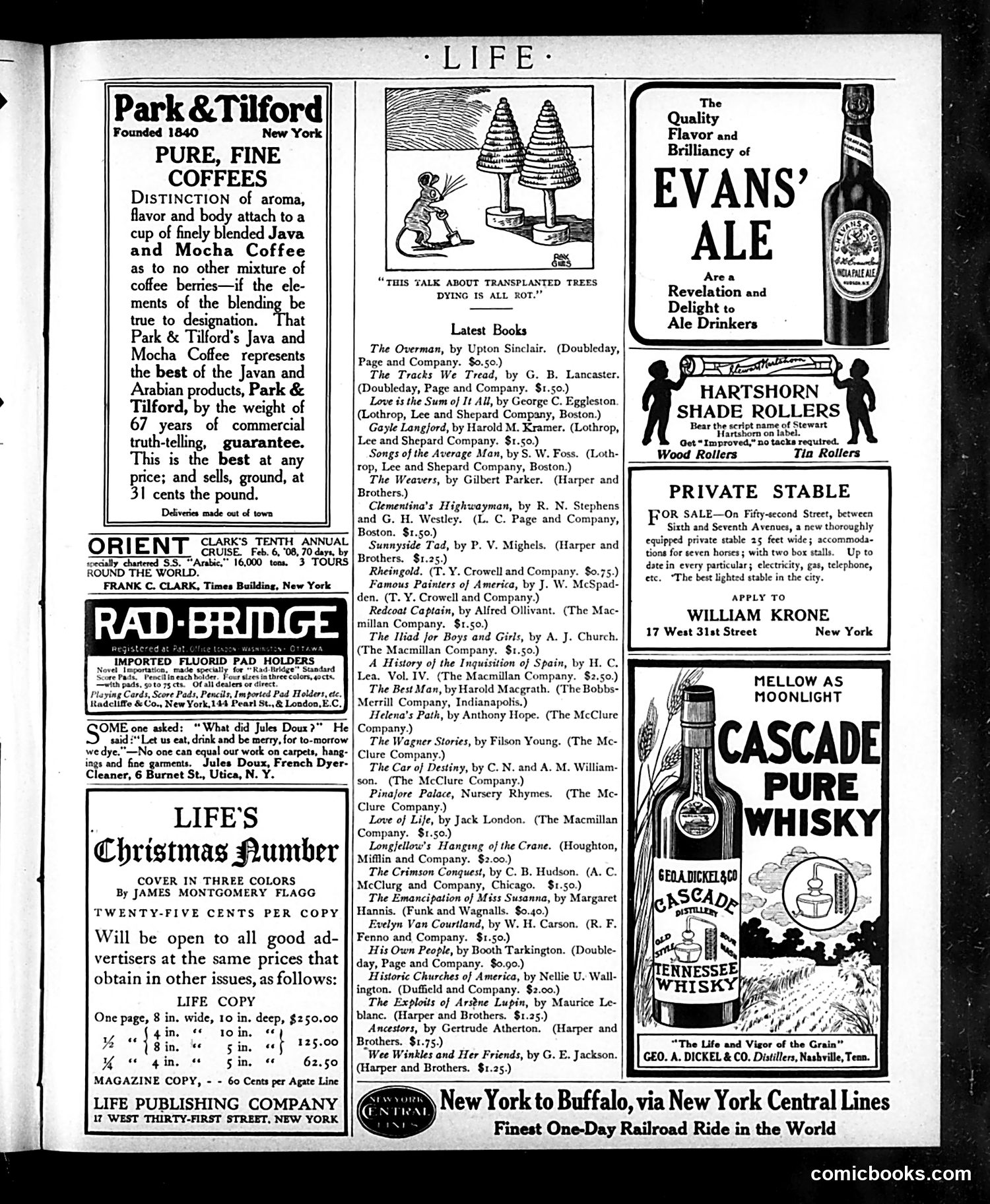
This page is primarily **advertising and announcements**, not political satire. The single cartoon shows a rabbit or hare near two evergreen trees, with the caption "THIS TALK ABOUT TRANSPLANTED TREES DYING IS ALL ROT." This is a straightforward joke promoting tree-planting: the animal's pun on "rot" (decay) humorously argues that transplanted trees survive fine—a mild horticultural cheerleading message, not satire. The rest of the page contains period advertisements (Park & Tilford coffee, Evans' ale, Cascade whisky) and announcements for *Life* magazine's Christmas issue and book reviews. There is no political commentary or social satire visible.
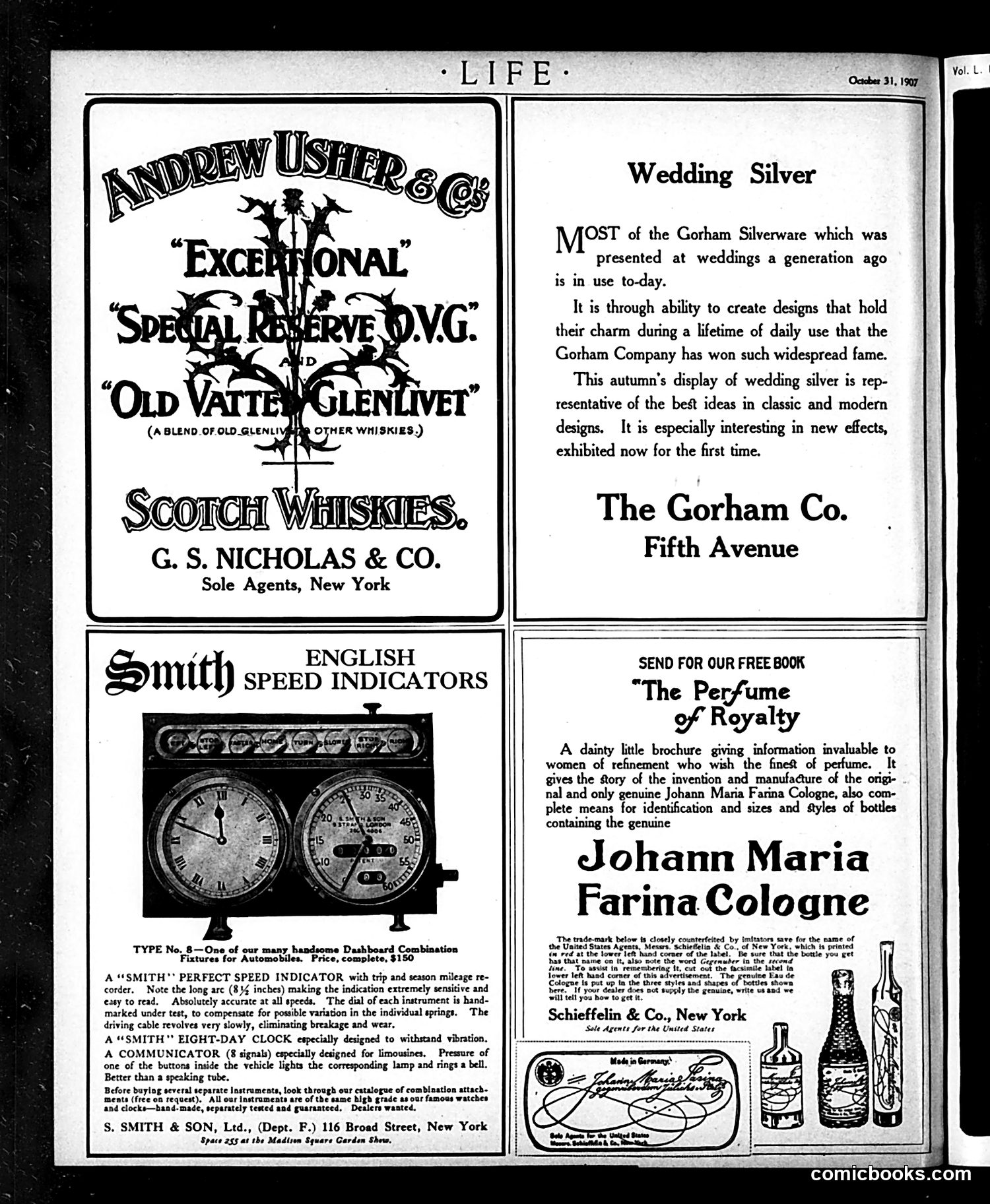
This page contains **no cartoons or satirical content**—it is entirely devoted to advertisements and promotional material typical of early 1900s magazines. The ads feature luxury goods marketed to wealthy consumers: - **Andrew Usher & Co.** advertises Scottish whiskies (Exceptional, Special Reserve, Old Vatted Glenlivet) - **The Gorham Co.** promotes wedding silverware, emphasizing heirloom quality and timeless design - **Smith & Son** showcases automobile dashboard instruments (speedometers, clocks, communicators)—reflecting the novelty of motorcar technology - **Johann Maria Farina Cologne** advertises authentic German perfume, warning against counterfeits The page reflects **Edwardian-era consumer culture**: expensive imported goods, automotive innovation, and emphasis on authenticity and craftsmanship. There is no political commentary or satire—merely commercial messaging targeting affluent readers of *Life* magazine.