
Life, 1907-10-31 · page 10 of 22
Life — October 31, 1907 — page 10: what you’re looking at
What you’re looking at
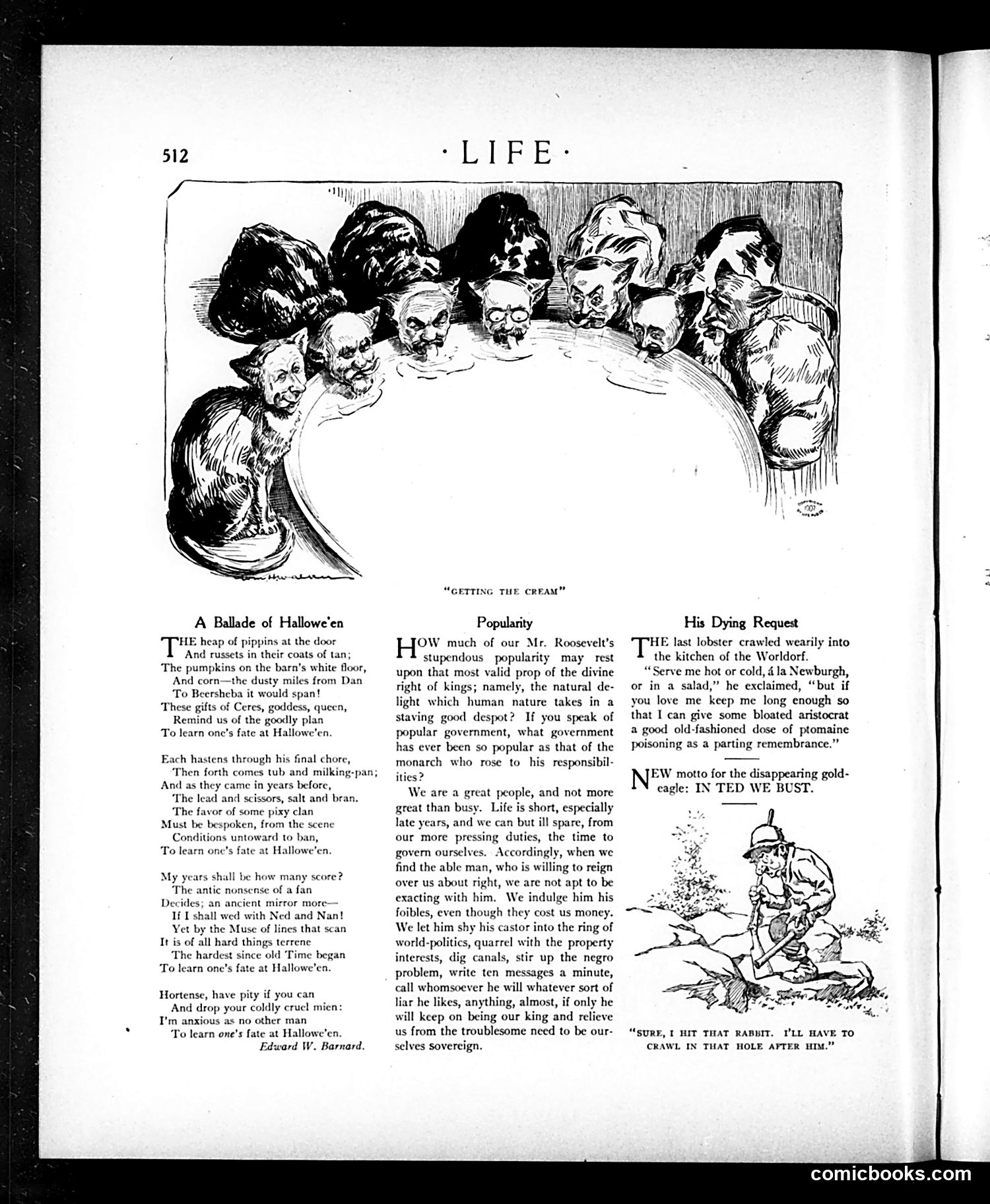
The top cartoon, titled "Getting the Cream," depicts multiple figures gathered around a table, appearing to share or divide something valuable—likely representing politicians or power-brokers "getting their share" of benefits or spoils. The three text sections below include: 1. **"A Ballad of Hallowe'en"** by Edward W. Barnard—a poem about Halloween festivities and fate 2. **"Popularity"**—an essay discussing President Roosevelt's popularity, arguing it stems from his willingness to "let shy his castor into the ring of world-politics" and handle various national problems (canals, race issues), thereby relieving citizens from governing responsibilities 3. **"His Dying Request"**—a humorous anecdote about a lobster's final wish, with accompanying illustration The page satirizes public willingness to delegate governance to popular leaders.
📄 Transcribed text from this page (OCR, searchable)
Machine-transcribed from the original scan — historical spelling and the odd misread are preserved.
A Ballade of Hallowe'en HE heap of pippins at the door And russets in their coats of tan; ‘The pumpkins on the barn's white floor, And corn—the dusty miles from Dan To Beersheba it would span! These gifts of Ceres, goddess, quecn, Remind us of the goodly plan To learn one’s fate at Hallowe'en. Each hastens through his final chore, ‘Then forth comes tub and milking-pan; And as they came in years before, ‘The lead and scissors, salt and bran. ‘The favor of some pixy clan Must be bespoken, from the scene Conditions untoward to ban, To learn one's fate at Hallowe'en. My years shall be how many score? ntic nonsense of a fan ; an ancient mirror more— If I shall wed with Ned and Nan! Yet by the Muse of lines that scan all hard things terrene ‘The hardest since old Time began To learn one’s fate at Hallowe'en. Hortense, have pity if you can And drop your coldly crucl mien: I'm anxious as no other man ‘To learn one’s fate at Hallowe'en. Edward W. Barnard. “GETTING THE CREAM” Popularity OW much of our Mr. Roosevelt's stupendous popularity may rest upon that most valid prop of the divine right of kings; namely, the natural de- light which human nature takes in a staving good despot? If you speak of popular government, what government has ever been so popular as that of the monarch who rose to his responsibil- ities? We are a great people, and not more great than busy. Life is short, especially late years, and we can but ill spare, from our more pressing duties, the time to govern ourselves. Accordingly, when we find the able man, who is willing to reign over us about right, we are not apt to be exacting with him. We indulge him his foibles, even though they cost us money. We let him shy his castor into the ring of world-politics, quarrel with the property interests, dig canals, stir up the negro problem, write ten messages a minute, call whomsoever he will whatever sort of liar he likes, anything, almost, if only he will keep on being our king and relieve us from the troublesome need to be our- selves sovereign. w 1%, ip J ZZ Z ZY Kea f} His Dying Request HE last lobster crawled wearily into the kitchen of the Worldorf. “Serve me hot or cold, 41a Newburgh, or in a salad,” he exclaimed, “but if you love me keep me long enough so that I can give some bloated aristocrat a good old-fashioned dose of ptomaine poisoning as a parting remembrance.” EW motto for the disappearing gold- cagle: IN TED WE BUST. “SURE, I HIT THAT RABBIT. I'LL HAVE TO CRAWL IN THAT HOLE AFTER HM. comicbooks.com