
Life, 1907-10-31 · page 15 of 22
Life — October 31, 1907 — page 15: what you’re looking at
What you’re looking at
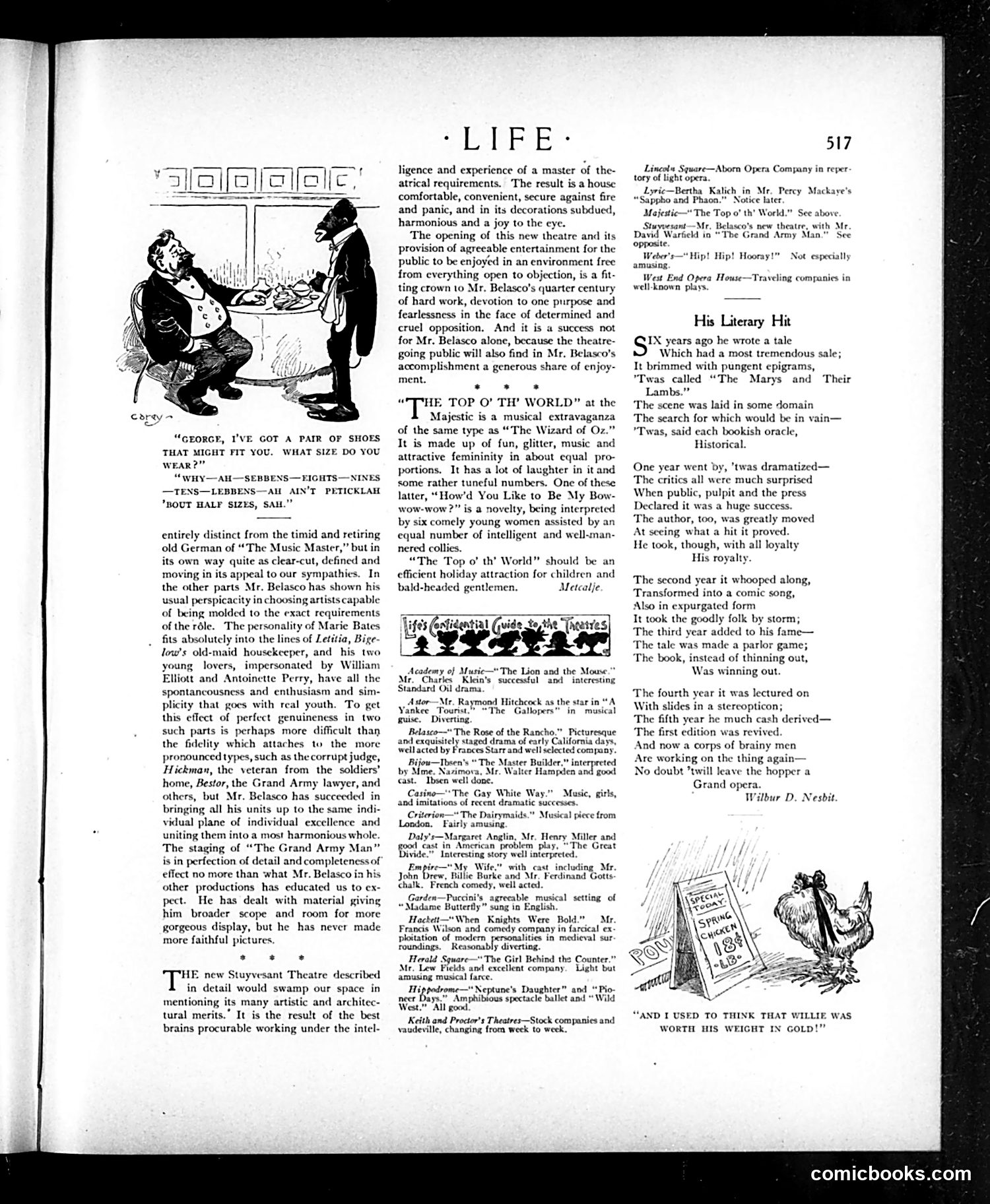
The cartoon depicts a shoe-store transaction between a white shopkeeper ("George") and a Black customer. The customer, rendered in caricature with exaggerated dialect ("LEBBED," "PETICKLAH"), responds to being asked his shoe size with nonsensical responses about fighting and numbers. **The Satire:** This is a racist "humor" piece typical of early 20th-century Life magazine. It mocks Black Americans through stereotyped dialect and implied stupidity—the customer cannot (or pretends not to) understand a simple question. The caricature and broken English are designed to demean. **Context:** While Life magazine was satirical, it frequently featured racist content reflecting widespread prejudices of the era. This represents offensive period humor targeting African Americans, not commentary critiquing racism. The rest of the page reviews theatrical productions by David Belasco and other Broadway shows.
📄 Transcribed text from this page (OCR, searchable)
Machine-transcribed from the original scan — historical spelling and the odd misread are preserved.
“GEORGE, I'VE GOT A PAIR OF SHOES THAT MIGHT FIT YOU. WHAT SIZE DO YoU WEAR?” “WHY—aH —TENS—LEBBED "BOUT HALF SIZES, SAH.” EBBENS—FIGHTS ES IN'T PETICKLAH entirely distinct from the timid and retiring old German of “The Music Master,” but in its own way quite as clear-cut, defined and moving in its appeal to our sympathies. In the other parts Mr. Belasco has shown his usual perspicacity in choosing artists capable of being molded to the exact requirements ofthe rdle. The personality of Marie Bates fits absolutely into the lines of Letitia, Bige- Jow’s old-maid housekeeper, and his two young lovers, impersonated by William Elliott and Antoinette Perry, have all the spontancousness and enthusiasm and sim- plicity that goes with real youth. To get this effect of perfect genuineness in two such parts is perhaps more difficult than the fidelity which attaches to the more pronounced types, such as the corrupt judge, Hickman, the veteran from the soldiers’ home, Bestor, the Grand Army lawyer, and others, but Mr. Belasco has succeeded in bringing all his units up to the same indi- vidual plane of individual excellence and uniting them into a most harmonious whole. The staging of “The Grand Army Man” is in perfection of detail and completeness of effect no more than what Mr. Belasco in his other productions has educated us to ex- pect. He has dealt with material giving him broader scope and room for more gorgeous display, but he has never made more faithful pictures. es 8 6 HE new Stuyvesant Theatre described in detail would swamp our space in mentioning its many artistic and architec- tural merits.’ It is the result of the best brains procurable working under the intel- eieelbaeE ligence and experience of a master of the- atrical requirements. The result is a house comfortable, convenient, secure against fire and panic, and in its decorations subdued, harmonious and a joy to the eye. The opening of this new theatre and its provision of agreeable entertainment for the public to be enjoyed in an environment free from everything open to objection, is a fit- ting crown to Mr. Belasco’s quarter century of hard work, devotion to one purpose and fearlessness in the face of determined and cruel opposition. And it is a success not for Mr. Belasco alone, because the theatre- going public will also find in Mr. Belasco’s accomplishment a generous share of enjoy- ment. * 8 @ “CHE TOP O’ TH’ WORLD” at the Majestic is a musical extravaganz: of the same type as “The Wizard of Oz. It is made up of fun, glitter, music and attractive femininity in about equal pro- portions. It has a lot of laughter in it and some rather tuneful numbers. One of these latter, “How'd You Like to Be My Bow- wow-wow ?” is a novelty, being interpreted by six comely young women assisted by an equal number of intelligent and well-man- nered collies. “The Top o’ th’ World” should be an efficient holiday attraction for children and bald-headed gentlemen. Metcalje “Taatves) ic—"The Lion and the Mouse.” Charles “Klein's successful and interesting Standard Oil drama Ador—Mr. Raymond Hitchcock as the star in “A Yankee Tourist.” “The Gallopers” in musical guise. Diverting. Belasco—" The Rose of the Rancho.” Picturesque and exquisitely staged drama of early California days, wellacted by Frances Starr and well selected company. Bijou—Tbsen's “The Master Builder,” interpreted by Mme. Nazimora, Mr. Walter Hampden and good cast. Ibsen well done. Casino—"The Gay White Way.” Music, gitls, and imitations of recent dramatic successes. Criterion— The Dairymaids."” Musical piece from London. Fairly amusing Daly's—Margaret Anglin, Mr, Henry. Miller and good cast in American problem play, “The Great Divide.” Interesting story well interpreted. Empire—"My Wife,” with cast including Mr. John Drew, Billie Burke and Mr. Ferdinand Gotts chalk. French comedy, well acted. Garden—Puccini's agreeable musical setting of “ Madame Butterfly” sung in English. Hackett—"When Knights Were Bold.” Mr. Francis Wilson and comedy company in farcical ex Blottation of modem personalities in modieval sur roundings. Reasonably diverting. Herald Square—The Girl Behind the Counter.” Mr. Lew Fields and excellent company. Light but amusing musical farce. Hippodrome—"Neptane’s Daughter” and "Pio- acer Days.” Amphibious spectacle ballet and “Wild West.” Ail good. Keith and Proctor’s Theatres—Stock companies and vaudeville, changing from week to week. 517 Lincol Square—Aborn Opera Company in reper- tory of light opera, Lyric—Bertha Katich in Mr. Pe “Sappho and Phaon.” Notice later Majestic—" The Top o' th’ World." See above Stuyvesant —Mr, Belasco David Warfield in “The € opposite, Weber's—" Hip! Hip! Hooray!” amusing West End Opera House—Traveling companies in well-known plays. y Mackaye's new theatre, with Mr. ind Army Man.” See Not especially His Literary Hit IX years ago he wrote a tale Which had a most tremendous sale; It brimmed with pungent epigrams, 'Twas called “The Marys and Lambs.” ‘The scene was laid in some domain The search for which would be in vain— "Twas, said each bookish oracle, Historical. Their One year went by, "twas dramatized— ‘The critics all were much surprised When public, pulpit and the press Declared it was a huge success. The author, too, was greatly moved At seeing what a hit it proved. He took, though, with all loyalty His royalty. The second year it whooped along, Transformed into a comic song, Also in expurgated form It took the goodly folk by storm; The third year added to his fame— The tale was made a parlor game; The book, instead of thinning out, Was winning out. ‘The fourth year it was lectured on With slides in a stereopticon; The fifth year he much cash derived— The first edition was revived And now a corps of brainy men Are working on the thing again— 'o doubt "twill leave the hopper a Grand opera. Wilbur D. Nesbit. comicbooks.com