
Life, 1907-10-31 · page 6 of 22
Life — October 31, 1907 — page 6: what you’re looking at
What you’re looking at
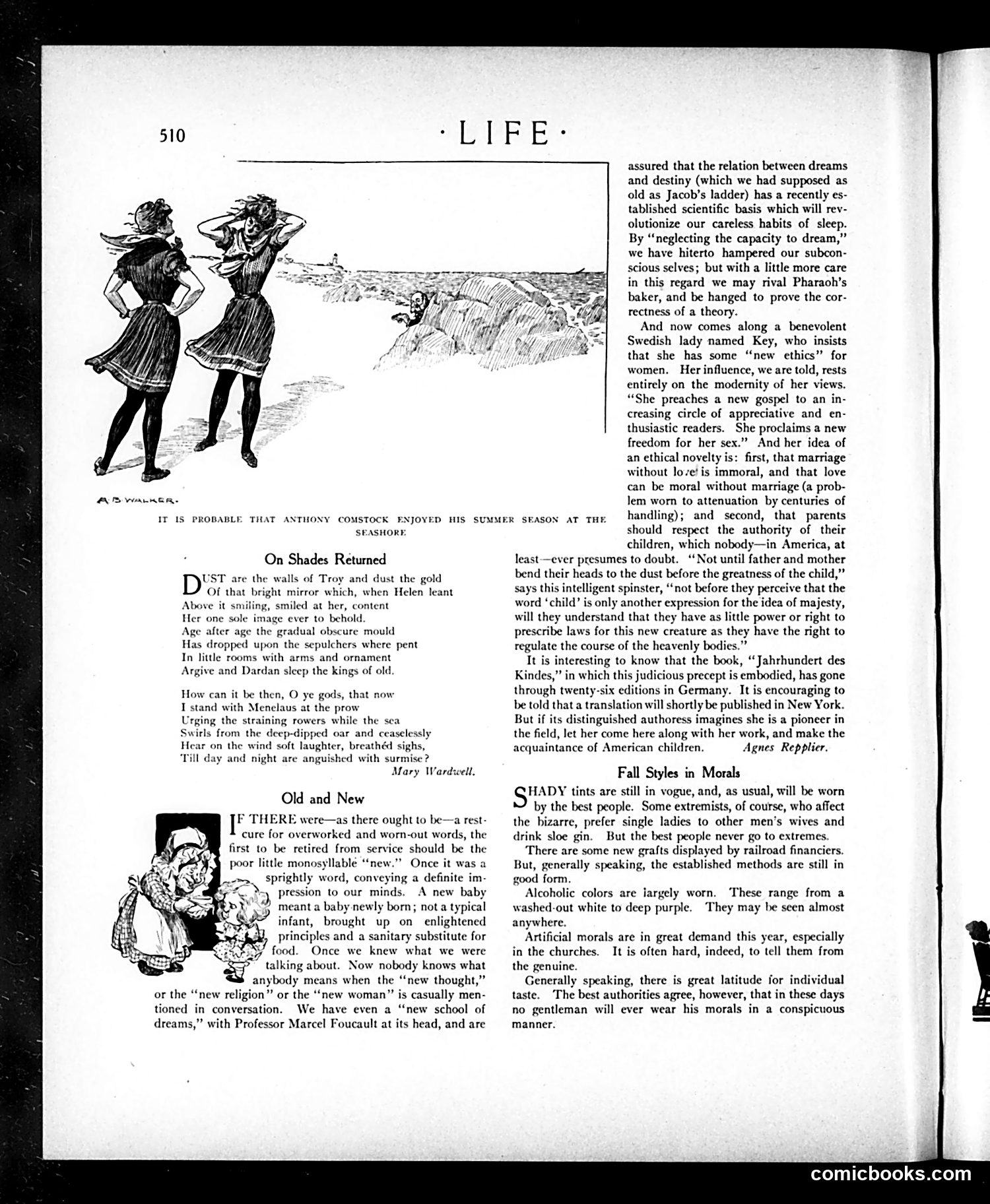
The top illustration depicts two women pointing toward a distant seashore landscape, captioned "It is probable that Anthony Comstock enjoyed his summer season at the seashore." This is a satirical jab at **Anthony Comstock**, the notorious anti-obscenity crusader who led the "Comstock Laws" campaign. The women's pointing gesture and knowing expressions suggest mockery of his moral policing efforts. The cartoon implies Comstock hypocritically enjoyed leisure activities while condemning others' freedoms. The page's text discusses "new ethics" for women, particularly Swedish author Ellen Key's ideas about marriage, love outside marriage, and parental authority—clearly progressive social positions Life's editors found worth satirizing against Comstock-style moral conservatism. The contrast between puritanical censorship and actual human behavior is the joke's essence.
📄 Transcribed text from this page (OCR, searchable)
Machine-transcribed from the original scan — historical spelling and the odd misread are preserved.
AR aLneR: IT IS PROBABLE THAT ANTHONY COMSTOCK ENJOYED HIS SUMMER SEASON AT THE SEASHORE: On Shades Returned UST are the walls of Troy and dust the gold Of that bright mirror which, when Helen leant Above it smiled at her, content Her one sole image ever to behold Age after age the gradual obscure mould Has dropped upon the sepulchers where pent In little rooms with arms and ornament Argive and Dardan sleep the kings of old. How can it be then, O ye gods, that now I stand with Menelaus at the prow Urging the straining rowers while the sea Swirls from the deep-dipped oar and ceaselessly Hear on the wind soft laughter, breathéd sighs, ‘Till day and night are anguished with surmise? Mary Wardwell. Old and New F THERE were—as there ought to | rest- cure for overworked and worn-out words, the first to be retired from service should be the poor little monosyllable ‘‘new.”? Once it was a sprightly word, conveying a definite im- "3, Pression to our minds. A new baby meant a baby newly born; not a typical infant, brought up on_ enlightened principles and a sanitary substitute for food. Once we knew what we were talking about. Now nobody knows what anybody means when the ‘‘new thought or the “new religion” or the ‘new woman” is casually men- tioned in conversation. We have even a ‘‘new school of dreams,” with Professor Marcel Foucault at its head, and are assured that the relation between dreams and destiny (which we had supposed as old as Jacob’s ladder) has a recently es- tablished scientific basis which will rev- olutionize our careless habits of sleep. By ‘neglecting the capacity to dream,” we have hiterto hampered our subcon- scious selves; but with a little more care in this regard we may rival Pharaoh's baker, and be hanged to prove the cor- rectness of a theory. And now comes along a benevolent Swedish lady named Key, who insists that she has some “new ethics” for women. Her influence, we are told, rests entirely on the modernity of her views. “She preaches a new gospel to an in- creasing circle of appreciative and en- thusiastic readers. She proclaims a new freedom for her ”” And her idea of an ethical novelty is: first, that marriage without love! is immoral, and that love can be moral without marriage (a prob- lem worn to attenuation by centuries of handling); and second, that parents should respect the authority of their children, which nobody—in America, at least—ever presumes to doubt. “Not until father and mother bend their heads to the dust before the greatness of the child,” says this intelligent spinster, “not before they perceive that the word ‘child’ is only another expression for the idea of majesty, will they understand that they have as little power or right to prescribe laws for this new creature as they have the right to regulate the course of the heavenly bodies.” It is interesting to know that the book, “Jahrhundert des Kindes,” in which this judicious precept is embodied, has gone through twenty-six editions in Germany. It is encouraging to be told that a translation will shortly be published in New York. But if its distinguished authoress imagines she is a pioneer in the field, let her come here along with her work, and make the acquaintance of American children. Agnes Repplier. Fall Styles in Morals giapy tints are still in vogue, and, as usual, will be worn by the best people. Some extremists, of course, who affect the bizarre, prefer single ladies to other men’s wives and drink sloe gin. But the best people never go to extremes. ‘There are some new grafts displayed by railroad financiers. But, generally speaking, the established methods are still in good form. Alcoholic colors are jargely worn. These range from a washed-out white to deep purple. ‘They may be scen almost anywhere. Artificial morals are in great demand this year, especially in the churches. It is often hard, indeed, to tell them from the genuine. Generally speaking, there is great latitude for individual taste. The best authorities agree, however, that in these days no gentleman will ever wear his morals in a conspicuous manner. comicbooks.com