
Life, 1907-10-31 · page 16 of 22
Life — October 31, 1907 — page 16: what you’re looking at
What you’re looking at
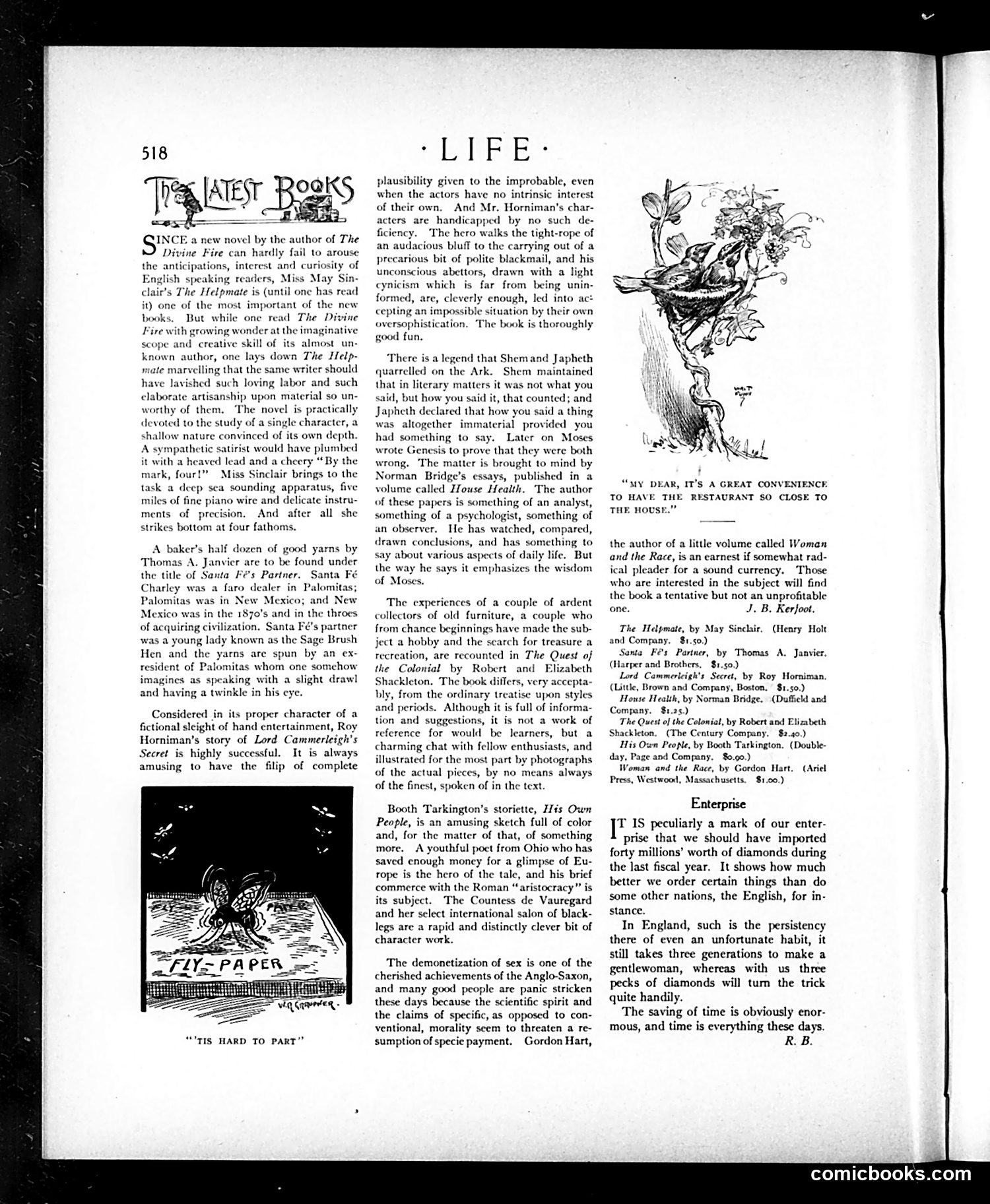
This page from Life magazine (circa early 1900s) contains book reviews and a small cartoon titled "Tis Hard to Part" showing a fly attempting to escape from flypaper—a visual pun on the expression "hard to part" (difficult to separate). The reviews discuss contemporary novels, with the critic particularly harsh on Miss May Sinclair's *The Helpmate*, using an extended metaphor comparing her analytical approach to using deep-sea sounding equipment to measure shallow waters. The reviewer suggests she wasted her considerable talent on an unworthy subject. Other reviews praise lighter entertainment: Thomas Janvier's Western yarns set in 1870s New Mexico, and Roy Horniman's *Lord Cammerleigh's Secret*, a thriller about blackmail. Norman Bridge's essay collection *House Health* receives criticism for over-analyzing everyday life. The page exemplifies Life's role as a literary and cultural arbiter for educated American readers, mixing humor with substantive criticism of popular books.
📄 Transcribed text from this page (OCR, searchable)
Machine-transcribed from the original scan — historical spelling and the odd misread are preserved.
518 Tye a 4, CE a new novel by the author of The Divine Fire can hardly fail to arouse the anticipations, interest and curiosity of English speaking readers, Miss May Sin- clair’s The Helpmate is (until one has read it) one of the most important of the new books. But while one read The Divine Fire with growing wonder at the imaginative scope and creative skill of its almost_un- known author, one lays down The Help- mate marvelling that the same writer should have lavished such loving labor and such elaborate artisanship upon material so un- worthy of them, ‘The novel is practically devoted to the study of a single character, a shallow nature convinced of its own depth. A sympathetic satirist would have plumbed it with a heaved lead and a cheery “By the mark, four!” Miss Sinclair brings to the task a deep sea sounding apparatus, five miles of fine piano wire and delicate instru- ments of precision, And after all she strikes bottom at four fathoms, A baker’s half dozen of good yarns by Thomas A. Janvier are to be found under the title of Santa Fé’s Partner, Santa Fé Charley was a faro dealer in Palomitas; Palomitas was in New Mexico; and New Mexico was in the 1870's and in the throes of acquiring civilization, Santa Fé’s partner was a young lady known as the Sage Brush Hen and the yarns are spun by an ex- resident of Palomitas whom one somehow imagines as speaking with a slight draw! and having a twinkle in his eye. Considered in its proper character of a fictional sleight of hand entertainment, Roy Horniman’s story of Lord Cammerleigh's Secret is highly successful. It is always amusing to have the filip of complete TIS HARD TO PART" TEESE, plausibility given to the improbable, even when the actors have no intrinsic inte: of their own. And Mr. Horniman’s char- acters are handicapped by no such de- ficiency. ‘The hero walks the tight-rope of an audacious bluff to the carrying out of a precarious bit of polite blackmail, and his unconscious abettors, drawn with a light cynicism which is far from being unin- formed, are, cleverly enough, led into act cepting an impossible situation by their own oversophistication. ‘The book is thoroughly good fun. ‘There is a legend that Shemand Japheth quarrelled on the Ark. Shem maintained that in literary matters it was not what you said, but how you said it, that counted; and Japheth declared that how you said a thing was altogether immaterial provided you had something to say. Later on Moses wrote Genesis to prove that they were both wrong. The matter is brought to mind by Norman Bridge’s essays, published in a volume called House Health. The author of these papers is something of an analyst, something of a psychologist, something of an observer. He has watched, compared, drawn conclusions, and has something to say about various aspects of daily life. But the way he says it emphasizes the wisdom of Moses. The experiences of a couple of ardent collectors of old furniture, a couple who from chance beginnings have made the sub- ject a hobby and the search for treasure a recreation, are recounted in The Quest of the Colonial by Robert and Elizabeth Shackleton, The book differs, very accepta- bly, from the ordinary treatise upon styles and periods. Although it is full of informa- tion and suggestions, it is not a work of reference for would be learners, but a charming chat with fellow enthusiasts, and illustrated for the most part by photographs of the actual pieces, by no means always of the finest, spoken of in the text. Booth Tarkington's storiette, His Own People, is an amusing sketch full of color and, for the matter of that, of something more, A youthful poet from Ohio who has saved enough money for a glimpse of Eu- rope is the hero of the tale, and his brief commerce with the Roman “aristocracy” is its subject. The Countess de Vauregard and her select international salon of black- legs are a rapid and distinctly clever bit of character work. The demonetization of sex is one of the cherished achievements of the Anglo-Saxon, and many good people are panic stricken these days because the scientific spirit and the claims of specific, as opposed to con- ventional, morality seem to threaten a re- sumption of specie payment. Gordon Hart, “MY DEAR, IT’S A GREAT CONVENIENCE TO HAVE THE RESTAURANT SO CLOSE TO THE HOUSE.” the author of a little volume called Women and the Race, is an earnest if somewhat rad- ical pleader for a sound currency. Those who are interested in the subject will find the book a tentative but not an unprofitable one. J.B. Kerfoot. The Helpmate, by May Sinchir. and Company, $1.50.) Santa Fé’s Partner, by Thomas A, Janvier. (Harper and Brothers, $1.0.) Lord Cammericigh's Secret, by Roy Horniman, (Little, Brown and Company, Boston. $1.50.) House Health, by Norman Bridge. (Duffield and Company. $1.25.) The Quest of the Colonial, by Robert and Elizabeth Shackleton, (The Century Company. $2.40.) His Own People, by Booth Tarkington. (Double- day, Page and Company. $0.90.) Woman and the Race, by Gordon Hart. Press, Westwood, Massachusetts. $1.00.) (Henry Holt (Ariel Enterprise [23S peculiarly @ mark of our enter. prise that we should have imported forty millions’ worth of diamonds during the last fiscal year. It shows how much better we order certain things than do some other nations, the English, for in- stance. In England, such is the persistency there of even an unfortunate habit, it still takes three generations to make a gentlewoman, whereas with us three pecks of diamonds will tum the trick quite handily. The saving of time is obviously enor- mous, and time is everything these days. R.B. comicbooks.com