
Life, 1907-10-31 · page 14 of 22
Life — October 31, 1907 — page 14: what you’re looking at
What you’re looking at
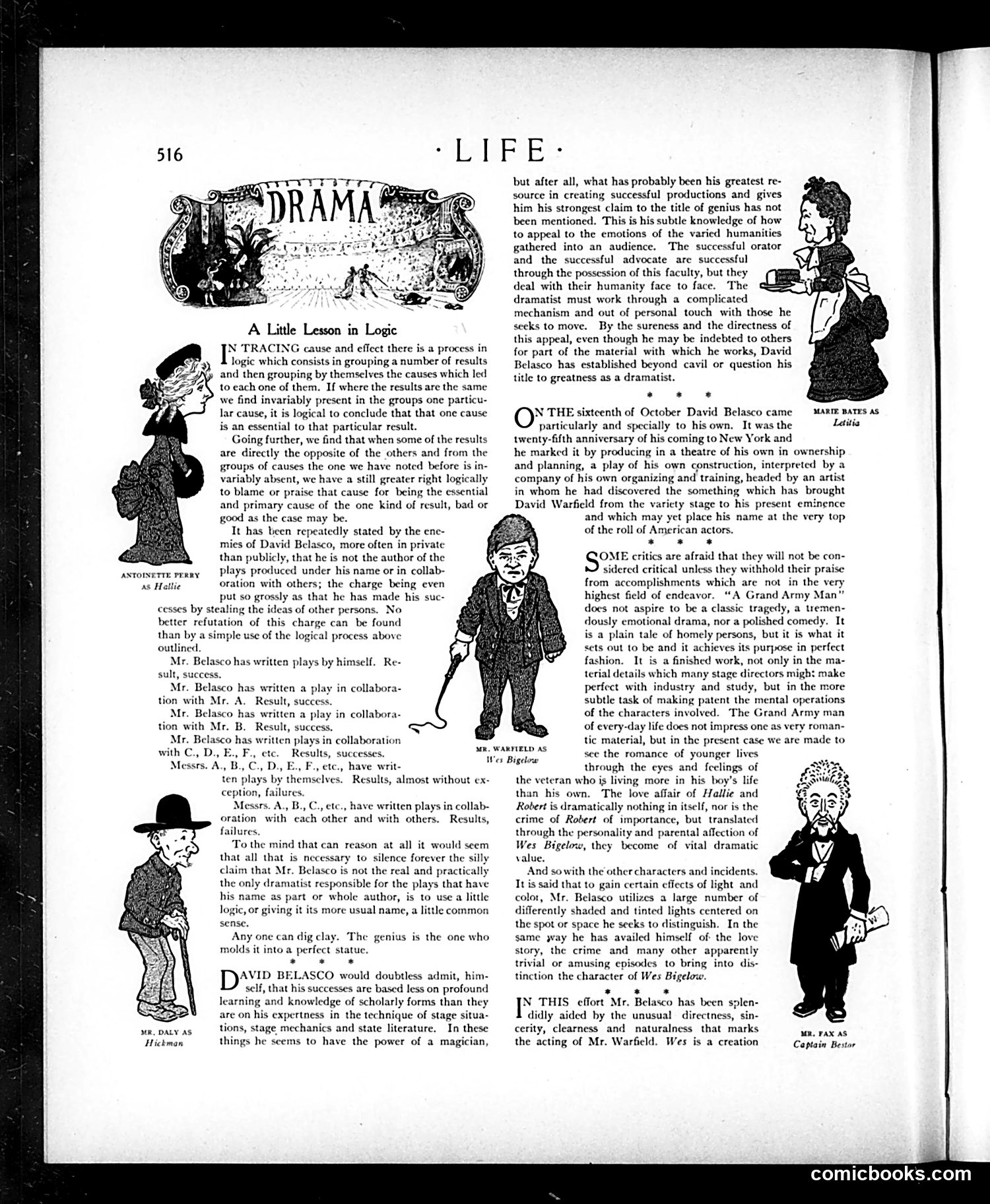
This page celebrates **David Belasco**, a prominent theatrical producer and dramatist. The article defends him against accusations that he steals others' work, using a satirical "logic lesson" format. ## The Satire: The opening section titled "A Little Lesson in Logic" mockingly demonstrates through formal logical reasoning that Belasco's consistent success—whether working alone or in collaboration—proves he is the essential creative force, not a plagiarist. The cartoons show caricatured figures (labeled as theatrical types like "Hallie" and "Belasco") illustrating this logical progression humorously. ## The Context: The piece marks Belasco's 25th anniversary in New York theater. It acknowledges contemporary criticism that Belasco merely repackages others' material, then rebuts this by showing his track record produces success regardless of collaboration structure. ## For Modern Readers: This defends a powerful theater figure against reputation-damaging claims—essentially early-20th-century accusations of creative theft. The "logic" format is tongue-in-cheek, suggesting critics were being unfair or envious of his success.
📄 Transcribed text from this page (OCR, searchable)
Machine-transcribed from the original scan — historical spelling and the odd misread are preserved.
aE eee but after all, what has probably been his greatest re- source in creating successful productions and gives him his strongest claim to the title of genius has not been mentioned. This is his subtle knowledge of how to appeal to the emotions of the varied humanities gathered into an audience. The successful orator and the successful advocate are successful through the possession of this faculty, but they deal with their humanity face to face. The dramatist must work through a complicated mechanism and out of personal touch with those he A Little Lesson in Logic seeks to move. By the sureness and the directness of fae < . this appeal, even though he may be indebted to others IK TRACING cause and effect there is a process in for part of the material with which he works, David logic which consists in grouping a number of results Belasco has established beyond cavil or question his and then grouping by themselves the causes which led title to greatness as a dramatist. to each one of them. If where the results are the same we find invariably present in the groups one particu lar cause, it is logical to conclude that that one cause THE sixtcenth of October David Belasco came MARIE BATYS AS is an essential to that particular result. particularly and specially to his own, It was the Latitia Going further, we find that when some of the results _ twenty-fifth anniversary of his coming to New York and are directly the opposite of the others and from the he marked it by producing in a theatre of his own in ownership groups of causes the one we have noted before is in- and planning, a play of his own construction, interpreted by a variably absent, we have a still greater right logically company of his own organizing and training, headed by an artist to blame or praise that cause for being the essential in whom he had discovered the something which has brought and primary cause of the one kind of result, bad or David Warficld from the variety stage to his present eminence good as the case may be. and which may yet place his name at the very top It has been repeatedly stated by the ene- oe of the roll of American actors. mies of David Belasco, more often in private . 2 * than publicly, that he is not the author of the OME critics are afraid that they will not be con- asroierte rreny Plays produced under his name or in collab- sidered critical unless they withhold their praise as Hallie oration with others; the charge being even > from accomplishments which are not in the very put so grossly as that he has made his suc- f highest field of endeavor. “A Grand Army Man cesses by stealing the ideas of other persons. No Ey does not aspire to be a classic tragedy, a tremen- better refutation of this charge can be found Batey dously emotional drama, nor a polished comedy. It than by a simple use of the logical process above f is a plain tale of homely persons, but it is what it outlined. sets out to be and it achieves its purpose in perfect Mr. Belasco has written plays by himself. Re- ae fashion. It is a finished work, not only in the ma- sult, success. t terial details which many stage directors might make Mr. Belasco has written a play in collabora- perfect with industry and study, but in the more tion with Mr. A. Result, success. f subtle task of making patent the mental operations Mr. Belasco has written a play in collabora- i of the characters involved. The Grand Army man tion with Mr. B, Result, success. . of every-day life does not impress one as very roman- Mr. Belasco has written plays in collaboration tic material, but in the present case we are made to with C., D., E., F., etc. Results, successe: baie earns see the romance of younger lives Messrs. A., B., C., D., E., F., ete., have writ- Mes Biatee through the eyes and feelings of ten plays by themselves. Results, almost without ex- the veteran who js living more in his boy’s life ception, failures. than his own. The love affair of Hallie and Messrs. A., B., C., ete., have written plays in collab- Robert is dramatically nothing in itself, nor is the oration with cach other and with others. Results, crime of Robert of importance, but translated failures. through the personality and parental affection of To the mind that can reason at all it would seem Wes Bigelow, they become of vital dramatic that all that is necessary to silence forever the silly value. claim that Mr. Belasco is not the real and practical And sowith the other characters and incidents. the only dramatist responsible for the plays thathave _It is said that to gain certain effects of light and his name as part or whole author, is to use alittle color, Mr. Belasco utilizes a large number of logic, or giving it its more usual name, alittle common _ differently shaded and tinted lights centered on sense. the spot or space he seeks to distinguish. In the Any one can dig clay. The genius is the one who same way he has availed himself of the love molds it into a perfect statue. story, the crime and many other apparently * * 6 trivial or amusing episodes to bring into dis- AVID BELASCO would doubtless admit, him- tinction the character of Wes Bigelow. self, that his successes are based less on profound + e « learning and knowledge of scholarly forms than the I THIS effort Mr. Belasco has been splen- are on his expertness in the technique of stage situa- didly aided by the unusual directness, sin- su. patyas tions, stage mechanics and state literature. In these cerity, clearness and naturalness that marks ety Hickman things he seems to have the power of a magician, the acting of Mr. Warfield. Wes is a creation Captain Bestor * 8 8 comicbooks.com