
A complete issue · 24 pages · 1907
Life — September 26, 1907
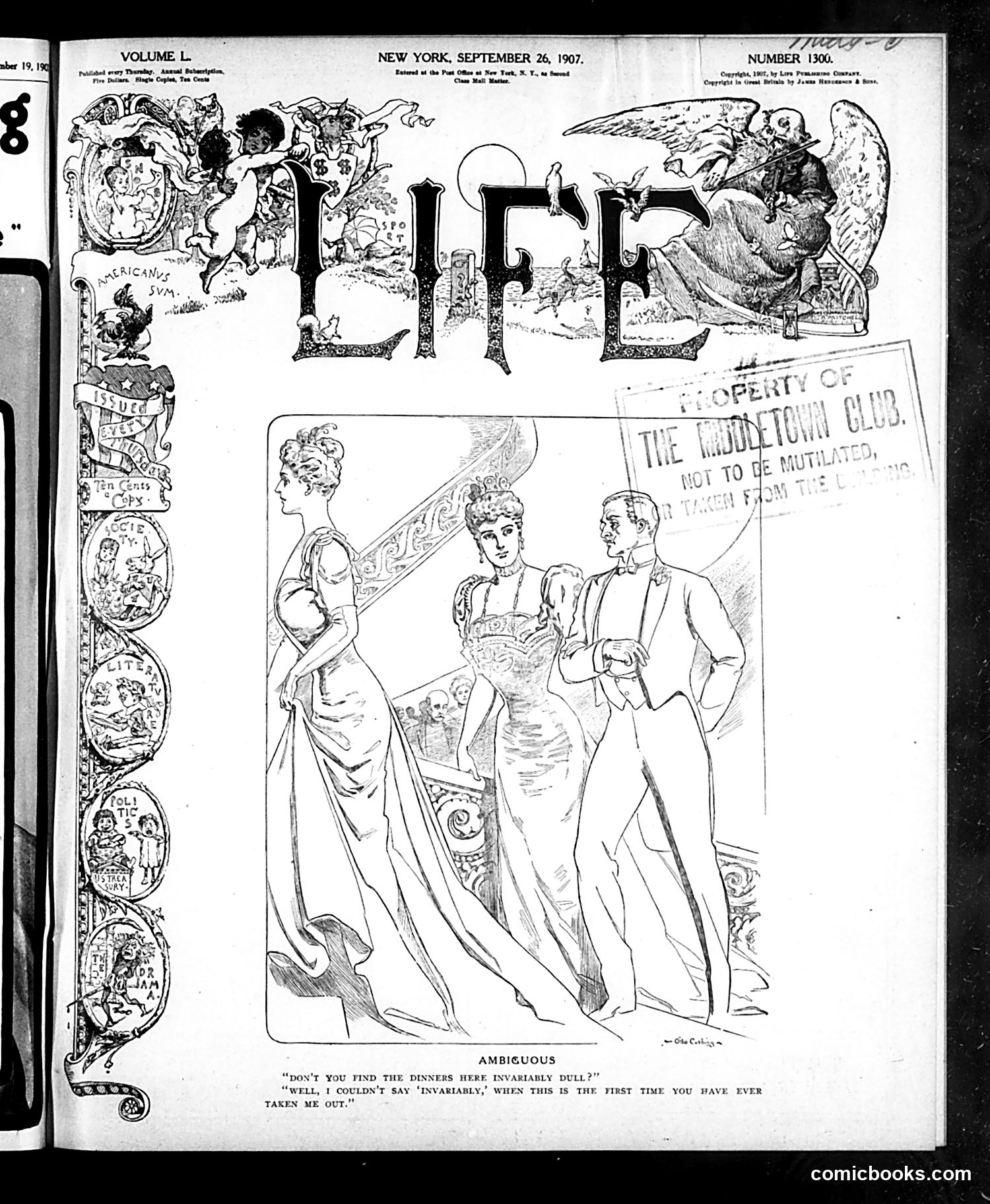
The main cartoon, titled "Ambiguous," depicts a social situation with satirical commentary on courtship and marriage customs. Two men escort a woman, and the caption reveals the humor: when asked if he finds "the dinners here invariably dull," one man responds that he "couldn't say 'invariably' when this is the first time you have taken me out." The joke plays on the ambiguity of the woman's marital status—it's unclear whether she's being courted by one man or both, and whether this outing represents a pattern or a singular event. This reflects early 1900s anxieties about changing social dynamics between men and women, courtship protocols, and evolving gender relations during the Progressive Era.
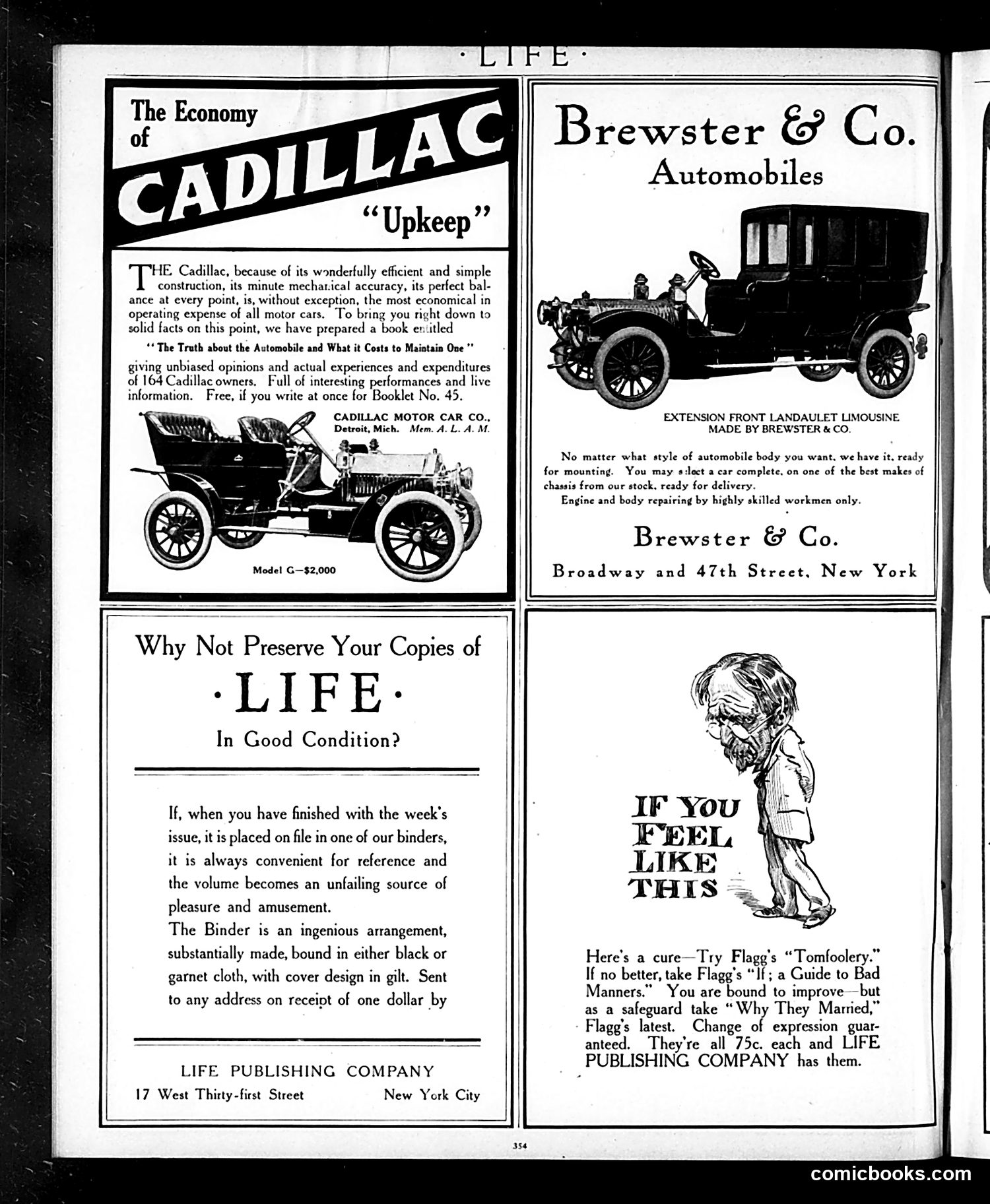
This is primarily **advertising content** from an early 1900s *Life* magazine, not satirical editorial material. The page contains three advertisements: 1. **Cadillac automobiles** — promoting the Model G at $2,000, emphasizing economical operation and offering a free booklet about automobile maintenance costs. 2. **Brewster & Co. automobiles** — advertising custom automobile bodies and chassis, located on Broadway and 47th Street, New York. 3. **Life Publishing Company** — promoting magazine binders for preservation and Flagg's humor books ("Tomfoolery," "A Guide to Bad Manners," "Why They Married"), each priced at 75 cents. The small cartoon of a sad man ("IF YOU FEEL LIKE THIS") is simply a visual hook to advertise Flagg's humorous books as a cure for melancholy. There is no political satire on this page.
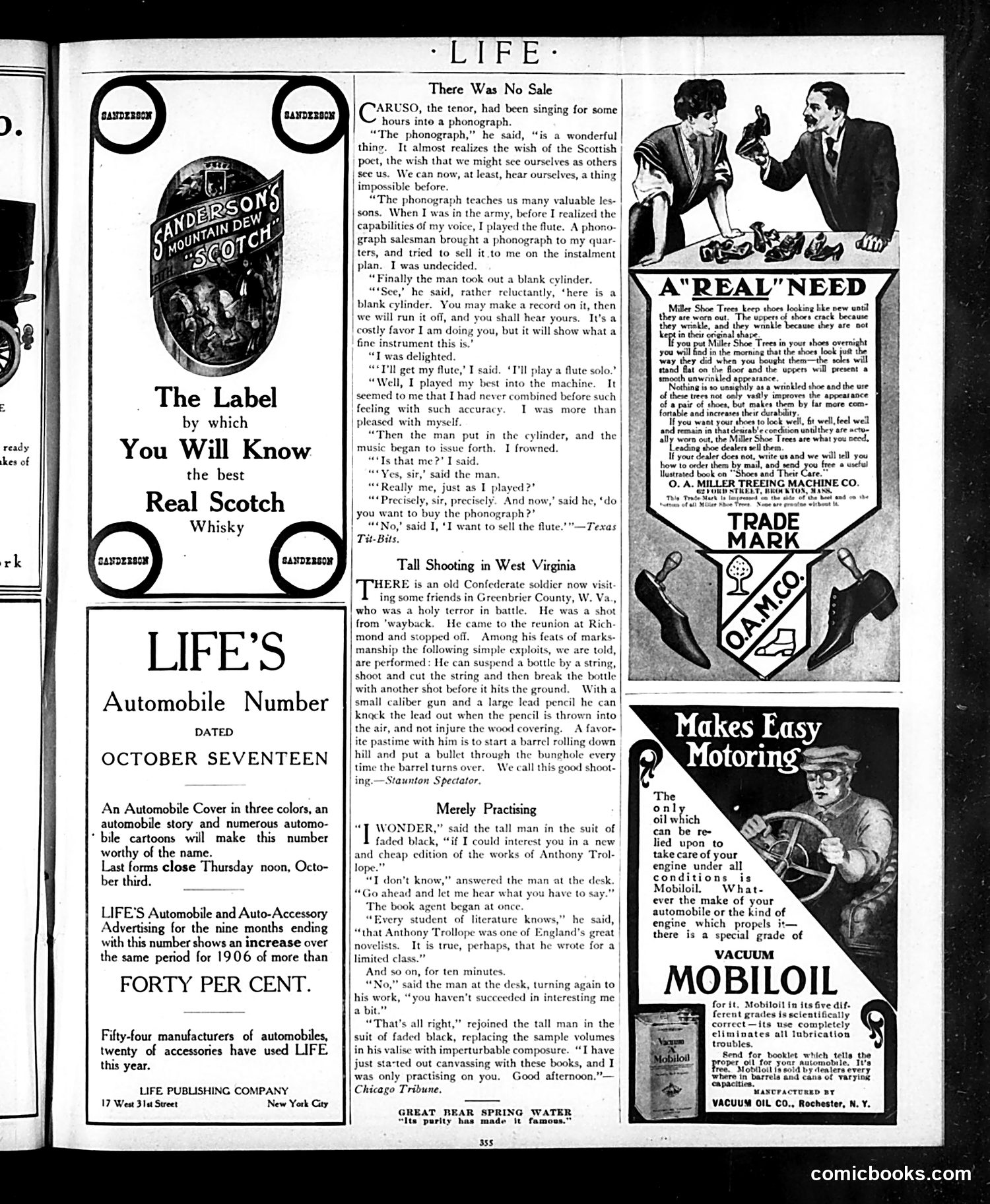
This page is primarily **advertising and light editorial content** rather than political satire. The main elements include: 1. **Sanderson's Scotch Whisky advertisement** - promoting "Real Scotch Whisky" with the brand's label prominently displayed 2. **"There Was No Sale"** - a humorous anecdote about a tenor trying to sell a phonograph recording of himself playing flute, highlighting the awkwardness of self-promotion 3. **"Tall Shooting in West Virginia"** - a brief story about a Confederate soldier's marksmanship feats, presented as amusing tall tale 4. **Multiple product advertisements** - for automobiles, Mobiloil motor oil, and Miller Shoe Trees The page reflects early 20th-century Life magazine's mix of light humor, automobile industry advertising (reflecting 1906-1907 prosperity), and consumer product promotion targeting middle-class readers.
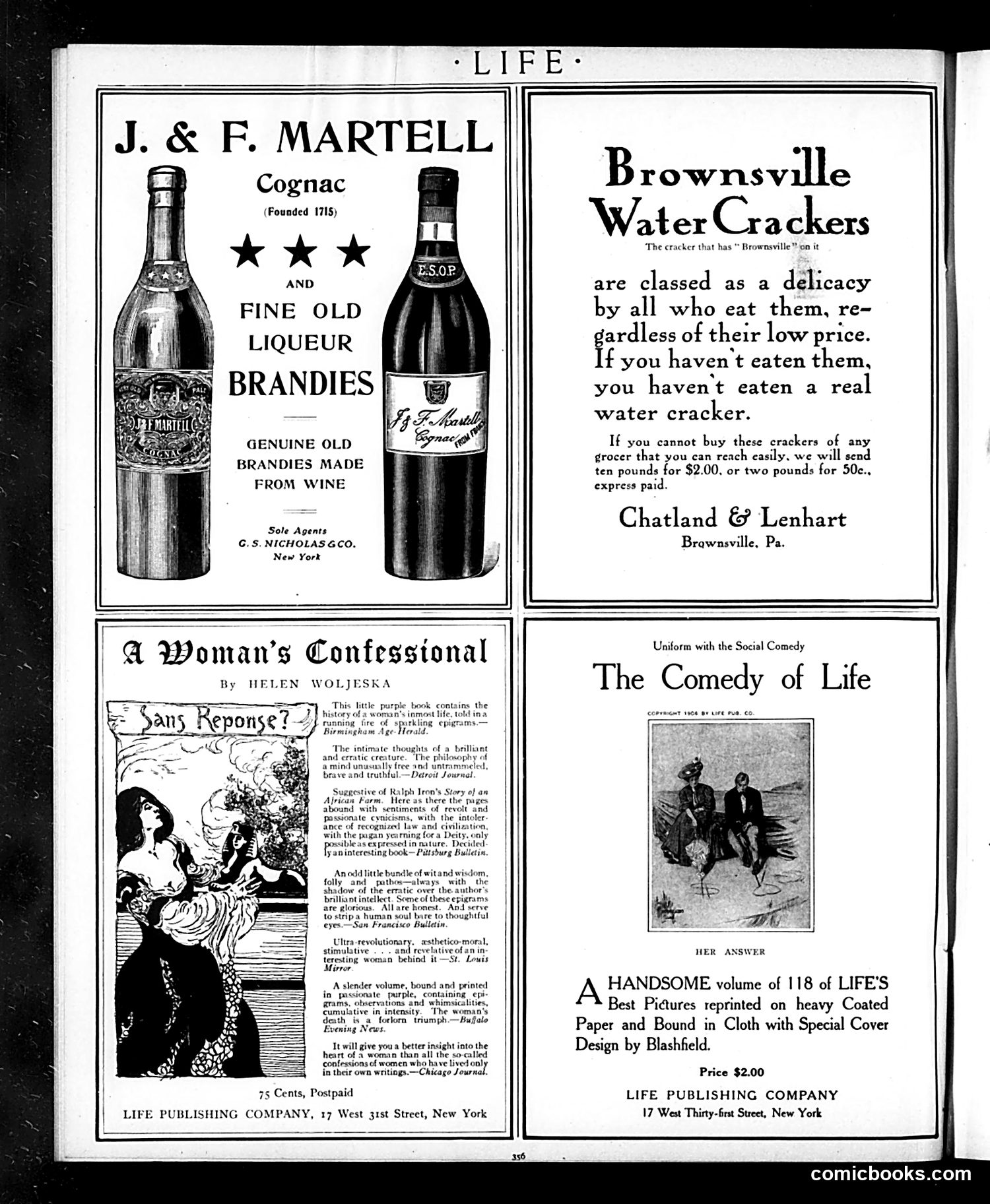
This page is primarily **advertising**, not satirical content. It contains four advertisements: 1. **J. & F. Martell Cognac** — promoting French brandy, founded 1715, sold by G.S. Nicholas & Co. in New York 2. **Brownsville Water Crackers** — a snack food from Chatland & Lenhart in Brownsville, Pennsylvania, marketed as an affordable delicacy with mail-order availability 3. **"A Woman's Confessional" by Helen Woljeska** — a book advertisement describing it as containing intimate thoughts and philosophy, priced at 75 cents 4. **"The Comedy of Life"** — a collection of 118 Life magazine pictures reprinted in a bound volume, priced at $2.00 There is no political satire or social commentary evident on this page. It reflects early 20th-century consumer culture and publishing.
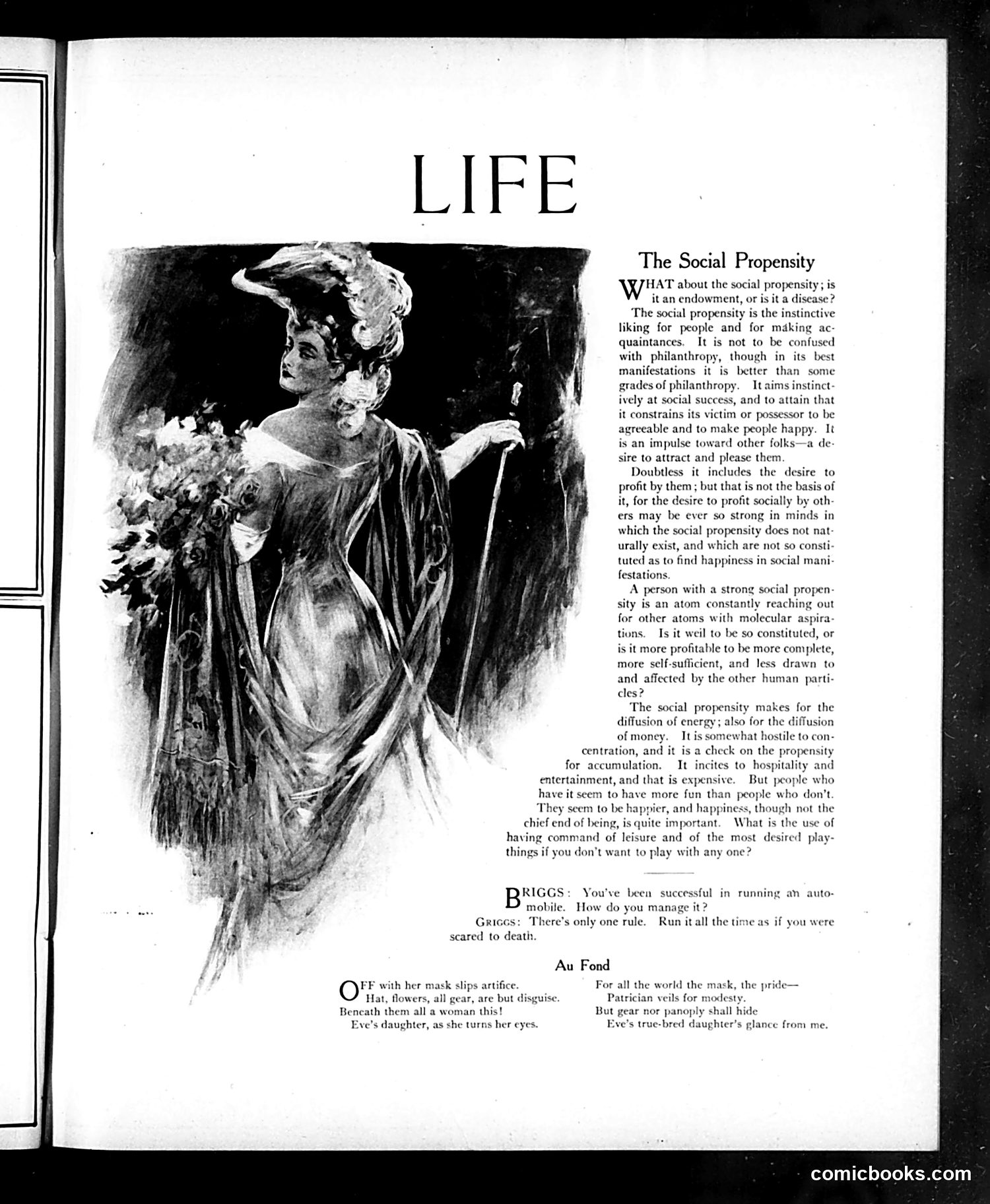
This page presents an essay titled "The Social Propensity" discussing whether sociability is a virtue or flaw. The accompanying illustration shows an elegantly dressed woman in classical drapery, embodying the personification of social grace or society itself. Below appears a brief poem titled "Au Fond" (At Bottom), playing on the contrast between outward appearance and inner truth—specifically, how masks and formal dress conceal a woman's authentic self beneath aristocratic pretense. The satirical angle targets upper-class society's superficiality: the essay questions whether constant socializing and hospitality truly serve human happiness, while the poem ironically suggests that refined Patrician "modesty" masks rather than reveals genuine character. It's social commentary on performative respectability.
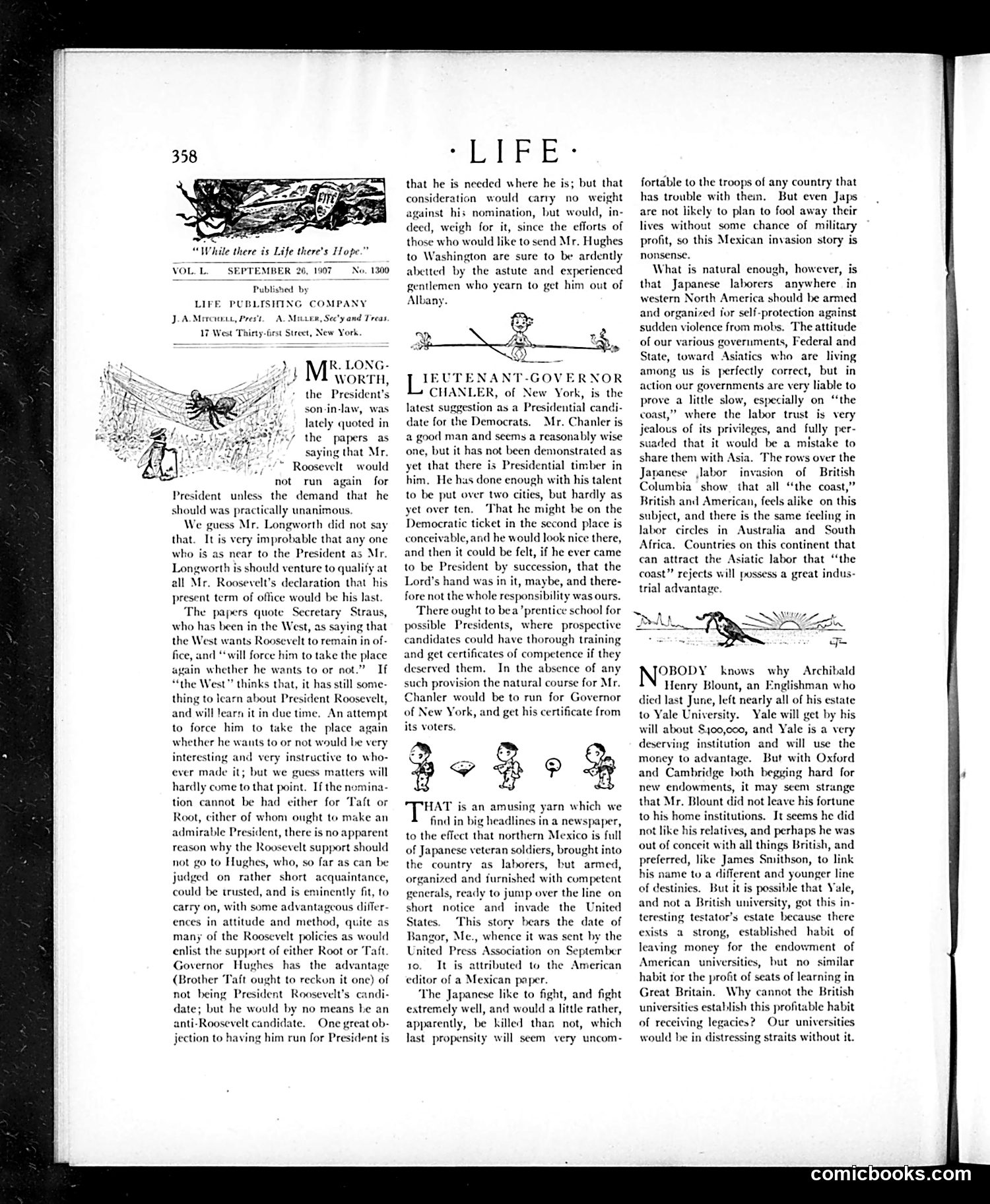
This page contains two main political commentaries from the early 1900s: **Left cartoon**: Depicts "Mr. Longworth" (likely Nicholas Longworth, Ohio congressman) being proposed as a potential Democratic Presidential candidate. The text mocks the idea as impractical—arguing he lacks sufficient experience for the presidency, having managed only "two cities" rather than a full state. **Right section**: Discusses Japanese laborers in western North America, expressing concern about their organization and potential military value. The commentary reveals period anxieties about Japanese immigration and Asian labor competition, while criticizing American governments for slow response to these concerns. Both pieces reflect turn-of-the-century American political debates: domestic succession politics and escalating tensions over Asian immigration.
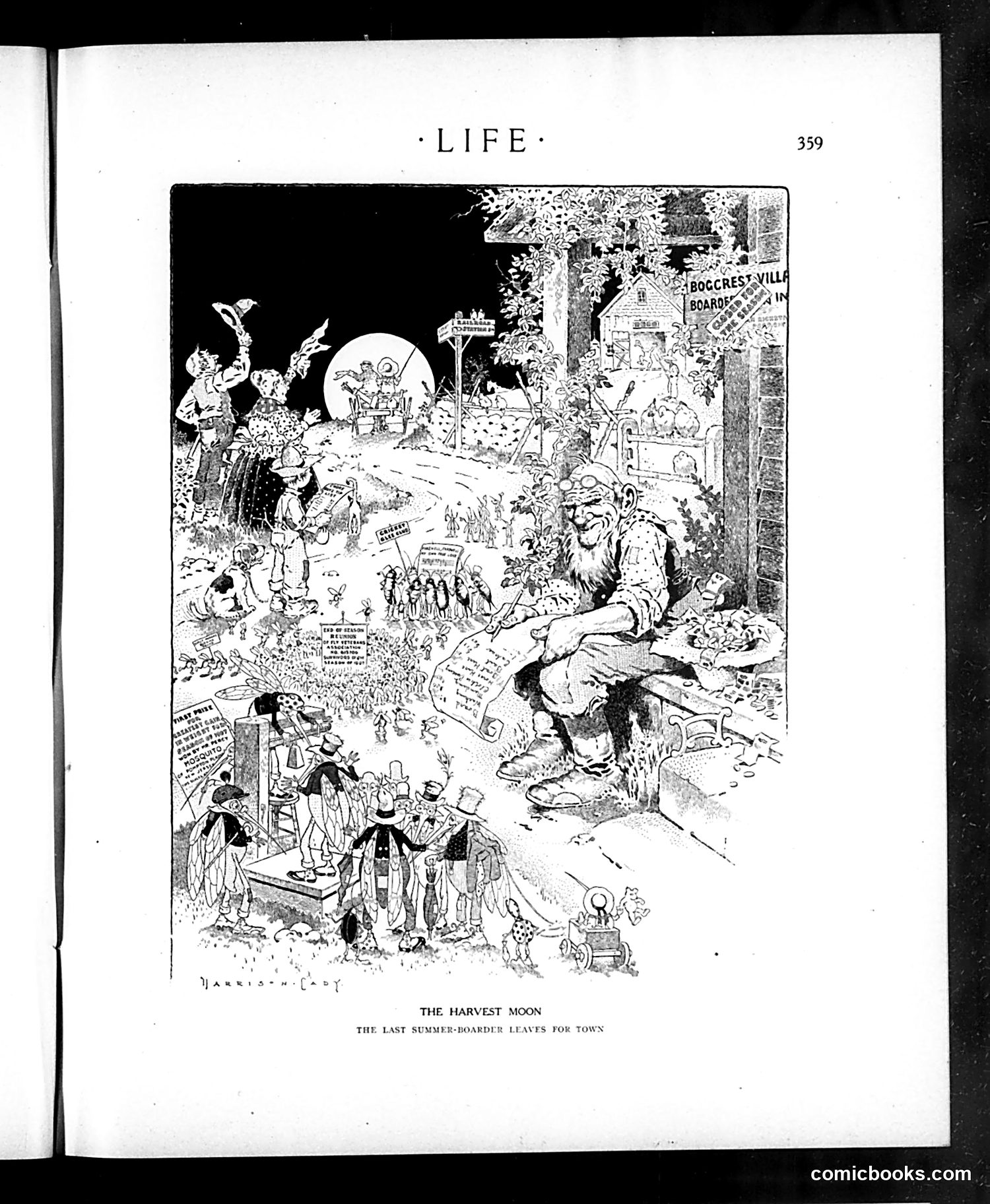
This satirical illustration depicts the end of summer tourist season at what appears to be a seaside or resort boarding house (visible signage reads "Rocccest Villa" and "Boarders"). The cartoon mocks the departure of summer boarders returning to the city. A portly, disheveled figure dominates the right side—likely representing either an exhausted landlord or a departing boarder. The scene shows chaotic activity: various guests, luggage, carriages, and general disorder suggesting the commotion of seasonal transitions. The satire targets either the relief of locals at tourists' departure or the chaos caused by transient summer visitors. The "harvest moon" title suggests autumn's arrival ending the profitable but disruptive summer season. The crowded, anarchic composition emphasizes the mayhem of seasonal travel.
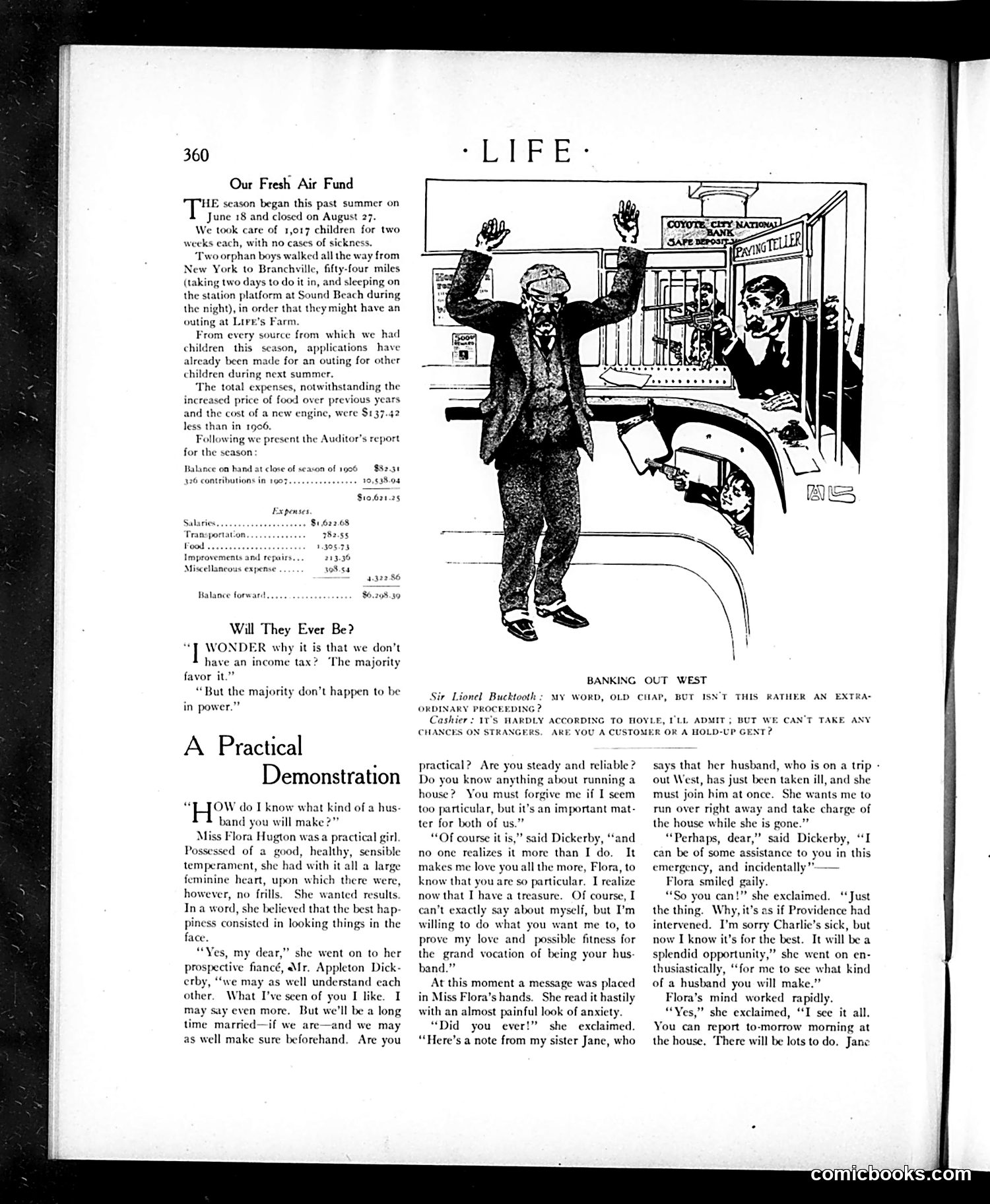
**The Main Cartoon ("Banking Out West"):** The illustration depicts a bank robbery scenario. A bandit with raised hands confronts a banker, with the caption asking whether this is "rather an extraordinary proceeding" and whether the banker is a customer or "hold-up gent." The satire suggests confusion about who is actually robbing whom—implying that banks themselves engage in predatory financial practices comparable to robbery. This reflects early 20th-century populist skepticism toward banking institutions during economically unstable times. **Context:** The page also contains the "Our Fresh Air Fund" section documenting charitable work with urban children, and "A Practical Demonstration," a domestic fiction piece. The banking cartoon's dark humor satirizes public distrust of financial institutions of the era.
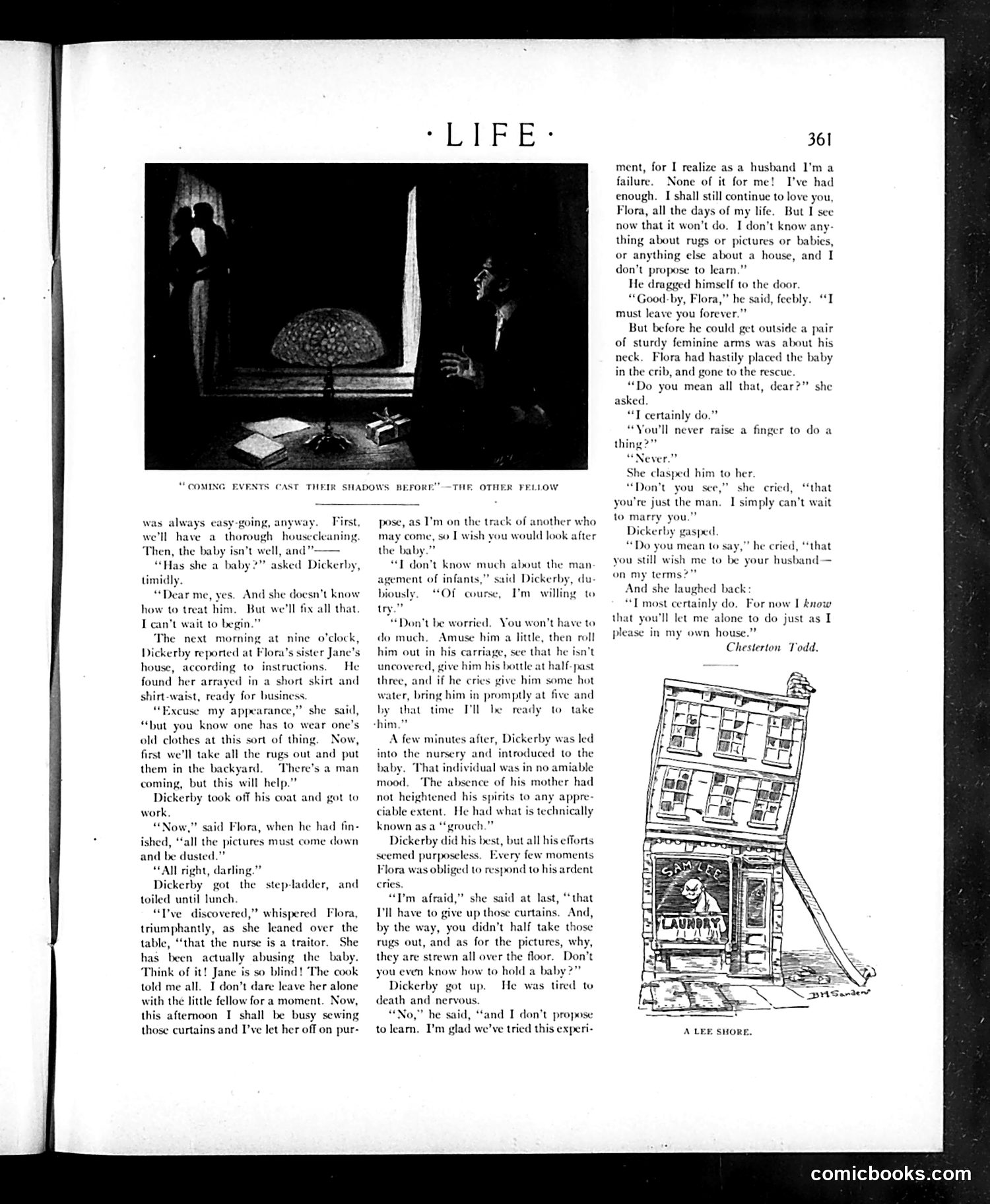
This page contains a short story titled "Coming Events Cast Their Shadows Before" (referencing the famous phrase about omens). The narrative concerns a husband named Dickerly and his wife Flora navigating early parenthood and domestic tensions. The small illustration labeled "A Lee Shore" (bottom right) depicts a tenement building or apartment block, likely illustrating working-class urban housing—a common subject for social commentary in early 20th-century satire. The story itself satirizes domestic anxieties about childrearing, housekeeping competence, and marital strain among middle-class families. The humor derives from Dickerly's incompetence with infant care and Flora's exasperation with traditional gender roles and household management expectations—social tensions reflecting contemporary debates about marriage and domestic labor.
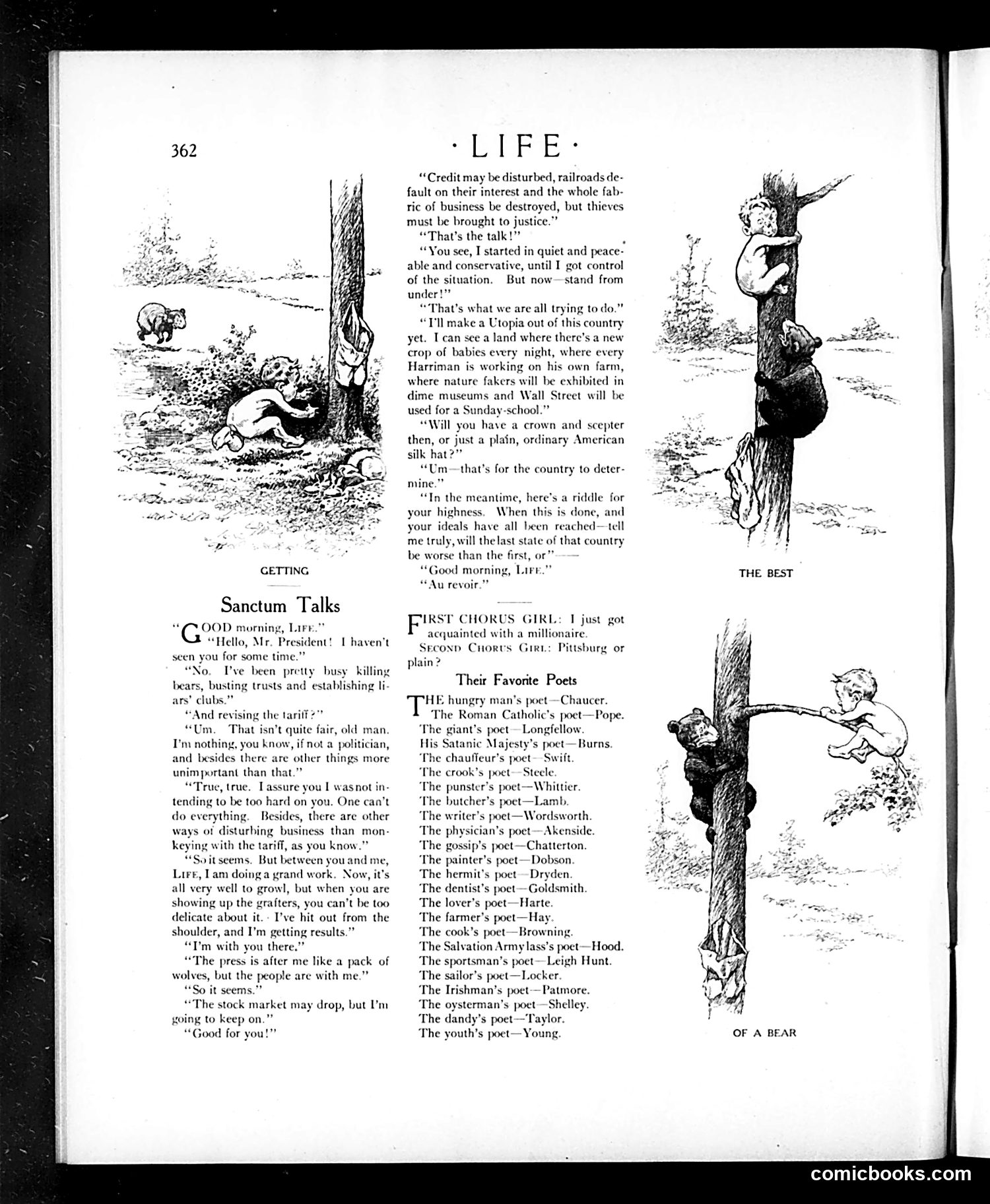
This page contains a satirical dialogue titled "Sanctum Talks" between "Life" (the magazine personified) and "Mr. President" (likely a sitting U.S. President, though unspecified in visible text). The conversation addresses **tariff policy** — a major political/economic issue of the era. The President defends protective tariffs as necessary for business, while Life argues they harm ordinary citizens and favor wealthy industrialists ("the gratters"). The illustrations show cherubs climbing trees, labeled "The Best" and "Of a Bear," likely representing innocent American ideals being corrupted by political maneuvering. The page also lists "Their Favorite Poets" — matching professions with classical poets (e.g., "The farmer's poet—Hay"), a humorous wordplay feature. **Context**: This reflects early 20th-century American debates over tariff protectionism versus free trade.
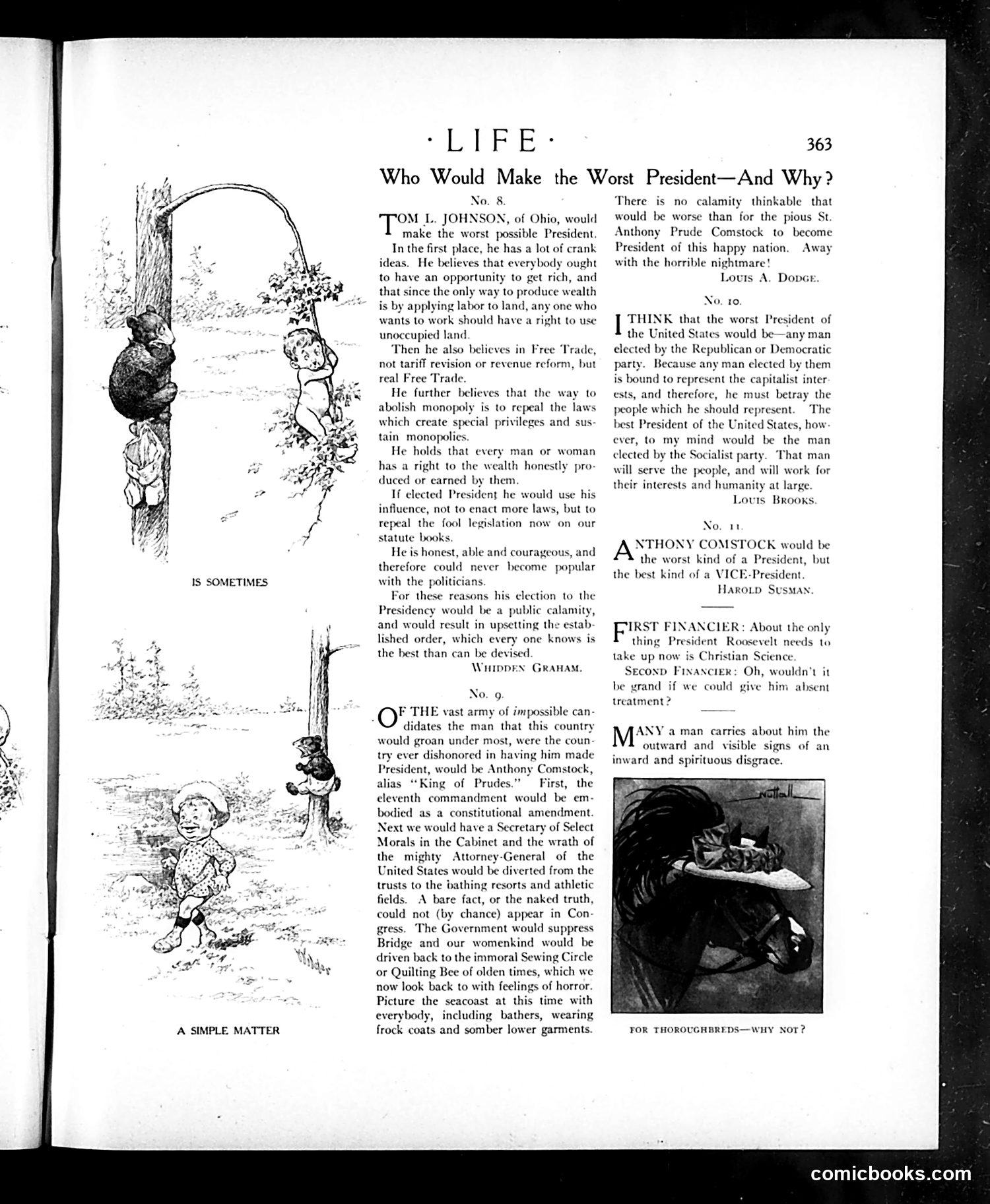
This page satirizes who would make the worst U.S. President. The main target is **Anthony Comstock**, a real historical figure known for moral censorship campaigns. Multiple commentators argue Comstock would be catastrophic as president—not because of incompetence, but because his rigid moral crusade would impose puritanical restrictions on American life. One writer warns he'd suppress "Bridge" (a card game), force women into "Sewing Circles," and ban "seacoast" bathing in revealing clothes. The cartoons (labeled "Sometimes a Simple Matter" and "For Thoroughbreds—Why Not?") appear to be visual jokes accompanying this anti-Comstock commentary, though their exact meaning requires clearer resolution. The satire warns that even a morally serious man would be dangerous as president.
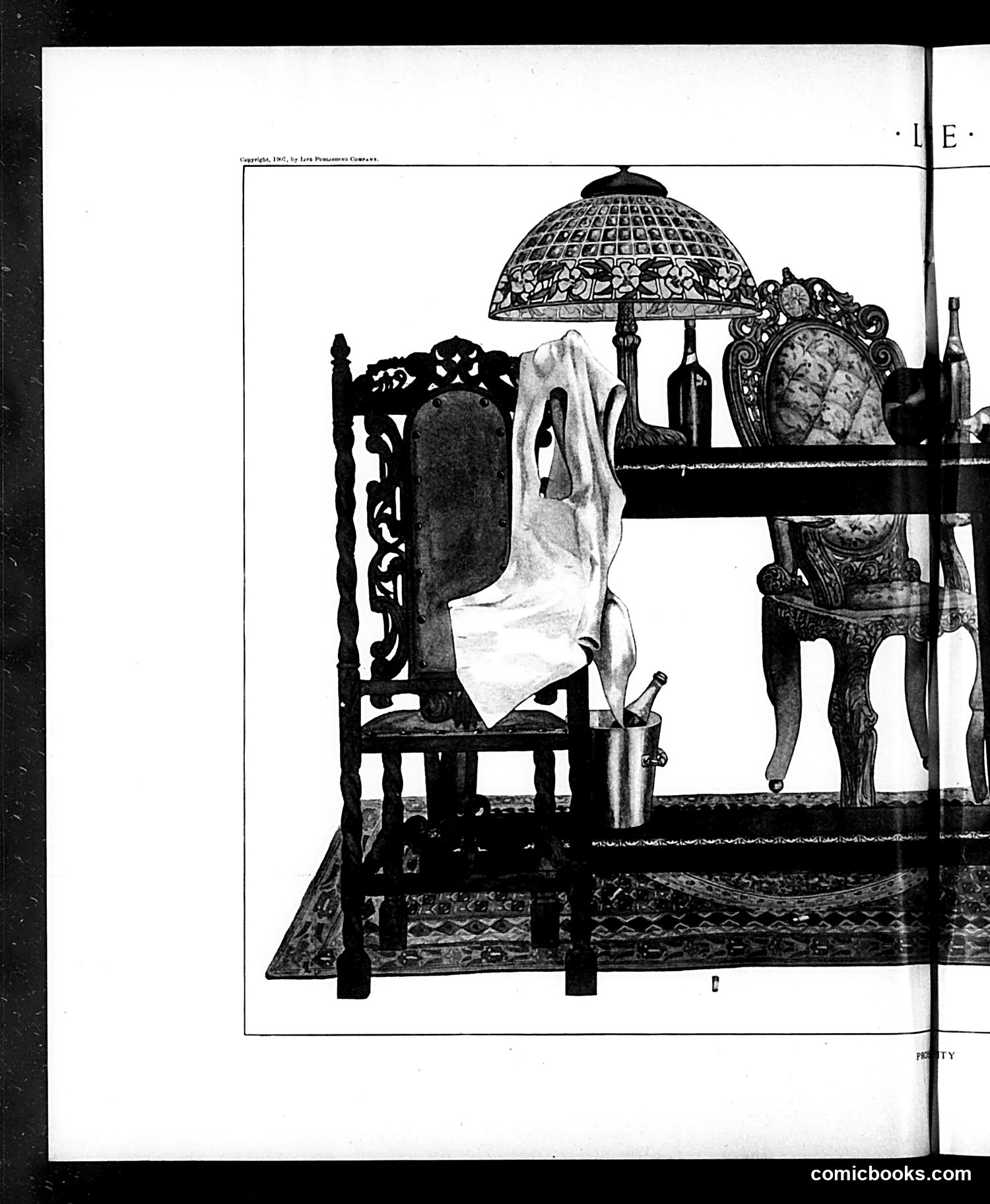
This is a black and white illustration showing a figure seated in an ornate chair, partially draped in white fabric, positioned at a vanity or dresser. The scene includes decorative period furnishings: an elaborate Tiffany-style lamp, wine bottles, ornamental mirror, and patterned rug. The image appears to be satirical commentary on vanity and indulgence, likely targeting a specific social figure or type—possibly someone of wealth or status engaged in excessive self-regard or leisure. The theatrical staging, luxurious props, and dramatic draping suggest mockery of pretension or decadence. Without clearer text or identifying details visible in the OCR, the specific subject of the satire remains unclear. The style and production quality suggest this is from Life magazine's early-to-mid 20th century period, when it specialized in social and political satire.
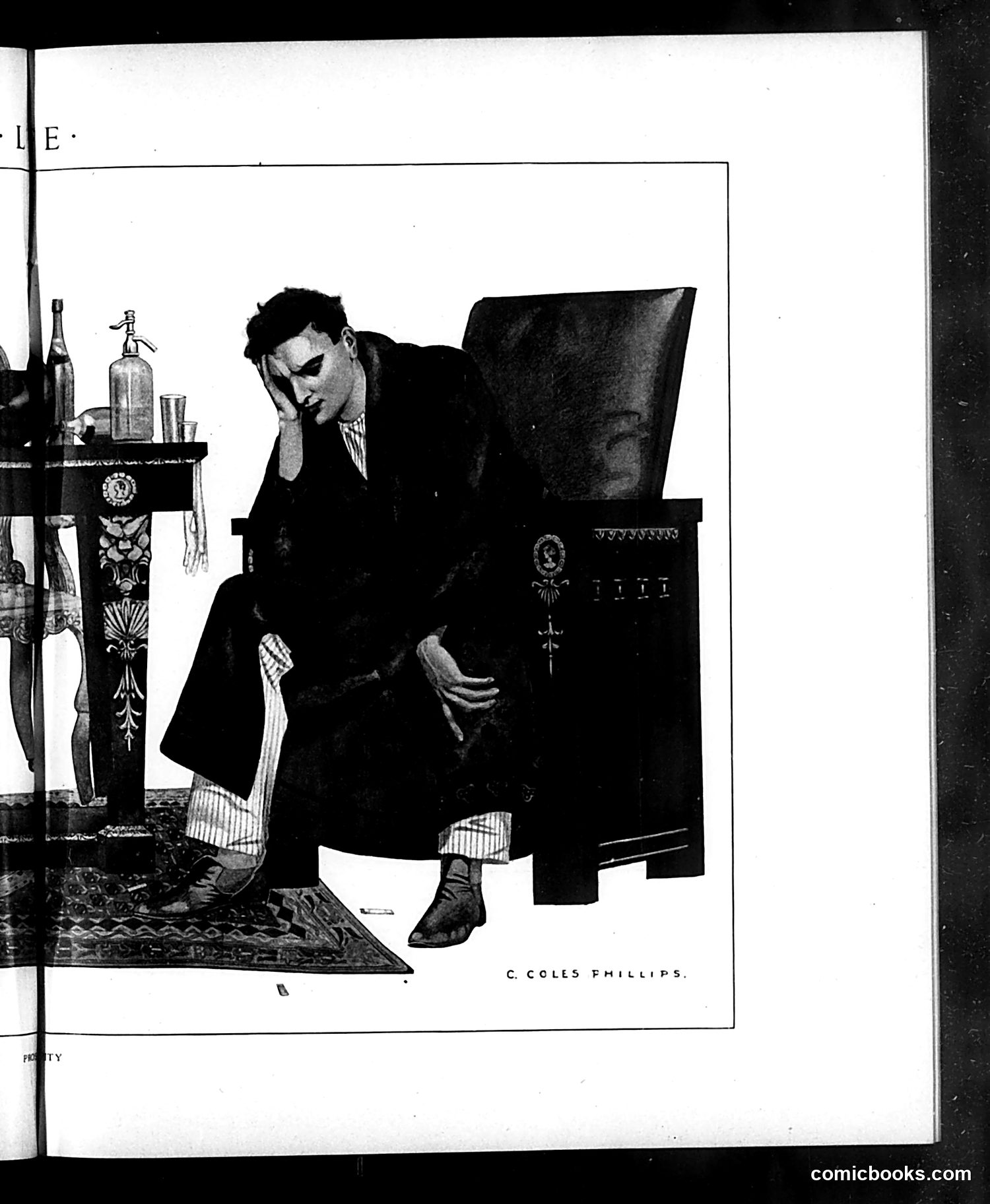
This is a black and white illustration credited to **C. Coles Phillips**, a prominent Life magazine artist of the early 20th century. The image shows a well-dressed man in formal attire (suit and striped shirt) seated at an ornate desk or table, leaning forward with his hand to his face in a posture suggesting contemplation, worry, or distress. The desk features decorative elements including what appear to be bottles and glasses on the left side. The satire appears to target a businessman or professional dealing with some form of anxiety or concern—possibly related to finances, business decisions, or personal matters. Without additional visible text on the page identifying the specific figure or event being satirized, the precise subject cannot be determined. The composition emphasizes the man's troubled mental state through his posture and expression.
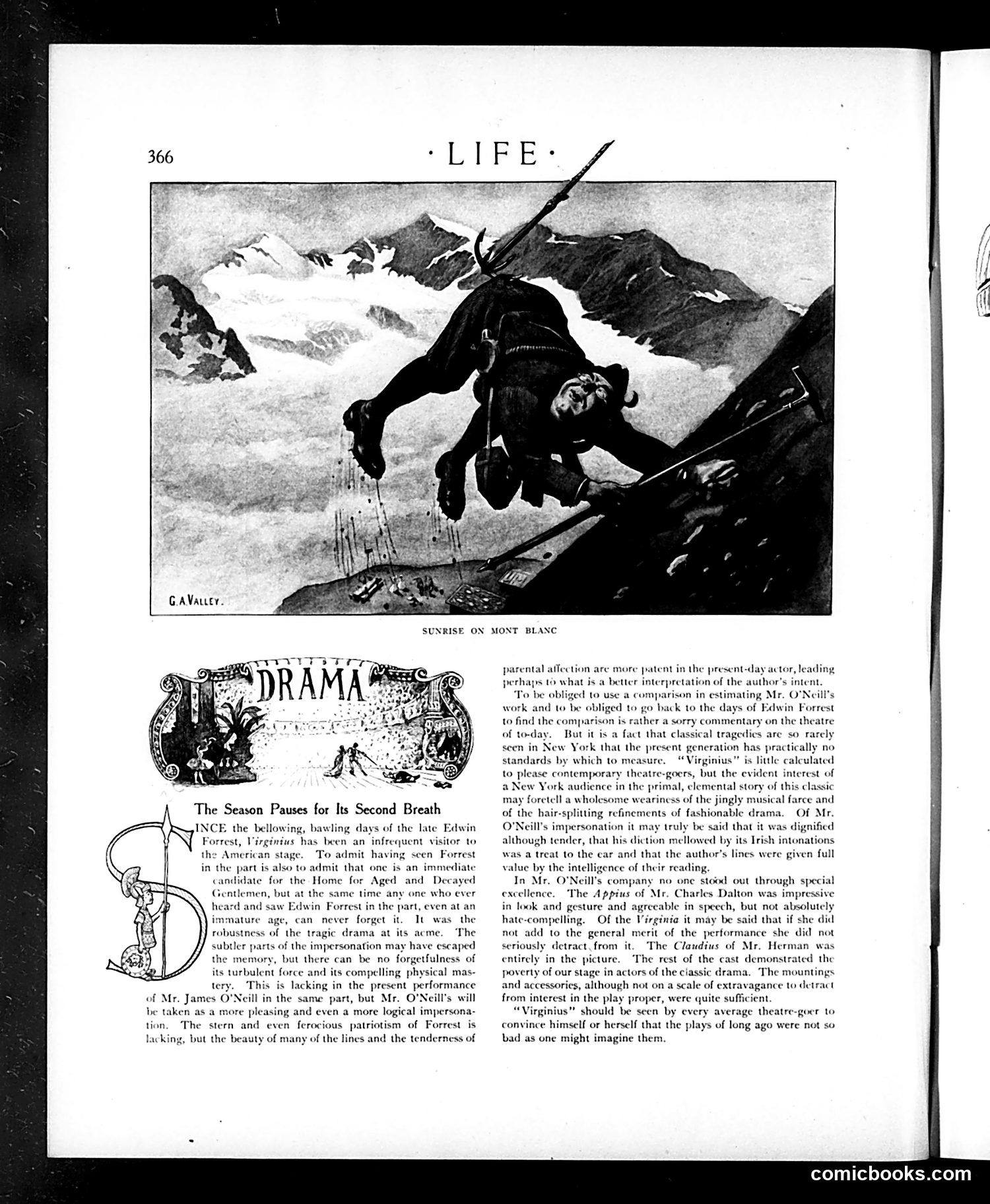
This page reviews a theatrical production of *Virginius*, a classical tragedy, starring James O'Neill. The photo shows a mountaineer on Mont Blanc—unrelated to the drama section below. The critic compares O'Neill's performance unfavorably to the legendary Edwin Forrest, who played the role decades earlier. Forrest embodied "robust" tragic drama with "turbulent force," while O'Neill offers a more tender, refined interpretation emphasizing beauty and paternal affection over fierce patriotism. The review laments that modern New York audiences lack standards for evaluating classical drama—classical plays are rarely staged anymore. Yet O'Neill's dignified, Irish-accented performance of this ancient Roman story about a father and daughter suggests audiences retain appetite for "primal, elemental" drama beneath contemporary "jingly musical farce." The critic recommends the production to modern theatergoers to prove classical drama isn't inherently inferior to contemporary entertainment.
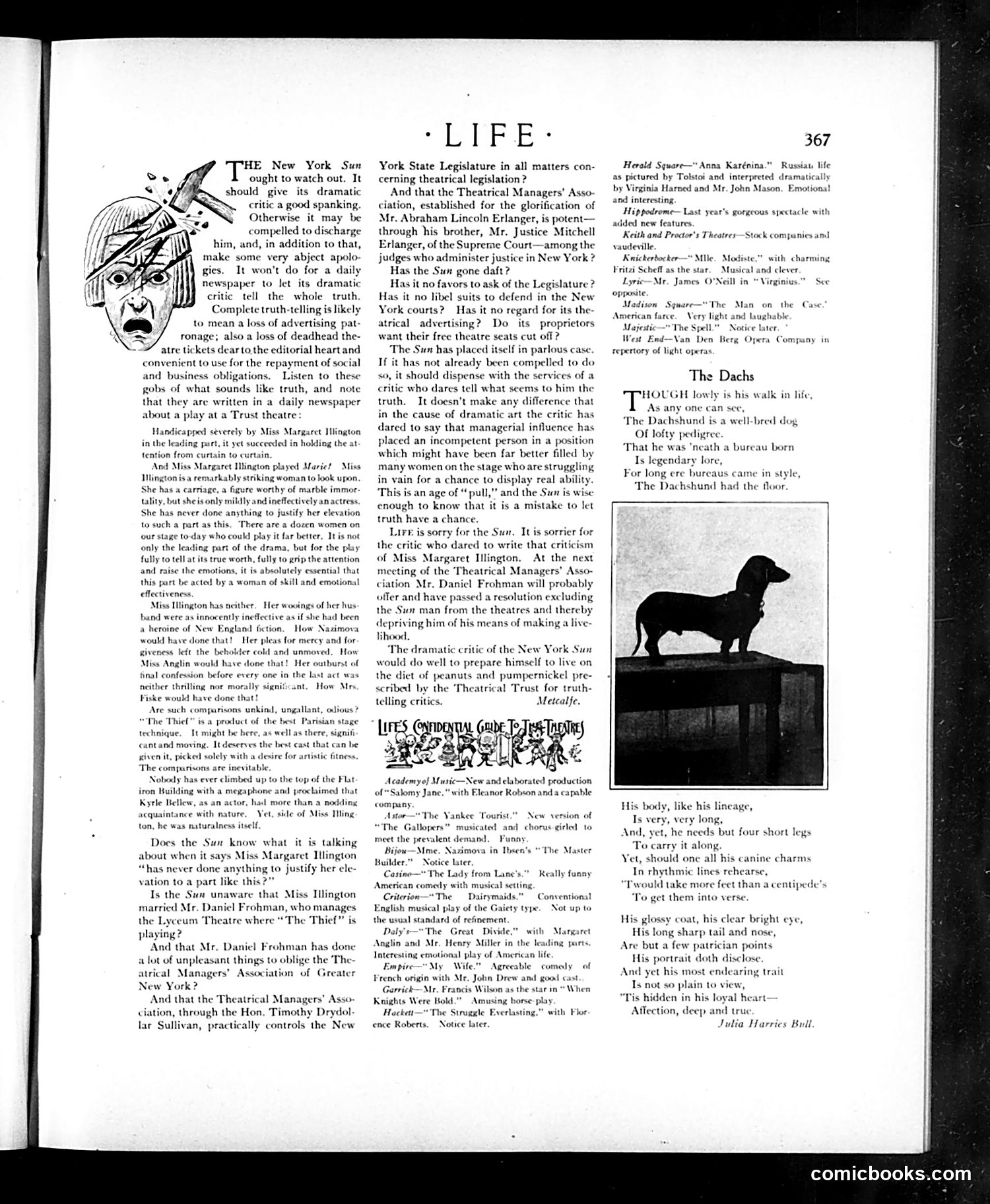
This satirical piece attacks corruption in New York's theater industry and press freedom. The author mocks the *New York Sun* for publishing a theater critic's honest review of actress Margaret Illington in "The Thief"—a play at a Trust theatre (monopoly-controlled). The satire exposes how the **Theatrical Managers' Association**, led by Abraham Lincoln Erlanger, controls New York through: - Legislative influence via brother Justice Mitchell Erlanger - The critic Margaret Illington's husband, Daniel Frohman, who manages the Lyceum Theatre The piece argues the *Sun* will face pressure to silence its critic through lost advertising revenue, legal threats, and withdrawn free theater tickets—showing how theatrical monopolies coerced newspapers into favorable coverage. The accompanying poem "The Dachs" (about a dachshund) appears unrelated filler content. The cartoon's caricatured face (upper left) likely represents editorial hypocrisy or journalistic compromise.
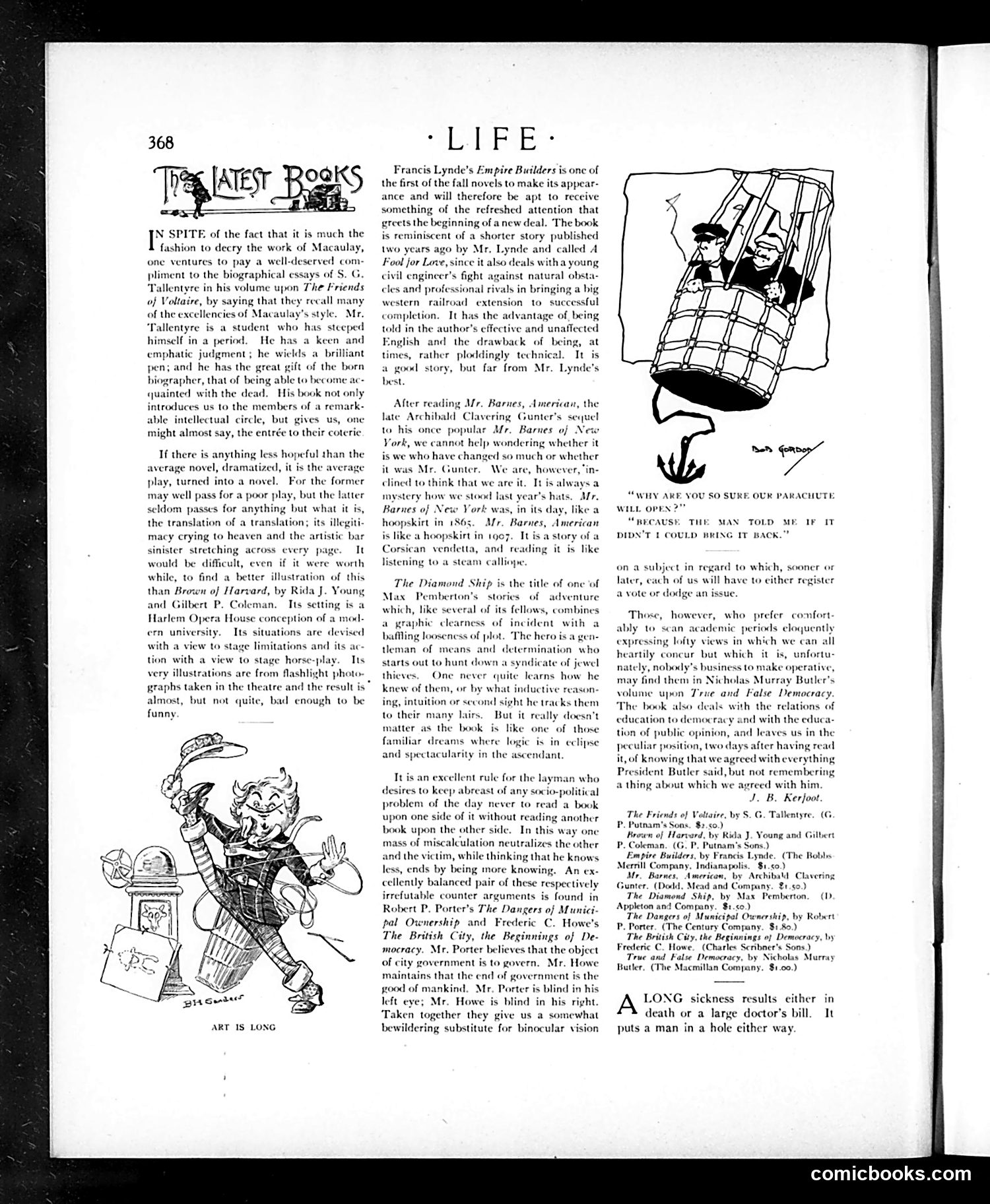
The cartoon depicts a disheveled, corpulent figure struggling with an oversized artist's palette and brushes—likely representing a pretentious or incompetent artist. The caption "ART IS LONG" references the classical aphorism "Ars longa, vita brevis" (art is long, life is short). The satire appears to mock either artistic pretension or the gap between artistic ambition and actual talent. The figure's struggle with unwieldy tools suggests someone burdened by or unsuited to their chosen field. The page's text, reviewing literary works, reinforces this theme—criticizing poorly adapted plays-turned-novels and dated fiction. The overall message seems to be that true art requires more than effort; it demands genuine skill and contemporary relevance. The struggling figure embodies the futility of creative work divorced from talent or timeliness.
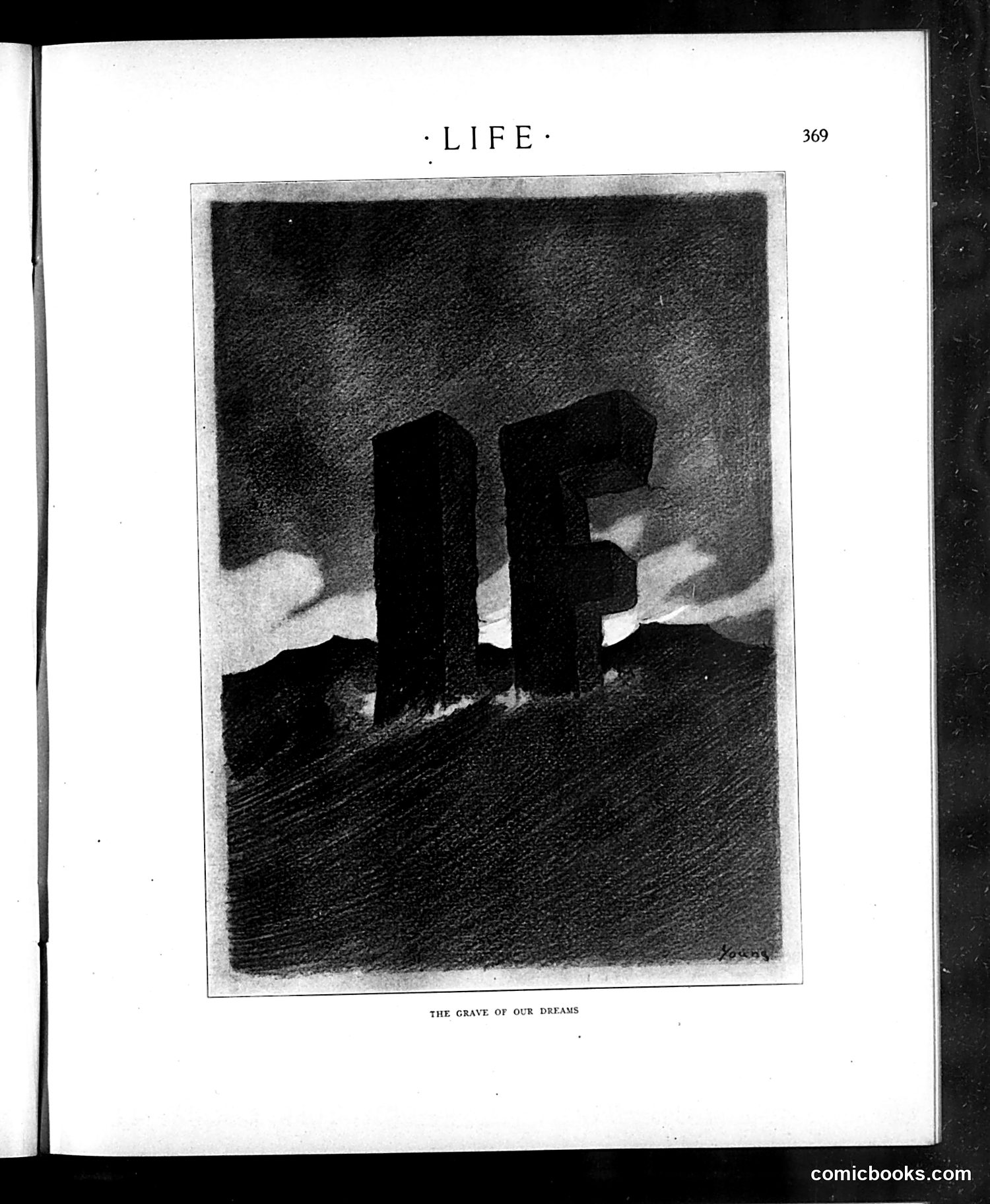
This is a stark, expressionistic illustration showing two tall black crosses or tombstones against a dark, shadowed landscape. The caption beneath reads "THE GRAVE OF OUR DREAMS." The image appears to be satirical commentary on disillusionment or lost hope—likely responding to a specific historical moment. Without additional context from the magazine's date and surrounding articles, the exact reference is unclear. However, the style and symbolism suggest it addresses disappointed expectations or failed aspirations, possibly related to political promises, social movements, or historical events of the period when Life magazine published this work. The double grave imagery emphasizes a collective loss—"our dreams" plural—suggesting widespread cultural disappointment rather than individual tragedy.
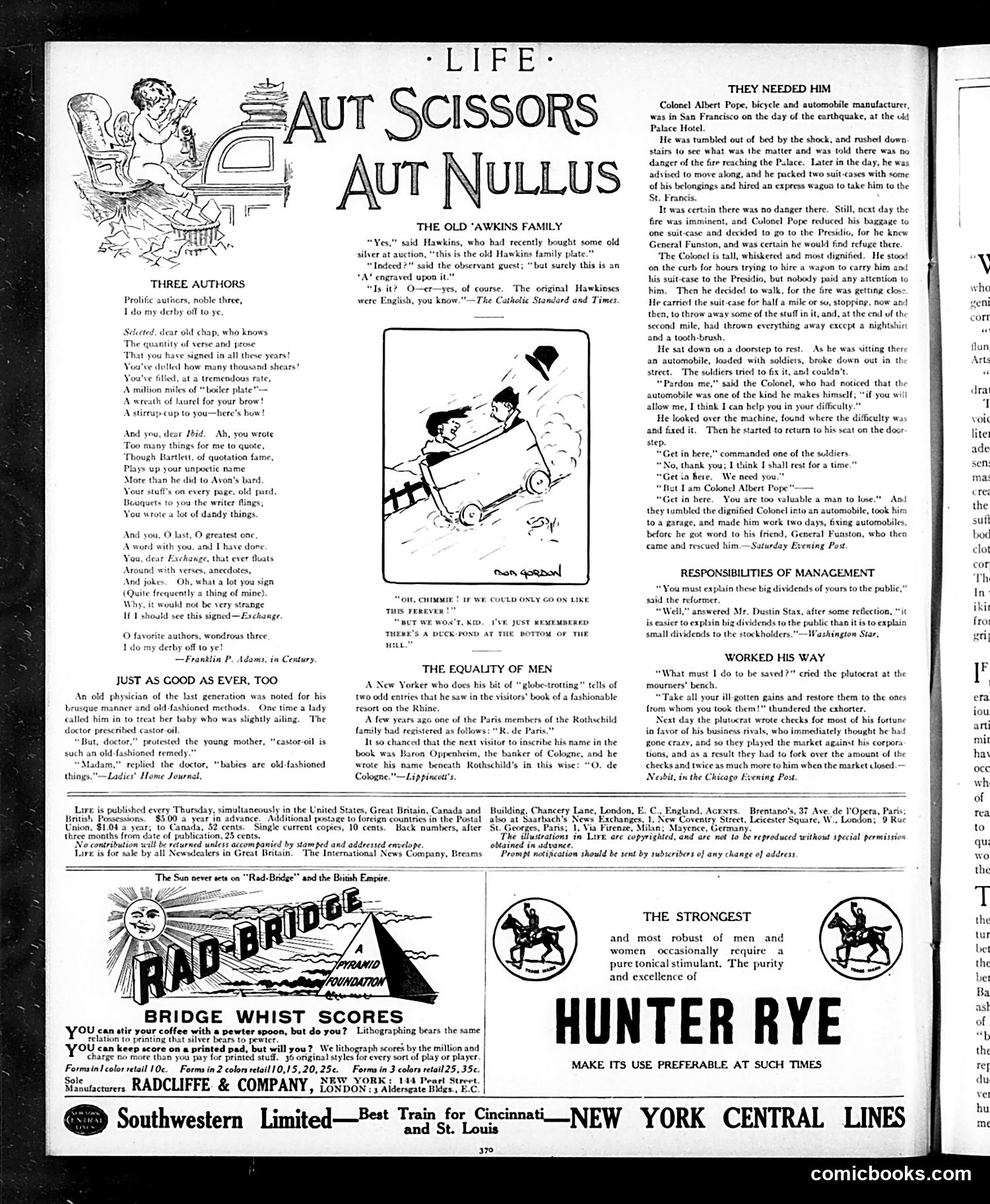
This page contains three distinct humorous pieces: ## "Aut Scissors Aut Nullus" (The Old Hawkins Family) A satirical cartoon mocking social climbing. The Hawkins family claims ownership of old silver plate they've recently purchased at auction, pretending it's a family heirloom. The guest's skeptical observation—that the engraving shows it's not actually theirs—exposes their pretense. The joke targets nouveau riche attempts to fabricate aristocratic heritage through purchased artifacts. ## "Three Authors" Celebratory verses praising prolific magazine writers (likely Franklin P. Adams and others), mocking their relentless output of "boiler plate" content filling publications constantly. ## "They Needed Him" & "The Equality of Men" Anecdotes about the 1906 San Francisco earthquake and social observations about class pretension (Rothschild vs. Oppenheim bankers competing in a guest book). These reflect turn-of-century American humor about wealth, status, and human nature. The page primarily satirizes social pretension and class aspiration among newly wealthy Americans.
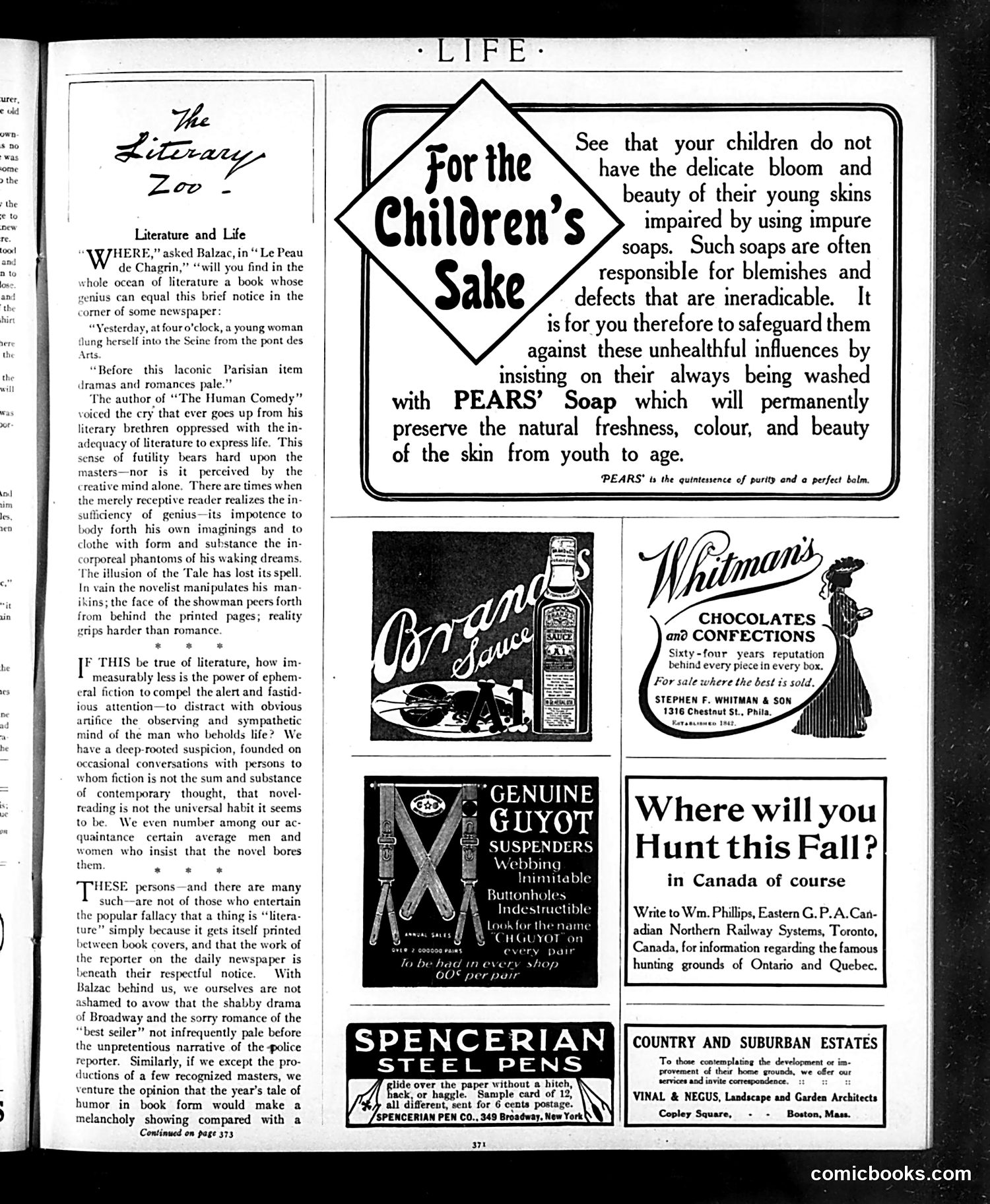
This page is primarily **advertising**, not satirical content. The top section contains a literary essay titled "Literature and Life" discussing the limitations of fiction compared to real life, referencing Balzac's observation that a newspaper suicide notice can be more compelling than novels. The advertisements below are vintage products from the early 20th century: - **Pears' Soap**: A luxury soap brand emphasizing purity and skin health for children—reflecting period anxieties about product safety - **Whitman's Chocolates**: Emphasizing 64 years of reputation and quality - **Guyot Suspenders**: Men's clothing hardware - **Spencerian Steel Pens**: Writing instruments - Additional ads for hunting tourism in Canada and landscape architecture services The juxtaposition of highbrow literary criticism with mass-market consumer goods is characteristic of *Life* magazine's format, but there's no discernible satire or cartoon here—just a standard magazine layout mixing editorial content with period advertisements targeting middle and upper-class readers.
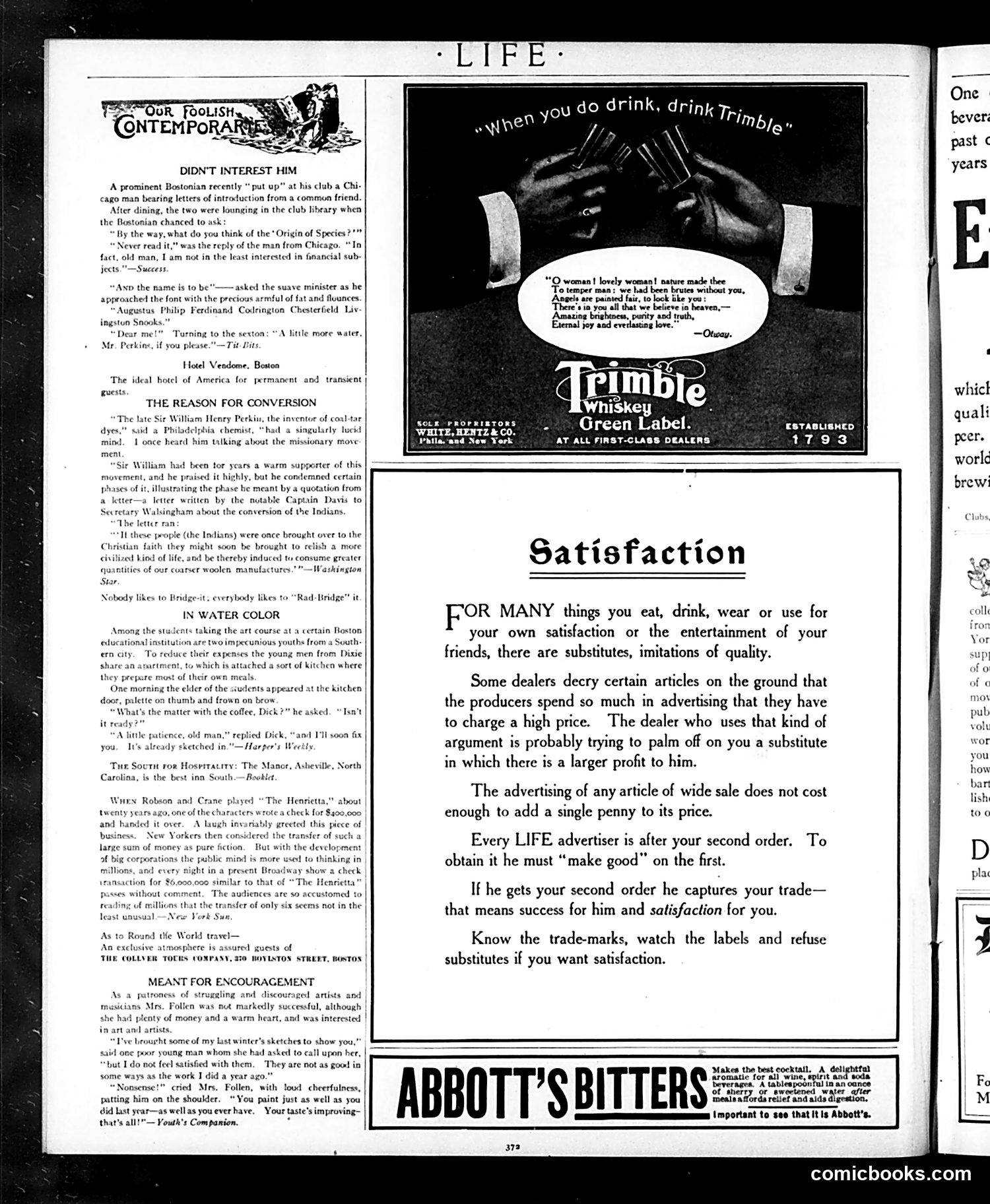
This page contains several brief satirical anecdotes typical of Life's humor section, plus advertisements. **The cartoons/jokes:** 1. **"Didn't Interest Him"**: A Chicago businessman dismisses Darwin's *Origin of Species* as uninteresting, claiming he's "not in the least interested in financial subjects"—a joke playing on the fact that Darwin's scientific work has nothing to do with finance, suggesting the man is either ignorant or deliberately obtuse. 2. **"The Reason for Conversion"**: Mocks 17th-century colonial motivations by quoting a letter suggesting Native Americans should convert to Christianity so they'd become "civilized" consumers of English woolen goods—satirizing how religious conversion was often economically motivated. 3. **"In Water Color"**: A student apologizes that his coffee sketch isn't "ready" yet—a pun on artistic preparation versus actual coffee-making. **Advertisements** dominate the lower half, including Trimble Whiskey and Abbott's Bitters. The page reflects early 1900s American social satire: mocking provincial attitudes, colonialism's hypocrisy, and educated pretension.
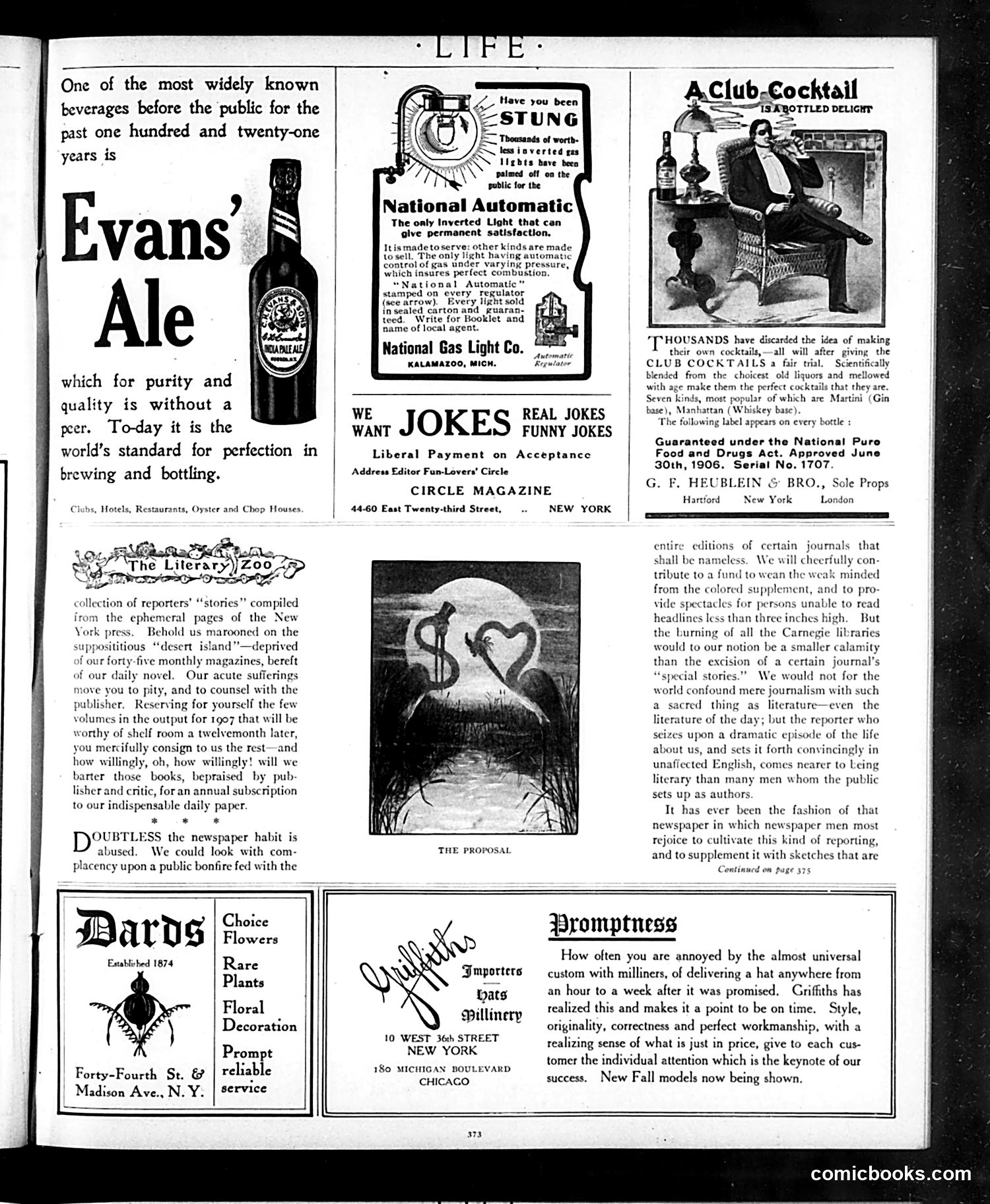
This page is primarily **advertising**, with one sidebar editorial piece. The main cartoon, "The Proposal," depicts a man on one knee proposing to a woman—a conventional romantic scene used to advertise "Club Cocktails." The editorial section, "The Literary Zoo," satirizes newspaper culture circa 1907. It mocks journalists and publishers who strip valuable reporting from papers to create cheaper compilations, comparing the loss to burning Carnegie libraries. The author argues that good newspaper reporting—dramatic, clearly written accounts of real events—is a legitimate literary form, even if critics dismiss it. The satire targets the era's class-conscious literary establishment that elevated "literature" while dismissing journalism as inferior. For modern readers: this defends everyday newspaper writing as valid literature against snobbish critics. The remainder consists of advertisements for Evans' Ale, gas lights, flowers, cocktails, and millinery services—typical early-20th-century magazine advertising.
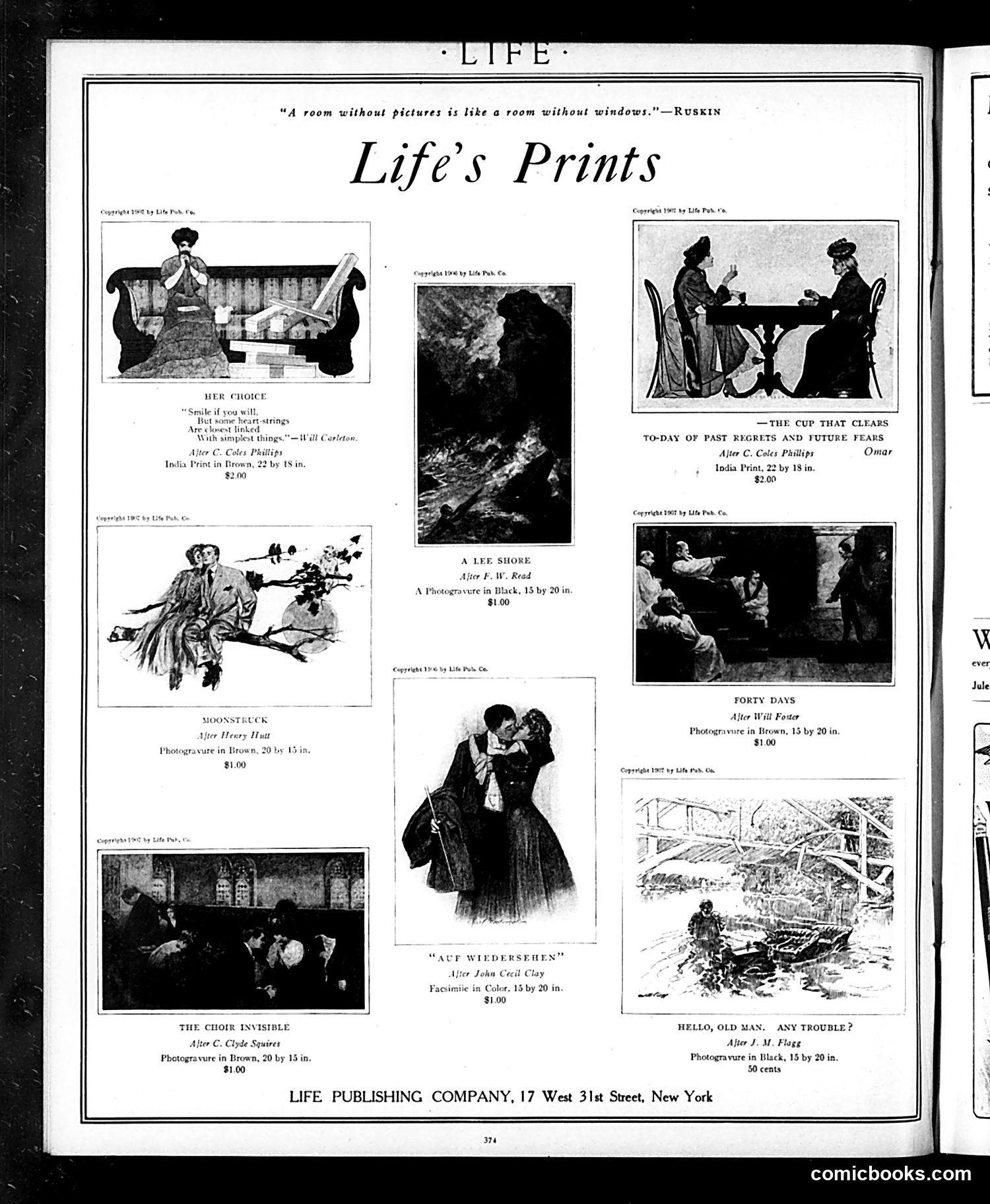
This page is primarily an **advertisement catalog** for art prints and photogravures available from Life Publishing Company. Rather than political satire, it showcases theatrical and literary-inspired artwork, including prints titled "Her Choice," "Moonstruck," "The Choir Invisible," "A Lee Shore," "The Cup That Clears," "Forty Days," "Ace Wiedersekes," and "Hello, Old Man. Any Trouble?" The prints appear adapted from popular plays and literary works of the early 1900s. The epigraph at top—a Ruskin quote about pictures as "windows"—frames art's cultural value. Works are credited to artists like Alice Henry Huat and C. Clyde Squires. This is essentially a commercial product listing, not satirical content, offering reproductions priced from 50 cents to $2.00.
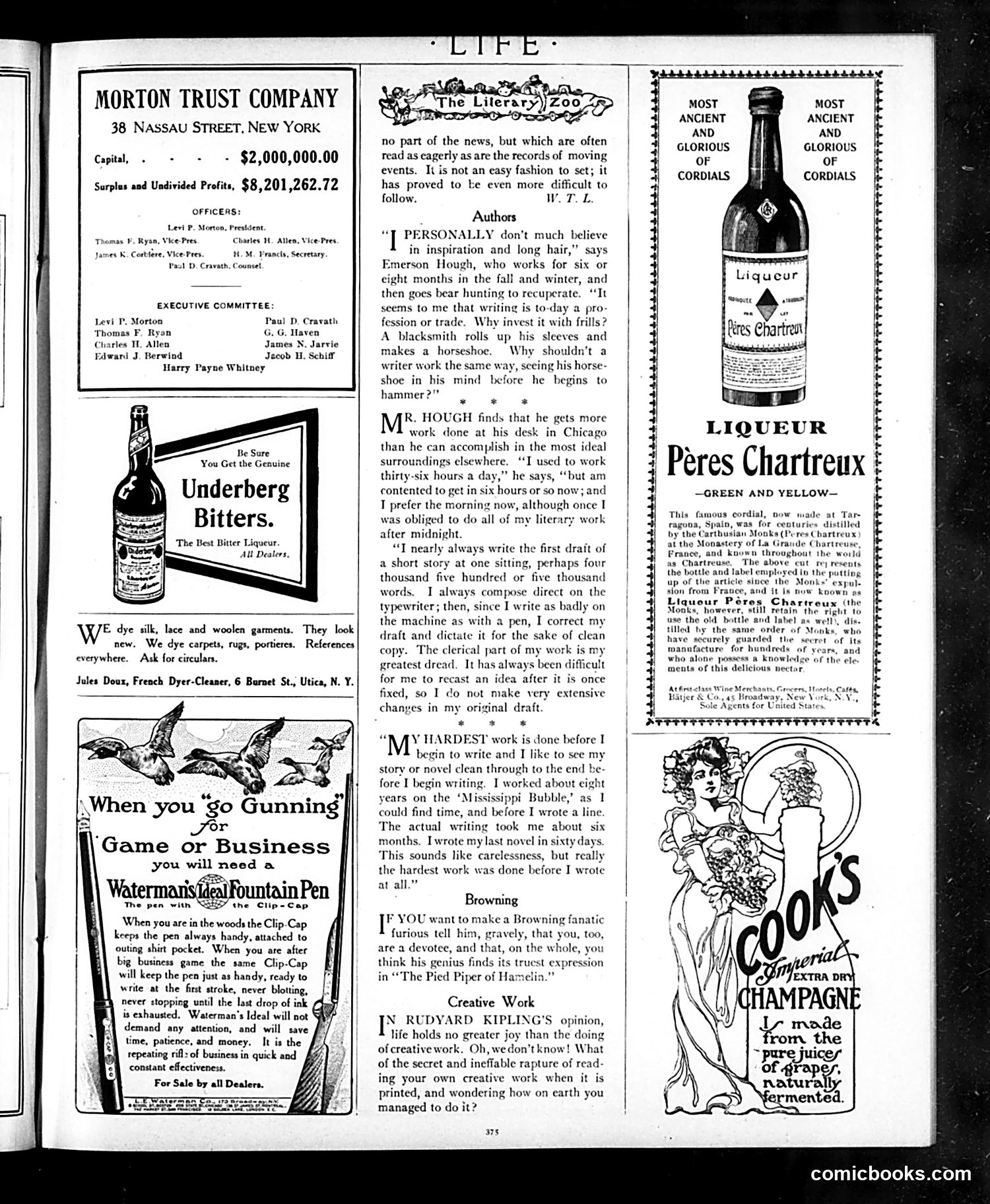
This page is primarily **advertisements interspersed with editorial content** about authors' writing habits. The main editorial feature interviews famous writers (Emerson Hough, Rudyard Kipling, and others identified only by last name) about their creative processes—where they write, how many hours they work, whether they revise drafts. The piece presents practical, unglamorous writing routines: Hough works six hours daily at a Chicago desk; another author composes directly on typewriter; Kipling values the "joy" of seeing creative work in print. The advertisements promote liqueurs (Underberg Bitters, Peres Chartreux), a fountain pen with a clip-cap designed for outdoor use ("Game or Business"), and dyeing services. The Morton Trust Company masthead appears at top. There is **no political satire or caricature** visible. The page reflects early 20th-century *Life* magazine's mixed editorial-advertising format and contemporary interest in the professional lives of celebrated authors.
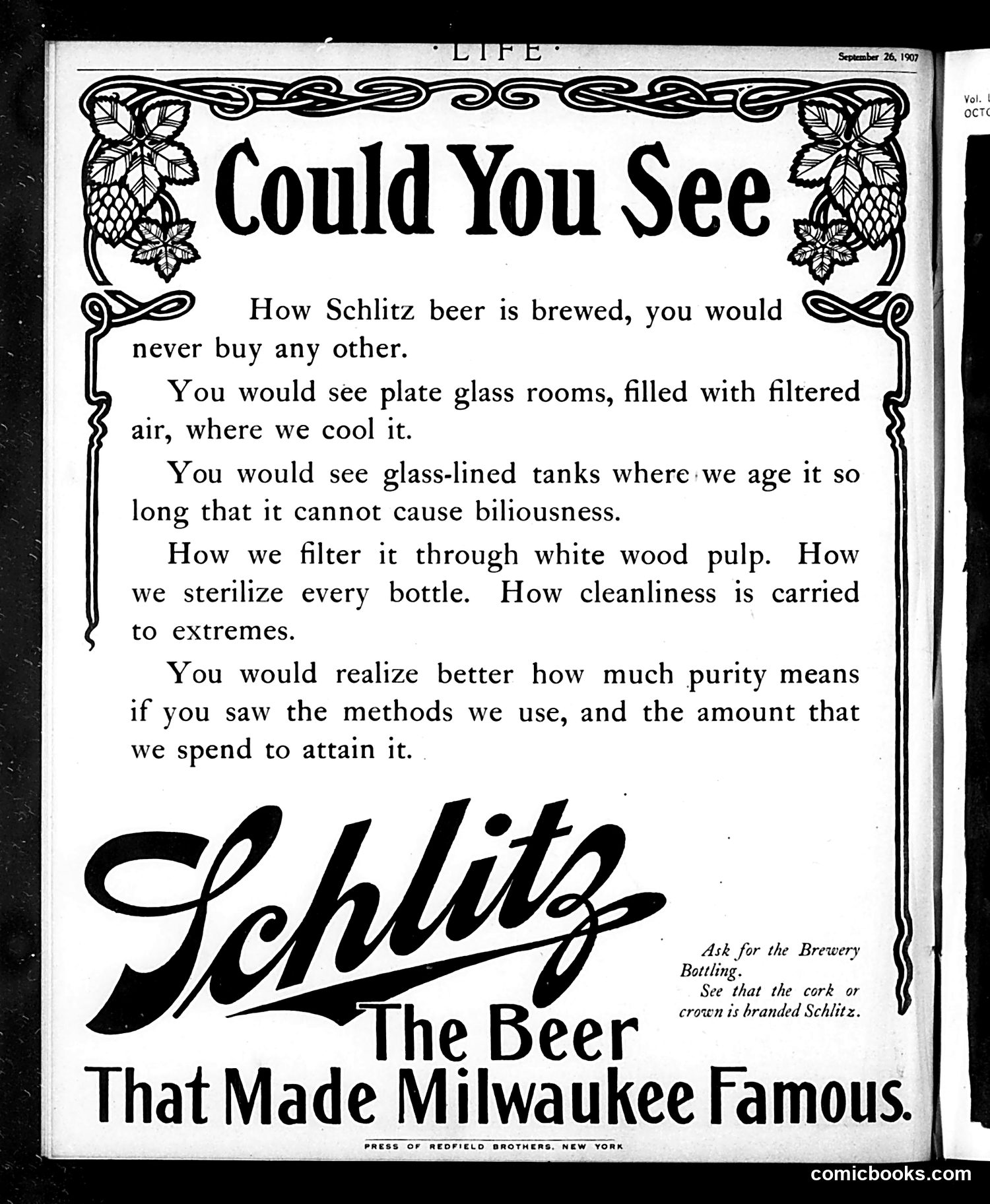
This is a **Schlitz beer advertisement** from September 26, 1907—not satire or political commentary. The "Could You See" headline is a sales pitch inviting consumers to imagine the brewery's production process. The ad emphasizes purity and cleanliness as selling points: filtered air rooms, glass-lined tanks for aging, white wood pulp filtration, and sterilized bottles. This reflects early 20th-century marketing that capitalized on germ theory and sanitation anxieties—relatively new scientific concerns that made "cleanliness" and "purity" powerful consumer appeals. The phrase "biliousness" (digestive upset) addresses a real concern about beer quality at the time, when inconsistent brewing could cause illness. The decorative hop motifs and tagline "The Beer That Made Milwaukee Famous" position Schlitz as a premium product worthy of verification (note the instruction to check the branded cork). This is purely commercial persuasion using period health-consciousness language.