
Life, 1907-09-26 · page 14 of 24
Life — September 26, 1907 — page 14: what you’re looking at
What you’re looking at
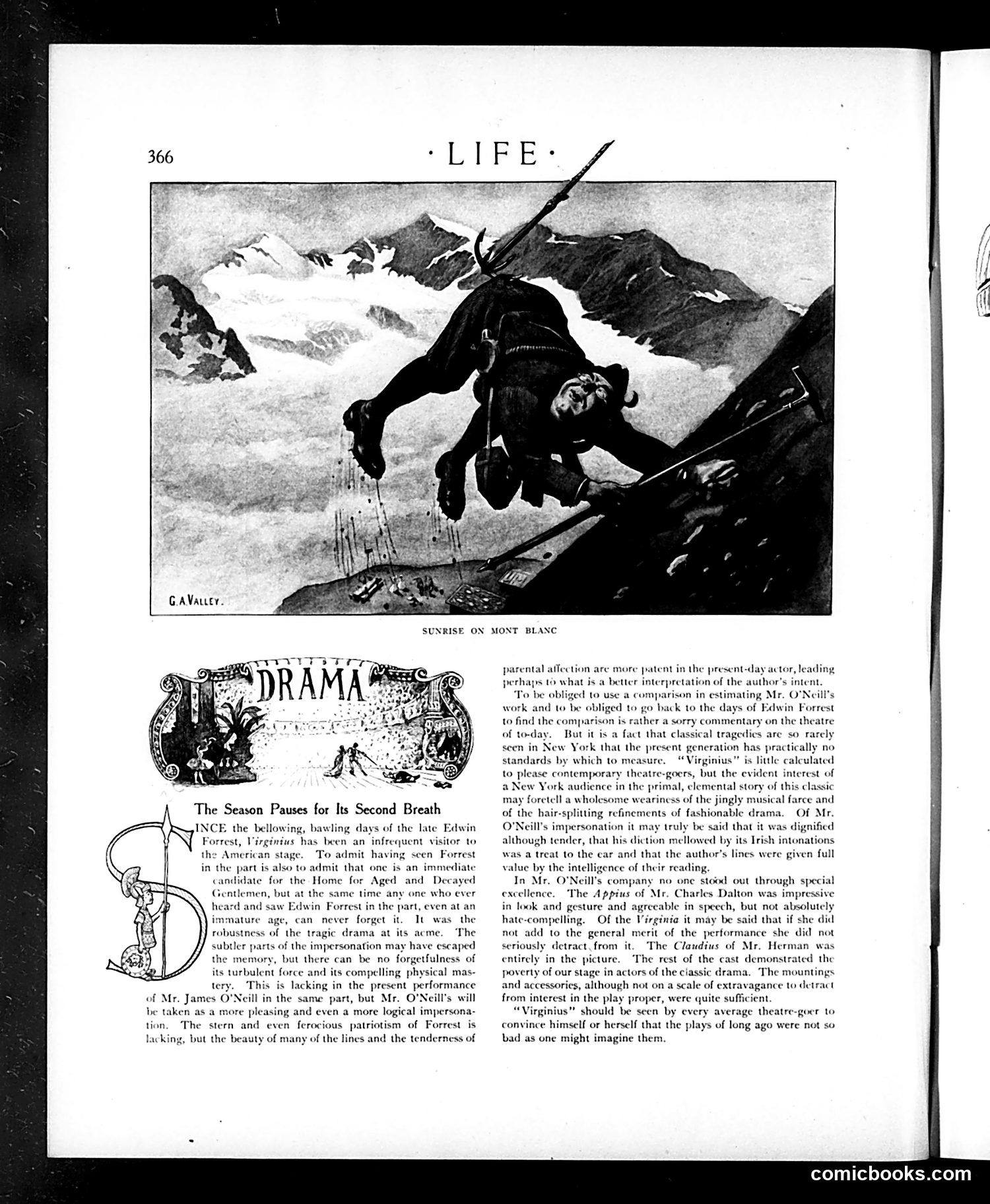
This page reviews a theatrical production of *Virginius*, a classical tragedy, starring James O'Neill. The photo shows a mountaineer on Mont Blanc—unrelated to the drama section below. The critic compares O'Neill's performance unfavorably to the legendary Edwin Forrest, who played the role decades earlier. Forrest embodied "robust" tragic drama with "turbulent force," while O'Neill offers a more tender, refined interpretation emphasizing beauty and paternal affection over fierce patriotism. The review laments that modern New York audiences lack standards for evaluating classical drama—classical plays are rarely staged anymore. Yet O'Neill's dignified, Irish-accented performance of this ancient Roman story about a father and daughter suggests audiences retain appetite for "primal, elemental" drama beneath contemporary "jingly musical farce." The critic recommends the production to modern theatergoers to prove classical drama isn't inherently inferior to contemporary entertainment.
📄 Transcribed text from this page (OCR, searchable)
Machine-transcribed from the original scan — historical spelling and the odd misread are preserved.
G.AVaueY. SUNRISE ON MONT BLANC The Season Pauses for Its Second Breath INCE the bellowing, bawling days of the late Edwin Forrest, Virginius has been an infrequent visitor to the American stage. To admit having scen Forrest in the part is also to admit that one is an immedia candidate for the Home for Aged and Decayed Gentlemen, but at the same time any one who ever heard and saw Edwin Forrest in the part, even at an immature age, can never forget it. It was the robustness of the tragic drama at its acme. ‘The subtler parts of the impersonation may have escaped the memory, but there can be no forgetfulness of its turbulent force and its compelling physical mas- tery. This is lacking in the present performance of Mr. James O'Neill in the same part, but Mr. O'Neill's will logical impersona- nd even ferocious patriotism of Forrest is be taken as a more pleasing and even a mor tion, The stern lacking, but the beauty of many of the lines and the tenderness of parental affection are more patent in the present-day actor, leading perhaps t what is a better interpretation of the author's intent. ‘To be obliged to use a comparison in estimating Mr. O'Neill's work and to be obliged to go back to the days of Edwin Forrest to find the comparison is rather a sorry commentary on the theatre But it is a fact that classic scen in New York that the present generation has practically no standards by which to measure.“ Virginius” is little calculated to please contemporary theatre-goers, but the evident interest of a New York audience in the primal, elemental story of may foretell a wholesome weariness of the jingly musical farce and of the hair-splitting refinements of fashionable drama. Of Mr. O'Neill's impersonation it may truly be said that it was dignified although tender, that his diction mellowed by its Irish intonations was a treat to the car and that the author's lines were given full value by the intelligence of their reading. In Mr. O'Neill's company no one stood out through special excellence. ‘The Appius of Mr. Charles Dalton was impressive in look and gesture and agreeable in speech, but not absolutely hate-compelling. Of the Virginia it may be said that if she did not add to the general merit of the performance she did not seriously detract from it. The Claudius of Mr. Herman was entirely in the picture. ‘The rest of the cast demonstrated the poverty of our stage in actors of the ciassic drama. ‘The mountings and accessories, although not on a scale of extravagance to detract from interest in the play proper, were quite sufficient “Virginius” should be seen by every average theatre-gocr to convince himself or herself that the plays of long ago were not so bad as one might imagine them. of to-day. tragedies are so rarely classic comicbooks.com