
Life, 1907-09-26 · page 16 of 24
Life — September 26, 1907 — page 16: what you’re looking at
What you’re looking at
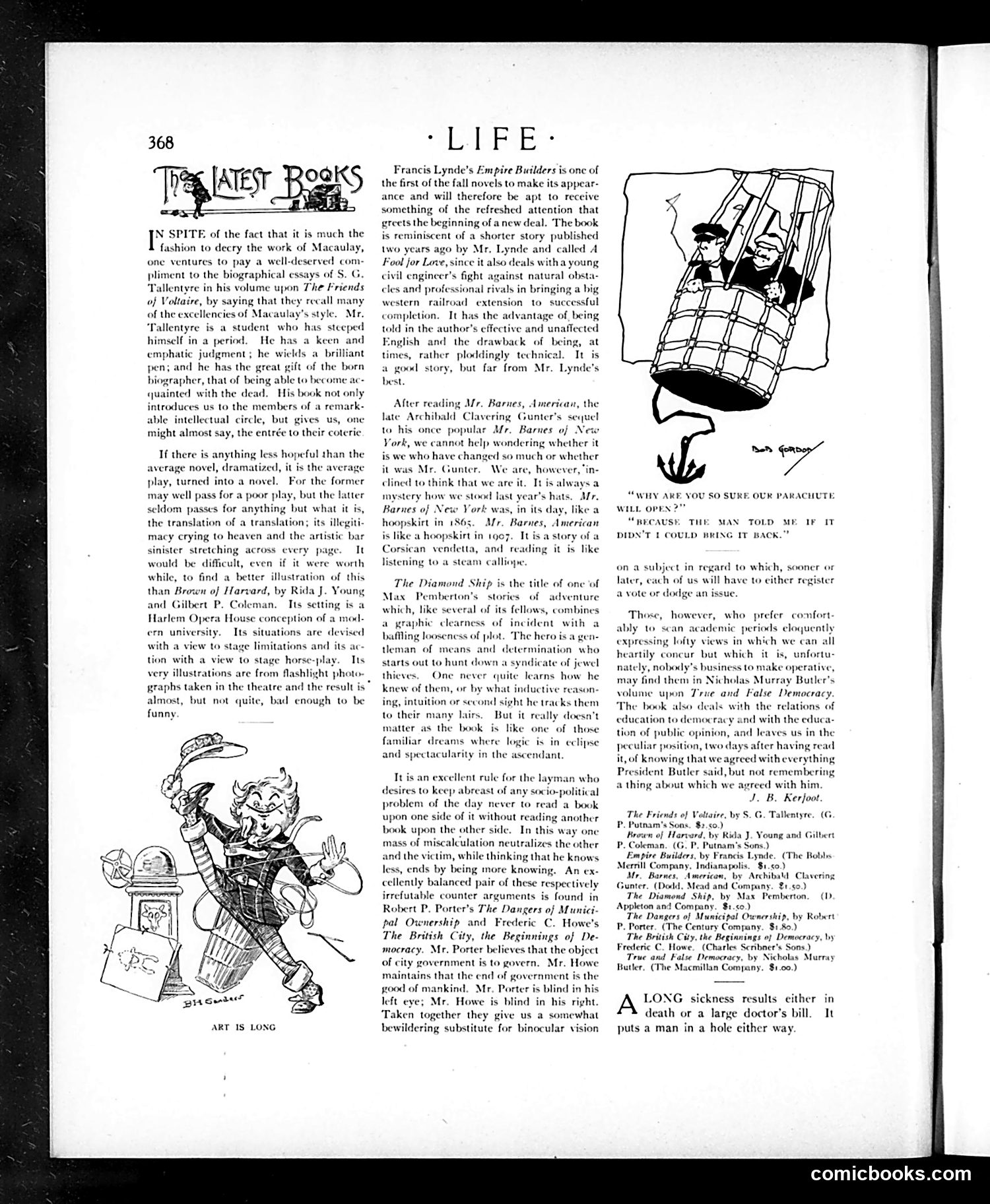
The cartoon depicts a disheveled, corpulent figure struggling with an oversized artist's palette and brushes—likely representing a pretentious or incompetent artist. The caption "ART IS LONG" references the classical aphorism "Ars longa, vita brevis" (art is long, life is short). The satire appears to mock either artistic pretension or the gap between artistic ambition and actual talent. The figure's struggle with unwieldy tools suggests someone burdened by or unsuited to their chosen field. The page's text, reviewing literary works, reinforces this theme—criticizing poorly adapted plays-turned-novels and dated fiction. The overall message seems to be that true art requires more than effort; it demands genuine skill and contemporary relevance. The struggling figure embodies the futility of creative work divorced from talent or timeliness.
📄 Transcribed text from this page (OCR, searchable)
Machine-transcribed from the original scan — historical spelling and the odd misread are preserved.
N SPITE of the fact that it is much the fashion to decry the work of Macaulay one ventures to pay a well-deserved com pliment to the biographical essays of S. G. ‘Tallentyre in his volume upon The Friends of Voltaire, by saying that the of the ncies of Macaulay Tallentyre is a stud recall many s style. Mr. nt who has steeped himself in a period. He has a keen and emphatic judgment; he wields a brilliant pen; and he has the great gift of the born biographer, that of being able to becor qquainted with the dead. His book not on introduces us to the members of a remark- able intellectual circle, but gives us, ¢ might almost say, the entrée to their coter xcell If there is anything less hopeful than the average novel, dramatized, it is the average play, turned into a novel. For the y well pass for a poor play, but the latter seldom passes for anything but what it is, the translation of a translation; its illegiti- macy crying to heaven and the artistic bar rer sinister stretching across every pa It would be difficult, even if it were worth while, to find a better illustration of this than Brown of Harvard, by Rida J and Gilbert P. Harlem Opera House conception of a mod- bung, Coleman, Its setting is a crn university, Its situations are devised with a view to st tion with a view to stage horse-play. Its very illustrat ¢ from flashlight photo- graphs taken in the theatre and the result is, almost, but not qu funny limitations and its ac- bad cnough to be ART IS LONG oe ool oie Francis Lynde’s Empire Builders is onc of the first of the fall novels to make its appear- ance and will therefore be apt to receive something of the refreshed attention that greets the beginning of a new deal. ‘The book is reminiscent of a shorter story published two years ago by Mr. Lynde and called A Fool jor Love, since it also deals witha young civil engineer's fight against cles and professional rivals in bringing a big western railroad extension to successful completion. It has the advantage of, being told in the author's effective and unaffected English and the drawback of being, times, rather ploddingly obsta- a good story, but far from Mr. Lynde’s best. Alter reading Mr. Barnes, American, the late Archibald Clavering Gunter’s sequel to his once popular Mr, Barnes of N York, we cannot help wondering whether it is we who have chan it was Mr. Gunter. We are, however, in- clined to think that we are it, Tt is always a mystery how we stood last year’s hats, Mr. Barnes of : like a hoopskirt in- 1865 American ed so much or whether ‘ew York was, in its da Mr hoopskirt in 1907. I vendetta listening to a stea Barnes, sa story of a and reading it iS like calling The Diamond Ship is the title of 0 Max Pemberton’s adventu which, like several of its fellows, combi incident with a g looseness of plot. ‘The hero is a gen- a shic clearness: of bafl tleman of means and determination who starts out to hunt dow On learns how he knew of them, or by what inductiv syndicate never quite of jewel thieves reason- ing, intuition oF second sight he tracks them to their nm But it really matter as the book is like one of th familiar dreams where logic lairs. doesn’t in eclipse and spectacularity in the ascendant. It is an excellent rule for the layman who ires to keep abreast of any socio-political problem of the day never to read a book upon one side of it without reading another book upon the other side. In this way one mass of miscalculation neutralizes the other and the victim, while thinking that he knows less, ends by being more knowing. An ex- cellently balanced pair of these respectively irrefutable counter arguments is found i Robert P. Porter’s The Dangers of Munici- pal Ownership and Frederic C. Howe's The British City, the Beginnings of De- y. Mr. Porter believes that the object , nt is to govern. Mr. Howe maintains that the end of government is the good of mankind. Mr. Porter is blind in his Mr. Howe is blind in his right. en together they give us a somewhat bewildering substitute for binocular vision “WHY ARE YOU SO SURE OUR PARACHUTE WILL OPEN?” “BECAUSE THE MAN TOLD ME IF IT DIDN'T 1 COULD BRING IT BACK.” on a subject in regard to w later, each of us will have to cither register a vote o1 h, sooner oF lodge an issue Those, however, who prefer comfort ably to sean academic periods eloquently expressing lofty views in which we can all heartily concur but which it is, unfortu- nately, nobody’s business to make operative, may find them in Nicholas Murray Butler's volume upon True and False Democracy. The hook also deals with the relations of nd with the educa- tion of public opinion, and leaves us in the peculiar position, two days after having read it, of knowing that we agreed with everything ident Butler said, but not remembering a thing about which we agreed with him. J. B. Kerjoot The Friends of Voltaire, by $. G. Tallentyre. (G P. Putnam's Sons. $2,s0.) n of Harvard, by Rida J. Young P. Coleman. (G. P. Putnam's Sons.) Empire Builders, by Francis Lynde. (The Bobs Merrill Company, Indianapolis. $1.<0.) Mr. Barnes, American, by Archibald Clavering Gunter. (Dodd. Mead and Company. £1.50.) The Diamond Ship, by Max Pemberton. Appleton and Company. $1.<0.) The Dangers of Municipal Ownership, by Robert P. Porter. (The Century Company. $1.85.) The British City, the Beginnings 0} Democracy, by Frederic C. Howe. (Charles Scribner's Sons.) True and False Democracy, by Nicholas Murray Butler. (The Macmillan Company, $1.00.) education to democracy LONG sickness results either in death or a large doctor's bill. It puts a man in a hole cither way. comicbooks.com