
Life, 1907-09-26 · page 6 of 24
Life — September 26, 1907 — page 6: what you’re looking at
What you’re looking at
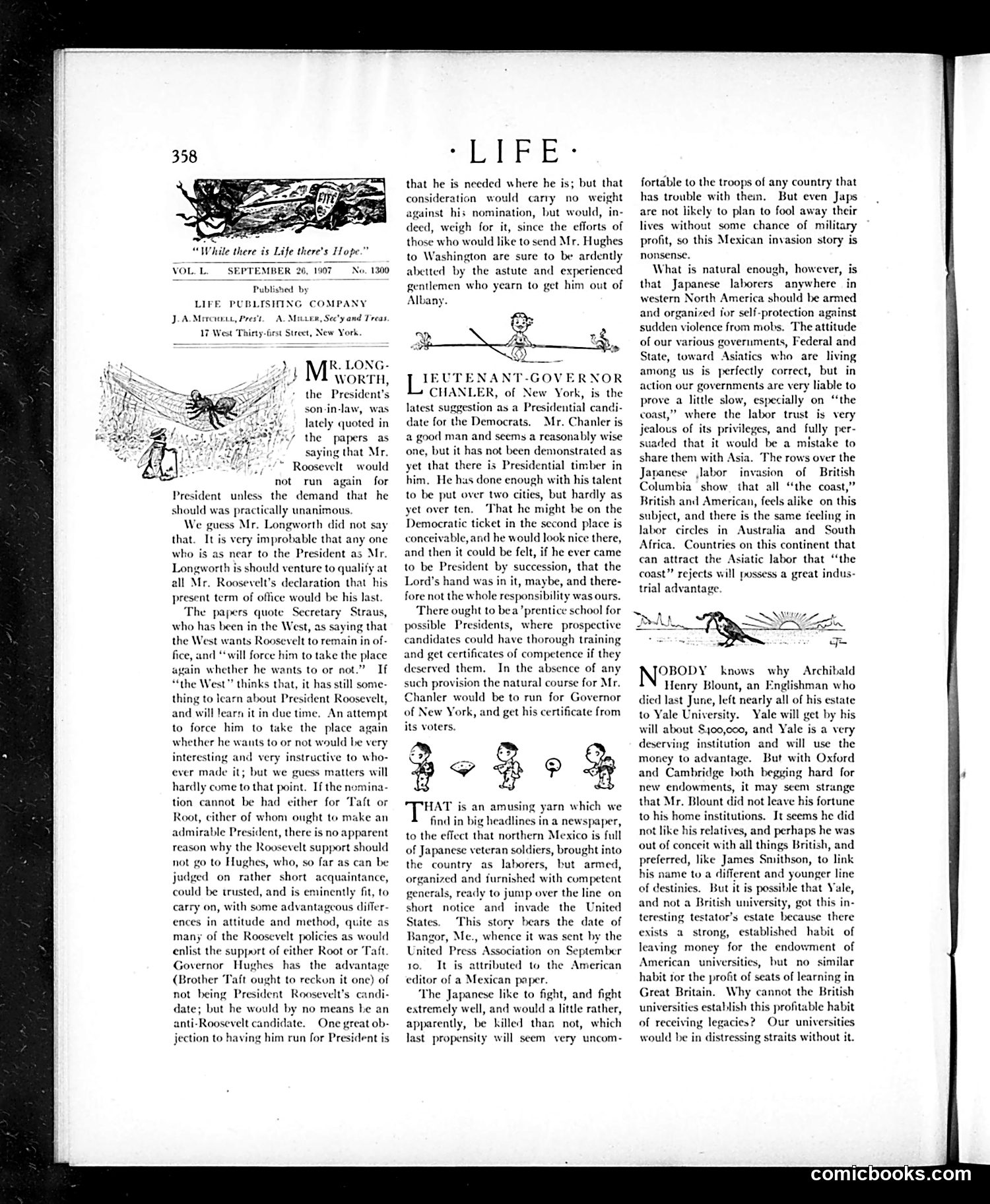
This page contains two main political commentaries from the early 1900s: **Left cartoon**: Depicts "Mr. Longworth" (likely Nicholas Longworth, Ohio congressman) being proposed as a potential Democratic Presidential candidate. The text mocks the idea as impractical—arguing he lacks sufficient experience for the presidency, having managed only "two cities" rather than a full state. **Right section**: Discusses Japanese laborers in western North America, expressing concern about their organization and potential military value. The commentary reveals period anxieties about Japanese immigration and Asian labor competition, while criticizing American governments for slow response to these concerns. Both pieces reflect turn-of-the-century American political debates: domestic succession politics and escalating tensions over Asian immigration.
📄 Transcribed text from this page (OCR, searchable)
Machine-transcribed from the original scan — historical spelling and the odd misread are preserved.
me “While there is Life there’s Hope.” VOL.L. SEPTEMBER Published by LIFE PUBLISHING COMPANY J.-A. Mrrewnt, Pres't 17 West Thirty-first Street, New York A. Murr, Sec'y and Treas } R. LONG- 7 WORTH, T\0 + the President's son-in-law, was lately quoted in the papers as saying that Mr. Roosevelt would not run again for President unless the demand that he should was practically unanimous, We guess Mr. Longworth did not say that. It is very improbable that any one who. near to the President as Mr Longworth is should venture to qualify at all Mr. Roosevelt’s declaration that his present term of office would be his last. The papers quote Secretary Straus, who has been in the West, as saying that the West wants Roosevelt to remain in of- fice, and “will force him to take the place again whether he wants to or not.” If “the West" thinks that, it has still some- thing to learn about President Roosevelt, and will learn it in due time. An attempt to force him to take the place again whether he wants to or not would be very interesting and very instructive to who- ever made it; but we guess matters will hardly come to that point. If the nomina- tion cannot be had either for Taft or Root, cither of whom ought to make an admirable President, there is no apparent reason why the Roosevelt support should not go to Hughes, who, so far as can be judged on rather short acquaintance, could be trusted, and is eminently fit, to carry on, with some advantageous difler- ences in attitude and method, quite as many of the Roosevelt policies as would enlist the support of either Root or Taft Governor Hughes has the advantage (Brother Taft ought to reckon it one) of not being President Roosevelt’s candi- date; but he would by no means be an anti-Roosevelt candidate. One great ob- jection to having him run for President is that he is needed where he is; but that consideration would carry no weight against his nomination, but would, in- deed, weigh for it, since the efforts of those who would like to send Mr. Hughes to Washington are sure to be ardently abetted by the astute and experienced gentlemen who yearn to get him out of Albany. IEUTENANT-GOVERNOR CHANLER, of New York, is the latest suggestion as a Presidential candi- date for the Democrats. Mr. Chanler is a good man and seems a reasonably wise one, but it has not been demonstrated as yet that there is Presidential timber in him. He has done enough with his talent to be put over two cities, but hardly as yet over ten. ‘That he might be on the Democratic ticket in the second place is conceivable, and he would look nice there, and then it could be felt, if he ever came to be President by succession, that the Lord’s hand was in it, maybe, and there- fore not the whole responsibility was ours. There ought to bea’ prentice school for possible Presidents, where prospective candidates could have thorough training and get certificates of competence if they deserved them, In the absence of any such provision the natural course for Mr. Chanler would be to run for Governor of New York, and get his certificate from its voters. bo ges HAT is an amusing yarn which we find in big headlines in a newspaper, to the effect that northern Mexico is full of Japanese veteran soldiers, brought into the country as laborers, but armed, organized and iurnished with competent generals, ready to jump over the line on short notice and invade the United States. This story bears the date of Bangor, Me., whence it was sent by the United Press Association on September io. It is attributed to the American editor of a Mexican paper. ‘The Japanese like to fight, and fight eastremely well, and would a little rather, apparently, be killed than not, which last propensity will seem very uncom- fortable to the troops of any country that has trouble with them. But even Japs are not likely to plan to fool away their lives without some chance of military profit, so this Mexican invasion story is nonsense. What is natural enough, however, is that Japanese laborers anywhere in western North America should be armed and organized for self-protection against sudden violence from mobs. The attitude of our various governments, Federal and State, toward Asiatics who are living among us is perfectly correct, but in action our governments are very liable to prove a little slow, especially on “the coast,” where the labor trust is very jealous of its privileges, and fully per- suaded that it would be a mistake to share them with Asia. The rows over the Japanese ,labor invasion of British Columbia show that all “the coast,” British and American, feels alike on this subject, and there is the same feeling in labor circles in Australia and South Africa. Countries on this continent that can attract the Asiatic labor that “the coast” rejects will possess a great indus- trial advantage. RES Lido. OBODY knows why Archibald Henry Blount, an Englishman who died last June, left nearly all of his estate to Yale University. Yale will get by his will about $400,000, and Yale is a very deserving institution and will use the moncy to advantage. But with Oxford and Cambridge both begging hard for new endowments, it may seem strange that Mr. Blount did not leave his fortune to his home institutions. Jt seems he did not like his relatives, and perhaps he was out of conceit with all things British, and preferred, like James Smithson, to link his name to a different and younger line of destinies. But it is possible that Yale, and not a British university, got this in- teresting testator’s estate because there strong, established habit of leaving money for the endowment of American universities, but no similar habit tor the profit of seats of learning in Great Britain. Why cannot the British universities establish this profitable habit of receiving legacies? Our universities would be in distressing straits without it. exists a comicbooks.com