
A complete issue · 22 pages · 1907
Life — July 25, 1907
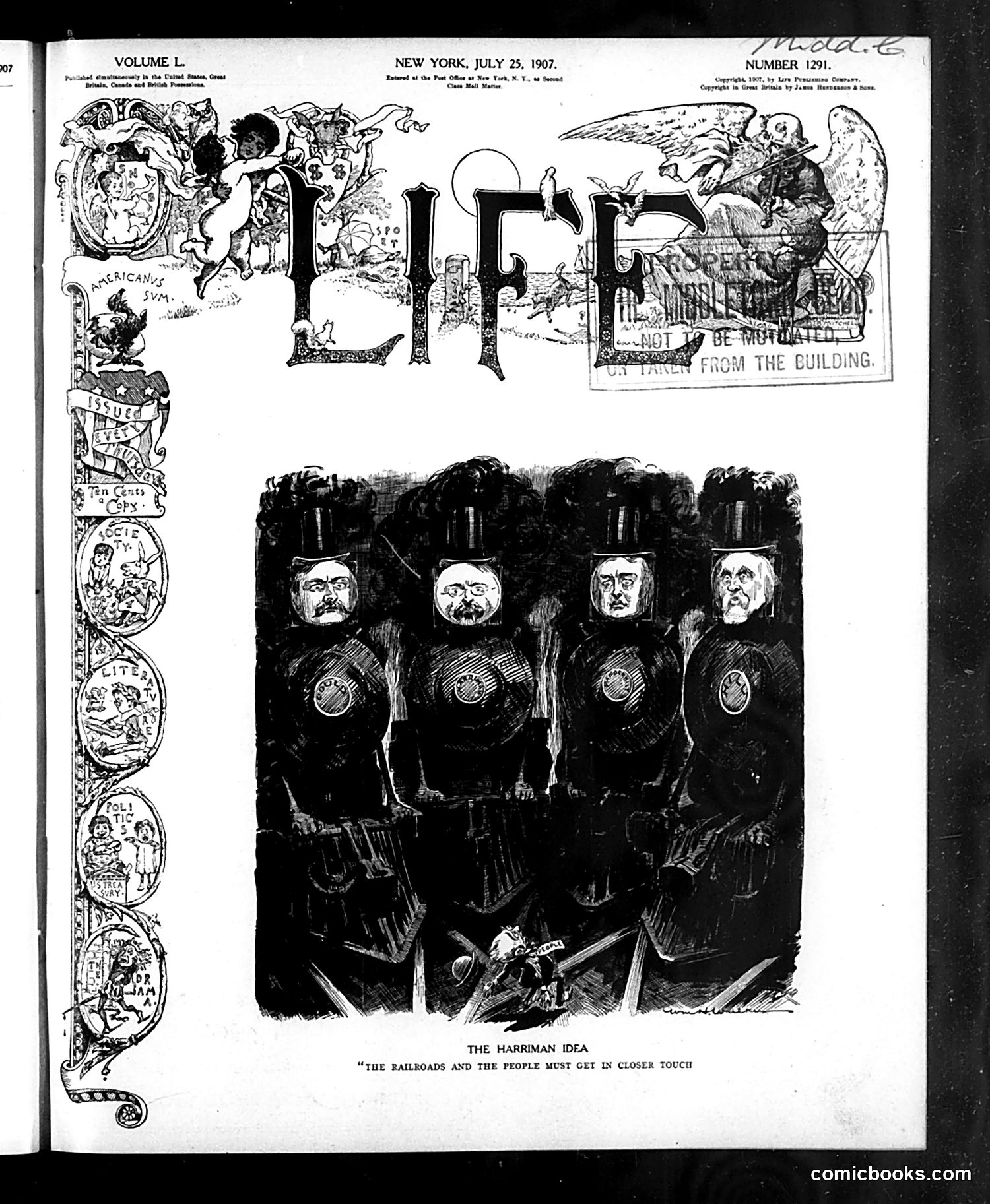
**"The Harriman Idea"** cartoon depicts four military or uniformed figures with the caption: "The Railroads and the People Must Get in Closer Touch." This appears to satirize railroad magnate E.H. Harriman's proposal for closer relations between railroads and the public. The grotesque military figures—rendered menacingly in dark shading—suggest the satire critiques this relationship as potentially authoritarian or coercive rather than genuinely cooperative. The timing (1907) aligns with Progressive Era skepticism toward railroad monopolies and their political influence. The martial imagery implies Harriman's "closer touch" idea would impose order on citizens rather than foster genuine democratic engagement. The decorative left border contains small vignettes typical of Life's satirical style.
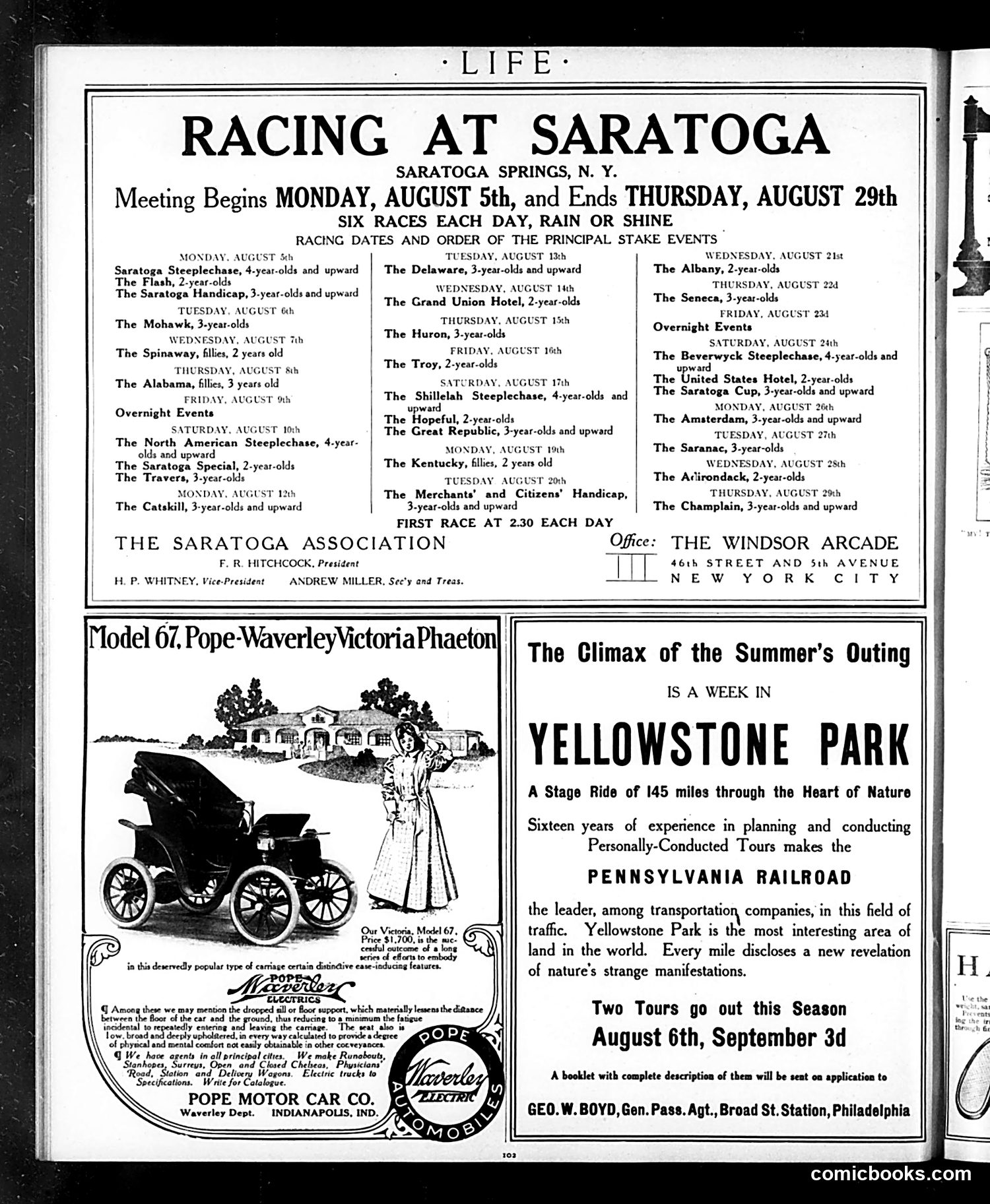
This page contains **no political cartoons or satire**. Instead, it features **period advertisements and event announcements** from what appears to be an early 1900s issue of Life magazine. The top half announces horse racing at Saratoga Springs, New York (August 5-29), listing various stakes races and their details. The Saratoga Association operated from an office in New York City. Below are two separate advertisements: one for the Pope-Waverley Victoria Phaeton automobile (Model 67), and another promoting Yellowstone Park tours via the Pennsylvania Railroad, departing August 6th and September 3rd. The page is primarily commercial content rather than satirical commentary, reflecting Life's dual function as both humor magazine and advertising venue during this era.
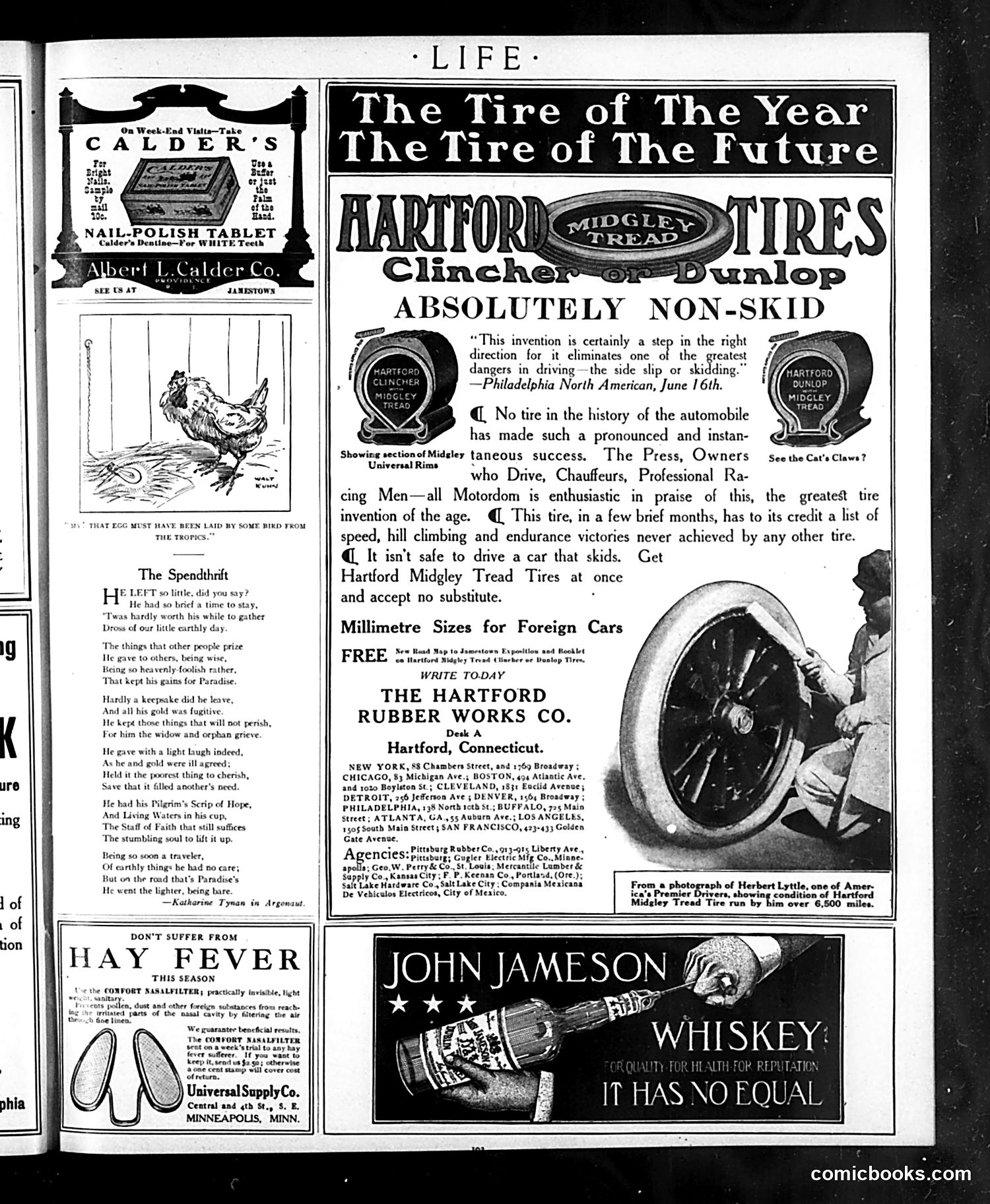
This page is primarily **advertising**, not satirical content. The dominant feature is a large Hartford Midgley Tread Tire advertisement claiming to be "The Tire of The Year" and "The Tire of The Future." The ad emphasizes the tire's "absolutely non-skid" design, quoting a Philadelphia newspaper endorsement about safety benefits. The smaller cartoon, "The Speedshift," depicts a wealthy man (identified by his fine clothing) gathering funds, apparently to support his leisure pursuits. The accompanying poem critiques materialism and greed—suggesting he accumulated wealth ruthlessly and now faces consequences including widow and orphan grief. Other advertisements include Calder's nail polish, hay fever treatment, and John Jameson whiskey. The page reflects early 20th-century consumer marketing and class commentary.
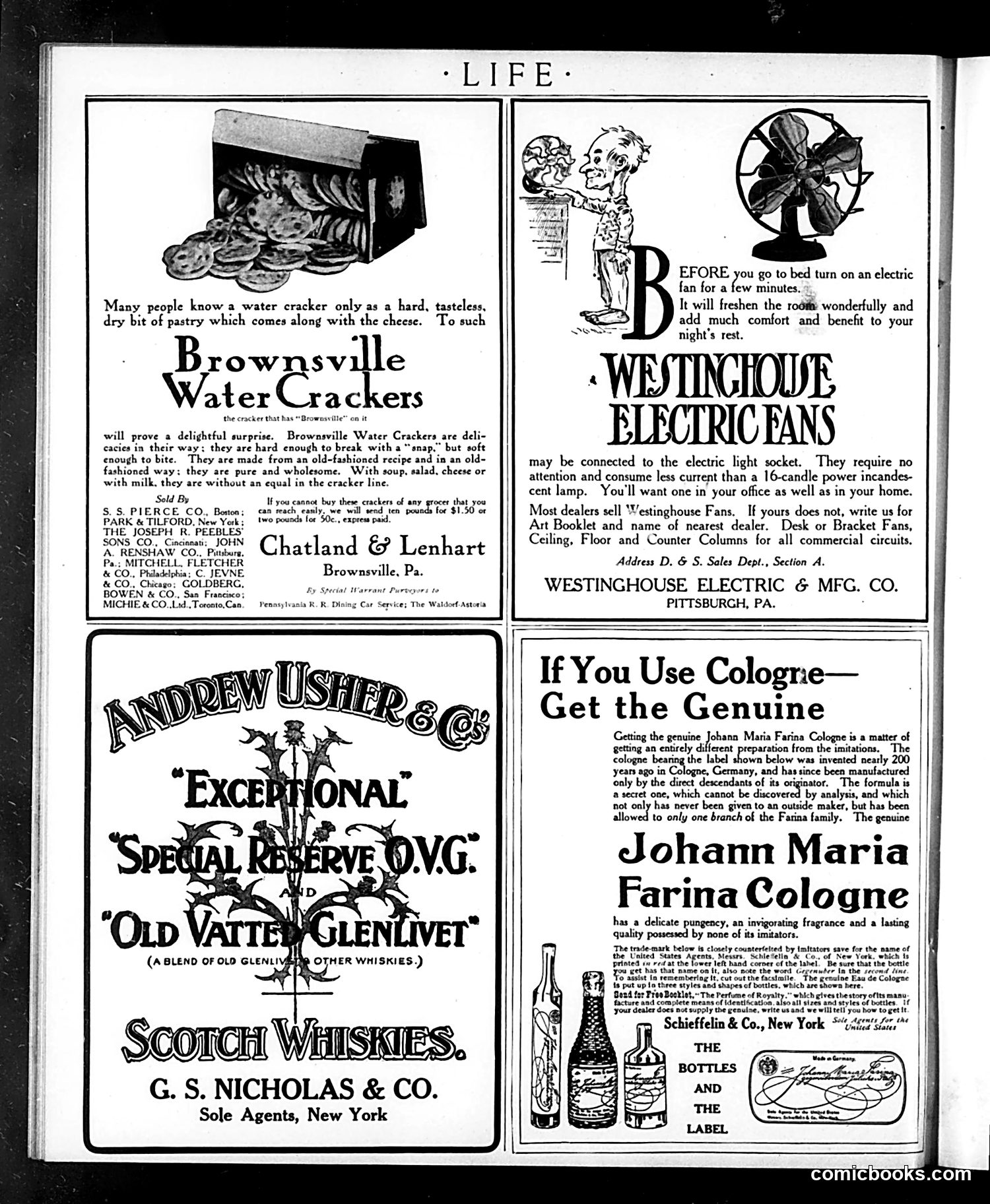
This page contains **no political cartoons or satire**—it's primarily **early 20th-century advertising**. The four ads promote: 1. **Brownsville Water Crackers** (top left)—a food product; the ad emphasizes these are superior crackers, contrasting them with harder, tasteless varieties. 2. **Westinghouse Electric Fans** (top right)—household appliances marketed for bedroom cooling before air conditioning, claiming efficiency and comfort benefits. 3. **Andrew Usher & Co. Scotch Whiskies** (bottom left)—spirits advertising their various blended whisky products. 4. **Johann Maria Farina Cologne** (bottom right)—a cologne brand emphasizing authenticity and warning against counterfeits, explaining the product's 200-year history. The page reflects consumer culture and product competition of the era, with no satirical or political content present.
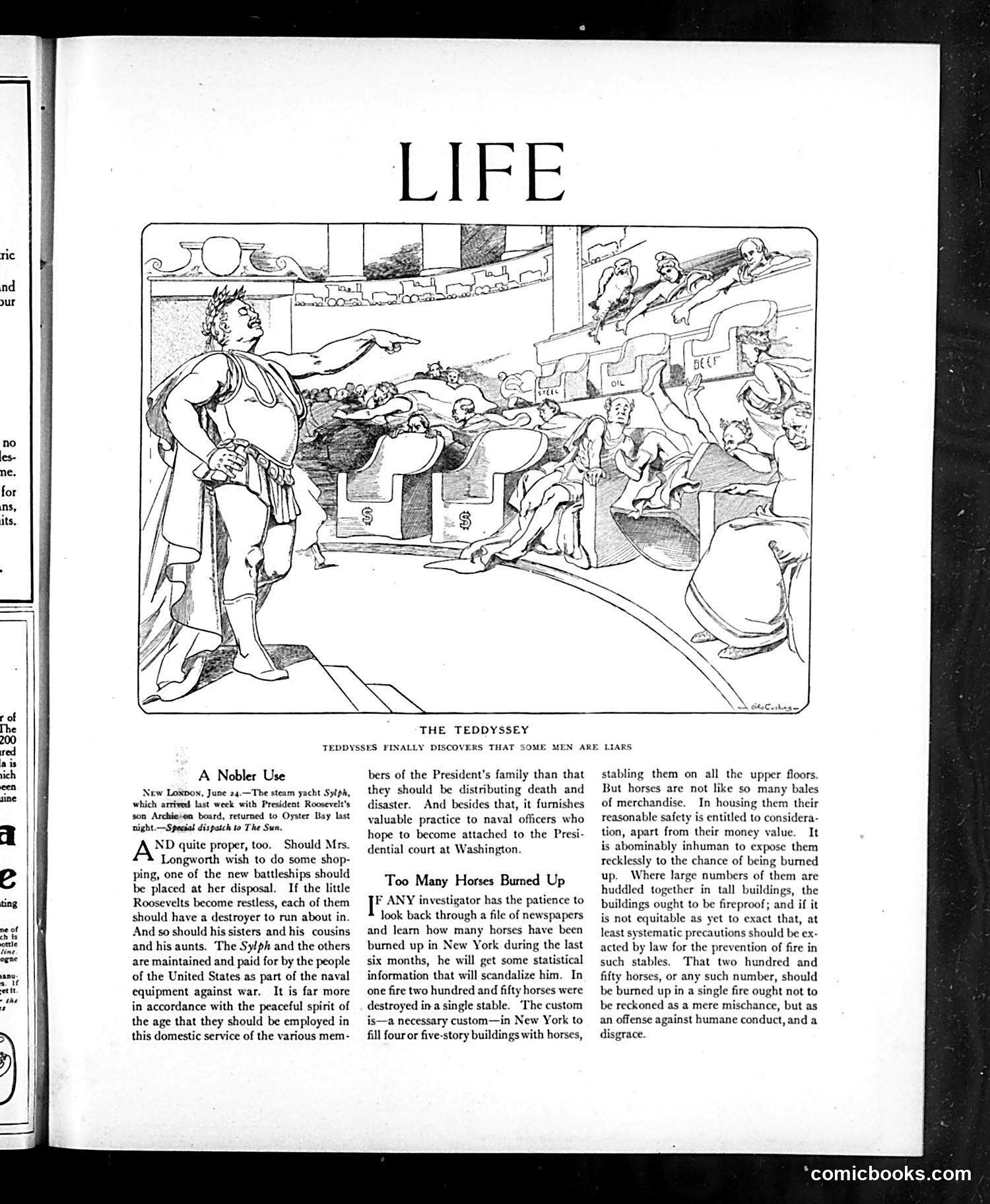
This page satirizes Theodore Roosevelt and his administration during the early 1900s. The main cartoon, titled "The Teddyssey Finally Discovers That Some Men Are Liars," depicts Roosevelt (identifiable by his characteristic robust physique and prominent teeth) discovering deception among his associates. The accompanying articles address two specific scandals: "A Nobler Use" discusses mismanagement of battleships intended for Roosevelt's naval program, suggesting they be repurposed for the President's family rather than wasted. "Too Many Horses Burned Up" criticizes dangerous conditions in New York stables where over 150 horses died in a single fire, arguing such losses constitute animal cruelty and reflect poor government oversight. The satire critiques Roosevelt's executive management and trust in subordinates.
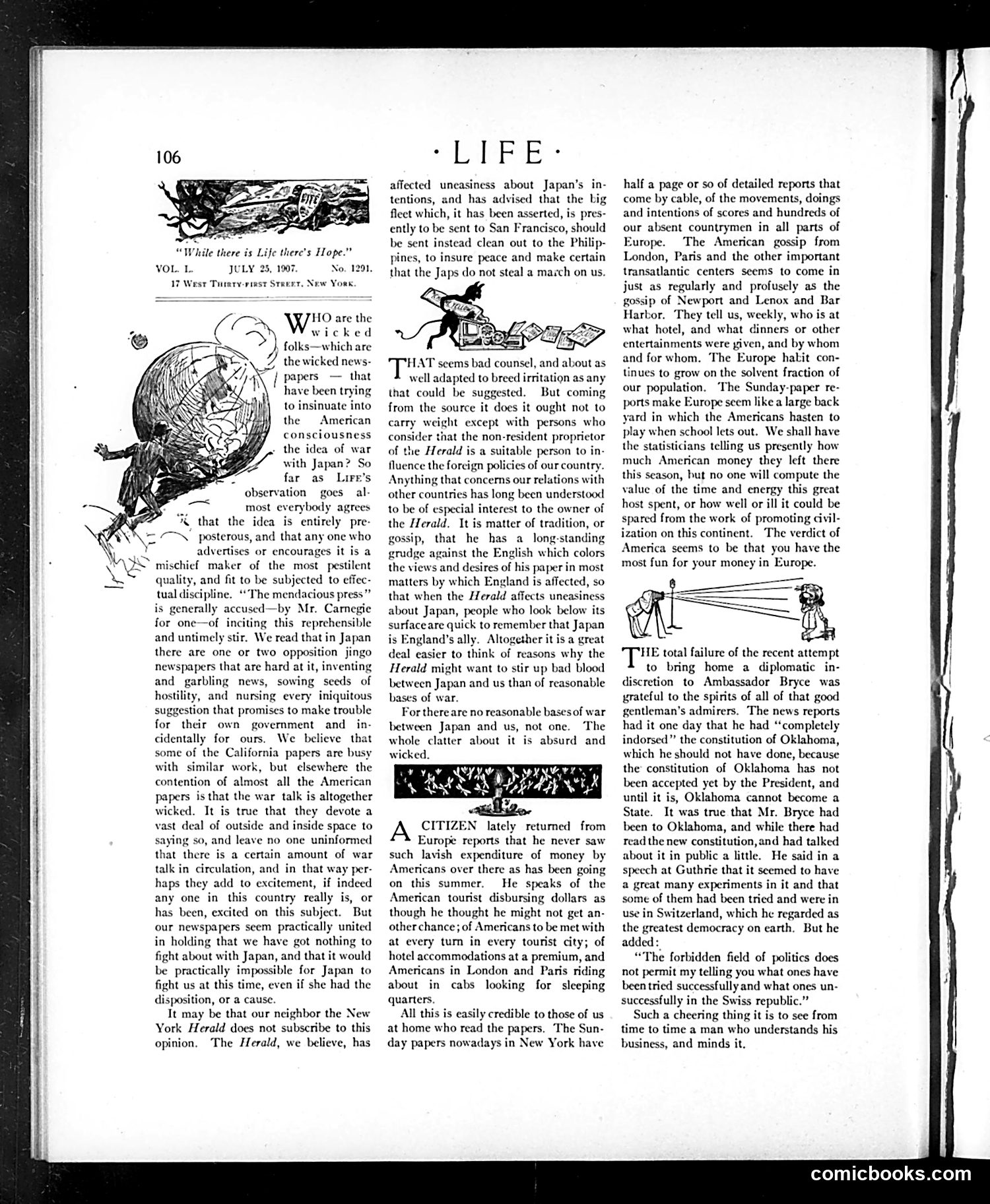
The page contains editorial commentary rather than traditional political cartoons. The main illustration shows a globe being crushed or weighted down, symbolizing America's global concerns and responsibilities. The text discusses American newspapers' coverage of Japan, particularly the *New York Herald*'s role in inflaming tensions. The author argues that sensationalist reporting about potential war with Japan is irresponsible, especially since there are "no reasonable bases of war" between the nations. The piece criticizes how papers manufacture anxiety about foreign affairs for circulation, while lamenting that Ambassador Bryce's failed diplomatic mission to resolve Oklahoma statehood disputes received inadequate attention. The satire targets both jingoistic media and diplomatic incompetence during an era of rising international tensions.
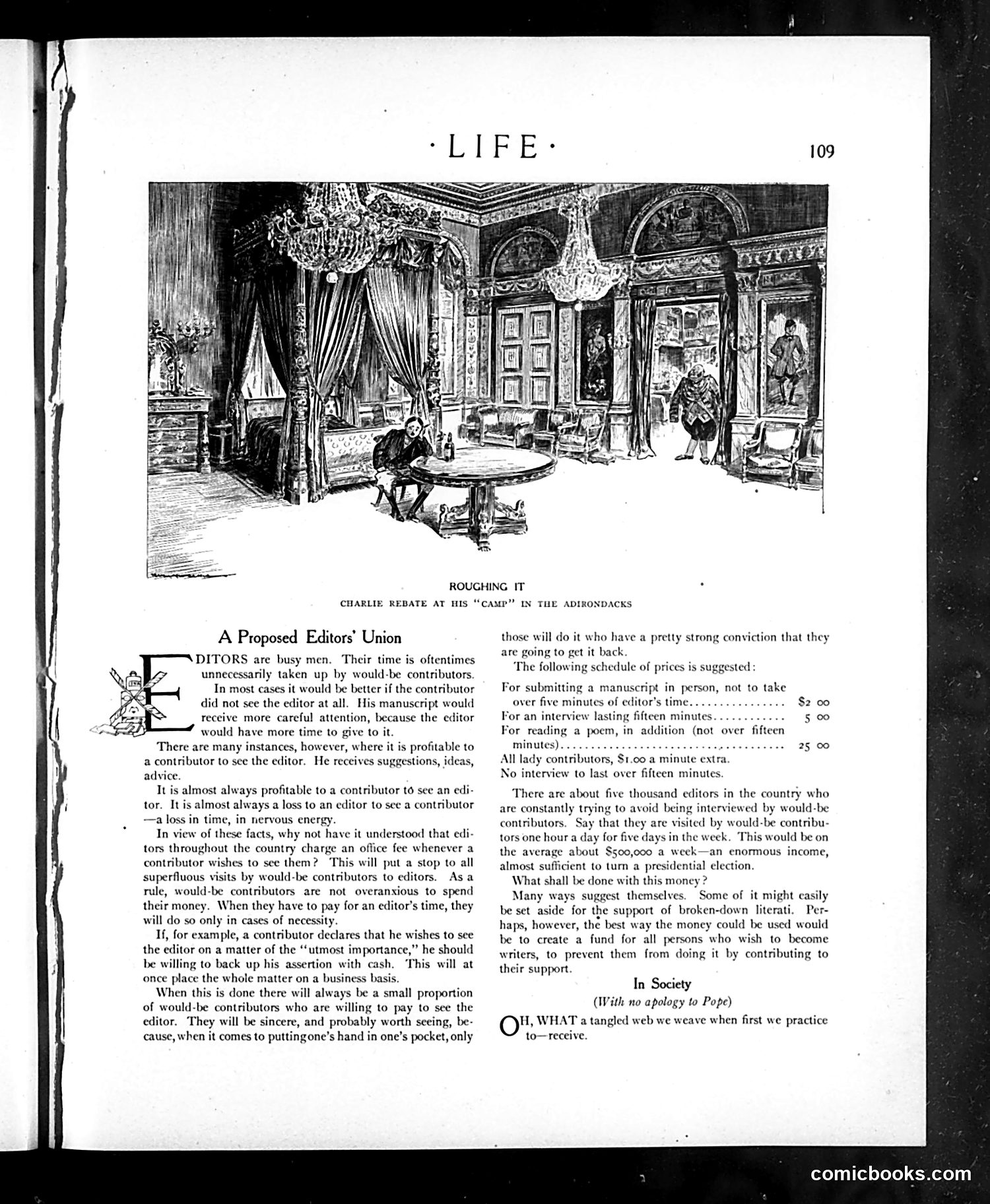
The page features two distinct sections: **Top Image:** "Roughing It - Charlie Rebate at His 'Camp' in the Adirondacks" depicts a luxuriously appointed bedroom with fine furnishings, chandeliers, and decorative paintings—clearly satirizing the wealthy's definition of "roughing it." The joke mocks how the rich sanitize outdoor vacationing with urban comforts. **Main Article:** "A Proposed Editors' Union" satirizes the relationship between magazine editors and freelance contributors. It proposes a fee schedule ($2-25) for contributors to see editors, mocking how editors waste contributors' time. The piece suggests this absurd reversal would address the power imbalance, while ironically proposing a fund to support struggling writers—highlighting economic inequality in publishing circa early 1900s.
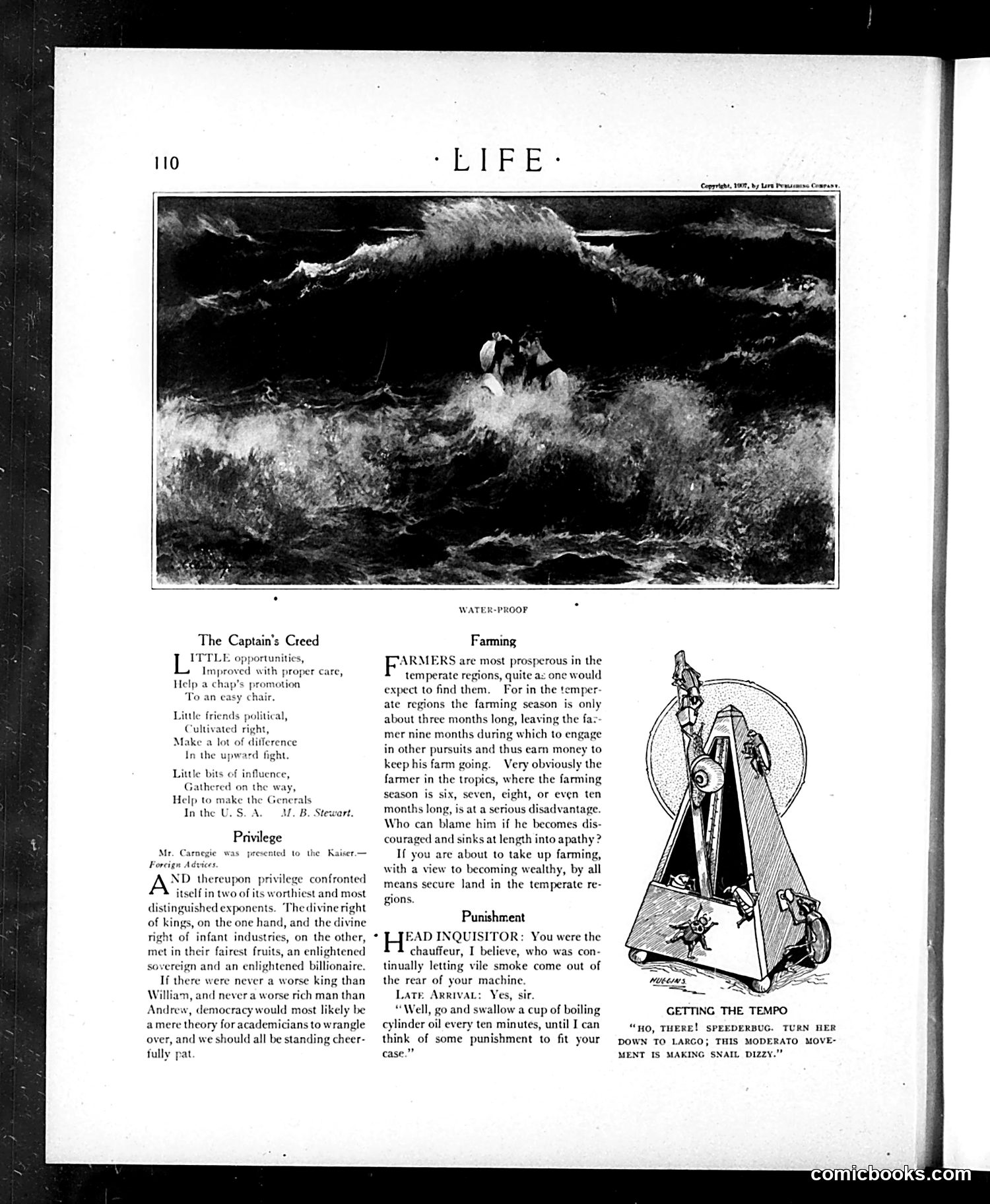
This page contains three separate pieces of satirical content: **"The Captain's Creed"** and **"Privilege"** are poems/verses mocking aristocratic entitlement and class systems. "Privilege" specifically critiques the unfair advantages of nobility, referencing kings like William and Andrew, suggesting that democracy would be preferable to such unequal systems. **"Farming"** discusses seasonal agricultural work in temperate versus tropical climates, presenting practical commentary rather than satire. **"Punishment"** depicts a dialogue between an Inquisitor and a "Late Arrival," mocking religious institutional cruelty through dark humor—the punishment of drinking boiling oil is presented as absurd and excessive. The illustration **"Getting the Tempo"** shows a speedboat/snail hybrid vessel, a visual pun about speed and slowness, likely satirizing technological pretension or the gap between ambition and reality.
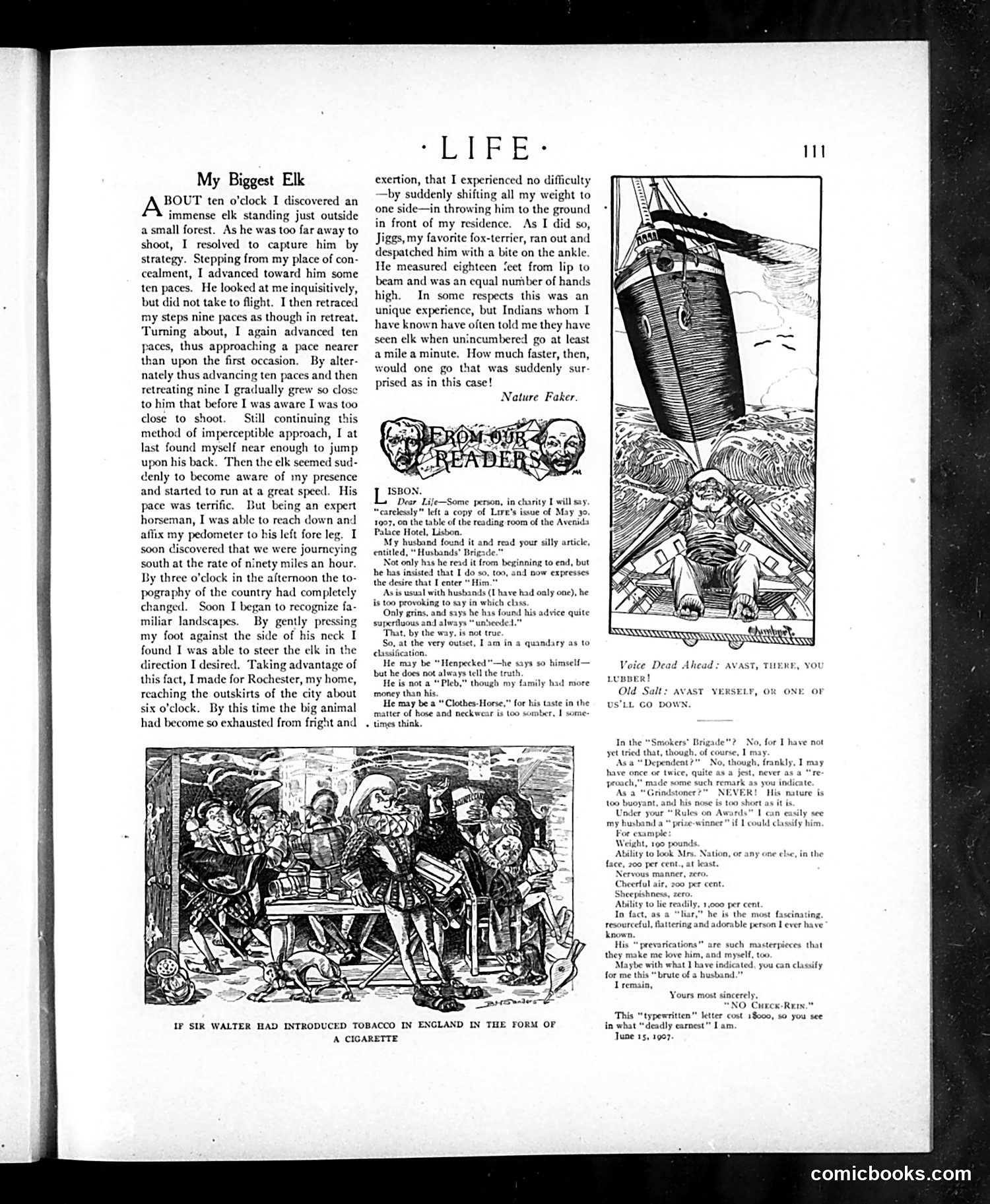
This page contains two distinct pieces: **"My Biggest Elk"** (left): A hunting narrative about pursuing an elk, describing the author's strategy of gradually approaching the animal until shooting it near Rochester. The story emphasizes the elk's speed and the challenge of the hunt. **"From Our Reader"** (right): A humorous letter from a reader responding to a previous "Husbands' Brigade" article in Life. The writer defends her husband against various unflattering classifications (Henpecked, Clothes-Horse, etc.), providing comedic descriptions of his actual merits. She concludes with pointed sarcasm about her husband's "typewritten" letter being "deadly earnest." **The large illustration** depicts a Renaissance-era scene captioned as showing "IF SIR WALTER HAD INTRODUCED TOBACCO IN ENGLAND IN THE FORM OF A CIGARETTE"—a humorous historical alternate-reality scenario.
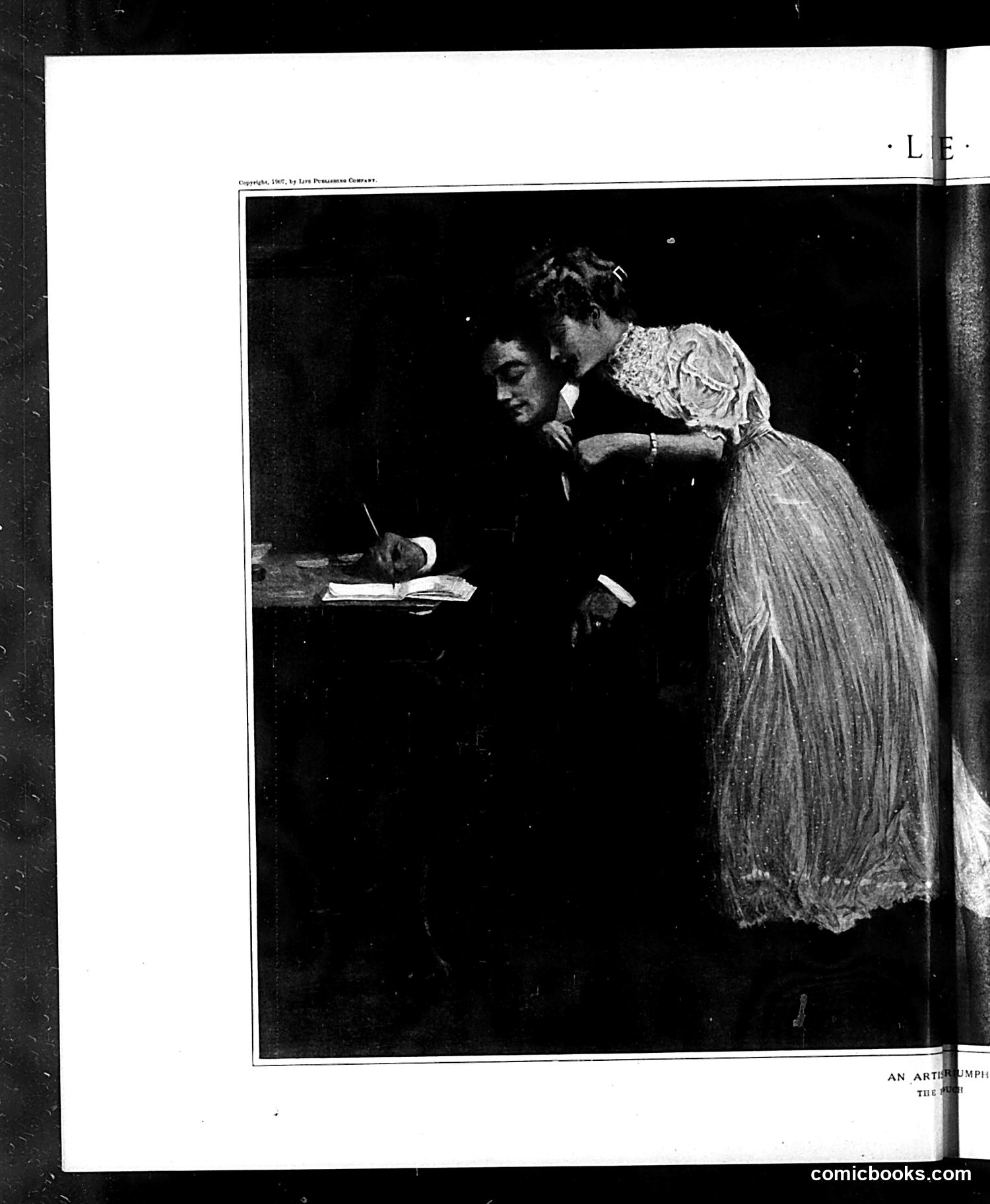
This appears to be a page from Life magazine (copyright 1907, per the header). The black and white photograph shows two figures in what seems to be an interior scene—a man seated at a desk or table writing, and a woman in an elaborate dress leaning toward him in an intimate pose. The caption reads "AN ARTIST'S TRIUMPH" (partially visible at bottom), suggesting this depicts a romantic or flirtatious scenario, likely satirizing artistic life or social interactions of the Edwardian era. Without clearer caption text or identifying context, I cannot specify which particular figures, events, or social commentary this references. The image appears to be satirical commentary on relationships or artistic society of early 1900s America, but specific identities remain unclear.
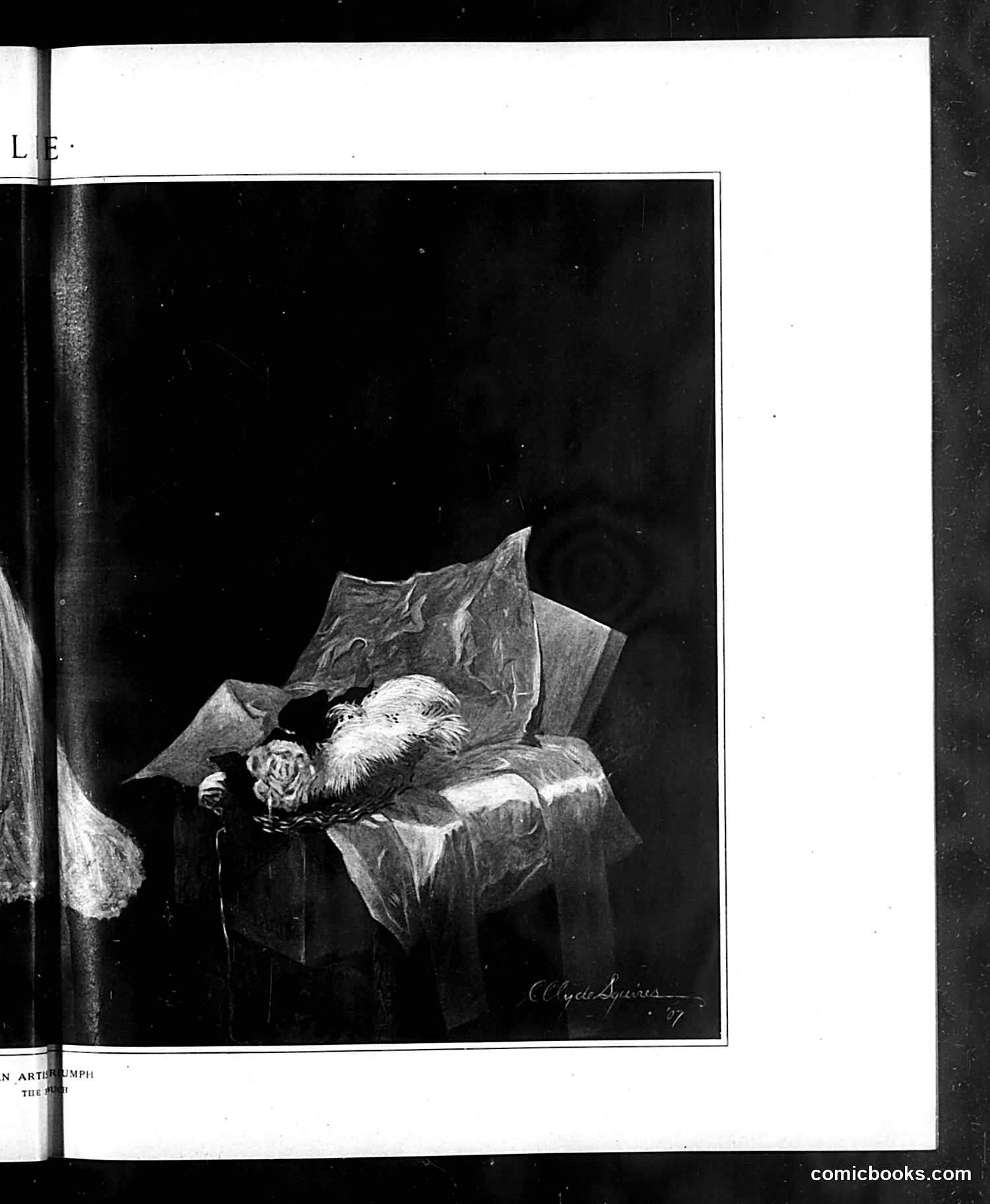
This appears to be a satirical illustration from Life magazine, signed by what looks like "Opper Spires" (or similar) and dated '97. The image shows an elderly bearded man reclining among cushions and fabrics, holding what appears to be a rose. The man's exaggerated features and luxurious surroundings suggest this is a caricature of a specific public figure. The OCR text mentions "AN ARTIST'S TRIUMPH" and "THE" (text cut off), but without the complete caption, the specific identity and satirical point remain unclear. The composition and style suggest commentary on wealth, vanity, or artistic pretension common to Life's satirical approach of that era, but I cannot definitively identify the target or intended message without additional context.
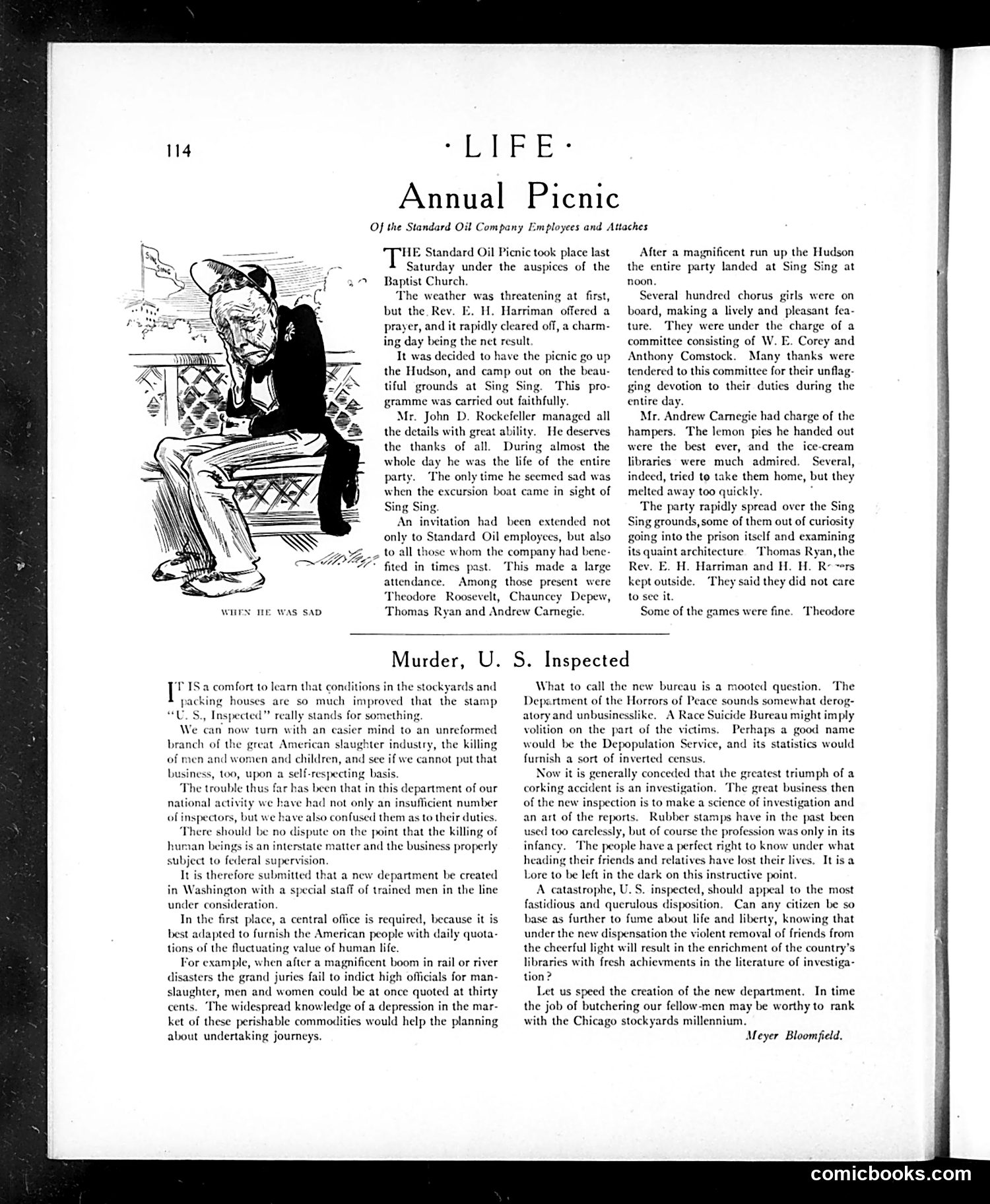
**"Annual Picnic"** (top): Illustrates a Standard Oil Company employee picnic at Sing Sing prison grounds on the Hudson River. The cartoon shows a seated figure labeled "WHEN HE WAS SAD," depicting someone eating at the event. The article describes the picnic's organization, food (including "lemon pies"), games, and notable attendees including Theodore Roosevelt and Andrew Carnegie. It's a lighthearted account of corporate recreation. **"Murder, U.S. Inspected"** (bottom): A satirical opinion piece arguing for a new government department to oversee slaughterhouse conditions and meat inspection. The author (Meyer Bloomfield) critiques current inspection standards as inadequate, suggesting the "Department of Horrors of Peace" as a sardonic name. He argues improved oversight could prevent contaminated meat from entering commerce—a reference to Progressive Era food-safety concerns.
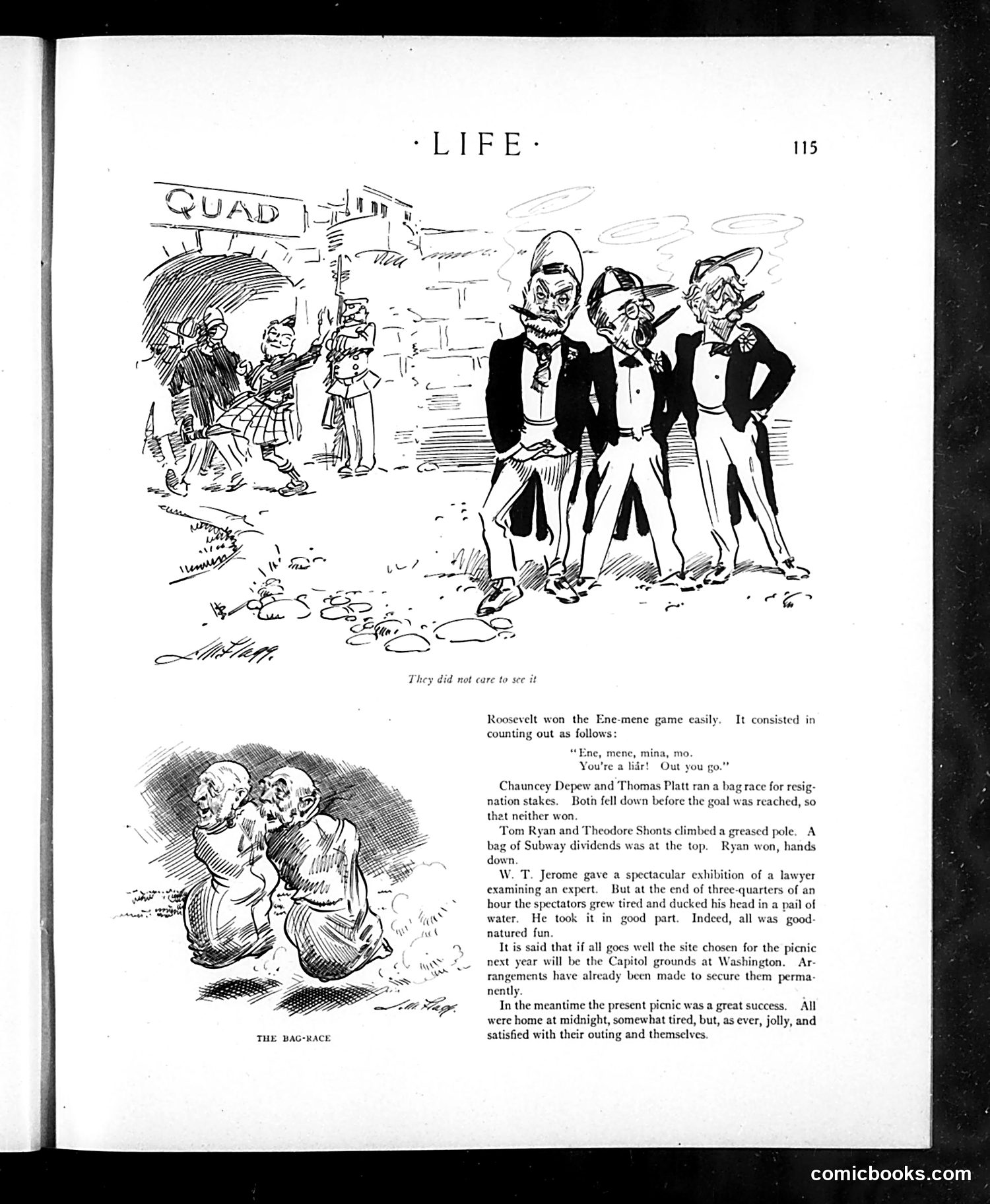
This page satirizes a picnic outing featuring prominent political figures. The top cartoon shows three men in formal attire labeled "QUAD" who "did not care to see it"—likely referencing a Fourth of July or patriotic celebration they're ignoring or dismissing. The text mentions Roosevelt winning an "Eene-mene" counting game, alongside anecdotes about other figures: Chauncey Depew, Thomas Platt, Tom Ryan, Theodore Shorts, W.T. Jerome, and others engaged in various competitive activities. The "Bag-race" illustration depicts two rotund figures in a humorous physical competition. The satire appears to mock these political figures' undignified behavior at a social gathering, presenting them as vain and absurd—a common Life magazine approach to deflating public figures' pretensions through caricature and comic scenarios.
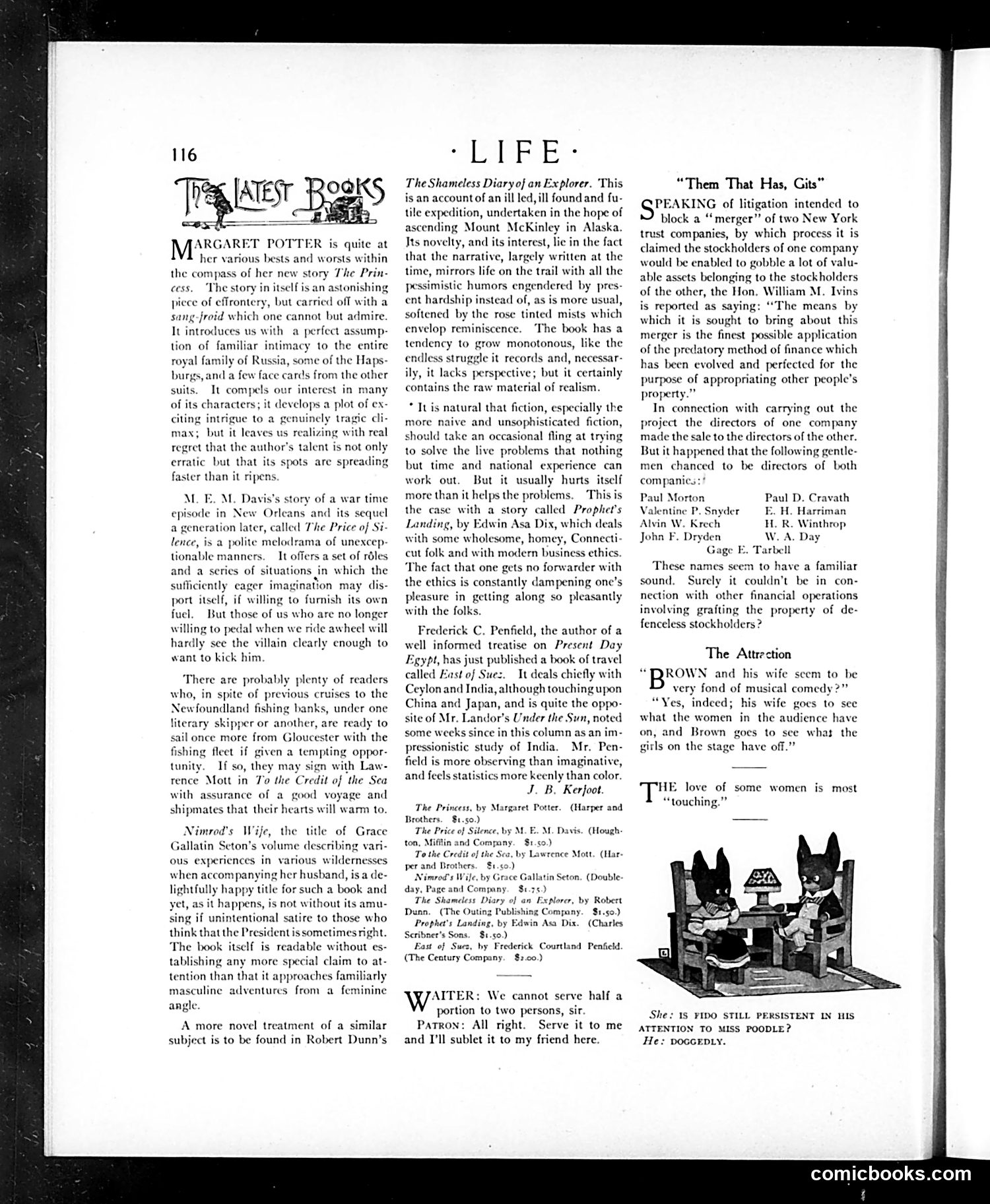
This page is primarily a book review column from *Life* magazine. The cartoon at bottom right, titled "The Attraction," depicts a theatrical castle set with two silhouetted figures. The accompanying dialogue—"Yes indeed; his wife goes to see what the scenery in the audience has on, and Brown goes to see what the girls on the stage have off!"—is a joke about differing reasons spouses attend theater. The humor relies on gender stereotypes: wives supposedly attend to observe fashionable clothing worn by female audience members, while husbands attend to ogle actresses. This reflects early 20th-century social attitudes about male and female interests and the theater as a space where such voyeurism was normalized or joked about. The illustration's theatrical setting emphasizes the performance and spectatorship central to the joke.
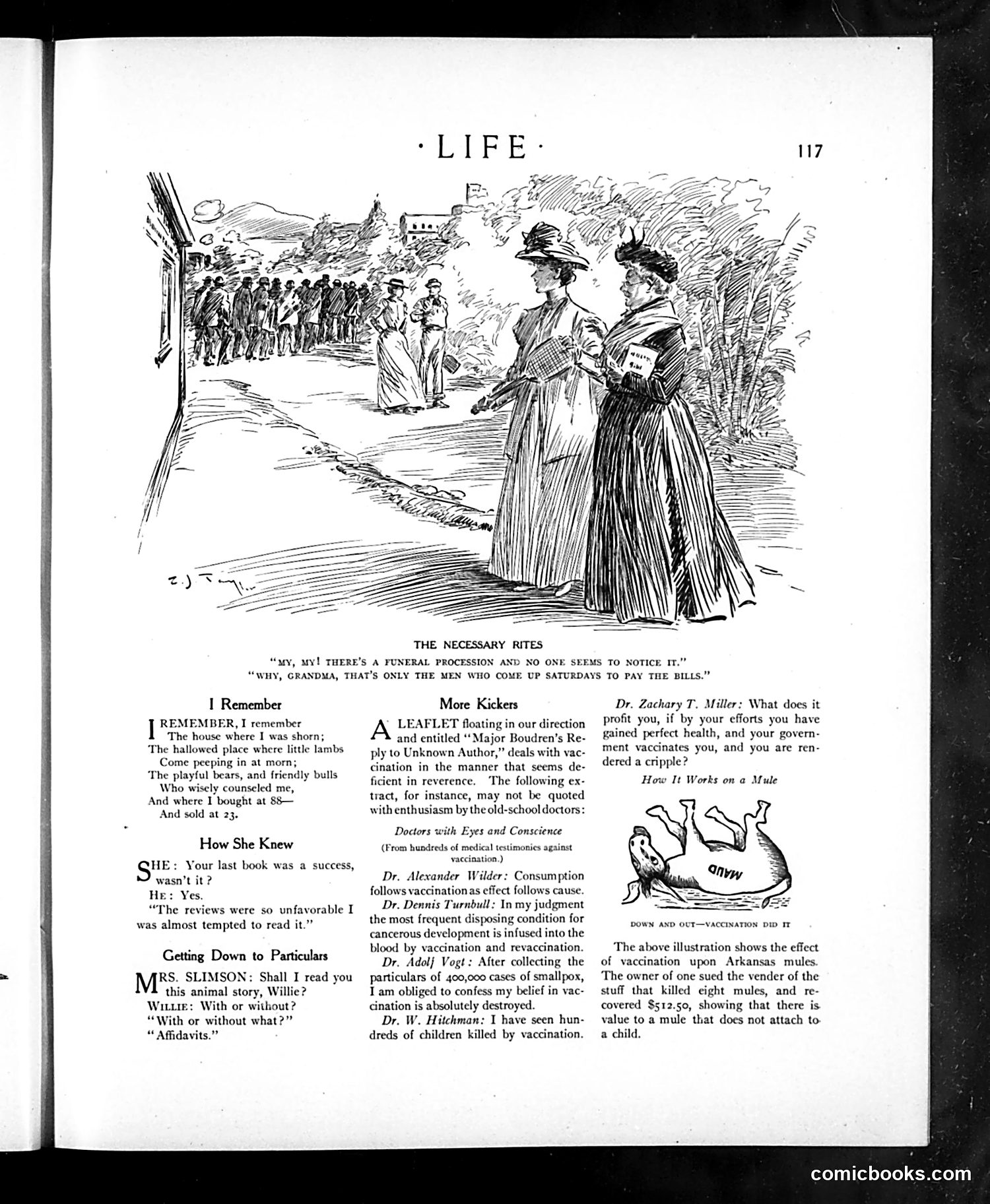
This page attacks mandatory vaccination through satire and mock-serious "evidence." The top cartoon jokes that funeral processions go unnoticed because people are too busy paying bills—suggesting vaccination deaths are commonplace and ignored. The main content, "More Kickers," presents a leaflet allegedly by "Major Boudren" quoting doctors claiming vaccination causes consumption, cancer, and death. The illustration of a dead mule sarcastically notes that Arkansas courts awarded $512.50 damages for a vaccinated mule's death, but offers no such protection for vaccinated children—implying children's lives are valued less than animals. This reflects early 20th-century anti-vaccination sentiment, presenting debunked medical claims as fact. The satire's target appears ambiguous: it may mock either anti-vaccinationists or pro-vaccination authorities, though the overall effect amplifies vaccine hesitancy arguments through ridicule dressed as evidence.
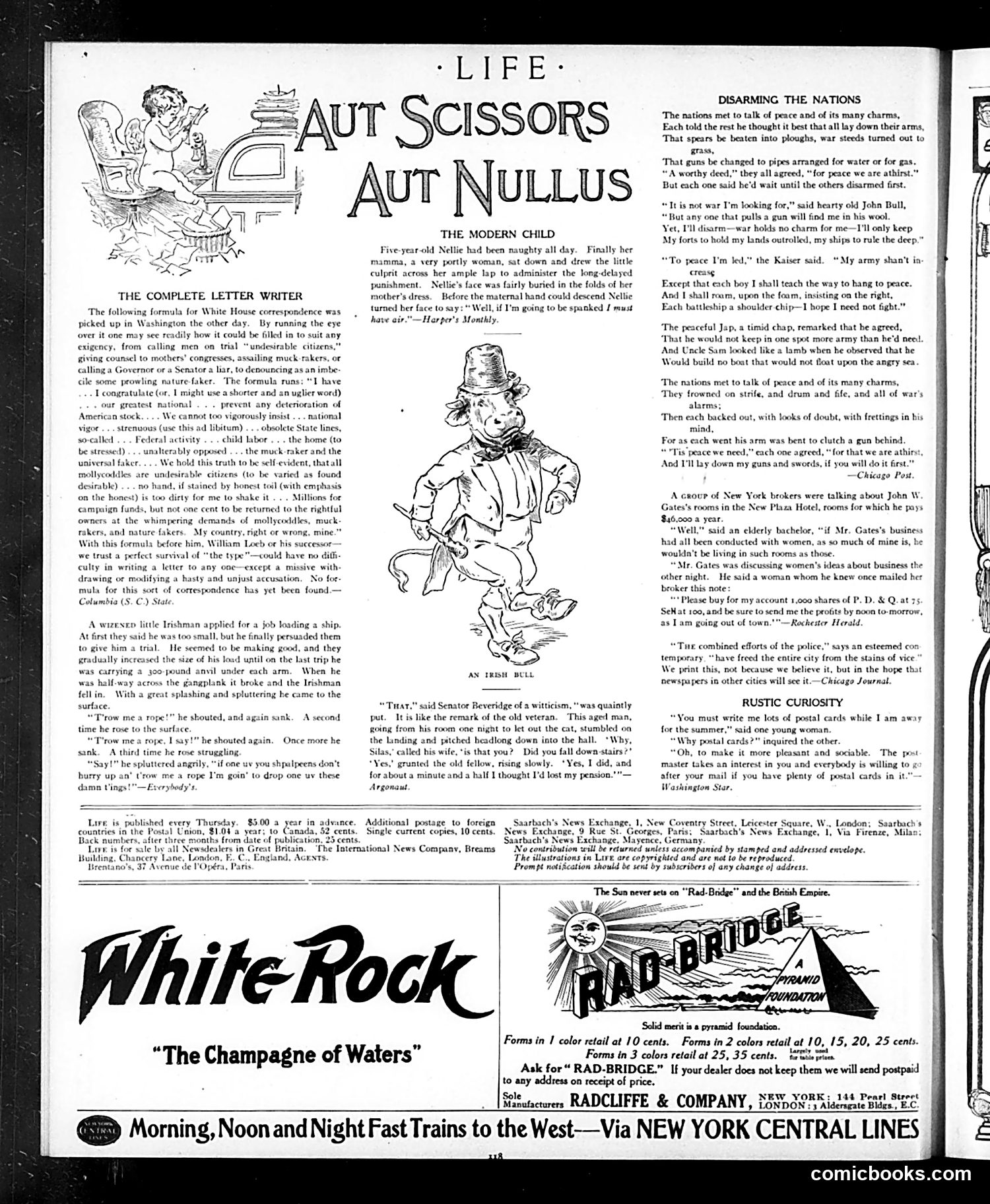
This page from *Life* magazine contains three distinct satirical pieces: **"The Complete Letter Writer"** mocks President Theodore Roosevelt's inflammatory rhetoric by providing a "formula" for White House correspondence. The text demonstrates how Roosevelt routinely deployed insulting labels—calling political opponents "mollycoddles," "muck-rakers," and "undesirable citizens"—while wrapping his attacks in patriotic language about national vigor and the American character. The satire shows how these attacks were formulaic and interchangeable, suggesting Roosevelt's moral outrage was performative rather than principled. **"The Modern Child"** is a brief humor piece about a child's literal-minded complaint during spanking. **"An Irish Bull"** presents an ethnic joke (typical of the era) about Irish immigrants, playing on supposed Irish illogic. **"Disarming the Nations"** is a poem satirizing peace conferences where nations verbally commit to disarmament while continuing military preparations—peace talk as empty performance. The advertisements below are unrelated commercial content typical of the magazine's revenue model.
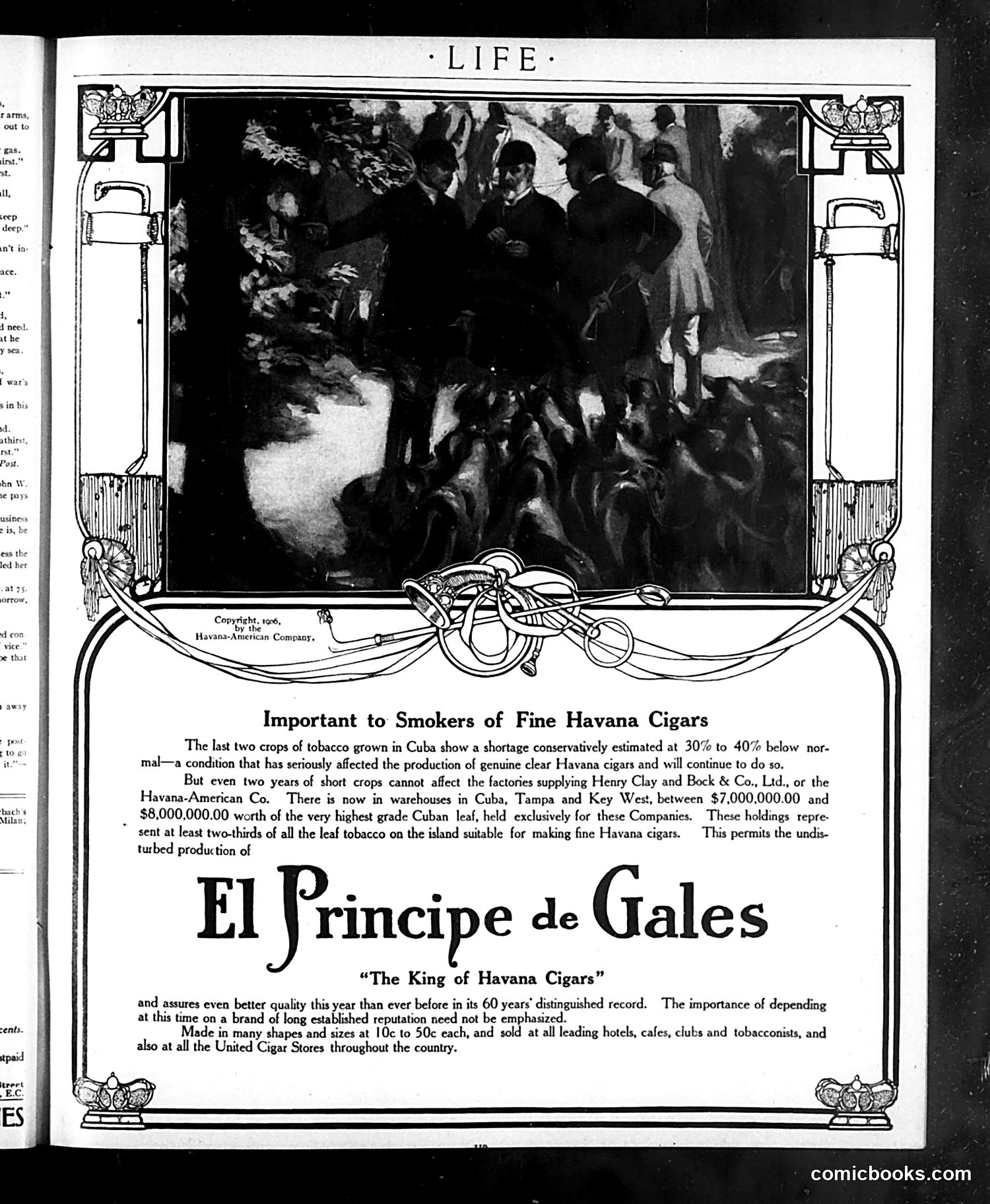
This is a **full-page advertisement** for El Príncipe de Gales cigars, not a political cartoon. The image shows a social gathering (likely a formal event or reception), but serves merely as decorative framing for the ad's message. **The actual content is commercial propaganda** addressing a real 1906 crisis: Cuban tobacco shortages (30-40% below normal) threatening Havana cigar production. The ad claims Henry Clay, Bock & Co., and Havana-American Co. stockpiled $7-8 million worth of premium Cuban leaf—two-thirds of all suitable island tobacco—guaranteeing uninterrupted quality. **The pitch**: While competitors struggle, El Príncipe de Gales ("The King of Havana Cigars") maintains its 60-year reputation through strategic reserves. Buy established brands, not risky unknowns. This is marketing exploiting geopolitical disruption, not satire.
This page from *Life* magazine is primarily **advertising and humorous anecdotes**, not political content. The small cartoons/jokes mock everyday situations: 1. **"Not Even the Clock"** — A joke about an insane asylum where an inmate jokes that the clock can't be right "or it wouldn't be here." The satire targets institutional absurdity. 2. **"They Run the Same Way"** — A play on "true love never did run smooth" (Shakespeare) applied to a malfunctioning automobile. Light domestic humor. 3. **The Arkansas landlord story** — Rural satire depicting a backwoods innkeeper's indifference to guest safety, playing on period stereotypes of isolated Southern hospitality. 4. **"An Eye to Business"** — A Chicago man admits he's lived 15 years without visiting his own city's famous attractions, mocking urban provincialism. The page is dominated by **period advertisements** for Garrick Club Whiskey, Hartshorn Shade Rollers, Pall Mall cigarettes, and hotels. These reflect early 20th-century consumer culture. The humor is gentle, domestic, and character-based rather than political.
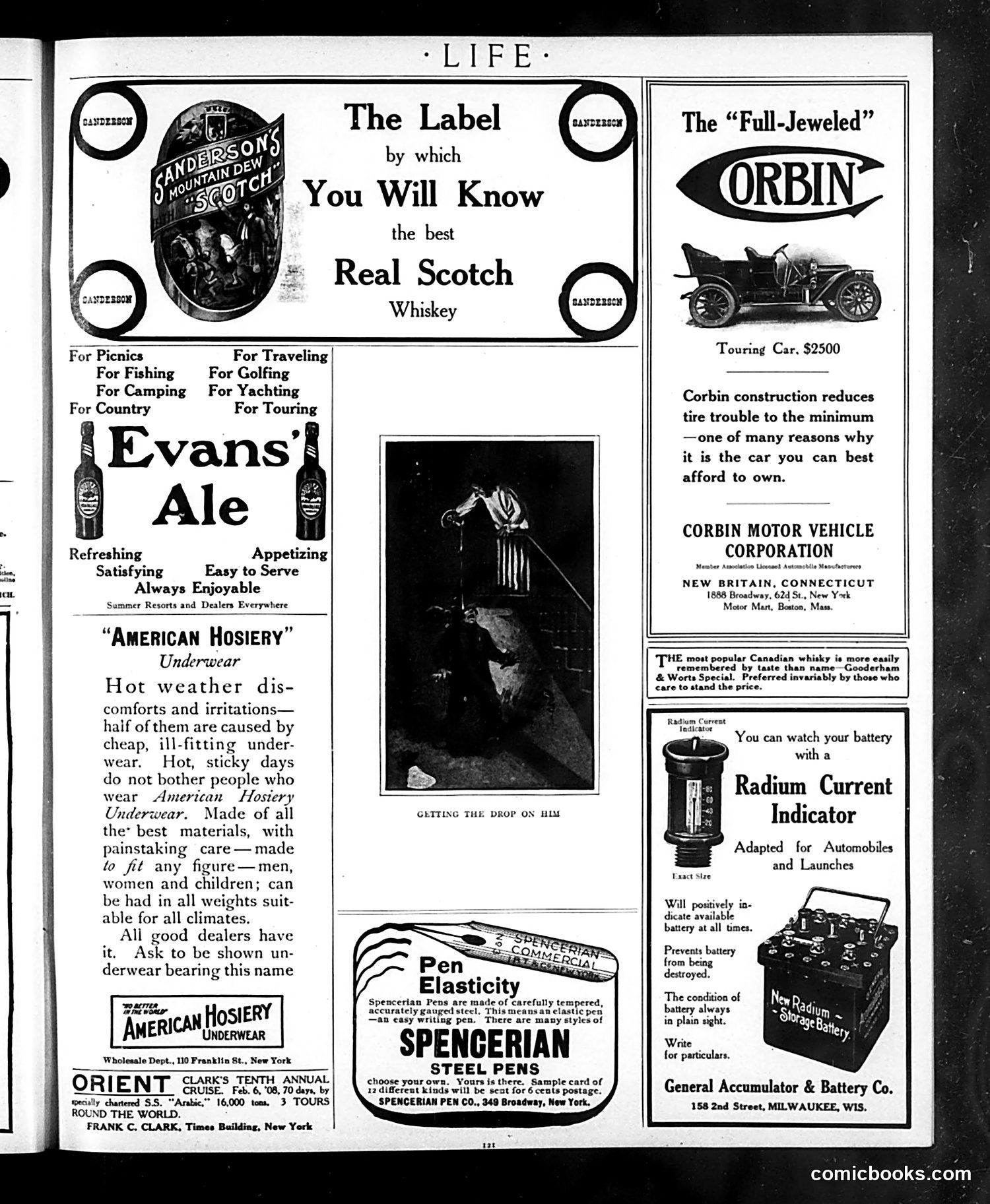
This page is primarily **advertising**, not political satire or editorial cartooning. It contains roughly a dozen commercial advertisements for early 20th-century products: Scotch whisky, Evans' Ale, American Hosiery underwear, the Corbin touring car ($2,500), Spencerian steel pens, a Radium Current battery indicator, and a world cruise. The single illustration—captioned "Getting the Drop on Him"—appears to depict a dramatic scene of someone on a horse, though its specific meaning is unclear without additional context. It may illustrate a Western or adventure narrative but doesn't constitute political or social satire. The page reflects the magazine's era: early automobile advertising, luxury goods marketing, and the casual promotion of radium-based products (before radiation dangers were understood). This is a commercial rather than editorial page.
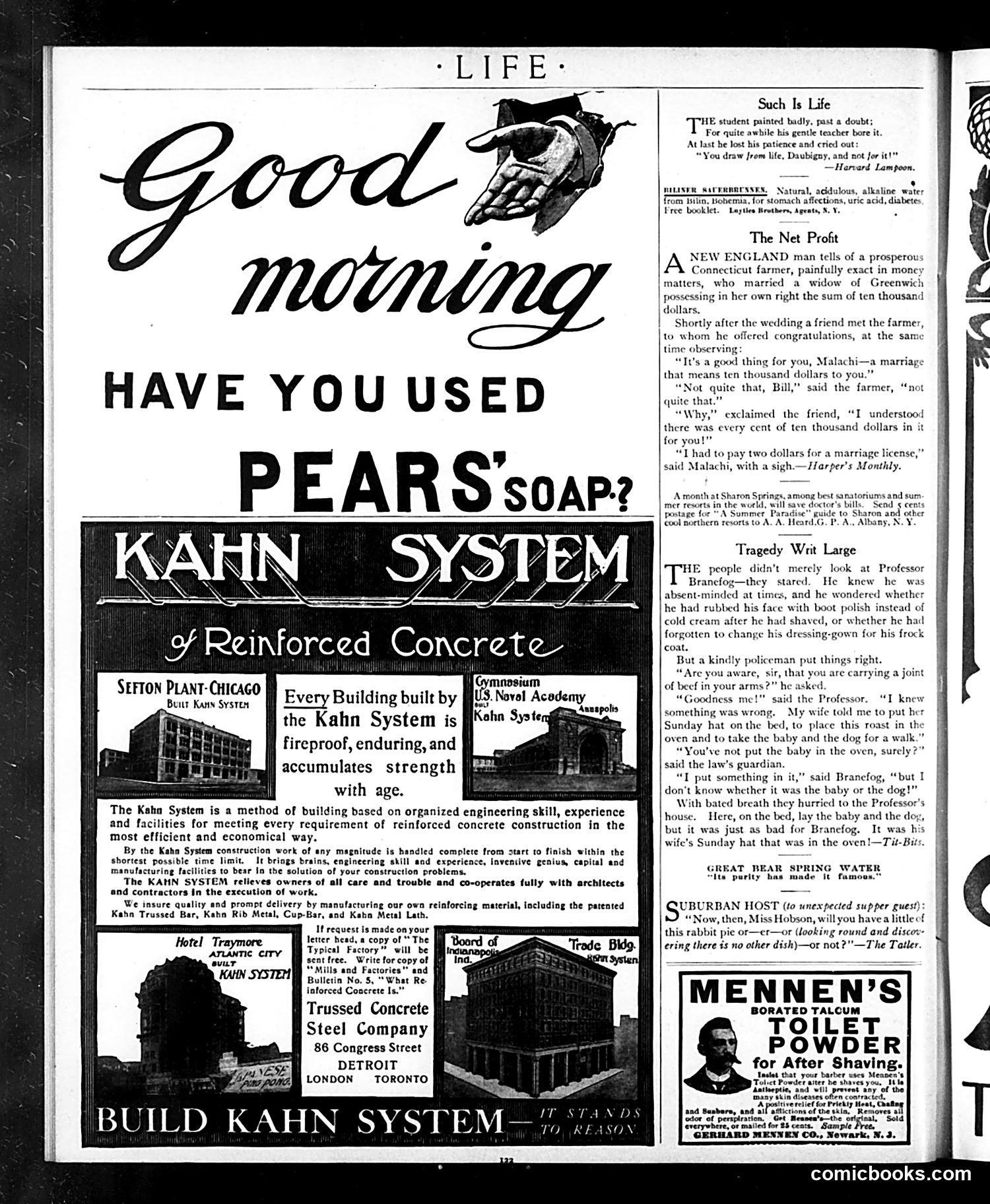
This page is primarily **advertising**, not satirical content. The dominant feature is a large Kahn System reinforced concrete advertisement showcasing building construction methods, with photographs of completed structures (a hotel, gymnasium, and office building). The small text pieces labeled "Such Is Life," "The Net Profit," and "Tragedy Writ Large" are brief humorous anecdotes—typical filler content for the era. They employ gentle, domestic humor: a student's poor drawing, a farmer's penny-pinching over marriage costs, and an absent-minded professor who confuses his wife's hat with a roast beef while carrying items in his arms. The page also includes period advertisements for mineral water, talcum powder, and other products. There is **no political satire or caricature** on this page. It represents the standard advertising-heavy format of early 20th-century American magazines, where commercial announcements subsidized editorial content.
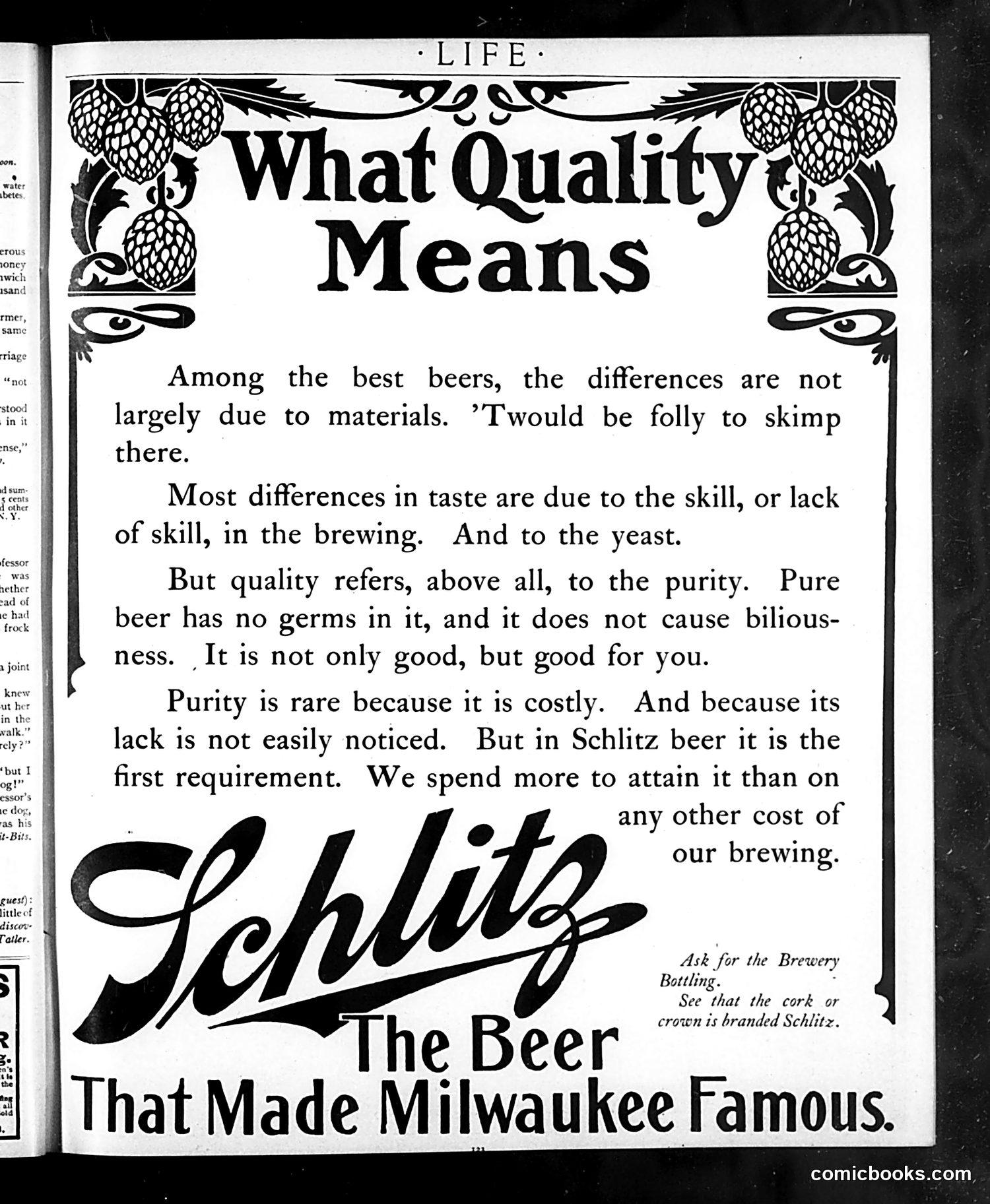
This is a **Schlitz beer advertisement**, not a political cartoon. It appeared in *Life* magazine during the early 20th century. The ad argues that quality beer depends primarily on **purity** rather than ingredients. Schlitz claims to prioritize purity above all else, spending more on this than any other brewing cost. The message emphasizes that pure beer contains no germs and won't cause illness—framing beer consumption as actually beneficial to health. This reflects the era's concerns about contaminated food and beverages, which were genuine public health issues before modern food safety regulations. The ad's tagline, "The Beer That Made Milwaukee Famous," references Milwaukee's prominence as a major brewing center. The decorative hop imagery frames this as a premium product. Readers should note this predates the FDA's modern regulations; such health claims would be illegal in contemporary advertising.
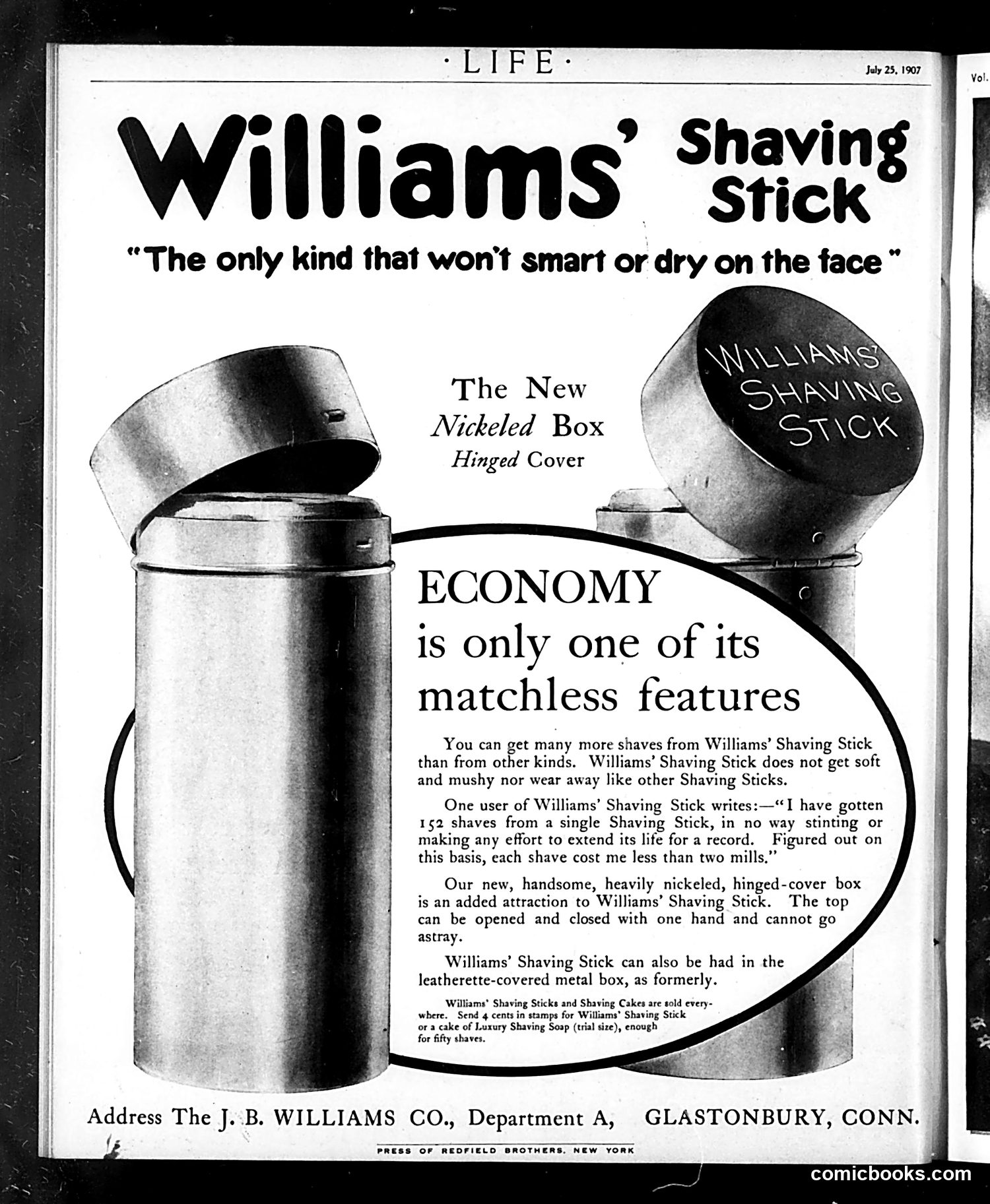
This is a **product advertisement**, not political satire. It promotes Williams' Shaving Stick, a solid grooming product sold by The J.B. Williams Co. of Connecticut. The page uses visual comparison of two cylindrical containers—one open, one closed—to showcase the "new" feature: a hinged, nickeled box that can be opened and closed one-handed. The advertisement emphasizes practical benefits: economy (152 shaves per stick), durability (won't soften or wear away), and convenience. The headline's promise—"won't smart or dry on the face"—addresses common complaints about competing shaving products of the era. A customer testimonial calculates the cost at less than two mills per shave, appealing to early-1900s consumer interest in value. This represents typical early-twentieth-century magazine advertising that emphasized product innovation and practical household economy.