
Life, 1907-07-25 · page 14 of 22
Life — July 25, 1907 — page 14: what you’re looking at
What you’re looking at
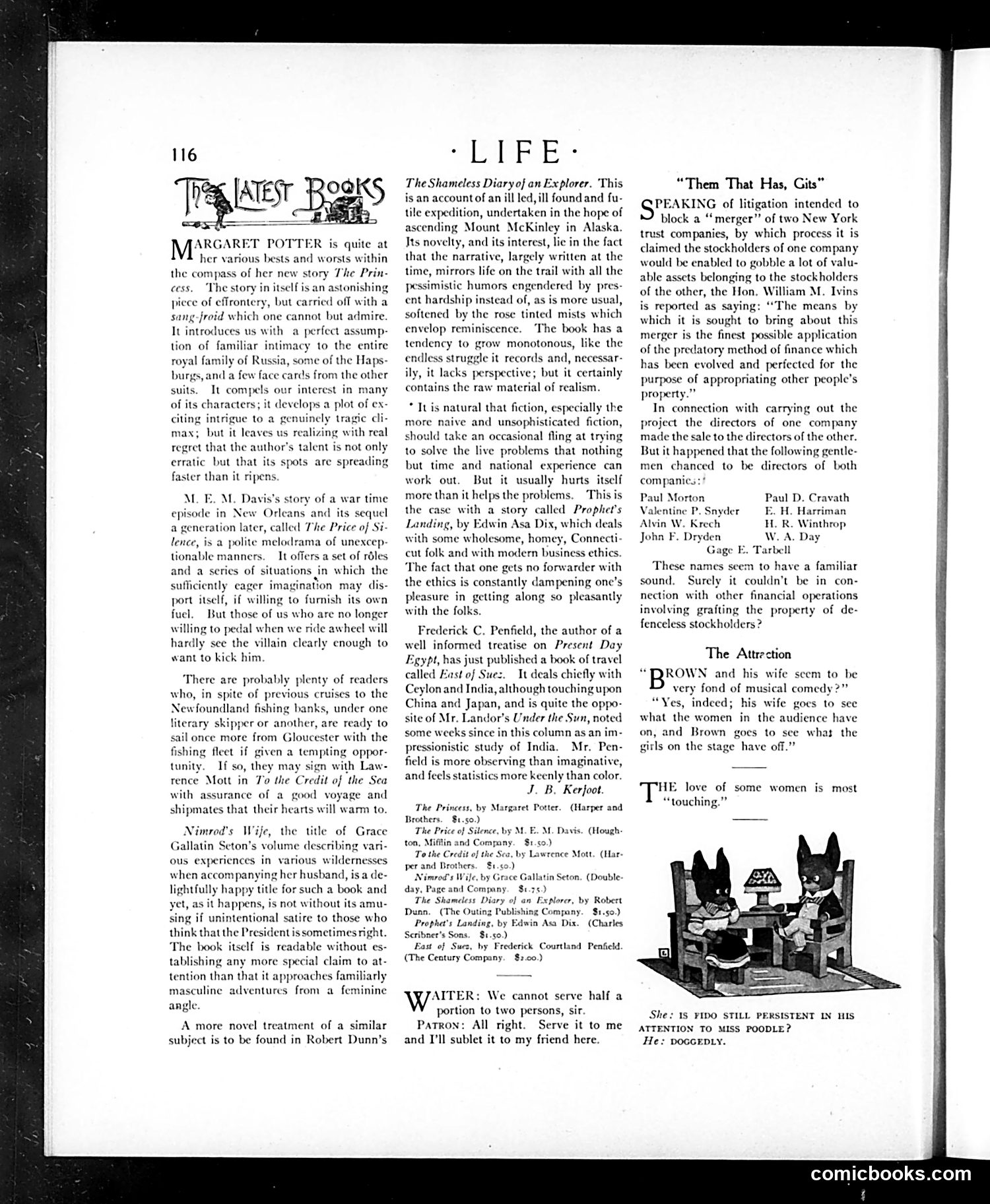
This page is primarily a book review column from *Life* magazine. The cartoon at bottom right, titled "The Attraction," depicts a theatrical castle set with two silhouetted figures. The accompanying dialogue—"Yes indeed; his wife goes to see what the scenery in the audience has on, and Brown goes to see what the girls on the stage have off!"—is a joke about differing reasons spouses attend theater. The humor relies on gender stereotypes: wives supposedly attend to observe fashionable clothing worn by female audience members, while husbands attend to ogle actresses. This reflects early 20th-century social attitudes about male and female interests and the theater as a space where such voyeurism was normalized or joked about. The illustration's theatrical setting emphasizes the performance and spectatorship central to the joke.
📄 Transcribed text from this page (OCR, searchable)
Machine-transcribed from the original scan — historical spelling and the odd misread are preserved.
116 Tp Bagi ARGARET POTTER is quite at her various bests and worsts within the compass of her new story The Prin- cess. ‘The story in itself is an astonishing piece of effrontery, but carried off with a sang-jroid which one cannot but admire. It introduces us with a perfect assum tion of familiar intimacy to the entire royal family of Russia, some of the Haps- burgs, and a few face cards from the other suits. It compels our interest in many of its characters; it develops a plot of ex- citing intrigue to a genuinely tragic cli- max; but it leaves us realizing with real regret that the author's talent is not only erratic but that its spots are spreading faster than it ripens. M. E. M. Davis's story of a war time episode in New Orleans and its sequel a generation later, called The Price of Si lence, is a polite melodrama of unexcep: tionable manners. It offers a set of roles and a series of situations in which the sufliciently eager imagination may dis- port itself, if willing to furnish its own fuel. But those of us who are no longer willing to pedal when we ride awheel will hardly see the villain clearly cnough to want to kick him There are probably plenty of readers who, in spite of previous cruises to the Newfoundland fishing banks, under one literary skipper or another, are ready to sail once more from Gloucester with the fishing fleet if given a tempting oppor- tunity. If so, they may sign with Law- rence Mott in To the Credit of the Sea with assurance of a good voyage and shipmates that their hearts will warm to. Nimrod’s Wije, the title of Grace Gallatin Seton’s volume describing vari- ous experiences in various wildernesses when accompanying her husband, is a de- lightfully happy title for such a book and yet, as it happens, is not without its amu- sing if unintentional satire to those who think that the President is sometimes right. The book itself is readable without es- tablishing any more special claim to at- tention than that it approaches familiarly masculine adventures from a feminine angle A more novel treatment of a similar subject is to be found in Robert Dunn’s ab) a) The Shameless Diary of an Explorer. This is an accountof an ill led, ill found and fu- tile expedition, undertaken in the hope of ascending Mount McKinley in Alaska. Its novelty, and its interest, lie in the fact that the narrative, largely written at the time, mirrors life on the trail with all the pessimistic humors engendered by pres- ent hardship instead of, as is more usual, softened by the rose tinted mists which envelop reminiscence. The book has a tendency to grow monotonous, like the endless struggle it records and, necessar ily, it lacks perspective; but it certainly contains the raw material of realism. * Ivis natural that fiction, especially the more naive and unsophisticated fiction, should take an occasional fling at trying to solve the live problems that nothing but time and national experience can work out. But it usually hurts itself more than it helps the problems. This is the case with a story called Prophet's Landing, by Edwin Asa Dix, which deals with some wholesome, homey, Connecti- cut folk and with modern business ethics. ‘The fact that one gets no forwarder with the ethics is constantly dampening one’s pleasure in getting along so pleasantly with the folks. Frederick C. Penfield, the author of a well informed treatise on Present Day Egypt, has just published a book of travel called East of Suez. It deals chiefly with Ceylon and India, although touching upon China and Japan, and is quite the oppo- site of Mr. Landor’s Under the Sun, noted some weeks since in this column as an im- pressionistic study of India. Mr. Pen- field is more observing than imaginative, and feels statistics more keenly than color. J. B. Kerfoot. The Princess, by Margaret Potter Brothers. $1.50.) The Price of Silence, by M. E. M. Davis. (Hough. ton, Miffin and Cc $1.0) To the Credit of by Lawr per and Brothers. $1.s0.) Nimrod’s Wile, by Grace Gallatin Seton. (Double- day, Page and Compa: S78) The Shameless Diary of an Explore Dunn, (The Outing Publishing Company Prophet's Landing, by Edwin Awa Dix. Scribner's Sons. $1.50.) East of Suez, by Frederick Courtland Penfield. (The Century Company. $2.00.) (Harper and pany nce Mott. (Har- by Robert $1.50.) (Charles ITER: We cannot serve half a portion to two persons, sir. Patron: All right. Serve it to me and I'll sublet it to my friend here. “Them That Has, Gits” PEAKING of litigation intended to block a ‘‘ merger” of two New York trust companies, by which process it is claimed the stockholders of one company would be enabled to gobble a lot of valu- able assets belonging to the stockholders of the other, the Hon, William M. Ivins is reported as saying: “The means by which it is sought to bring about this merger is the finest possible application of the predatory method of finance which has been evolved and perfected for the purpose of appropriating other people's property In connection with carrying out the project the directors of one company made the sale to the directors of the other. But it happened that the following gentle- men chanced to be directors of both companics:! Paul D. Cravath FE. H. Harriman H. R. Winthrop W. A. Day ‘arbell These names seem to have a familiar sound. Surely it couldn’t be in con- nection with other financial operations involving graiting the property of de- fenceless stockholders? Paul Morton Valentine P. Snyder Alvin W. Krech John F. Dryden Gage E. The Attrection “BROWN and his wife seem to be very fond of musical comedy?” “Yes, indeed; his wife goes to see what the women in the audience have on, and Brown goes to see what the girls on the stage have off.” HE love of some women is “touching.” most She: 1S ¥IDO STILL PERSISTENT IN HIS ATTENTION TO MISS POODLE? He: poocepty. comicbooks.com