
Life, 1907-07-25 · page 7 of 22
Life — July 25, 1907 — page 7: what you’re looking at
What you’re looking at
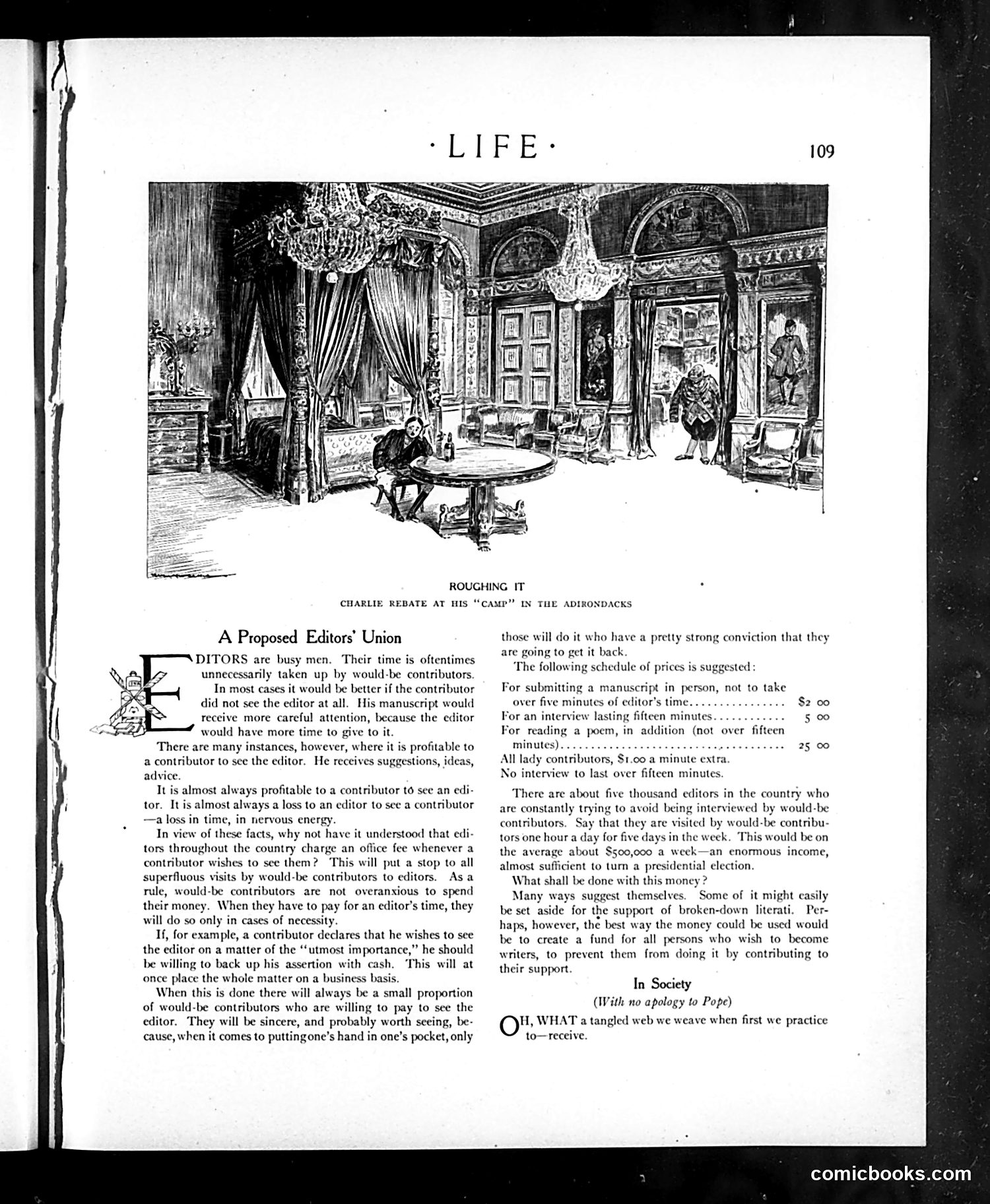
The page features two distinct sections: **Top Image:** "Roughing It - Charlie Rebate at His 'Camp' in the Adirondacks" depicts a luxuriously appointed bedroom with fine furnishings, chandeliers, and decorative paintings—clearly satirizing the wealthy's definition of "roughing it." The joke mocks how the rich sanitize outdoor vacationing with urban comforts. **Main Article:** "A Proposed Editors' Union" satirizes the relationship between magazine editors and freelance contributors. It proposes a fee schedule ($2-25) for contributors to see editors, mocking how editors waste contributors' time. The piece suggests this absurd reversal would address the power imbalance, while ironically proposing a fund to support struggling writers—highlighting economic inequality in publishing circa early 1900s.
📄 Transcribed text from this page (OCR, searchable)
Machine-transcribed from the original scan — historical spelling and the odd misread are preserved.
ROUGHING IT CHARLIE REBATE AT HIS A Proposed Editors’ Union DITORS are busy men. Their time is oftentimes unnecessarily taken up by would-be contributors. In most cases it would be better if the contributor did not see the editor at all. His manuscript would receive more careful attention, because the editor would have more time to give to it. There are many instances, however, where it is profitable to a contributor to see the editor. He receives suggestions, ideas, advice. It is almost always profitable to a contributor to see an edi- tor. It is almost always a loss to an editor to see a contributor —a loss in time, in nervous energy. In view of these facts, why not have it understood that edi- tors throughout the country charge an office fee whenever a contributor wishes to see them? This will put a stop to all superfluous visits by would-be contributors to editors. Asa rule, would-be contributors are not overanxious to spend their money. When they have to pay for an editor’s time, they will do so only in cases of necessity. If, for example, a contributor declares that he wishes to see the editor on a matter of the ‘‘utmost importance,” he should be willing to back up his assertion with cash. This will at the whole matter on a business basis. done there will always be a small proportion of would-be contributors who are willing to pay to see the editor. They will be sincere, and probably worth seeing, be- cause, when it comes to putting one’s hand in one’s pocket, only CAMP” IN THE ADIRONDACKS those will do it who have a pretty strong conviction that they are going to get it back. The following schedule of prices is suggested : For submitting a manuscript in person, not to take over five minutes of editor's time. . esters For an interview lasting fifteen minutes... For reading a poem, in addition (not over fifte minutes). : All lady contributors, $1.00 a minute extra. No interview to last over fifteen minutes $2 00 5 00 25 00 There are about five thousand editors in the country who are constantly trying to avoid being interviewed by would-be contributors. Say that they are visited by would-be contribu- tors one hour a day for five days in the week. This would be on the average about $500,000 a week—an enormous income, almost sufficient to turn a presidential election. What shall be done with this money ? Many ways suggest themselves. Some of it might casily be set aside for the support of broken-down literati. Per- haps, however, the best way the money could be used would be to create a fund for all persons who wish to become writers, to prevent them from doing it by contributing to their support. In Society (With no apology to Pope) H, WHAT a tangled web we weave when first we practice to—receive. comicbooks.com