
Life, 1907-07-25 · page 6 of 22
Life — July 25, 1907 — page 6: what you’re looking at
What you’re looking at
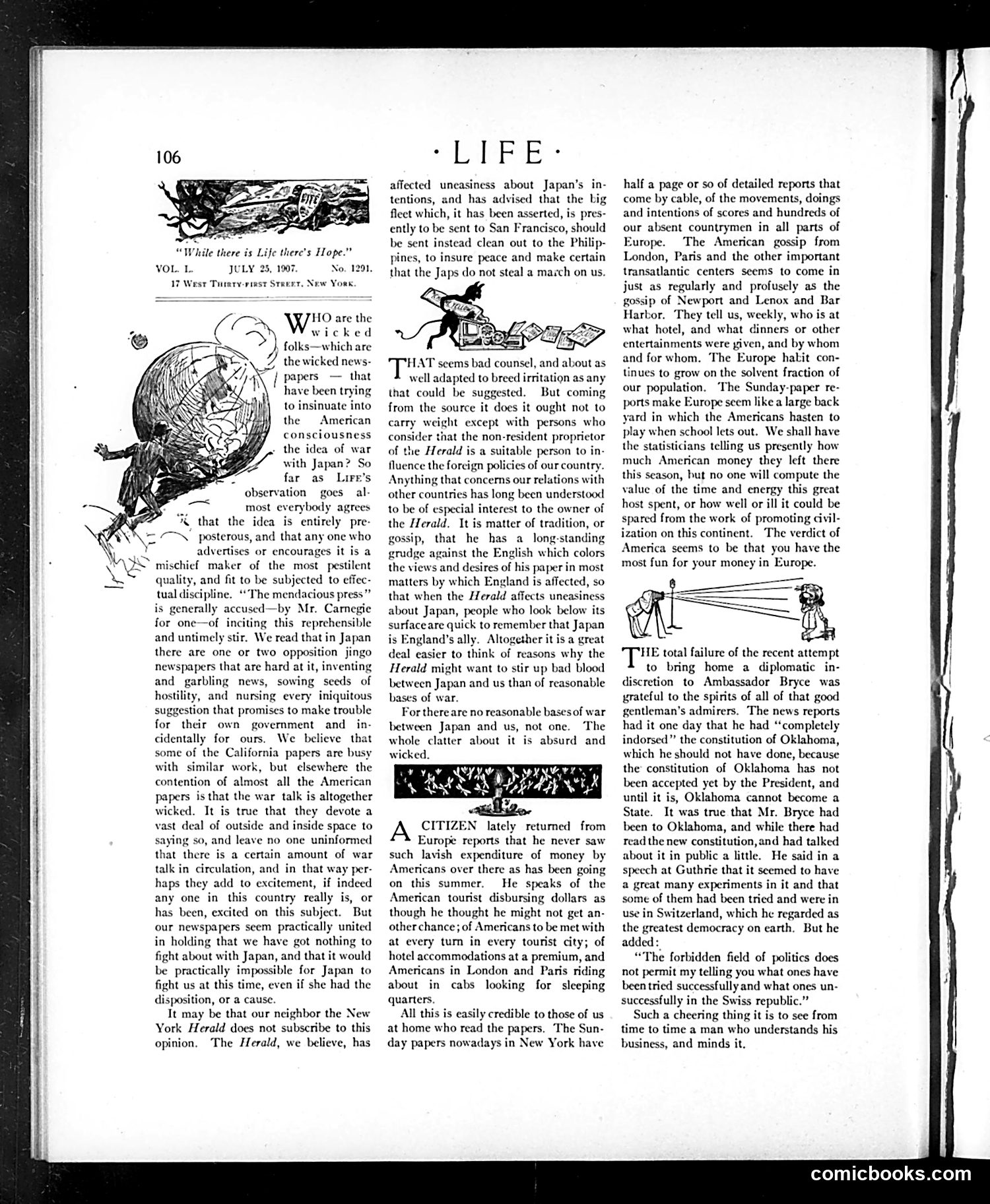
The page contains editorial commentary rather than traditional political cartoons. The main illustration shows a globe being crushed or weighted down, symbolizing America's global concerns and responsibilities. The text discusses American newspapers' coverage of Japan, particularly the *New York Herald*'s role in inflaming tensions. The author argues that sensationalist reporting about potential war with Japan is irresponsible, especially since there are "no reasonable bases of war" between the nations. The piece criticizes how papers manufacture anxiety about foreign affairs for circulation, while lamenting that Ambassador Bryce's failed diplomatic mission to resolve Oklahoma statehood disputes received inadequate attention. The satire targets both jingoistic media and diplomatic incompetence during an era of rising international tensions.
📄 Transcribed text from this page (OCR, searchable)
Machine-transcribed from the original scan — historical spelling and the odd misread are preserved.
“While there is Life there's Hope.” JULY 25, 1907. No. 1291, est Tutary-rinst Strerr, New York HO are the wicked folks—which are the wicked news- papers — that have been trying to insinuate into the — American consciousness . the idea of war with Japan? So far as Lire observation goes al- most everybody agrees % that the idea is entirely pre- =~ _posterous, and that any one who WY yo Nas advertises or encourages it is a mischief maker of the most pestilent quality, and fit to be subjected to effec- tual discipline. “The mendacious press” is generally accused—by Mr. Carnegie for one—of inciting this reprehensible and untimely stir, We read that in Japan there are one or two opposition jingo newspapers that are hard at it, inventing and garbling news, sowing seeds of hostility, and nursing every iniquitous suggestion that promises to make trouble for their own government and_in- cidentally for ours. We believe that some of the California papers are busy with similar work, but elsewhere the contention of almost all the Ameri papers is that the war talk is altogether wicked. It is true that they devote a vast deal of outside and inside space to saying so, and leave no one uninformed that there is a certain amount of war talk in circulation, and in that way per- haps they add to excitement, if indeed any one in this country really is, or has been, excited on this subject. But our newspapers seem practically united in holding that we have got nothing to fight about with Japan, and that it would be practically impossible for Japan to fight us at this time, even if she had the disposition, or a cause. It may be that our neighbor the Nev York Herald does not subscribe to this opinion, The Herald, we believe, has ie Eo og affected uneasiness about Japan's in- tention: id has advised that the big flect which, it has been asserted, is pres ently to be sent to San Francisco, should be sent instead clean out to the Philip- pines, to insure peace and make certain that the Japs do not steal a maych on us. HAT seems bad counsel, and about as well adapted to breed irritation as any that could be suggested. But coming from the source it does it ought not to carry weight except with persons who consider that the non-resident proprietor of the Herald is a suitable person to in- fluence the foreign policies of our country. Anything that concerns our relations with other countries has long been understood to be of especial interest to the owner of the Herald, It is matter of tradition, or gossip, that he has a grudge against the the views and desires of his paper in most matters by which England is affected, so that when the Herald affects uneasin about Japan, people who look below its surface are quick to remember that Japan is England’s ally. Altogether it is a great deal easier to think of reasons why the Herald might want to stir up bad blood between Japan and us than of reasonable bases of war. For there are no reasonable bases of war between Japan and us, not one. ‘The whole clatter about it is absurd and wicked. CITIZEN lately returned from Europe reports that he never saw such lavish expenditure of money by Americans over there as has been going on this summer. He speaks of the American tourist disbursing dollars as though he thought he might not get an- other chance; of Americans to be met with at every tum in every tourist city; of hotel accommodations at a premium, and Americans in London and Paris riding about in cabs looking for sleeping quarters, All this is easily credible to those of us at home who read the papers. The Sun- day papers nowadays in New York have half a page or so of detailed reports that come by cable, of the movements, doings and intentions of scores and hundreds of our absent countrymen in all parts of Europe. The American gossip from London, Paris and the other important transatlantic centers seems to come in just as regularly and profusely as the gossip of Newport and Lenox and Bar Harbor. They tell us, weekly, who is at what hotel, and what dinners or other entertainments were given, and by whom and for whom. ‘The Europe habit con- tinues to grow on the solvent fraction of our population. ‘The Sunday-paper re- ports make Europe seem like a large back yard in which the Americans hasten to play when school lets out. We shall have the statisticians telling us presently how much American money they left there this season, but no one will compute the value of the time and energy this great host spent, or how well or ill it could be spared from the work of promoting cvil- ization on this continent. The verdict of America seems to be that you have the most fun for your money in Europe. THe total failure of the recent attempt to bring home a diplomatic in- discretion to Ambassador Bryce was yrateful to the spirits of all of that good gentleman's admirers. The news reports had it one day that he had “‘completely indorsed” the constitution of Oklahoma, which he should not have done, because the constitution of Oklahoma has not been accepted yet by the President, and until it is, Oklahoma cannot become a State. It was true that Mr. Bryce had been to Oklahoma, and while there had read the new constitution, and had talked about it in public a little. He said in a speech at Guthrie that it seemed to have a great many experiments in it and that some of them had been tried and were in use in Switzerland, which he regarded as the greatest democracy on earth. But he added:, “The forbidden field of politics does not permit my telling you what ones have been tried successfully and what ones un- successfully in the Swiss republic.” Such a cheering thing it is to see from time to time a man who understands his business, and minds it. comicbooks.com