
A complete issue · 28 pages · 1907
Life — July 18, 1907
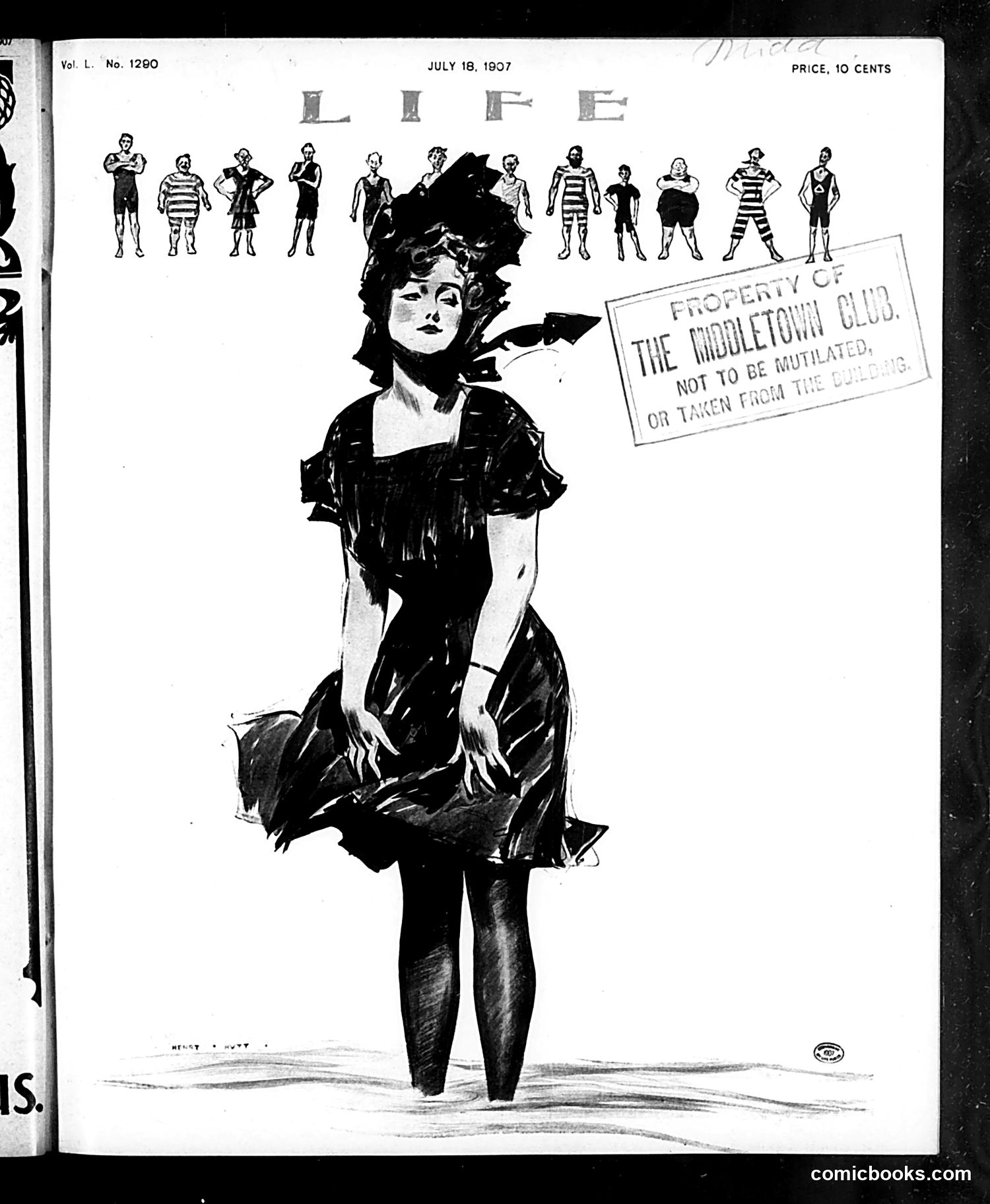
This appears to be a Life magazine cover featuring a stylized female figure in an elegant black dress with an upswept hairstyle, pointing authoritatively. The figure represents a fashionable woman of the Gibson Girl era—the idealized American woman popular in early 1900s illustration. The lineup of athletes across the top (swimmers, boxers, various sports competitors) suggests commentary on women's athletics or physical culture. The text stamp references "The Middletown Club," indicating this may satirize women's sports clubs or athletic organizations of the period. The overall composition likely jokes about women's growing participation in sports and physical activities—a relatively novel and sometimes controversial social development for the era, challenging Victorian notions of feminine delicacy.
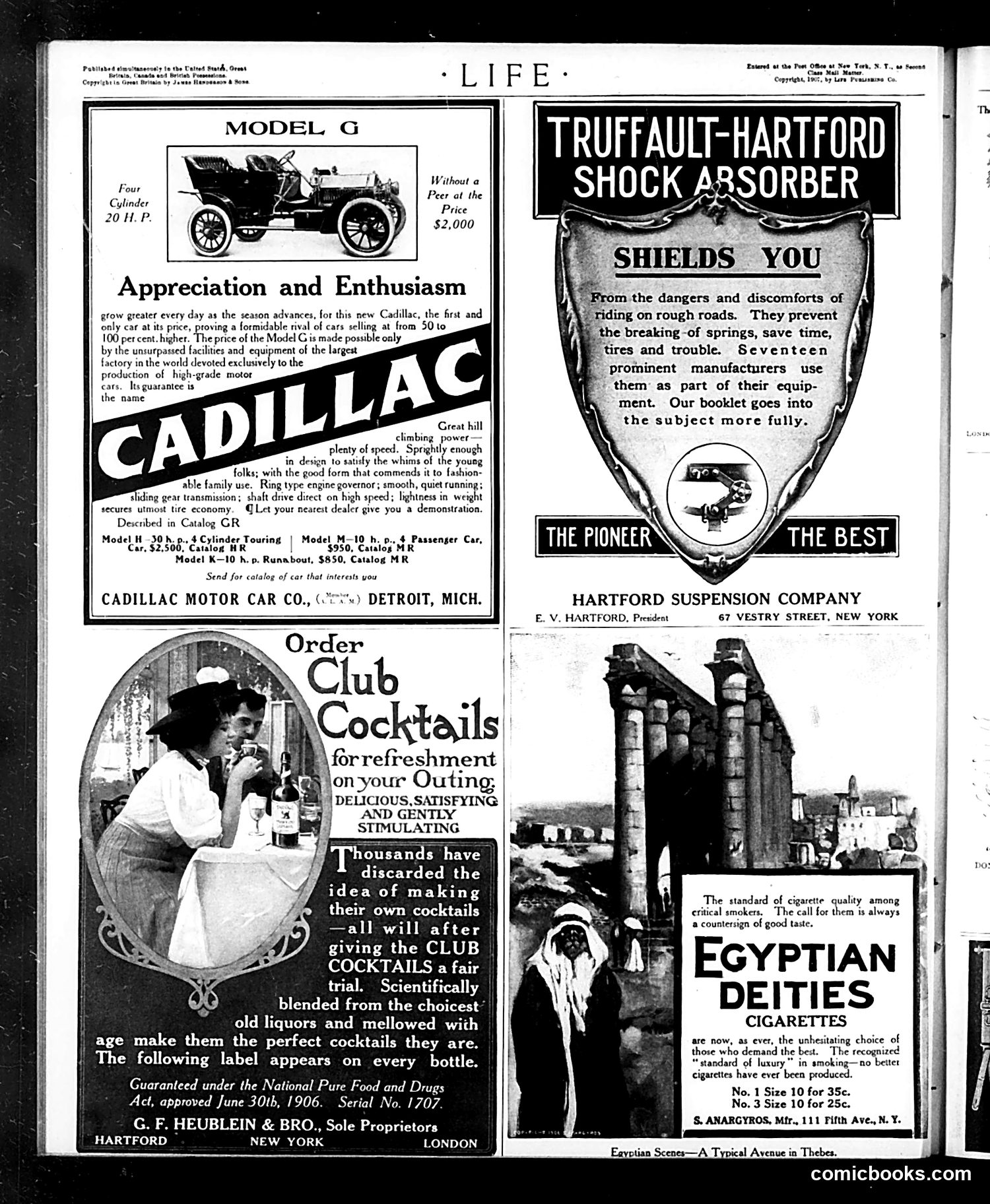
This page is **primarily advertising**, not satire or political commentary. It contains four distinct advertisements from the early 1900s: 1. **Cadillac Model G** - promoting a new four-cylinder car at $2,000, emphasizing appreciation and enthusiasm for the vehicle 2. **Truffault-Hartford Shock Absorber** - advertising suspension technology for automobiles 3. **Club Cocktails** - pre-mixed cocktails by Heublein & Bros., marketed as convenient for outings 4. **Egyptian Deities Cigarettes** - luxury cigarettes positioned as high-quality The page reflects early 20th-century consumer culture, showcasing emerging automobile technology, convenience products, and luxury goods. There is no discernible political or social satire present—this appears to be standard commercial advertising typical of *Life* magazine's revenue model.
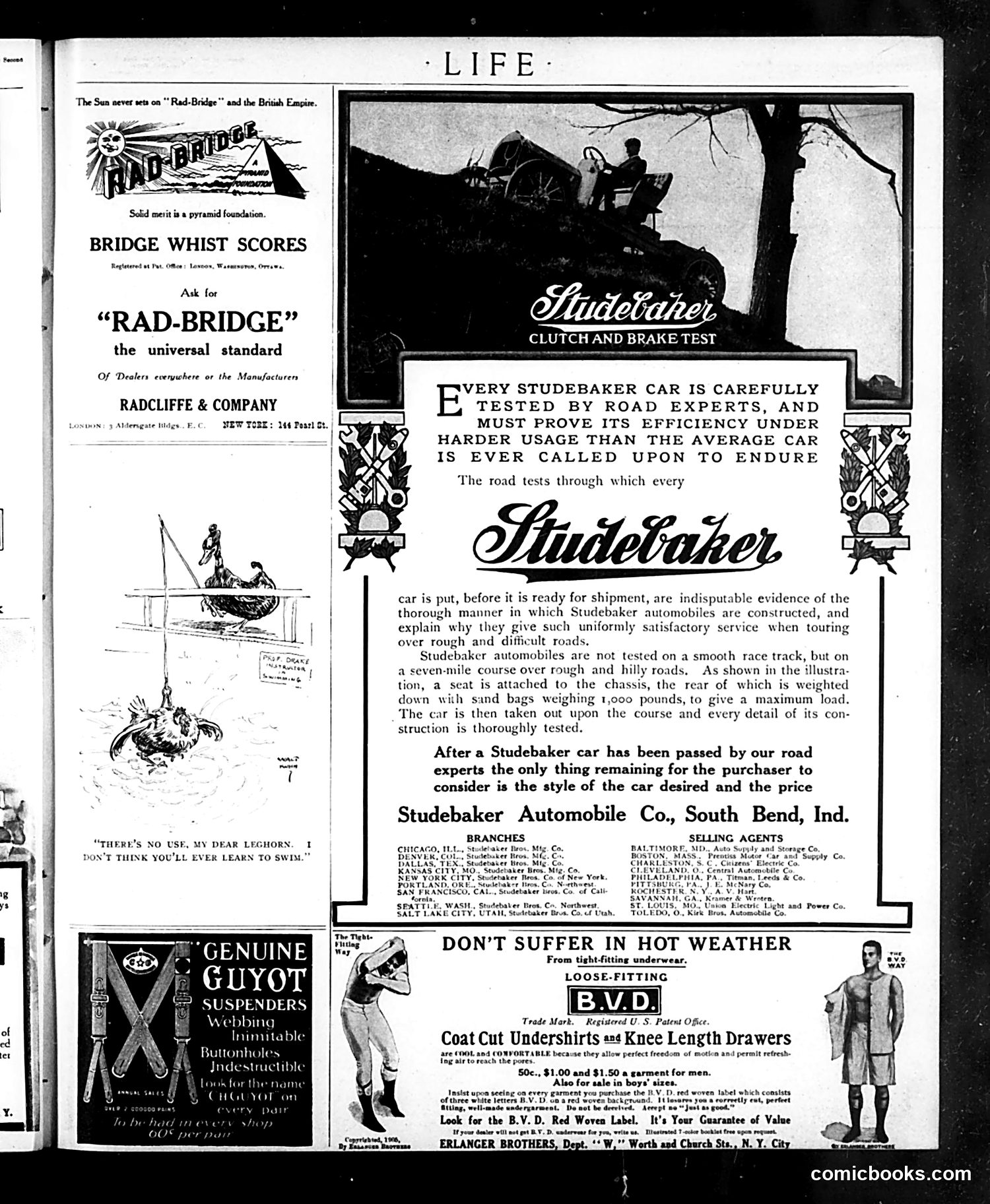
This page is **primarily advertising** rather than satirical content. The dominant feature is a large Studebaker automobile advertisement emphasizing rigorous road testing ("clutch and brake test"). The ad claims Studebaker cars undergo harsher conditions than typical use to prove durability. The left side contains smaller ads: a "Rad-Bridge" whist score card product and a "Genuine Guyot Suspenders" ad. At the bottom are advertisements for B.V.D. underwear ("Don't Suffer in Hot Weather") and Guyot suspenders—typical commercial content from this era. The only apparent cartoonish element is a small humorous illustration on the left showing someone in a boat, with a caption about learning to swim, but it's marginal to the page's primary commercial purpose.
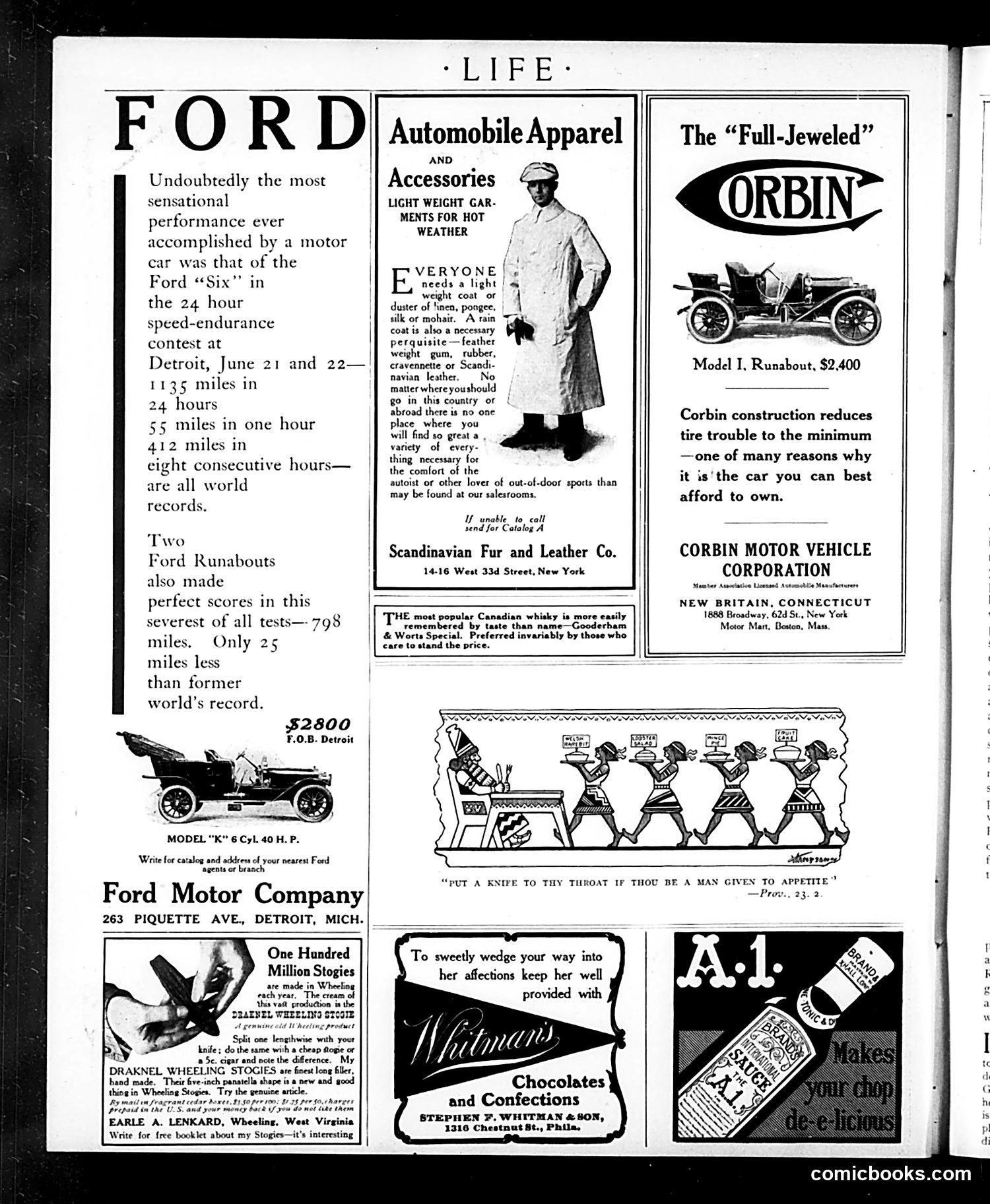
This page is primarily **advertising**, not political satire. It features automobile and consumer product advertisements from the early 1900s, including Ford Motor Company, Corbin Motor Vehicle, and various accessories. The only cartoon element is a small illustrated advertisement for **Whitman's Chocolates** at bottom center, showing a stylized silhouette figure with text "To sweetly wedge your way into her affections keep her well provided with..." The humor is romantic/lighthearted rather than political—it's a common early-20th-century marketing trope using gentle courtship imagery to sell candy. The page's real interest lies in documenting period consumer culture and early automobile advertising rather than satirical commentary.
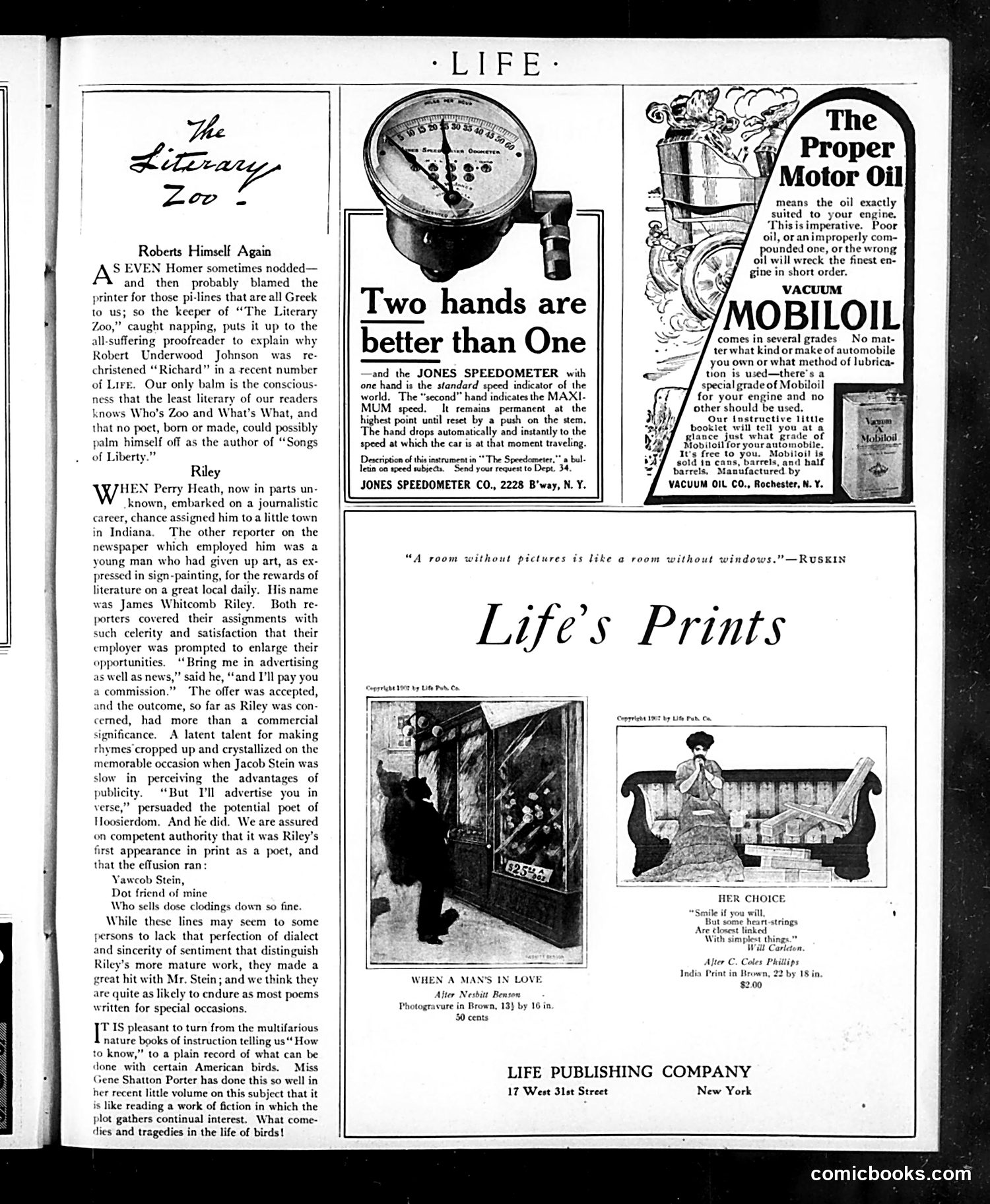
This page is primarily **advertising and literary content** rather than political satire. The main items are: 1. **"The Literary Zoo"** column discusses Robert Underwood Johnson's poem "Richard" and mentions poet James Whitcomb Riley, establishing this as a **literary appreciation piece**. 2. **Advertisements dominate**: Jones Speedometer ("Two hands are better than One") and Mobiloil motor oil ads promote commercial products. 3. **"Life's Prints" section** features reproductions of artwork, including a photograph titled "When a Man's in Love" by Alvin Coburn. The page reflects early 20th-century Life magazine's **mixed format of cultural commentary, advertising, and art reproduction** rather than the satirical political cartoons one might expect. No clear political satire or caricature is evident.
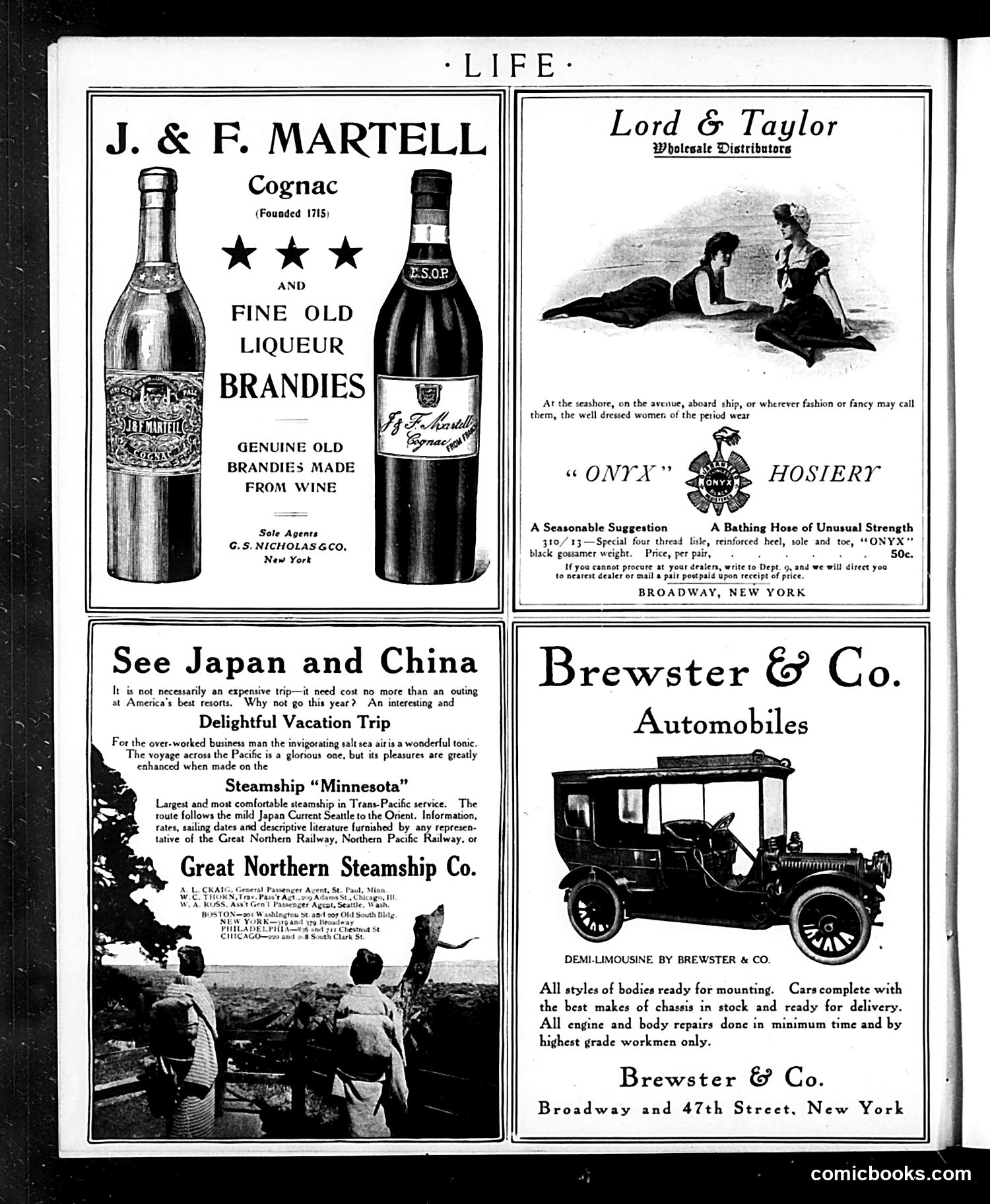
This page is primarily **advertising, not satire or political cartoons**. It contains four commercial advertisements from what appears to be an early 20th-century edition of Life magazine: 1. **J. & F. Martell Cognac** - promoting French brandy 2. **Lord & Taylor** - advertising women's hosiery ("Onyx" brand) 3. **Great Northern Steamship Co.** - promoting Pacific voyages to Japan and China 4. **Brewster & Co.** - selling automobiles (demi-limousine models) The only noteworthy detail is the steamship ad's image showing people observing distant landscape, likely emphasizing travel's appeal to leisure travelers. Otherwise, these are straightforward period advertisements targeting affluent American consumers with luxury goods and travel services.
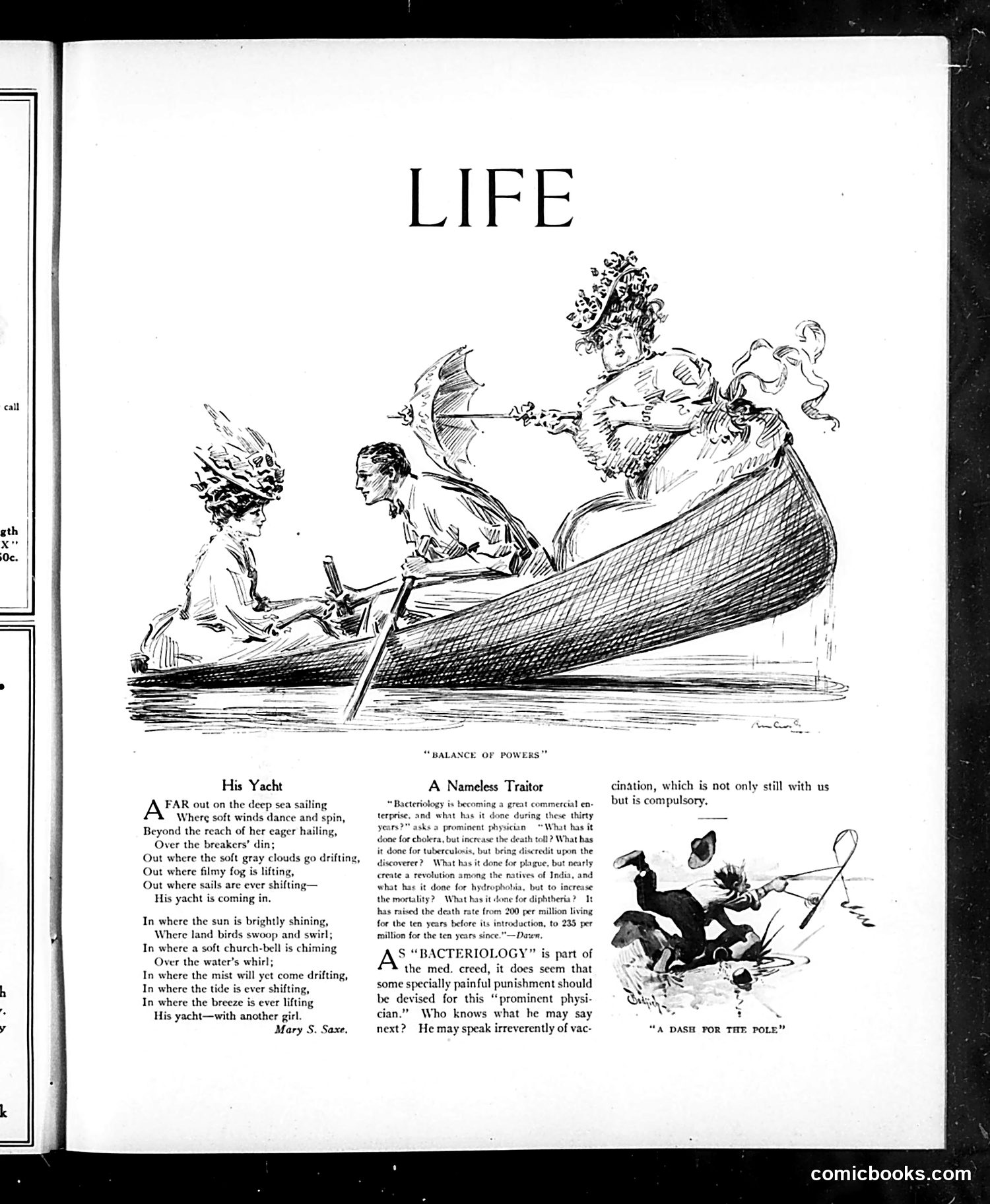
This page satirizes medical and scientific authority through two pieces: **"His Yacht"** (poem by Mary S. Saxe): Romantically describes a man's yacht coming in, using sailing metaphors that resolve with him arriving "with another girl." **"A Nameless Traitor"** (main cartoon): Criticizes bacteriology as a new commercial enterprise. The text sarcastically suggests a "prominent physician" should face punishment for promoting germ theory, which has allegedly caused panic about disease transmission. The accompanying sketch ("A Dash for the Pole") shows figures fleeing, likely mocking the public hysteria over newly-discovered bacteria. **"Balance of Powers"** (boat illustration): Shows figures precariously balanced in a canoe, captioned as a woman rowing while a man attempts to manage competing demands—likely satirizing gender dynamics and the difficulty of maintaining equilibrium in relationships or social structures. The overall theme appears to critique both romantic entanglements and the social disruption caused by emerging scientific knowledge.
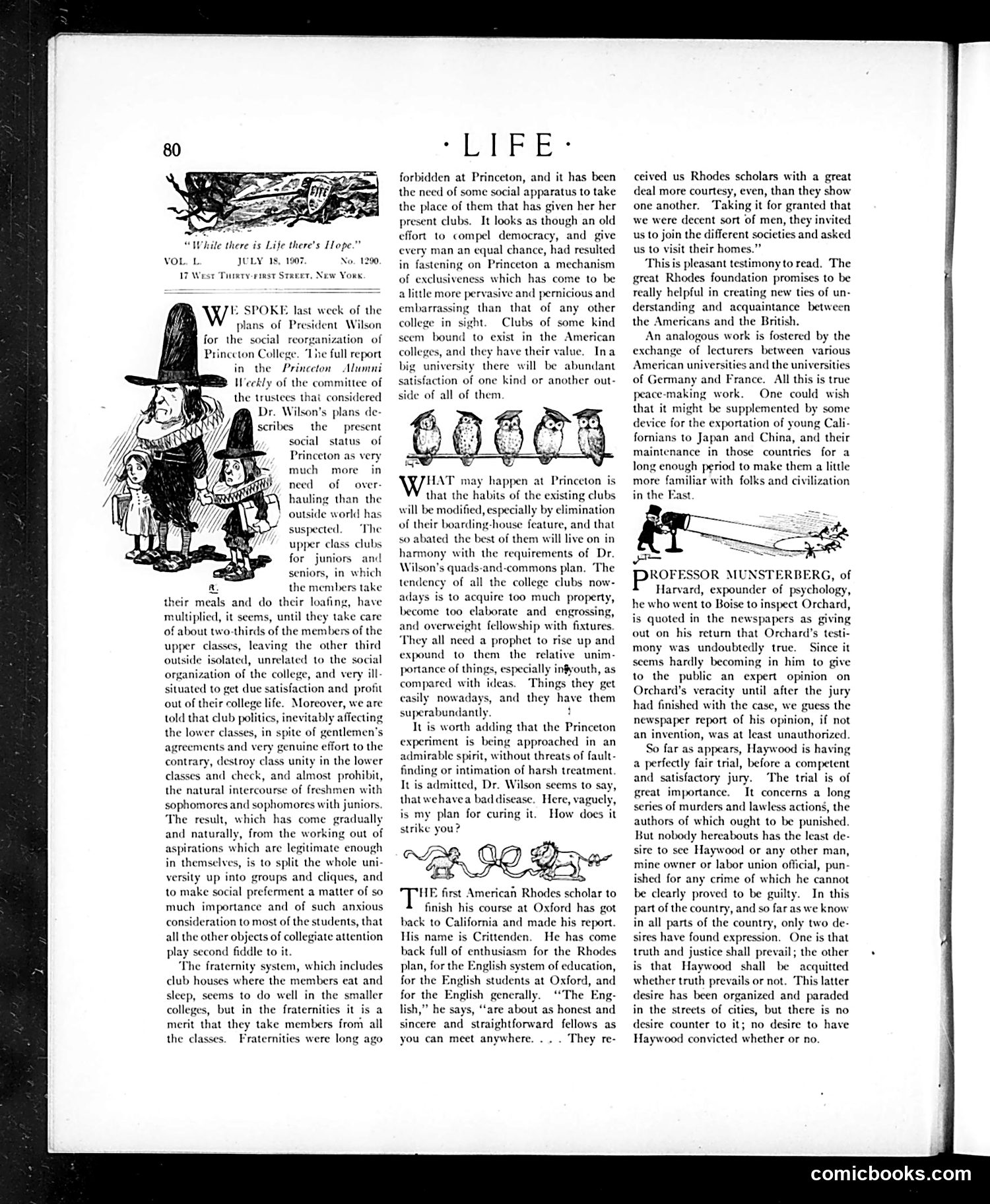
This page from *Life* (July 18, 1907) discusses President Wilson's social reorganization plans for Princeton College. The left cartoon depicts a figure shepherding a flock of doves—likely representing Princeton students—with the title suggesting idealistic hopes for institutional reform. The article criticizes Princeton's existing club system as elitist and divisive, fragmenting students into exclusive social hierarchies. Wilson apparently proposed eliminating these clubs or reforming them to promote greater equality and unity among all classes of students. The satire suggests that despite Wilson's good intentions ("in the Dove's Hope"), his idealistic plans may face practical resistance from the entrenched social structures at Princeton—a commentary on the difficulty of reforming traditional institutions.
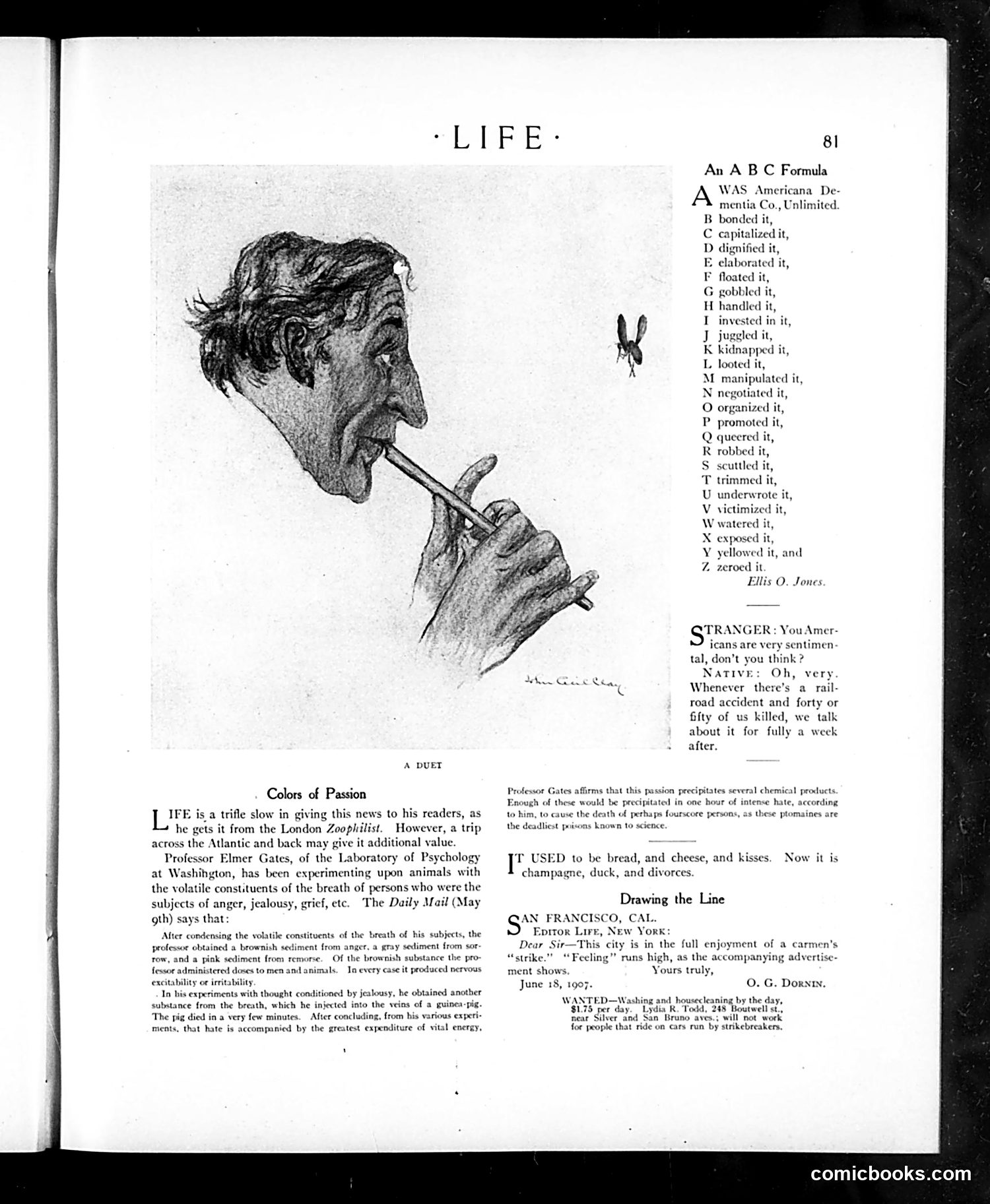
The main cartoon, titled "A Duet," depicts a man smoking a pipe in profile. The accompanying text "An ABC Formula" by Ellis O. Jones humorously catalogs what happened to an investment in "WAS Americana Dementia Co., Unlimited"—from being "bonded" through various misfortunes (robbed, scuttled, trimmed, watered, zeroed) to final ruin. Below, "Colors of Passion" discusses Professor Ernest Gates's experiments measuring chemical changes in subjects' breath during emotional states like anger and jealousy. The text notes hate produced the most nervous excitability. The page also includes brief satirical exchanges about American sentimentality and a notice about San Francisco's carman's "strike," reflecting early 1900s labor concerns. The overall tone mocks both financial schemes and pseudo-scientific emotion research.
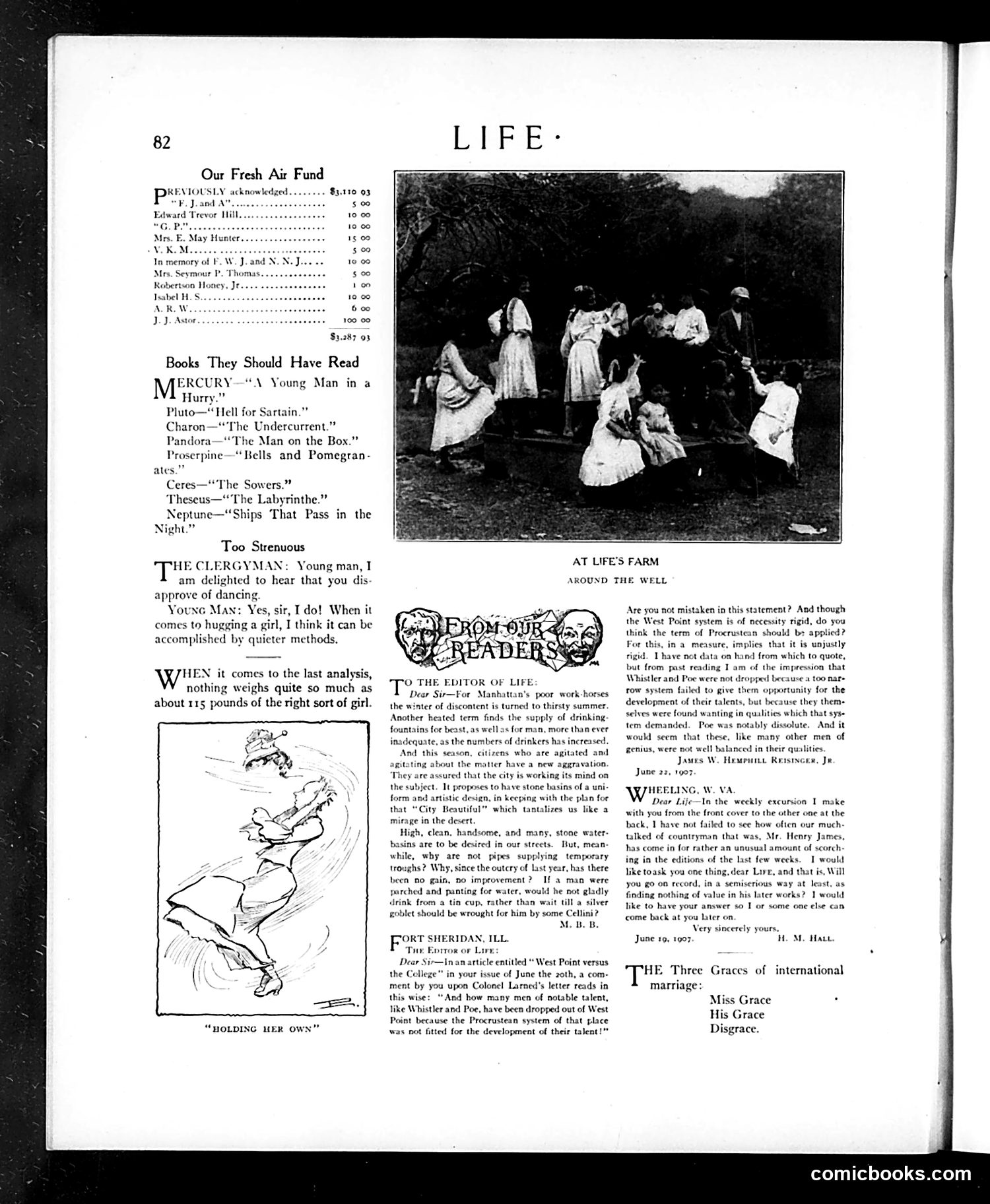
This page from *Life* magazine contains a cartoon titled "Holding Her Own" depicting a woman in a defensive posture, appearing to fend off or resist someone's advances. The cartoon accompanies a section titled "Too Strenuous," featuring a dialogue between a clergyman and young man debating the propriety of dancing and "bugging a girl." The satire addresses early 20th-century debates about modern courtship and physical affection. The clergyman represents conservative moral values opposing dancing and close physical contact between unmarried people, while the young man represents changing social attitudes. The cartoon illustrates the tension between traditional morality and modern dating practices, with the woman's defensive stance humorously suggesting the physical struggles resulting from these conflicting social expectations.
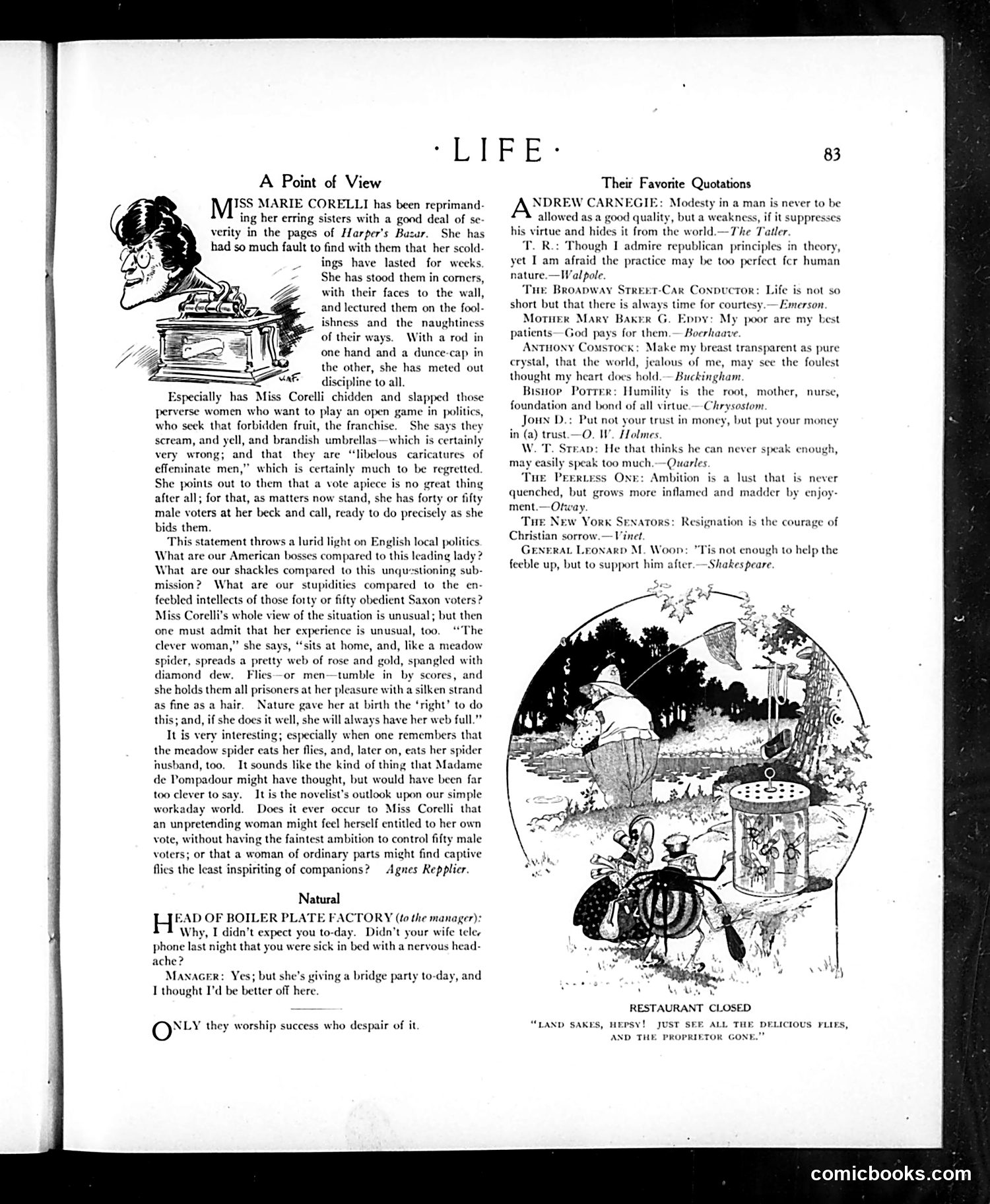
This page contains two satirical pieces: **"A Point of View"** critiques Miss Marie Corelli, a popular novelist whom the author accuses of being overly moralistic and censorious in *Harper's Bazar*. The piece mocks her for lecturing women about virtue while disparaging male voters as "silly" and "effeminate." The satire suggests Corelli's views on women's suffrage are hypocritical—she wants women to vote but holds contempt for male voters. **"Natural"** is a brief workplace dialogue between a boiler plate factory head and manager, joking about unexpected absences due to social obligations. The illustration labeled "Restaurant Closed" depicts an overturned establishment, humorously captioning that flies and the proprietor have abandoned it. The page reflects early 20th-century debates about women's rights and literary celebrity.
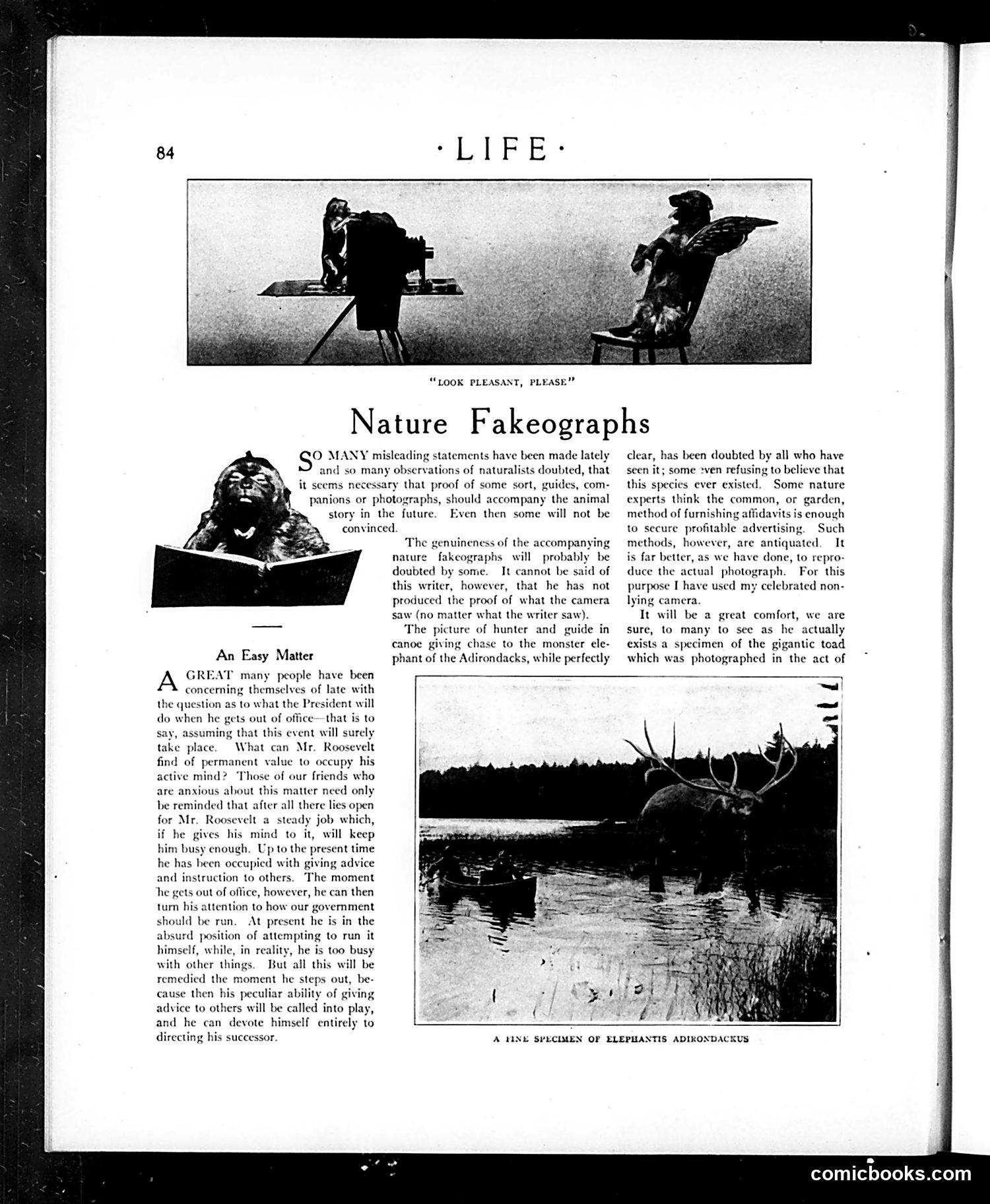
This *Life* magazine page satirizes nature photography and makes a political jab at President Roosevelt's post-presidency plans. **Top cartoon**: Shows two figures with cameras on tripods facing each other with caption "LOOK PLEASANT, PLEASE"—a visual joke about the artificiality of posed nature photography. **"Nature Fakeographs" section**: Discusses skepticism about nature photographs accompanying animal stories, noting some experts doubt their authenticity. The author claims to use a "non-lying camera" and promises to show a "gigantic toad" specimen as proof. **"An Easy Matter"**: Jokes that Roosevelt, leaving office, needs a job. The text ironically suggests his talent for giving advice makes him perfect to advise his successor—implying he'd struggle to actually step aside and let someone else lead.
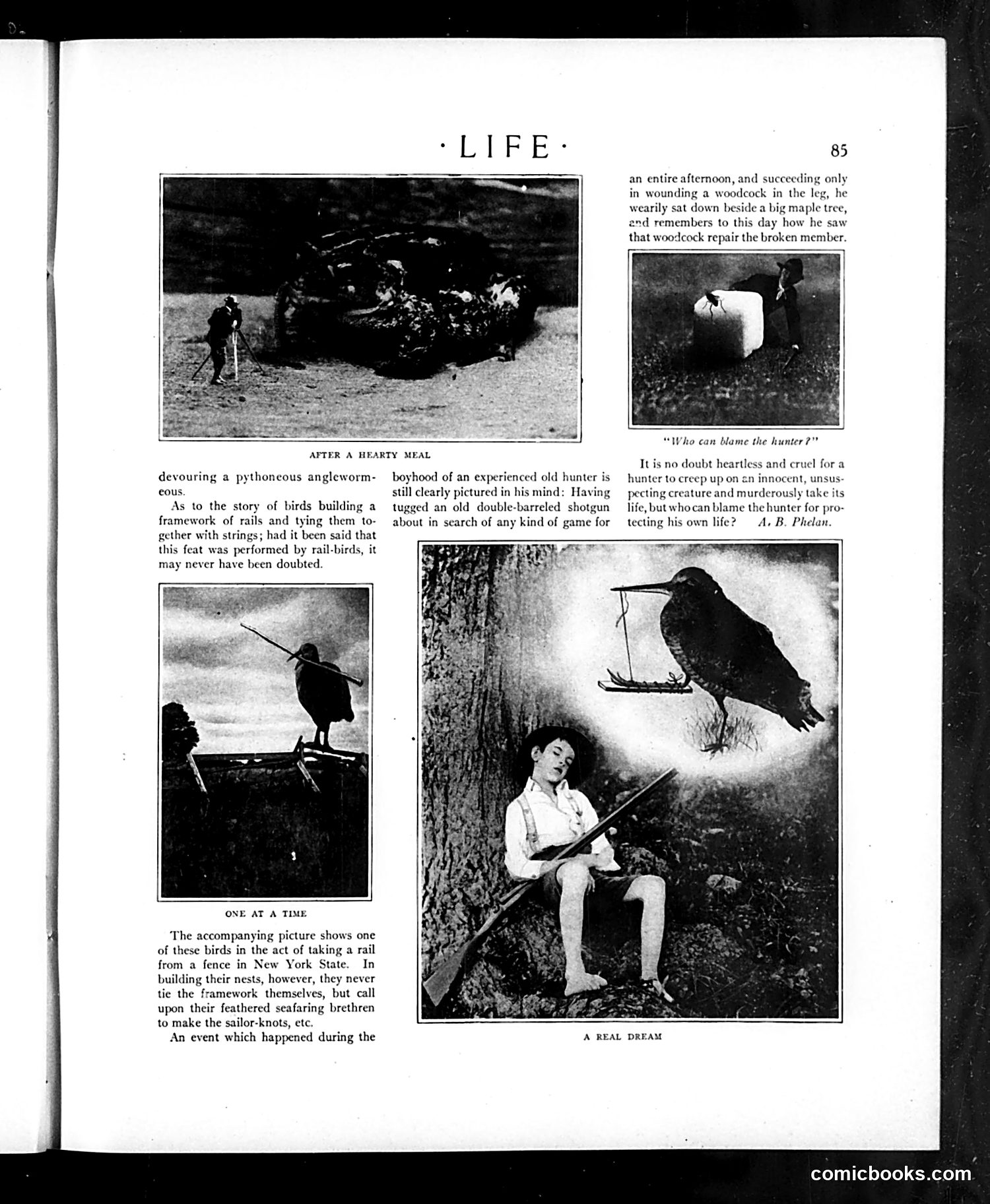
This page contains four wildlife photographs with accompanying text about hunting and animal behavior—not political cartoons or satire. The content discusses: - A python's meal ("After a Hearty Meal") - Birds using twigs to build nests ("One at a Time") - A hunter's experience with woodcock - A boy with a rifle and a large bird ("A Real Dream") The text debates whether hunters should be blamed for killing animals, quoting "A. B. Phelan" on the ethics of hunting. The page explores natural history and hunting practices rather than political commentary. The photographs appear to be genuine nature documentation typical of early 20th-century Life magazine content, which mixed serious journalism with lighter lifestyle pieces.
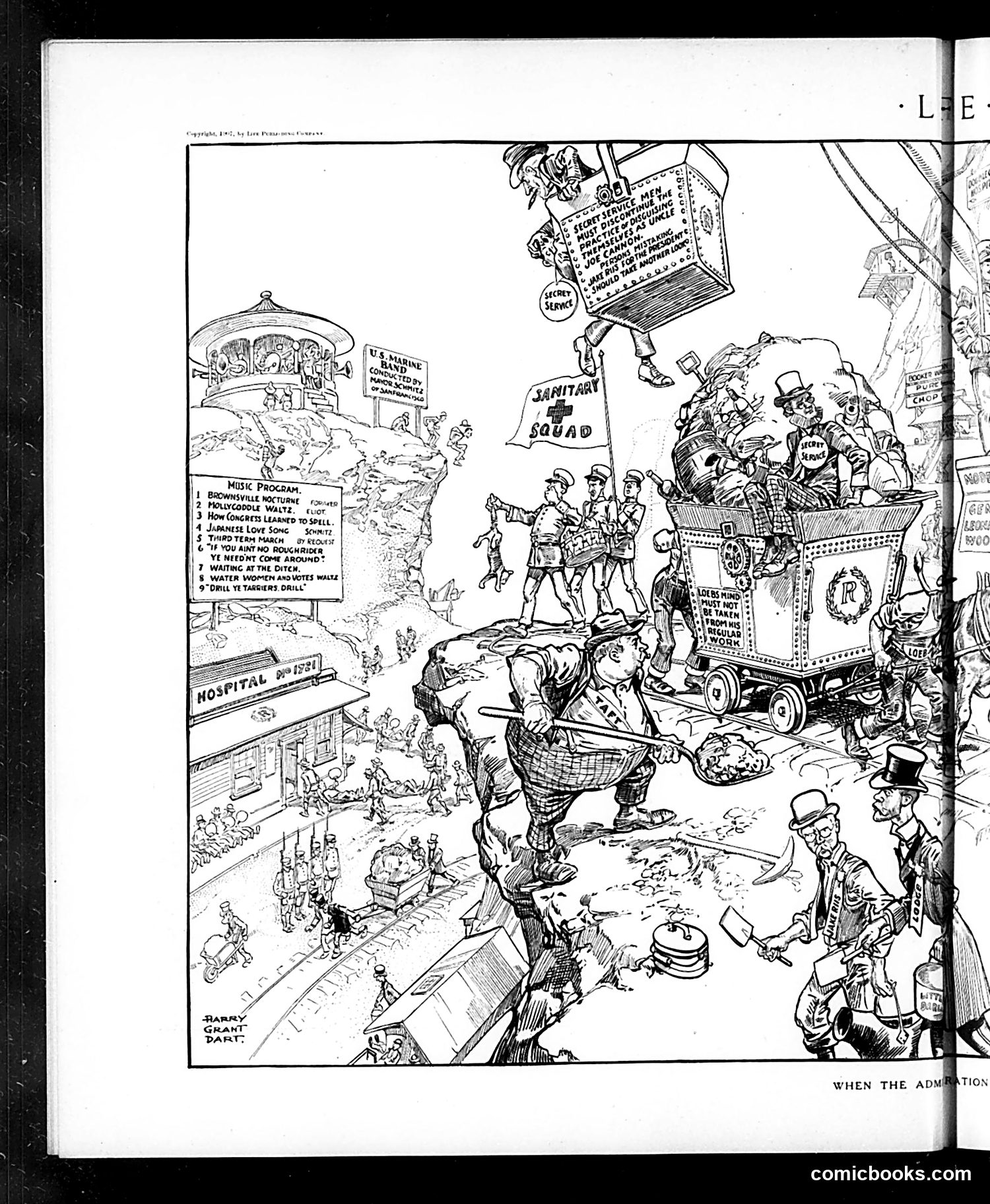
This is a satirical cartoon titled "When the Admiration..." (caption incomplete). It depicts a chaotic "Sanitary Squad" scene, with soldiers and civilians engaged in cleanup work around a hospital. The cartoon mocks the U.S. Marine Corps' public relations efforts, showing an idealized "Music Program" list contrasted with the messy reality of military sanitation duties. The satire targets the gap between military propaganda and actual soldier experience—the romanticized musical performances versus unglamorous work like drilling and ditch-digging. References to "Roughriders" suggest Theodore Roosevelt's famous cavalry unit, implying criticism of militaristic heroism narratives. The cartoon criticizes how institutions sanitize (literally and figuratively) their public image while soldiers perform unglamorous labor. The exaggerated, busy composition emphasizes the disconnect between promotional materials and workday reality.
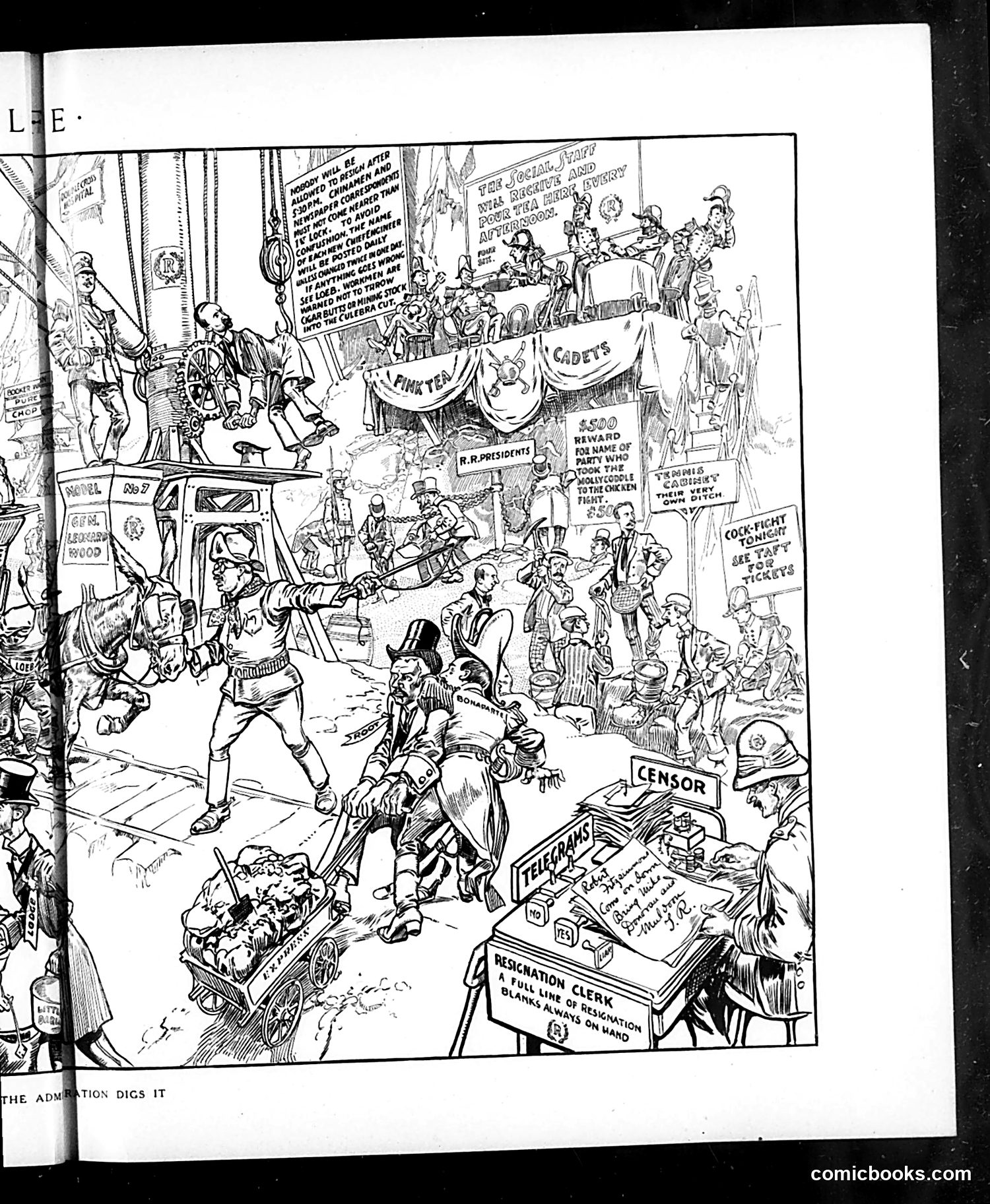
This is a satirical cartoon depicting political chaos and bureaucratic absurdity. The scene shows a carnival-like atmosphere with multiple competing elements: a parade float labeled "Cadets" and "Fighters," signs offering "$500 reward," and figures in official positions including a "Censor," "Resignation Clerk," and "Telegrams" office. The central action involves figures fighting or struggling, while authority figures (the censor, resignation clerk) sit passively processing paperwork. The satire appears to critique governmental ineffectiveness—officials are preoccupied with administrative tasks and censorship while disorder erupts around them. Without the publication date visible, the specific political event referenced remains unclear, though the imagery suggests commentary on institutional failure to manage crisis or conflict effectively.
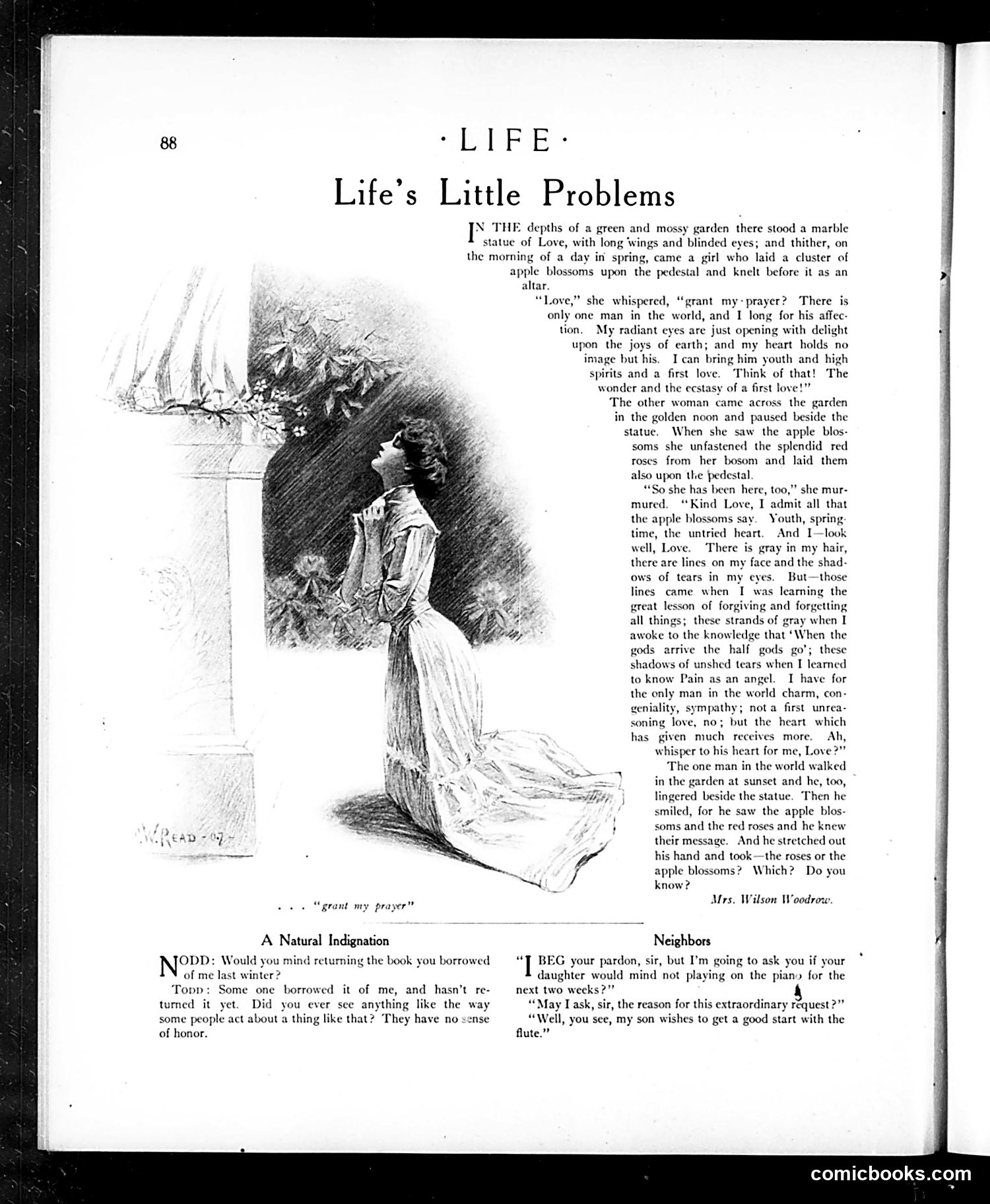
This page contains a sentimental short story titled "Life's Little Problems" by Mrs. Wilson Woodrow, accompanied by a pen-and-ink illustration of a woman kneeling before a statue of Cupid in a garden. The story presents a romantic dilemma: two women—one young and innocent, one mature and experienced—both leave offerings (apple blossoms and roses) at a statue of Love, each praying that a mysterious man will choose her. The narrative ends ambiguously: when the man arrives at sunset, he sees both offerings but the reader never learns which woman he selects. The page also includes two brief comedic sketches below: "A Natural Indignation" satirizes people's lack of honor regarding borrowed books, and "Neighbors" humorously depicts a man asking a neighbor to silence his daughter's piano practice so his son can learn the flute—an ironic request that will simply replace one noise with another. The content reflects early 20th-century magazine sensibilities: romantic sentiment paired with gentle social humor about manners and domestic life.
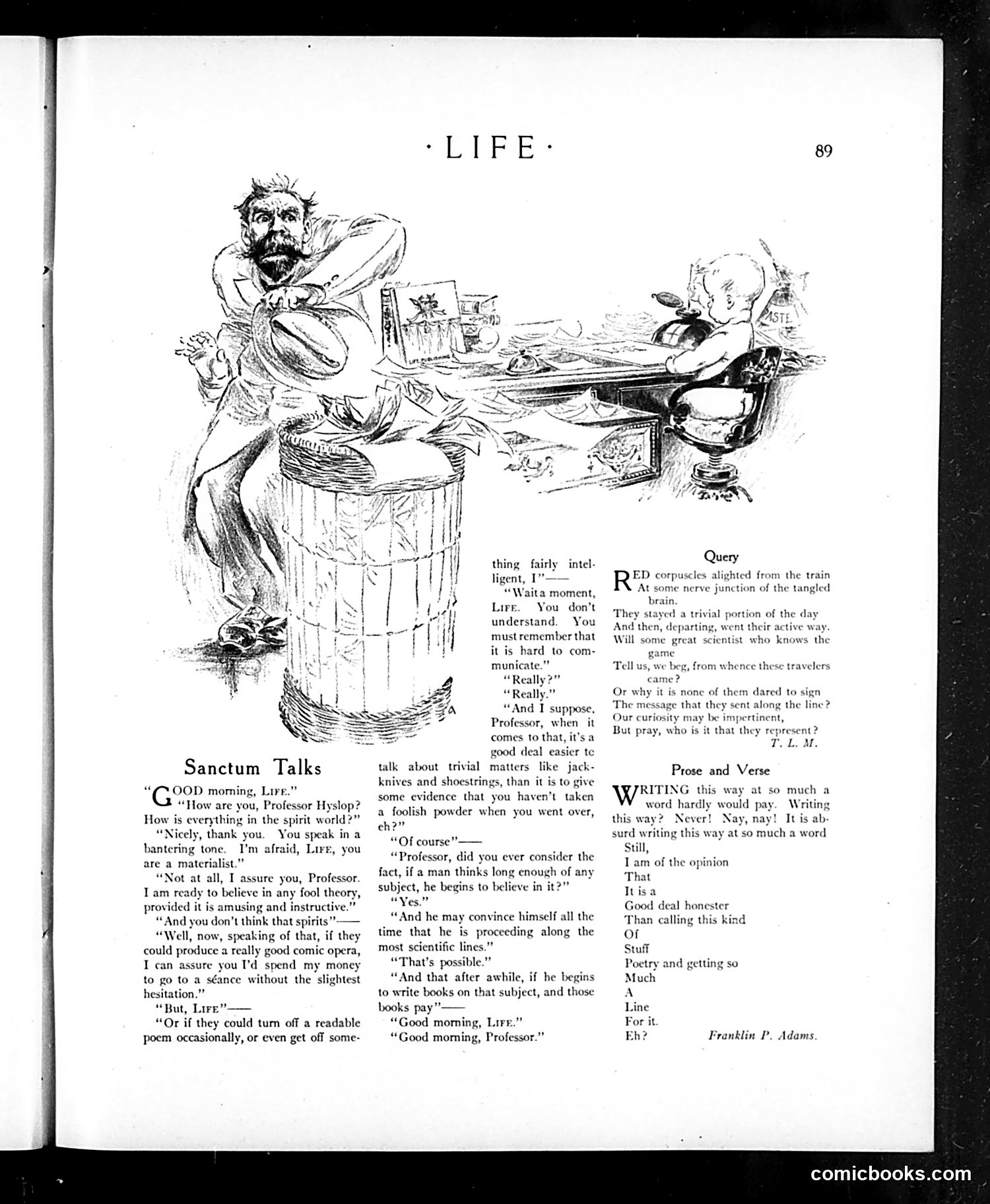
This cartoon satirizes spiritualism and séances, popular in the early 20th century. The bearded figure appears to be **Professor Hyslop**, likely James Hervey Hyslop, a real psychologist who investigated spiritualist claims and lectured on spirit communication. **The satire:** Life mocks spiritualism by having "Lire" (the magazine's voice) expose the movement's absurdity through logical argument. Hyslop claims spirits struggle to "communicate," but Lire points out this conveniently excuses any failure to produce evidence. He suggests that if someone *thinks* hard enough about anything, they'll believe it—and if they then write books about it, those books become profitable. The implication: spiritualists aren't discovering truth; they're convincing themselves and profiting from gullible believers. The accompanying poem plays on spiritualist jargon ("red corpuscles," "nerve junction") to mock pseudoscientific language used to legitimize séances. **Context:** This reflects widespread skepticism toward spiritualism among educated satirists, despite the movement's genuine popularity among believers.
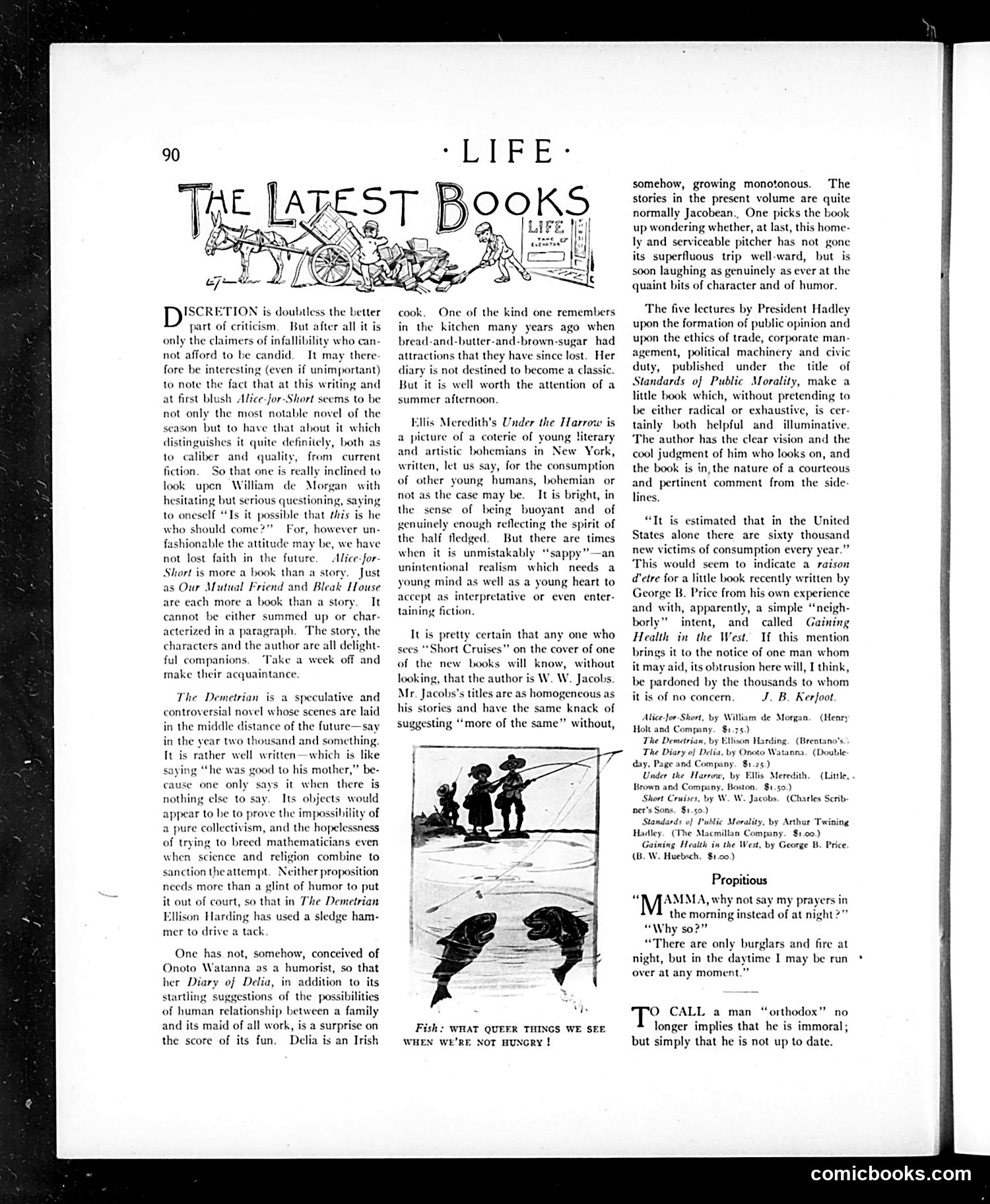
This page reviews recent books for educated readers. The cartoon shows two fish observing each other underwater with the caption "FISH: WHAT QUEER THINGS WE SEE WHEN WE'RE NOT HUNGRY!"—a humorous observation that perspective changes based on need or circumstance. The reviews discuss novels like *Alice-for-Short*, *The Demetrian* (a speculative future-set novel), and *Diary of Delia* by Onoto Watanna. The critic praises *Alice-for-Short* as the season's notable work while gently questioning whether author William de Morgan has truly arrived as a major talent. The satirical angle appears subtle: the critic maintains skepticism toward futuristic or overly intellectual fiction (*The Demetrian*) while championing character-driven, accessible storytelling. The fish cartoon reinforces this theme—good writing, like good observation, depends on one's vantage point and current needs.
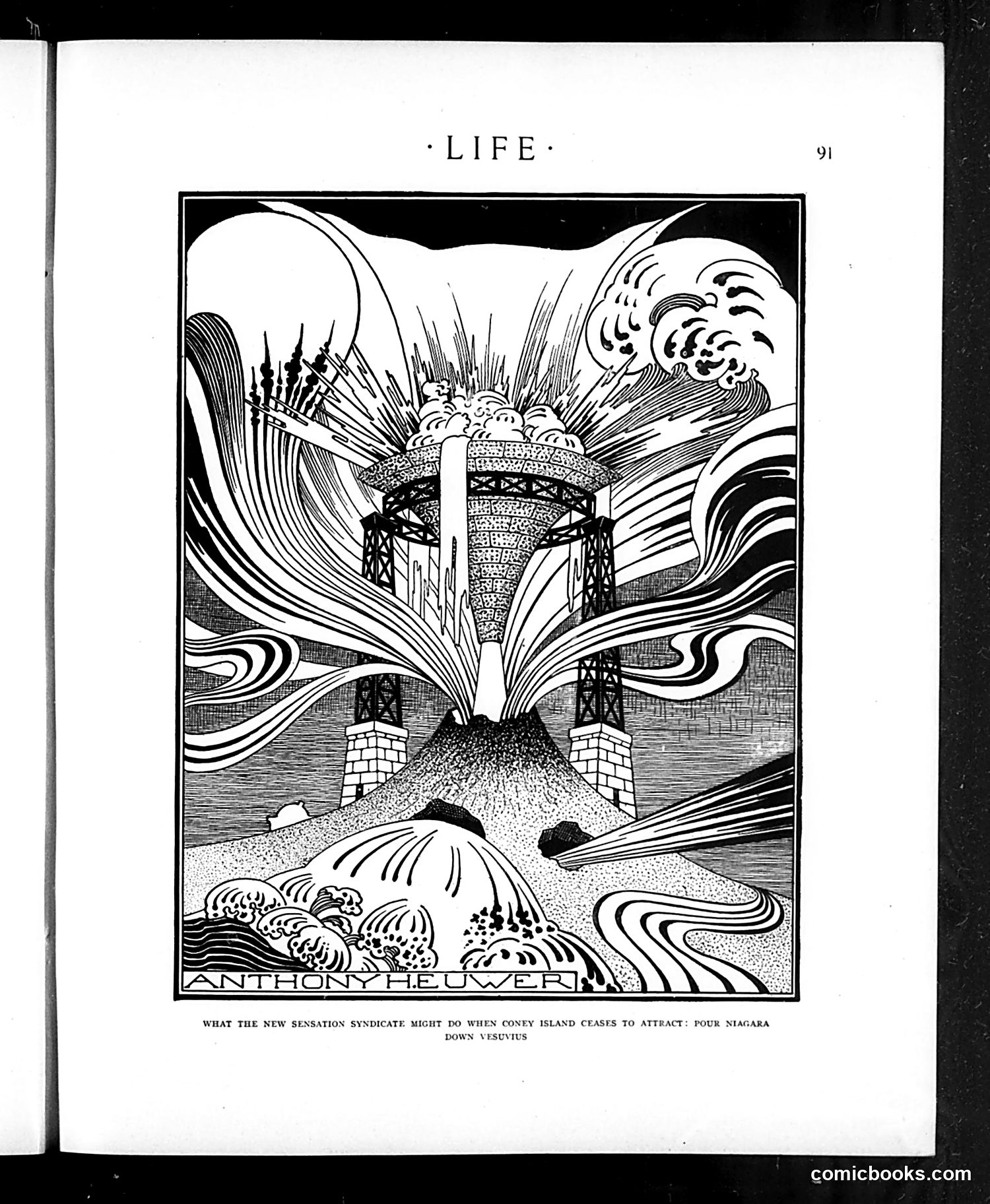
This is a speculative satirical cartoon by Anthony Heuzinger critiquing the entertainment industry's sensationalism. The image depicts an absurdist fantasy: water from Niagara Falls being diverted into Mount Vesuvius (the famous volcano), creating a catastrophic spectacle. The joke targets the "New Sensation Syndicate"—likely referring to entertainment promoters or newspaper syndicates competing for audiences. As Coney Island (a major New York amusement park) loses its novelty, the cartoon mockingly suggests these entertainment moguls would escalate to increasingly outlandish, dangerous stunts to draw crowds—even engineering geological disasters. The Art Deco aesthetic and dramatic composition emphasize the grandiosity of this imagined spectacle, highlighting how absurd the constant competition for novelty and sensation had become in early 20th-century American entertainment and media.
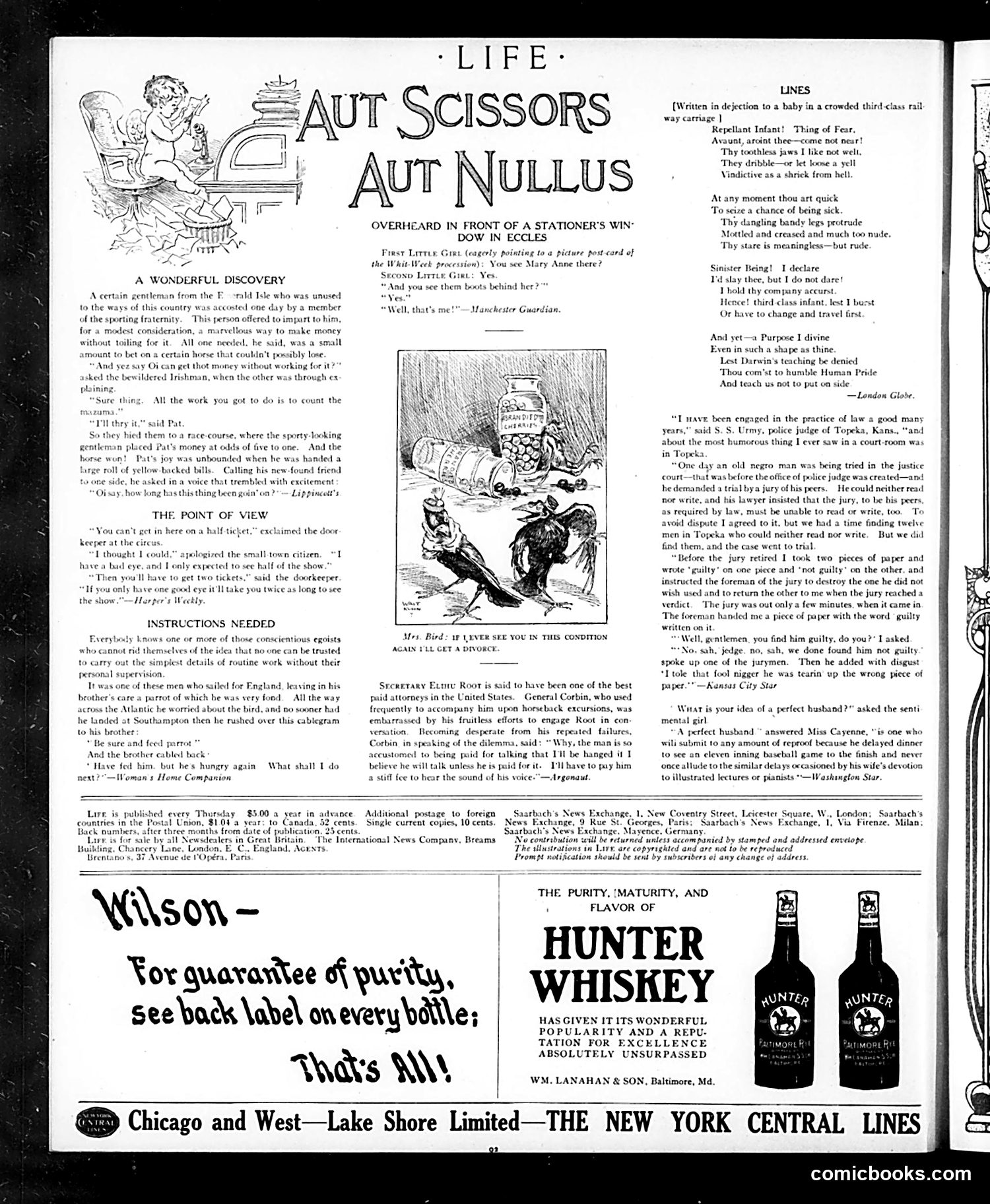
This page from Life magazine contains several humorous short pieces satirizing human nature and social pretension: **"Aut Scissors Aut Nullus"** (the main cartoon) depicts a confidence scheme where an Irish immigrant is duped into "investing" money on a fixed horse race—a commentary on gullible newcomers and urban con artists. **"The Point of View"** mocks a cheap circus patron demanding two tickets because he only has one eye—absurd literalism played for laughs. **"Instructions Needed"** ridicules obsessive control-freaks: a man abroad obsesses over his parrot's care, receiving increasingly exasperated telegrams from his brother. **"Lines"** is a humorous poem from a frustrated traveler stuck with a screaming, messy infant in third-class railway carriage—a relatable social complaint about public annoyance. The page also includes period advertisements for Wilson whiskey and railroad services. Overall, these pieces reflect turn-of-century urban life's inconveniences, social anxieties, and human folly treated with gentle satirical humor.
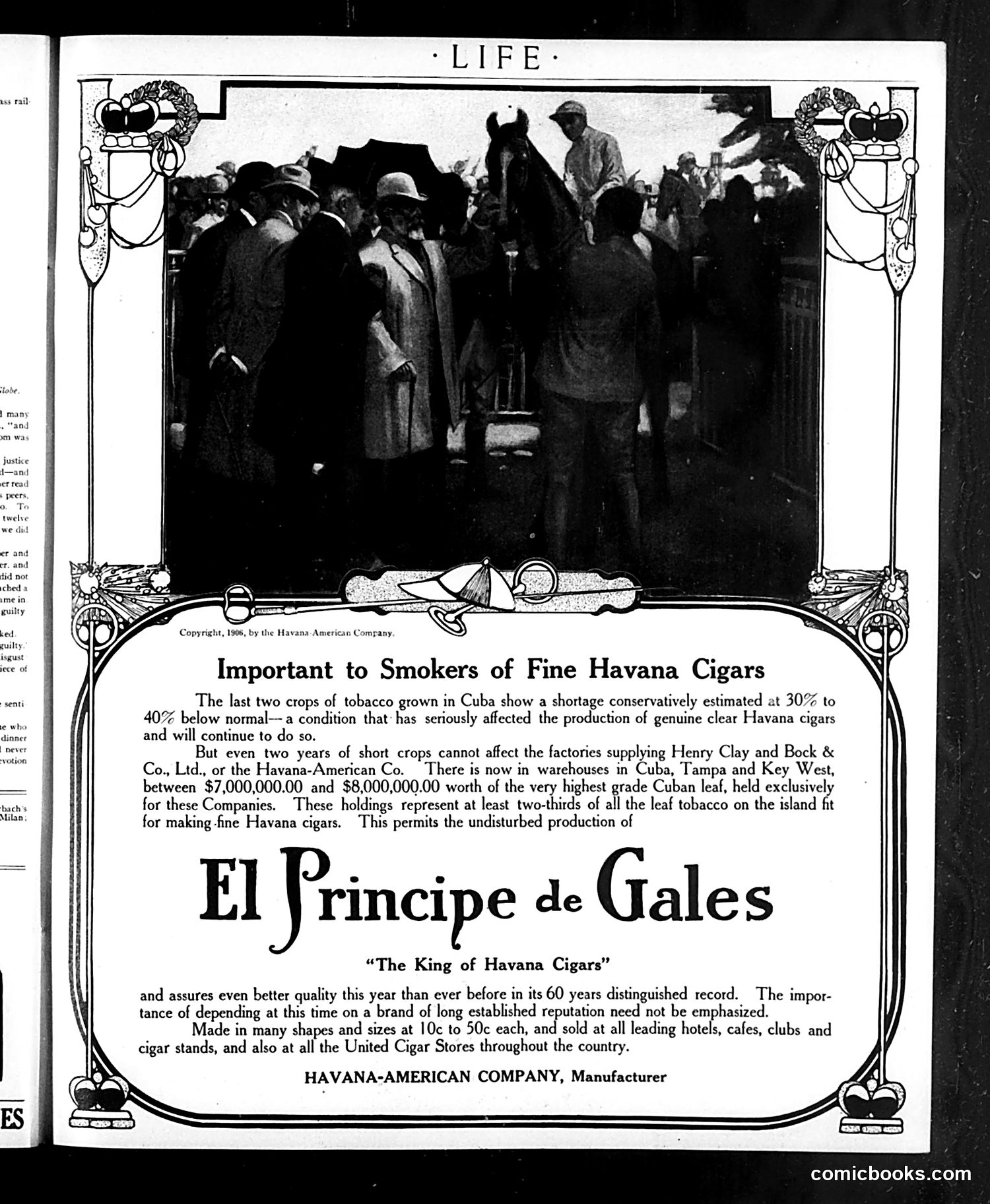
This is primarily a **cigarette advertisement**, not a political cartoon. It appears in *Life* magazine and promotes "El Príncipe de Gales" cigars. The image shows a crowd gathered around a horse—likely depicting a Cuban tobacco market or auction scene, establishing authenticity and origin. The ad's purpose is reassurance: Cuban tobacco crops have failed (30-40% shortage), threatening cigar quality. However, the Havana-American Company claims to hold $7-8 million worth of premium leaf in warehouses across Cuba, Tampa, and Key West—representing two-thirds of island supplies fit for fine cigars. This exclusive stockpile guarantees uninterrupted production and "even better quality" than the brand's 60-year record. The message targets worried consumers: don't panic about shortages; established brands with stored reserves remain reliable. It's a commercial appeal to brand loyalty during supply-chain anxiety, with no satirical content.
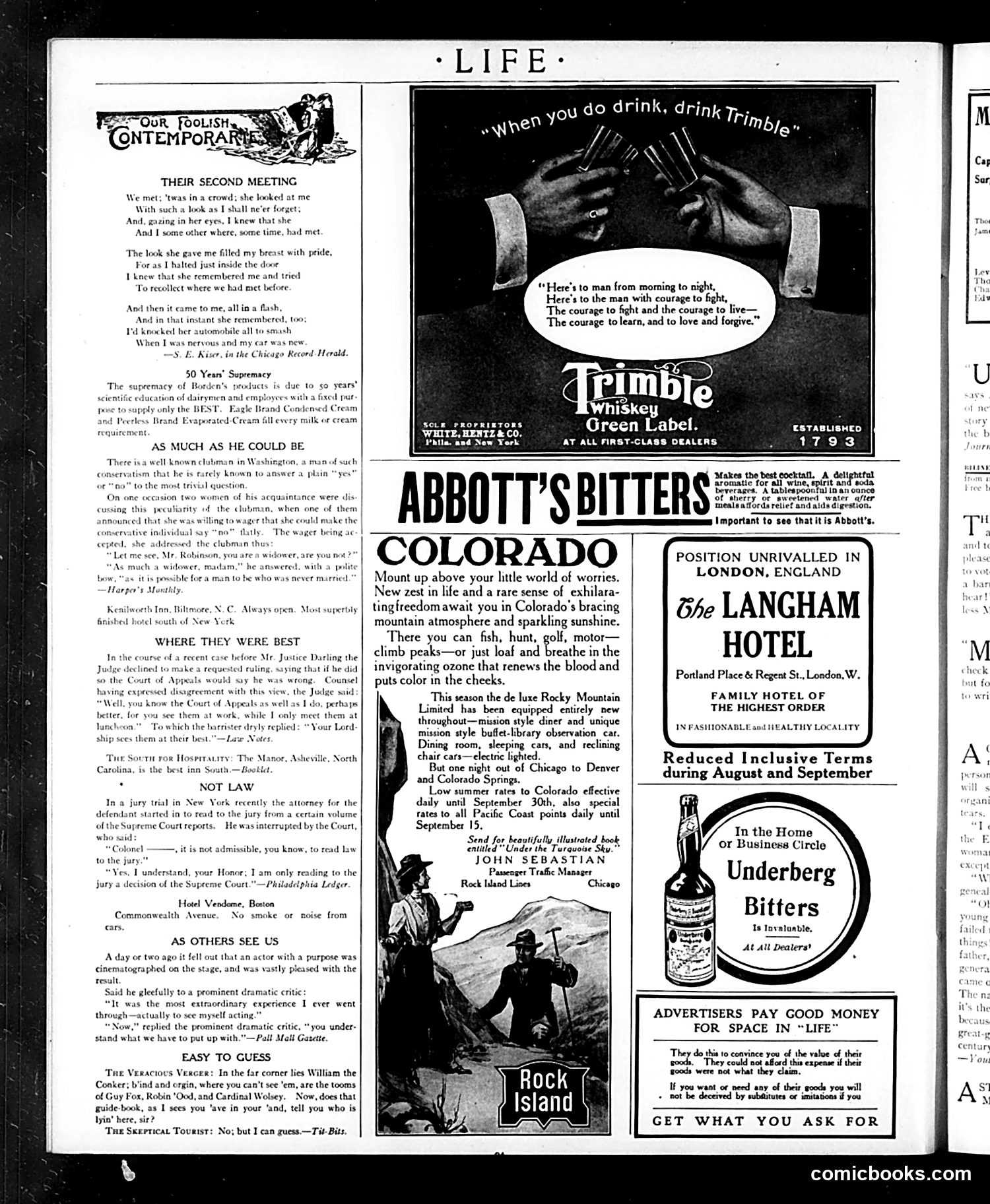
This page features *Life* magazine's signature humor column with short comic anecdotes and satirical observations about contemporary society. The main cartoon section (left) contains several brief humorous stories: **"Their Second Meeting"** jokes about two people who recognize each other from a prior encounter but can't quite remember where—the punchline implying an awkward romantic or social situation. **Other vignettes** poke fun at legal proceedings, jury trials, and pompous authority figures (judges, lawyers), typical targets of *Life*'s satire mocking pretentious institutions. The page is predominantly **advertisements**—whiskey, bitters, hotel promotions, and a Colorado tourism advertisement featuring the "Rocky Mountain Limited" train. These ads reflect early 20th-century luxuries aimed at affluent readers. The overall tone exemplifies *Life*'s formula: gentle mockery of everyday social situations and institutional absurdities, paired with upscale consumer advertising targeting the magazine's educated, wealthy audience.
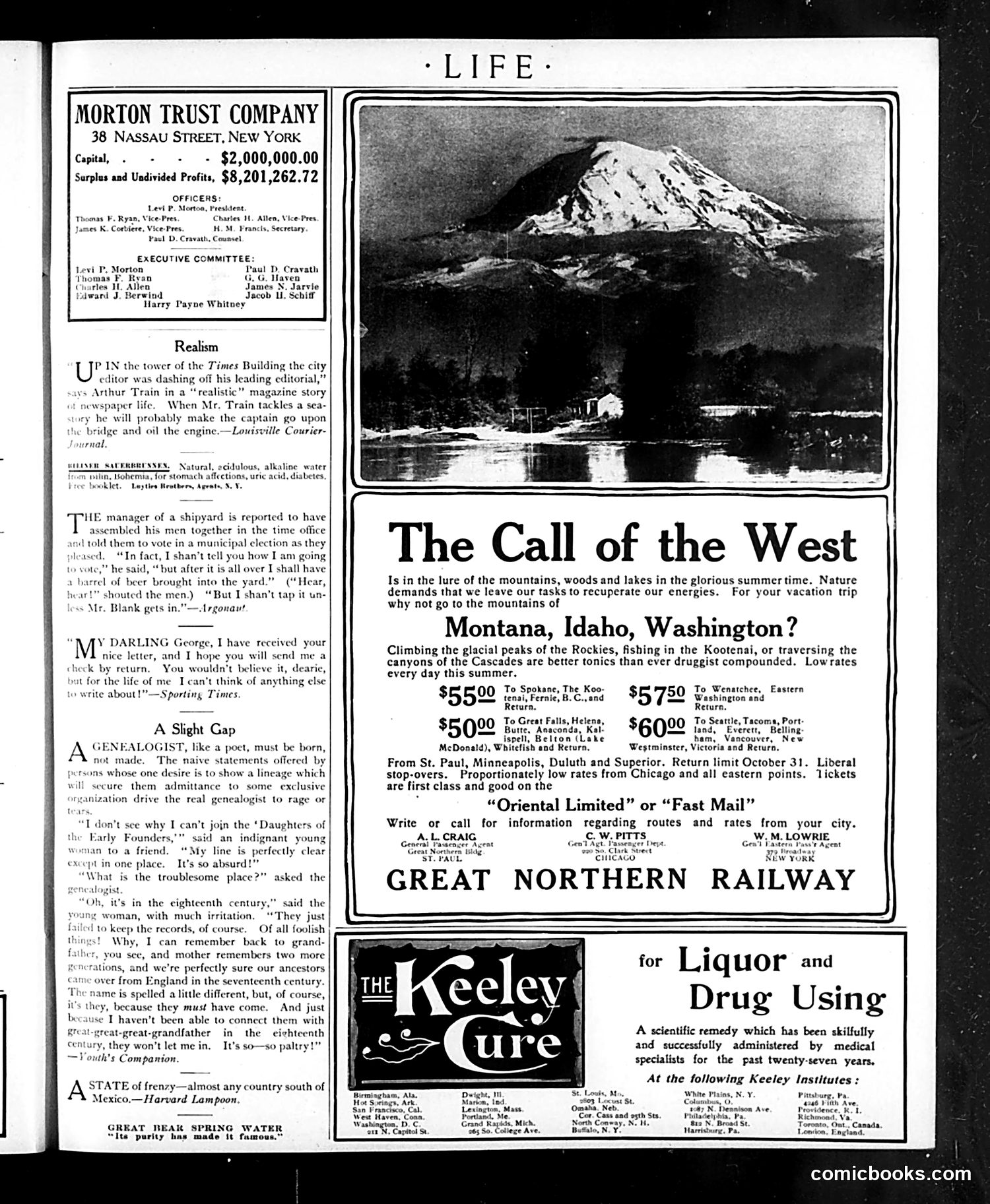
This page is primarily **advertising and financial announcements**, not political satire. The top features a Morton Trust Company advertisement listing officers and financial details. The main content consists of brief humorous anecdotes typical of Life magazine's satirical style: **"Realism"** mocks newspaper editors who write grandly about topics (like bridge engineering) without practical knowledge—a jab at armchair journalism. **"A Slight Gap"** satirizes genealogy snobbery: a young woman claims perfect lineage back to seventeenth-century England but cannot connect one eighteenth-century ancestor, making her ineligible for exclusive hereditary societies. The joke targets both genealogical pretension and the arbitrary gatekeeping of elite organizations. The page's dominant feature is a **Great Northern Railway advertisement** promoting Western vacation travel to Montana, Idaho, and Washington, emphasizing mountain climbing and fishing as restorative activities. A secondary advertisement promotes "The Keeley Cure," a medical treatment for alcohol and drug addiction. No identifiable political figures or cartoons appear on this page.
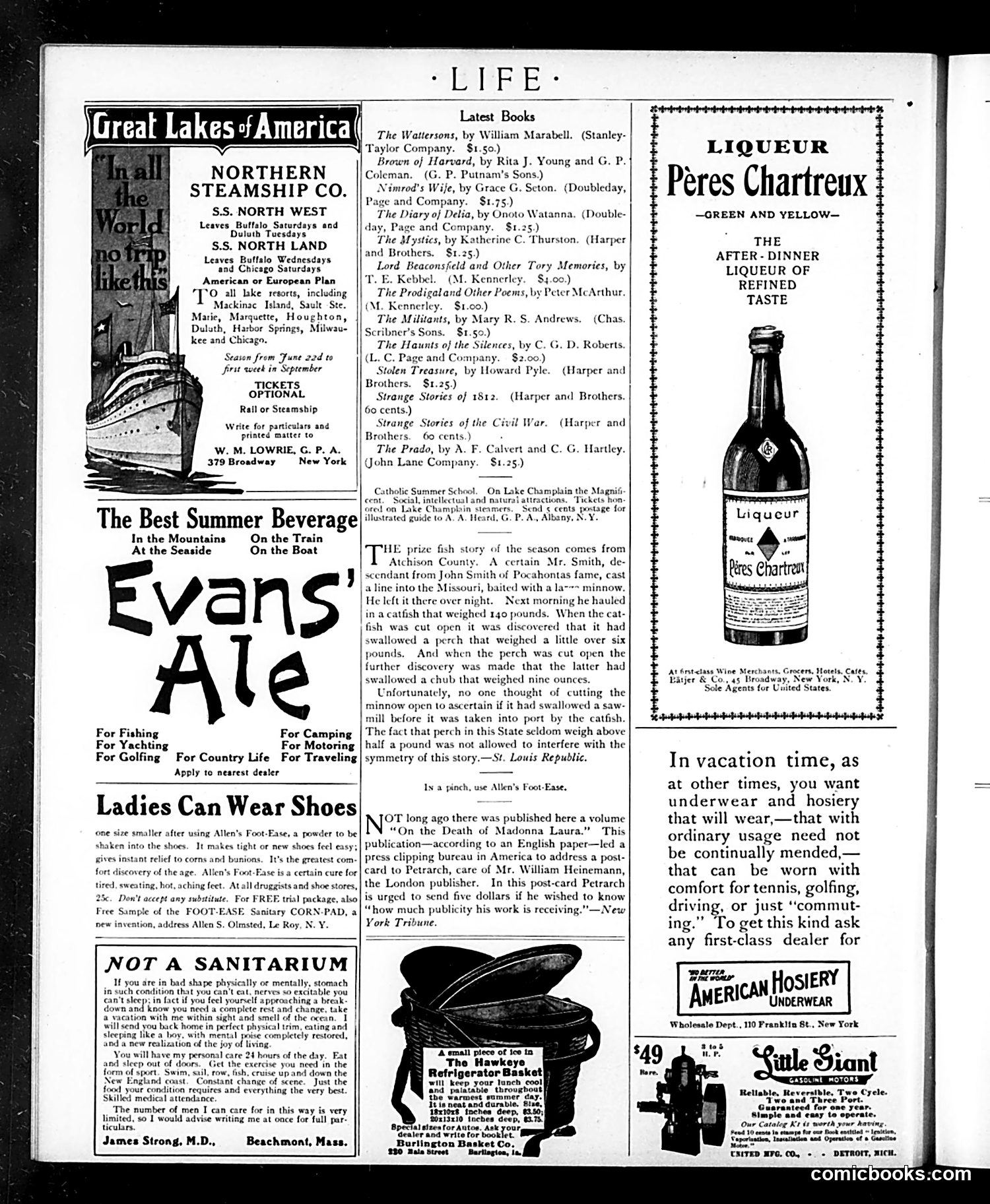
This page is primarily **advertising**, typical of early 20th-century magazines. The content includes: **Advertisements:** - Steamship lines (Northern Steamship Co.) - Evans Ale, positioned as suitable for various leisure activities - Allen's Foot-Ease powder for shoe comfort - Liqueur, hosiery, and other consumer goods **Editorial Content:** A brief humorous piece mocking tall tales: it describes an absurdly implausible fish story from the Missouri River involving nested animals (a 140-pound catfish swallowing a 6-pound perch, which swallowed a 9-ounce chub). The joke concludes with mock regret that no one cut open the original minnow to continue the chain—satirizing exaggerated frontier fishing narratives. Another short anecdote ridicules a American press clipping bureau that sent a postcard to the historical poet Petrarch, soliciting payment for publicity about "Madonna Laura," confusing the centuries-old literary figure with a contemporary subject. The page reflects early 1900s consumer culture and gentle satire of American gullibility.
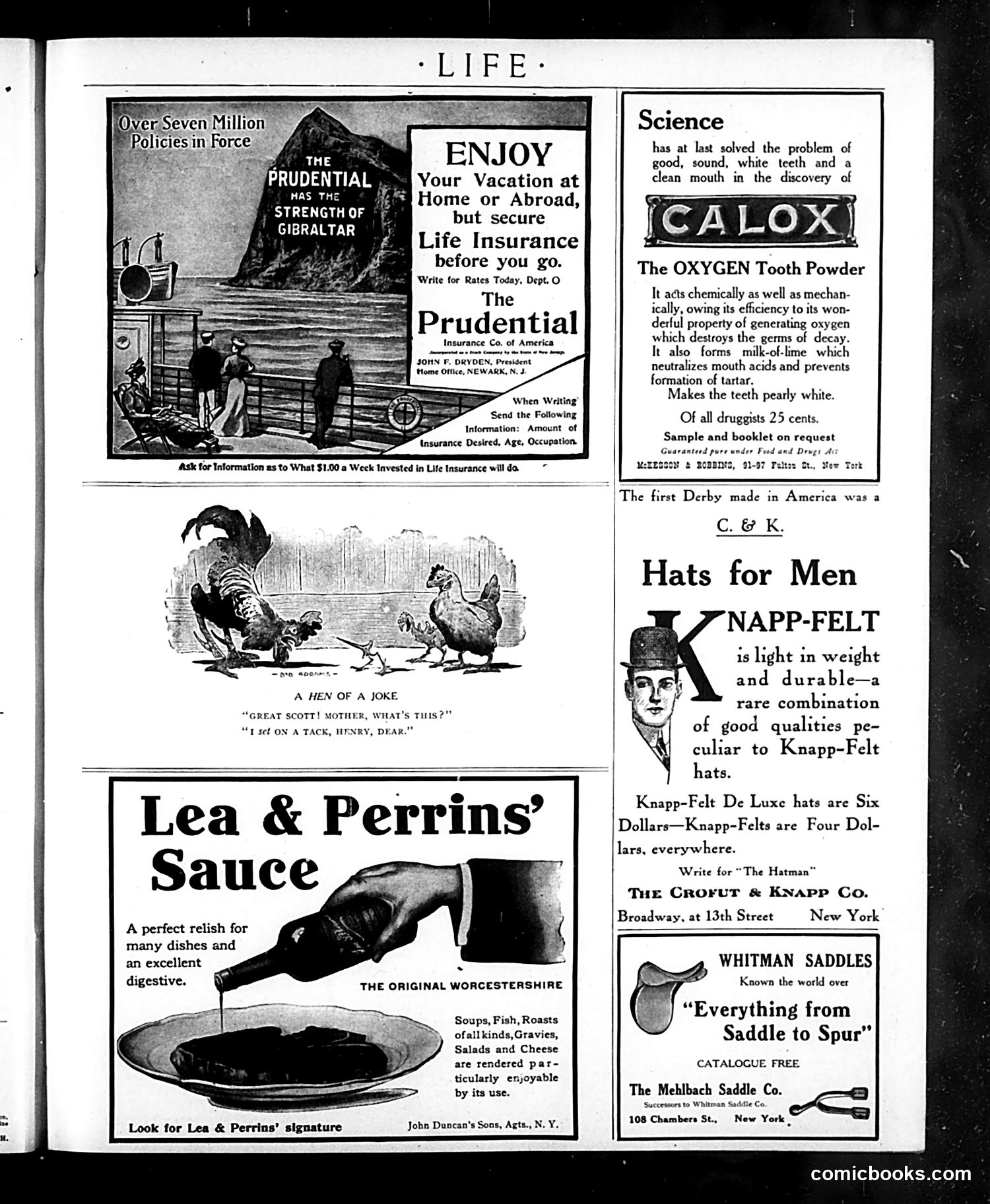
This page is primarily **advertising**, not editorial content. The single cartoon—a brief visual joke labeled "A Hen of a Joke"—shows a hen sitting on a tack, with a child asking mother what it is, and her reply: "I sat on a tack, Henry, dear." This is a pun: the hen's behavior mimics human discomfort, playing on the phrase "I sat on a tack." The bulk of the page showcases period advertisements for luxury goods (Prudential Insurance, Lea & Perrins Worcestershire Sauce, Calox tooth powder, Knapp-Felt hats, and Whitman Saddles). These reflect early 20th-century consumer products marketed to middle and upper-class readers. The Prudential ad notably invokes Gibraltar's "strength" as a metaphor for financial security—a common advertising trope of the era. No political satire is present; this is a commercial magazine page designed to generate revenue while entertaining readers with mild humor.
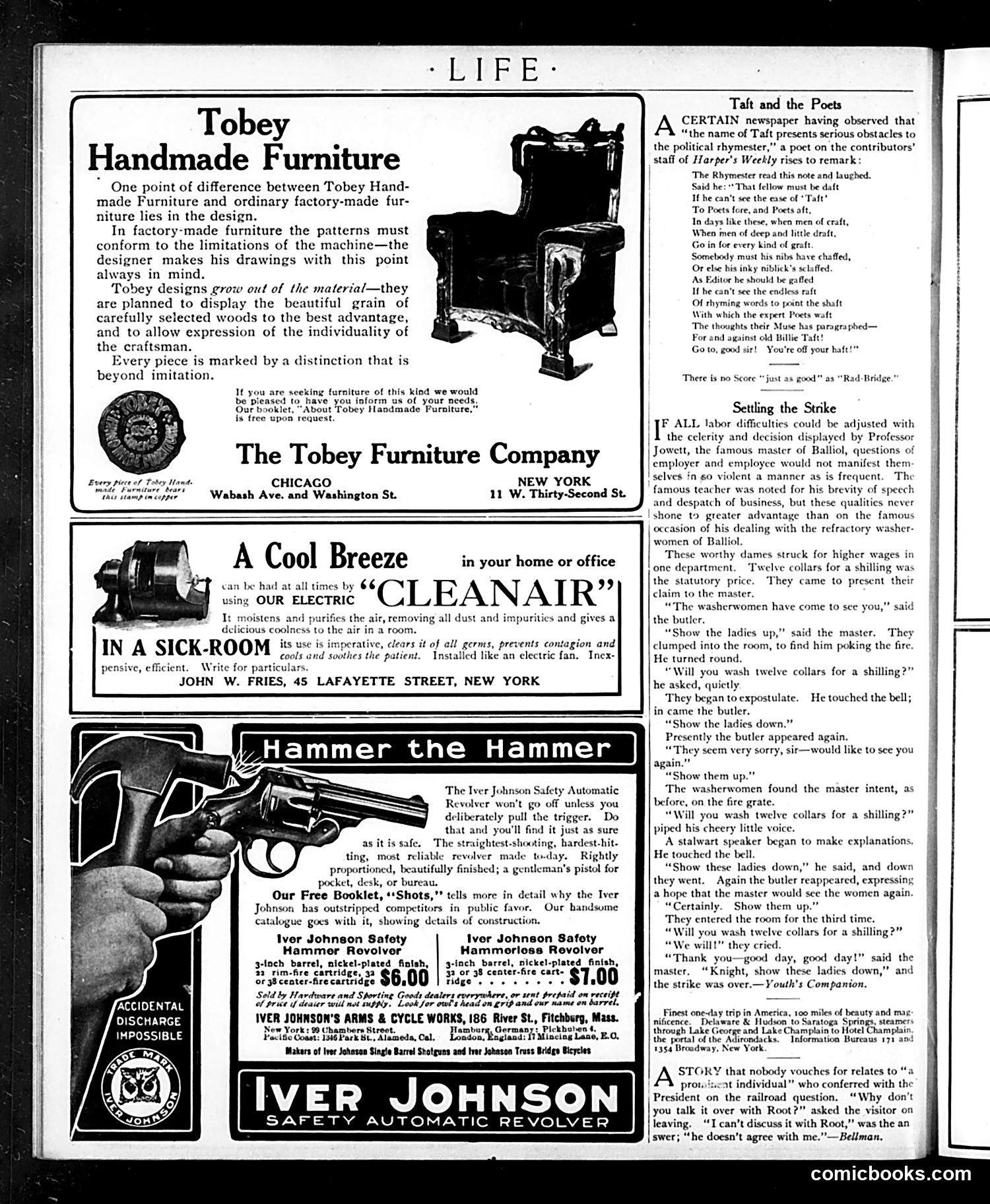
This page is primarily **advertisements** with a satirical article about President Taft. **The Taft satire** mocks a newspaper's claim that "Taft" is difficult to rhyme. A Harper's Weekly contributor responds with a mock-indignant poem demonstrating dozens of rhymes: "draft," "graft," "chaff," "shaft," etc. The joke targets the newspaper's absurd complaint while also satirizing contemporary politics—the poem references widespread corruption ("graft") among politicians. President William Howard Taft was in office circa 1909-1913. **"Settling the Strike"** begins a separate piece praising Professor Jowett of Oxford's efficient labor negotiation methods, suggesting he could resolve American labor disputes if his decisive approach were adopted. **The advertisements** include furniture, air purifiers, and notably, the **Iver Johnson Safety Revolver**—marketed with emphasis on its safety mechanism, suggesting this addresses contemporary concerns about accidental gun deaths or violence.
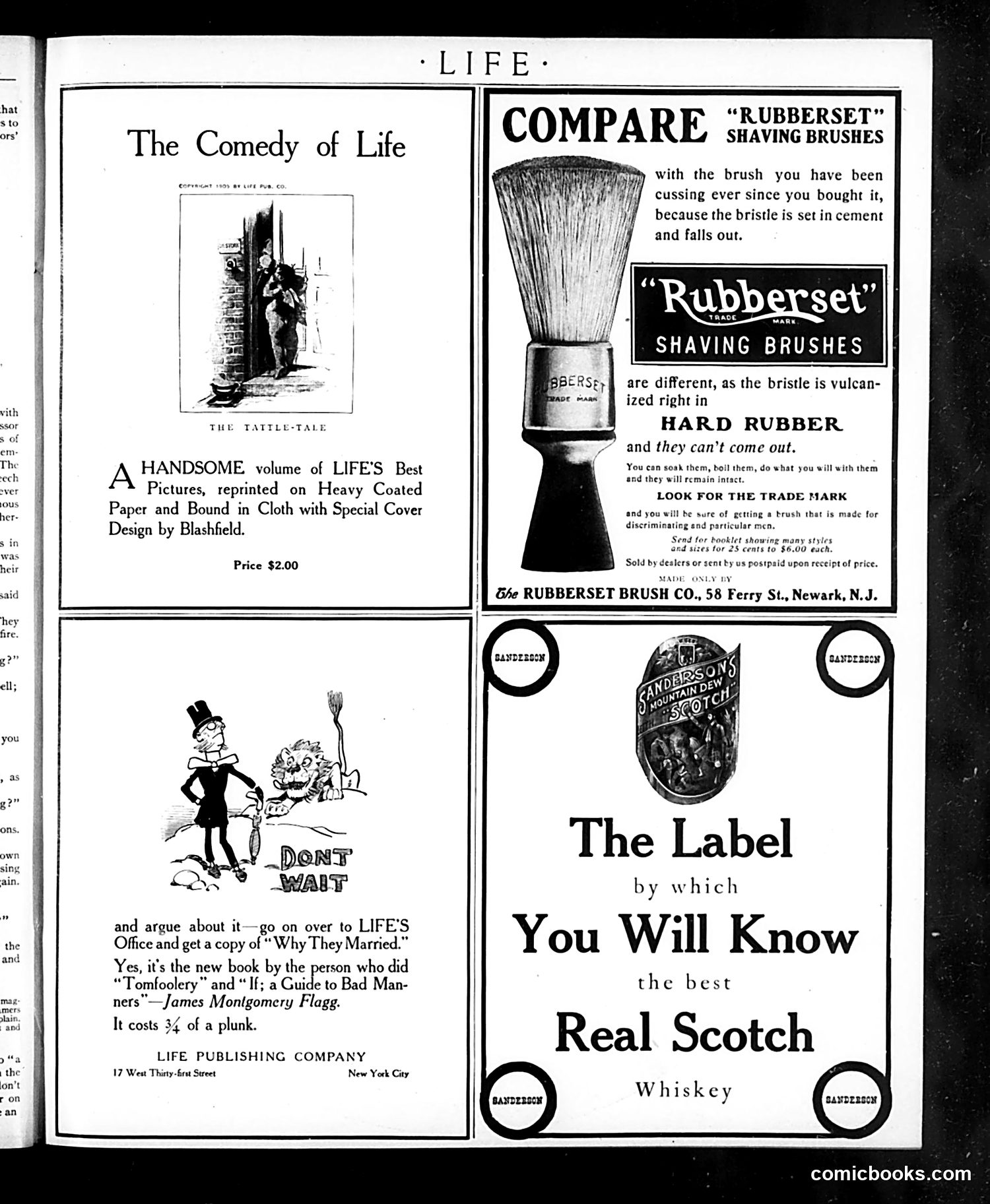
This is primarily an **advertising page** from Life magazine, not a satirical cartoon. It contains four advertisements mixed with minimal editorial content. The page includes: 1. **"The Comedy of Life"** — a book advertisement featuring a sketch titled "The Tattle-Tale" (showing a figure at a wall), promoting a collection of Life's best pictures, bound and priced at $2.00. 2. **Rubberset Shaving Brushes** — a product comparison ad claiming superiority over competitors whose bristles fall out, because Rubberset's bristles are vulcanized in hard rubber. 3. **James Montgomery Flagg book promotion** — advertising "Why They Married," a humorous book by the author of "Tomfoolery" and "If; a Guide to Bad Manners," priced at 3/4 of a plunk (unclear currency reference). 4. **Sanderson's Real Scotch Whiskey** — a label identification ad emphasizing brand recognition for quality whisky. The page reflects early 20th-century consumer advertising with emphases on product durability and brand trust.
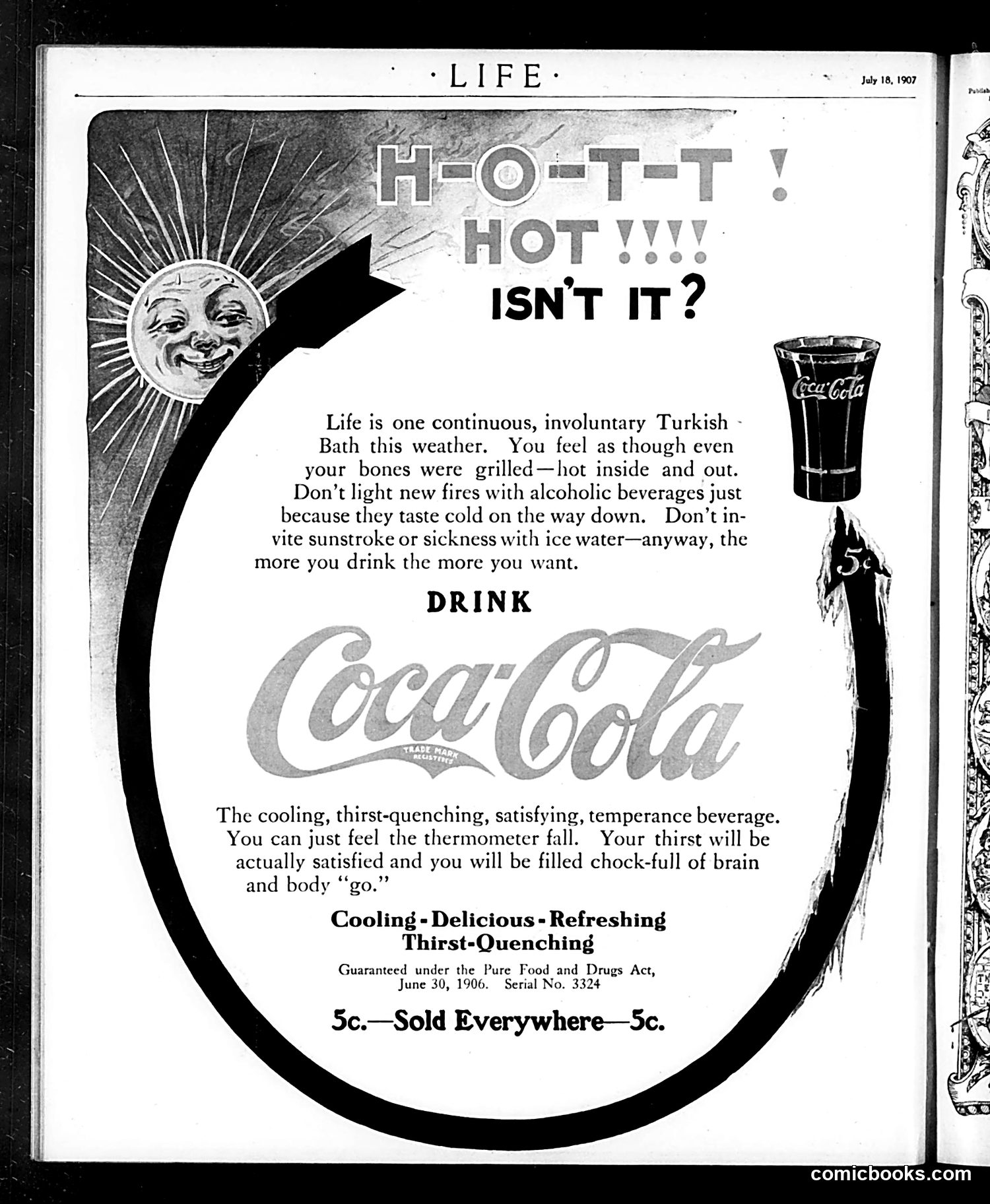
This page is primarily a **Coca-Cola advertisement**, not political satire. The "cartoon" element is minimal—just an anthropomorphized sun with a grinning face, used to illustrate the oppressive heat of summer. The ad's humor targets a specific 1907 concern: people drinking alcoholic beverages or ice water to cool off during hot weather, which the ad warns against as unhealthy or habit-forming. Coca-Cola is pitched as the rational alternative—a "temperance beverage" that satisfies thirst without these dangers. The reference to the "Pure Food and Drugs Act" (June 30, 1906) is significant: Coca-Cola had recently been scrutinized for its cocaine content. By prominently displaying this guarantee, the ad assures consumers the product is now federally approved and safe. The price ("5c.") and distribution claim ("Sold Everywhere") emphasize accessibility.