
Life, 1907-07-18 · page 17 of 28
Life — July 18, 1907 — page 17: what you’re looking at
What you’re looking at
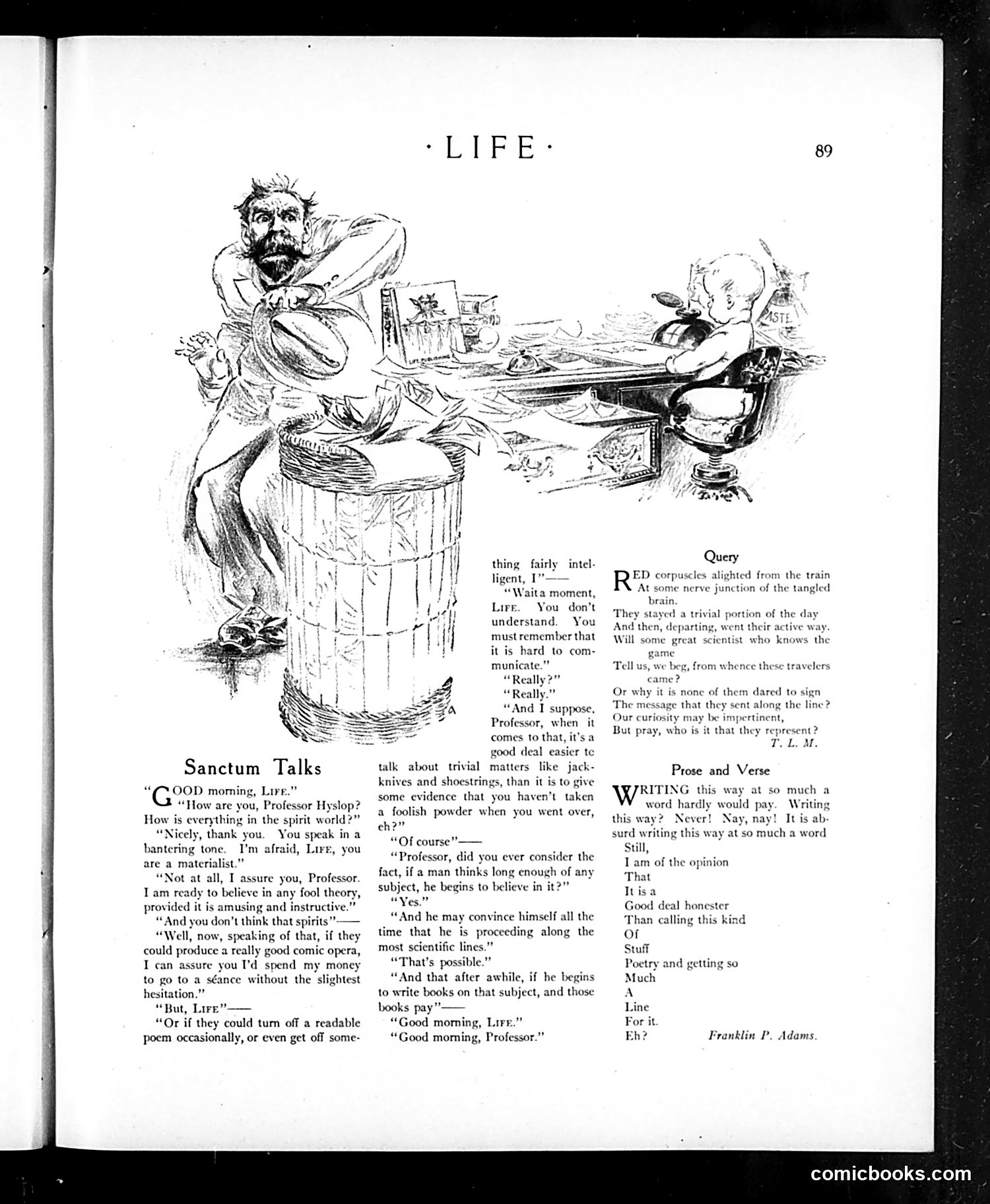
This cartoon satirizes spiritualism and séances, popular in the early 20th century. The bearded figure appears to be **Professor Hyslop**, likely James Hervey Hyslop, a real psychologist who investigated spiritualist claims and lectured on spirit communication. **The satire:** Life mocks spiritualism by having "Lire" (the magazine's voice) expose the movement's absurdity through logical argument. Hyslop claims spirits struggle to "communicate," but Lire points out this conveniently excuses any failure to produce evidence. He suggests that if someone *thinks* hard enough about anything, they'll believe it—and if they then write books about it, those books become profitable. The implication: spiritualists aren't discovering truth; they're convincing themselves and profiting from gullible believers. The accompanying poem plays on spiritualist jargon ("red corpuscles," "nerve junction") to mock pseudoscientific language used to legitimize séances. **Context:** This reflects widespread skepticism toward spiritualism among educated satirists, despite the movement's genuine popularity among believers.
📄 Transcribed text from this page (OCR, searchable)
Machine-transcribed from the original scan — historical spelling and the odd misread are preserved.
Sanctum Talks “(OOD moming, Lir “How are you, Professor Hyslop? How is ing in the spirit world?” cely, thank you. You speak in a bantering tone. I’m afraid, Lire, you are a materialist.” “Not at all, I assure you, Professor. I am ready to believe in any fool theory, provided it is amusing and instructive.” “And you don’t think that spirits” —— “Well, now, speaking of that, if they could produce a really good comic opera, I can assure you l’d spend my money to go to a séance without the slightest hesitation.” “But, Lire”— “Or if they could tum off a readable poem occasionally, or even get off some- thing fairly intel- ligent, 1” “Waita moment, Lire. You don’t understand. You must remember that it is hard to com- municate.” “Really?” “Really.” “And I suppose, Professor, when it comes to that, it's a good deal e: talk about trivial matters like jack- knives and shoestrings, than it is to give some evidence that you haven’t taken a foolish powder when you went over, ch?” “Of course”. “Professor, did you ever consider the fact, if a man thinks long enough of any subject, he begins to believe in it?” “Ye” “And he may convince himself all the time that he is proceeding along the most scientific lines.” “That’s possible.” “And that after awhile, if he begins to write books on that subject, and those books pay” — “Good morming, Lir “Good moming, Professor.” ier te ED corpuscles alighted from the train At some nerve junction of the tangled brain. ‘They stayed a trivial portion of the day then, departing, went their active way. Will some great scientist who knows the game ‘Tell us, we beg, from whence these travelers me? s none of them dared to sign ent along the line ? Prose and Verse RITING this way at so much a word hardly would pay. Writing this way? Never! Nay, nay! It is ab- surd writing this way at so much a word Still, I am of the opinion That Ttisa Good deal honester Than calling this kind of Stuff Poetry and getting so Much A Line For it, Eh? Franklin P. Adams comicbooks.com