
Life, 1907-07-18 · page 18 of 28
Life — July 18, 1907 — page 18: what you’re looking at
What you’re looking at
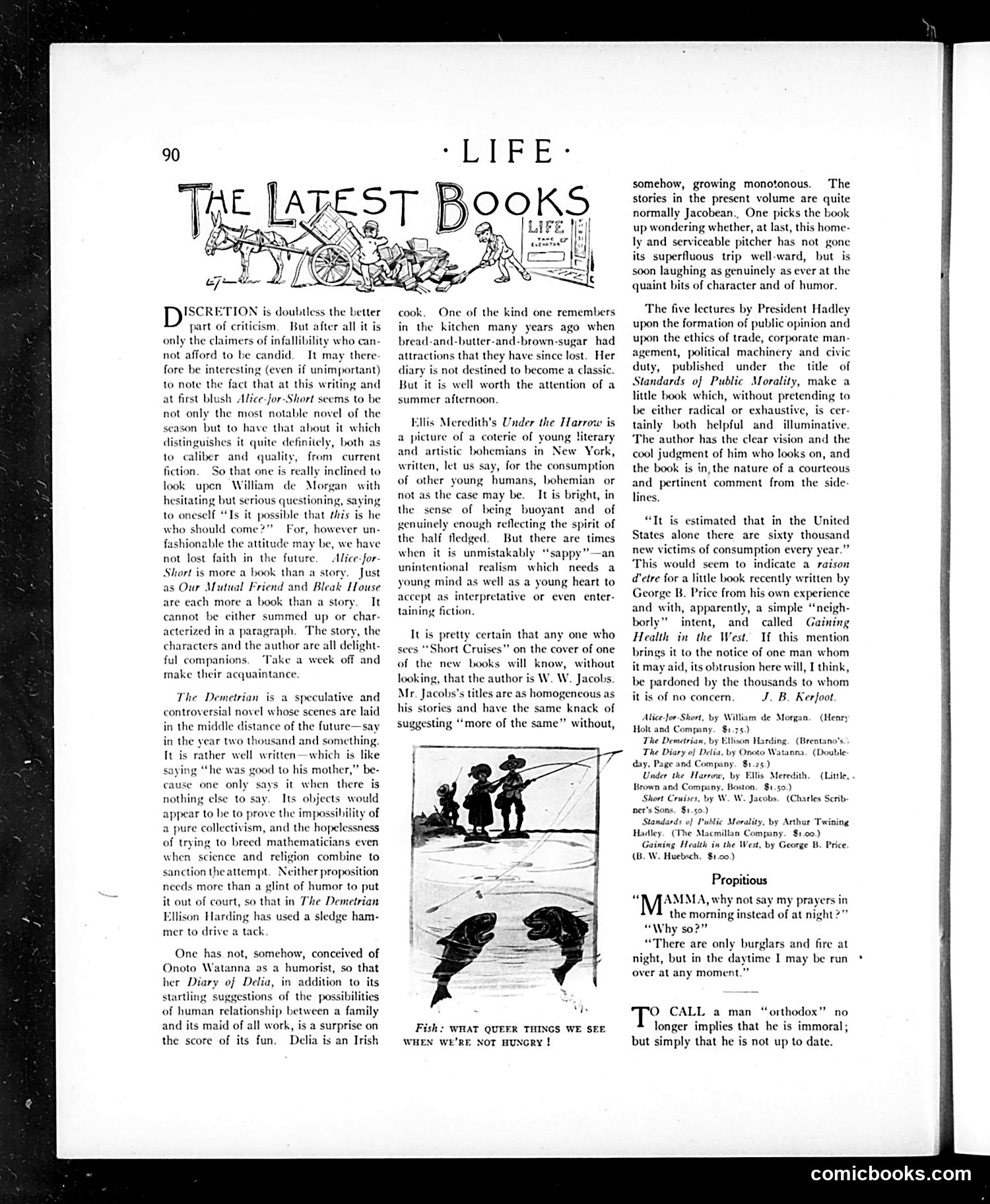
This page reviews recent books for educated readers. The cartoon shows two fish observing each other underwater with the caption "FISH: WHAT QUEER THINGS WE SEE WHEN WE'RE NOT HUNGRY!"—a humorous observation that perspective changes based on need or circumstance. The reviews discuss novels like *Alice-for-Short*, *The Demetrian* (a speculative future-set novel), and *Diary of Delia* by Onoto Watanna. The critic praises *Alice-for-Short* as the season's notable work while gently questioning whether author William de Morgan has truly arrived as a major talent. The satirical angle appears subtle: the critic maintains skepticism toward futuristic or overly intellectual fiction (*The Demetrian*) while championing character-driven, accessible storytelling. The fish cartoon reinforces this theme—good writing, like good observation, depends on one's vantage point and current needs.
📄 Transcribed text from this page (OCR, searchable)
Machine-transcribed from the original scan — historical spelling and the odd misread are preserved.
ISCRETION is doubtless the better part of criticism. But after all it is only the claimers of infallibility who can- not afford to be candid. It may there fore be interesting (even if unimportant) to note the fact that at this writing and at first blush Alice-for-Short seems to be not only the most notable novel of the season but to have that about it which distinguishes it quite definitely, both as to caliber and quality, from current fiction. So that one is really inclined to look upen William de Morgan’ with hesitating but serious questioning, saying to oneself “Is it possible that Uris is he who should come?" For, however un- fashionable the attitude may be, we have not lost faith in the future. Alice-jor. Short is more a book than a story. Just as Our Mutual Friend and Bleak House are each more a book than a story. It cannot be either summed up or char- acterized in a paragraph. The story, the characters and the author are all delight- ful companions. Take a week off and make their acquaintance. The Demetrian is a speculative and controversial novel whose scenes are laid in the middle distance of the future—say in the year two thousand and something. It is rather well written—which is like aying “he was good to his mother,” be- cause one only says it when there is nothing clse to Its objects would appear to be to prove the impossibility of a pure collectivism, and the hopelessness of trying to breed mathematicians even when science and religion combine to sanction theattempt. Neither proposition needs more than a glint of humor to put it out of court, so that in The Demetrian has used a sledge ham- tack Ellison Hardin mer to drive One has not, somehow, conceived of Onoto Watanna as a humorist, so that her Diary oj Delia, in addition to its startling suggestions of the possibilities of human relationship between a family and its maid of all work, is a surprise on the score of its fun. Delia is an Irish cook. One of the kind one remembers in the kitchen many years ago when bread-and-butter-and-brown-sugar had attractions that they have since lost. Her diary is not destined to become a classic. But it is well worth the attention of a summer afternoon. ‘Mis Meredith's Under the Harrow is a picture of a coterie of young titerary and artistic bohemians in New York, written, let us say, for the consumption of other young humans, bohemian or not as the case may be. It is bright, in the sense of being buoyant and of genuinely cnough reflecting the spirit of the half fledged. But there are times when it is unmistakably “sappy”—an unintentional realism which needs a young mind as well as a young heart to s interpretative or even enter- fiction. It is pretty certain that any one who Short Cruises” on the cover of one of the new books will know, without looking, that the author is W. W. Jacobs. Mr. Jacobs's titles homogencous as his stories and hav ame knack of suggesting “more of the same” without, Wy Fish: WHAT QUEER THINGS WE SEE WHEN WE'RE NOT HUNGRY ! somehow, growing monotonous. The stories in the present volume are quite normally Jacobean., One picks the book up wondering whether, at last, this home- ly and serviceable pitcher has not gone s superfluous trip well-ward, but is soon laughing as genuinely as ever at the quaint bits of character and of humor. The five lectures by President Hadley upon the formation of public opinion and upon the ethics of trade, corporate man agement, political machinery and civic duty, published under the title of Standards of Public Morality, make a little book which, without pretending to be either radical or exhaustive, is cer- tainly both helpful and_ illuminative. The author has the clear vision and the cool judgment of him who looks on, and the book is in, the nature of a courteous and pertinent comment from the side- lines. “Tt is estimated that in the United States alone there are sixty thousand new victims of consumption every year.” This would seem to indicate a raison d'etre for a little book recently written by George B. Price from his own experience and with, apparently, a simple “neigh- borly” intent, and called Gaining Health in the West. If this mention brings it to the notice of one man whom it may aid, its obtrusion here will, I think, be pardoned by the thousands to whom it is of no concern J. B. Kerjoot Alice-for Short, by William de Morgan. Holt and Company. $1.75.) The Demdtrian, by Ellison Harding The Diary o] Delia, by Onoto Watanna day, Page and Company, $1.25) Under the Harrow, by Ellis Meredi Brown and Company, Boston. $1.50.) Short Cruises, by W. W. Jacobs. (Charles Scrib- (Heary (Brentano's (Double (Little Mic Morality, by Arthur 1 (The Macmillan Company. $1.00.) Gaining Health in the West, by George B. Price. (B.W. Huebsch, $1.00) ‘wining Propitious “J JAMMA, why not say my prayers in the morning instead of at night 2” “Why so?” “There are only burglars and fire at night, but in the daytime I may be run over at any moment.” TO. CALL a man “orthodox” no longer implies that he is immoral; but simply that he is not up to date. comicbooks.com