
Life, 1907-07-18 · page 8 of 28
Life — July 18, 1907 — page 8: what you’re looking at
What you’re looking at
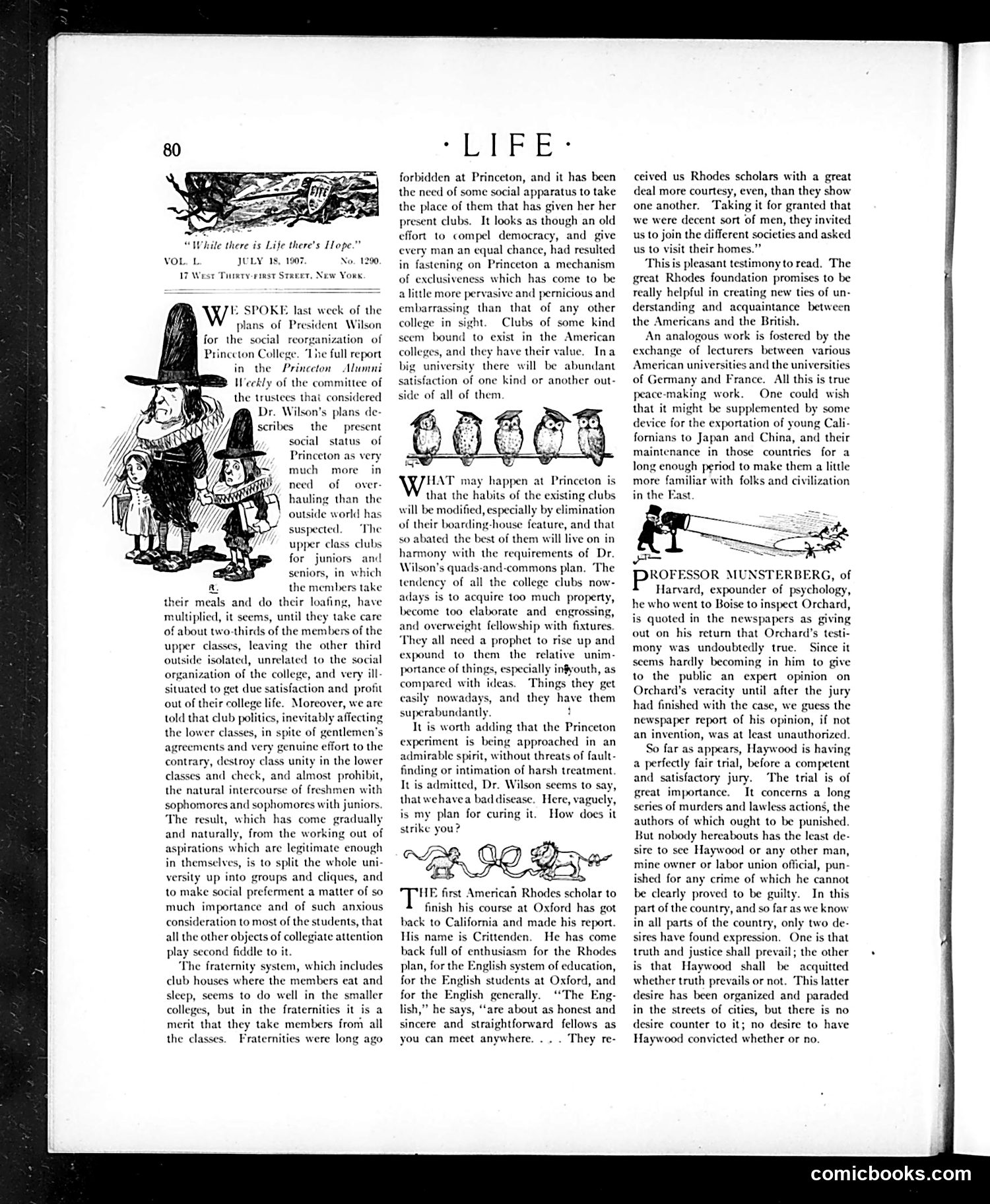
This page from *Life* (July 18, 1907) discusses President Wilson's social reorganization plans for Princeton College. The left cartoon depicts a figure shepherding a flock of doves—likely representing Princeton students—with the title suggesting idealistic hopes for institutional reform. The article criticizes Princeton's existing club system as elitist and divisive, fragmenting students into exclusive social hierarchies. Wilson apparently proposed eliminating these clubs or reforming them to promote greater equality and unity among all classes of students. The satire suggests that despite Wilson's good intentions ("in the Dove's Hope"), his idealistic plans may face practical resistance from the entrenched social structures at Princeton—a commentary on the difficulty of reforming traditional institutions.
📄 Transcribed text from this page (OCR, searchable)
Machine-transcribed from the original scan — historical spelling and the odd misread are preserved.
VOL. L JULY 18, 1907. No 17 West Tuiety-rinst Steer 1290 w Yous W' SPOKE last week of the f plans of President: Wilson for the social reorganization of Princeton College. ‘The full report in the Princeton Alonni Weekly of the committee of the trustees that considered Dr. Wilson’s plans de- scribes the — present social status of Princeton as very much more in need of — over hauling than the outside world has suspected. ‘The upper class clubs for juniors and seniors, in which g. the members take their meals and do their loafing, have multiplied, it seems, until they take care of about two-thirds of the mer rs of the upper classes, leaving the other third outside isolated, unrelated to the social organization of the college, and very ill situated to get due satisfaction and profit out of their college life. Moreover, we are told that club politics, inevitably affecting the lower classes, in spite of gentlemen’s agreements and very genuine effort to the contrary, destroy class unity in the lower classes and check, and almost prohibit, the natural intercourse of freshmen with sophomores and sophomores with juniors. The result, which has come gradually and naturally, from the working out of aspirations which are legitimate enough in themselves, is to split the whole uni- versity up into groups and cliques, and to make social preferment a matter of so much importance and of such anxious consideration to most of the students, that all the other objects of collegiate attention play second fiddle to it. ‘The fraternity system, which includes club houses where the members eat and sleep, seems to do well in the smaller colleges, but in the fraternities it is a merit that they take members from all the classes. Fraternities were long ago EE * forbidden at Princeton, and it has been the need of some social apparatus to take the place of them that has given her her present clubs. It looks as though an old effort to compel democracy, and give every man an equal chance, had resulted in fastening on Princeton a mechanism of exclusiveness which has come to be a little more pervasive and pernicious and embarrassing than that of any other college in sight. Clubs of some kind seem bound to exist in the American colleges, and they have their value. Ina big university there will be abundant satisfaction of one kind or another out- side of all of them. HAT may happen at Princeton is that the habits of the existing clubs will be modified, especially by elimination of their boarding-house feature, and that so abated the best of them will live on in harmony with the requirements of Dr. Wilson's quads-and-commons plan. The tendency of all the college clubs now- adays is to acquire too much property, become too elaborate and engrossing, and overweight fellowship with fixtures ‘They all need a prophet to rise up and expound to them the relative unim- portance of things, especially infyouth, as compared with id Things they get casily nowadays, and they have them superabundantly. 1 It is worth adding that the Princeton experiment is being approached in an admirable spirit, without threats of fault- finding or intimation of harsh treatment It is admitted, Dr. Wilson seems to say that wehavea bad disease. Here, vaguely, is my plan for curing it. How does it strike you? HE first American Rhodes scholar to finish his course at Oxford has got back to California and made his report. His name is Crittenden. He has come back full of enthusiasm for the Rhodes plan, for the English system of education, for the English students at Oxford, and for the English generally. “The Eng- lish,” he says, ‘‘are about as honest and sincere and straightforward fellows as you can meet anywhere... . They re- ceived us Rhodes scholars with a great deal more courtesy, even, than they show one another. Taking it for granted that we were decent sort of men, they invited us to join the different societies and asked us to visit their homes.” ‘This is pleasant testimony to read. The great Rhodes foundation promises to be really helpful in creating new ties of un- derstanding and acquaintance between the Americans and the British. An analogous work is fostered by the exchange of lecturers between various American universities and the universities of Germany and France. All this is true peace-making work. One could wish that it might be supplemented by some device for the exportation of young Cali- fomians to Japan and China, and their maintenance in those countries for a long enough period to make them a little more familiar with folks and civilization in the ay ROFESSOR MUNSTERBERG, of Harvard, expounder of psychology, he who went to Boise to inspect Orchard, is quoted in the newspapers as giving out on his return that Orchard’s testi- mony was undoubtedly true. Since it seems hardly becoming in him to give to the public an expert opinion on Orchard’s veracity until after the jury had finished with the case, we guess the newspaper report of his opinion, if not an invention, was at least unauthorized. So far as appears, Haywood is having a perfectly fair trial, before a competent and satisfactory jury. The trial is of great importance, It concerns a long series of murders and lawless actions, the authors of which ought to be punished But nobody hereabouts has the least de- sire to see Haywood or any other man, mine owner of labor union official, pun- ished for any crime of which he cannot be clearly proved to be guilty. In this part of the country, and so far as we know in all parts of the country, only two de- sires have found expression. One is that truth and justice shall prevail; the other is that Haywood shall be acquitted whether truth prevails or not. This latter desire has been organized and paraded in the streets of cities, but there is no desire counter to it; no desire to have Haywood convicted whether or no. comicbooks.com