
A complete issue · 25 pages · 1907
Life — June 27, 1907
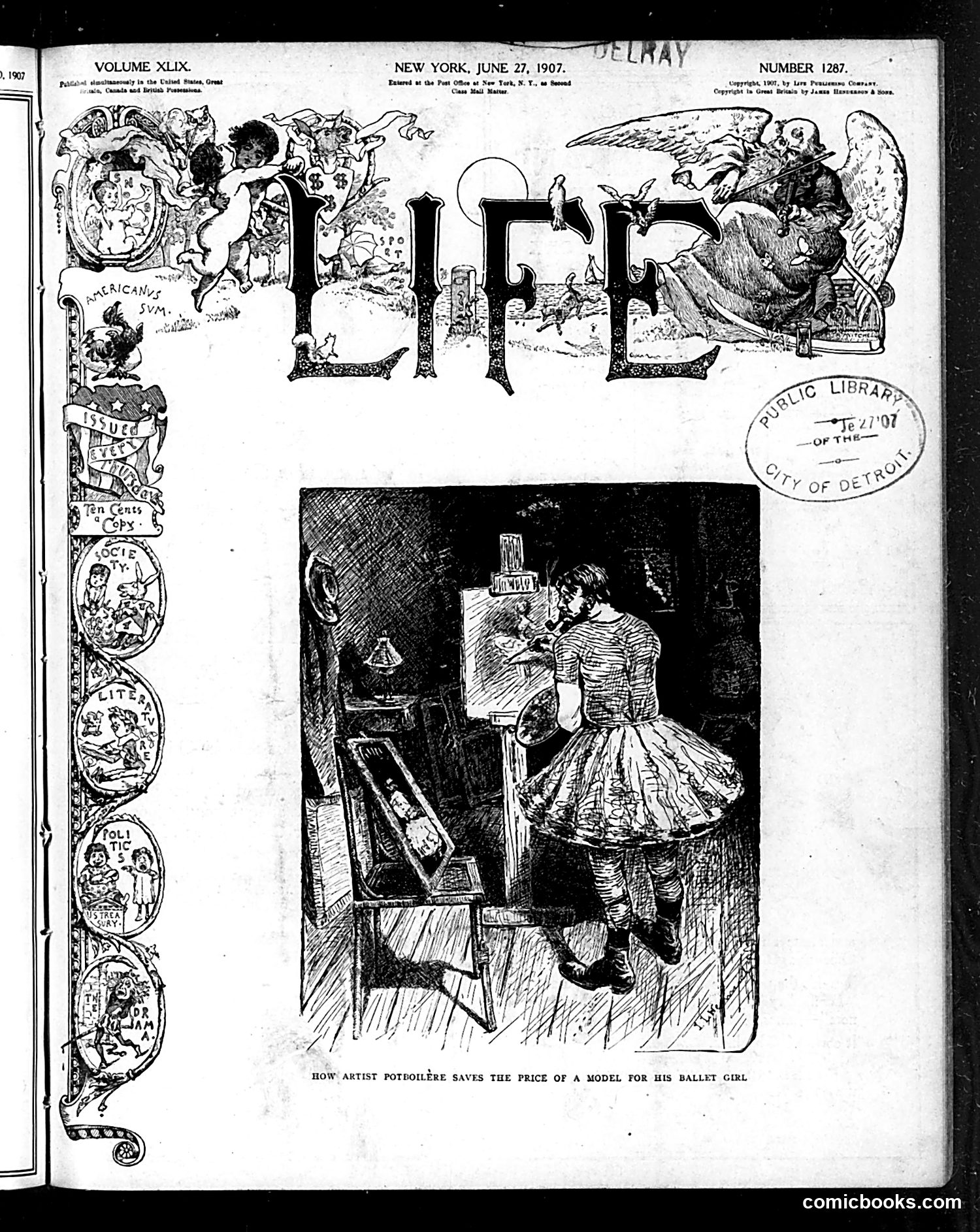
The main illustration depicts an artist painting a portrait of a young woman in a ballet costume. The caption reads: "HOW ARTIST POTBOILÈRE SAVES THE PRICE OF A MODEL FOR HIS BALLET GIRL." The satire targets artistic dishonesty: rather than paying for a live model, the artist uses a pre-existing portrait or painting as his reference, merely copying it onto canvas. "Potboilère" is French slang for a hack artist who produces commercial work for money rather than art for art's sake. This mocks both the economic pressures on struggling artists and the ethical shortcuts they take—essentially cheating by avoiding model fees while still claiming to create original work. The joke assumes readers understand the expectation that serious artists work from live subjects, making this practice particularly contemptible.
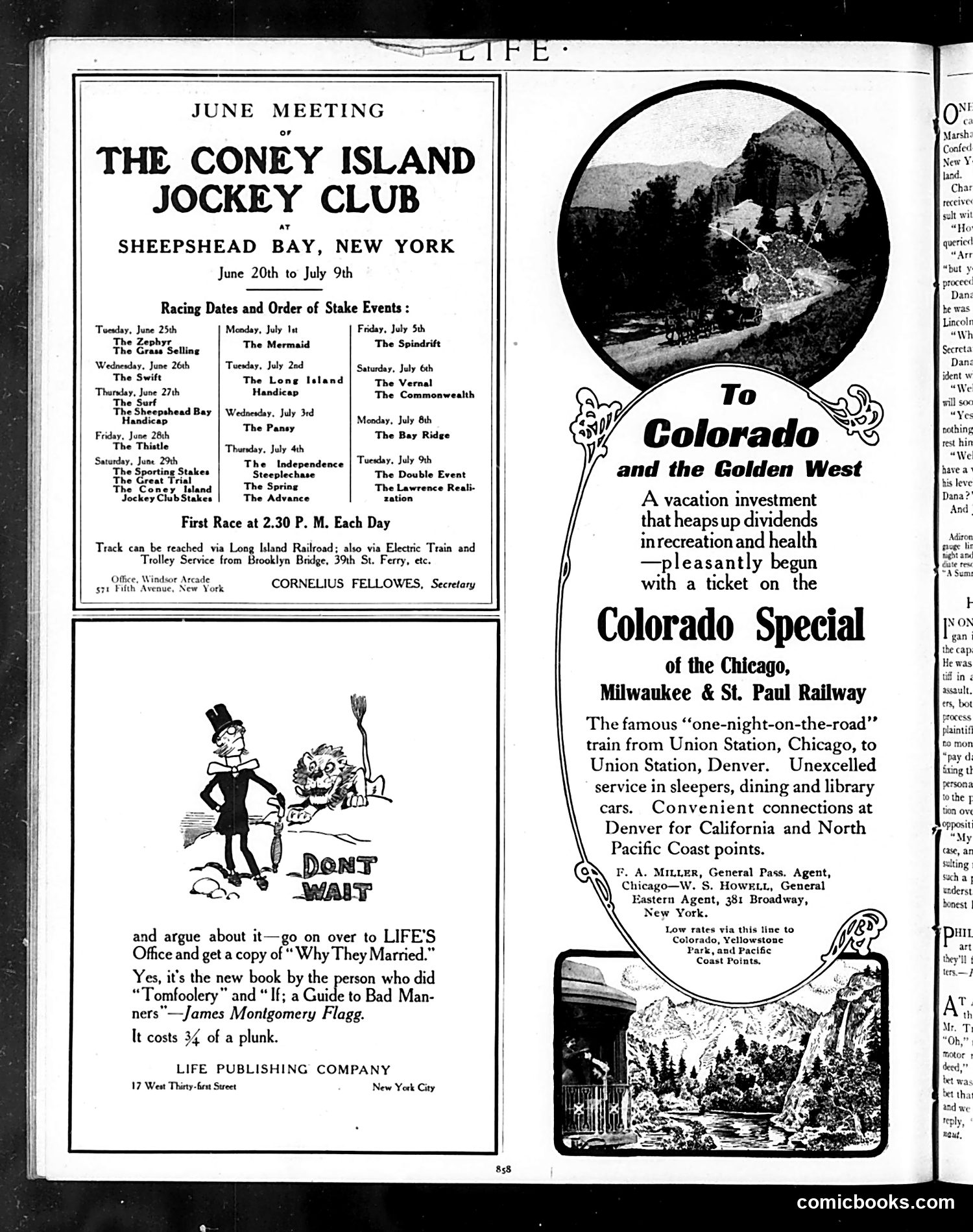
This small cartoon appears to be advertising a book titled "Why They Married" by James Montgomery Flagg. The image shows a man in formal attire (top hat and tuxedo) appearing exasperated or argumentative with a woman, suggesting marital discord or disagreement. The text's instruction to "go on over to LIFE's Office and get a copy of 'Why They Married'" and "argue about it" frames the book as commentary on marital conflict—a common satirical subject in early 20th-century humor. The joke suggests that couples constantly debate the reasons for their marriages, implying that matrimonial motivation is perpetually unclear or contentious. Priced at 3¢, this was marketed as light entertainment addressing domestic life's absurdities.
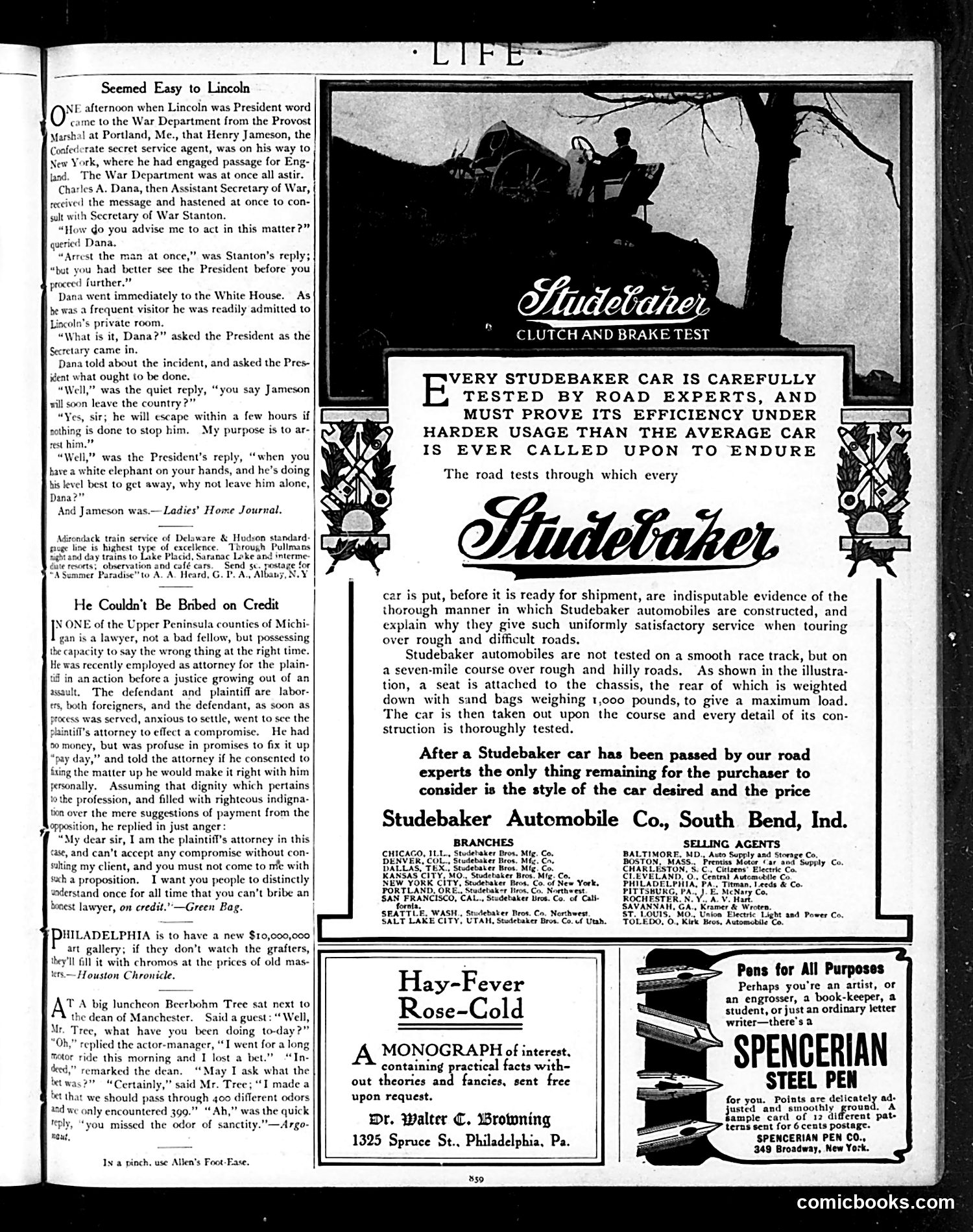
This page is primarily **advertising and light humor**, not political satire. The main content features a **Studebaker automobile advertisement** emphasizing rigorous testing on rough roads. The ad includes an illustration of a car being tested on hillside terrain with sand bags for weight. The left column contains two unrelated anecdotes: 1. "Seemed Easy to Lincoln" — a story about President Lincoln and a Confederate spy, illustrating Lincoln's wit and composure. 2. "He Couldn't Be Bribed on Credit" — a humorous legal anecdote about a lawyer who wouldn't accept a bribe even if offered on credit. The page also includes small advertisements for **Hay-Fever Rose-Cold monograph** and **Spencerian Steel Pens**. This appears to be a typical 1910s-era *Life* magazine page mixing advertising, automotive promotion, and genteel humor rather than sharp political commentary.
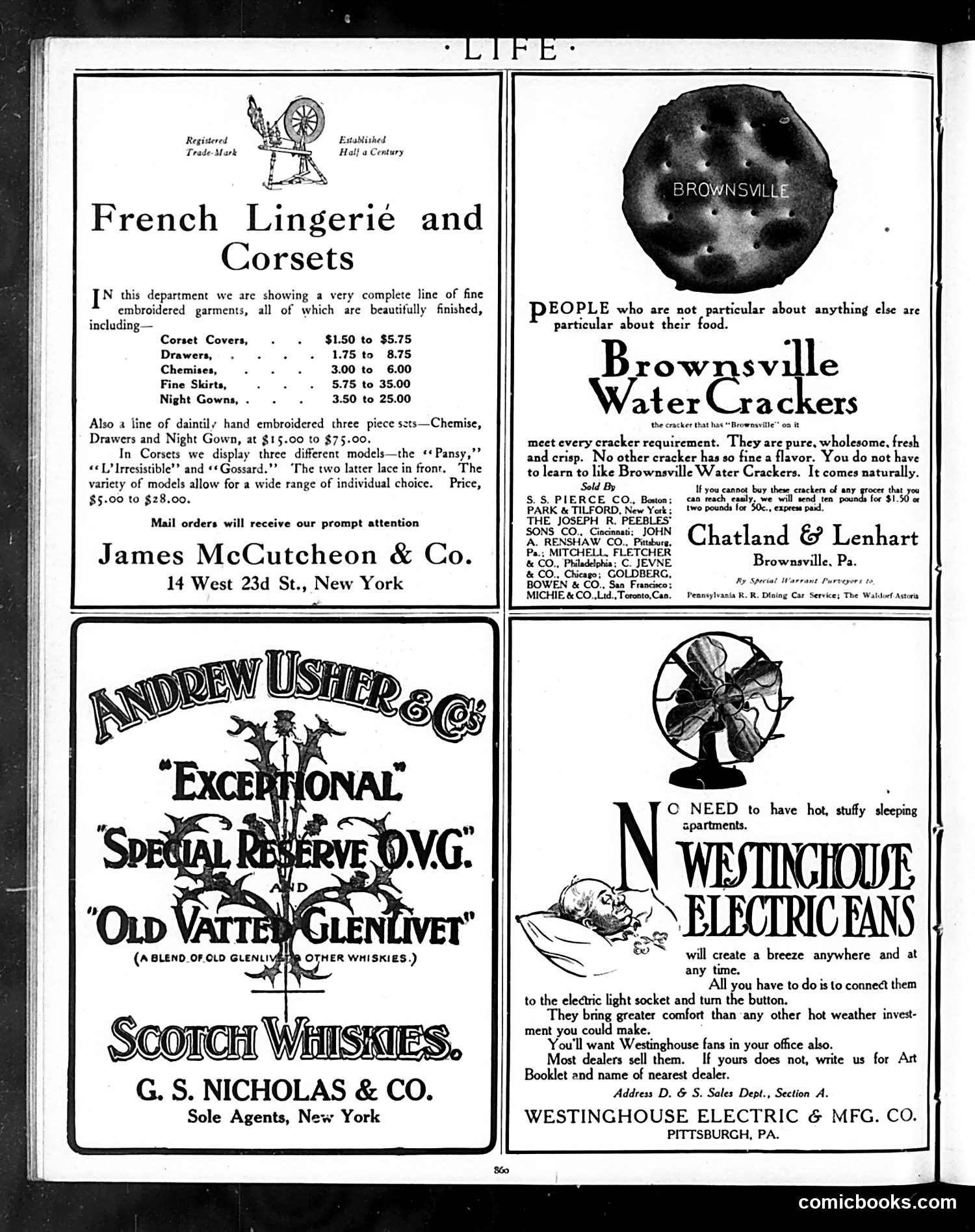
This page is **primarily advertising**, not satire or political content. It contains four advertisements from the early 20th century: 1. **French Lingerie and Corsets** (James McCutcheon & Co., NYC) - selling embroidered garments and corsets at various price points 2. **Brownsville Water Crackers** - promoting crackers as fresh and pure, with distribution details 3. **Andrew Usher & Co. Scotch Whiskies** - advertising three whisky brands including "Old Vat" and "Glenlivet" 4. **Westinghouse Electric Fans** - promoting electric fans for hot weather comfort, with installation instructions There are no political cartoons or satirical commentary visible. The page simply showcases period consumer goods and services typical of Life magazine's advertising section.
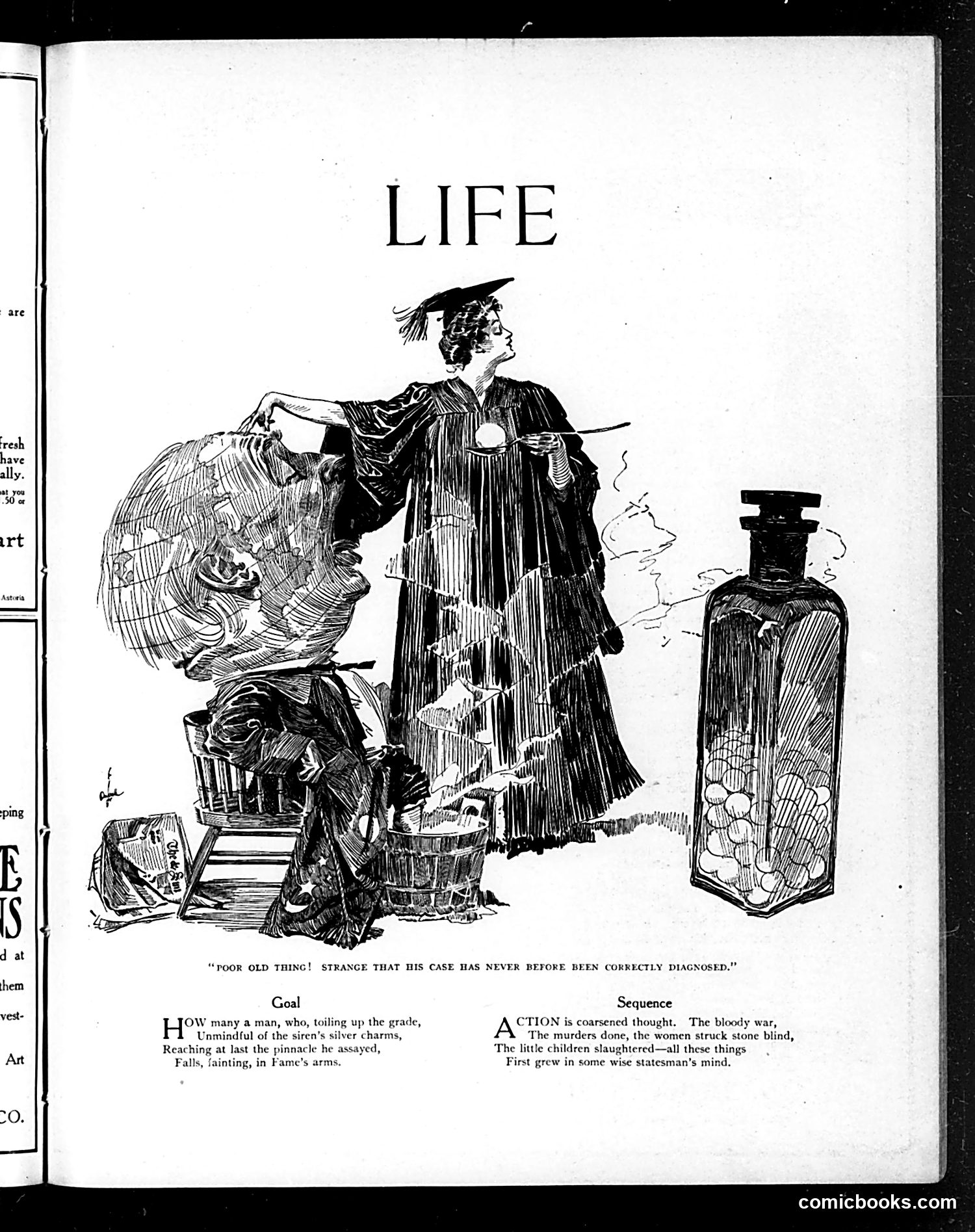
This is a satirical commentary on judicial diagnosis and treatment of social ills. The central figure is a graduate or educated professional (indicated by the mortarboard cap and robes) examining a patient—representing society or a social problem—with a bottle of medicine nearby. The caption quotes a doctor saying the case has "never before been correctly diagnosed," suggesting incompetence in addressing social issues. The poems titled "Goal" and "Sequence" reference war, murder, and children's slaughter, implying that society's violence stems from poorly understood root causes. The satire critiques how educated elites and institutions misdiagnose social problems, applying ineffective remedies. The sophisticated presentation contrasts with the serious subject matter, highlighting the gap between expert pretense and actual understanding of society's ailments.
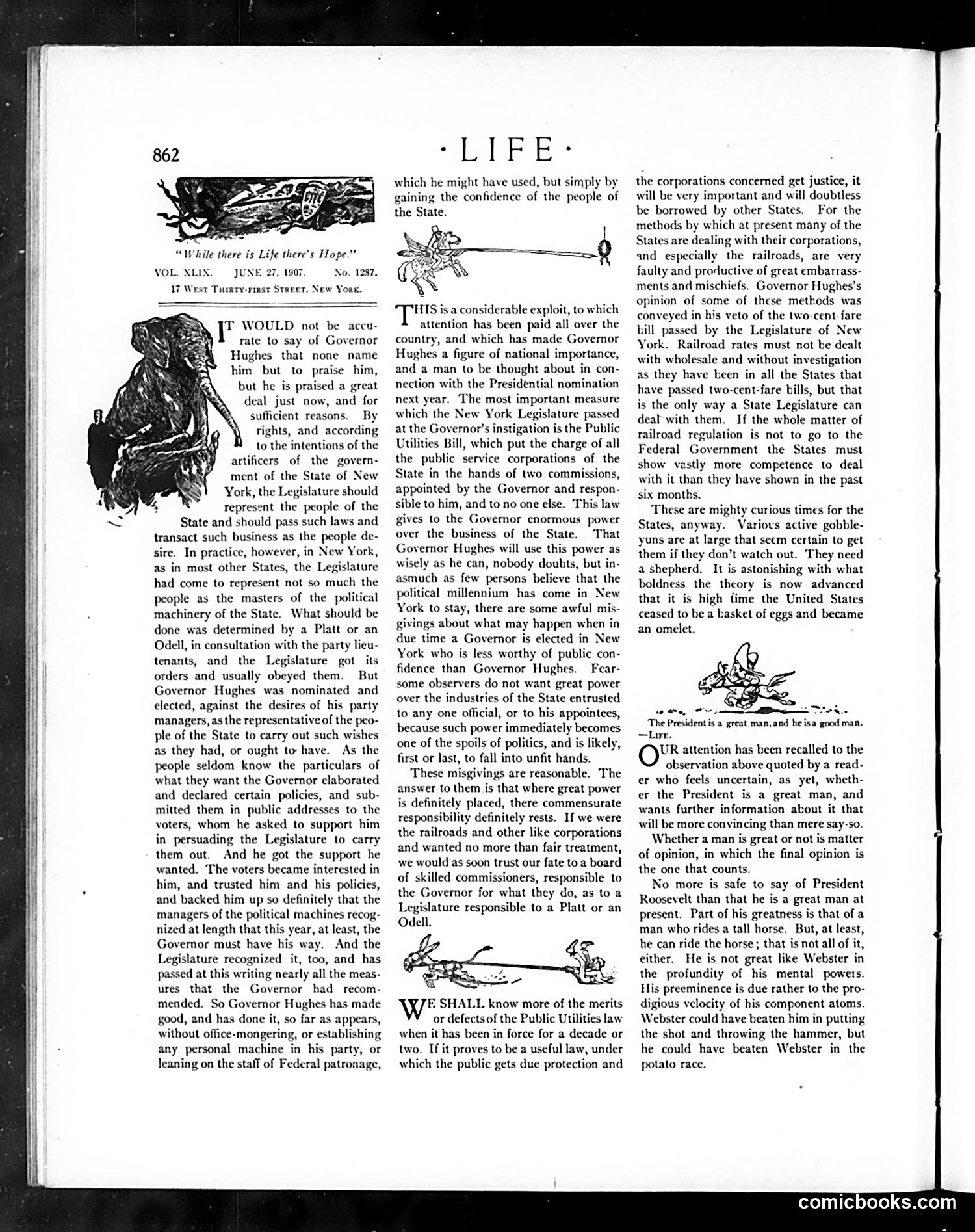
This page discusses Governor Hughes and New York State politics, specifically praising his creation of the Public Utilities Commission—a regulatory body to oversee public service corporations. The cartoons illustrate the article's arguments about executive power and competence. The illustrations appear to show caricatured political figures, though specific identities aren't entirely clear from the image alone. The text contrasts Hughes favorably with other potential leaders, suggesting some were less capable (references to horse-riding and potato races suggest mockery of rivals' abilities). The broader satirical point: that proper regulatory oversight and strong executive leadership matter more than political party loyalty—a progressive-era argument for administrative competence over patronage politics.
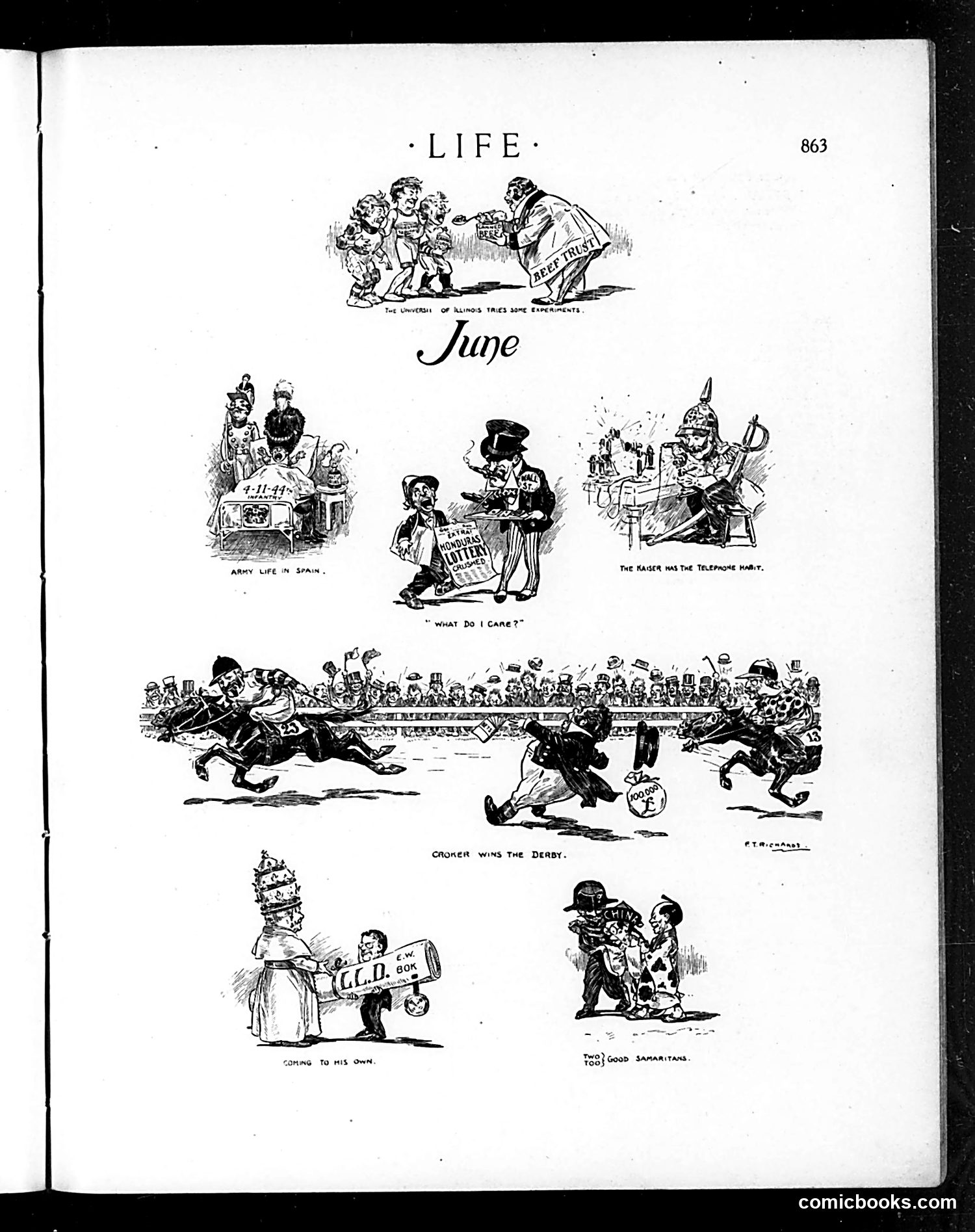
This page presents June-themed satirical cartoons. The top caption references "The University of Illinois Takes Some Experiments," suggesting commentary on academic activities. The cartoons include: - "Army Life in Spain" (likely referring to Spanish-American War context) - "What Do I Care?" (appears to show a figure with a newspaper) - "The Kaiser and the Telephone Habit" (depicting German military authority) - "Cromer Wins the Derby" (a horse racing scene with crowd) - "Caring to His Own" (unclear reference) - "Too Good Samaritans" (appears to show charitable or rescue activities) The satire targets contemporary military affairs, international politics (particularly German Kaiser), and social behaviors. Without clearer context on specific 1900s-era events, some references remain imprecise, though the overall tone mocks authority figures and current events typical of Life magazine's satirical approach.
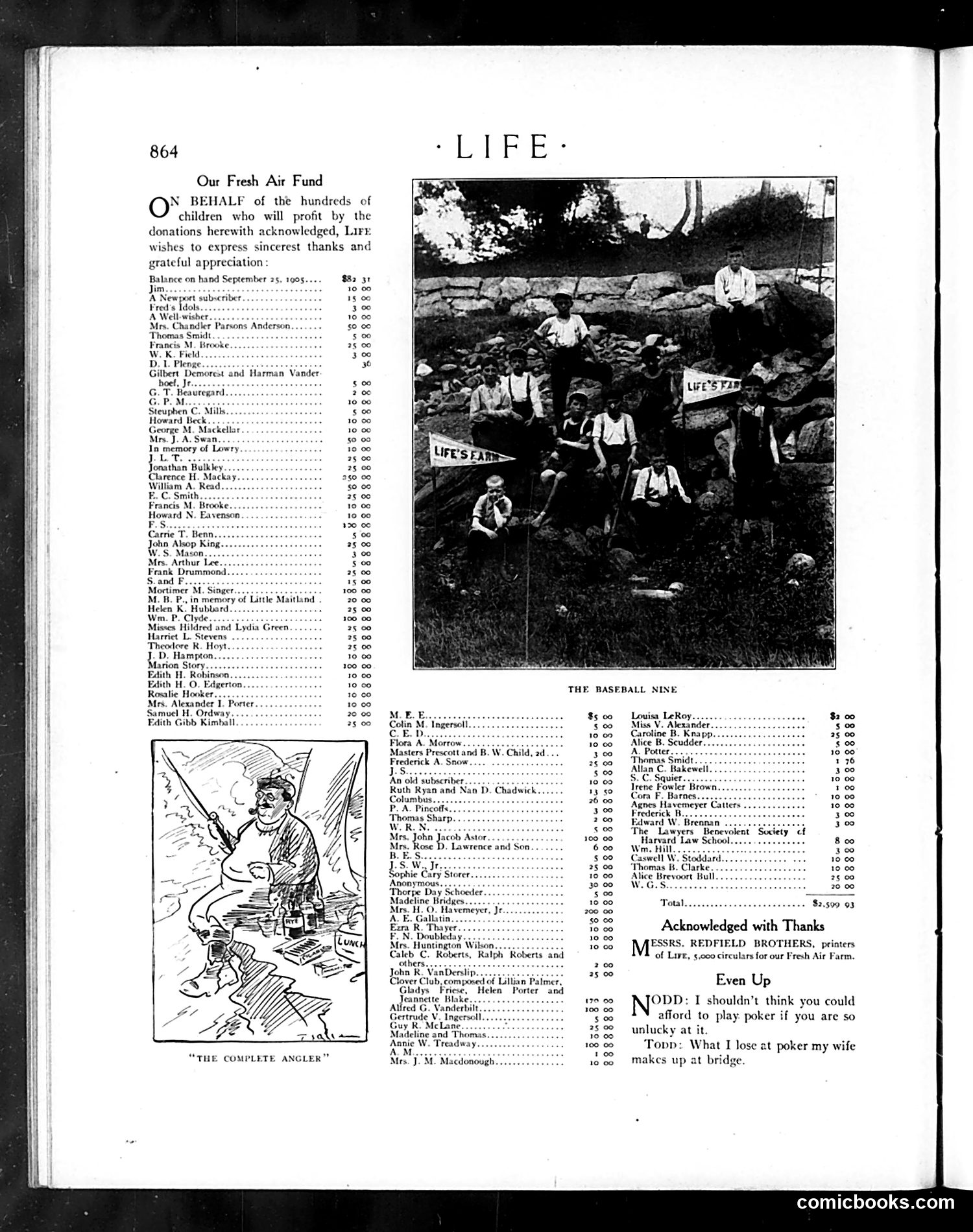
This page features a satirical cartoon titled **"The Complete Angler,"** showing a relaxed fisherman in a boat surrounded by various bottles and supplies. The figure appears to be a leisured gentleman enjoying recreational fishing. The cartoon likely satirizes **leisure and excess among the wealthy** during the early 1900s (based on Life magazine's era). The abundance of bottles beside the angler suggests alcohol consumption, possibly mocking upper-class indulgence or the disconnect between wealthy leisure activities and broader social concerns. The cartoon accompanies a fundraising list for Life's "Fresh Air Fund," which provided outdoor recreation for underprivileged children—creating ironic contrast between the carefree wealthy angler and charitable efforts to give poor children similar outdoor experiences.
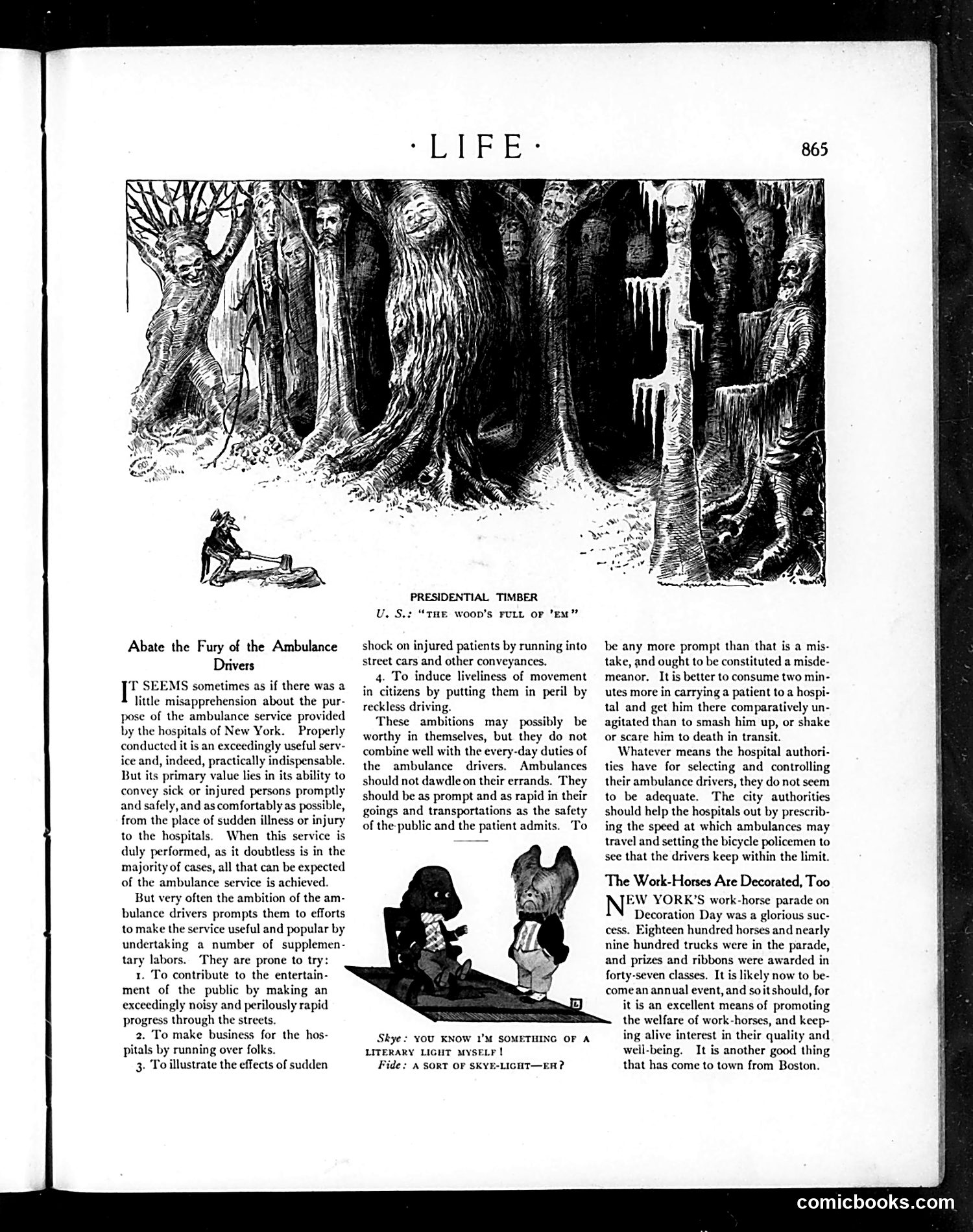
This page contains two distinct pieces: **"Abate the Fury of the Ambulance Drivers"** critiques New York ambulance services. The article argues that ambulance drivers prioritize speed and showmanship over patient safety, recklessly racing through streets to entertain the public. It advocates for hospitals to enforce stricter controls on driver behavior and speed limits, warning that current practices endanger both patients in transit and pedestrians. **"The Work-Horses Are Decorated, Too"** reports on New York's Decoration Day horse parade, celebrating 1,800 horses and nearly 900 trucks in a festive event with prizes across 47 classes. The author praises it as beneficial for promoting work-horse welfare and public interest. The illustration shows a satirical dialogue between two figures—apparently a "skye" (Skye terrier) and a "fide" (possibly the magazine's mascot), making a pun about "skye-light."
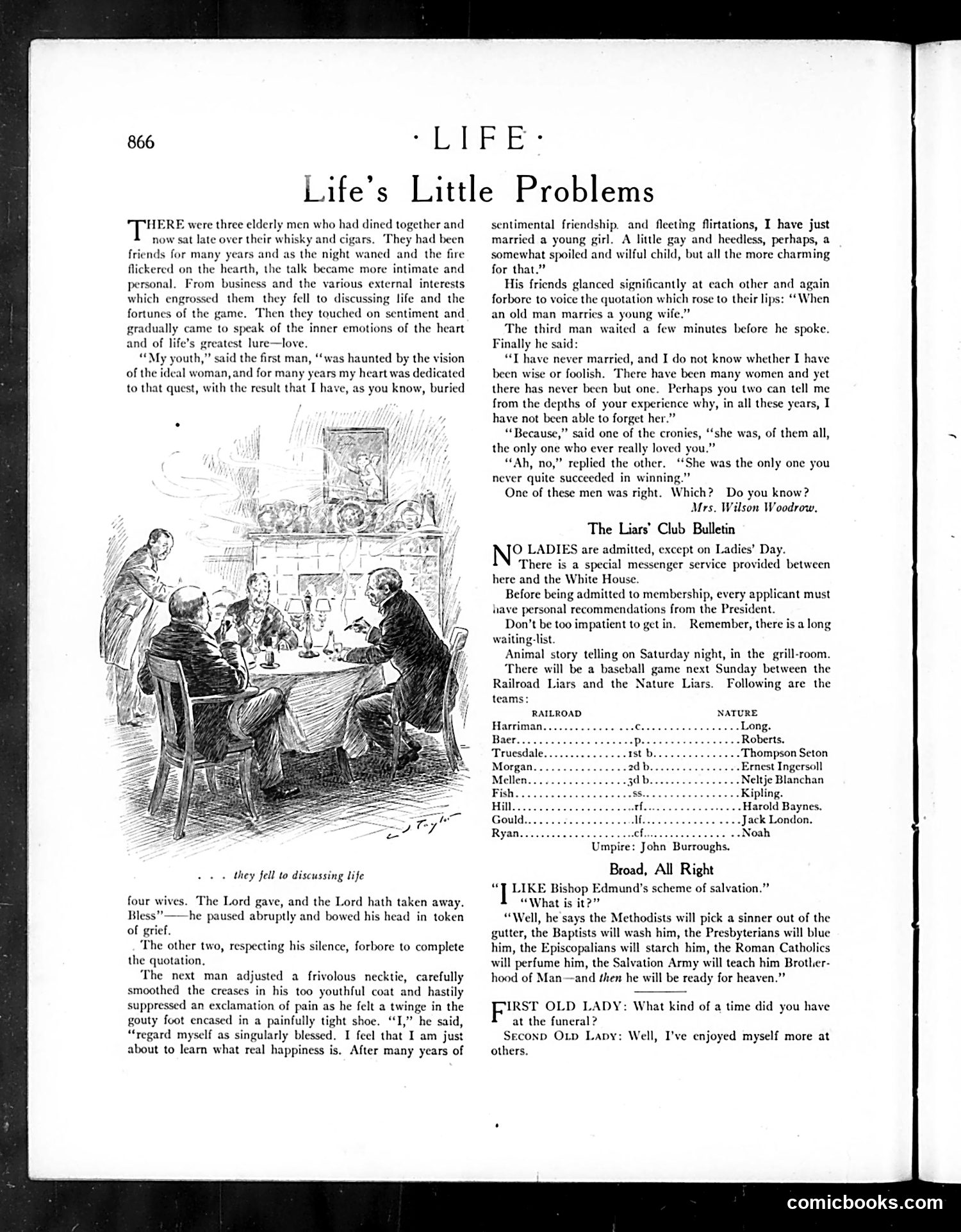
This page presents a satirical story about three elderly men discussing love and marriage. The accompanying sketch shows three men in what appears to be a social club, conversing while seated around a table with drinks. The satire examines romantic life choices: one man never married and pursued an "ideal woman," another married young to a spoiled child, and the third married later. The joke's punchline—delivered by Mrs. Wilton Woodrow—poses which man was "right," suggesting none achieved happiness. This reflects early 20th-century satirical commentary on marriage as fundamentally problematic for men, a common theme in Life magazine's humor targeting middle-class male anxieties about domestic life and romantic commitment.
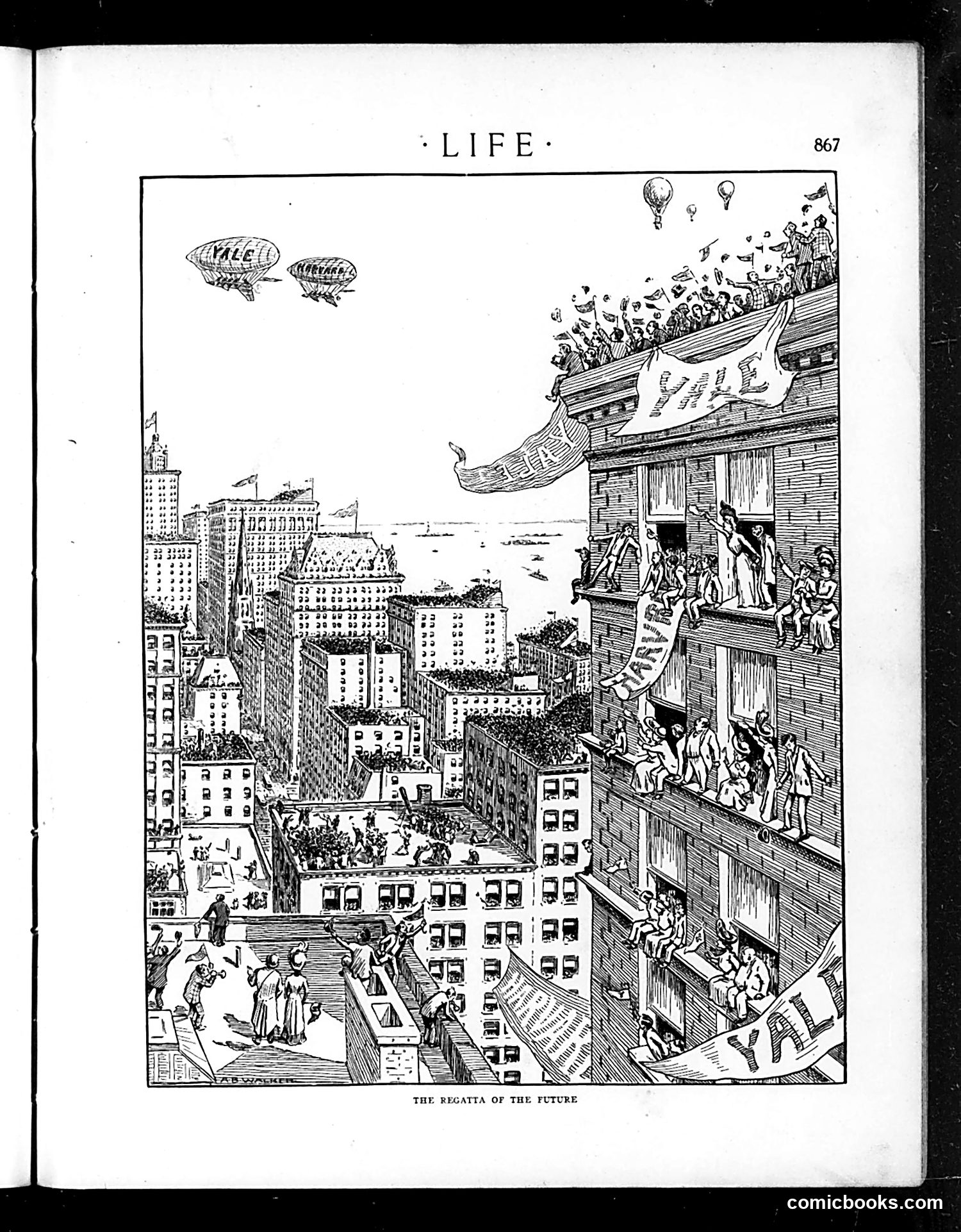
This satirical cartoon depicts a fantastical future cityscape where a massive Oriental-style vessel (appearing Asian in design, with upturned eaves) floats above modern skyscrapers. Crowds of people populate building rooftops, fire escapes, and streets below, seemingly watching or participating in this aerial "regatta." The satire likely comments on: - Urban overcrowding and density in early 20th-century American cities - The emergence of aviation and fantastical future technologies - Possible anxieties about Asian immigration or influence (the ship's design suggests this) - The spectacle of modern entertainment and how crowds gather for novelties The humor derives from the absurdity of boats racing above cities rather than on water, satirizing both technological utopianism and contemporary urban life. The exact date and specific event referenced remain unclear from the visible text alone.
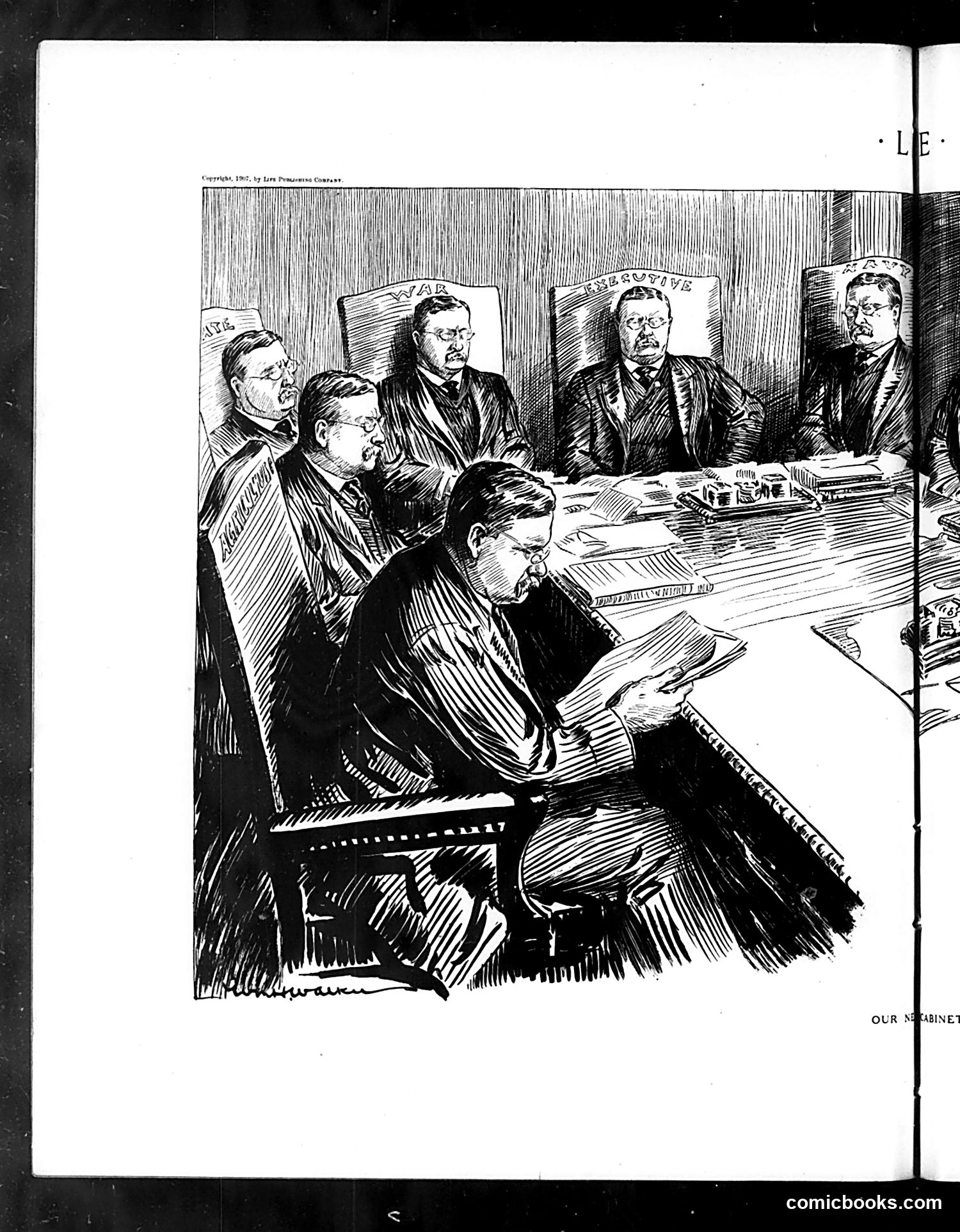
This is a satirical cartoon titled "OUR CABINET" depicting what appears to be an early 20th-century U.S. Cabinet meeting. The illustration shows several men in formal dress seated around a table, examining documents. The cartoon's point seems to be satirizing the Cabinet members' work or decision-making process. The style and subject matter suggest this is political satire about government leadership, though without clearer identification of the specific figures or the publication date visible in the image, I cannot definitively name which administration is being mocked or what specific policy is under scrutiny. The formal setting and serious expressions suggest the satire concerns weighty governmental matters rather than trivial issues. The artist's signature appears at the bottom left.
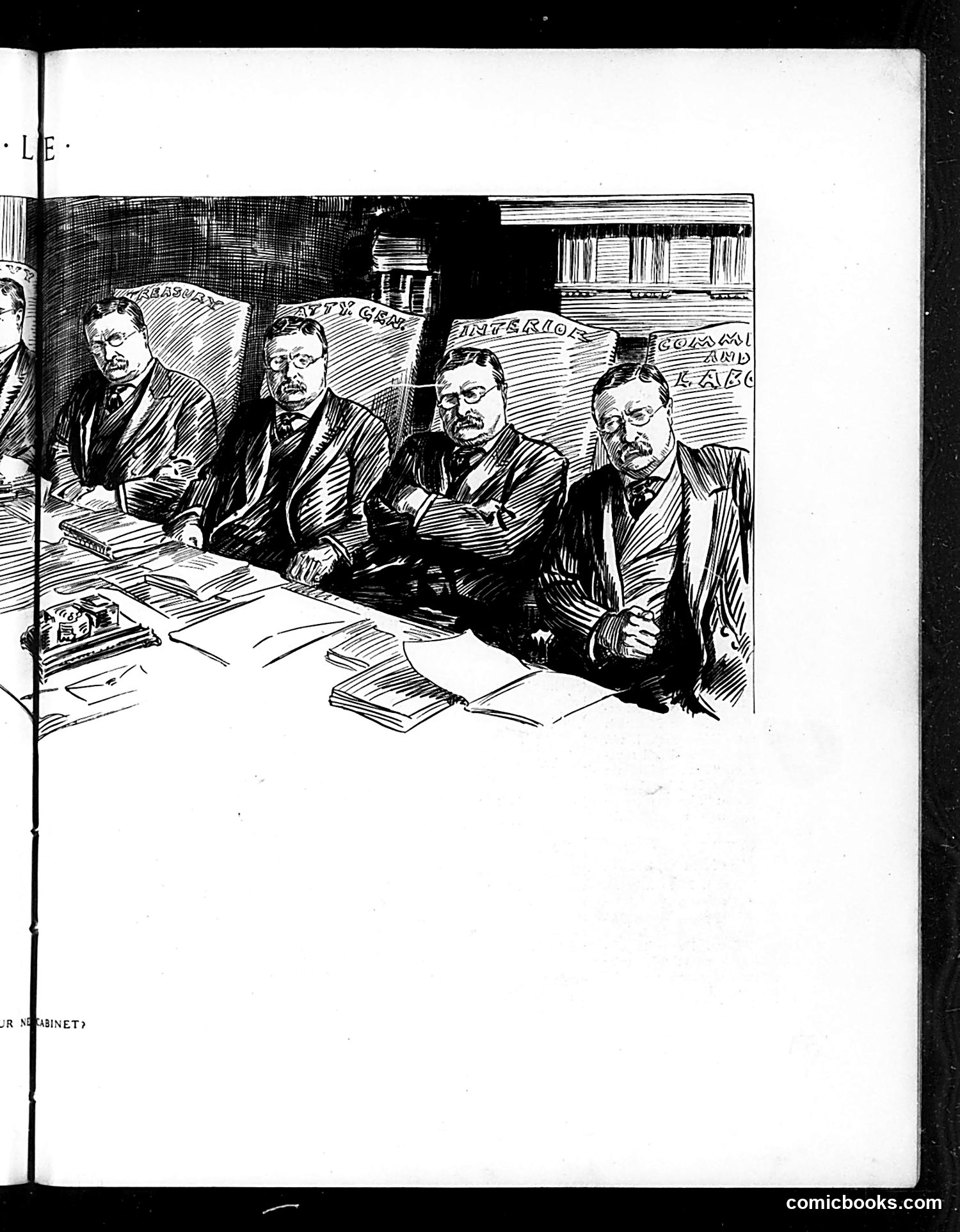
This black-and-white illustration depicts four men in suits seated at a table with papers and documents before them, appearing to be in an official meeting or cabinet setting. The sketch style and cross-hatching are typical of early 20th-century political cartoons. The visible text fragments on papers/items in the scene include references to what appear to be administrative or governmental matters, though some text is partially obscured or unclear in the reproduction. Without being able to definitively identify the specific individuals caricatured or read complete text labels, I cannot confidently specify which political figures or exact historical moment this cartoon references. The formal setting and serious expressions suggest satire of governmental proceedings, likely commentary on executive or cabinet-level decision-making of that era.
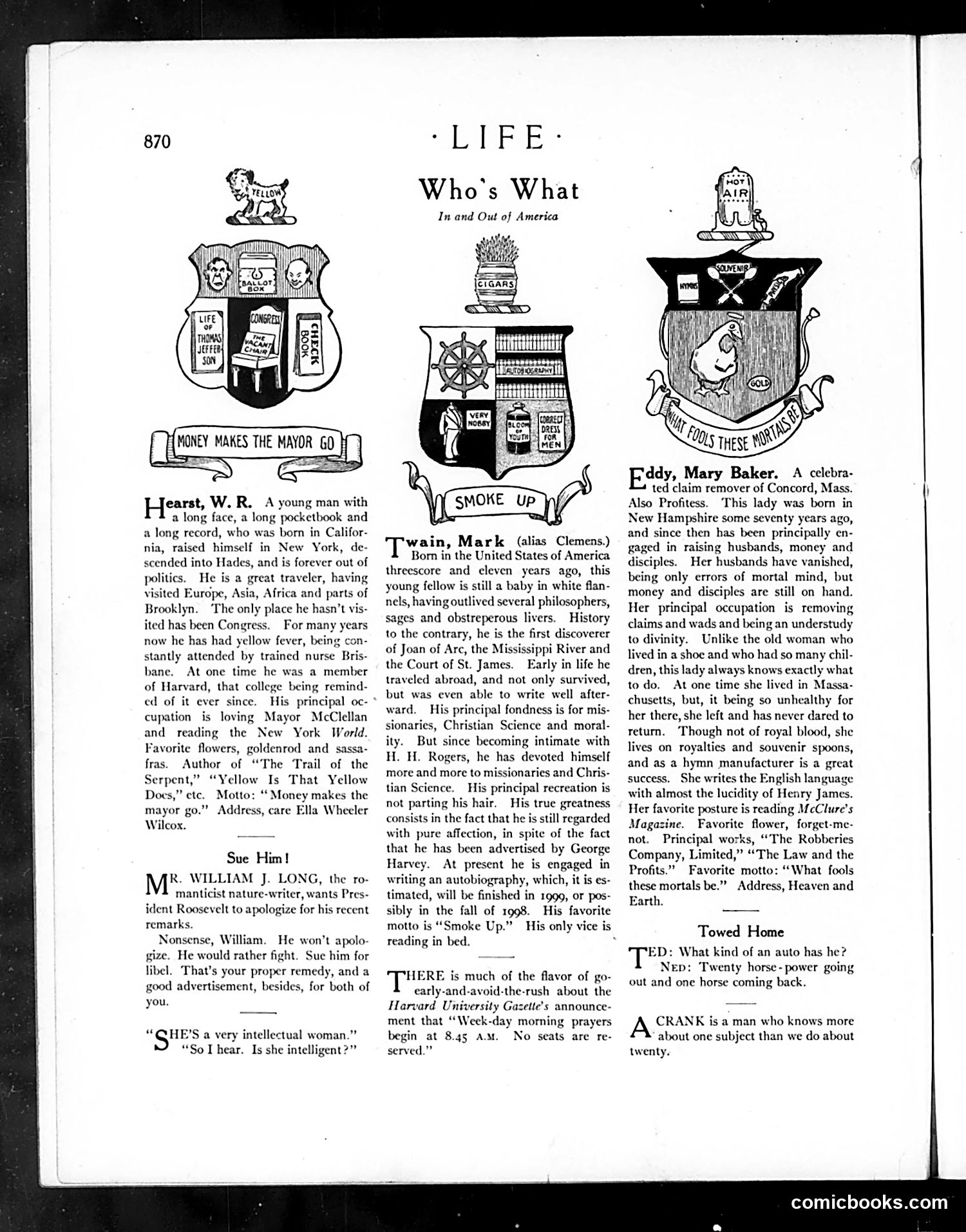
This page from *Life* magazine contains satirical biographical sketches of prominent Americans. The humor relies on exaggeration and coded criticism: **W.R. Hearst**: Depicted as a wealthy, traveling newspaper magnate obsessed with politics and Mayor McClellan, with the motto "Money makes the mayor go"—suggesting he buys political influence. **Mark Twain**: Mocked affectionately for outliving philosophers, befriending industrialist H.H. Rogers, and taking forever to finish his autobiography. "Smoke Up" references his famous cigar-smoking. **Mary Baker Eddy**: Founder of Christian Science, satirized as a "claim remover" who has gone through multiple husbands (which she attributed to "errors of mortal mind"), while accumulating money and followers. The sketch ridicules both her theology and her financial success. The cartoons and sketches use exaggerated biographical parody to poke fun at these public figures' pretensions, wealth, and influence—typical of *Life*'s satirical approach to American celebrities and power brokers of the era.
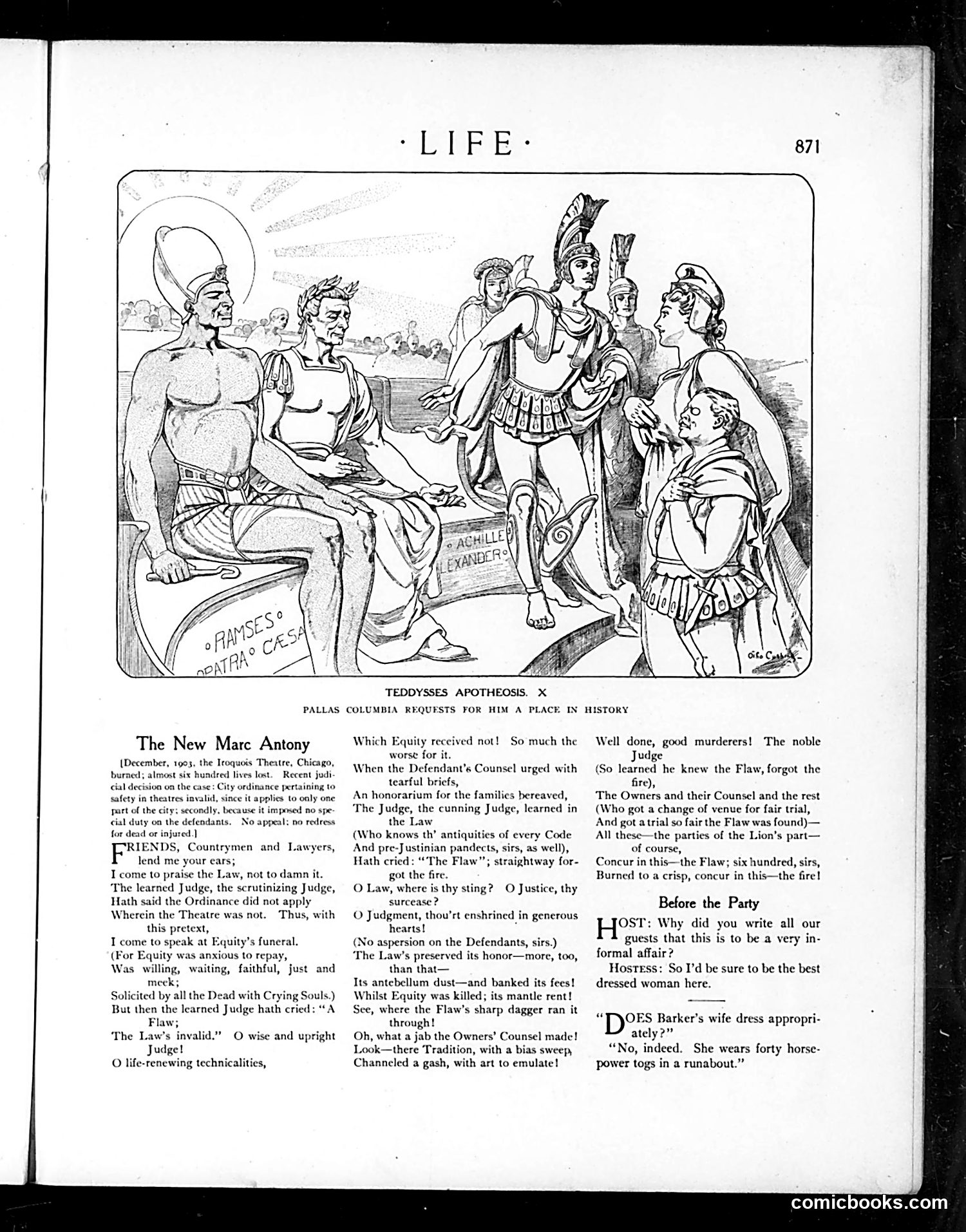
This 1903 Life cartoon lampoons the judicial verdict following the Iroquois Theatre fire in Chicago that killed nearly 600 people. The main illustration depicts classical figures (representing Justice, Law, and civic authorities) in a scene of moral failure. The satire's target: a judge ruled the city's fire-safety ordinance invalid on a technicality—it applied only to part of the city. This legal "Flaw" meant no one faced consequences despite the massive loss of life. The accompanying poem parodies Mark Antony's funeral oration, sarcastically praising the judge and owners' lawyers for preserving the "honor" of law through technicalities while hundreds burned. The bitter refrain contrasts "the Flaw" (the legal loophole) with "the fire" (the actual tragedy)—suggesting the legal system prioritized procedure over justice for the dead. The brief jokes below are unrelated social humor.
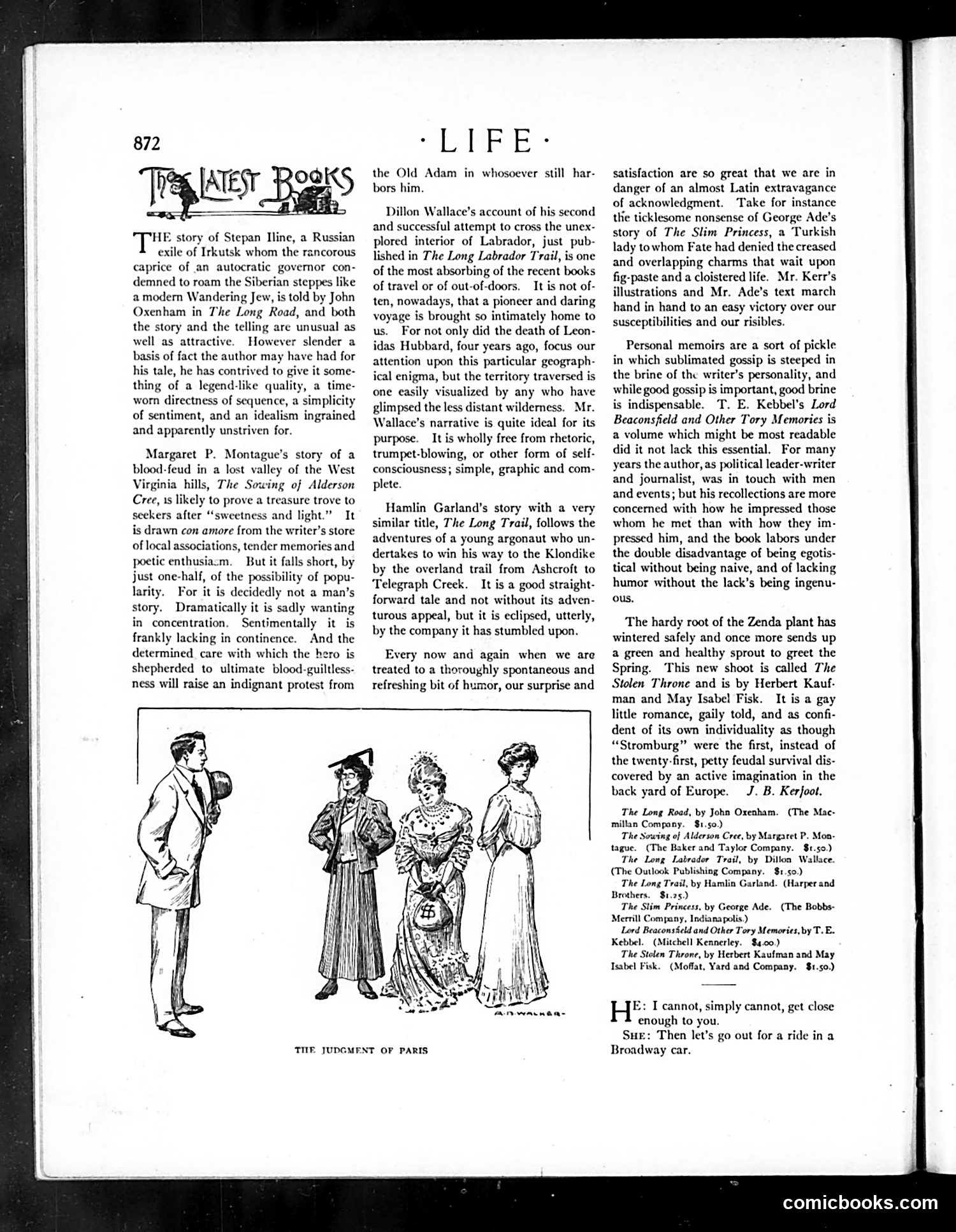
This page from *Life* magazine reviews several contemporary books. The central illustration, captioned "The Judgment of Paris," depicts a social scene of four elegantly dressed figures—likely representing characters from George Ade's satirical novella *The Slim Princess*, which the review praises for its "ticklesome nonsense." The cartoon illustrates Ade's humorous story about a Turkish princess denied the fashionable physical attributes (described as "fig-paste and a cloistered life") that marked high-society Ottoman women. The illustration shows the social judgment and courtship dynamics central to Ade's satire of both Turkish customs and American attitudes toward beauty and femininity. The review emphasizes the story's "spontaneous and refreshing" humor, with particular praise for the collaboration between Ade's text and the accompanying illustrations (by Mr. Kerr), which achieve an "easy victory" over readers' susceptibilities—suggesting the work successfully combines wit with visual charm to mock both cultural pretension and rigid beauty standards.
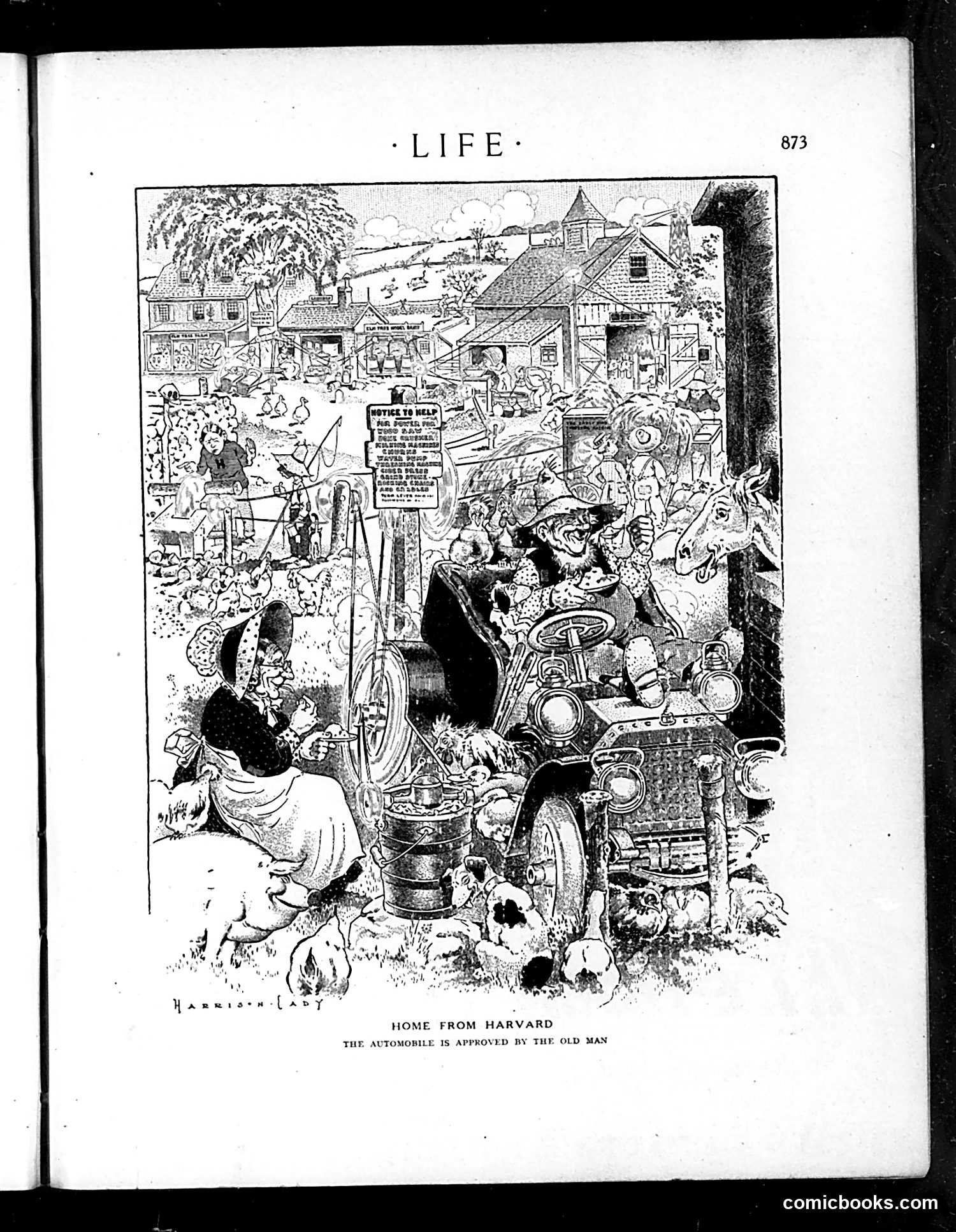
This satirical cartoon depicts a young man returning home from Harvard University in an automobile, with an elderly man (likely his father) observing the vehicle. The scene is set in a rural American village with traditional farms and houses visible in the background. The joke appears to center on social class and generational attitudes: the "old man" represents traditional rural values, while the automobile symbolizes modern, upper-class sophistication associated with Harvard education. The caption suggests surprise or irony that the father approves of this modern technology—implying either that automobiles were initially viewed with skepticism by older generations, or that the father's approval represents a shift in accepting contemporary progress and his son's elevated status. The detailed village scene emphasizes the contrast between traditional rural life and urban modernity.
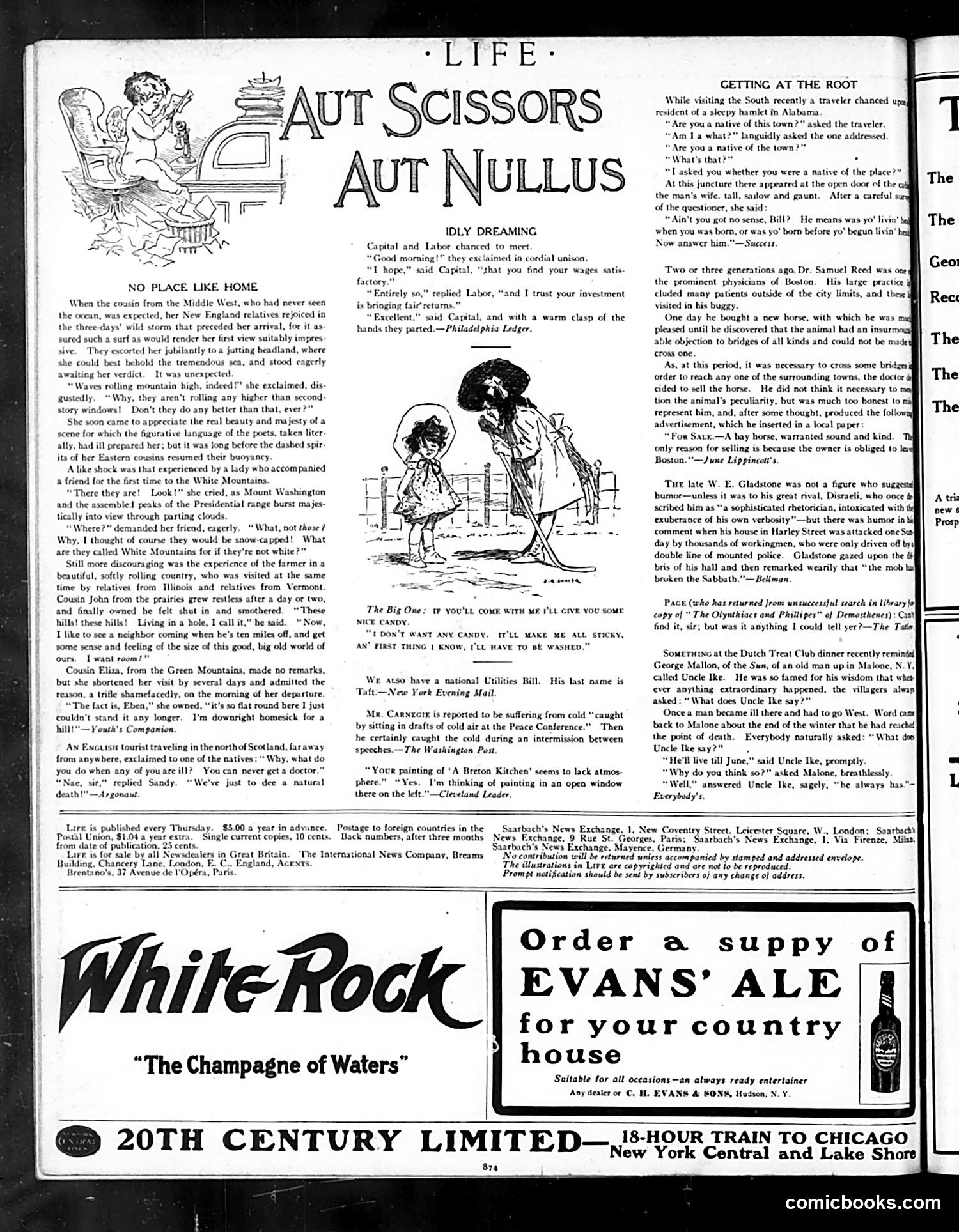
This Life magazine page contains several short satirical pieces typical of early 20th-century American humor: **"No Place Like Home"** satirizes regional differences—Eastern relatives disappointed by actual mountains and ocean ("not snow-capped?") compared to literary descriptions, while Midwesterners feel claustrophobic in hilly terrain. The humor relies on contrasting expectation versus reality. **"Aut Scissors/Aut Nullus"** features a brief dialogue where Capital and Labor meet cordially, each praising the other's returns—obvious satire of their actual antagonistic relationship during a period of labor unrest. **Other brief items** mock President Taft's "Utilities Bill," cold-catching at peace conferences, and an artist's painting technique. The cartoons are gentle, domestic humor rather than sharp political commentary—typical of Life's satirical approach. Context: this appears early 20th century, when labor-capital conflict was genuine but still treated here with mild irony rather than outrage.
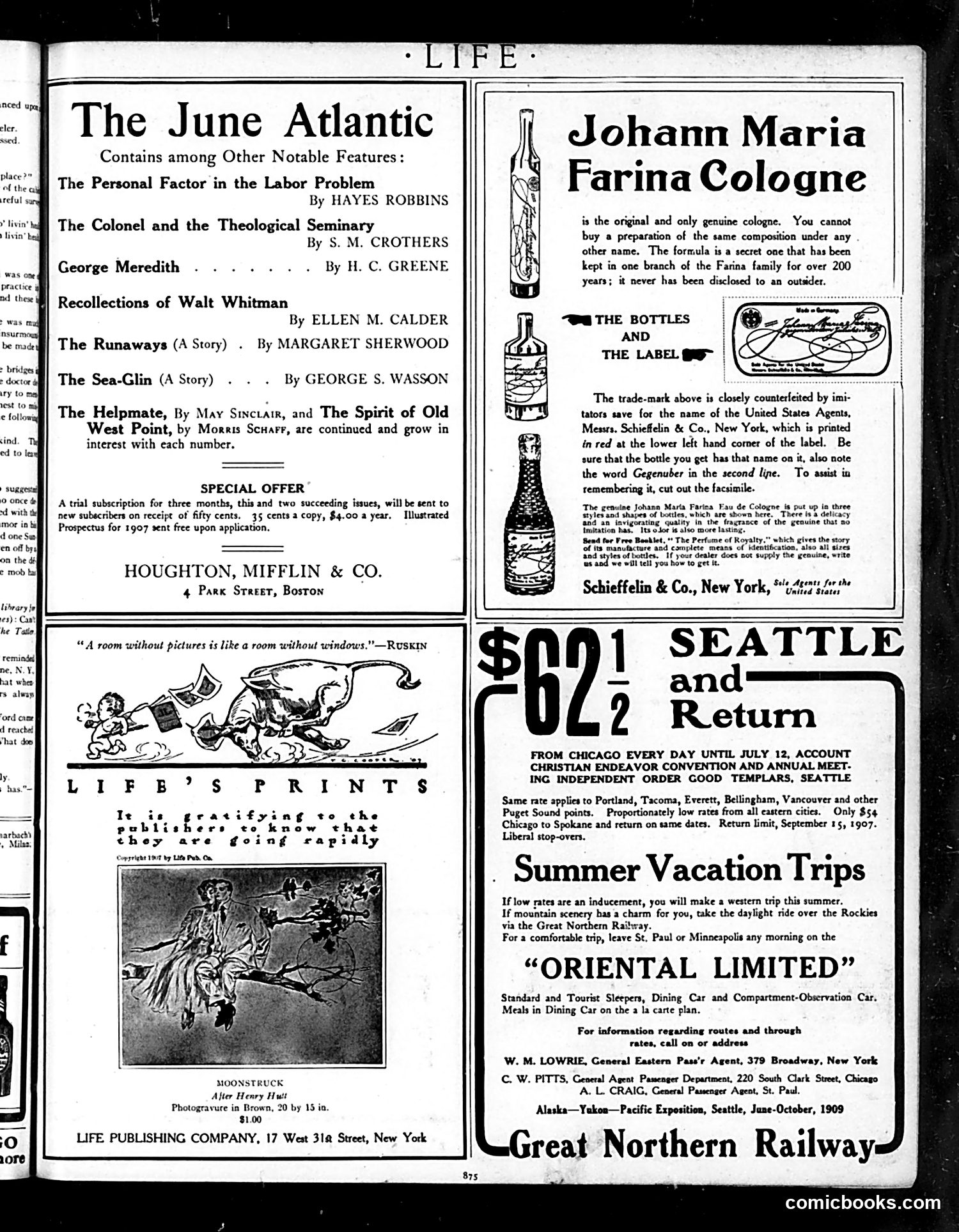
This page is primarily **advertising and magazine promotion** rather than political satire. The content includes: **Left side:** Announcements for *The Atlantic Monthly's* June issue (featuring articles on labor, theology, and literary figures) and a "Lifb's Prints" section promoting photogravure reproductions. **Right side:** Multiple advertisements including Johann Maria Farina Cologne (emphasizing authenticity against counterfeits), a $62.50 excursion fare to Seattle for a Christian Endeavor Convention (1907), and Great Northern Railway vacation advertisements promoting the "Oriental Limited" train service to the Pacific Northwest. **The one cartoon** ("Moonstruck," after Henry Hutt) appears to be a romantic or whimsical illustration unrelated to political commentary. There is **no significant political satire** on this page—it reflects turn-of-the-century consumer culture and leisure travel advertising typical of *Life* magazine's commercial content.
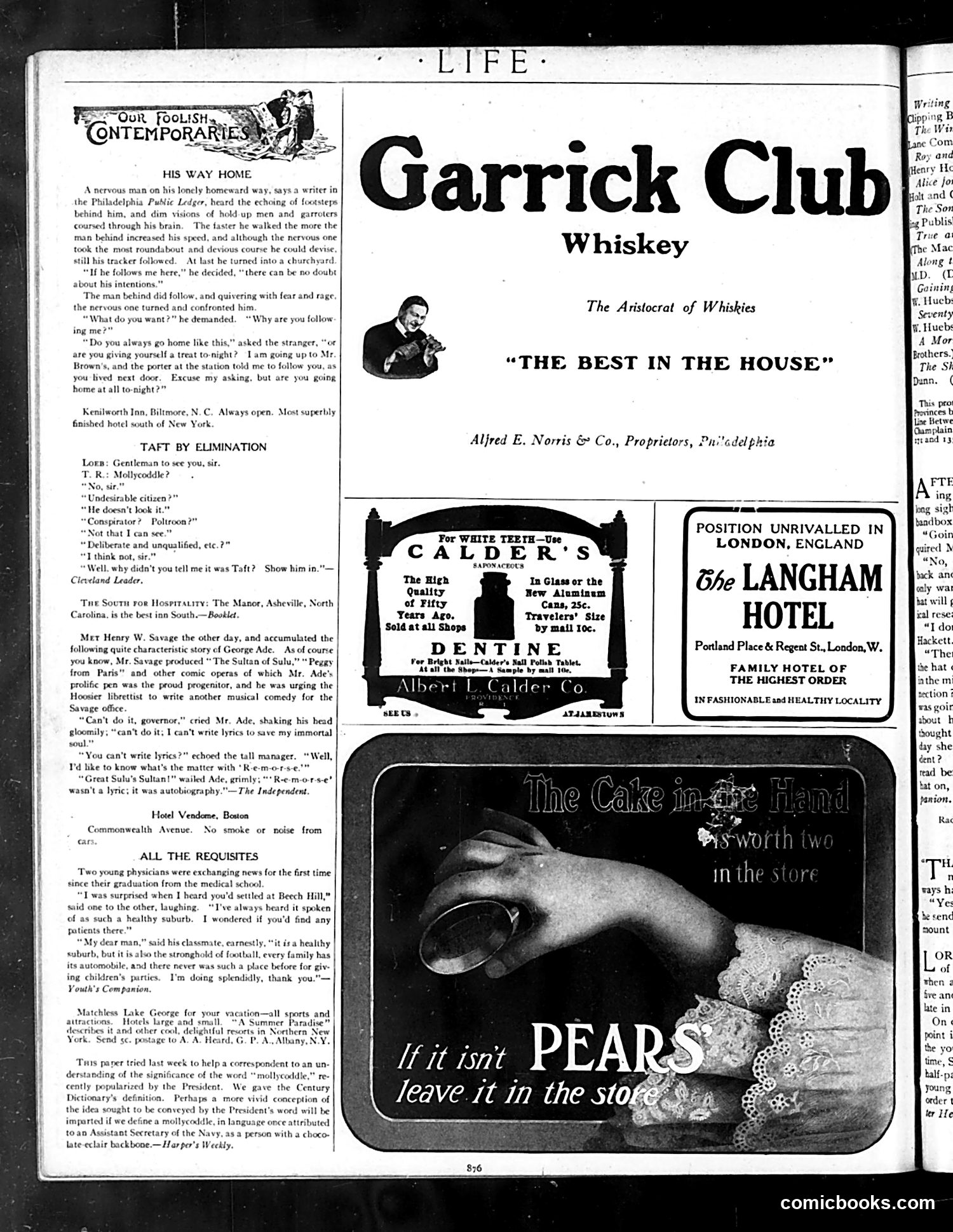
This page from *Life* magazine contains several sections of satirical content aimed at early 20th-century readers: **"Taft by Elimination"** satirizes President Theodore Roosevelt's dismissive view of his successor, William Howard Taft. The joke depicts T.R. rejecting various undesirable types—mollycoddlers, conspirators, poltroons—until finally accepting someone, only to learn it's "Taft." The satire mocks both Roosevelt's verbose condemnation of those he deemed weak (a contemporary political obsession) and the irony that Taft, despite being Roosevelt's chosen successor, apparently didn't meet T.R.'s stringent standards. "Mollycoddle" was Roosevelt's favored insult for men he considered insufficiently vigorous or masculine. The page is mostly advertisements interspersed with brief humorous anecdotes, which was typical of *Life*'s format during this era.
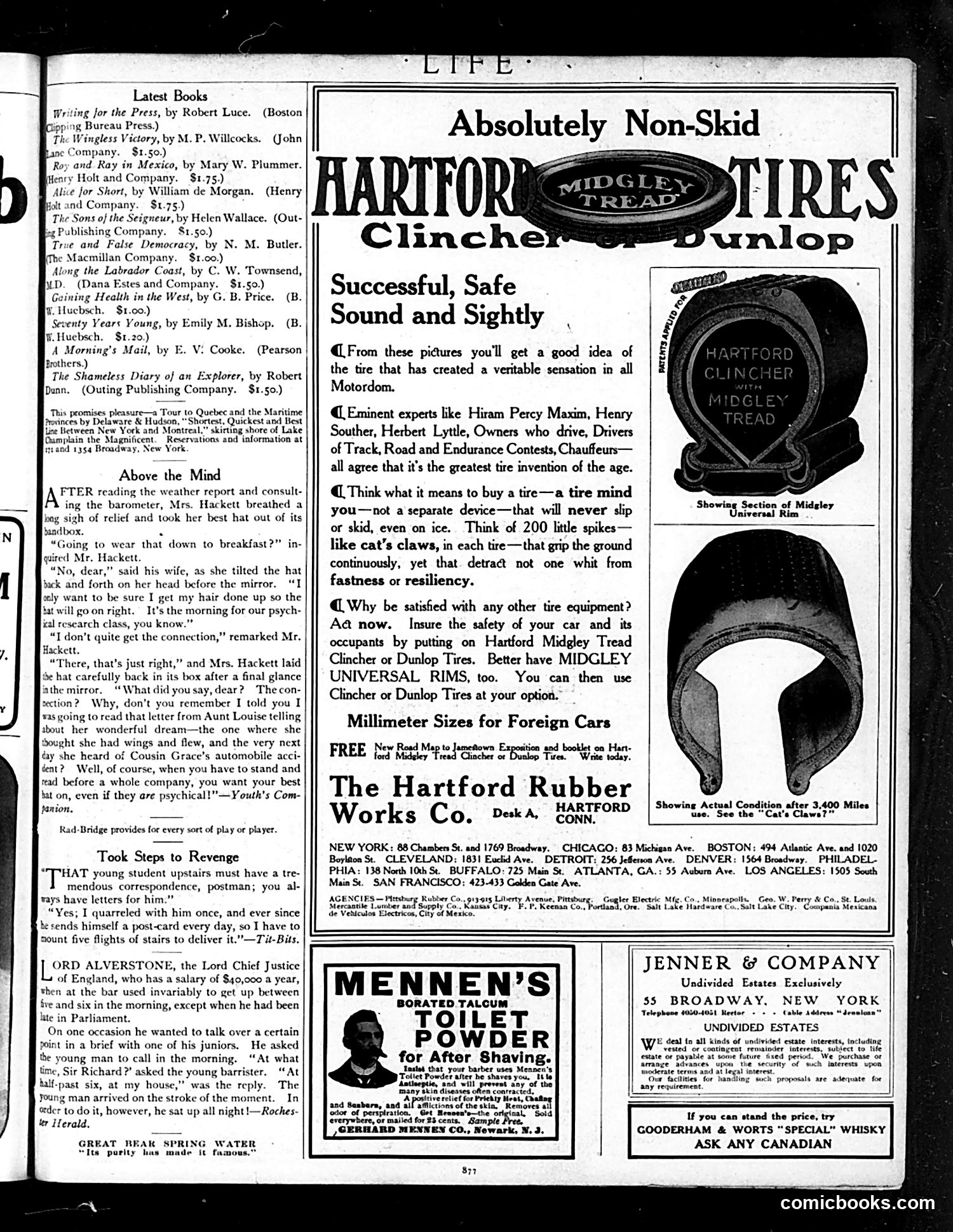
This short humorous piece satirizes early 20th-century spiritualism and pseudoscience. Mrs. Hackett attends a "psychical research class" where she'll read aloud a letter from her aunt describing a dream about flying. Absurdly, Mrs. Hackett insists on wearing her best hat to this indoor reading event because the very next day after her aunt's dream, cousin Grace had an automobile accident—establishing (in her mind) a supernatural connection between dreams and real events. The joke mocks both the credulity of spiritualism enthusiasts and the superstitious logic they employed. The title "Above the Mind" suggests the pretense of intellectual pursuits while describing decidedly irrational thinking. It's gentle satire on popular fascinations with the occult that flourished during this era. The rest of the page consists of book advertisements and tire company marketing.
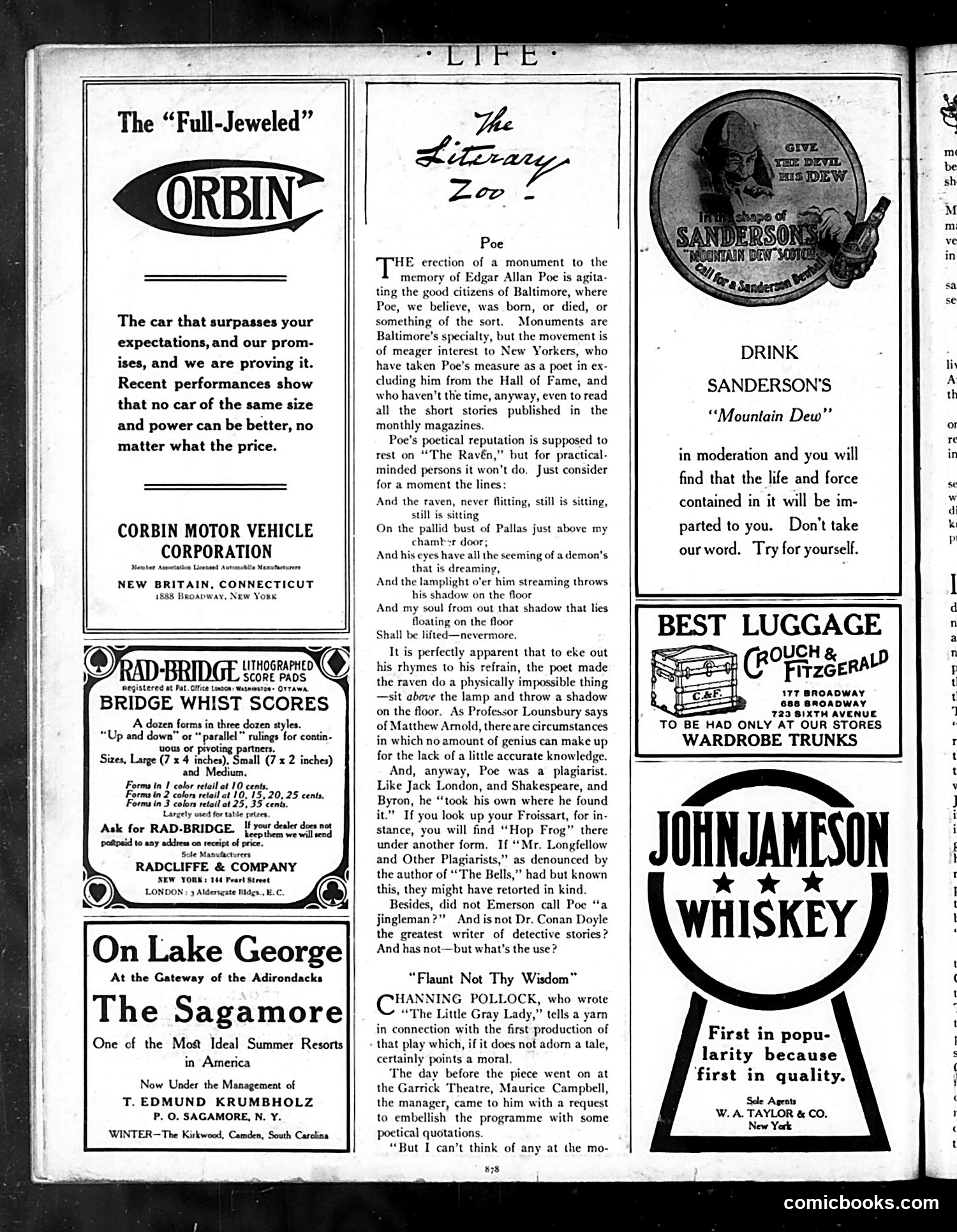
This page is primarily **advertisements interspersed with two satirical articles**—not political cartoons. **"The Literary Zoo: Poe"** mocks the proposed Baltimore monument to Edgar Allan Poe. The satirist dismisses Poe's reputation, claiming New Yorkers have already excluded him from the Hall of Fame and lack time to read his stories. The critique focuses on logical flaws in "The Raven"—the raven cannot physically sit above a lamp and cast a shadow downward. The author argues Poe was a plagiarist (like Shakespeare and Jack London) and quotes Emerson calling him a "jingleman," questioning whether Poe deserves commemoration at all. This reflects early 20th-century American literary criticism that questioned Romantic-era writers. **"Flaunt Not Thy Wisdom"** begins a anecdote about playwright Channing Pollock's interaction with theater manager Maurice Campbell regarding program quotations—the punchline appears to continue on another page. The remaining content consists of period advertisements for automobiles (Corbin), luggage (Crouch & Fitzgerald), whiskey (John Jameson), and resort hotels.
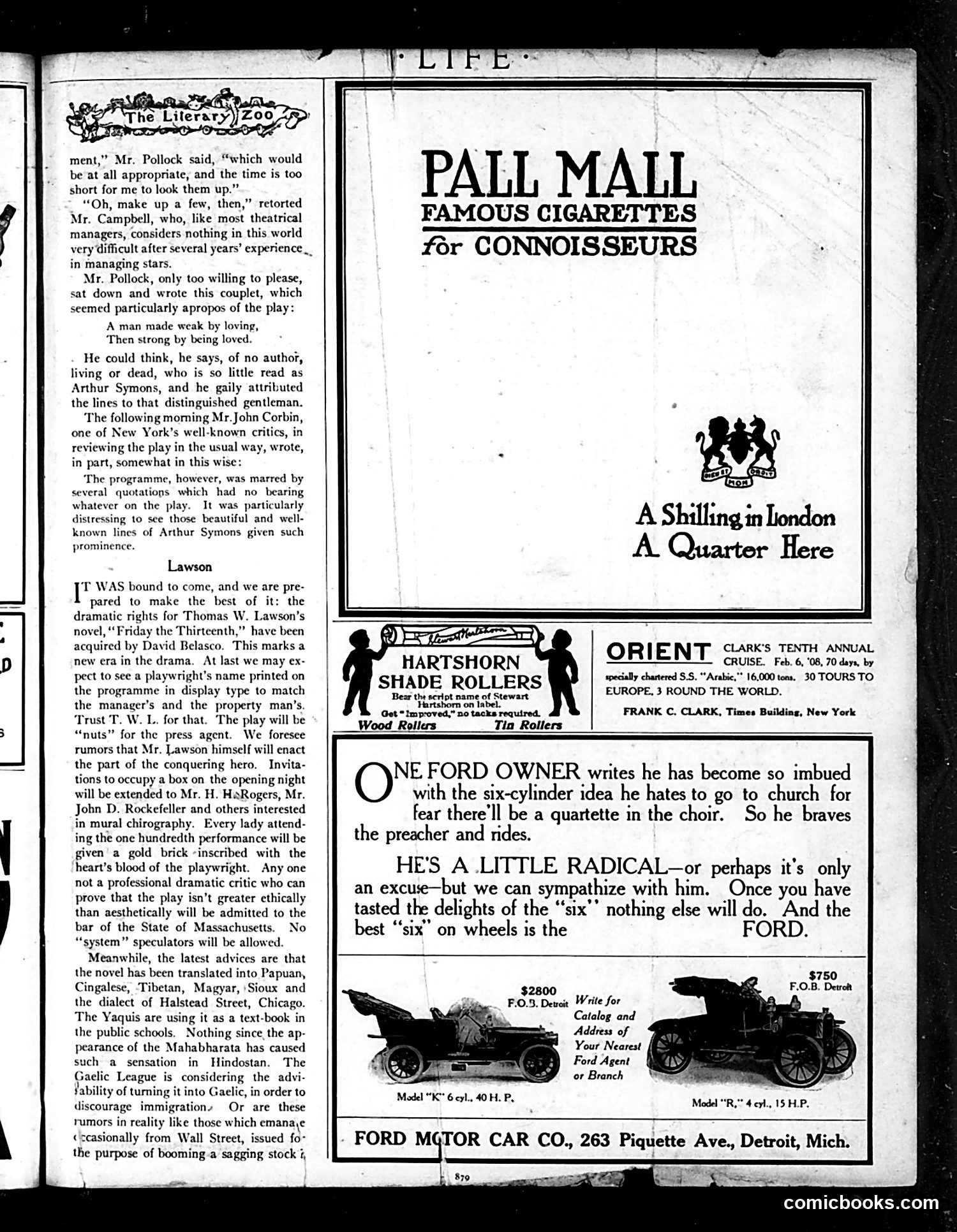
This page combines theater commentary with advertising and a satirical automobile advertisement. **Theater Content:** The top section ridicules theatrical pretension. It describes how a theater manager invented a fake quotation attributed to obscure poet Arthur Symons for a play program. A New York critic then praised these "beautiful and well-known lines"—demonstrating how critics praise without verification. The satire mocks both managers' hype and critics' superficiality. The "Friday the Thirteenth" section lampoons producer David Belasco's acquisition of Thomas Lawson's novel, sarcastically suggesting such ego-driven productions will feature the author prominently, include gold-brick gifts for attendees, and generate absurd promotional rumors (the novel being translated into Papuan, Sioux, etc.). It's mockery of American hype and press-agent sensationalism. **Ford Advertisement:** The bottom section humorously advertises Ford's six-cylinder model through a man so devoted to his car's performance that he resents church quartettes by comparison—satirizing both automotive enthusiasm and religious indifference.
This is a **Schlitz beer advertisement**, not a political cartoon. The page promotes Schlitz as "The Beer That Made Milwaukee Famous" by arguing that while people have different taste preferences, **purity is the truly important factor** in beer quality. The ad's argument: taste is subjective and varies, but purity—defined as healthfulness, cleanliness, freedom from germs, and inability to cause digestive upset—objectively separates superior beers from inferior ones. Schlitz claims this purity as its distinguishing merit. The decorative border features hops, appropriate to beer advertising. This reflects early-20th-century marketing that emphasized scientific cleanliness and health benefits to sell consumer products, a common advertising strategy of that era before modern food safety regulations.
I can see this is a very dark, heavily aged page from what appears to be a historical publication. The image quality is extremely poor—almost entirely black with minimal visible detail except for some faint decorative elements along the edges and the "comicbooks.com" watermark at the bottom. Without being able to discern specific text, figures, caricatures, or cartoon imagery clearly enough to identify them with confidence, I cannot responsibly explain what political or social references this page contains. The deterioration or scanning quality has rendered the content illegible to me. To provide accurate historical context as you've requested, I would need a clearer image where the text and illustrations are actually readable.