
Life, 1907-06-27 · page 16 of 25
Life — June 27, 1907 — page 16: what you’re looking at
What you’re looking at
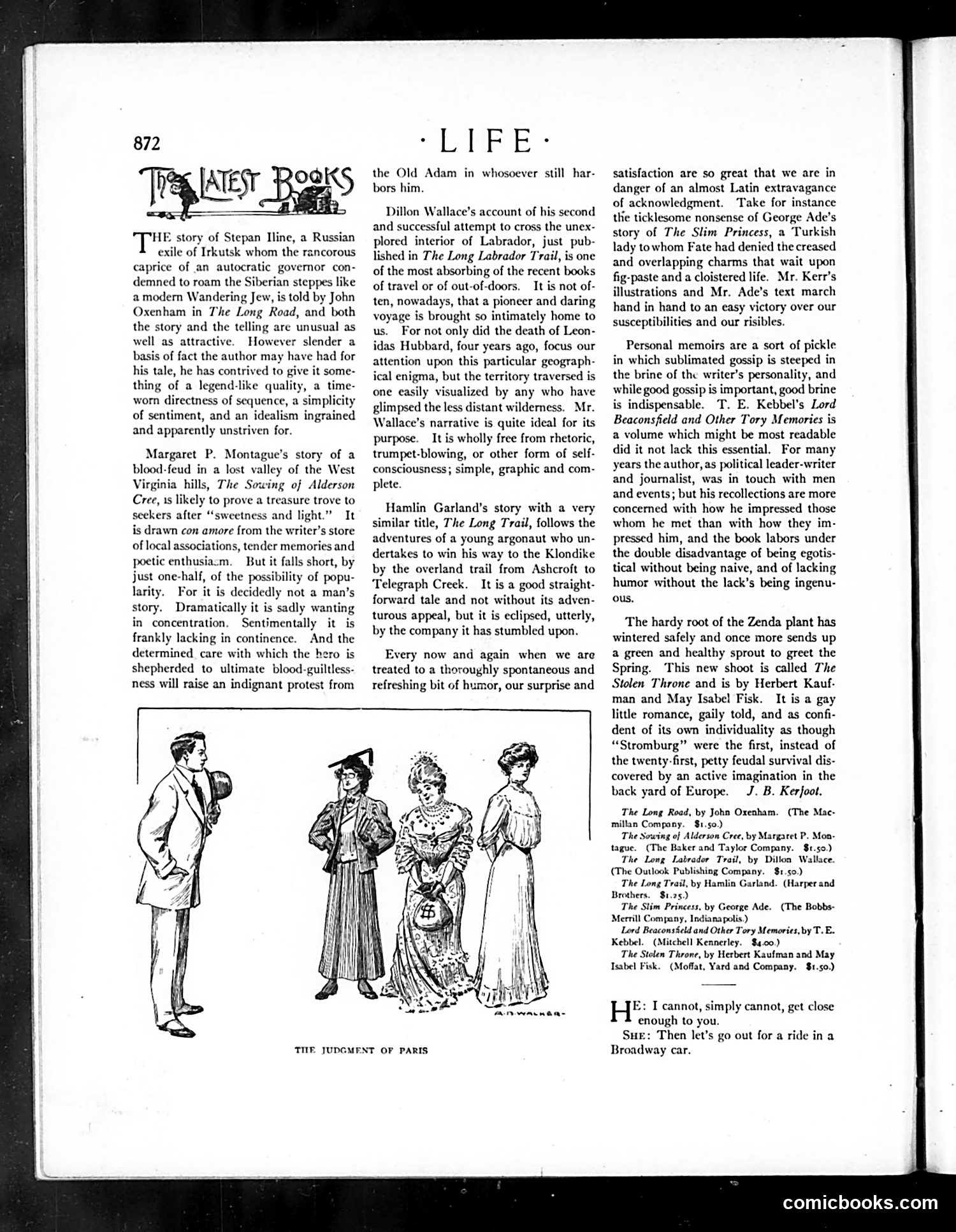
This page from *Life* magazine reviews several contemporary books. The central illustration, captioned "The Judgment of Paris," depicts a social scene of four elegantly dressed figures—likely representing characters from George Ade's satirical novella *The Slim Princess*, which the review praises for its "ticklesome nonsense." The cartoon illustrates Ade's humorous story about a Turkish princess denied the fashionable physical attributes (described as "fig-paste and a cloistered life") that marked high-society Ottoman women. The illustration shows the social judgment and courtship dynamics central to Ade's satire of both Turkish customs and American attitudes toward beauty and femininity. The review emphasizes the story's "spontaneous and refreshing" humor, with particular praise for the collaboration between Ade's text and the accompanying illustrations (by Mr. Kerr), which achieve an "easy victory" over readers' susceptibilities—suggesting the work successfully combines wit with visual charm to mock both cultural pretension and rigid beauty standards.
📄 Transcribed text from this page (OCR, searchable)
Machine-transcribed from the original scan — historical spelling and the odd misread are preserved.
Th Bis Tite story of Stepan Thine, a Russian exile of Irkutsk whom the rancorous caprice of an autocratic governor con- demned to roam the Siberian steppes like a modern Wandering Jew, is told by John Oxenham in The Long Road, and both the story and the telling are unusual as well as attractive. However slender a basis of fact the author may have had for his tale, he has contrived to give it some- thing of a legend-like quality, a time- worn directness of sequence, a simplicity of sentiment, and an idealism ingrained and apparently unstriven for. Margaret P. Montague’s story of a blood-feud in a lost valley of the West Virginia hills, The Sowing of Alderson Cree, 1s likely to prove a treasure trove to seckers after “sweetness and light.” It is drawn con amore from the writer’s store of local associations, tender memories and poetic enthusiacm. But it falls short, by just one-half, of the possibility of popu- larity. For it is decidedly not a man’s story. Dramatically it is sadly wanting in concentration. Sentimentally it is frankly lacking in continence. And the determined care with which the hero is shepherded to ultimate blood-guiltless- ness will raise an indignant protest from “ERE the Old Adam in whosoever still har- bors him. Dillon Wallace’s account of his second and successful attempt to cross the unex- plored interior of Labrador, just pub- lished in The Long Labrador Trail, is one of the most absorbing of the recent books of travel or of out-of-doors. It is not of- ten, nowadays, that a pioneer and daring voyage is brought so intimately home to us. For not only did the death of Leon- idas Hubbard, four years ago, focus our attention upon this particular geograph- ical enigma, but the territory traversed is one easily visualized by any who have glimpsed the less distant wilderness. Mr. Wallace’s narrative is quite ideal for its purpose. It is wholly free from rhetoric, trumpet-blowing, or other form of self- consciousness; simple, graphic and com- plete. Hamlin Garland’s story with a very similar title, The Long Trail, follows the adventures of a young argonaut who un- dertakes to win his way to the Klondike by the overland trail from Ashcroft to Telegraph Creek. It is a good straight- forward tale and not without its adven- turous appeal, but it is eclipsed, utterly, by the company it has stumbled upon. Every now and again when we are treated to a thoroughly spontaneous and refreshing bit of humor, our surprise and THE JUDGMENT OF PARIS satisfaction are so great that we are in danger of an almost Latin extravagance of acknowledgment. Take for instance the ticklesome nonsense of George Ade’s story of The Slim Princess, a Turkish lady towhom Fate had denied the creased and overlapping charms that wait upon fig-paste and a cloistered life. Mr. Kerr’s illustrations and Mr. Ade’s text march hand in hand to an easy victory over our susceptibilities and our risibles. Personal memoirs are a sort of pickle in which sublimated gossip is steeped in the brine of the writer’s personality, and while good gossip is important, good brine is indispensable. T. E. Kebbel's Lord Beaconsfield and Other Tory Memories is a volume which might be most readable did it not lack this essential. For many years the author, as political leader-writer and journalist, was in touch with men and events; but his recollections are more concerned with how he impressed those whom he met than with how they im- pressed him, and the book labors under the double disadvantage of being egotis- tical without being naive, and of lacking humor without the lack’s being ingenu- ous. The hardy root of the Zenda plant has wintered safely and once more sends up a green and healthy sprout to greet the Spring. This new shoot is called The Stolen Throne and is by Herbert Kauf- man and May Isabel Fisk. It is a gay little romance, gaily told, and as confi- dent of its own individuality as though “Stromburg” were the first, instead of the twenty-first, petty feudal survival dis- covered by an active imagination in the back yard of Europe. J. B. Kerfoot. The Long Road, by John Oxenham. (The Mac- millan Company. $1.50.) The Sowing of Alderson Cree, by Margaret P. Mon- tague. (The Baker and Taylor Company. $t.50.) The Long Labrador Trail, by Dillon Wallace. (The Outlook Publishing Company. $1.50.) The Long Trail, by Hamlin Garland. (Harper and Brothers. $1.25.) The Stim Princess, by George Ade. Merrill Company, Indianapolis.) Lord Beaconsheld and Other Tory Memories, by T.E. Kebbel. (Mitchell Kennerley. $4.00.) The Stolen Throne, by Herbert Kaufman and May Isabel Fisk. (Moffat, Yard and Company. $1.50.) (The Bobbs- HE: F cannot, simply cannot, get close enough to you. Sue: Then let’s go out for a ride in a Broadway car. comicbooks.com