
Life, 1907-06-27 · page 6 of 25
Life — June 27, 1907 — page 6: what you’re looking at
What you’re looking at
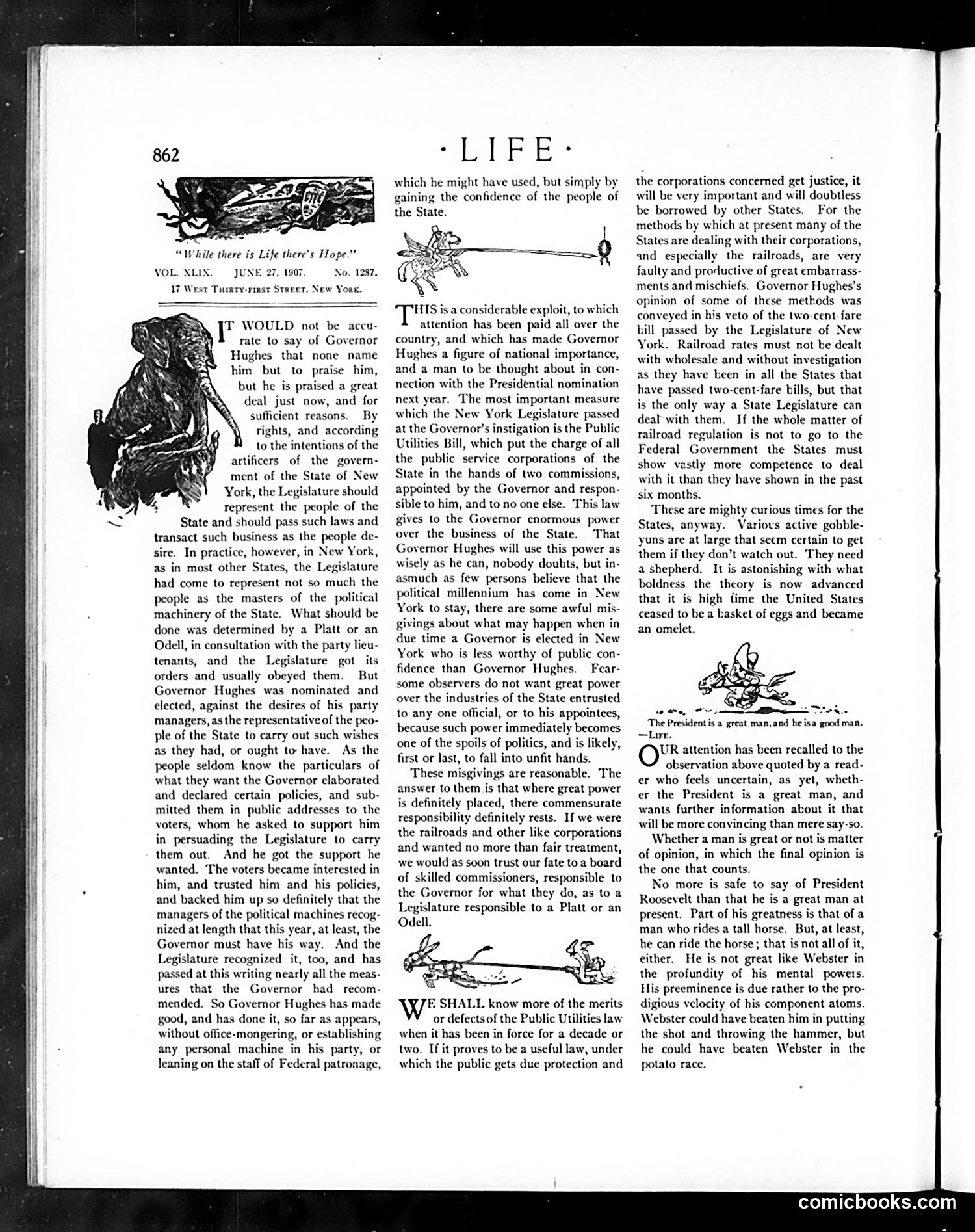
This page discusses Governor Hughes and New York State politics, specifically praising his creation of the Public Utilities Commission—a regulatory body to oversee public service corporations. The cartoons illustrate the article's arguments about executive power and competence. The illustrations appear to show caricatured political figures, though specific identities aren't entirely clear from the image alone. The text contrasts Hughes favorably with other potential leaders, suggesting some were less capable (references to horse-riding and potato races suggest mockery of rivals' abilities). The broader satirical point: that proper regulatory oversight and strong executive leadership matter more than political party loyalty—a progressive-era argument for administrative competence over patronage politics.
📄 Transcribed text from this page (OCR, searchable)
Machine-transcribed from the original scan — historical spelling and the odd misread are preserved.
“While there is Life there’s Hope.” VOL. XLIX. JU 1907. No. 1287. 17 West Tuurty-rirst Staret, New York. 'T WOULD not be accu- rate to say of Governor Hughes that none name him but to praise him, but he is praised a great deal just now, and for sufficient reasons. By rights, and according to the intentions of the artificers of the govern- ment of the State of New York, the Legislature should $ represent the people of the ~ State and should pass such laws and transact such business as the people de- sire. In practice, however, in New York, as in most other States, the Legislature had come to represent not so much the people as the masters of the political machinery of the State. What should be done was determined by a Platt or an Odell, in consultation with the party lieu- tenants, and the Legislature got its orders and usually obeyed them. But Governor Hughes was nominated and elected, against the desires of his party managers, as the representative of the peo- ple of the State to carry out such wishes as they had, or ought to have. As the people seldom know the particulars of what they want the Governor elaborated ' and declared certain policies, and sub- | mitted them in public addresses to the voters, whom he asked to support him in persuading the Legislature to carry i them out. And he got the support he I; h ti tl wanted. The voters became interested in him, and trusted him and his policies, and backed him up so definitely that the ; managers of the political machines recog- nized at length that this year, at least, the Governor must have his way. And the | Legislature recognized it, too, and has passed at this writing nearly all the meas- i ures that the Governor had recom- | mended. So Governor Hughes has made | good, and has done it, so far as appears, i without office-mongering, or establishing ai. i | i | | any personal machine in his party, or leaning on the staff of Federal patronage, oa ea Fo ae which he might have used, but simply by gaining the confidence of the people of the State. HIS is a considerable exploit, to which attention has been paid all over the country, and which has made Governor Hughes a figure of national importance, and a man to be thought about in con- nection with the Presidential nomination next year. The most important measure which the New York Legislature passed at the Governor’s instigation is the Public Utilities Bill, which put the charge of all the public service corporations of the State in the hands of two commissions, appointed by the Governor and respon- sible to him, and to no one else. This law gives to the Governor enormous power over the business of the State. That Governor Hughes will use this power as wisely as he can, nobody doubts, but in- asmuch as few persons believe that the political millennium has come in New York to stay, there are some awful mis- givings about what may happen when in due time a Governor is elected in New York who is less worthy of public con- fidence than Governor Hughes. Fear- some observers do not want great power over the industries of the State entrusted to any one official, or to his appointees, because such power immediately becomes one of the spoils of politics, and is likely, first or last, to fall into unfit hands. These misgivings are reasonable. The answer to them is that where great power is definitely placed, there commensurate responsibility definitely rests. If we were the railroads and other like corporations and wanted no more than fair treatment, we would as soon trust our fate toa board of skilled commissioners, responsible to the Governor for what they do, as to a Legislature responsible to a Platt or an Odell. E SHALL know more of the merits or defectsof the Public Utilities law when it has been in force for a decade or two. If it proves to be a useful law, under which the public gets due protection and the corporations concerned get justice, it will be very important and will doubtless be borrowed by other States. For the methods by which at present many of the States are dealing with their corporations, and especially the railroads, are very faulty and productive of great embarras ments and mischiefs. Governor Hughes's opinion of some of these methods was conveyed in his veto of the two-cent fare bill passed by the Legislature of New York. Railroad rates must not be dealt with wholesale and without investigation as they have been in all the States that have passed two-cent-fare bills, but that is the only way a State Legislature can deal with them. If the whole matter of railroad regulation is not to go to the Federal Government the States must show vastly more competence to deal with it than they have shown in the past six months, These are mighty curious times for the States, anyway. Variovs active gobble- yuns are at large that secm certain to get them if they don’t watch out. They need a shepherd. It is astonishing with what boldness the theory is now advanced that it is high time the United States ceased to be a basket of eggs and became an omelet. ee ee The President is a great man, and he isa good man. Lire. UR attention has been recalled to the observation above quoted by a read- er who feels uncertain, as yet, wheth- er the President is a great man, and wants further information about it that will be more convincing than mere say-so. Whether a man is great or not is matter of opinion, in which the final opinion is the one that counts. No more is safe to say of President Roosevelt than that he is a great man at present. Part of his greatness is that of a man who rides a tall horse. But, at least, he can ride the horse; that is not all of it, either. He is not great like Webster in the profundity of his mental powers. His preeminence is due rather to the pro- digious velocity of his component atoms. Webster could have beaten him in putting the shot and throwing the hammer, but he could have beaten Webster in the potato race, comicbooks.com