
A complete issue · 28 pages · 1907
Life — February 14, 1907
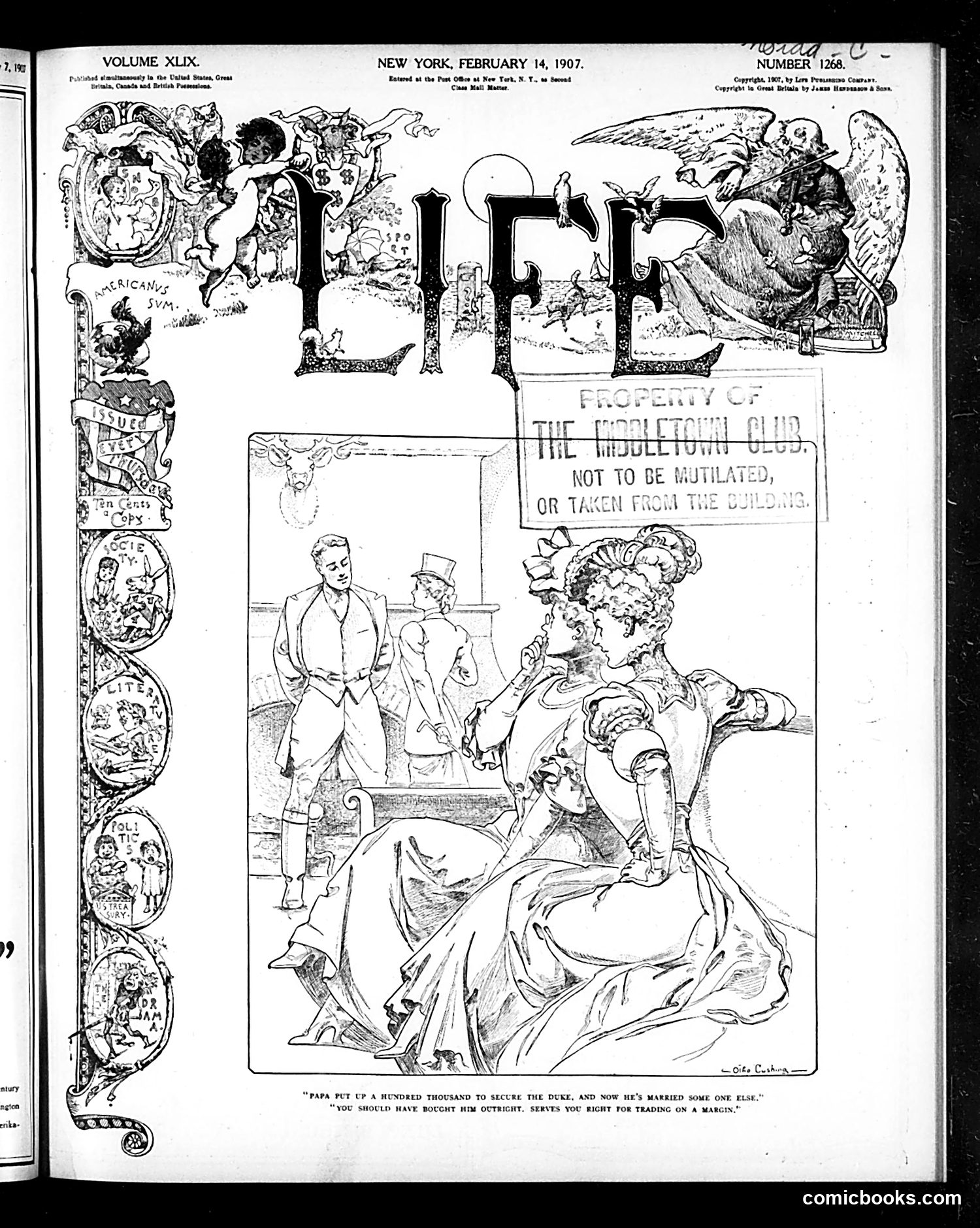
The main cartoon depicts a wealthy woman (likely representing high society) in an elaborate dress, conversing with two men in formal attire. The caption reads: "Papa put up a hundred thousand to secure the duke, and now he's married some one else. You should have bought him outright. Serves you right for trading on a margin." This satirizes the common practice among wealthy American families of the Gilded Age: using substantial dowries to purchase European titles through marriage. The joke mocks a father who invested heavily in securing a "duke" (aristocratic husband) for his daughter, only to have the duke marry someone else instead. The financial language ("margin," "outright") treats matrimonial arrangements as stock market transactions, highlighting the transactional nature of such aristocratic marriages and the absurdity of treating human relationships as commodities.
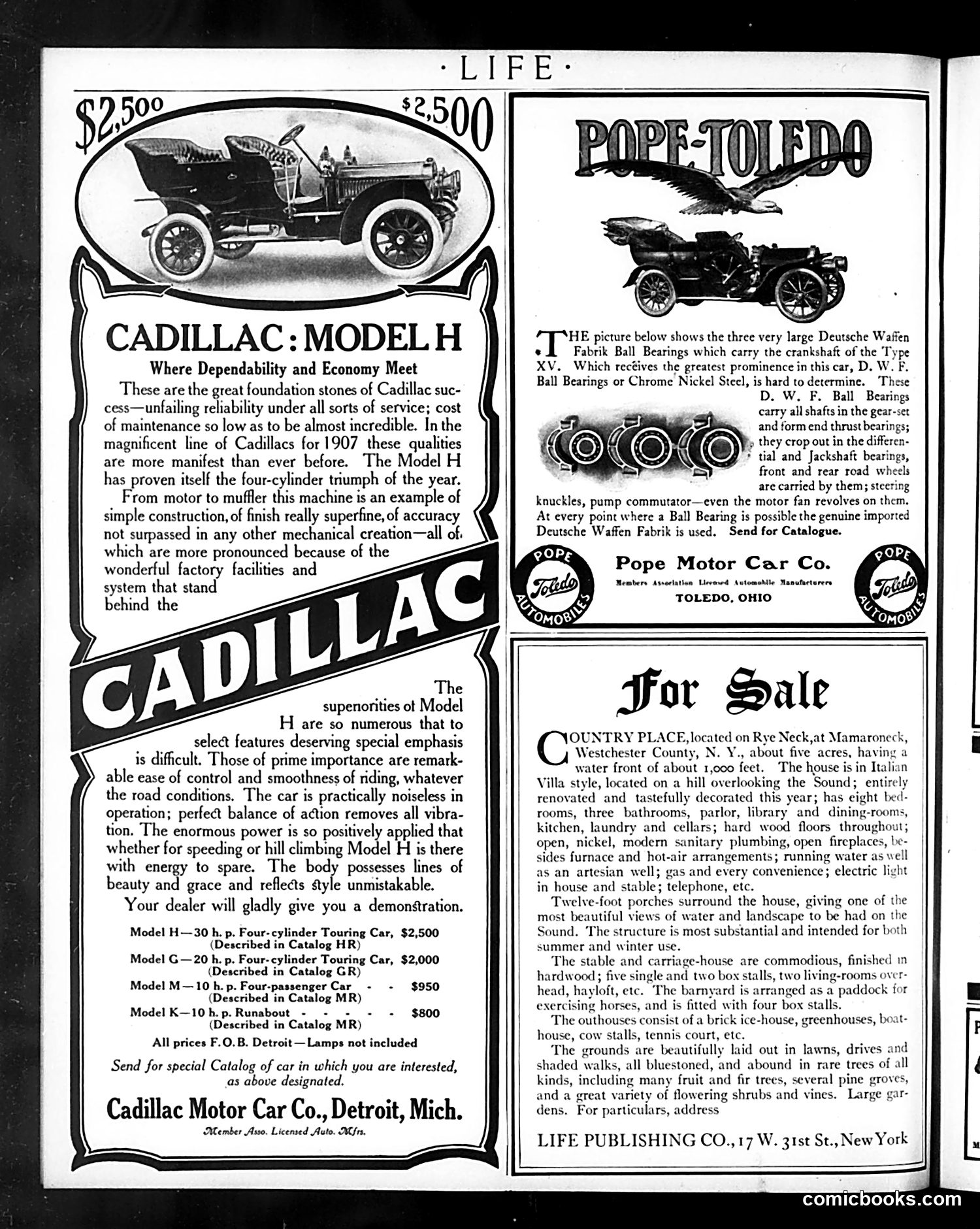
This page contains **no political cartoons or satire**—it's primarily **early automotive advertising** from Life magazine's commercial section. The left half advertises the **Cadillac Model H** ($2,500), emphasizing mechanical reliability, smooth operation, and power. The right half promotes the **Pope-Toledo automobile** from Toledo, Ohio, highlighting its ball bearings and precision manufacturing. Both ads employ common early 1900s marketing rhetoric: technical superiority, quality craftsmanship, and the luxury/prestige of automobile ownership. The Pope-Toledo ad also includes a "For Sale" property listing, suggesting Life served diverse commercial purposes. There is **no satire, political commentary, or identifiable caricatures** present. This is straightforward period advertising reflecting the automotive industry's early competitive landscape.
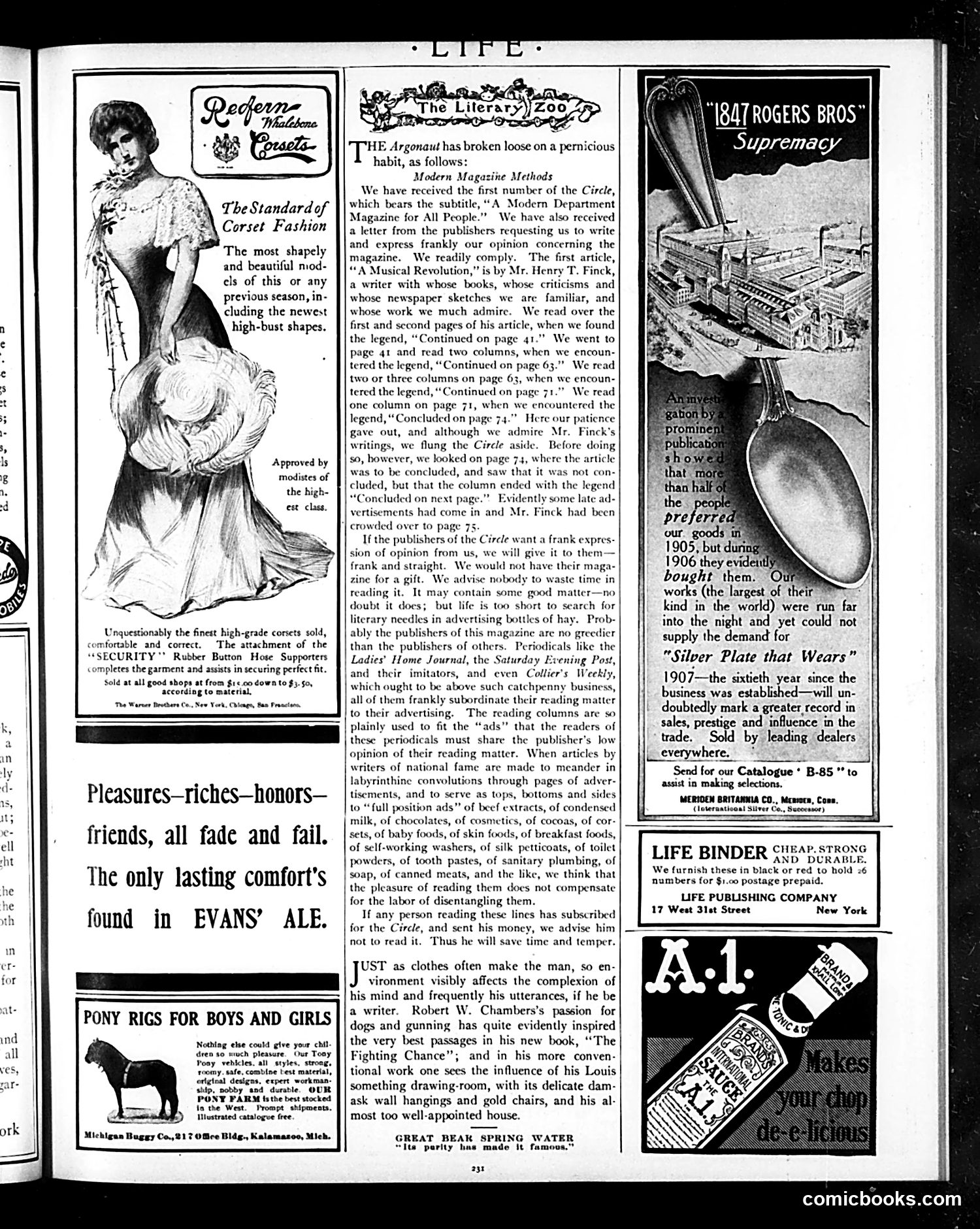
This page is primarily **advertising and editorial content** rather than political satire. The main editorial piece, "The Argonaut has broken loose on a pernicious habit," critiques *Modern Magazine Methods*—specifically complaining about a magazine's practice of running articles with repeated "Continued on page X" legends, fragmenting content across many pages. The editors argue this wastes readers' time searching for conclusions and subordinates editorial content to advertising placement. The advertisements include corsets, pony rigs, and other consumer goods typical of early 1900s Life magazine. **No significant political cartoon or satire appears on this page.** The humor is directed at magazine publishing practices rather than political figures or events.
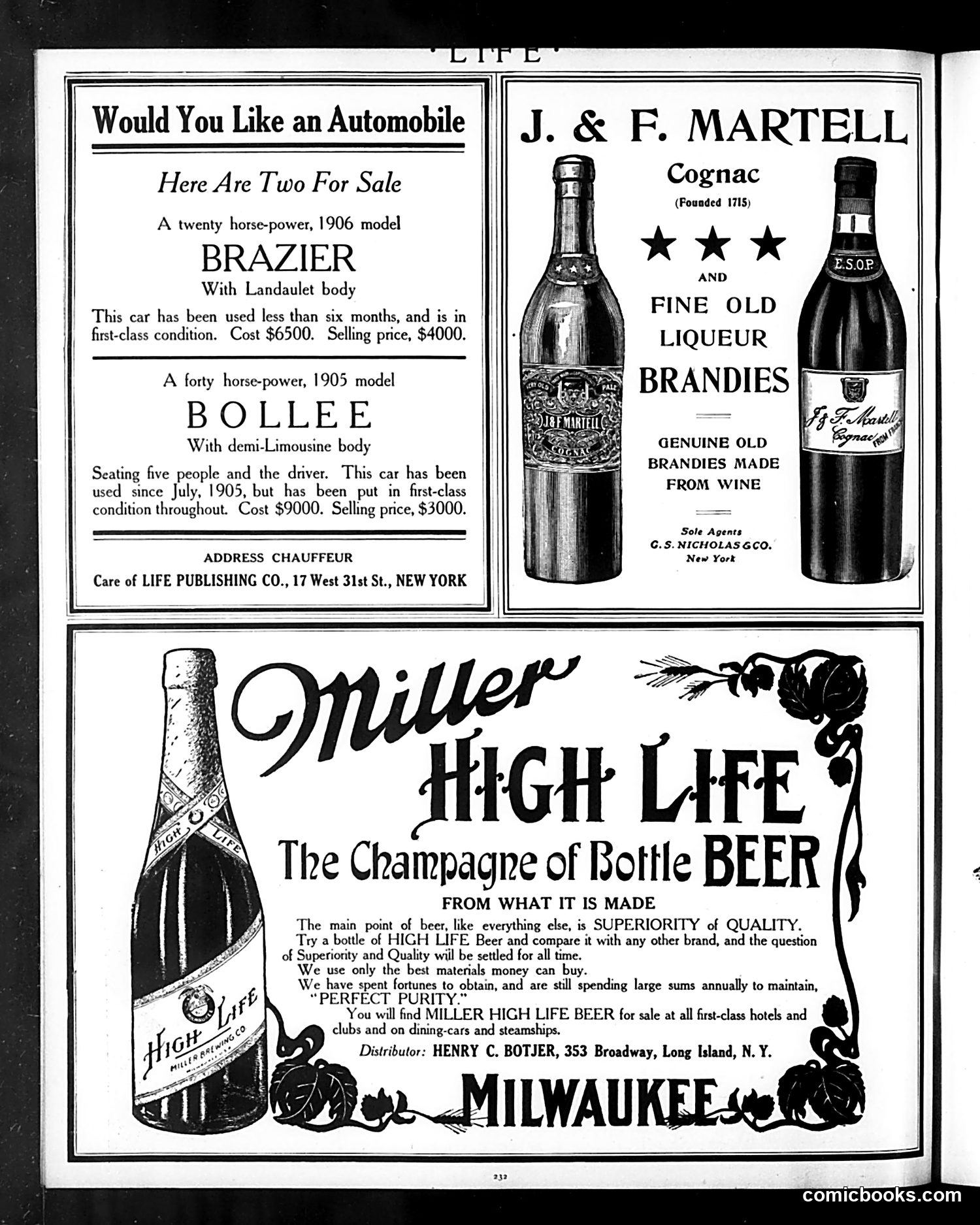
This page contains **three advertisements, not political cartoons or satire**. It appears from an early 1900s issue of *Life* magazine. The ads promote: 1. **Used automobiles** (a 1906 Brazier and 1905 Bollee) — relatively new consumer goods 2. **J. & F. Martell Cognac** — French brandy with three-star rating and E.S.O.F. designation 3. **Miller High Life Beer** — Milwaukee beer positioned as superior quality, distributed in New York The only notable context: these ads reflect the early automobile era and pre-Prohibition America (alcohol advertised openly). The beer's emphasis on "superiority of quality" suggests competitive marketing among breweries. Nothing satirical is present—this is straightforward period advertising.
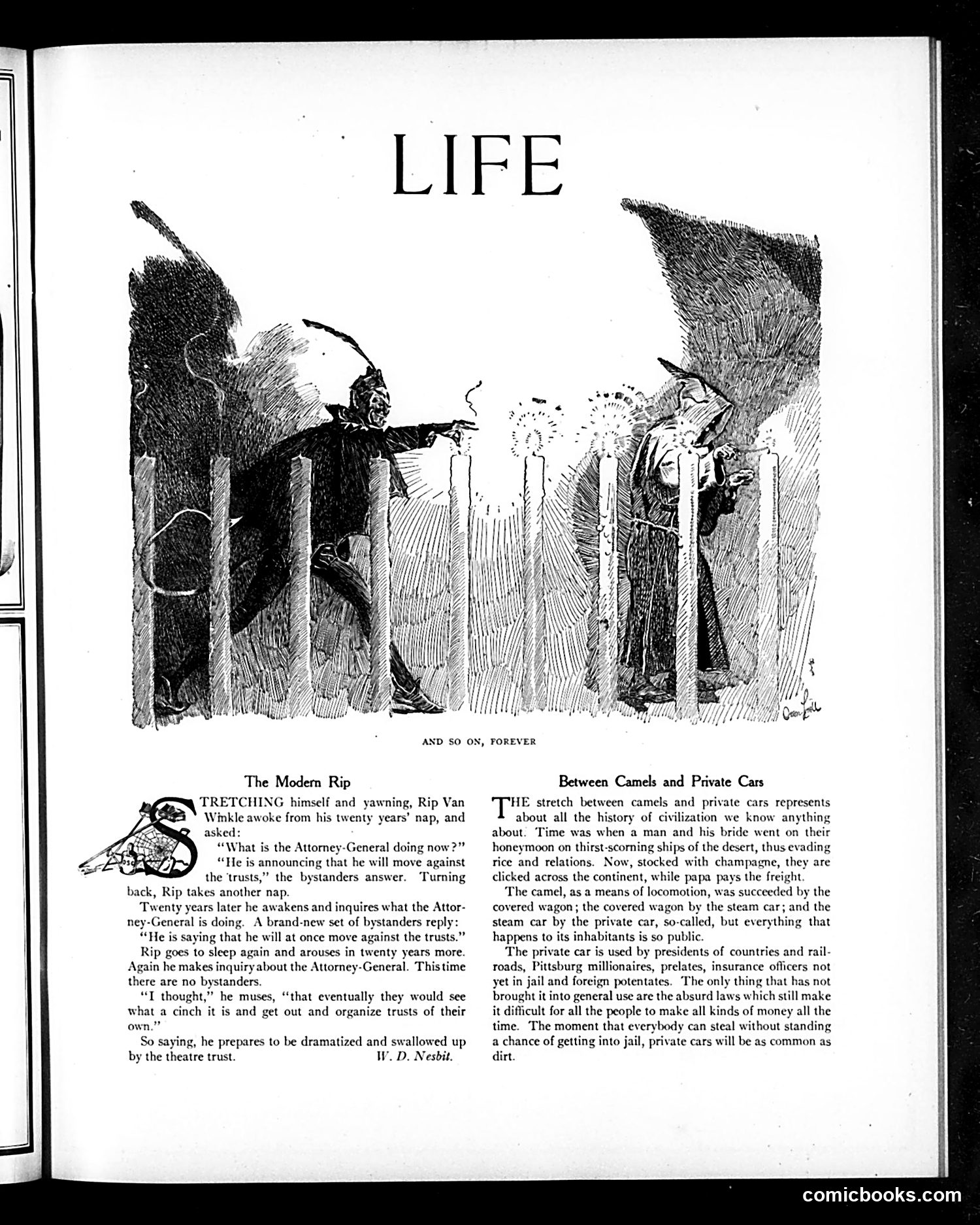
The cartoon "And So On, Forever" satirizes endless political cycles. Two figures (one appears to be a politician or official) stand separated by columns, repeatedly making the same gestures—suggesting cyclical, meaningless political theater. Below, "The Modern Rip" parodies Washington Irving's Rip Van Winkle story. An Attorney-General sleeps 20 years, wakes to ask about his duties, receives the same answer about fighting trusts, sleeps again, and repeats endlessly. The satire mocks the futility of trust-busting efforts—whether from Theodore Roosevelt's era or later administrations—suggesting anti-monopoly campaigns produce no real change despite repeated political promises. "Between Camels and Private Cars" criticizes wealth inequality, contrasting camel transportation with private automobiles as symbols of civilization's progress benefiting only the wealthy while ordinary people remain excluded.
This page discusses Senator Beveridge's Child-Labor Bill, a progressive measure to regulate interstate commerce and restrict child labor in factories and mines. The text praises Beveridge's effort as "one of the most appealing" reforms conceivable, while acknowledging fierce opposition from commercial interests profiting from child labor. The satirical point: reformers face resistance from Southern cotton mills and Northern industries that exploit cheap child labor. The opposition comes from "strong commercial interests, able to employ skilful advocates" to influence legislatures—highlighting how business lobbies undermine child-welfare laws. The ornamental illustrations appear decorative rather than specific political caricatures. The page advocates for federal intervention to protect children, criticizing those who prioritize profit over child welfare.
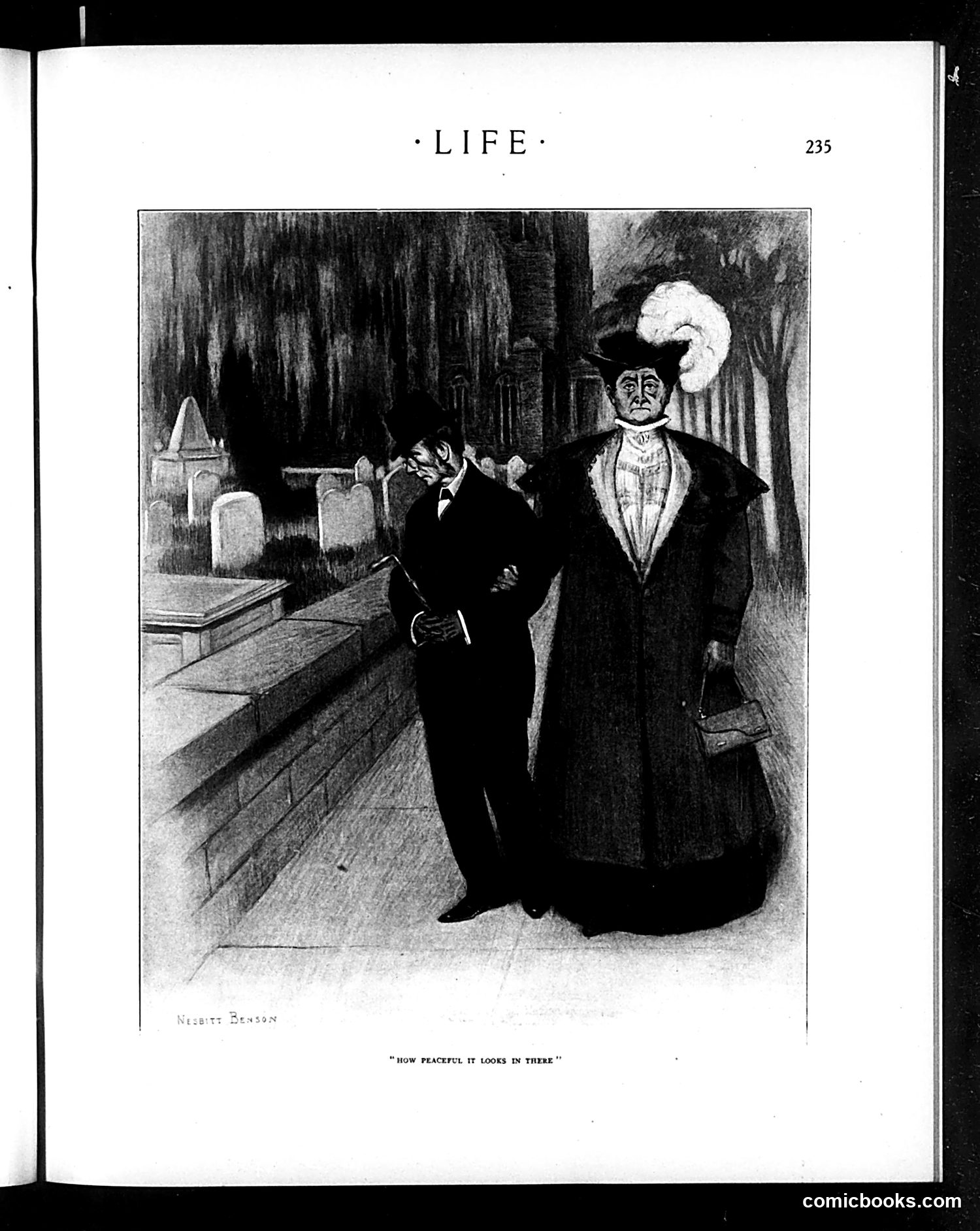
This cartoon by **Nisbett Benson** depicts a nighttime cemetery scene. Two figures in dark formal attire stand at the gates—one appearing distressed or worried, the other more composed. The caption reads: "How Peaceful It Looks in There." The satire appears to target attitudes toward death or burial practices. The contrast between the grave-like peacefulness of the cemetery and the anxiety of the living suggests commentary on either: fear of mortality, the irony of death's "peace" versus life's troubles, or possibly hypocrisy about funeral/burial industry practices. Without additional historical context from the magazine's publication date, the specific target remains somewhat unclear, though the tone suggests social critique of contemporary death-related attitudes or customs.
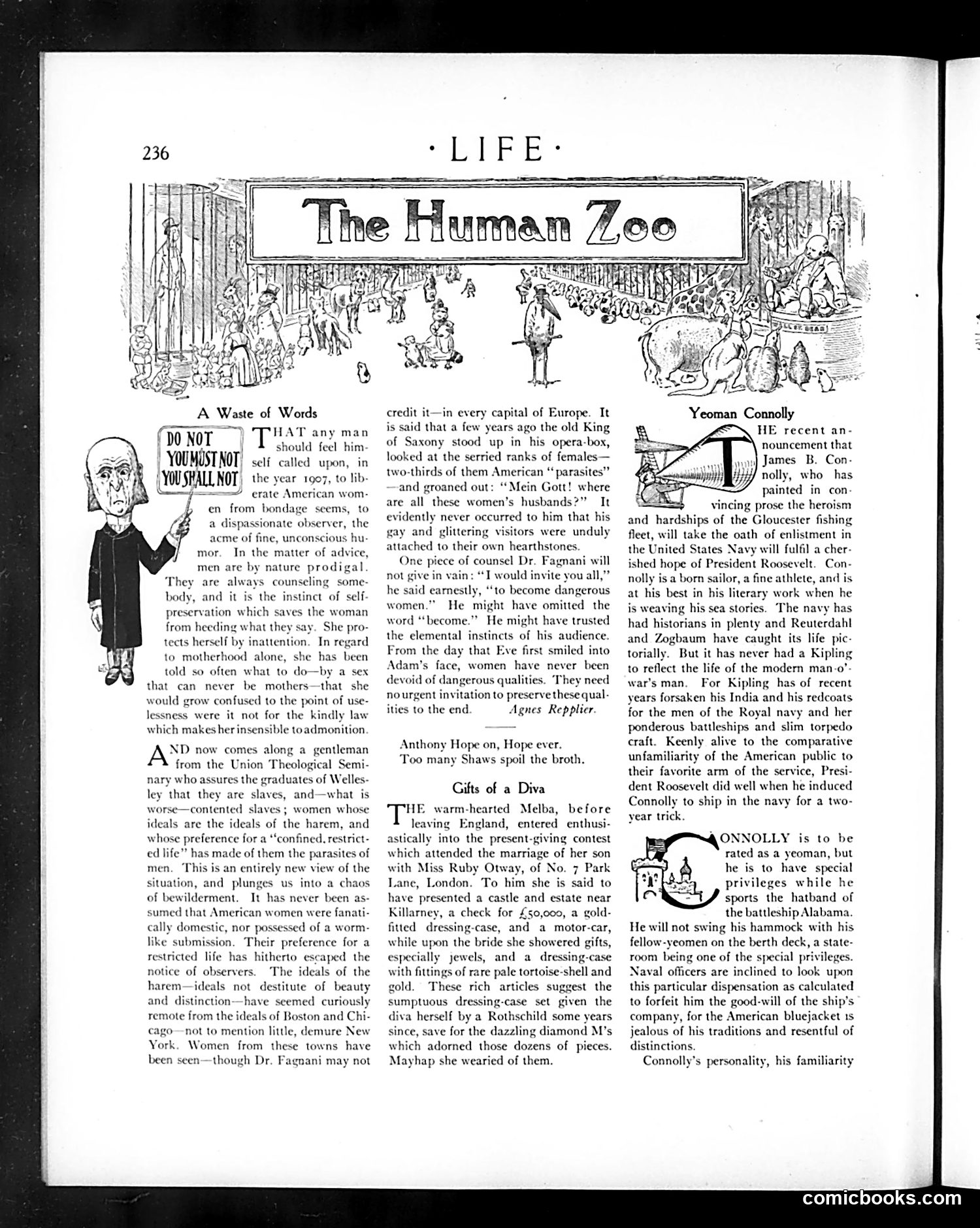
This satirical piece critiques women's behavior and social aspirations through two main sections: **"A Waste of Words"** mocks women who feel compelled to "sell" themselves, arguing that women are inherently prodigal and self-preserving by nature. The text suggests women don't need external encouragement toward dangerous behavior—they're already inclined toward it. **"Gifts of a Diva"** describes a wealthy woman (Misha) who received lavish wedding gifts including a castle, estate, jewelry, and motor-car from her groom. The piece sarcastically notes these extravagant presents, suggesting absurd excess in wealthy marriages. The overall satire targets upper-class women's materialism, vanity, and perceived moral weakness, reflecting early 20th-century misogynistic attitudes common in Life magazine's humor. The "Human Zoo" title frames women as specimens on display.
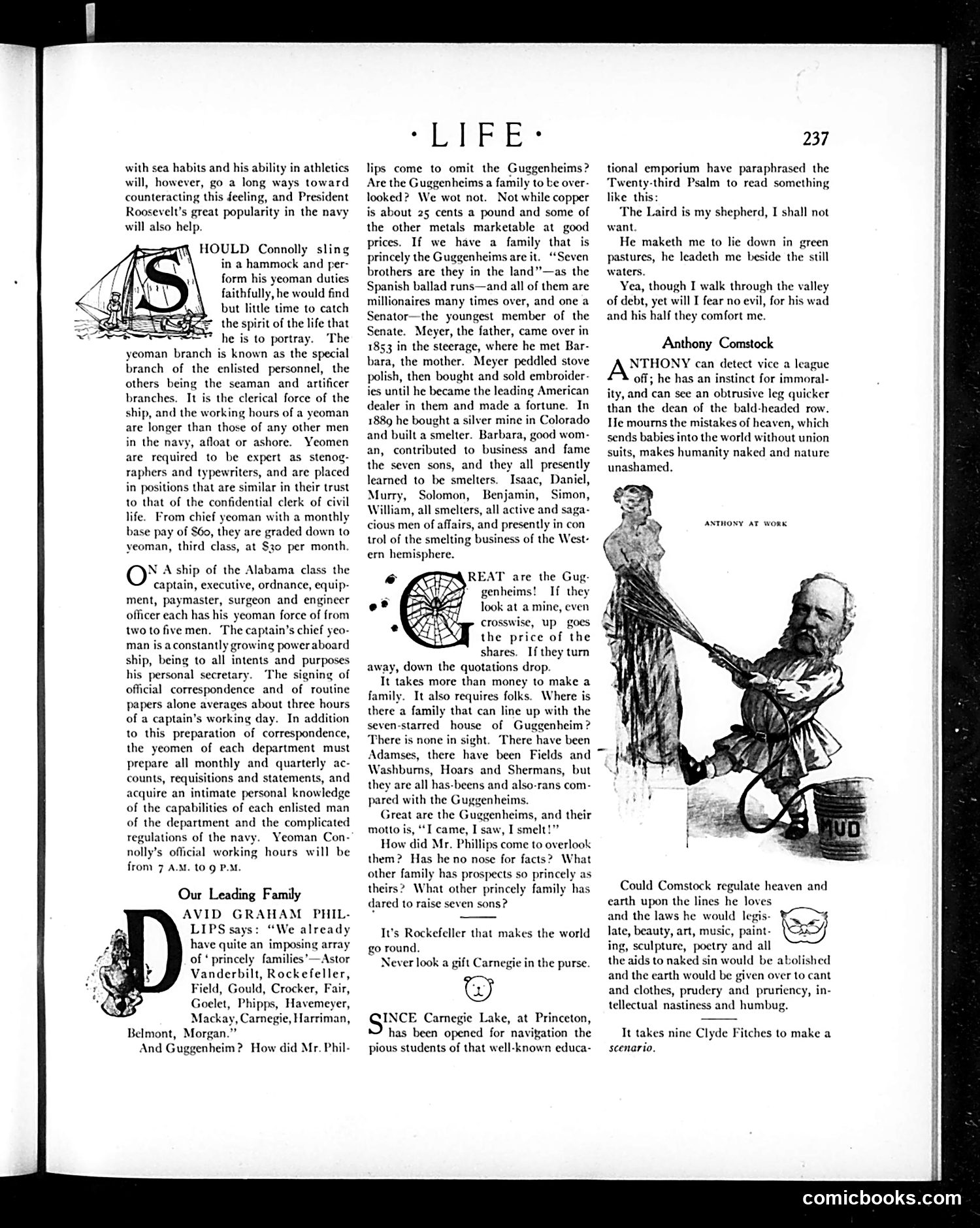
This page satirizes wealthy American families and their social prominence. The main article discusses the Guggenheim family—a prominent mining and banking dynasty—comparing their wealth and influence to other "princely families" like the Vanderbilts, Rockefellers, and Carnegies. The text mocks how the Guggenheims have parlayed their fortune into social status, noting they've produced seven sons who became smelters and businessmen. There's satirical commentary on the absurd notion that wealth alone determines family importance. The illustration labeled "Anthony at Work" appears to depict a wealthy figure engaged in leisure activities, sarcastically contrasting with claims of their business acumen. The overall tone critiques American plutocracy and the conflation of industrial wealth with cultural or moral superiority.
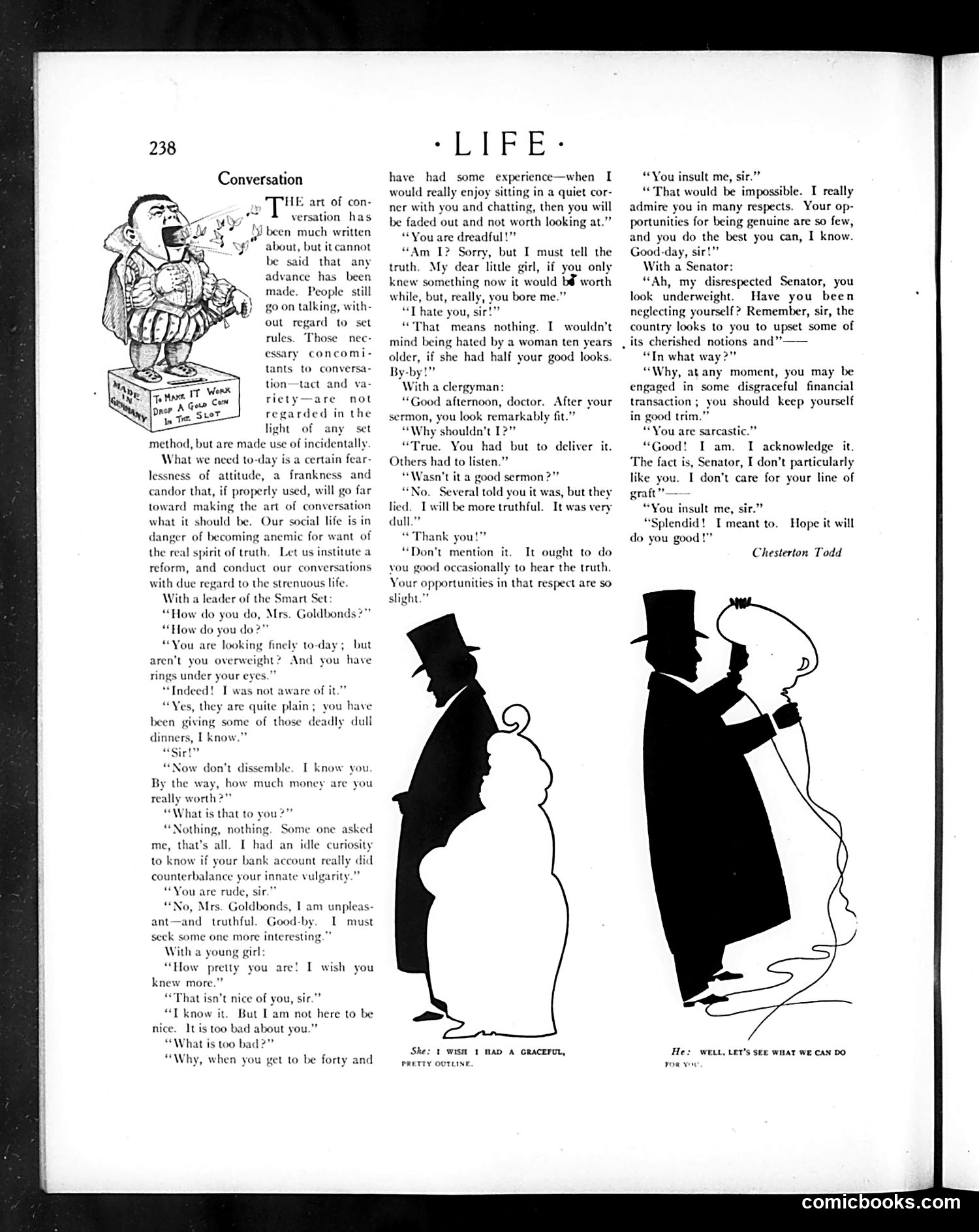
This page satirizes superficial social conversation and rudeness masquerading as honesty. The left illustration shows a caricatured man delivering blunt, insulting remarks to various people—calling a woman "dreadful," criticizing another's appearance, and interrogating Mrs. Goldblonds about her finances and weight. The bottom cartoon depicts two silhouetted figures: a woman wishing she had "a graceful, pretty outline" and a man saying "Well, let's see what we can do for you"—likely implying cosmetic improvement or manipulation. The article critiques how people justify unkind behavior as "truthfulness" while ignoring basic courtesy. It argues that honest conversation should maintain dignity and respect, not weaponize bluntness as an excuse for cruelty. The satire targets the hypocrisy of those claiming virtue through brutal candor.
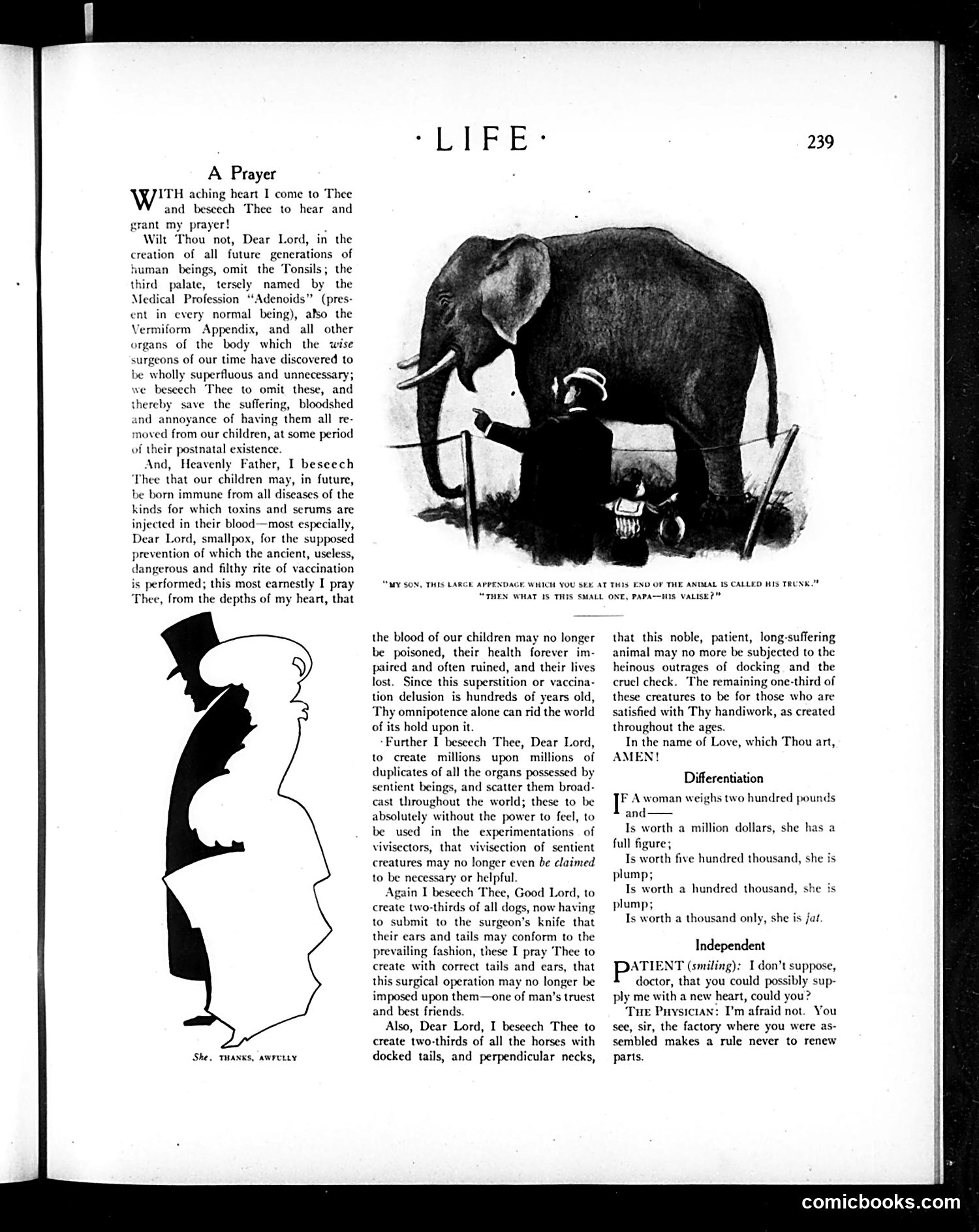
This page contains an anti-vaccination prayer and related satirical content. The prayer mockingly requests God to eliminate "superfluous" organs (tonsils, adenoids, appendix) and prevent vaccination, which the author calls a "superstition" and "dangerous filthy rite." The left cartoon by Sh. Franks Artsully depicts a thin, gaunt figure in profile—likely representing an anti-vaccination advocate—shown in an exaggerated, undignified posture. The elephant illustration with caption mocks someone asking about the animal's "trunk," implying stupidity or naiveté. The page reflects early-20th-century vaccine skepticism, presenting anti-vaccination arguments as absurd religious pleading. Life magazine used satire to ridicule what it viewed as medically ignorant positions regarding public health interventions.
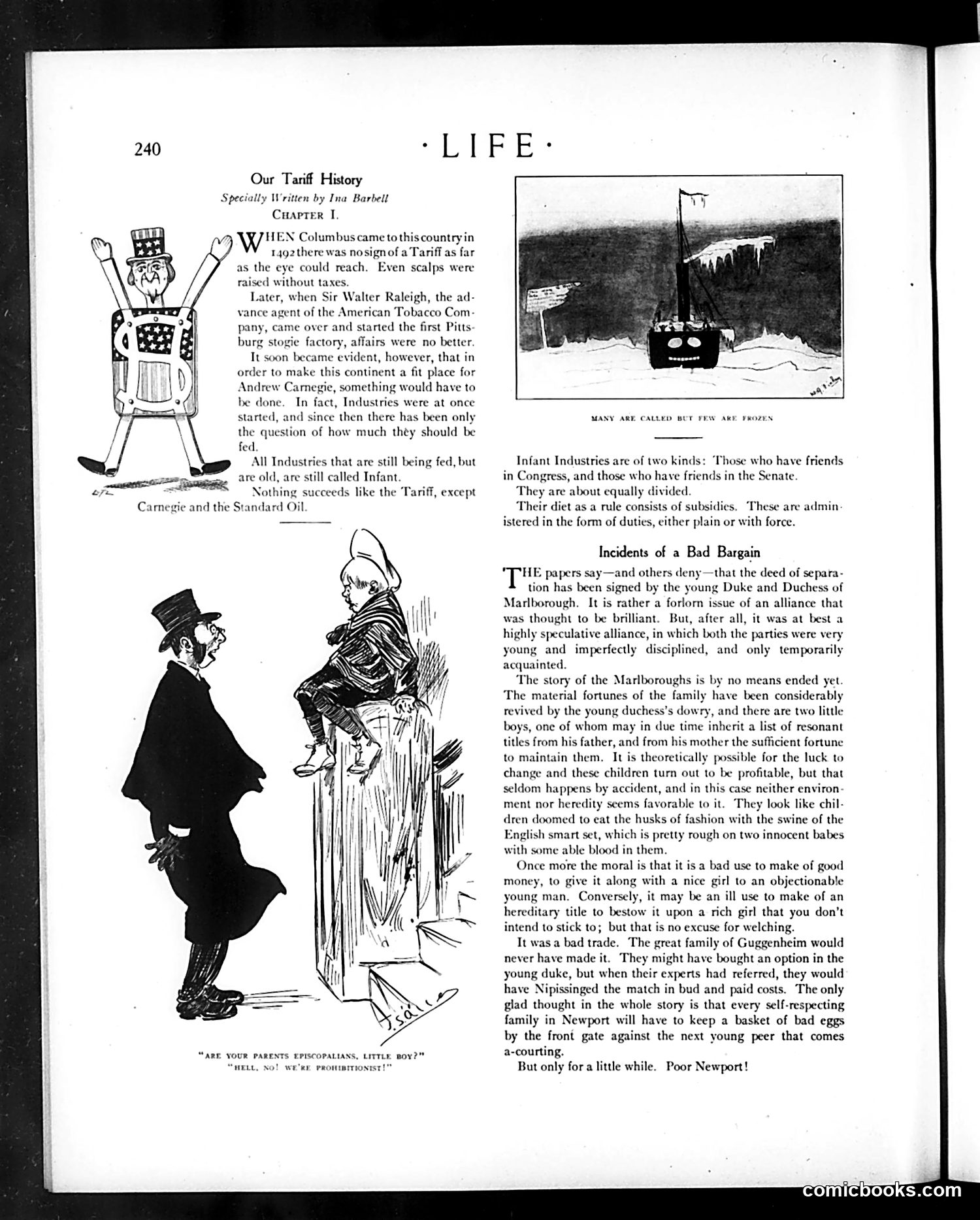
This *Life* magazine page contains two distinct pieces: **"Our Tariff History"** (left): A satirical article by Ina Barkell using Uncle Sam as a mascot. It traces American tariff policy from Columbus onward, arguing that protective tariffs have created dependent "infant industries" that never mature. The piece sarcastically notes these industries survive only through political connections—"those who have friends in Congress" versus the Senate. **"Incidents of a Bad Bargain"** (right): Commentary on the Duke and Duchess of Marlborough's separation, presented as a cautionary tale about aristocratic marriages. It critiques both the imprudent union and the broader practice of wealthy families using titles and dowries as currency in marriage negotiations, rather than genuine compatibility. Both pieces mock the era's power structures—political favoritism and aristocratic economics.
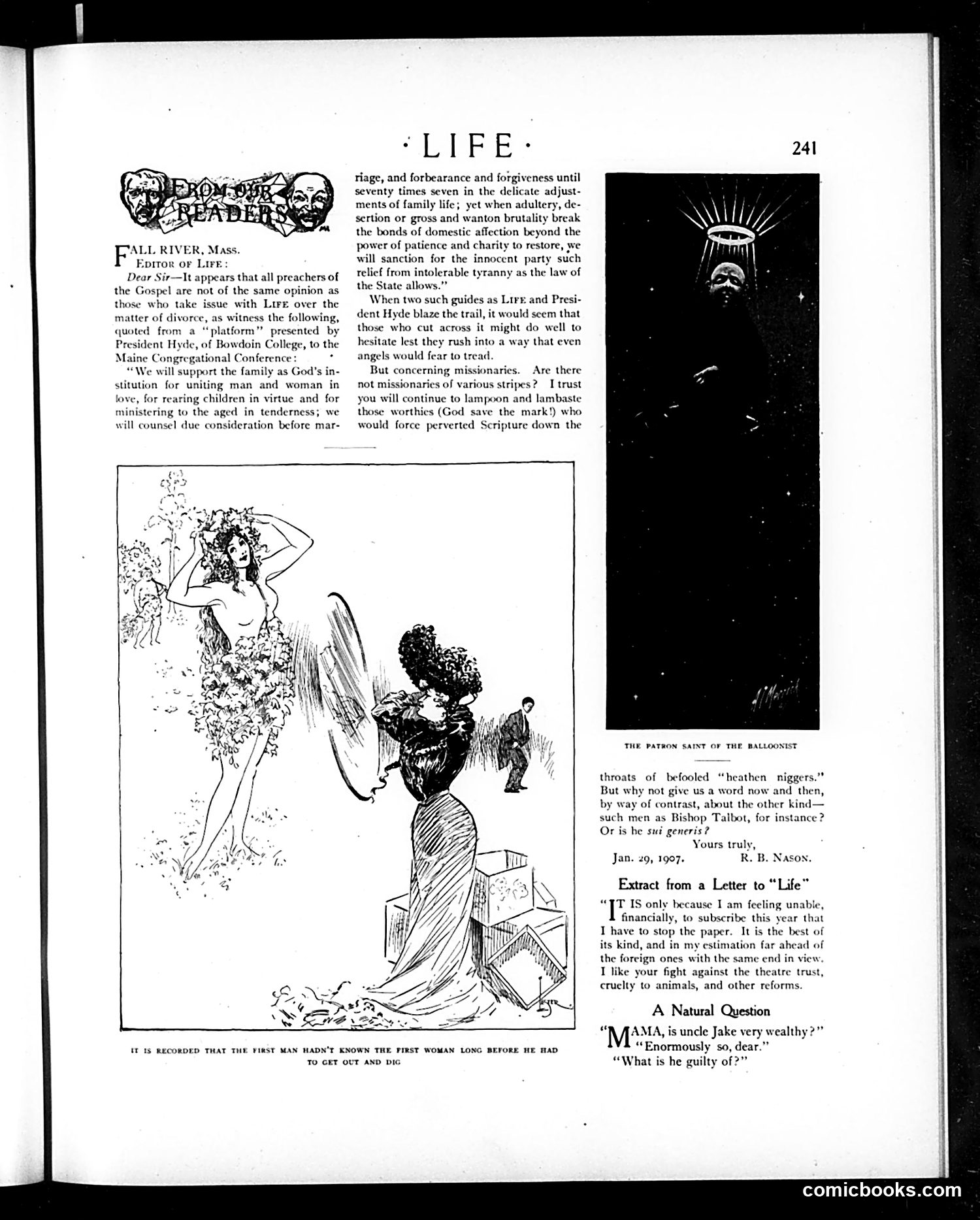
This page contains editorial content addressing social debates of early 1907. The main cartoon depicts a woman figure (appearing to represent "Woman" or feminine virtue) encountering a small dark figure, illustrating the caption about "the first man hadn't known the first woman long before he had to get out and dig"—a joke about women's expectations burdening men. The text includes a letter from R.B. Nason criticizing Life's editorial positions on theater reform, animal cruelty, and other causes, suggesting the magazine was known for progressive advocacy. A brief "Natural Question" joke follows about wealth and guilt, likely satirizing the conscience of wealthy industrialists. The overall page reflects Life's role as a satirical voice commenting on contemporary social reform movements and gender relations.
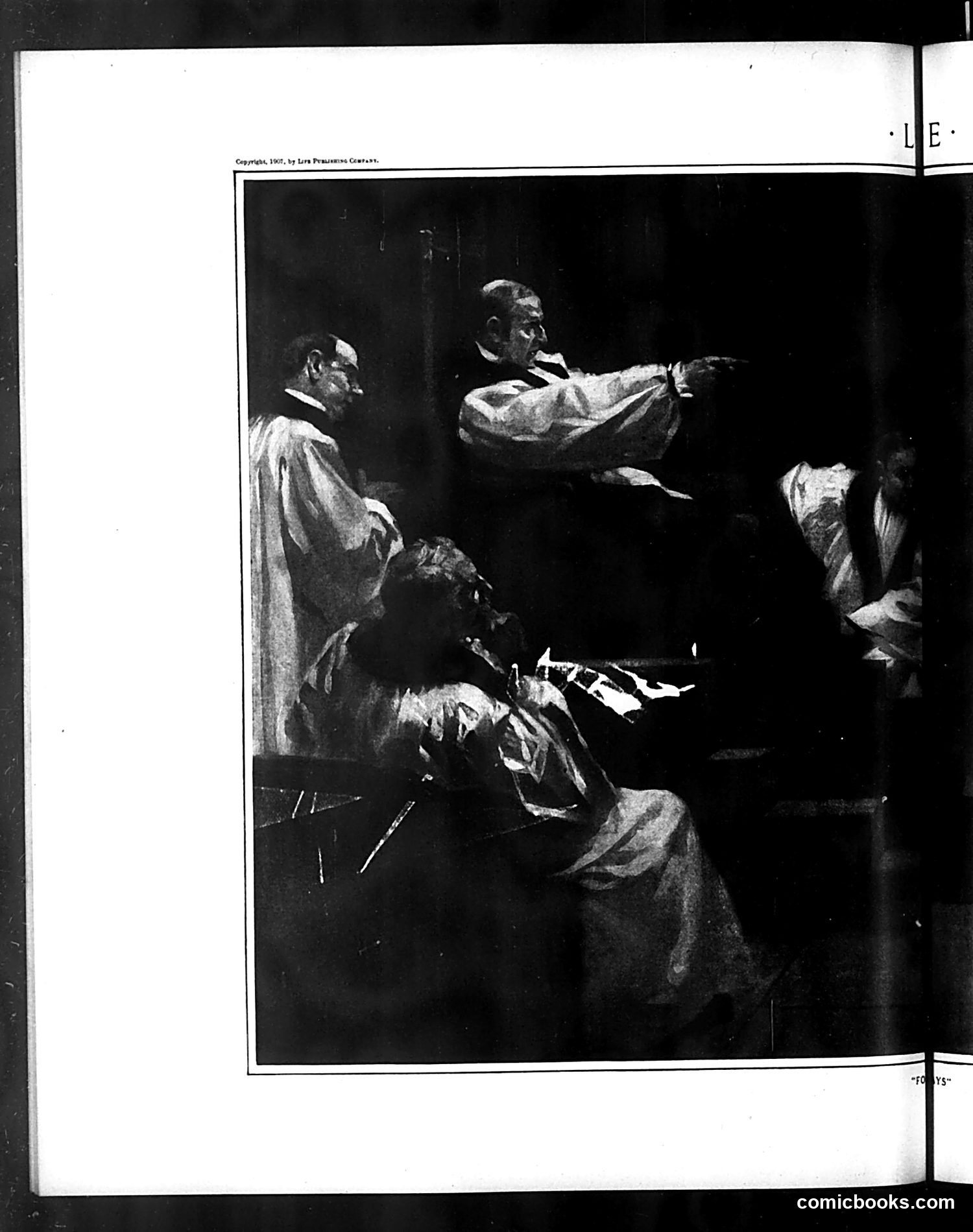
This appears to be a dramatic illustration rather than a cartoon, depicting what seems to be a courtroom or formal proceeding scene. The image shows several figures in period dress (appearing to be late 19th or early 20th century based on clothing styles), with one man gesturing forcefully while others observe, including what appears to be a seated figure. Without clearer text identifying the specific political or social reference, I cannot definitively state which event or figures are being satirized. The composition suggests a moment of conflict or accusation, but the exact context—whether this references a specific trial, political scandal, or social commentary—is unclear from the visible elements alone. The copyright notice indicates 1907 as the publication date, which would help narrow historical context, but specific identification requires additional textual information not legible here.
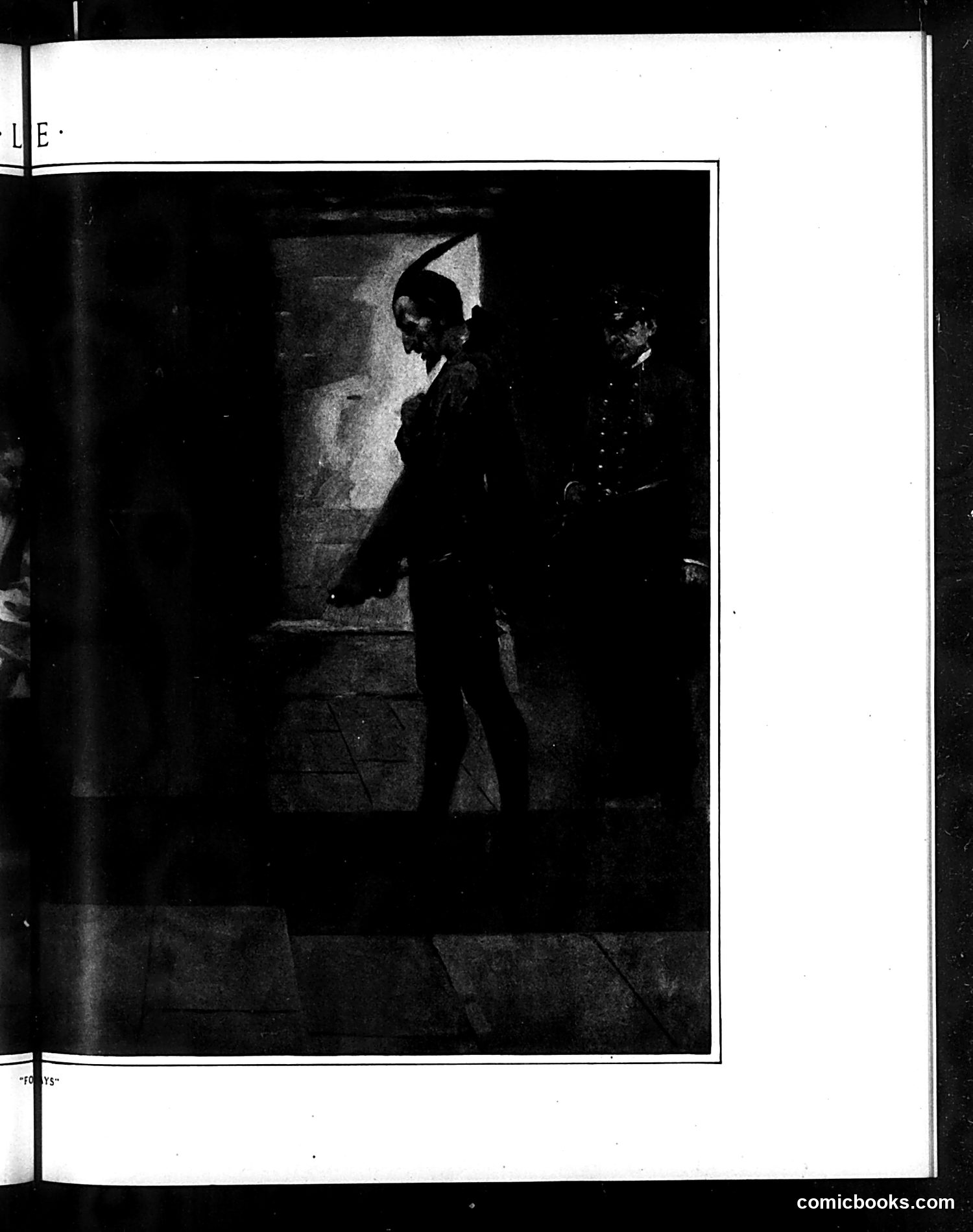
This is a black and white photograph rather than a cartoon. The image shows two figures in what appears to be an interior setting with dramatic lighting. One figure is prominently positioned in the foreground, while another is visible to the right. The photo has a theatrical or cinematic quality typical of early-to-mid 20th century magazine photography. Without additional visible text or captions identifying these figures or the specific reference, I cannot definitively explain the political or social satire intended. The "comicbooks.com" watermark at the bottom appears to be a modern addition unrelated to the original Life magazine publication. To properly interpret the satire or subject matter, I would need visible caption text or other identifying information from the page.
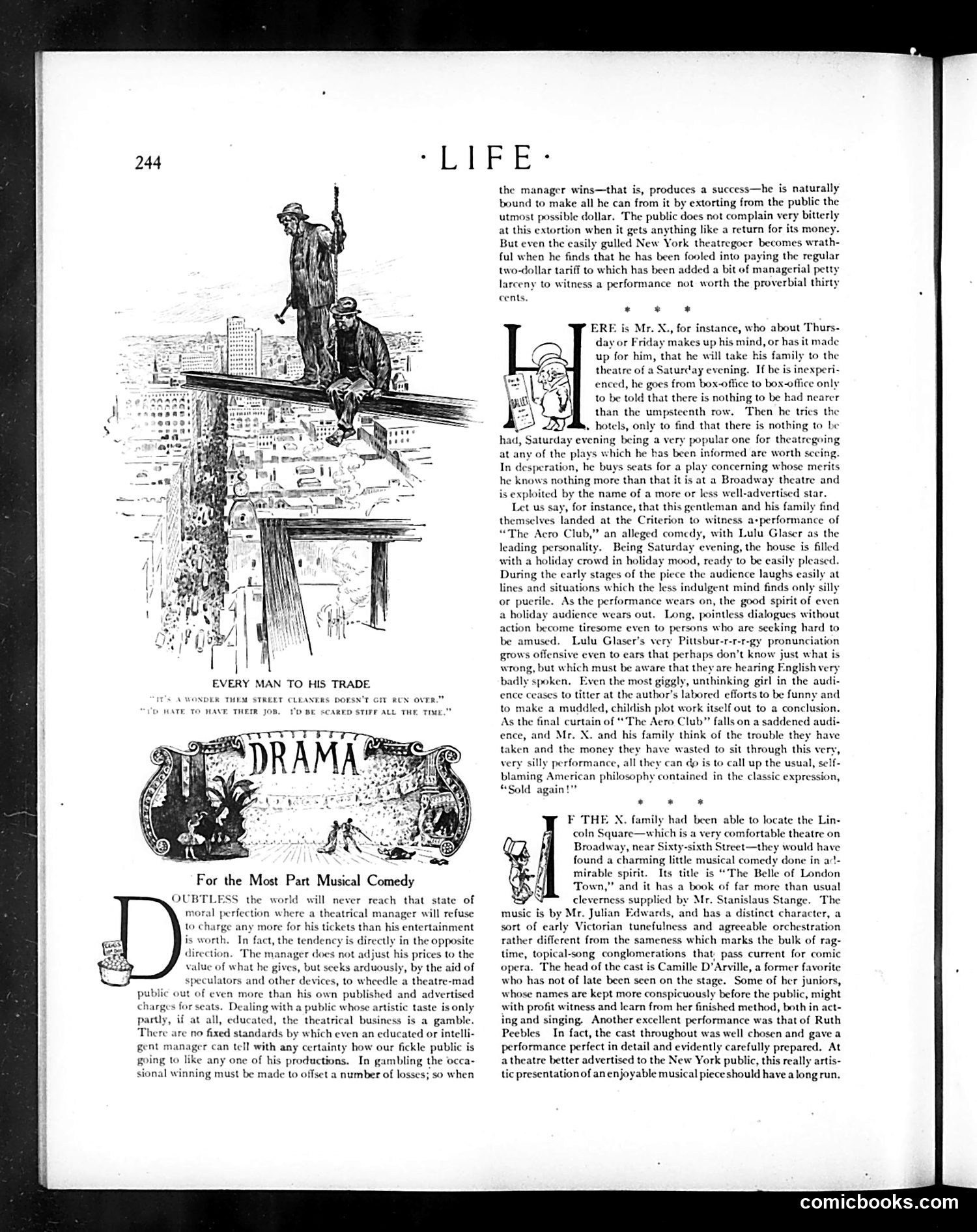
This page contains two distinct pieces of Life magazine satire: **"Every Man to His Trade"** (top): A cartoon mocking street cleaners' dangerous work, with figures perched precariously on a building ledge above city streets. The caption suggests amazement they don't get hit by vehicles—dark humor about occupational hazard. **"For the Most Part Musical Comedy"** (bottom): A lengthy essay criticizing theatrical managers who overcharge audiences. The author argues managers extract maximum profit from successful shows without adjusting prices to actual entertainment value. He illustrates this with "Mr. X," an average theatergoer who pays inflated prices to see "The Aero Club" at the Criterion Theatre, only to endure a poorly-written comedy with actress Lulu Glaser (whose "Pittsbur-r-r-g" accent grates). The satire targets both theatrical greed and low-quality productions that exploit captive audiences unable to find alternative entertainment.
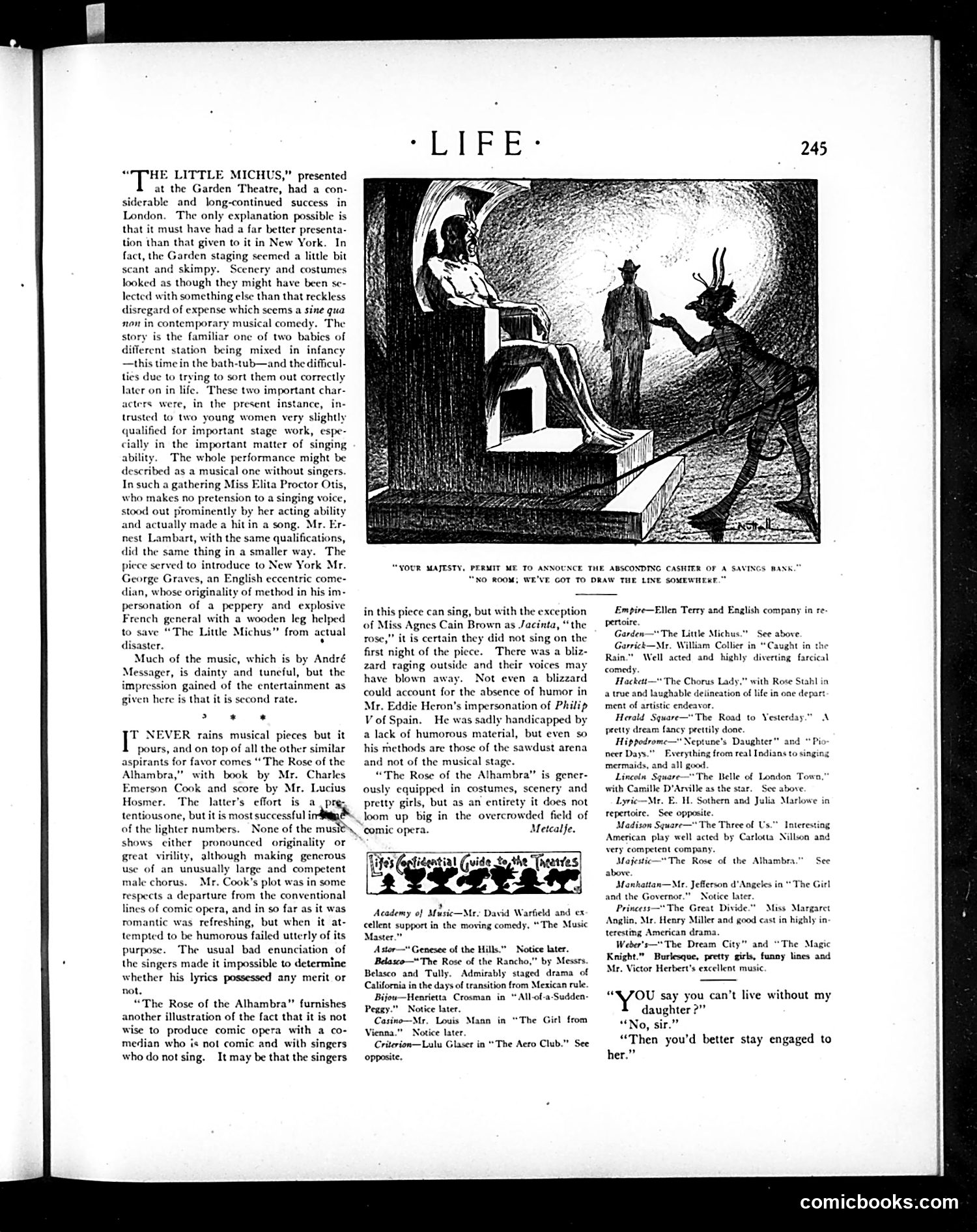
This page reviews two musical comedies playing in New York theaters. The main cartoon depicts a bank official announcing an absconding cashier to royalty, with the caption "NO ROOM; WE'VE GOT TO DRAW THE LINE SOMEWHERE"—a joke about exclusivity and overcrowding. The reviews themselves are scathing critiques. "The Little Michus," successful in London, disappointed New York audiences due to cheap staging and unqualified female leads who couldn't sing. "The Rose of the Alhambra" similarly suffered from non-singing singers and unfunny comedians. The critic notes these failures demonstrate the folly of producing comic opera without genuinely talented performers. Both pieces featured spectacle—costumes, scenery, pretty girls—but lacked substance, representing the overcrowded, mediocre musical theater market of the era.
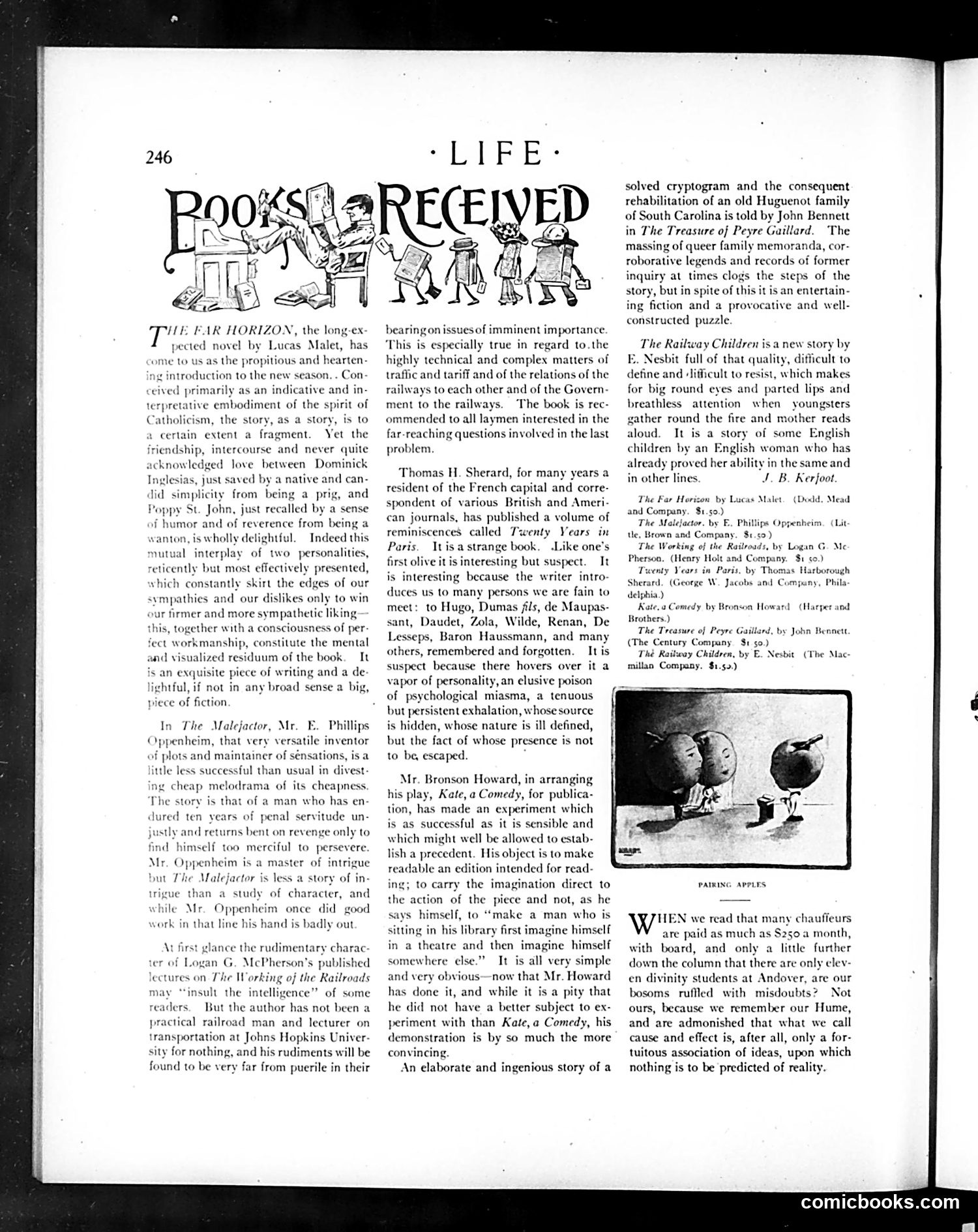
This is a **book review section** from Life magazine, not a political cartoon. The page reviews several new publications, including novels by Lucas Malet and E. Phillips Oppenheim, and a work on railroad economics by Logan G. McPherson. The single illustration labeled "PAIRING APPLES" shows two figures examining apples—likely a humorous domestic scene unrelated to the reviews above it. The page's humor is literary rather than political. It critiques authors' strengths and weaknesses: praising Malet's character work while noting Oppenheim relies too heavily on melodrama, and commending McPherson's technical railroad knowledge despite his "rudimentary" storytelling. The reviews assume educated readers interested in contemporary fiction and economic policy—typical Life magazine content for a literate, middle-to-upper-class American audience of the late 19th/early 20th century.
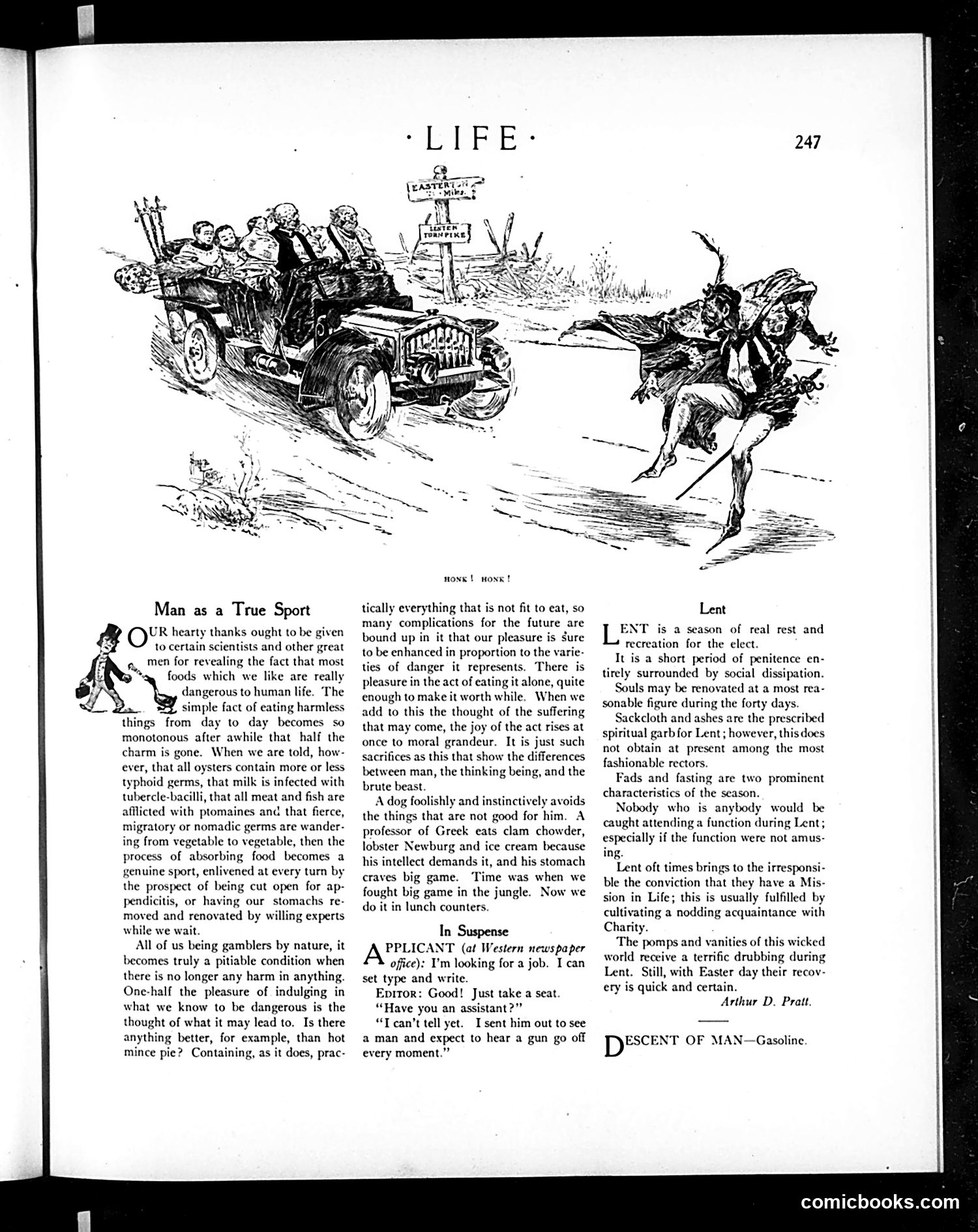
This satirical page from *Life* magazine contains two main pieces mocking early 20th-century attitudes: **"Man as a True Sport"** satirizes the contemporary obsession with newly-discovered food contamination dangers. Scientists had recently revealed that oysters, milk, and meats contained typhoid germs and other pathogens. The author mockingly argues that eating these dangerous foods has become thrilling precisely *because* they're hazardous—turning ordinary meals into a "sport" of gambling with one's health. The joke: humans perversely enjoy risks (like eating mince pie) specifically for their potential consequences, unlike dogs who simply avoid what's bad for them. **"In Suspense"** is a brief joke about newspaper office chaos: an editor has sent his assistant to meet someone and expects gunfire "every moment"—suggesting either extreme danger or that the assistant himself is unreliable/violent. **"Lent"** section mocks wealthy society's hypocritical observance of the religious season—claiming fashionable people attend functions during Lent despite claiming abstinence, and that charitable impulses vanish after Easter. The cartoon above depicts a car full of people and a horse bolting away, likely illustrating the "gasoline" theme and early automobile era anxieties.
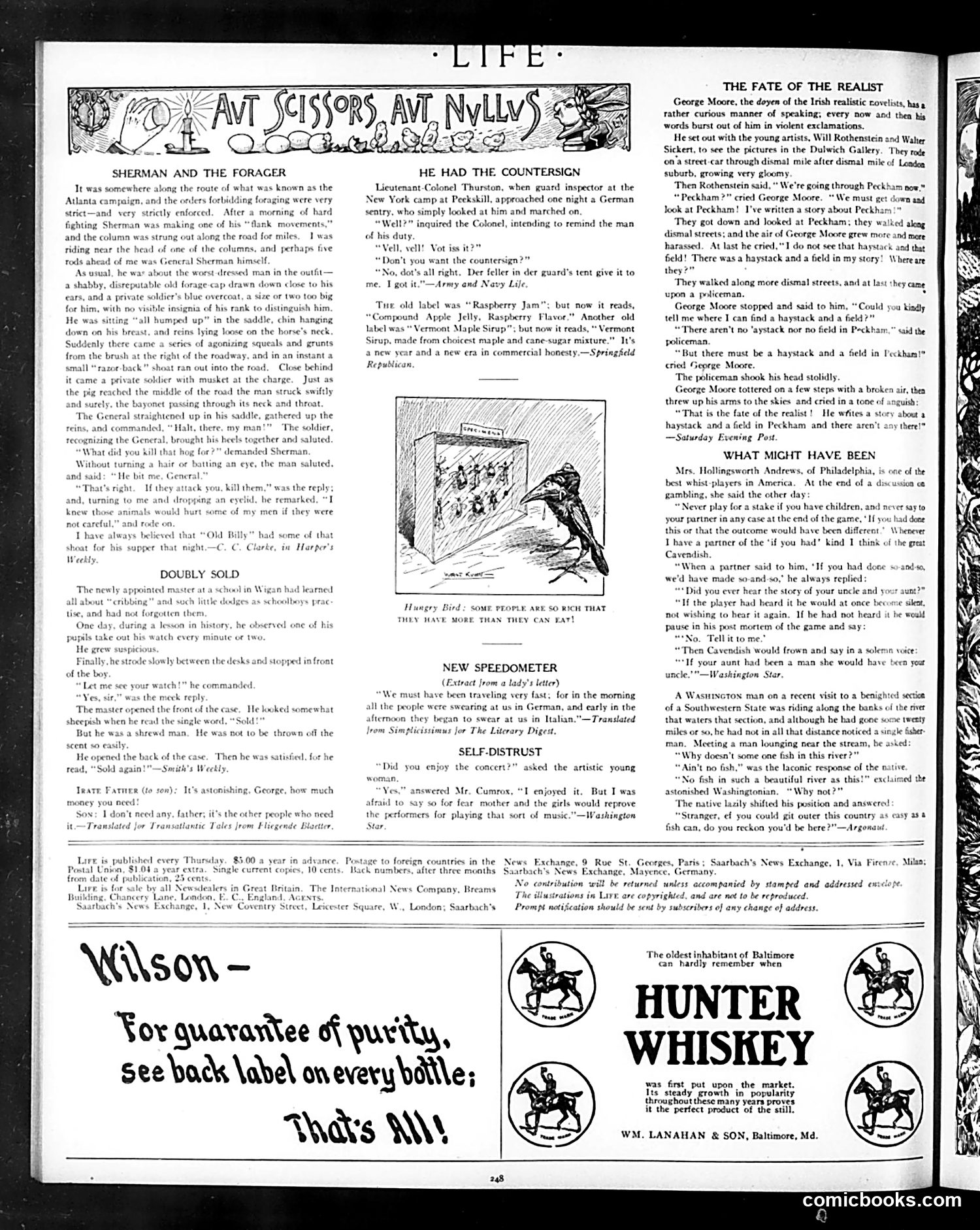
This page contains several humorous anecdotes satirizing American military and social life, likely from the early 1900s. **"Sherman and the Forager"** recounts General William Tecumseh Sherman during the Civil War Atlanta campaign summarily executing a soldier for killing a pig—illustrating Sherman's notorious severity and pragmatism regarding discipline and resource protection. **"He Had the Countersign"** mocks a German sentry's incompetence at a Union Army camp, where the soldier admits receiving the password from someone in the guard tent rather than properly challenging an officer. **Other brief comedic pieces** address commercial dishonesty (relabeling jars), academic cheating, and courtship anxieties—reflecting Progressive Era concerns about business ethics and social propriety. The advertisements for Wilson whiskey and Hunter whiskey anchor the page in its commercial context. The overall tone is nostalgic, featuring Civil War anecdotes alongside contemporary humor about modern life's absurdities.
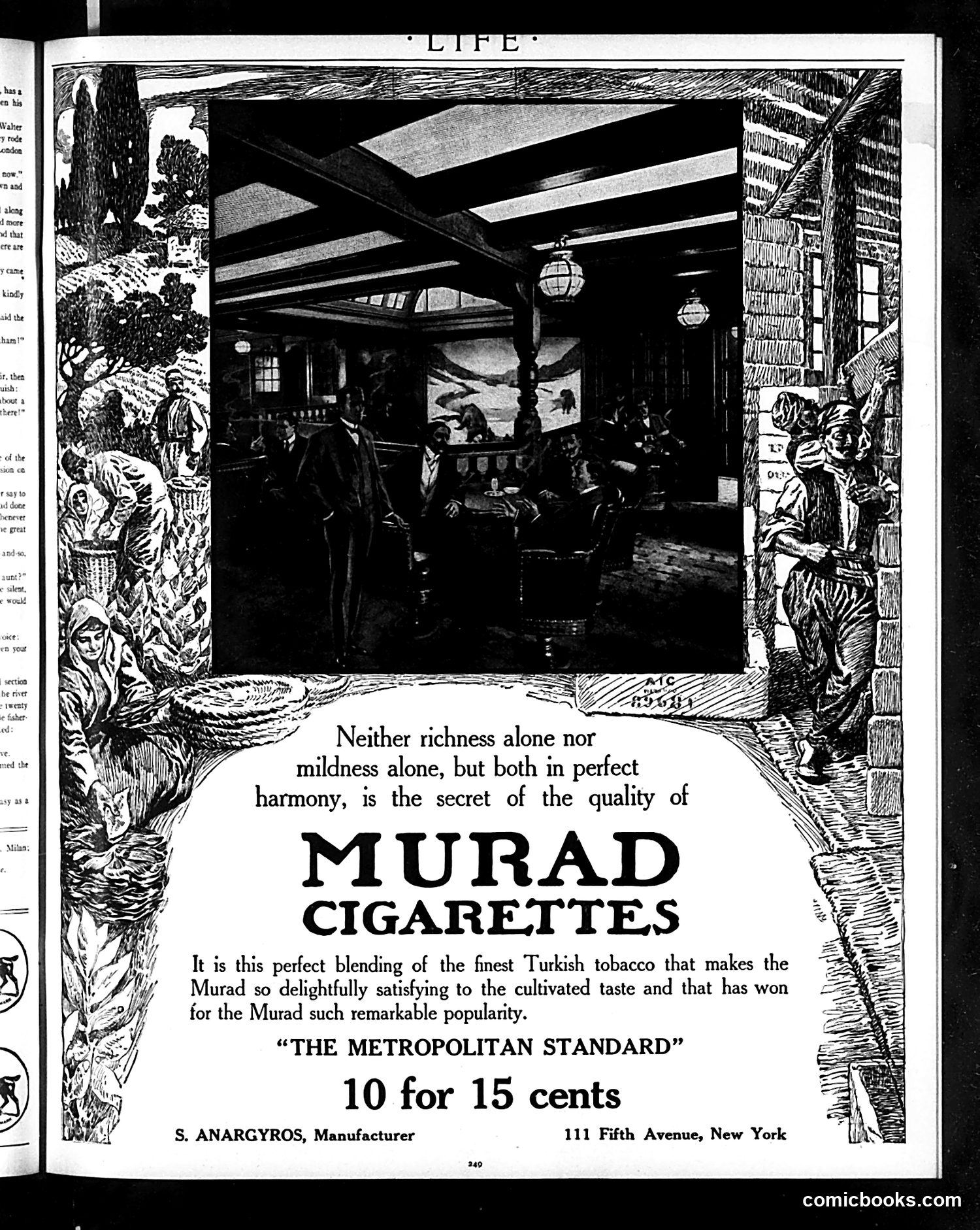
This page is **primarily an advertisement**, not editorial satire or cartooning. It's a Murad Cigarettes ad from *Life* magazine featuring an illustration of an upscale interior scene—appears to be a nightclub, lounge, or social gathering space with well-dressed patrons and hanging lamps. The ad uses aspirational imagery typical of early 20th-century tobacco marketing, positioning the product as refined and sophisticated ("cultivated taste," "Metropolitan Standard"). The decorative border contains ornamental illustrations unrelated to the product. There is **no political or social satire** visible here—this is straightforward commercial advertising leveraging class associations and aesthetic appeal to sell cigarettes at the budget price of "10 for 15 cents."
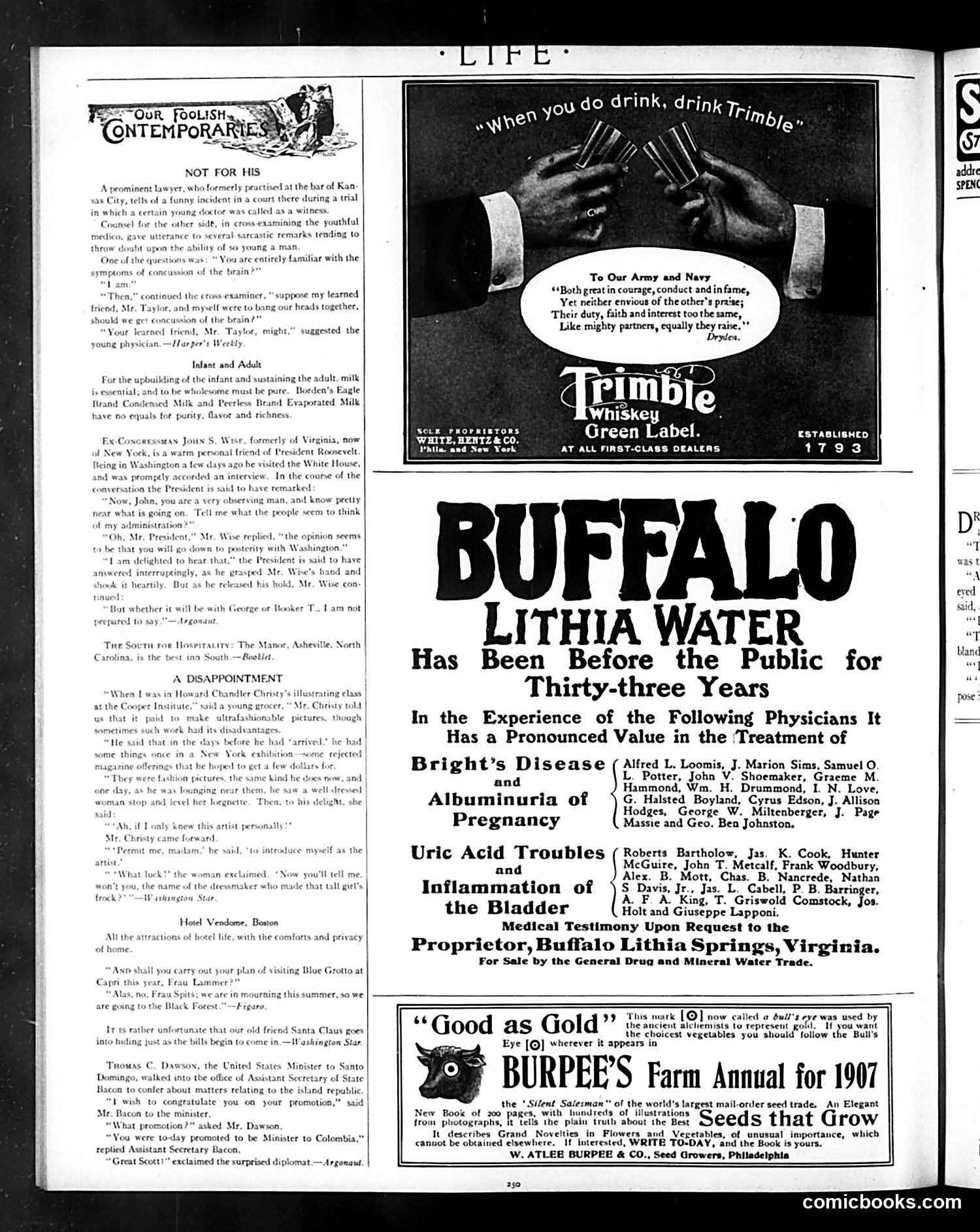
This page from *Life* magazine contains several humorous anecdotes and contemporary advertisements rather than a political cartoon. The main humorous pieces include brief jokes about prominent figures: an anecdote about a lawyer in Kansas City questioning whether two heads together contain one brain; and a story about President Roosevelt receiving news of a promotion to Colombia (when he'd already received it). These highlight minor embarrassments or ironies in professional contexts. The page is primarily filled with advertisements for patent medicines (Buffalo Lithia Water, claimed to treat Bright's Disease and pregnancy ailments) and Trimble Whiskey, with endorsements from physicians. These reflect the era's largely unregulated medical advertising, when such products made broad health claims with little oversight. The "Good as Gold" section advertises Burpee's Farm Annual seed catalog. The content reflects early 1900s American consumer culture and the nascent advertising industry's techniques.
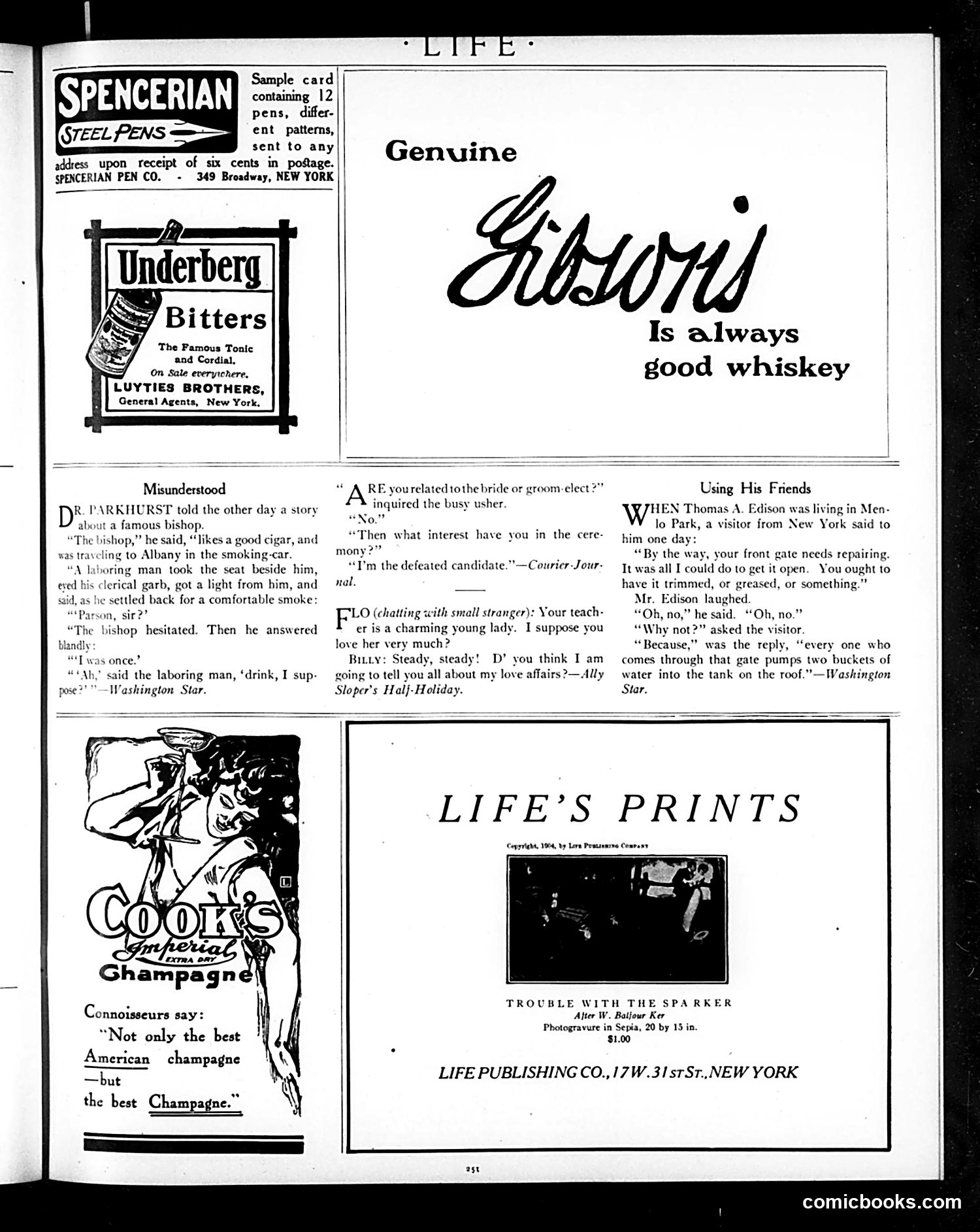
This page mixes period advertisements with three brief satirical anecdotes typical of *Life* magazine's humor format. **The anecdotes mock social pretension and naiveté:** 1. **"Misunderstood"**: A bishop is mistaken for a laborer because he smokes cigars—the joke being the laboring man assumes clergy don't smoke, revealing class assumptions about respectability. 2. **"Wedding usher exchange"**: A candidate (likely political) crashes a wedding by claiming to be "the defeated candidate," gaining admission through absurd logic—satirizing how people exploit social events. 3. **"Edison's gate"**: Thomas Edison deliberately leaves his gate broken so visitors must pump water into his tank as they enter—a humorous example of using guests' labor for practical purposes. **Advertisements** include Spencerian pens, Underberg Bitters (marketed as tonic), and Cook's Champagne—typical early 1900s product placements. The humor relies on wordplay, unexpected twists, and gentle mockery of human behavior rather than political commentary.
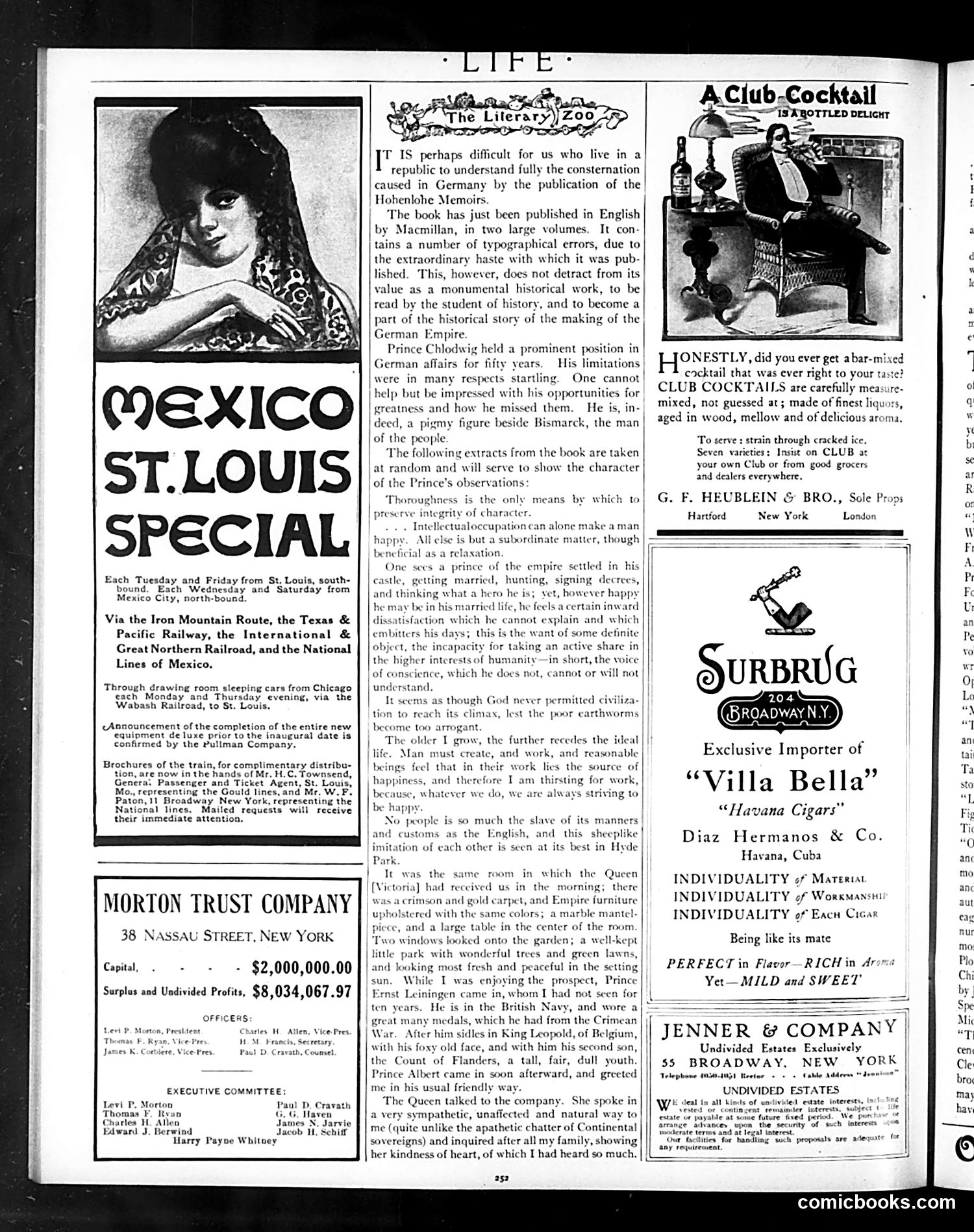
This page is primarily **advertisements and corporate announcements** rather than satirical cartoons. The dominant content includes: **Main Elements:** - A "Mexico St. Louis Special" railroad advertisement announcing a new luxury train route with drawing room sleeping cars - Morton Trust Company financial advertisement (capital $2,000,000) - Various smaller ads for cigars, cocktail mixers, and real estate services **Literary Content:** The central text discusses the recently published English translation of the **Hohenlohe Memoirs**—reflections by a prominent German statesman on character, duty, and imperial governance. The excerpts present the Prince's philosophical observations on work, happiness, and civilization. **Historical Context:** This appears to be early 20th-century content; the Hohenlohe Memoirs caused political controversy in Germany upon publication. The page reflects Gilded Age America's fascination with both European aristocratic memoir literature and domestic commercial expansion (railroads, banking, luxury goods). There is **no political satire** visible on this page—it's a standard mixed-content magazine layout of that era.
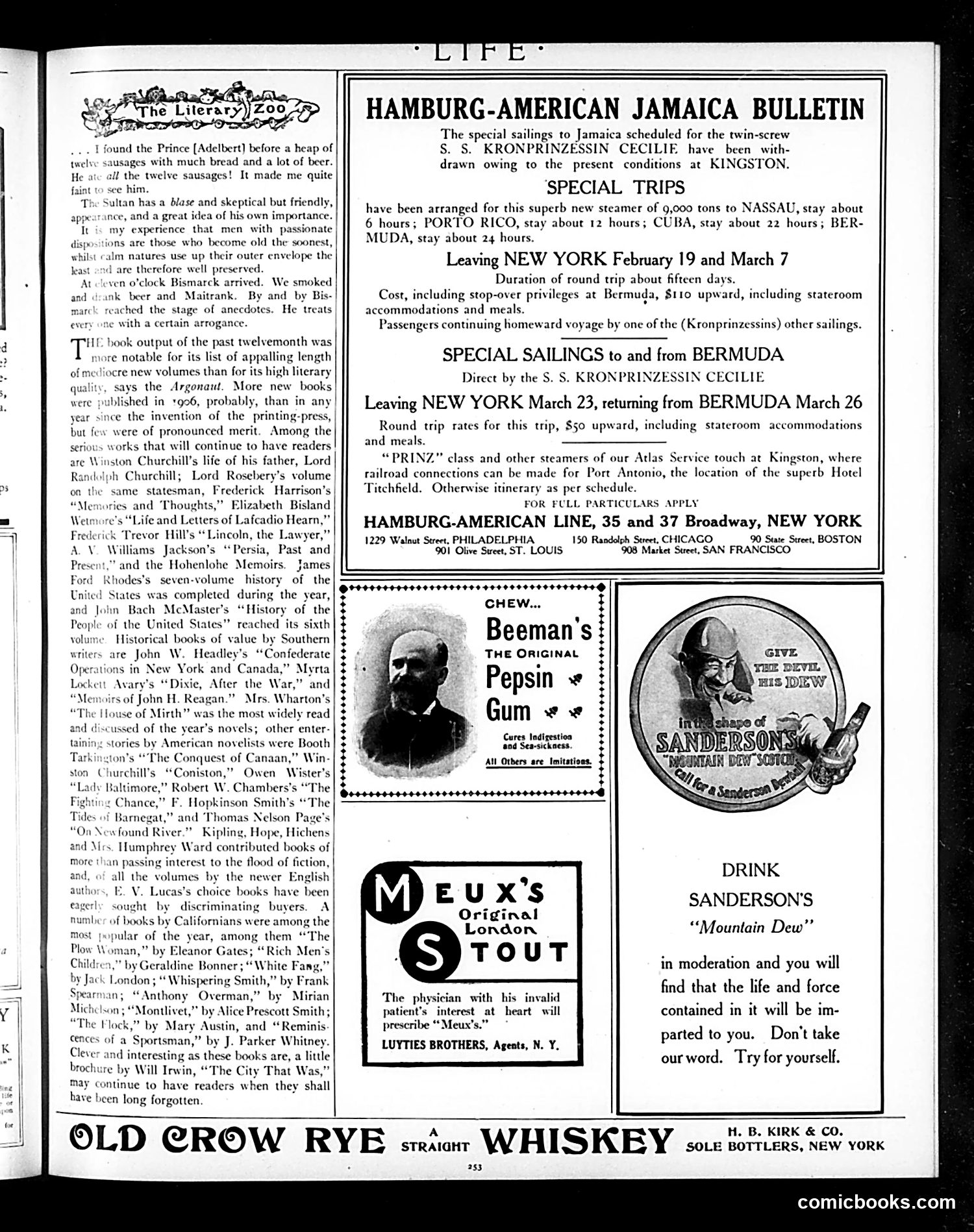
This is primarily an **advertising and literary review page** from Life magazine, not a political cartoon page. The left column reviews recent books (circa 1906), praising works by Churchill, Rosebery, and others, while noting the flood of mediocre new publications. Notable mentions include *The House of Mirth* by Edith Wharton and works by Southern writers on Civil War history. The right side contains **cruise ship advertisements** for the Hamburg-American Line's steamship *Kronprinzessin Cecilie*, offering trips to Jamaica, Nassau, Cuba, Bermuda, and Puerto Rico—with a note that Jamaica sailings were canceled due to "present conditions" (likely political unrest). Below are **product advertisements**: Beeman's Pepsin Gum, Sanderson's Mountain Dew soft drink, Meux's Original London Stout (with a physician's endorsement), and Old Crow Rye Whiskey. There are no political cartoons or satirical illustrations on this page—it functions as a standard magazine advertising and content section.
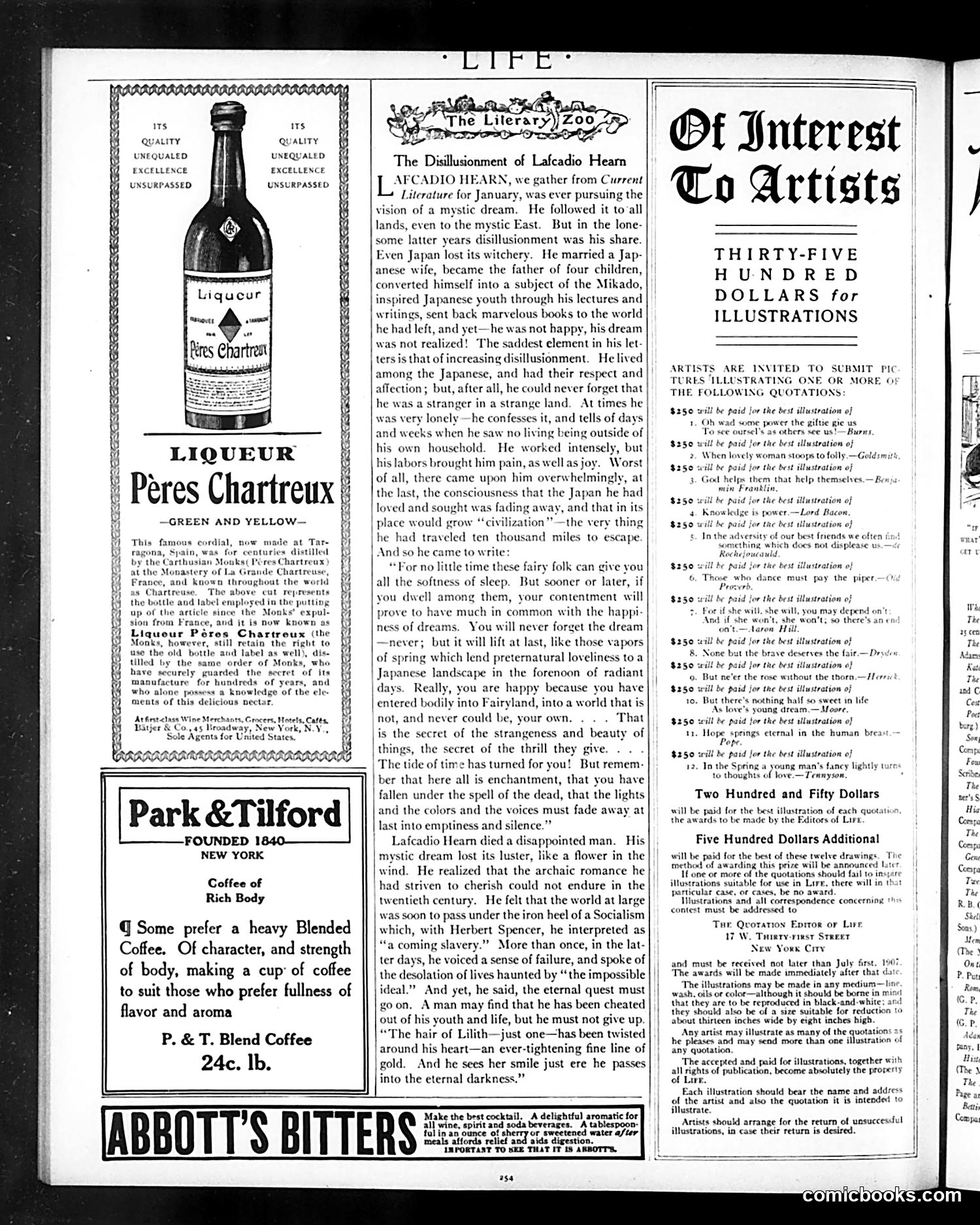
This page is primarily **advertising and editorial content**, not political satire. The main feature is a biographical essay on **Lafcadio Hearn**, a 19th-century writer-adventurer who pursued romantic ideals across the world, eventually settling in Japan. The article describes his disillusionment: despite marrying a Japanese woman, fathering children, teaching, and writing celebrated books about Japan, he remained fundamentally lonely and felt like a permanent outsider. The piece uses Hearn's life to explore a broader theme—that exotic dreams cannot survive contact with reality. His quoted reflections lament how Japan's traditional beauty would inevitably succumb to modernization and Western "Socialism." The essay is melancholic rather than satirical, treating Hearn as a cautionary figure whose romantic vision of the "Orient" ultimately proved unsustainable. The surrounding ads (Pères Chartreux liqueur, Park & Tilford coffee, Abbott's Bitters) are standard commercial content unrelated to the editorial.
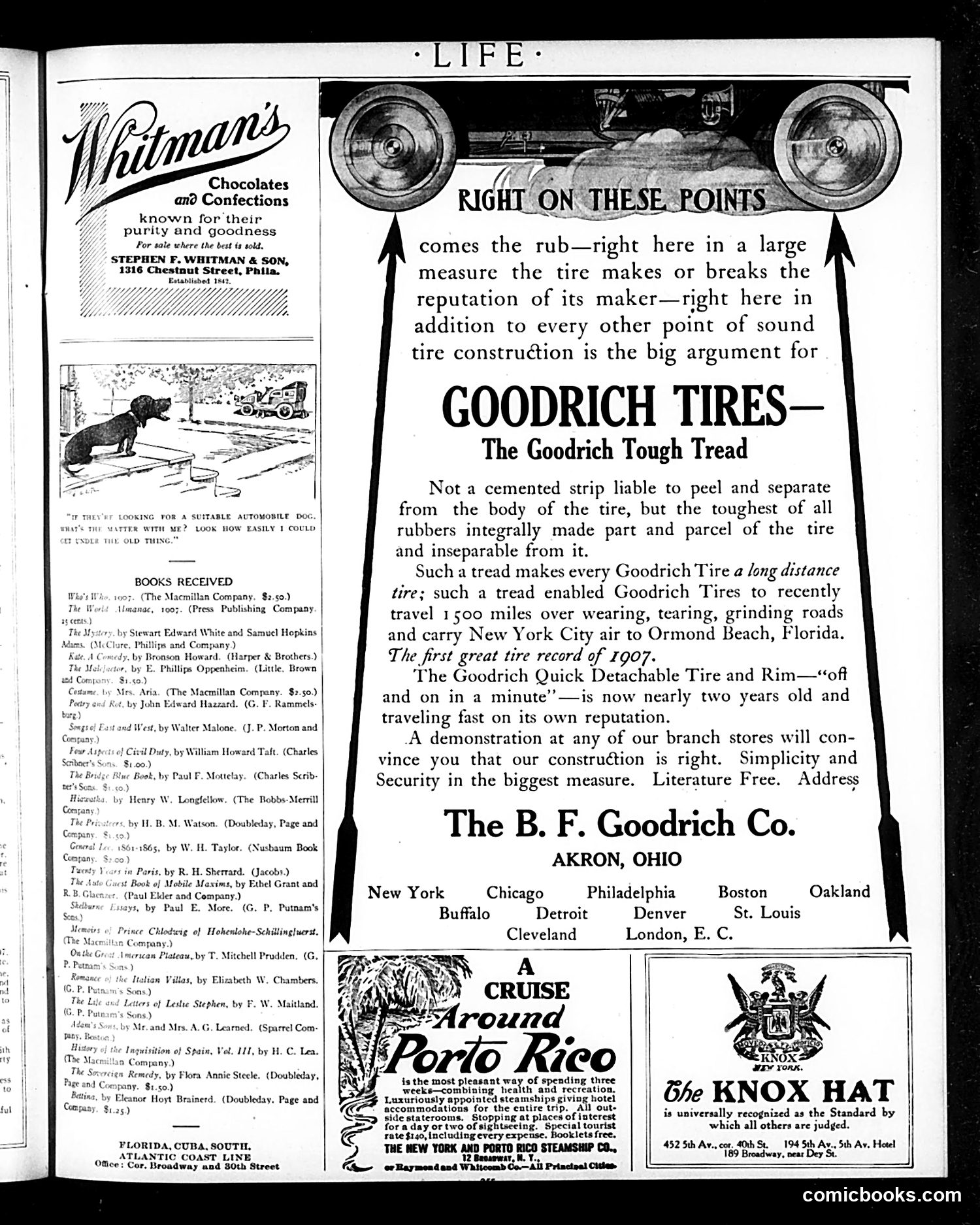
This is primarily an **advertising page** from Life magazine, not a satirical cartoon page. The content consists of commercial advertisements and a "Books Received" section listing new publications. The main advertisements are: 1. **Whitman's Chocolates** — emphasizing purity and quality 2. **Goodrich Tires** — promoting their "Tough Tread" technology, claiming a 1500-mile durability record from a 1907 New York to Florida journey 3. **Knox Hat** — marketed as the standard by which "all others are judged" 4. **Porto Rico cruise** advertisement 5. **Atlantic Coast Line** railroad The "Books Received" section lists recent publications from major publishers like Macmillan and Doubleday. There is **no political satire or cartoon content** visible on this page — it's a straightforward commercial page typical of early 20th-century magazines, where advertisements subsidized publication costs.
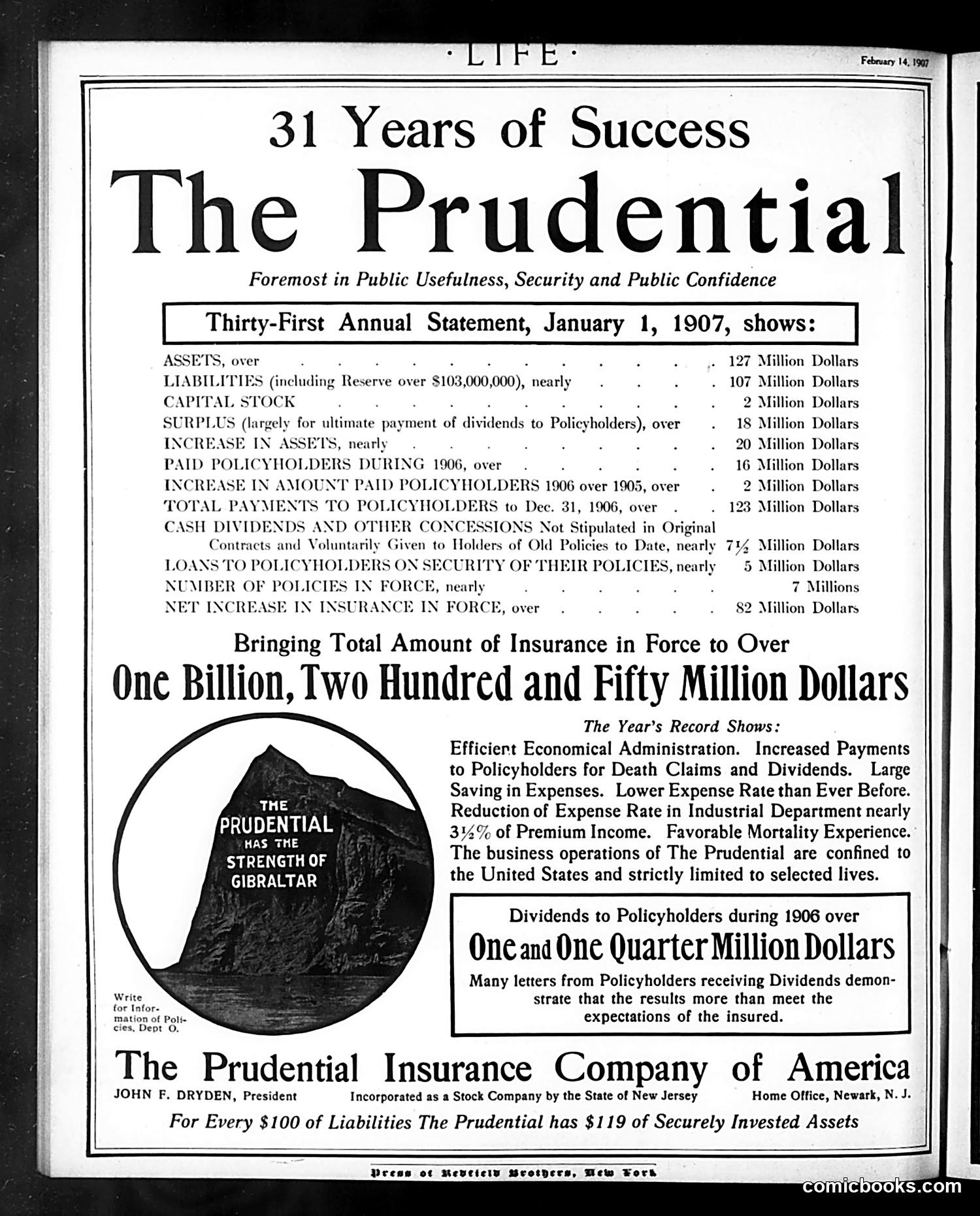
This is a full-page advertisement for The Prudential Insurance Company celebrating 31 years of success. Rather than satire or political commentary, this represents straightforward corporate promotion. The key visual element—the Rock of Gibraltar illustration with text "THE PRUDENTIAL HAS THE STRENGTH OF GIBRALTAR"—uses a metaphor for stability and permanence. This was a common advertising trope of the era, suggesting the company's unshakeable financial security. The advertisement showcases impressive financial figures: $127 million in assets, $1.25 billion in insurance in force, and $1.25 million in dividends distributed to policyholders. For a 1907 audience, these numbers conveyed prosperity and trustworthiness. The tagline "For Every $100 of Liabilities The Prudential has $119 of Securely Invested Assets" emphasizes solvency—a crucial selling point during an era when insurance company failures were not uncommon. This appears to be a period corporate image-building advertisement rather than editorial satire.