
Life, 1907-02-14 · page 8 of 28
Life — February 14, 1907 — page 8: what you’re looking at
What you’re looking at
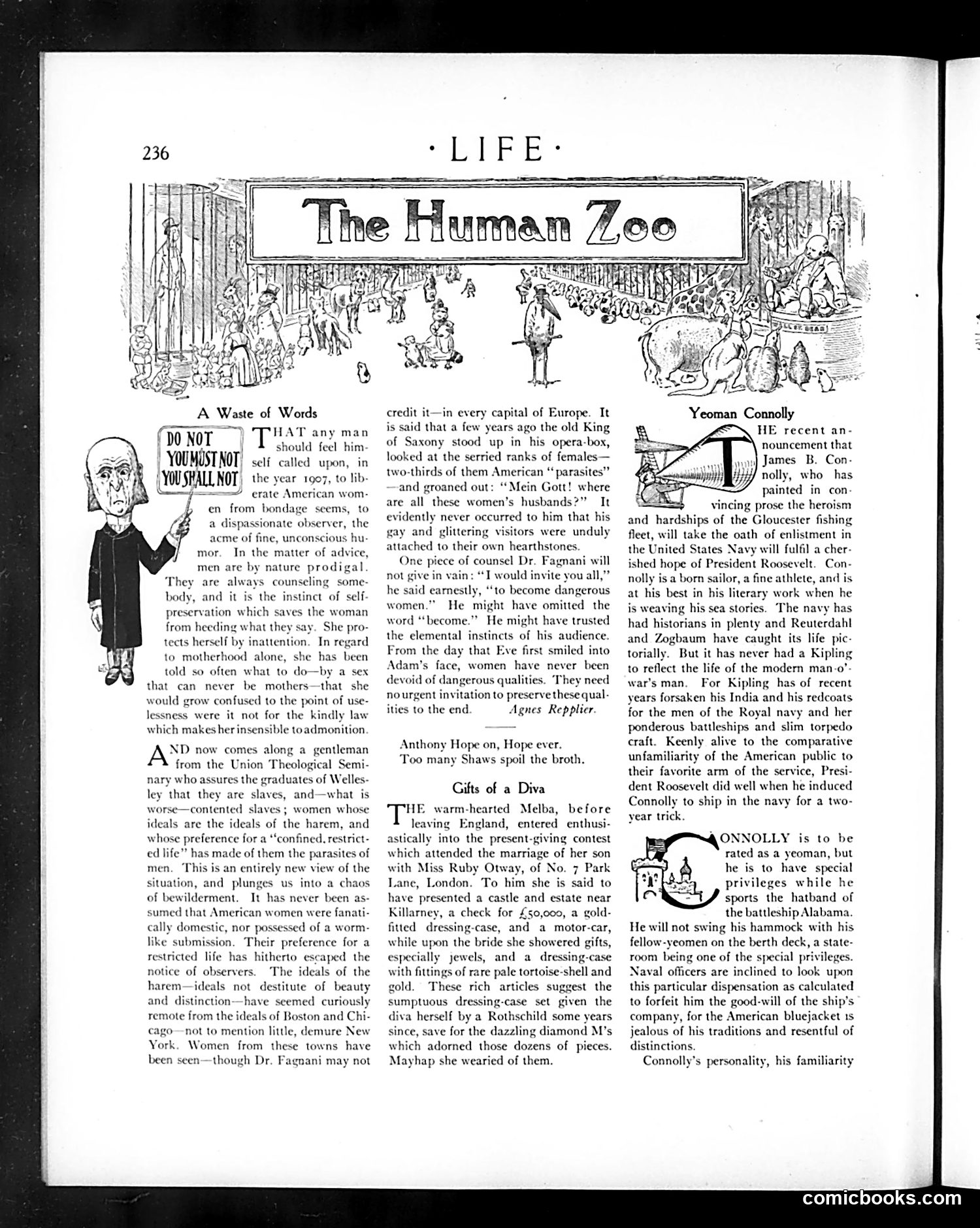
This satirical piece critiques women's behavior and social aspirations through two main sections: **"A Waste of Words"** mocks women who feel compelled to "sell" themselves, arguing that women are inherently prodigal and self-preserving by nature. The text suggests women don't need external encouragement toward dangerous behavior—they're already inclined toward it. **"Gifts of a Diva"** describes a wealthy woman (Misha) who received lavish wedding gifts including a castle, estate, jewelry, and motor-car from her groom. The piece sarcastically notes these extravagant presents, suggesting absurd excess in wealthy marriages. The overall satire targets upper-class women's materialism, vanity, and perceived moral weakness, reflecting early 20th-century misogynistic attitudes common in Life magazine's humor. The "Human Zoo" title frames women as specimens on display.
📄 Transcribed text from this page (OCR, searchable)
Machine-transcribed from the original scan — historical spelling and the odd misread are preserved.
A Waste of Words HAT any man | DO NOT ml should feel him | YOUMUSTNOT) self called upon, in | YOU SHALL NOT the year 1907, to lib- ————_ erate American wom- en from bondage a dispassionate observer, the acme of fine, unconscious hu- mor. In the matter of advice, men are by nature prodigal. They are always counseling some- body, and it is the instinct of self- preservation which saves the woman seems, to from heeding what they say. She pro- In regard to motherhood alone, she has been told so often what to do—by a sex that can never be mothers—that she would grow confused to the point of use- lessness were it not for the kindly law which makes her insensible toadmonition. tects herself by inattention ND now comes along a gentleman from the Union Theological Semi- nary who assures the graduates of Welles- ley that they are slaves, and—what is worse—contented slaves ; women whose ideals are the ideals of the harem, and whose preference for a “confined. restrict- ed life” has made of them the parasites of men. This is an entirely new view of the situation, and plunges’ us into a chaos of bewilderment. It has never been as- sumed that American women were fanati- cally domestic, nor possessed of a worm- like submission. Their preference for a restricted life has hitherto escaped the notice of observers. The ideals of the harem—ideals not destitute of beauty and distinction—have seemed curiously remote from the ideals of Boston and Chi- cago—not to mention little, demure New York. Women from these towns have been seen—though Dr. Fagnani may not credit it—in every capital of Europe. It is said that a few y go the old King of Saxony stood up in his opera-box, looked at the serried ranks of females— two-thirds of them American “parasites” and groaned out: “Mein Gott! where are all these women’s husbands?” It evidently never occurred to him that his gay and glittering visitors were unduly attached to their own hearthstones, One piece of counsel Dr. Fagnani will not give in vain: “I would invite you all,” “to become dangerous women.” He might have omitted the word “become.” He might have trusted the elemental instincts of his audience. From the day that Eve first smiled into Adam’s face, women have never been devoid of dangerous qualities. ‘They need no urgent invitation to preserve these qual- ities to the end. Agnes Repplier. he said earnestly Anthony Hope on, Hope ever. Too many Shaws spoil the broth. Gifts of a Diva HE warm-hearted Melba, before leaving England, entered enthusi- astically into the present-giving contest which attended the marriage of her son with Miss Ruby Otway, of No. 7 Park Lane, London. To him she is said to have presented a castle and estate near Killarney, a check for £50,000, a gold- fitted dressing-case, and a motor-car, while upon the bride she showered gifts, especially jewels, and a dressing-case with fittings of rare pale tortoise-shell and gold. These rich articles suggest the sumptuous dressing-case set given the diva herself by a Rothschild some years since, save for the dazzling diamond M which adorned those dozens of pieces. Mayhap she wearied of them. ZS HE recent an- nouncement that James B. Con- nolly, who has painted in con vincing prose the heroism and hardships of the Gloucester fishing fleet, will take the oath of enlistment in the United States Navy will fulfil a cher- ished hope of President Roosevelt. Con- y is a born sailor, a fine athlete, and is best in his literary work when he aving his sea stories. ‘The navy has had historians in plenty and Reuterdahl and Zogbaum have caught its life pi torially. But it has never had a Kipling to reflect the life of the modern man-o’- war's man. For Kipling has of recent years forsaken his India and his redcoats for the men of the Royal navy and her ponderous battleships and slim torpedo craft. Keenly alive to the comparative unfamiliarity of the American public to their favorite arm of the service, Presi- dent Roosevelt did well when he induced Connolly to ship in the navy for a two- year trick. QONNOLLY is to be rated as a yeoman, but he is to have special privileges while he sports the hatband of the battleship Alabama. He will not swing his hammock with his fellow-yeomen on the berth deck, a state- room being one of the special privileges. Naval officers are inclined to look upon this particular dispensation as calculated to forfeit him the good-will of the ship’s company, for the American bluejacket 1s jealous of his traditions and resentful of distinctions. Connolly's personality, his familiarity comicbooks.com